
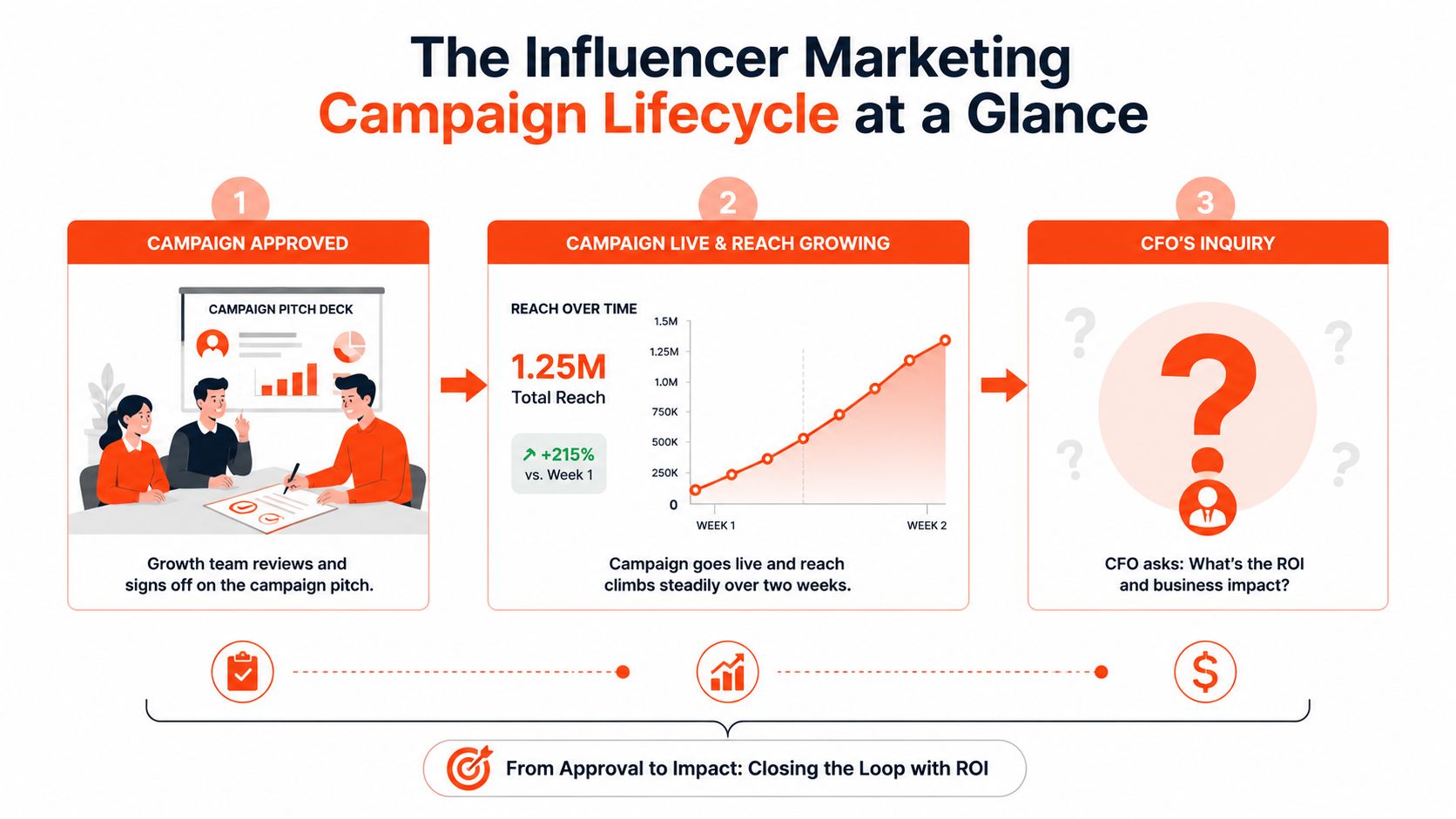
You've got the deck, the creator list, and the excitement. The first two posts go live, reach climbs, and the team celebrates because the numbers look healthy. Then the CFO asks a simple question, and nobody can answer it cleanly: what did this influencer marketing campaign drive?
That's the trap. Creator work still runs like a branding side quest, then teams act surprised when they can't defend the spend. The better way is to treat it like a performance channel from day one, with attribution, forecasting, and post-launch optimization built into the workflow instead of bolted on later.
Table of Contents
The Influencer Marketing Campaign Lifecycle at a Glance
A lot of teams approve an influencer marketing campaign because the pitch deck looks polished and the creators feel on-brand. Two weeks later, the dashboard shows healthy reach, the social team is happy, and finance still has no answer on revenue contribution. That's not a media problem, it's a process problem.
The fix is to run the campaign as a seven-stage dependency chain, not a pile of parallel tasks. Each stage either protects the path from creative to conversion or breaks it: objective setting, forecasting, creator vetting, briefing and contracting, launch, attribution, and post-campaign optimization. Skip one and the whole thing gets harder to defend.
Why the sequence matters
Objective setting comes first because it decides what success even means. Forecasting comes next because you need a budget guardrail before any outreach starts. Creator vetting, briefs, and contracts then turn that plan into something the market can execute.
Practical rule: if a stage doesn't make the next one easier to measure, it's probably decoration.
Launch is not the finish line. It's the start of the measurement sprint, where attribution either holds up or falls apart. The last stage, optimization, is where budget gets moved toward creators and formats that are producing outcomes, not just attention.
That's the discipline many teams miss. They treat content and measurement as separate problems, then wonder why the campaign feels busy but doesn't compound. A good lifecycle makes every handoff explicit, so the brand can answer not just who posted, but what happened after the post.
Why Influencer Marketing Campaigns Now Earn a Real Budget
A campaign only gets real budget when it can justify spend with outcomes. Creator content used to sit in the brand bucket. Now it has to stand up as a measurable acquisition channel, with attribution, lift, and resale value from repurposed assets.
The market growth explains why finance teams stopped treating this as a side project. One industry summary puts the influencer marketing market at about $1.7 billion in 2016 and $32.6 billion in 2026, while another forecast places it at $40.51 billion in 2026 after $31.07 billion in 2025. U.S. brands alone are expected to spend $12.17 billion in 2026 in that reporting (Digital Applied statistics roundup). That is enough budget pressure to force better planning.
The shift is measurement. Analysts at Influee statistics summary report $5.78 back for every $1 spent, which is why brands now ask for tracking links, promo codes, and creator-level surveys instead of vanity metrics. The same source says 86% of U.S. marketers partnered with influencers in 2025, 74% planned to increase budgets in 2026, and 77% of brands repurpose creator content in paid ads. That is a performance channel, not a branding hobby.
Budget logic has changed
Here is the clean comparison.
SignalLegacy ViewCurrent RealityMarket sizeSmall experimentMature channel worth planning againstCreator contentNice-to-have brandingTrackable acquisition and awareness assetMeasurementReach and likesLinks, codes, surveys, attribution windowsPaid usageAfterthoughtPlanned into the contract upfront
The budget case gets stronger when teams stop overpaying for broad reach. Mid-tier influencers often deliver better ROI than mega influencers, because their work is easier to control, test, and attribute. That makes them a better fit for campaigns that need to prove return, not just generate noise.
If you still fund influencer campaigns like a one-off content test, you will keep paying for attention you cannot defend. If you budget like a performance lead, you can forecast, test, and scale across TikTok, Instagram, YouTube, and Twitch with the same discipline you use for paid social.
Setting Clear Objectives Before Any Creator Outreach
A campaign without a tight objective turns into a content wishlist. One person wants awareness, another wants conversions, and a third wants reusable assets for paid media. That sounds collaborative until the bills come in.
Start with one primary objective tied to revenue or pipeline. Not five. If the campaign's real job is installs, set the install target first. If it's sales, set the sales target first. Every other KPI should support that decision, not compete with it.
Then forecast against reality, not optimism. Look at historical reach, engagement, click behavior, and conversion patterns from your own past creator work or from comparable placements on the same platform. If the math doesn't work before you brief creators, it won't magically work after.
The planning block that saves budget
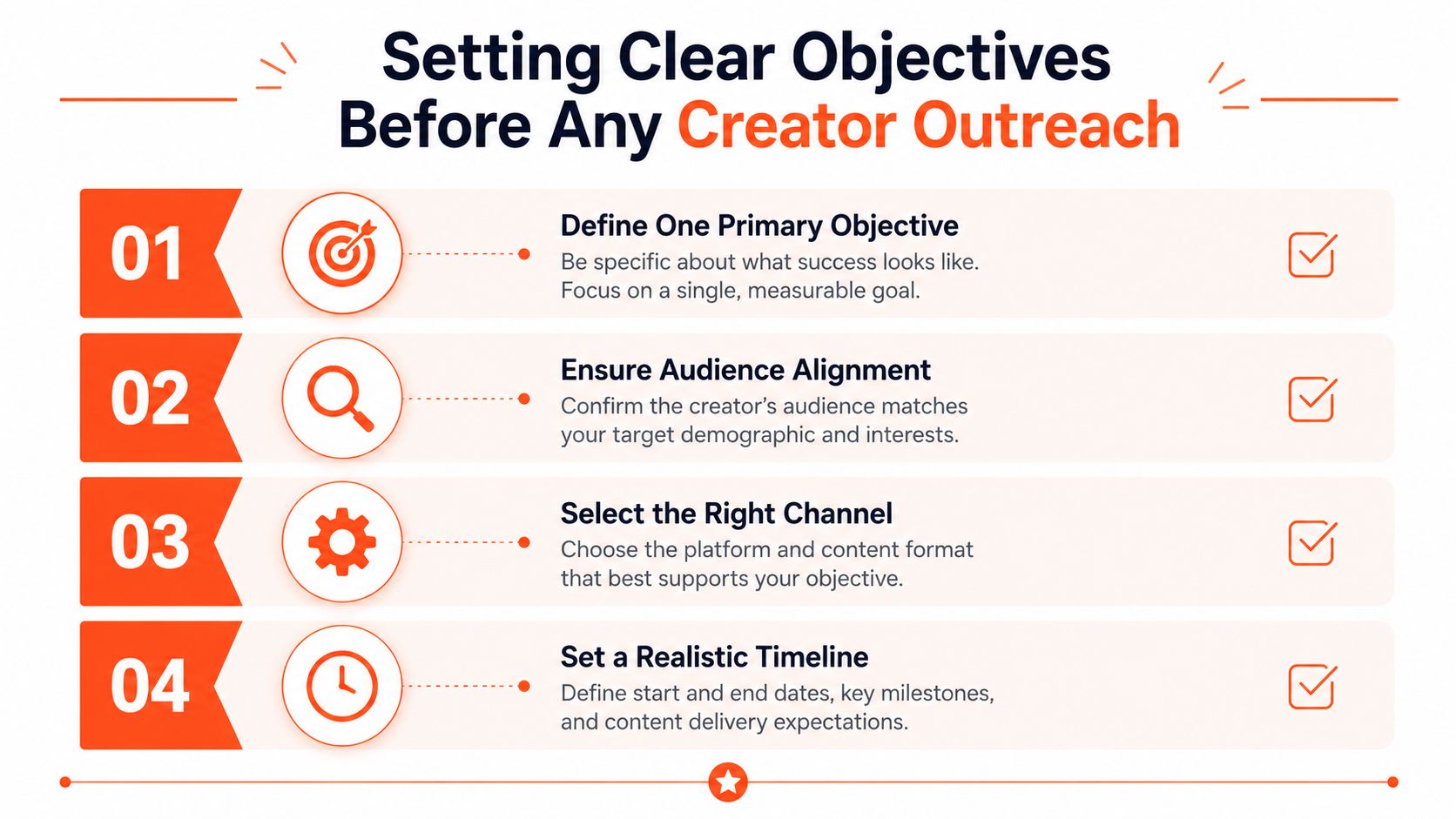
Before outreach, lock four decisions:
- Primary objective. Pick one outcome the campaign must move.
- Audience fit. Confirm where the target customer converts.
- Channel mix. Choose platforms based on buyer behavior, not brand preference.
- Timeline. Set launch, reporting, and review dates before any DM goes out.
Practical rule: if you can't write the objective on one line, the brief is already too broad.
You also need a target CPI or CPA before outreach. That number is your kill switch, because creators who miss it shouldn't get more budget just because their content “feels promising.” Without a target, reporting turns into storytelling, and storytelling is expensive.
The artifact list should be boring and complete. Have the objective, forecast, target CPI or CPA, channel mix, launch calendar, and tracking plan ready before you message a single creator. Otherwise, you'll spend the next month trying to reverse-engineer a campaign you should've designed up front.
Vetting Creators Beyond Vanity Numbers
Follower count is the laziest possible filter. It tells you who looks big, not who will move product. The better screen is whether a creator has the right audience, the right fit, and a history of measurable sponsored performance.
A practical shortlist has to pass three tests. First, the follower-to-engagement ratio should be under 10%. Second, the audience geography should match your target market. Third, the creator needs a real track record of outcomes from previous brand work, not just a pretty feed and a sponsor tag. Social Cloud says it vets creators from a network of 12,000+ creators, which is the right mindset even if you don't use that specific provider, because scale only matters when the vetting is strict.
What good looks like
A creator with 500K reach and 0.3% engagement usually loses to a creator with 80K reach and 6% engagement when conversion is the goal. The second creator is more likely to have trust, response, and a narrower audience that pays attention.
The warning signs are obvious if you bother to look:
- Sudden follower spikes often mean paid growth or low-quality audience inflation.
- Generic comment patterns usually mean the audience isn't engaged.
- Disproportionate views-to-follower gaps can signal reach without loyalty.
Always ask for recent performance data and audience screenshots before you sign anyone.
If you want a concrete workflow for creator discovery, the internal guide on finding the right YouTube influencer is a useful reference point for how to think about fit, not just fame.
Vanity metric vs performance signal
Vanity MetricPerformance SignalFollower countAudience overlap with your buyerTotal likesQuality of comments and savesBig view spikesConsistent historical sponsored resultsBroad appealClear match to target geography
Don't hire creators to impress your team. Hire them to reach people who might buy. That's a different decision, and it usually produces a different shortlist.
Briefs, Contracts, and Usage Rights That Protect Everyone
A loose brief creates vague content. A vague contract creates rights problems. A sloppy disclosure process creates compliance risk. All three usually show up in the same campaign.
The creative brief should be tight enough to protect the business and loose enough to let the creator sound human. That means one conversion action, three to five product truths, banned claims, and platform-native hooks. On TikTok, that might mean a sound choice or an early hook. On Instagram, it could mean a pinned comment. On YouTube, it's often a CTA in the description.
The contract has a different job. It needs to define exclusivity windows, disclosure language, whitelisting permissions, and usage rights. If you plan to run creator content in paid media, say so upfront. If you want a 90-day usage rights period across organic channels, put that in writing before anyone films.
The workflow that keeps campaigns clean
Creators usually accept these terms when the scope is clear and the timeline is predictable. They don't want surprise revisions any more than your legal team wants surprise claims. The whole point is to preserve voice while reducing risk.
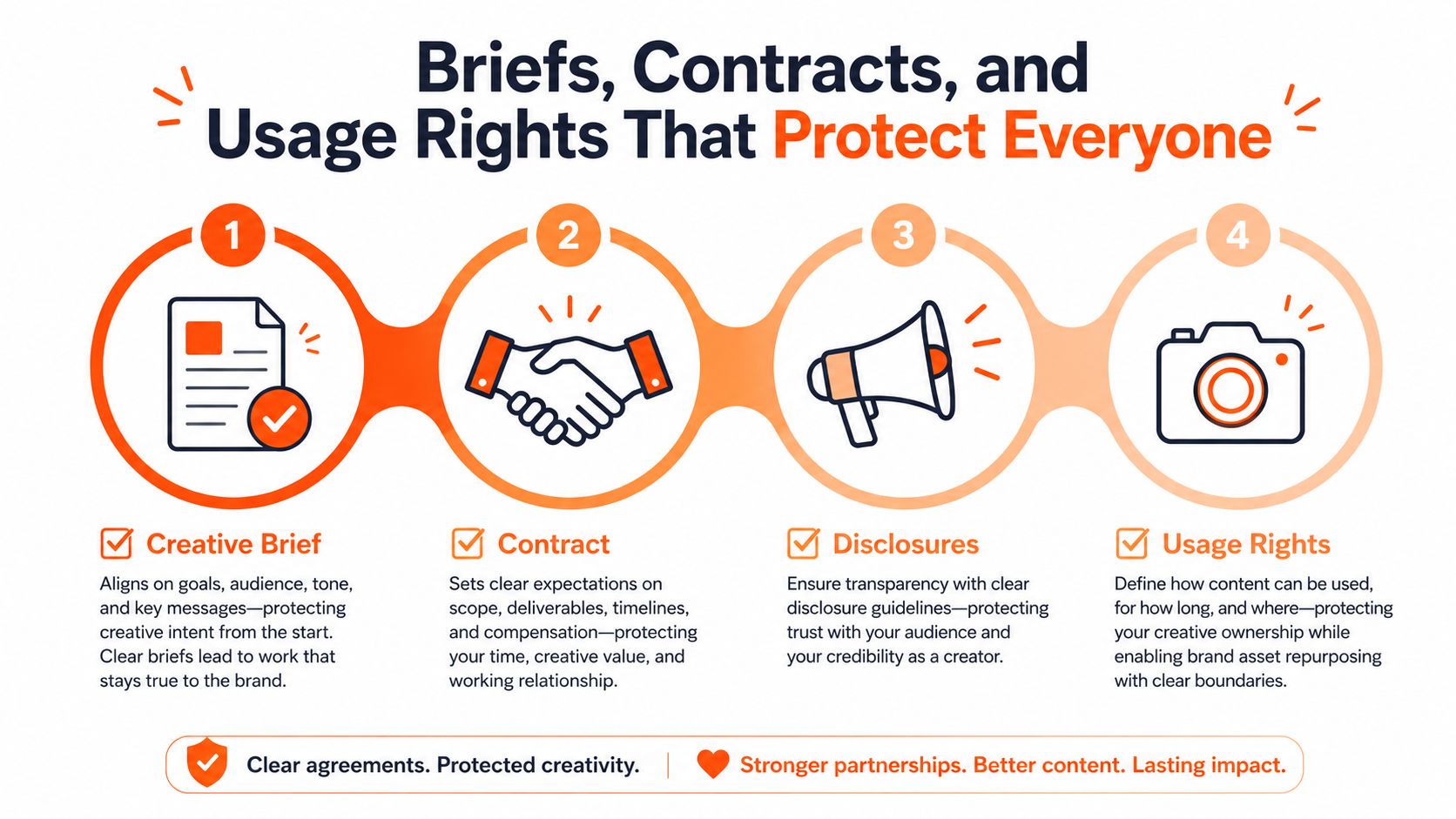
- Creative brief: defines the message, the action, and the essential elements.
- Contract: locks timing, payment, exclusivity, and rights.
- Disclosure: keeps the campaign compliant and transparent.
- Usage rights: makes repurposing possible without renegotiation later.
Keep brand legal in the loop when the brief and contract are reviewed together. That way, the messaging that goes live is the same messaging that got approved. If the legal team sees the brief too late, everyone ends up negotiating against finished content, which is the most expensive time to discover a mismatch.
Attribution and Tracking Across Every Placement
Launch day starts the measurement sprint. If the post cannot be traced, it cannot be defended, and creator work can influence attention, curiosity, and delayed purchase behavior at the same time.
Use a layered stack. Set up unique UTM links for each creator, short promo codes for direct-response and offline conversions, pixel tracking on landing pages and checkout, and a post-purchase survey that asks how the buyer heard about you. The attribution window needs to stay open long enough to catch delayed intent, and guidance in the field typically uses roughly 30 to 90 days for creator-driven buying behavior (Digital Applied ROI framework).
Why one layer never tells the whole story
Tracking links show the clean click path, but they miss people who saw a creator, left, and came back later. Promo codes catch customers who convert without clicking the tracked URL. Surveys catch halo conversions that never touch the link at all.
Track creators at both the link and campaign level. Attribution models for creator work need to account for upper-funnel discovery and lower-funnel conversion, or you will under-credit the people who start demand. Data-driven attribution usually needs 1,000+ conversions before credit assignment settles down, which is why many teams use a U-shaped approach while volume stays limited.
One source is never enough here. When survey, code, and link data disagree, the setup is usually broken, not the customer.
An influencer marketing campaign is only as defensible as its weakest tracking method. Break one layer and the story gets shaky. Keep all four layers live and you can usually tell who moved the needle and who only created noise.
Launch, Weekly Reporting, and the Optimization Loop
Launch day is where a lot of teams relax, which is backwards. It's the first day of the measurement sprint, and the first job is operational hygiene, not celebration. Check every tracking link, confirm every promo code is live, and verify that creators posted on the agreed cadence.
Then build a weekly reporting rhythm that forces decisions. Rank each creator against the forecast, not against the team's hopes. The main question each week is simple. Do we kill, scale, or iterate?
A useful internal dashboard should show the lowest cost per acquisition first, because that's where budget pressure should land. If one creator is producing a stronger result, move remaining contracted posts toward that creator or at least toward the format and hook that worked. There's no prize for being polite about underperformance.
What to document every week
- Winning hooks: the opening lines or angles that got attention.
- Formats that held attention: short video, integration, tutorial, or live mention.
- Talking points that converted: the claims or demos that caused action.
- Budget shifts: where spend moved and why.
That weekly discipline is where campaigns stop being isolated bets and start becoming a repeatable system. The next brief gets better because the last one produced evidence, not just screenshots. A good reporting cadence also keeps finance comfortable, because nobody likes funding a channel that can't explain its own drift.
For teams that want a cleaner read on post-campaign performance, the measurable ROI framework is a decent model for turning creator activity into something finance can review.
Measuring What Matters After Launch
Views are cheap. Likes are noisier than people admit. Neither one tells you whether the campaign moved business.
Use a dual-axis scorecard. One axis measures engagement depth, including saves, comments, watch time, and follower delta. The other measures conversion depth, including tracked clicks, add-to-carts, promo code redemptions, and survey mentions. Early in the campaign, engagement helps spot strong creative. After the first week, conversion needs more weight.
Read the campaign in layers
A creator can win attention without winning sales. A post with strong comments and weak click-through should not get more budget by default. A quieter post with stronger tracked actions may deserve the next round of spend.
Metric AxisPrimary MetricsWeight (Day 1-7)Weight (Day 8-90)Decision TriggerEngagement depthSaves, comments, watch time, follower deltaHigherLowerKeep if it predicts conversionConversion depthClicks, add-to-carts, code redemptions, survey mentionsLowerHigherScale if CPA stays strong
The closeout should include a documented incrementality read, a per-creator CPA, and a recap of which hooks, formats, and platforms paid back. That is the version finance can review and the version growth can learn from. Gut feel does not survive budget review, but a clean read usually does.
For teams that want a cleaner read on post-campaign performance, the measurable ROI framework is a useful model for turning creator activity into something finance can review. The deciding factor for continued budget is whether the channel has enough attribution to earn its next dollar.