
Mega-influencers deliver reach. Mid-tier creators deliver results. Here's the data showing why the 100k–1.2M follower range consistently outperforms mega-scale campaigns on ROI.
TL;DR
The influencer marketing industry has it backward: bigger follower counts don't drive better ROI. Mid-tier creators (100k–1.2M followers) consistently deliver 4x+ ROAS, lower CPAs, and higher conversion rates than mega-influencers. Why? Smaller audiences mean higher trust, authentic engagement, and real conversions. HelloFresh hit 4.1x ROAS with mid-tier creators. Temu achieved 54% lower customer acquisition costs. Honey saw 8.6% conversion rates to active users - all through mid-tier creator strategy. The data is clear: when you care about performance over vanity metrics, mid-tier is where the ROI lives.
The Big Lie: Bigger Isn't Better
There's a belief baked into marketing that bigger always wins. More followers = more reach = more sales. It sounds logical. But it's wrong.
The mega-influencer industry thrives on this myth. A brand pays $50k for a post from someone with 5 million followers, gets decent impressions, and calls it a success. But impressions aren't sales. Views aren't conversions. And a follower count inflated with bots and inactive accounts isn't an audience.
Meanwhile, creators with 200k genuinely engaged followers are getting overlooked. And they're delivering the actual results brands say they want.
The numbers don't lie. Social Cloud reports 66–71% higher ROI than industry average by focusing on mid-tier creators and performance-based outcomes. That gap isn't luck - it's the compounding effect of doing everything right: picking creators with real audiences, optimizing for conversion instead of reach, and pricing based on results, not hours.
Let's look at what the data actually shows.
The Case Studies: Real Numbers, Not Vanity Metrics
HelloFresh: 4.1x ROAS, 31,800+ Conversions
Social Cloud ran an influencer marketing campaign for HelloFresh using mid-tier creators across YouTube and TikTok. The result: 4.1x ROAS, 31,800 new conversions, 12.2M views, and a 4.2% click-through rate - well above the D2C average of 2–3%.
That's not reach for reach's sake. That's a performance campaign that turned creators into a conversion machine.
Temu: 54% Lower Customer Acquisition Cost
For Temu's app install campaign, Social Cloud focused exclusively on mid-tier creators who could authentically speak to the product. The result: 12,000+ app installs, CPI 54% below platform benchmarks, and 11.3M views. That 54% CPA reduction is the difference between a campaign that breaks even and one that drives real profit.
Honey: 8.6% Conversion Rate (4x the SaaS Average)
Honey needed to drive installer sign-ups, not just browser impressions. With mid-tier creators, they achieved 150k+ installs, 8.6% conversion rate to active users (four times the SaaS benchmark), and CPI 42% below platform benchmarks. The real kicker: 22% 30-day retention, meaning these weren't one-time clicks - they were real users sticking with the product.
Epic Games: 27M Views, +18% Returning Players
Gaming campaigns live or die on engagement lift, not follower counts. For Epic Games, mid-tier gaming creators drove 27M views, generated 4 YouTube Trending videos, and most importantly, increased week-over-week returning players by 18%. That's the metric that matters in gaming: not who sees the trailer, but who comes back to play.
Robinhood: 17k+ Account Sign-Ups in Finance
Finance is brutally conversion-focused, and finance audiences are skeptical of big celebrity endorsements. Social Cloud's mid-tier creators for Robinhood delivered 17k+ account sign-ups, 5.2M views, and a 3.4% CTR - substantially above the finance industry average of 0.5–1%. The reason: these creators had built real trust with finance-focused audiences, not celebrity status.

Why Mid-Tier Works: The Economics of Authenticity
There are three concrete reasons mid-tier creators outperform mega-influencers, and all three compress into one outcome: genuine audience trust.
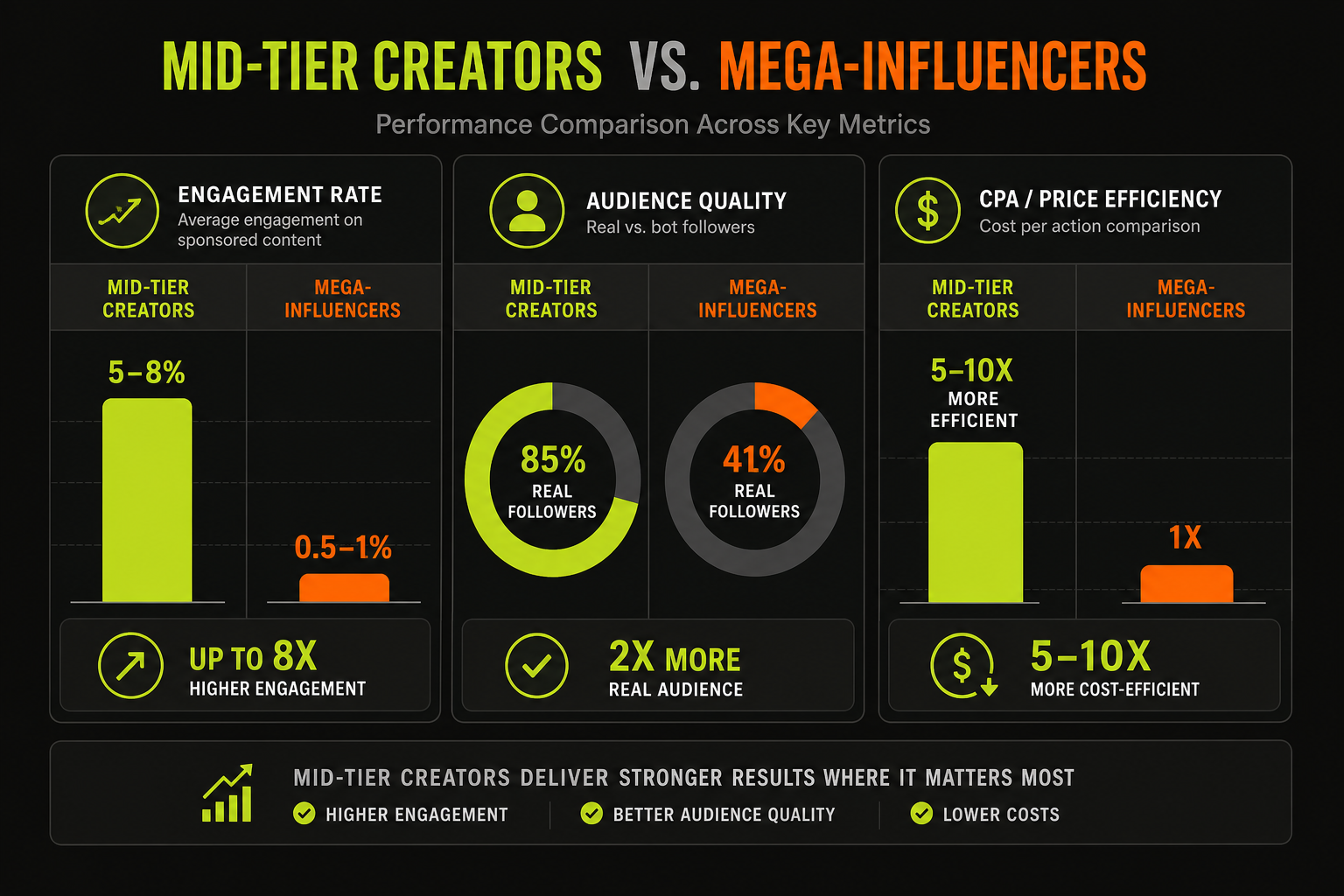
1. Engagement Rates: 5–10x Higher Than Mega-Influencers
A mega-influencer with 5M followers might see 0.5–1% engagement (50k–100k likes, comments, or shares per post). A mid-tier creator with 300k followers might see 5–8% engagement (15k–24k interactions per post).
The difference matters because engagement is a proxy for attention. If a creator's audience is liking, commenting, and sharing, they're really watching. If 99.5% of followers never interact, they're not really an audience - they're a follower count.
Higher engagement also changes the conversion math: a recommendation from someone your followers trust is worth infinitely more than a celebrity mention they scroll past.
2. Audience Authenticity: Real People, Not Bot Armies
Mega-influencer follower counts are often inflated. Purchased followers, inactive accounts, and bot engagement networks are endemic at mega-scale. You pay for the headline number, not the actual audience.
Mid-tier creators don't have the budget or incentive to buy followers. Their audience is either real or they don't exist as a viable creator. Social Cloud uses verification tools to spot fake followers and bot engagement, ensuring every creator in their network is actually connected to real people.
This matters on a channel level too. TikTok's algorithm rewards genuine engagement, so mid-tier creators with real audiences rank higher, get more organic reach, and deliver better performance. A mega-influencer coasting on celebrity status gets no algorithmic boost - their reach depends on paid promotion or legacy audience inertia.
3. Price-Performance Ratio: 5–10x More Efficient
A mega-influencer might charge $50k–$100k per post. A mid-tier creator might charge $5k–$15k. But the mid-tier creator often delivers better conversion rates, lower CPAs, and higher ROI per dollar spent.
This creates a compounding advantage: you can afford more creators, more tests, and more optimization at the same budget. Instead of one mega-influencer post, you run five mid-tier creator campaigns and pick the winners. The statistical power of multiple bets beats the vanity of a single celebrity endorsement.
The Mega-Influencer Trap
It's worth naming why brands still book mega-influencers despite worse ROI: risk aversion and vanity.
Risk aversion: a mega-influencer is a "safe" bet because the follower count is huge and the platform is recognizable. If the campaign fails, you can at least say "we worked with someone huge." Mid-tier creators feel riskier because they're less famous, even though the data says they're safer.
Vanity: there's prestige in saying your brand worked with a celebrity. Boards of directors recognize famous names. Nobody recognizes a creator with 500k subscribers. But again, the data is unambiguous - that creator will deliver better results.
The smartest brands have moved past this. Social Cloud's client list spans D2C (HelloFresh, Bumble), gaming (Epic Games, Sega, Tencent), finance (Robinhood), and tech (Mastercard, AG1) - all outcome-focused companies that prioritize ROI over headlines.
How to Find and Vet Mid-Tier Creators
If you're convinced by the data and want to shift to mid-tier strategy, here's how to actually do it.

1. Source Creators in the Right Range
Target the 100k–1.2M follower range. This is the sweet spot - big enough to have real reach and influence, small enough to maintain authentic audience relationships.
Start with vertical-specific research:
- YouTube: Search for channels in your category with 100k–500k subscribers. Sort by views and engagement rate, not subscriber count.
- TikTok: Use TikTok Analytics (if you have the account) or third-party tools like Social Cloud's creator database to find creators in your niche with 5–10% engagement rates.
- Instagram: Look for accounts with 100k–300k followers in your category. Real engagement should be visible in the comments (actual replies, not bot spam).
2. Verify Audience Quality
Don't trust the follower count. Tools like HypeAudience, Social Blade, and Social Cloud's verification system can scan for bought followers, bot engagement, and audience demographics. A creator with 200k real followers is worth more than one with 2M bot-inflated followers.
Check:
- Engagement rate: YouTube 2–5%, TikTok/Instagram 4–8%. Anything lower at mid-tier usually signals bot engagement.
- Comment quality: Real followers leave substantive replies. Bot followers leave "🔥🔥" spam.
- Audience geography: Does the creator's audience match your target market? A creator with 500k followers in Indonesia is useless if you're selling to the US.
- Audience age/gender: Most platforms allow demographic filters. Make sure the creator's audience aligns with your customer.
3. Vet Creator Fit
Look beyond follower count. What verticals does this creator work in? Have they done brand partnerships before? Do they have experience with your product category?
A creator with 300k followers who specializes in gaming but has never done a product review is a bigger risk than a creator with 150k followers who regularly partners with fintech brands and has experience driving sign-ups.
4. Negotiate Performance-Based Terms
This is crucial. Instead of paying flat fees, propose performance-based pricing:
- CPA (cost-per-acquisition): Pay per confirmed conversion.
- CPI (cost-per-install): Pay per app install with revenue attribution.
- CPL (cost-per-lead): Pay per lead collected.
Creators who know their audience converts will accept performance terms. Creators who are unsure of their real conversion power will push back. That's your signal.
The Real Benchmark: 71% Higher ROI
Social Cloud's benchmark is 66–71% higher ROI than industry average. That's not an outlier - it's the result of systematic focus on mid-tier creators, verified audience quality, and performance-based economics.
When you shift from "who has the biggest follower count" to "who can deliver real conversions," everything changes. Budget efficiency improves. ROAS scales. Customer acquisition cost plummets. And your board stops caring about celebrity endorsements because the spreadsheet is undeniable.
The playbook is straightforward:
- Source mid-tier creators with real audiences
- Vet for quality and fit
- Negotiate performance-based terms
- Let data drive decisions, not follower counts
The data is already out there. HelloFresh's 4.1x ROAS, Temu's 54% lower CPI, Honey's 8.6% conversion rate - these aren't anomalies. They're the norm when you pick creators based on actual audience quality and conversion potential instead of vanity metrics.
Stop booking mega-influencers. Start finding the 200k-follower creators with the real audience that actually converts.
Try Social Cloud
Social Cloud specializes in exactly this: finding and managing mid-tier creators across your customer verticals using performance-based pricing. They've built a network of 12,000+ verified creators and proven the ROI lift across D2C (HelloFresh 4.1x ROAS), gaming (Epic Games +18% returning players), SaaS (Honey 8.6% conversion), and finance (Robinhood 17k+ sign-ups).
If you're tired of paying for celebrity reach that doesn't convert, see how Social Cloud approaches mid-tier creator strategy.

