

The average influencer campaign returns about £5.78 for every £1 spent, or 478% ROI. That number only matters if you can break it down per creator, per platform, and per campaign, because CFOs don't fund averages, they fund repeatable profit.
Influencer marketing is often treated as a brand exercise. That's the wrong frame. How to measure influencer marketing ROI starts with hard revenue, total cost, and attribution you can defend when finance asks where the number came from.
Table of Contents
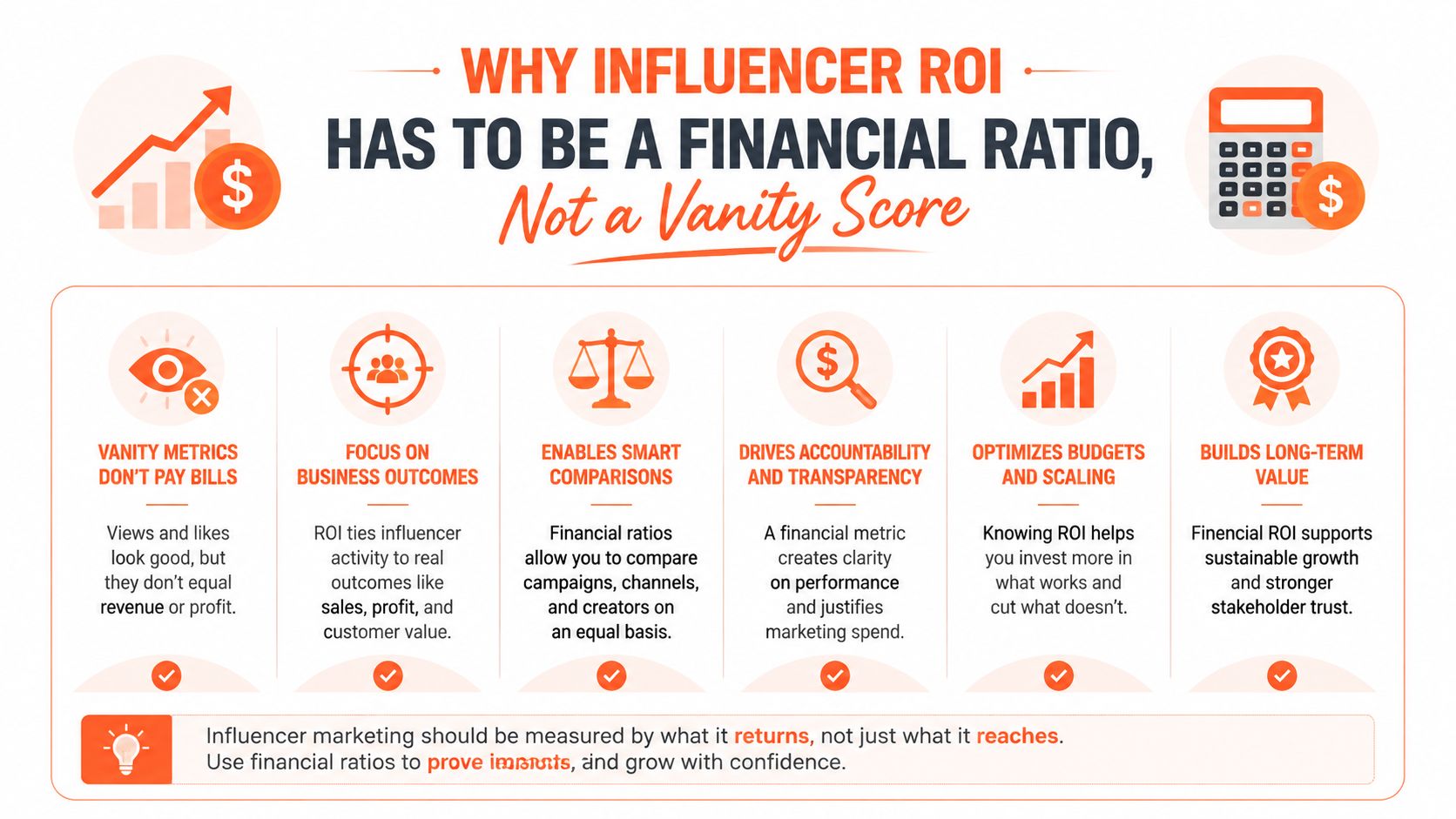
Why Influencer ROI Has to Be a Financial Ratio Not a Vanity Score
Influencer ROI should be treated like a financial ratio, not a popularity contest. The benchmark matters because it turns creator performance into something you can compare against paid social, search, and retention, instead of hiding behind reach and likes. The strongest recent benchmark puts the average return at £5.78 for every £1 spent across more than 1,200 influencer campaigns analyzed in 2025 to 2026, which makes the case for tracking ROI as a revenue ratio rather than a mood board metric (benchmark source).
Define the formula plainly. ROI = (Attributed Revenue - Total Campaign Cost) / Total Campaign Cost. Total campaign cost means creator fees, product seeding, agency retainers, platform fees, paid amplification, and the internal time your team burns on briefing, approvals, and reporting.
What belongs in the numerator and what doesn't
Revenue is the numerator. Engagement isn't. Reach isn't. Follower count definitely isn't. Those numbers are useful diagnostics, but they don't pay invoices.
Practical rule: if finance can't tie the line item to cash, it doesn't belong in your ROI numerator.
That's why a 4x ROI on a vanity-heavy campaign can still be worse than a 2.4x ROI on a tight creator mix. The first one may look prettier in a deck because it generated big reach, but if the second campaign used less waste, cleaner attribution, and better-margin buyers, it's the better investment. Performance leads need to stop rewarding spectacle and start rewarding contribution.
The minimum CFO scan should fit on one line. Revenue. Cost. Attributable orders. Margin. If you can't show those four numbers cleanly, you don't have ROI, you have commentary.
Build tracking before anyone posts
Every creator needs a prebuilt tracking template before launch. Don't let people paste links by hand. Use a single redirector, like Bitly, Linktree Pro, or a custom short domain, so the link stays controlled even if a creator edits captions later. The destination should route through a server-side redirect that drops a first-party cookie and fires the network pixel.
Use one UTM structure everywhere. Keep it rigid.
- utm_source=instagram for the platform source.
- utm_medium=influencer for the channel type.
- utm_campaign=brandname_q4 for the campaign name.
- utm_content=creator_handle for the individual creator.
- utm_term=asset_type for the format, like story, reel, short, or live.
Before anything goes live, run four QA checks. First, confirm the tag fires in GA4. Second, make sure the click appears in the affiliate platform. Third, verify the conversion event registers in Shopify. Fourth, place a test order and check that it attributes back to the right handle. If any one of those fails, you're not launching a campaign, you're launching a reporting gap.
Social Cloud's market report is the kind of internal benchmark page teams use when they want a cleaner view of creator performance before they brief the next round.
Using Promo Codes and Discount Codes for Per-Creator Attribution
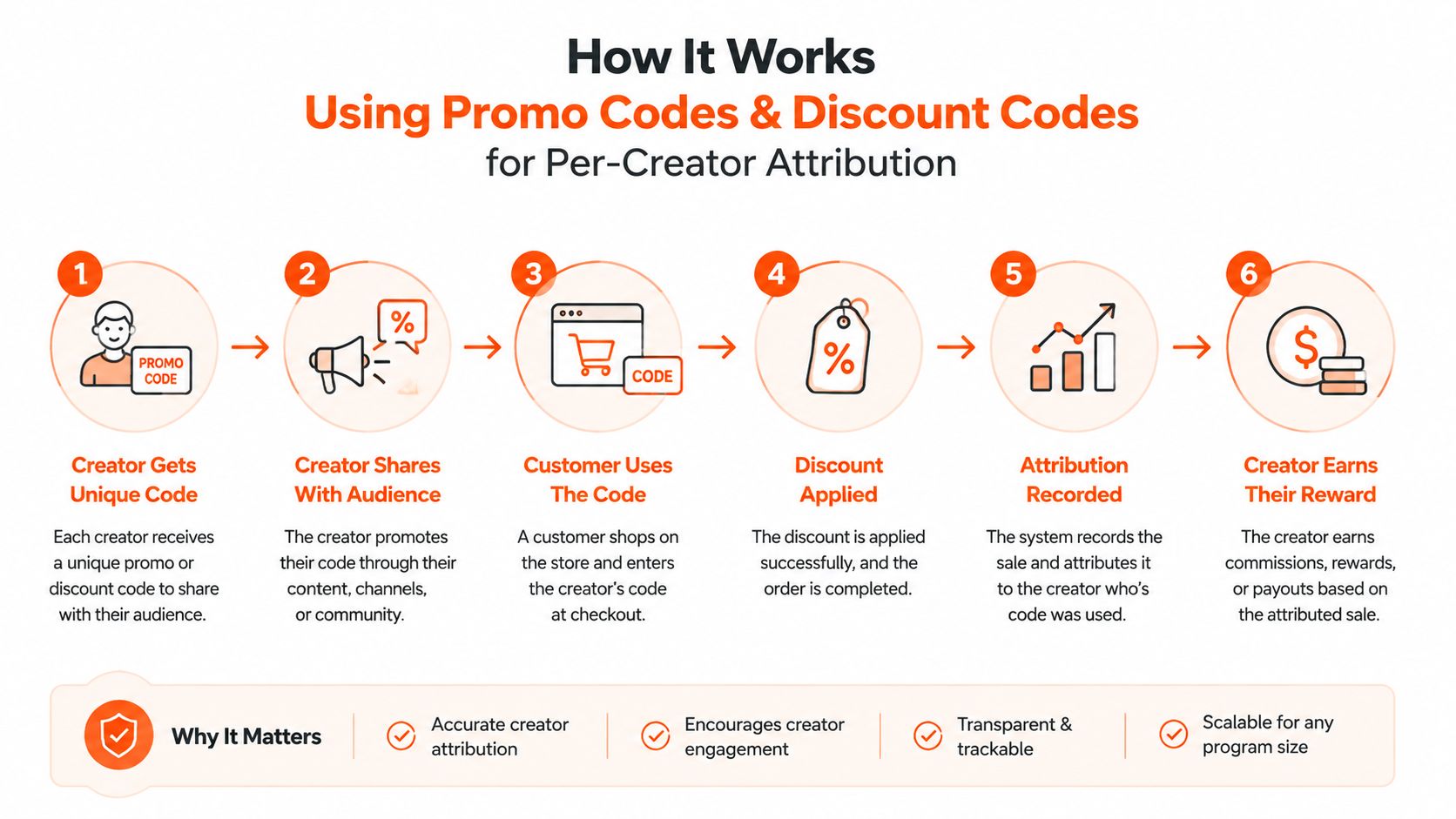
Promo codes still matter because they catch the sales that UTMs miss. Someone sees a creator post, doesn't click, remembers the code, and buys later. If you don't issue creator-specific codes, you lose that sale to blended site revenue and then pretend the campaign underperformed.
Make the naming convention boring and obvious. BRAND10_JESS. BRAND10_OLIVER. If the same creator runs across platforms, add a suffix like _IG, _TT, or _YT. Never use a generic code like SKALE10, because generic codes destroy attribution and make reconciliation messy.
Keep the code tied to the system, not the creator's memory
Each code should map to one discount rule in Shopify or Klaviyo, one influencer ID in your CRM, and one payout line in your finance sheet. Exclude it from automatic sitewide promotions so a sale doesn't get double-counted when another discount is already live. If your stack can't prevent overlap, your reported ROI will drift upward in ways finance will catch later.
Operational rule: one creator, one code, one platform record.
Reconciliation should happen every week, not at the end of the quarter. Export code redemptions, match them to the creator payout sheet, and flag anomalies when a code behaves far outside normal variance. Treat redemption rate as a health metric, not a target to game. A promo code should tell you whether the audience acted, not whether the creator learned how to stuff the funnel.
For campaign governance, keep the workflow in one place, and if you need a central operating view, use your own campaign management hub like Social Cloud campaigns so the code map, creator list, and payout record stay aligned.
Picking the Right Attribution Model and Window
Last-click is the easiest model, and it's also the most misleading if the creator's job was to create demand instead of close it. It credits the final touch only, which flatters retargeting and search while undercutting the creator who introduced the brand. That's why last-click is fine for pure direct-response tests, but weak for awareness-driven partnerships.
Multi-touch is the better default for most serious influencer programs. Linear or position-based models spread credit across the creator touchpoint, paid retargeting, branded search, and the eventual conversion path. That's closer to how people buy when creator content starts the journey and another channel finishes it.
Pick the window to match the product, not the dashboard
View-through attribution is useful, but only when the buying cycle is short and the exposure is fresh. It counts impressions inside a short window, which can help with fast-moving TikTok bursts, but it gets noisy fast at scale. Use a 1-day window for impulse products, 7 days for mid-ticket offers, and 30 days for subscription or high-consideration purchases, then align that choice with the platform's default so reporting doesn't fight the ad platform.
| Attribution Models for Influencer Campaigns | How It Credits | Best For | Recommended Window | Weakness |
|---|---|---|---|---|
| Last-click | Gives full credit to the final tracked interaction | Direct-response campaigns | Short campaigns with tight conversion paths | Undervalues discovery and trust-building |
| Multi-touch | Splits credit across multiple touchpoints | Consideration-stage products | Match to the buying cycle | Harder to explain without discipline |
| View-through | Credits exposure after an impression within a defined window | Fast social bursts and light consideration | Typically short windows | Can overstate influence at scale |
The right model is the one your team can explain without hand-waving. If the creator sparked demand, multi-touch will show it. If the buyer converted instantly, last-click may be enough. Don't force one model onto every campaign and pretend the mismatch is strategy.
Wiring Up Conversion Tracking and Pixels Across Platforms
Conversion tracking fails when teams treat every platform the same. They're not the same. TikTok, Meta, YouTube, and Twitch each need different plumbing, and if your events don't map cleanly into the reporting layer, your weekly readout turns into a manual cleanup job.
TikTok needs the Events API plus the Pixel ID passed through the ttclid URL parameter. Meta needs the Conversions API with deduped events so server-side and browser-side signals don't double count. YouTube should rely on Enhanced Conversions plus UTM parameters. Twitch works best with manual UTMs and pixel fires on the landing page, because live traffic often enters through messy paths.
Fire the same core events everywhere
Use the same event stack across channels.
- ViewContent for product page views.
- AddToCart for cart adds.
- InitiateCheckout for checkout starts.
- Purchase for completed orders with revenue and currency attached.
Put your server-side container in place so the browser isn't doing all the work alone. Keep consent mode flags active where they're required, and run each platform's test-event tool before the creator post goes live. That test matters more than the post itself, because a broken event stack makes every other metric suspect.
If the conversion event can't survive a browser block or a cookie reset, your reporting is too fragile to defend.
Each week, validate the same four things. Confirm event volume is flowing, dedupe logic is clean, revenue and currency values are attached, and the platform dashboard matches your internal order count. If one of those drifts, fix the plumbing before you judge the creator.
Layering Assisted Conversions Brand Search Lift and CLV on Top of Last Click
Last-click revenue understates ROI because it only sees the buyer at the end. Creator content often works earlier, when a person is discovering the brand, comparing options, or waiting to buy later. If you stop at last click, you're rewarding the closing channel and ignoring the creator who created the opening.
Assisted conversions are the first layer above last click. They show how often the creator appeared somewhere in the path but didn't get final credit. Brand search lift is the second layer. It captures demand that shows up as more branded queries during the campaign flight, which matters when users search before they buy and never touch the tracked link. Customer lifetime value is the third layer. It tells you whether creator-attributed buyers come back, which is the only way to judge whether a campaign built real demand or just pulled forward a one-time order.
Keep EMV out of the ROI calculation
Earned Media Value is a narrative tool, not a proof of efficiency. It multiplies impressions by an arbitrary media value, which can be useful in a presentation, but it doesn't prove revenue. Keep it out of ROI math and out of anything you'd show the CFO as a primary return number.
Current guidance increasingly recommends combining direct revenue with CLV, assisted conversions, and repurposed content value, because most coverage still stops at last-click arithmetic. A cleaner view comes from matching creator-attributed buyers against repeat purchase behavior and comparing their value against other acquisition sources. That's how you stop undercounting creators who start the journey but don't close it immediately.
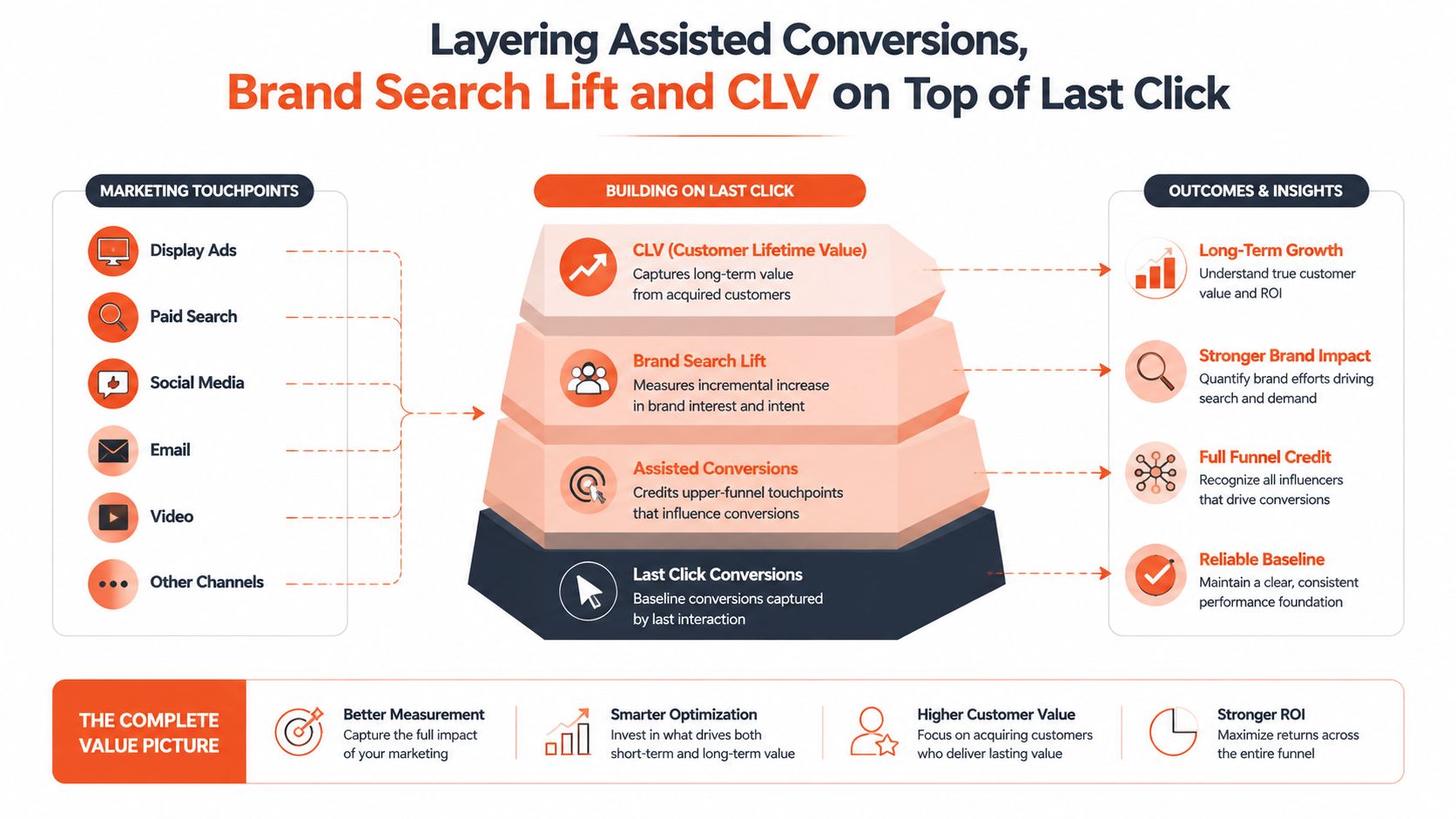
The honest answer is simple. Last click tells you who got paid credit. Assisted conversions, branded search, and CLV tell you who moved demand.
Designing Holdout Tests and Lift Studies That Prove Incrementality
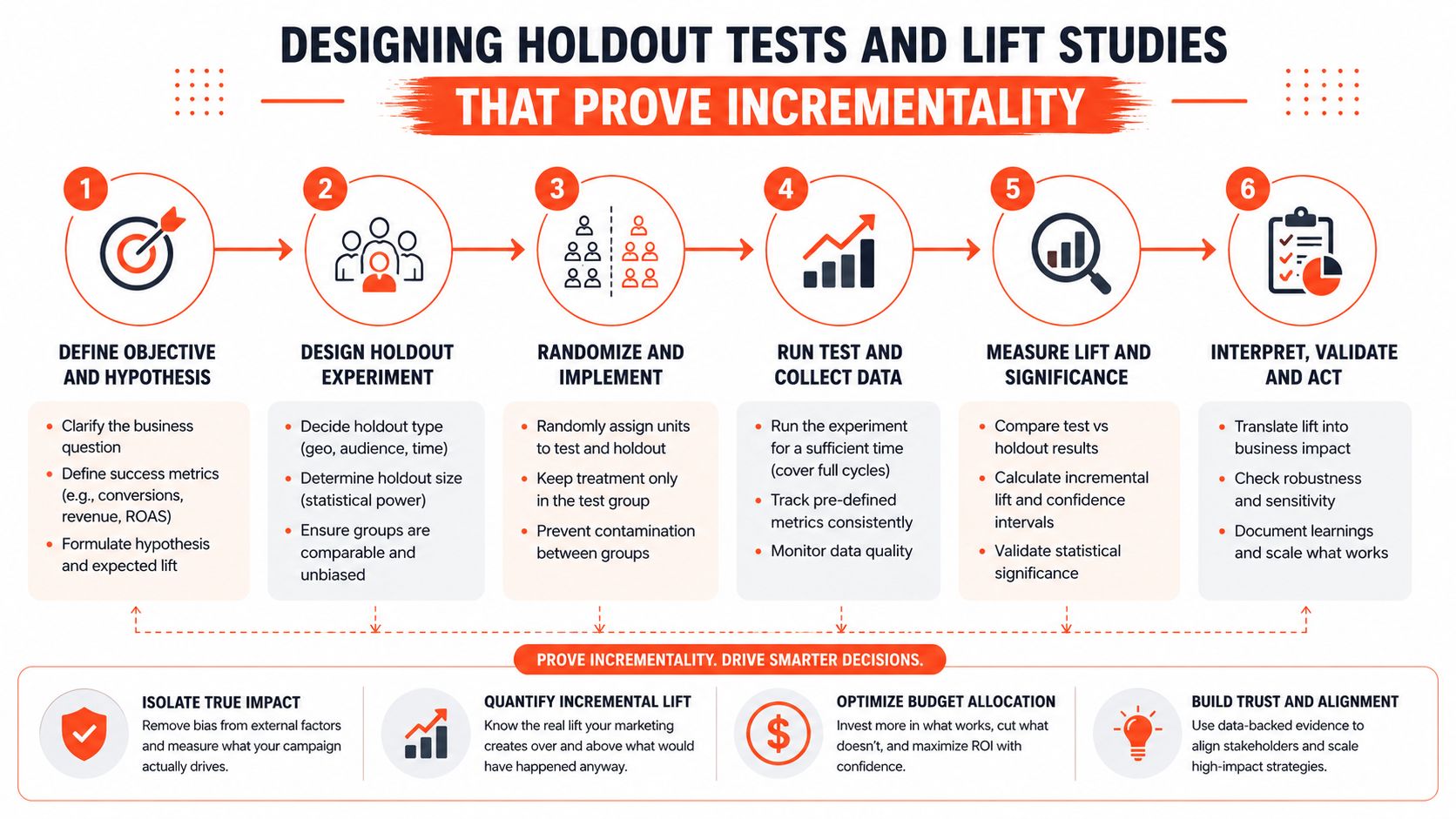
Tracked revenue is not the same as incremental revenue. That gap is where weak influencer reporting falls apart. If a buyer would've purchased anyway, the campaign gets too much credit. If you can't separate the two, the number won't survive finance scrutiny.
Build a holdout test before launch. Split your geo or audience into a treatment group that sees the creator content, either paid-boosted or organically matched, and a control group that doesn't. Measure conversions over a 14 to 28 day window using the same attribution model in both groups, then compare the lift. If the campaign is important enough to defend, it's important enough to test.
Run the test like an experiment, not a hope
Size the sample with a power calculation before you launch. You want the lift to clear the 90 percent confidence threshold, not just look positive in a spreadsheet. That means you need enough exposed and unexposed traffic to make the result stable, not a handful of conversions you can explain away either way.
Standout rule: every incrementality claim needs a control, a window, and a confidence interval.
When holdouts aren't practical, use a ghost-publisher lift test or compare pre and post brand search lift in exposed versus unexposed markets. Watch for contaminated audiences, because people often see the creator content elsewhere even if your test says they didn't. Also watch promo-driven purchases, since a coupon can pull forward demand that would've converted naturally.
Reporting Templates Weekly Views and End of Campaign Readouts
Weekly reporting should be ugly and useful, not polished and useless. The deck or sheet your team opens needs to show spend, tracked revenue, ROAS by creator tier, coupon redemption rate, CPM, and flagged anomalies, sliced by platform and creator. If it takes twenty clicks to find the number that matters, nobody will use it.
The end-of-campaign readout should have five parts. Start with an executive summary and the ROI ratio. Then move into a per-creator scorecard, a comparison of attribution models, the incrementality test result, and the reallocation recommendation. The CFO reads the first line, so make that line clean and specific.
Use one reporting template every week
| Weekly Influencer Campaign Reporting Template | Source | Formula | Review Cadence |
|---|---|---|---|
| Spend | Finance and platform exports | Total media, fees, gifting, and fees tied to the campaign | Weekly |
| Tracked revenue | GA4, Shopify, affiliate logs | Sum of attributed orders by creator | Weekly |
| ROAS by creator tier | Creator-level reporting | Tracked revenue divided by spend | Weekly |
| Coupon redemption rate | Shopify or Klaviyo exports | Redemptions divided by distributed codes or clicks | Weekly |
| CPM | Platform delivery data | Spend divided by impressions, times 1,000 | Weekly |
| Flagged anomalies | QA review and export reconciliation | Outliers against expected creator behavior | Weekly |
Build the end report around visuals that match the job. Use a bar chart for ROAS by creator, a line chart for the weekly trend, and a table for the scorecard. Keep the scorecard limited to the metrics that finance can reconcile, then archive the raw UTM data, ad platform exports, holdout results, and reconciled revenue tied back to finance. If you need a reference point for campaign structure, this Social Cloud campaign guide shows the kind of reporting rhythm performance teams expect.
The report should end with one decision. Double down, cut, or test again. Anything more is decoration.
If you want creator campaigns measured like real media, not social theater, Social Cloud runs influencer programs with tracking links, promo codes, and weekly reporting tied to creator-level outcomes. Social Cloud is built for teams that need per-creator attribution, cleaner ROAS, and a reporting setup finance won't reject when the quarter closes.
Written with the Outrank app