
You approved the creator budget. The posts went live, views looked strong, your team shared the screenshots, and then finance asked a simple question. Which creators drove sign-ups?
That's where the portfolio stops helping. A polished reel can hide weak tracking, bundled fees, and usage terms you never agreed to. The right influencer agency San Francisco brands can grow with is the one that makes spend measurable, fits your actual budget size, and puts attribution, deliverables, and pricing in writing before anyone posts.
The eight options below cover very different models, from enterprise managed campaigns and performance-focused creator programs to mobile user acquisition and celebrity moments. Social Cloud is included as an international partner for San Francisco brands, rather than an agency with a verified San Francisco office. Judge each option the same way. Ask how every placement is tracked, what the fee rewards, whether a small test is welcome, and what the agency will confirm contractually. Creator fit matters too, and details like building a media kit for brand partnerships help creators present audience and past performance clearly, but a good kit can't fix missing conversion data.
Table of Contents
- 1. Linqia
- 2. Social Cloud
- 3. Collectively
- 4. Open Influence
- 5. Sway Group
- 6. Portal A
- 7. Moburst
- 8. Talent Resources
- How the San Francisco influencer agencies compare at a glance
- Matching Your Budget to the Right Creator Partner
1. Linqia
Linqia is the most structured starting point if you're a growth or enterprise team that needs creator campaigns to run like paid media. It's San Francisco based, focuses specifically on influencer marketing, and pairs managed service with its Resonate platform. That combination matters if approvals across legal, brand, and growth usually slow you down.

What you actually get
Resonate handles creator discovery, approvals, campaign workflow, and performance monitoring in one place. Linqia also manages negotiations, contracts, paid amplification, and reporting across organic and paid results, with third-party measurement integrations available. For a team comparing agencies, that reporting layer is worth interrogating in the demo, not after signature. Ask what counts as a conversion, which attribution window applies, and whether you can see creator-level results or only blended totals. Our own guide to choosing an influencer marketing agency in San Francisco uses that same creator-level test.
The market context supports asking hard questions early. The World Federation of Advertisers recommendations on influencer marketing note that 60% of multinational brands now maintain dedicated influencer-marketing budgets, up from 37% in 2019, yet 63% of surveyed multinational marketers identify proving ROI and tracking performance as leading challenges. Reach can't carry a recurring budget on its own.
Ask in writing: Get minimum spend, platform costs, talent fees, and media fees listed separately before you compare Linqia to smaller agencies.
Pros: San Francisco roots, specialist focus, agency service plus technology, and reporting that can help you explain spend to stakeholders. Cons: Its enterprise orientation may not suit small teams or test budgets. Public pricing isn't listed, so confirm minimums and how technology, talent, and media costs break out.
2. Social Cloud
Social Cloud is a performance-focused option for San Francisco brands that want to judge creator campaigns by business results, not just reach. We work internationally with growth-stage e-commerce, apps, SaaS, and games teams, from a first creator test to always-on programs. Our verified office locations are Hamburg, New York, and Buenos Aires, so ask about the working arrangement if an in-person San Francisco team is essential.
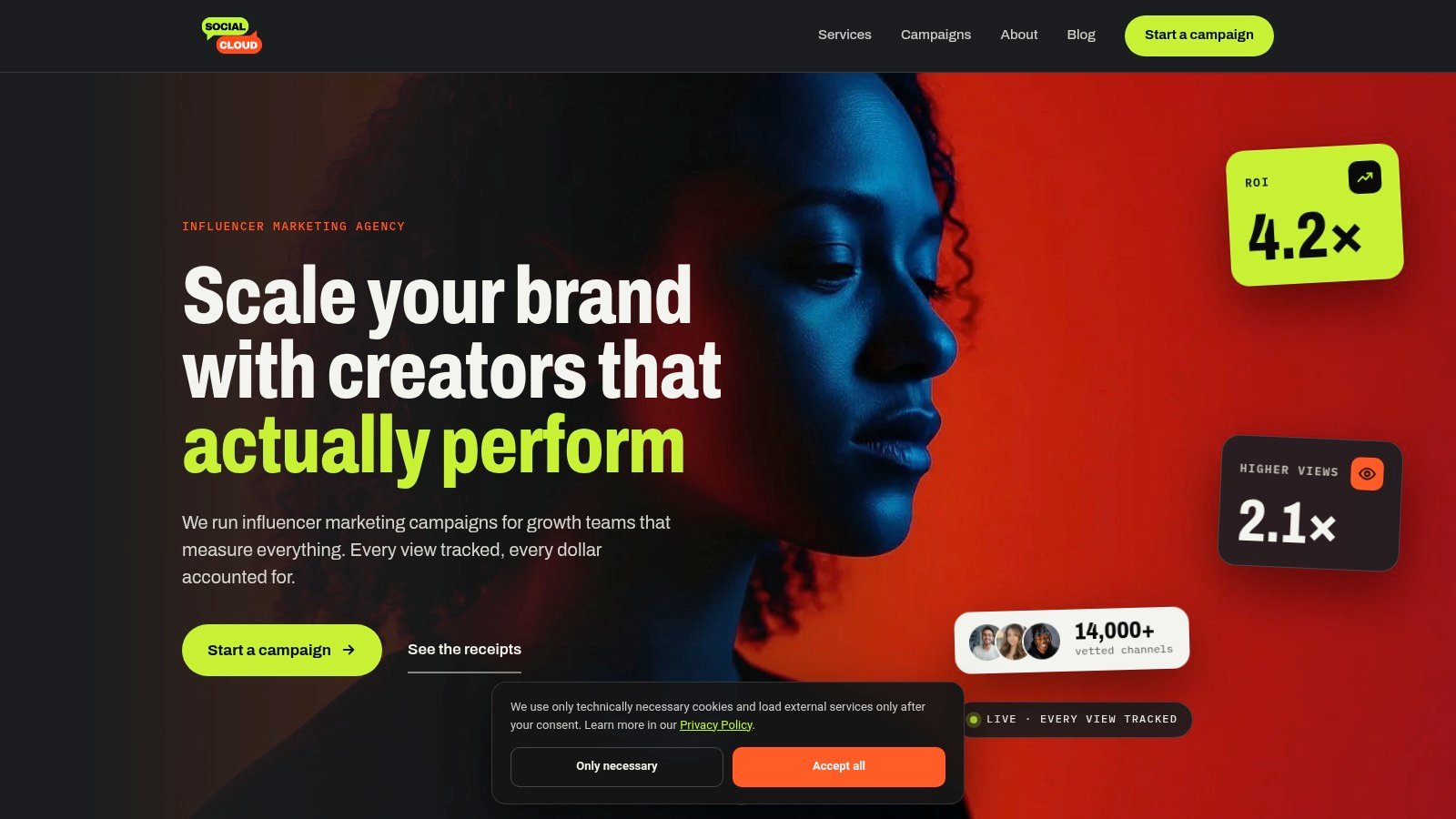
Our team works across YouTube, Instagram, TikTok, and Twitch. Every placement has a tracking link and promo code, and clients see views, CTR, conversions, and ROAS per creator weekly. That makes it easier to compare creators against a defined KPI and decide where to put the next round of spend. Performance fees depend on what the campaign delivers; request a proposal to clarify the fee structure and what is included.
Pros: Creator-level tracking, weekly performance reporting, and international reach. Cons: The verified office list does not include San Francisco. Confirm whether the proposed working arrangement fits a brief that requires local, in-person support.
3. Collectively
Say you need creators plugged into a bigger launch, not a standalone burst of posts. Collectively fits that brief. It has a San Francisco office, offers strategy through execution, and can coordinate creator work with broader marketing plans in other markets.

Its scope is broad, which is both the selling point and the risk. You get campaign strategy, creative concepts, briefs, content optimization, contracting, licensing, product gifting, content production, global support, and paid social. Reporting can include brand lift, sentiment, and paid social performance. That's useful if leadership cares about perception alongside sales, but you should decide the primary KPI before the kickoff so reporting doesn't drift to whichever metric looks best.
- Creator operations: Contracting, licensing, and gifting handled centrally, so your team isn't chasing terms creator by creator.
- Creative support: Concepts and optimization help if your internal team can't produce native social assets quickly.
- Scale proof: The agency reports having produced more than 1,700 campaigns and contracted more than 7,500 creators.
Licensing deserves extra attention here. The Federal Trade Commission guidance on endorsements, influencers, and reviews makes clear that compensated endorsers must disclose material connections, must not claim product experience they don't have, and cannot make unsupported claims. If content will run as paid social or move across markets, confirm who approves claims, where disclosure sits in short-form video, and how long usage rights last. A wider shortlist of the best influencer marketing agencies is useful for comparison, but those terms decide whether assets are usable.
Pros: Broad service range and a San Francisco office alongside other major markets. Cons: Public brand-side pricing and minimum campaign size aren't listed. Its global offering may exceed what a small local activation needs.
4. Open Influence
Open Influence suits teams that want one partner for strategy, creator selection, production, and paid distribution, rather than stitching together separate vendors. It has a San Francisco presence, runs campaigns across Instagram, TikTok, YouTube, and LinkedIn, and has experience in financial services, health, automotive, and consumer goods.

Where the full-service model helps
Its offer covers strategy, creative development, campaign management, and paid media amplification, plus creator-led production through Studio OI. That structure can reduce handoffs between creative, talent, and media teams. It's also relevant for regulated categories, because fewer vendors touching creator copy usually means fewer chances for an unapproved claim to slip into a caption or script.
Compliance isn't a footnote here. In its April 2017 reminder to influencers and brands, the FTC said staff sent more than 90 letters after reviewing Instagram posts, and warned that disclosures shouldn't be buried below the "more" button or hidden among hashtags and links. Ask Open Influence to show how disclosure placement is checked before publication, and who owns errors after a post is live.
Strong campaign management should include a documented approval trail for claims, disclosures, and usage rights, not just a shared drive of final assets.
Pros: Full-service structure, support for creator content plus paid distribution, and multi-market capability. Cons: Public agency pricing and minimums aren't listed. A global, full-service setup may be more than a small local campaign requires, and it's not clear from public information whether a tight test budget is welcome.
5. Sway Group
Choosing Sway Group starts with a practical question: does the campaign need creator-feed distribution, reusable content, or both? Based in Mill Valley in the Bay Area, Sway Group offers sponsored partnerships, creator-generated content, influencer administration, and social media management.

Its creator options span nano creators through celebrities. Massive Sway focuses primarily on nano creators, while its creator-generated content service produces assets without requiring posts on creators' feeds. That can suit a paid social team seeking fresh testimonials or product demos, especially when audience access is not the main goal.
- Reach campaigns: Creator-feed posts across tiers when distribution matters.
- Content-only work: Creator assets for brand channels or ads, without a feed-post requirement.
- Administration: Agency management of contracts, payments, and metrics.
Nano campaigns can involve many small deliverables, so clarify who coordinates briefs, approvals, contracts, and reporting. Ask how creator-level results are attributed, what metrics appear in reports, and whether the agency will put responsibilities and any performance commitments in writing.
Sway describes its pricing as customized. Request a written quote with an itemized breakdown before shortlisting it for a small test. Ask which costs cover creator fees, content production, administration, and any paid usage, and whether the scope can start with a limited campaign.
For context, Collabstr's 2025 report, covered by ESPN 690 on the 2025 influencer marketing report, projected the global industry would reach $22.2 billion in 2025. That market projection does not establish whether an individual quote is reasonable; judge the proposal by its deliverables, tracking, and terms.
Pros: Bay Area base, influencer focus, and formats for both audience reach and content production. Cons: The terms behind any results guarantee need clarification, including definitions and exclusions, in writing.
6. Portal A
Portal A is the creative outlier on this list. It's a social-first content company with a San Francisco hub, known for creator-led video, branded series, and internet-native entertainment. Public work includes campaigns with Google, Lenovo, Target, and YouTube, which gives you real examples to judge taste and format fit.

That makes it a strong option when the idea is the problem. Portal A integrates creative development, production, content strategy, design, and talent partnerships, with hubs in San Francisco, Los Angeles, and New York. If you want a YouTube-first concept that doesn't feel like an ad read, in-house production and strategy can simplify a complex project.
The performance question to settle early
Creative quality doesn't answer attribution. Reporting covered by Tubefilter on influencer marketing measurement notes that 46% of marketers track conversion rate and 44% track sales, while 55% identify revenue growth as a campaign goal. If revenue is your goal too, ask Portal A how creator-level links, codes, landing pages, and paid amplification results will be separated from organic views.
I wouldn't rule Portal A out for growth work, but I'd require a measurement plan in the proposal. Define whether you're optimizing to CPI, CPA, click quality, watch time, or assisted conversions. A lower CPM doesn't help if viewers watch, enjoy, and never take the next step.
Pros: Distinctive video concepts, creator collaboration, and in-house production. Cons: It's more content and entertainment led than a specialist performance agency. Pricing and project minimums aren't published, so confirm lower-funnel tracking before you compare it with agencies built around direct response.
7. Moburst
For an app team weighing creator spend against user acquisition, Moburst is worth considering as a mobile and performance marketing agency serving the San Francisco market. It includes influencer campaigns within a wider user-acquisition offer, which may suit a brief focused on installs better than a general creator roster.

Its workflow covers creator research, recruitment, briefing, campaign management, link tracking, and reporting against agreed KPIs, such as installs, sign-ups, and sales. Performance data can inform creator selection, and creator content may be repurposed as advertising assets. Ask for a forecast tied to your own target, and clarify what assumptions it uses.
The shift toward measurable outcomes is reflected in benchmark research reported by NetInfluencer on performance-based influencer marketing, which found revenue and sales rank as the leading performance indicator for 31.5% of surveyed marketers, compared with 20.2% for engagement. Moburst is easiest to assess when you can track install quality and post-install actions.
Practical rule: If an agency reports installs, require creator-level links and agree on what counts as a qualified install before launch.
Check contract terms before committing. They can include a monthly minimum, hourly fees, and a media-management fee. Ask which apply to your engagement, what the minimum covers, and whether a small creator test is workable. A broader acquisition program may justify the added scope; an organic activation or strategy-only brief may not.
Pros: Relevant to apps, combines creator campaigns with broader mobile marketing, and reports against acquisition KPIs. Cons: The wider service offer may be unnecessary if you only need a focused creator test. Confirm the pricing model and attribution approach in writing before signing.
8. Talent Resources
A launch that needs celebrity talent, press, events, and creator content calls for more coordination than a creator-only brief. Talent Resources combines influencer and creator campaigns with celebrity talent procurement, PR, social strategy, events, and paid amplification. Its San Francisco office may suit brands planning a local launch alongside activity in other markets.
The agency supports Instagram, TikTok, YouTube, and other platforms, and can manage creator and celebrity partnerships from planning through execution. Bringing related functions together can reduce duplicate negotiations and conflicting messages. The trade-off is cost and coordination: a larger scope can be harder to assess if each service is not priced and measured separately.
What to clarify before celebrity costs enter the plan
Celebrity access can quickly take up a large share of a campaign budget. Ask for separate costs for talent, agency fees, production, travel, events, and paid media. Confirm what happens if the headline talent under-delivers or cancels, and whether the usage rights cover the placements your paid team needs. Get rights, cancellation terms, and any make-good commitments in writing before signing.
Creator budgets vary widely by brand. Whether celebrity talent fits depends on the campaign goal, not an industry average. For a smaller performance test, a specialist creator marketing agency may make it easier to assess results by creator. Ask whether a small test is welcome, how results will be attributed, and which costs are fixed versus tied to delivery.
Pros: Celebrity and entertainment partnerships, PR and event support, and related services under one agency. Cons: That scope may exceed what a performance-focused creator test needs. Public pricing is not listed, so request a full cost breakdown and confirm what each fee covers before comparing quotes.
How the San Francisco influencer agencies compare at a glance
| Agency | Best For | Pricing Visibility | Standout Feature | Watch Out For |
|---|---|---|---|---|
| Linqia | Enterprise teams seeking measurable creator campaigns | Not public; confirm minimums and cost breakdown | Resonate platform combines creator workflows and performance monitoring | Enterprise focus may not suit small budgets |
| Social Cloud | San Francisco brands seeking measurable creator campaigns with an international partner | Performance fees depend on campaign delivery; request a proposal for details | Per-placement links and promo codes with weekly creator-level reporting | No verified San Francisco office; confirm the working arrangement if local presence matters |
| Collectively | Brands coordinating creator campaigns with broader marketing | Not public; minimum campaign size is unspecified | Broad support from strategy and production through paid social and reporting | Global offering may exceed the needs of a small local campaign |
| Open Influence | Teams seeking end-to-end creator campaigns with paid amplification | Not public; minimums are unspecified | Combines creator production, campaign management, and paid media | Full-service capabilities may be more than a small campaign requires |
| Sway Group | Brands seeking creator reach or creator-generated content | Customized; a separate FAQ lists a $50,000-$75,000 starting range | Offers campaigns from nano creators to celebrity talent, plus content-only options | Verify the starting range and clarify any results guarantee in writing |
| Portal A | Brands developing creator-led video, branded series, or entertainment | Not public; project minimums are unspecified | In-house creative strategy and production for creator-led content | Confirm how conversions and lower-funnel goals will be tracked |
| Moburst | Mobile apps and user-acquisition teams | Published terms cite a $4,500 monthly minimum, hourly fees, and a 15% media-management fee; confirm applicability | Tracks creator campaigns against app installs, sign-ups, and sales | Broader services may be unnecessary for a small organic activation |
| Talent Resources | Brands planning campaigns centered on celebrity, PR, or events | Not public; request an itemized breakdown | Combines creator and celebrity partnerships with PR, events, and paid amplification | Celebrity and PR services may not suit a performance-focused creator test |
Matching Your Budget to the Right Creator Partner
Start with the decision you're trying to make after the campaign, not the creators you want to announce. If the goal is installs, trials, subscriptions, or purchases, every agency should explain attribution before it shows you a talent list. If the goal is cultural visibility or premium video, judge creative fit first, but still agree on what evidence will justify a second flight.
There's budget momentum, but that shouldn't weaken your diligence. Reporting on Later's 2025 influencer marketing data states that 80% of surveyed brands either maintained or increased their influencer-marketing budgets, while 47% increased budgets by at least 11%. U.S. spend is also expected to grow, since an eMarketer forecast reported by Digiday in its 2025 influencer research puts U.S. influencer marketing spend at $10.5 billion in 2025, rising to as much as $13.7 billion by 2027 as a projection. More money in the channel makes weak measurement more expensive, not less.
Use this short checklist with every finalist:
- Tracking on every placement: Require a unique tracking link, promo code, platform event, or post-purchase survey route for each creator.
- Pricing in writing: Separate agency fees, talent fees, production, usage rights, and paid media so quotes are comparable.
- Test budget terms: Ask if a small first test is welcome, what minimum applies, and which creators you'd get at that level.
- Attribution definitions: Agree on KPI, attribution window, assisted-conversion treatment, invalid-traffic exclusions, and the weekly reallocation rule.
- Usage and compliance: Confirm disclosure placement, claim approval, paid usage duration, whitelisting or Spark rights, and who fixes a non-compliant post.
Social Cloud appears near the top of this list as a performance-led option. Compare its proposal with the other finalists using the same KPI, attribution window, and scope.
Shortlist two or three agencies, including at least one performance-led option. Give each the same brief, audience, budget range, and target KPI, then ask for a written proposal or forecast. Compare them on the same measurement terms. The best answer to your influencer agency San Francisco search isn't the longest creator list. It's the clearest line from creator content to business outcome.
If creator spend needs to show up as installs, conversions, or revenue, we at Social Cloud can build the test around per-creator tracking, weekly reporting, and a performance-linked fee. Tell us your target KPI and budget range, and we'll outline which creators and measurement setup make sense before you commit to a larger program. Start the conversation at Social Cloud.

