
You can feel the pressure before you can explain it. The creator budget is approved, the posts are queued, and the team wants a clean answer to a very blunt question, did any of this drive revenue, or did it just make the brand look active?
That's the point where a creator marketing agency stops being a nice-to-have and starts looking like a core operational asset. The modern version of the category exists because creator spend has grown fast, attribution is messy, and growth teams need someone who can connect creator activity to real business outcomes, not just comments and views. Market data shows influencer marketing expanded from $1.7 billion in 2016 to $16.4 billion in 2022, with estimates now above $32.5 billion by 2025–2026, and 74% of marketers planned to increase influencer budgets in 2026 (Digital Applied). That's not a side channel anymore, it's a real media line item.
What changed is simple. Brands used to hire creators for reach and vibe. Now they need help with discovery, contracting, reporting, content licensing, and the part many struggle with most, attribution. If you're trying to get creator campaigns through a finance review, or you're trying to decide whether the work belongs in-house, with a platform, or with an agency, the core question isn't who can post the most content. It's who can prove the revenue impact.
Table of Contents
- Why Growth Teams Are Hiring Creator Marketing Agencies Now
- Strategy and forecasting
- Creator sourcing and vetting
- Campaign execution and compliance
- Measurement and reporting
- What good vetting actually looks like
- Tier matters, but not the way people think
- Seeding and gifting play a different role
Why Growth Teams Are Hiring Creator Marketing Agencies Now
A growth manager can get a creator campaign over the line and still face the hardest question the next morning, did it move purchases, or did it just create a busy-looking feed?
That question is why more teams bring in a creator marketing agency. Creator work is no longer treated as a one-off brand exercise. It now sits closer to paid media, which means the team has to manage creative production, usage rights, audience fit, tracking, and budget discipline at the same time. Influee points out that brands increasingly reuse creator assets in ads, so creator content often becomes part of the performance stack, not just a sponsored post.
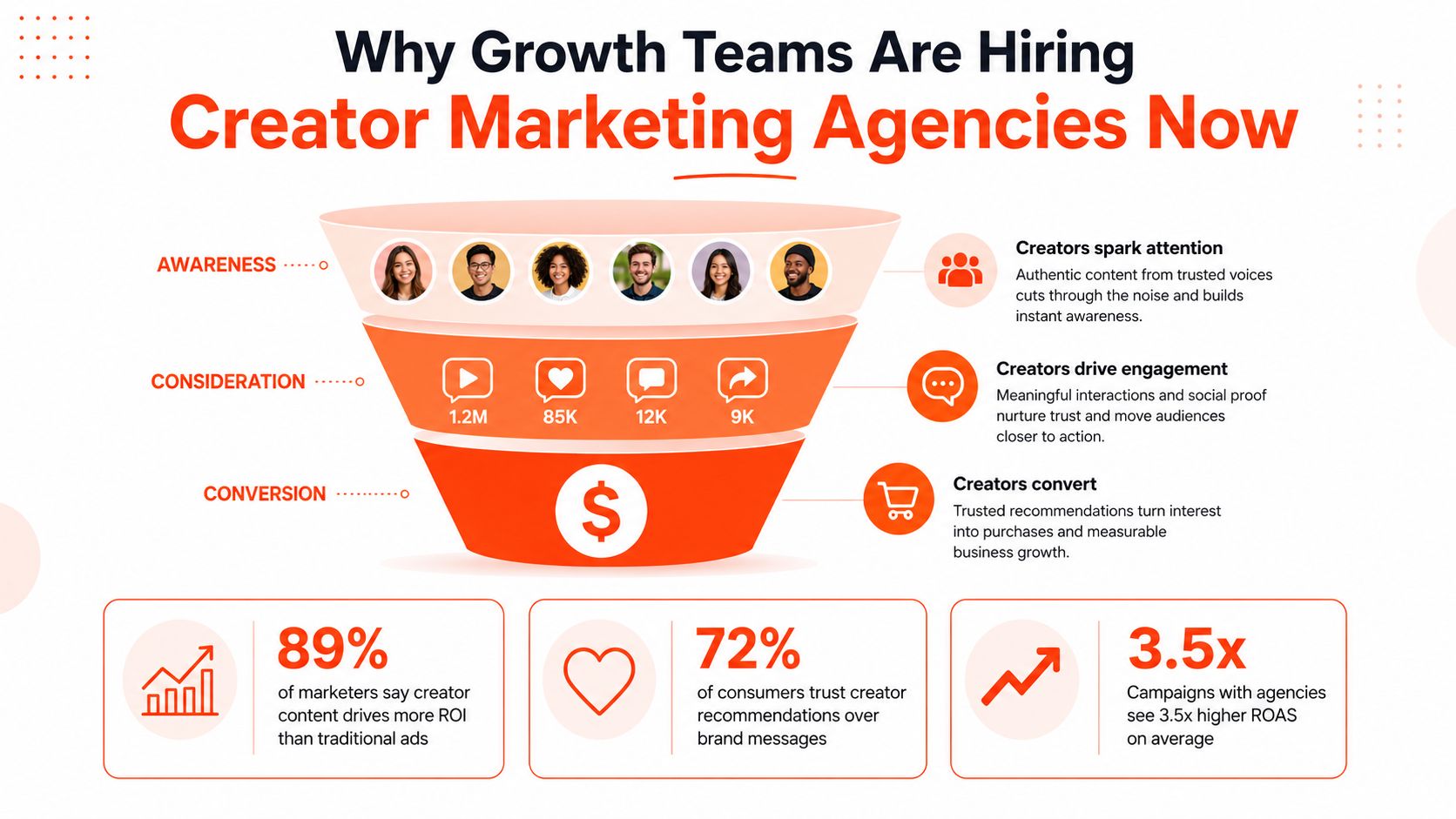
That shift changes how the work is judged. A campaign can still earn engagement and reach, but growth teams need to know whether those signals led to qualified traffic, sign-ups, or purchases. If the measurement stack cannot connect creator activity to downstream revenue, the team is left defending output instead of outcomes.
The operational load is what pushes agencies into the picture. Teams often start by finding a few creators who perform well, then the process gets harder. Discovery slows down. Briefs need to be adapted. Contracts, content rights, reporting, and channel-specific tracking all need attention. Without a specialist partner, the workflow turns into a patchwork of links, promo codes, screenshots, and subjective readouts.
An agency helps when the team needs more than content production. It can keep creator selection tied to the funnel stage that matters, set up reporting that finance can review, and compare campaigns in a way that supports budget decisions. If the creators are only being measured on comments and views, the business question is still unanswered.
Practical rule: if your team cannot tell whether creator spend changed purchases, the issue is measurement, not creative volume.
That is also why many growth teams ask whether creator work belongs in-house, through a platform, or with an agency. The answer usually depends on how much performance scrutiny the team expects. If the goal is to boost engagement with these tips, that helps at the top of the funnel. If the goal is to show revenue impact, the agency conversation starts to make more sense.
What a Creator Marketing Agency Does
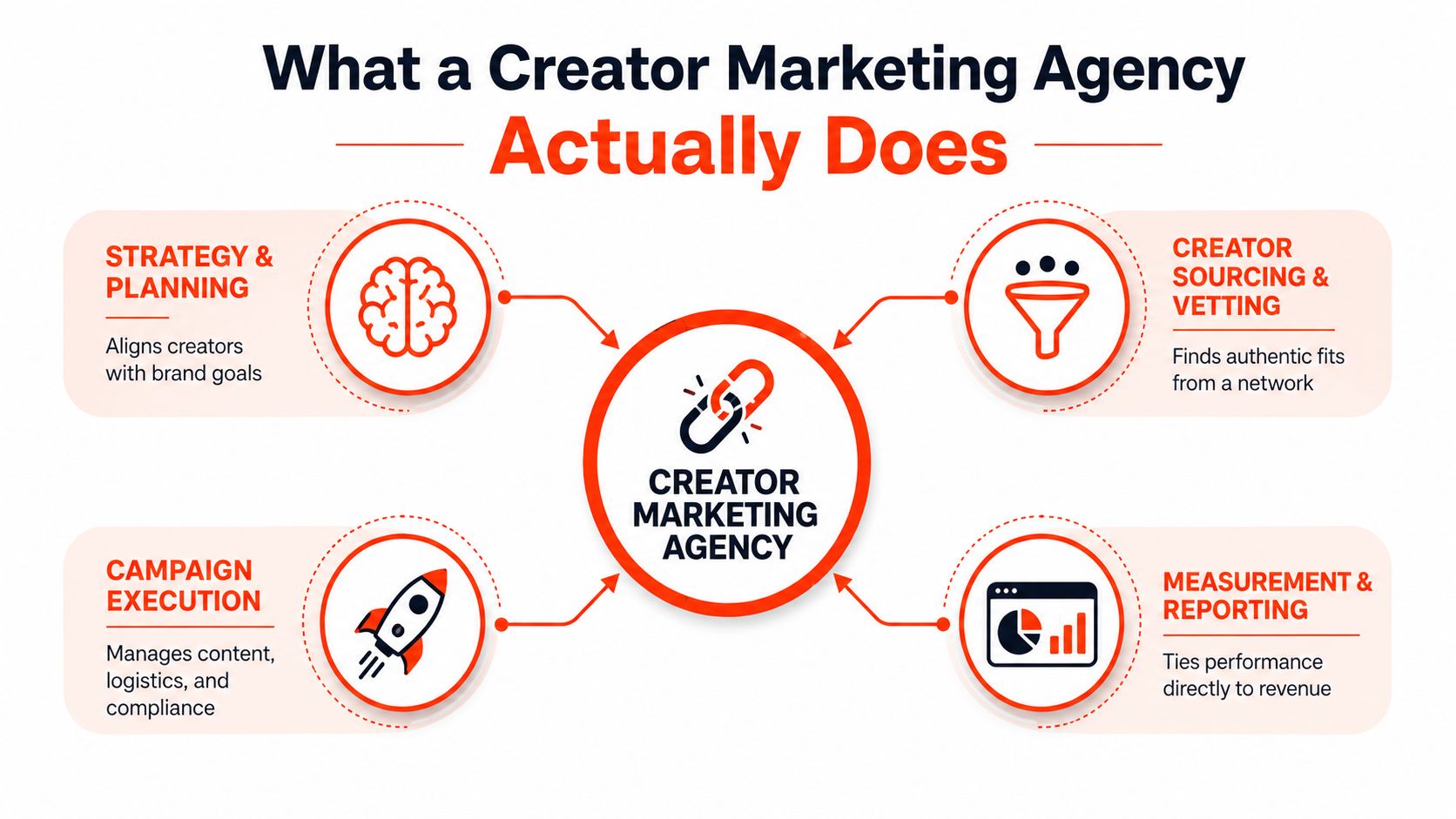
A creator marketing agency is an outside team that plans, runs, and measures creator campaigns end to end, with revenue as the north star. The useful version does more than source talent. It ties the brief, creator selection, contracts, tracking, and reporting together so the work can be judged against business outcomes instead of opinion.
Strategy and forecasting
The agency starts by deciding what success should look like. That means setting target CPI, CPA, or ROAS, then mapping creator mix and platform mix to those targets before spend goes live.
Social Cloud's model, for example, includes strategy and forecasting, budget allocation across YouTube, Instagram, TikTok, and Twitch, plus brief development that keeps creator voice intact while still aiming at the funnel stage that matters.
Creator sourcing and vetting
A good agency chooses creators by looking at audience overlap, niche relevance, historical sponsored performance, and whether the content pattern fits the campaign goal. A broad follower count can look impressive and still miss the audience that buys.
That is why the vetting process matters as much as discovery. Social Cloud says it works from a vetted network of 12,000+ creators, screened for audience quality, brand fit, and prior sponsored performance, which is the kind of operational detail growth teams should expect to hear in a real pitch.
Campaign execution and compliance
Once creators are chosen, the agency handles the work that in-house teams often end up stitching together by hand. Deliverables need to be tracked, disclosure language needs to be clear, payment terms need to be agreed, usage rights need to be documented, and review cycles need to stay moving.
Cross-market campaigns add another layer, because each platform and region can create its own approval and compliance burden. The process becomes closer to production management than to simple outreach.
Measurement and reporting
The last layer is where the agency earns or loses trust. Every placement should carry tracked links, promo codes, survey inputs, or platform-specific attribution methods, so the team can connect activity to outcome. Social Cloud's offering includes weekly reporting across views, CTR, conversions, ROAS, and learning by creator and platform.
The brand UGC video pipeline is a useful reference point if you want to see how creator assets can move from raw content into repeatable media material. Strategy without attribution is guesswork. Creators without contracts become legal exposure.
Strategy and Forecasting Before the First Dollar Goes Out
Forecasting should start from the business number, not the content format. Before the first post is approved, the agency should be able to explain what result the campaign is meant to produce, which creator mix supports that result, and how the budget should shift across platforms if the goal changes from awareness to conversion.
Start with the outcome, not the format
The first question is simple: what does success need to do for the business? If the brand already knows its paid social or search benchmarks, the agency should measure creator CPA or ROAS against those baselines and work backward from there. That matters because creator campaigns often get judged by reach, engagement, and creative taste, even when the commercial target is stricter.
A useful brief becomes a working plan, not a static deck. It should spell out hook structure, talking points, do-and-don't guidance, and the content format each platform rewards. Short-form video on TikTok and Reels often supports conversion or fast testing, while YouTube integrations can support deeper consideration. Niche audio or live environments can build authority in categories where the audience needs more context.
Match platform to job
A creator strategy should shift with the funnel stage. Awareness campaigns usually rely on broader creators, stronger recall, and a wider exposure window. Conversion campaigns usually depend on more focused creators with buying audiences and tighter attribution discipline.
| Funnel Stage | Primary KPI | Creator Tier | Content Format | Attribution Window |
|---|---|---|---|---|
| Awareness | Reach or recall | Broader creators | Short-form and integrated mentions | Longer |
| Consideration | Engagement and qualified traffic | Mid-tier creators | Video explainers and demos | Moderate |
| Conversion | CPA or ROAS | Niche creators | Direct-response clips and offers | Tighter |
If the team wants a concrete example of how the brief should connect to outcomes, the internal guide on influencer marketing campaign planning shows the basic structure.
Keep the model alive after launch
Forecasting is not a one-time PDF. The agency should revisit assumptions weekly, update the media model as placements land, and use the post-flight readout to adjust the next wave. That is what separates a planning deck from a planning system.
A strategy document that never changes is usually a sign the campaign is being managed for presentation, not performance.
How Agencies Find and Vet the Right Creators
A lot of brand money leaks out with the wrong creator choice. The content can look fine on the surface, feel on-brand, and still fail to move sales. Agencies that care about performance treat creator selection like a filtering problem, not a popularity contest.
What good vetting actually looks like
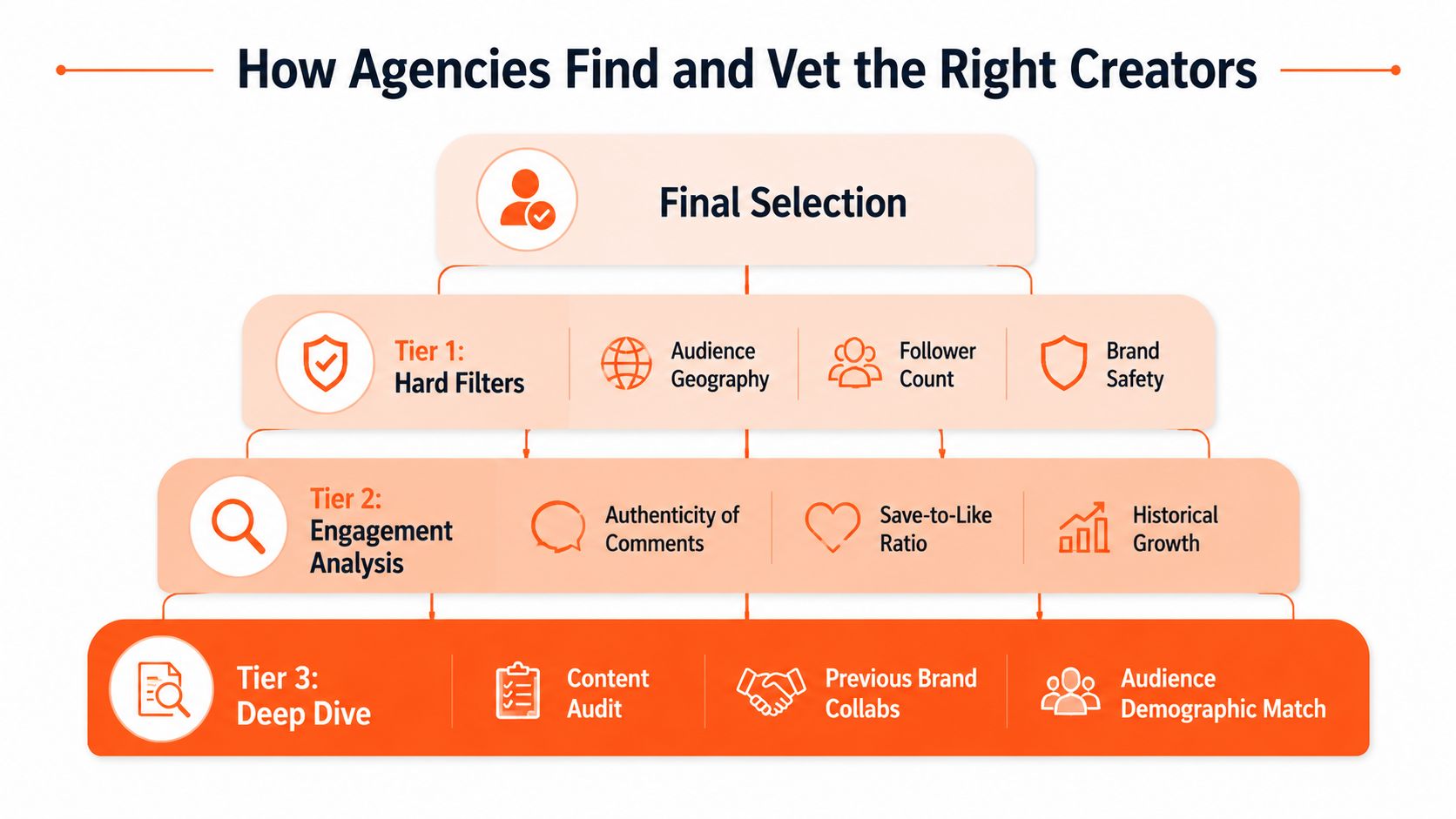
The first pass is simple elimination. Geography, follower range, brand-safety history, and audience fit remove obvious mismatches before the team spends time on outreach. After that, the agency checks whether the comments look real, whether people save or share the content, and whether viewers stay with the video long enough for the message to register.
The next layer is more practical than glamorous. A competent agency reviews a creator's previous sponsored work, but it does not stop at sponsored-post history. It asks whether the creator's content style can support the campaign's objective and whether the audience is likely to act, not just watch.
One useful screen is a conversion-quality threshold. For example, some teams will set a minimum on engaged viewers or qualified clicks before a creator moves past the shortlist. That keeps the process tied to outcomes, not just surface engagement.
Tier matters, but not the way people think
Mid-tier creators often carry the most practical value for direct-response work. They usually sit in the zone where the audience still trusts the recommendation, but the fee has not been inflated by celebrity status. Household names still matter, especially for category education or broad visibility, but they are often less efficient if the goal is immediate response.
That is why a smaller creator can beat a bigger name on a conversion campaign. A creator with a tighter audience and a clearer fit may drive stronger purchase behavior even if the raw reach is lower. In practice, agencies often use that pattern to shift budget away from prestige and toward measurable lift.
Seeding and gifting play a different role
Seeding and gifting should run beside paid partnerships, not replace them. Product seeding creates a wider long-tail pool of mentions, event coverage, and future paid opportunities. It is useful because it builds option value, not because it guarantees direct conversion.
If an agency cannot explain how it turns audience fit and content quality into a shortlist, you probably do not have a selection system, just a roster.
Contracting, Compliance, and Content Rights
Creator campaigns often break in the paperwork, not in the creative. The contract is where an agency prevents confusion later, and it is also where a one-time sponsorship becomes an asset the brand can reuse.
The agreement should spell out deliverables, timelines, exclusivity windows, payment terms, disclosure language, and brand-safety clauses. Usage rights deserve the same attention. Organic-only rights differ from paid amplification rights, and geography and duration should be explicit, because a post that performs well can become expensive if the brand has to renegotiate after launch.
Agencies usually help here because they negotiate these terms every day. They know which requests are standard, they have existing creator relationships, and they can move faster than a brand team starting from zero. That speed matters when legal and marketing are trying to describe the same rights in different language.
The handoff should be clear. The agency secures the right to reuse the creator asset, adapts it into platform-native ad units, then routes it through tools like whitelisting or Spark Ads so the original creator content can run as paid media. That setup also makes attribution cleaner, because spend stays tied to the original placement or creator instead of disappearing into a generic ad bucket.
Practical rule: if usage rights are not negotiated up front, the brand often pays again later or loses the asset just when it starts to work.
Reporting and compliance matter even more in regulated categories, where disclosure and brand-safety review cannot be left to the last minute. For teams that want a closer look at channel-specific operations, the internal guide on YouTube influencer marketing agency is a useful companion.
Attribution and Incrementality the Performance-Focused Way
A creator campaign can look busy and still miss revenue. Growth teams need more than views and likes, they need a way to connect creator activity to sales, so the next budget decision is based on evidence, not hope.
The standard tools each cover a different part of the path. UTM links show credited traffic, promo codes capture some direct-response behavior, and affiliate pixels track downstream events. Each one helps, but each one also has blind spots. UTMs miss view-through behavior, codes can be shared or overused, and pixels can lose fidelity when privacy changes interrupt the path.
Post-purchase surveys fill part of that gap because they can catch influence that never touches a clickable link. A buyer may see a creator video, remember it later, then purchase through search or direct traffic. The survey will still depend on memory, but it gives the agency a second lens on what shaped the sale.
The stronger layer is incrementality testing. It compares exposed groups with holdout groups, or splits markets geographically, to estimate lift rather than just credited conversion. That matters because a creator can receive credit for an order that would have happened anyway through branded search or organic demand. Agencies that care about ROAS should say that directly.
| Method | What It Measures | Key Limitation |
|---|---|---|
| UTM links | Clicked traffic and attributed conversions | Misses view-through behavior |
| Promo codes | Code redemptions tied to a creator | Can be shared or misused |
| Pixels | Downstream conversion events | Can lose signal in privacy-constrained environments |
| Post-purchase surveys | Self-reported influence | Depends on buyer recall |
| Holdout testing | Incremental lift | Requires more planning and volume |
A useful measurement stack brings these signals together and reports on a steady cadence. That usually means weekly placement-level reviews, monthly incrementality readouts, and a creator-level CPA or ROAS number that the growth team can trust. If you're comparing content formats and want to understand how creators are being analyzed across short-form environments, the resource on analyze TikTok Reels and Shorts is a useful technical complement.
The internal guide on performance-based influencer marketing fits here as well, because it makes the same point, the agency should be judged by measurable outcomes, not by how much noise it can generate.
Agency vs In-House Team vs Self-Serve Platform
The right operating model depends on how much operational burden your team can carry. The wrong one usually looks cheaper at first, then gets expensive in time, coordination, and missed learnings.
The three models behave differently
An agency sits in the middle. It's usually the most expensive option per dollar of spend, but it can own strategy, sourcing, negotiation, launch, and reporting in one place. That matters when the team needs portable learnings across multiple brands or product lines.
An in-house team makes more sense once creator spend is large enough that the company wants the muscle memory embedded internally. It also fits brands where creator work is so central to the identity that leaving it outside would slow every decision.
Self-serve platforms are the lightest option. They work when the team already knows how to source creators, negotiate terms, and measure performance, and just needs software to support the process.
| Variable | Agency | In-House Team | Self-Serve Platform |
|---|---|---|---|
| Total cost | Retainer plus fees | Salary and overhead | SaaS fees |
| Speed to first activation | Slower than software, faster than building a team | Slowest to build | Fastest |
| Creator-side expertise | Deep and portable | Depends on hires | Limited to user skill |
| Attribution quality | Usually strongest if the agency is performance-led | Strong if the team has measurement talent | Varies widely |
| Scalability | High | High once mature | Limited by internal bandwidth |
A simple decision rule
If revenue attribution has to survive a finance review and the budget sits in a meaningful growth range, an agency is usually the default. If the company already has a creator strategist and only needs workflow software, a platform can be enough. If the category is brand-defining and long-form, bring it inside.
The mistake most teams make is underestimating the operational tax of in-house work or overestimating the strategic depth of software alone.
There's also a budget signal worth watching. CreatorIQ's 2025-2026 report says average annual influencer budgets grew 171% year over year, 71% of organizations increased investment, and nearly two-thirds of new spend was reallocated from traditional paid and digital channels (CreatorIQ). That kind of shift is exactly why the operating model choice matters more now than it did when creator programs were smaller and easier to improvise.
How to Pick a Creator Marketing Agency That Will Move Revenue
A real evaluation should feel like a procurement review, because the question is whether the agency can move revenue and prove it. If it will own part of acquisition, ask how it measures results, how fast it can operate, and who is accountable when numbers miss the mark.
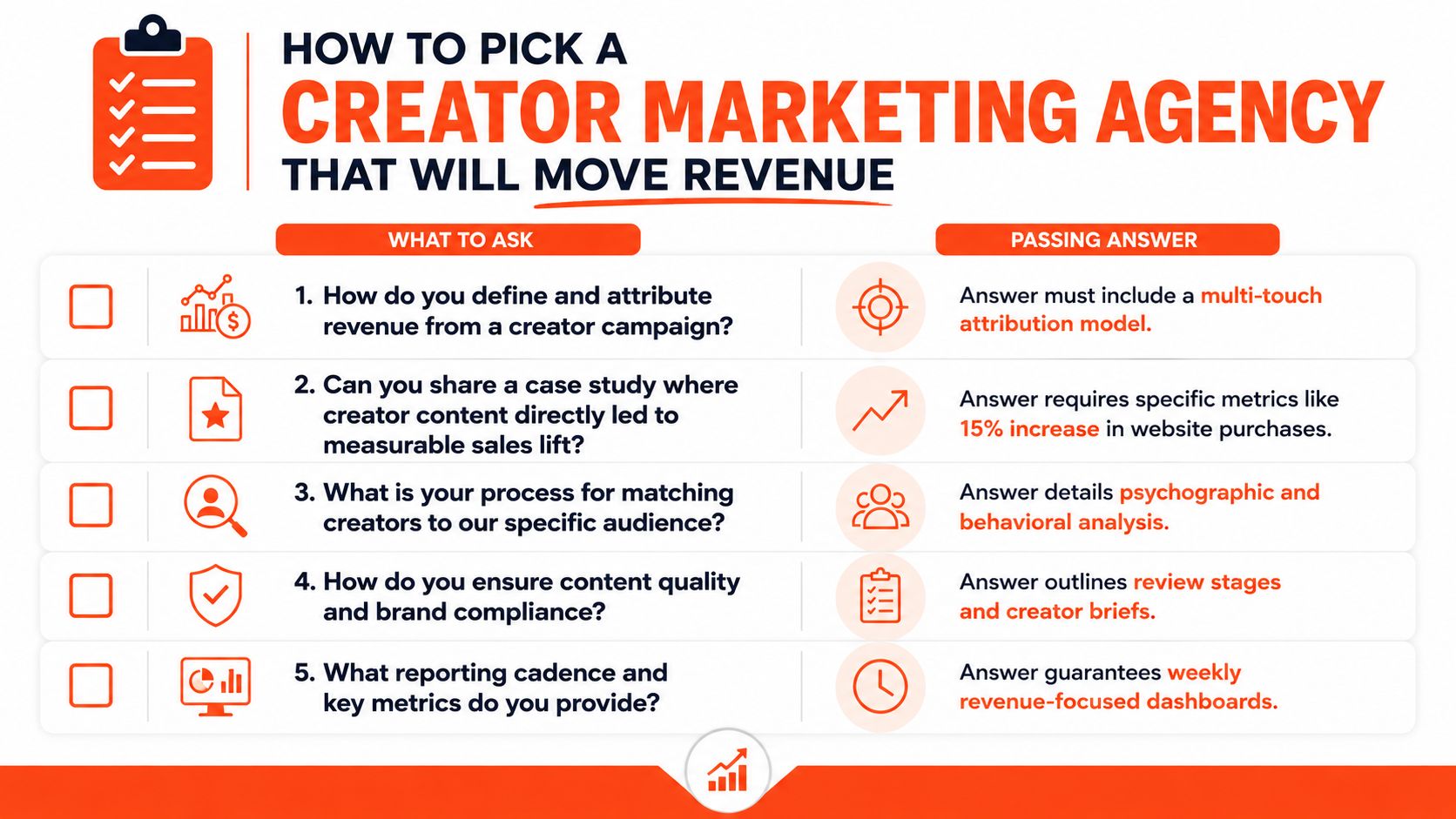
Start with the measurement question
How does the agency define revenue from creator work? A useful answer should describe the attribution model, the reporting path, and the limits of what it can and cannot prove.
Can it show a campaign that produced measurable sales lift? Ask for a case with enough context to judge whether the result came from the creators, the offer, or the channel mix. That matters more than polished creative samples.
How does it match creators to your audience? The answer should go beyond follower count and talk about behavior, fit, and purchase intent.
How does it handle content quality and compliance? Briefs, review steps, disclosure, and escalation paths should all be clear before work begins.
What reporting cadence do you get? For a performance team, weekly revenue-focused dashboards are the right starting point.
Look for operating clarity in the room
The stronger agencies can name the person responsible for the work, explain how creator fees and media spend are handled, and say whether pricing is tied to outcomes or activity. They also answer the speed question plainly. If a brief takes too long to reach live placements, the team may be creative-heavy but weak on execution.
Ask one direct follow-up. If the agency cannot explain its attribution model, will not show creator budgets clearly, or keeps talking about reach instead of revenue, the issue is already visible. A YouTube influencer marketing agency should be able to explain how YouTube placements are measured in the same practical way, not just how they are produced.
A single red-flag question can settle a lot. Ask, “If finance asked how this campaign earned back spend, what would you show them?” The right agency answers with a reporting path, a test plan, and a clear owner. The wrong one talks about exposure and leaves the math vague.