
You've got a Q3 budget, three agency decks in your inbox, and every one promises “authentic creators,” “strong engagement,” and “scalable reach.” The problem is that none of them explains who owns attribution, how quickly the campaign can launch, what happens when a creator misses a disclosure, or whether the quoted fee includes hidden markups.
That's the real challenge when you're evaluating an influencer marketing agency in Germany. The market is large, commercially mature, and demanding, but many agency comparisons still reduce the decision to creator count, platform logos, and polished case-study slides. Those details matter less than the operating system behind the campaign.
Table of Contents
- 1. Attribution rigor
- 2. Creator vetting quality
- 3. Pricing transparency
- 4. Compliance and rights management
- 5. Speed to value
Why Choosing the Right German Influencer Agency Is Harder Than It Looks
Most agency roundups are built for browsing, not buying. They list full-service firms, boutique specialists, and creator platforms with nearly identical descriptions. You're left comparing adjectives instead of capabilities.
A serious evaluation starts with a harder question: what happens after the creator posts? If the agency can show views and engagement but can't connect individual placements to clicks, installs, sales, or qualified demand, you're not buying a measurable growth channel. You're buying media exposure and hoping the finance team accepts the report.
Germany adds operational pressure. Budgets are substantial, the creator ecosystem has expanded quickly, and brands expect careful handling of disclosures, contracts, usage rights, and brand safety. An agency that works well for a lightweight awareness activation in another market may struggle when German legal, procurement, and reporting requirements enter the workflow.
The deck is rarely the risk
I've reviewed enough agency pitches to know where the weak points hide. The strategy slide looks thoughtful. The creator mood board feels relevant. The forecast uses confident language. Then the campaign starts and the client discovers that:
- Attribution stops at the platform dashboard: The agency reports reach and engagement, but there's no creator-level path to revenue.
- Legal ownership is unclear: Nobody knows who checks disclosures, approves claims, or stores usage-rights agreements.
- Creator selection is superficial: Follower count substitutes for audience quality, content fit, and sponsored-content history.
- Launch timing slips: Briefing, contracting, product delivery, approvals, and revisions pass through disconnected teams.
- Pricing hides the economics: Creator costs, agency fees, production charges, and amplification budgets are bundled into one opaque figure.
These gaps are more consequential than whether an agency has a fashionable office or a long list of recognizable clients. You need a partner that can make its decisions auditable and its assumptions testable.
Practical rule: Don't ask an agency only what it can produce. Ask what it can prove, who is accountable when something breaks, and how quickly it can turn a brief into a live test.
The best German agency for your business may not be the largest. A brand-led shop can be right for a major launch with broad creative requirements. A niche firm may outperform everyone in a tightly defined community. A performance specialist is usually the stronger fit when installs, purchases, or qualified leads determine whether the budget gets renewed.
The rest of the decision should be based on those operating differences, not on a generic ranking.
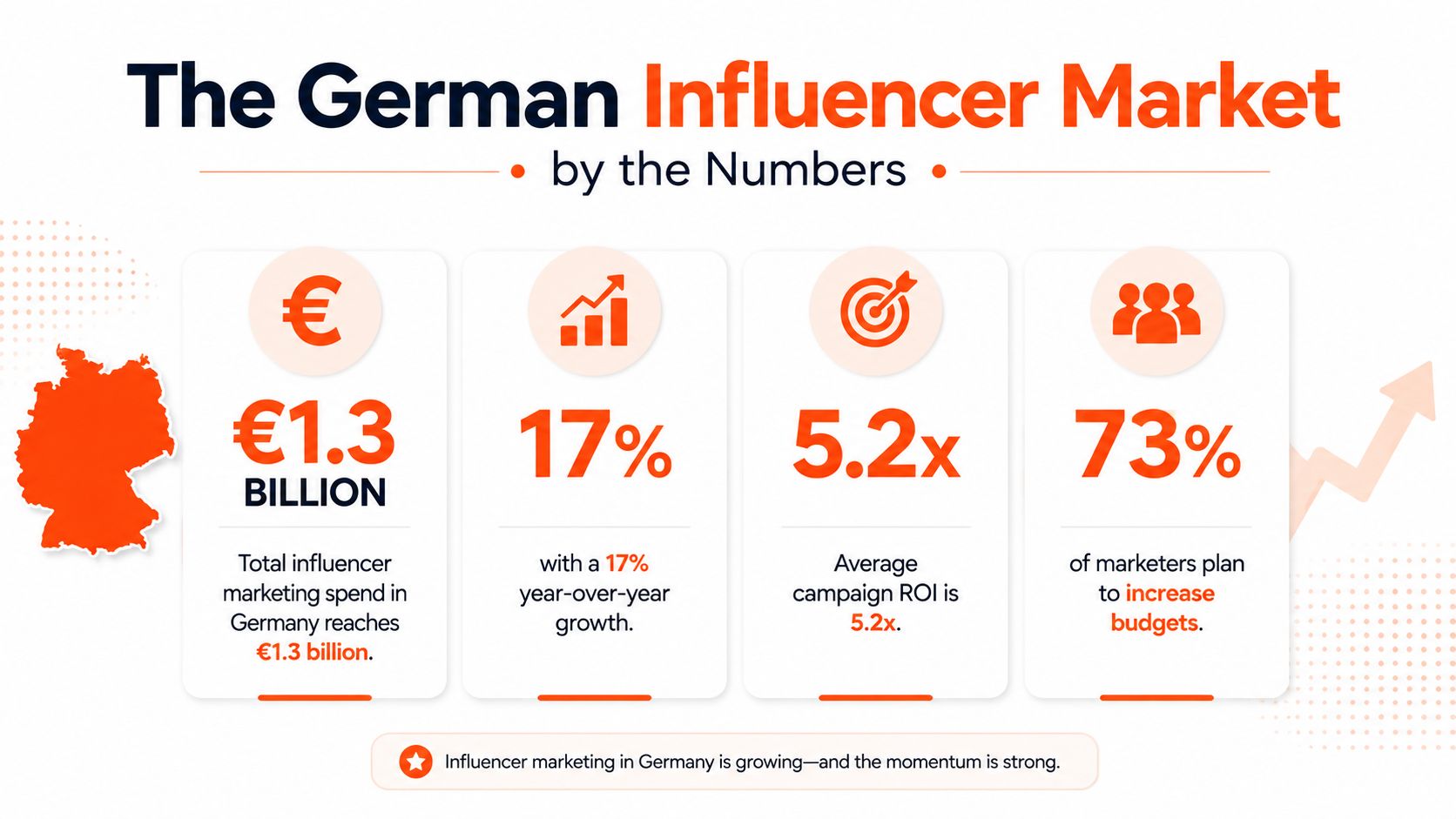
The German Influencer Market by the Numbers
Germany is already a mature influencer market, not a testing ground at the edge of a media plan. A 2024 industry summary reported that German companies spend an average of €5.74 million per year on influencer marketing, compared with a European average of €3.375 million. It also found that 45% of marketing leaders work with agencies, while 32% manage influencer marketing fully in-house (Meedia's German influencer marketing summary). Those figures make the buying question practical: an agency must improve sourcing, contracting, compliance, launch speed, tracking, or optimization enough to justify its fee.
Supply has grown alongside demand
Creator supply has expanded with the budgets. A 2023 industry report stated that Germany's KOL ecosystem grew 9.7% in one year, adding nearly 5,000 Instagram creators with more than 5,000 followers and reaching 51,625 total creators in that category. The same report forecast German influencer advertising spend rising from €549 million in 2023 to €622 million in 2024, and projected German influencer marketing spend at €1.8 billion in 2026 (Kolsquare's Germany market report).
That scale changes agency selection. Gifting and broad creator lists are no longer enough. Ask how a partner shortens the path from brief to approved content, handles German disclosure requirements, and reports performance by creator and placement.
Measurement is still uneven
Spend alone does not show market maturity. The sharper question is whether agencies connect the metrics used in reporting to commercial outcomes.
In the 2026 State of German Influencer Marketing survey, 71% of respondents named engagement rate as their primary KPI, 60% cited reach, and 58% cited conversions or sales. Yet only 17% used attribution models and 11% used online surveys (Xpose360's State of German Influencer Marketing survey). The gap gives disciplined buyers a clear test: require creator-specific links or codes, platform data, and a feedback loop after purchase or install.
Use a market report on influencer marketing for wider context, then judge each agency on its own measurement design. Outcome-based pricing should follow the same logic. If the fee covers activity but ignores attributable results, demand a clear explanation of what the agency owns, what it measures, and how success affects renewal.
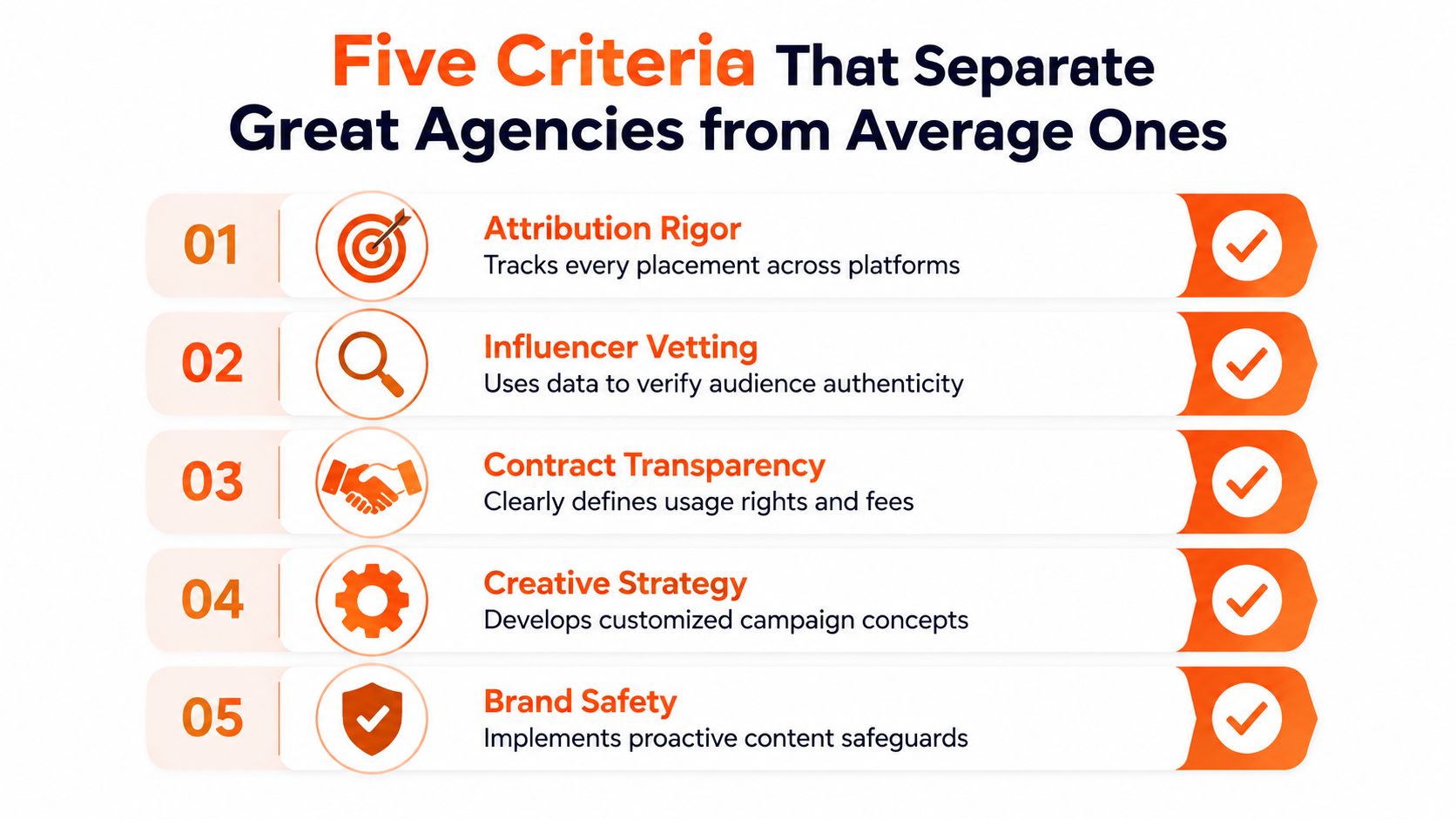
Five Criteria That Separate Great Agencies from Average Ones
A German influencer agency earns its fee by controlling the operational details that determine whether a campaign launches, complies, and produces usable evidence. Your scorecard should fit on one page. If a pitch cannot answer these five areas clearly, attractive creative does not compensate for the gap.
1. Attribution rigor
Start with the conversion path, not the creator roster. Require the agency to show how it assigns a trackable link, promo code, landing page, or survey response to every placement. For an app, that means connecting a creator post to an install and later in-app event. For e-commerce, it means distinguishing creator-driven purchases, assisted conversions, and existing organic demand.
Set the reporting grain before launch. Confirm what appears in weekly reporting, how delayed conversions are handled, and which platform limitations affect interpretation. “We report what Instagram or TikTok provides” is not a measurement system. It leaves your commercial decisions to a platform dashboard.
Use this influencer marketing ROI measurement guide to sharpen your questions before agency pitches begin.
2. Creator vetting quality
Follower count is a screening signal, not a selection strategy. Ask for an anonymized creator assessment covering audience authenticity, German geography, content fit, comment quality, prior sponsored performance, and commercial conflicts.
Strong agencies explain the job assigned to each creator. One voice may demonstrate the product, another may provide credibility, and another may deliver efficient reach. A roster has value only when the agency can connect each creator to a defined funnel role and explain the evidence behind that choice.
3. Pricing transparency
Demand a line-item budget. Separate creator compensation, product costs, production, agency fees, paid amplification, usage rights, exclusivity, and contingency. Confirm whether creator budgets pass through at cost or include an undisclosed markup.
Outcome-linked pricing works only when the outcome is defined before signing. Agree on the conversion event, tracking method, attribution window, quality threshold, and payment schedule. If the agency charges for activity while accepting no responsibility for attributable results, ask what its fee is meant to reward.
4. Compliance and rights management
German campaigns require more than a disclosure copied into a caption. The agency should manage creator contracts, disclosure requirements, product claims, approval workflows, exclusivity, usage rights, and paid-media permissions.
Ask who reviews content before publication and where final agreements are stored. Confirm whether your team can reuse creator assets in paid social, product pages, email, or retail media. Rights handled late create approval delays, renegotiation, and added costs. Make ownership and permitted uses part of the initial brief.
5. Speed to value
Speed means removing waiting time, not pushing creators into production without control. Ask for the operating timeline from brief to forecast, shortlist, contracting, product delivery, content approval, launch, and first reporting cycle.
A capable agency identifies launch blockers early and assigns an owner to every decision. A weak one blames “creative iteration” while procurement and legal wait for basic documents. Ask how quickly the team can produce a qualified shortlist, resolve compliance questions, and return usable reporting after launch.
Red flag: If an agency will not show its tracking structure, fee breakdown, or approval workflow before contract signature, expect the same opacity after launch.
Comparing Agency Archetypes Across Germany
There are three agency types you'll encounter repeatedly in Germany. None is automatically right or wrong. The mistake is hiring one archetype for a job it wasn't designed to perform.
| Criterion | Full-Service Brand Agency | Performance-Focused Specialist | Boutique Niche Agency |
|---|---|---|---|
| Primary strength | Big creative platforms, awareness, integrated brand work | Attribution, testing, creator performance, measurable outcomes | Deep knowledge of a specific community or vertical |
| Creator selection | Often guided by brand fit and creative direction | Data-led, with audience and sponsored-performance checks | Relationship-led and highly specialized |
| Attribution | Can be secondary to reach and brand reporting | Built into campaign design and placement tracking | Varies widely, often dependent on tools and team capacity |
| Pricing | Project or retainer structure, with production layers | Transparent base fee plus agreed performance component | Flexible, but may be less standardized |
| Compliance and rights | Usually strong if supported by legal and production teams | Centralized as part of campaign operations | Strong in its niche, but capacity can be limited |
| Speed to launch | Can slow with multiple departments and approvals | Usually optimized around a single accountable workflow | Fast for focused campaigns, slower when scale is required |
| Best fit | Major launches and brand-led programs | Growth campaigns tied to installs, sales, leads, or ROAS | Specialist audiences and culturally specific activations |
Full-service brand agencies
Choose this route when the campaign's main job is creative impact, cultural visibility, or integration with a broader brand platform. These agencies often bring strong production, PR, media, and brand strategy capabilities.
The tradeoff is accountability. Ask whether the influencer team owns conversion measurement or supplies content into a larger campaign report. If your renewal decision depends on sales or acquisition efficiency, insist on creator-level tracking before signing.
Performance-focused specialists
These firms make the most sense for growth teams that already know their commercial objective. They typically start with a target event, forecast the likely economics, and build creator selection around measurable movement through the funnel.
Social Cloud is one example of this archetype. Its stated model combines a vetted network of 12,000+ creators, placement-level attribution, and outcome-linked fees. Treat those capabilities as items to verify during procurement, not as a substitute for your own diligence.
Boutique niche agencies
A boutique can be the strongest choice when your audience lives inside a specialist community, such as a narrow hobby, regional scene, or technical category. Local creator relationships can produce better cultural judgment than a large roster.
The concern is resilience. Ask what happens if the campaign expands to additional platforms, markets, or creator tiers. A boutique that depends on one founder's relationships may be excellent for a focused test and unsuitable for a sustained, multi-market program. For a deeper view of the specialist model, compare the requirements of a micro-influencer agency with your actual audience strategy.
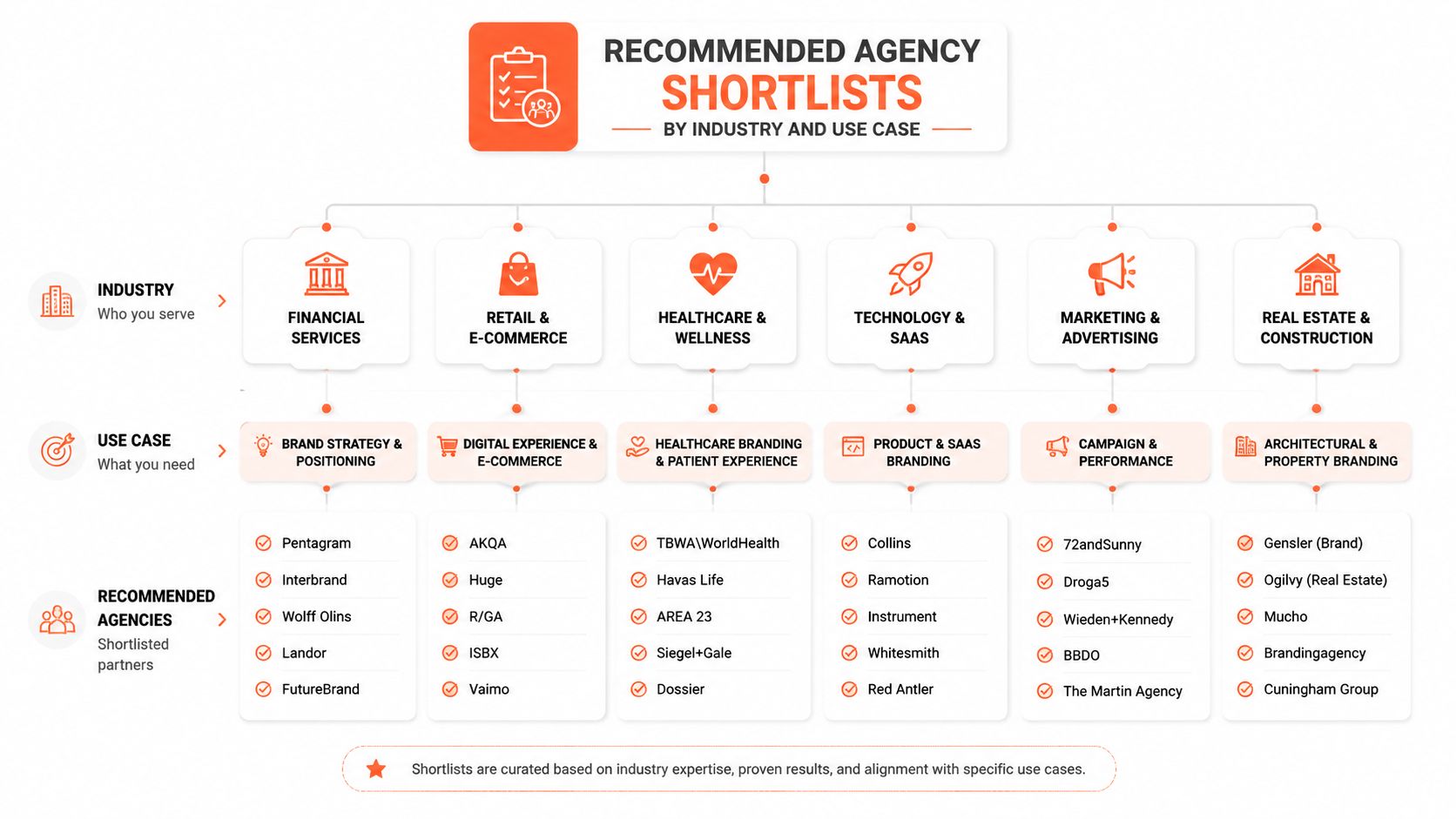
Recommended Agency Shortlists by Industry and Use Case
Industry determines what “good” looks like. An agency that excels at product demonstrations for direct-to-consumer brands may have no useful answer for mobile attribution or regulated health claims.
E-commerce and DTC
Prioritize agencies that can track product-level sales, distinguish first-touch from assisted activity, and connect creator content to paid amplification. Product seeding should be selective, not a mass shipment exercise. Ask how the team chooses recipients, collects usable content rights, and decides which organic assets deserve amplification through formats such as TikTok Spark Ads, Reels, or Shorts.
Your brief should include margin constraints, product availability, landing-page readiness, and the conversion event that controls optimization. An agency that reports only impressions cannot tell you whether the campaign works economically.
Mobile apps
App teams need a forecast built around installs and post-install behavior, not just clicks. Require a clear plan for install attribution, platform-level tracking, creative testing, and the events that define a valuable user.
Ask whether the agency can separate creator performance by operating system, format, audience, and downstream event. A cheap install that never reaches activation may distort the entire campaign decision.
SaaS and technology
SaaS campaigns need patience and content depth. Long-form YouTube partnerships, product walkthroughs, expert-led content, and credible comparisons usually matter more than a short promotional mention.
The agency should connect creator activity with demand-generation systems. Agree on how you'll evaluate qualified traffic, demo requests, trial starts, and assisted pipeline without forcing every conversion into an artificial last-click model.
Gaming
Gaming requires platform-native execution. Twitch streams, live integrations, community chat, launch events, and creator-specific gameplay formats need different planning from a pre-recorded product video.
Ask who manages live moderation, talking points, approvals, codes, and escalation if the creator or community raises an issue. The right agency understands that the audience isn't just watching content. It's participating in the experience.
Fintech and health
These categories need the highest compliance bar. Ask how the agency reviews claims, manages disclosures, handles restricted language, documents approvals, and checks whether a creator's content history creates brand-safety exposure.
Don't accept “legal can review it later” as an operating model. Build compliance into creator selection and briefing from the start. The agency should also clarify usage rights and whether approved content can be adapted for paid media without triggering a new review cycle.
Social Cloud presents industry-specific playbooks across e-commerce, apps, SaaS, gaming, fintech, and health, with creator selection, forecasting, contracting, tracking, and reporting handled within the campaign workflow. It's a reasonable option to include when your shortlist requires cross-platform execution and outcome-linked measurement, but you should compare its proposal against the same evidence standard as every other candidate.
Your Agency Evaluation Toolkit and RFP Checklist
A good RFP removes subjectivity before the sales process begins. Give every agency the same brief and require the same output, otherwise you'll compare a detailed forecast from one firm with a creative mood board from another.
Put these fields in the brief
- Business objective: State whether the campaign must drive sales, installs, qualified demand, content production, awareness, or a combination.
- Primary KPI: Name the event that determines success, such as a purchase, activated user, trial, or qualified lead.
- Audience definition: Include geography, customer profile, exclusions, language, and relevant communities.
- Platform scope: Specify preferred platforms, but ask agencies to challenge the mix with evidence from their creator strategy.
- Budget structure: Provide the available range and ask for separate creator, agency, production, rights, and amplification costs.
- Compliance requirements: List restricted claims, approval owners, disclosure standards, and legal review expectations.
- Timeline: Give the intended launch window and identify immovable commercial dates.
Require comparable answers
Ask every agency to return a creator-selection rationale, placement-level tracking plan, forecast assumptions, draft timeline, reporting sample, team structure, and complete fee schedule. Require them to identify what they'll need from your team and what could delay launch.
Then interrogate the forecast. What assumptions drive expected clicks or conversions? Which variables are known, which are estimates, and which will be tested? Can the agency show how the budget changes if the first creator cohort underperforms?
A credible forecast makes uncertainty visible. A padded forecast hides it behind precise-looking outputs.
Check the commercial model carefully. A low agency fee may conceal creator markups, compulsory production charges, or expensive usage rights. A performance fee may sound attractive while attaching payment to a metric the agency controls or defines loosely.
Finally, confirm the operating team. Get names for strategy, creator sourcing, legal coordination, campaign management, reporting, and escalation. The person who sells the account shouldn't be the only person who understands it.
Making Your Decision and Getting Started Fast
Reduce the longlist to two or three agencies that can satisfy your measurement, compliance, pricing, and platform requirements. Don't choose based on agency size or famous logos. Choose the team that gives you a clear forecast, exposes its assumptions, and assigns one accountable owner from briefing through reporting.
Speed matters because influencer campaigns improve through learning. An agency that can return a forecast within 48 hours of receiving a brief and typically go live within three to five weeks demonstrates the kind of operational discipline that keeps testing cycles moving. Those timelines come from Social Cloud's stated operating model, so treat them as commitments to validate in your proposal process, not as universal market standards.
Walk away when the agency can't explain attribution, bundles every cost into one number, leaves compliance to your legal team, or promises reach without defining the business outcome. Send the same brief to your shortlist, compare the forecasts with your checklist, and schedule a kickoff with the partner that makes execution easiest to inspect.
Social Cloud plans, runs, and measures creator campaigns across YouTube, Instagram, TikTok, and Twitch, with vetted creator selection, placement-level attribution, compliance support, and outcome-linked fees. Visit Social Cloud to submit your brief and assess whether its performance-focused workflow fits your next German campaign.