
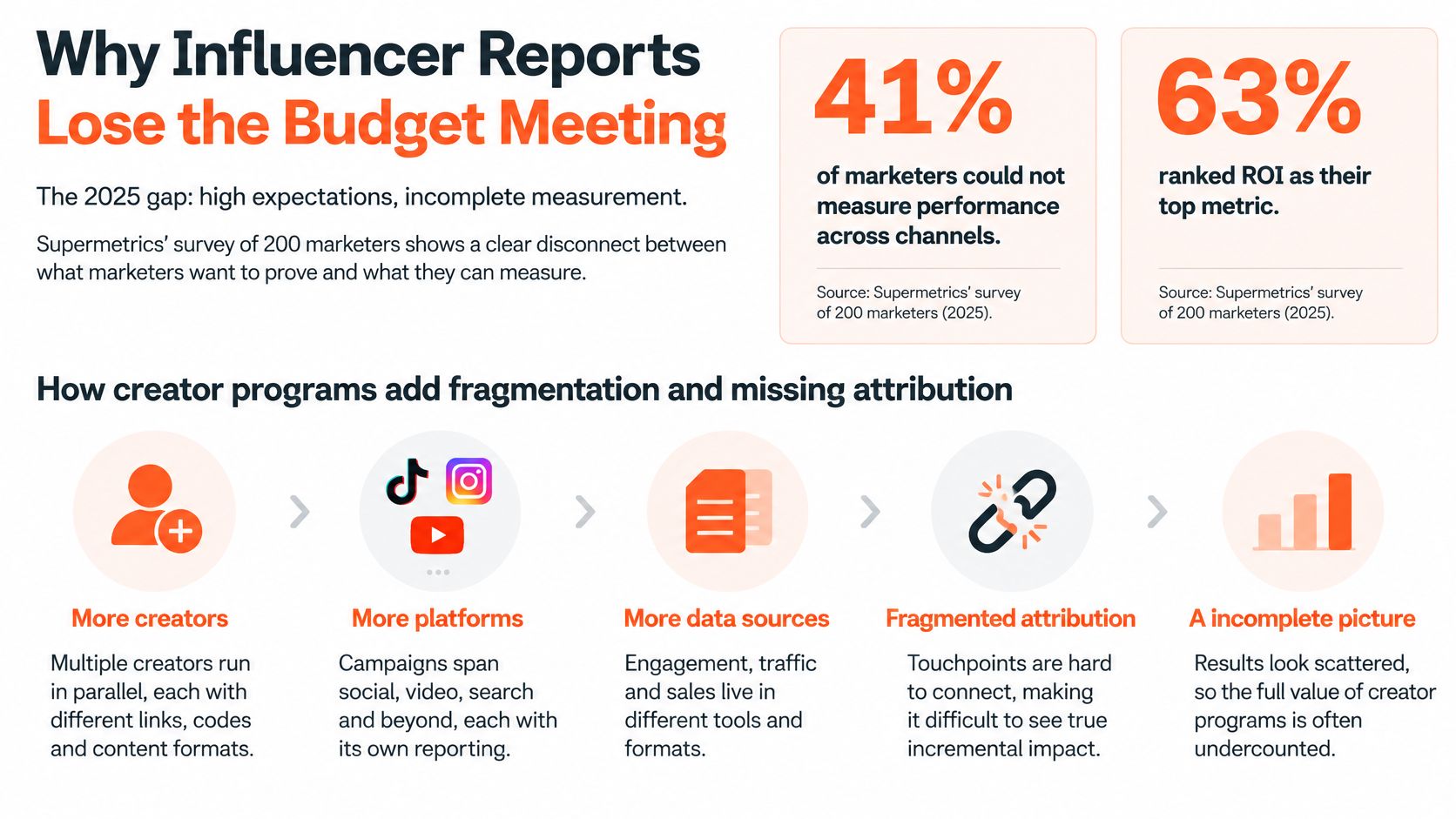
In 2025, 41% of marketers couldn't effectively measure marketing performance across channels, while 63% ranked ROI as their top marketing metric, according to Supermetrics' global survey of 200 marketers. That's the problem with campaign performance reporting: the number everyone wants to act on is often the number the team is least equipped to defend.
Table of Contents
- Why Influencer Reports Lose the Budget Meeting
- KPIs and Attribution Rules to Lock First
- How to Set Up Tracking and the Dashboard
- Report Templates and a Cadence You Do Not Rewrite
- Creator and Platform Reads You Can Trust
- Turn This Week's Report Into a Spend Call
Why Influencer Reports Lose the Budget Meeting
Say a DTC brand sees a creator delivering excellent last-click ROAS. The growth lead renews the partnership and increases paid amplification. Then the team checks the purchase paths and discovers that many buyers already had the product in their carts after arriving through paid social.
The creator may have helped close those purchases. But the report never established whether the placement generated additional demand or collected credit for demand the brand had already paid to create.
That distinction disappears when an influencer report contains a views slide, screenshots of engagement, and a blended ROAS number. Finance asks what happens if the budget doubles. The channel manager answers with delivery metrics. Nobody has evidence for the actual spending decision.
The fragmentation starts at the placement level.
Lock the decision before buying the placement
Campaign performance reporting is a weekly operating system, not a month-end PDF. For YouTube, Instagram, TikTok, and Twitch placements, it should connect spend, delivery, outcomes, evidence quality, and the action someone can take.
Before launch, agree on:
- The primary outcome. Choose an install, purchase, or qualified lead. Don't let whichever metric looks best become the objective afterward.
- The attribution window and credit rule. Decide which events qualify and how competing touchpoints receive credit.
- The diagnostic-only metrics. Views and CTR can explain performance without authorizing more spend.
The wider measurement gap explains why these locks matter. In 2025, 67% of U.S. marketers prioritized incremental ROI, while 55% prioritized improving cross-channel attribution, according to TransUnion and EMARKETER's survey of 196 marketers.
Yet only 34% of marketers tracked ROI consistently in Adobe's 2025 survey findings, and only 25% used a clear attribution model to measure incremental revenue, according to the 2025 Practitioner Survey reported by Retail Dive.
A pretty ROAS number isn't a spending instruction until the report says what it measures and how reliable it is.
For the DTC brand, the fix isn't another dashboard chart. It's a KPI map, placement-level tracking, a stable reporting cadence, confidence-labeled creator results, and a stakeholder note that asks for a specific decision. Start with a map the growth lead and finance partner can paste into the campaign brief.
KPIs and Attribution Rules to Lock First
Influencer KPIs and what they are allowed to prove
| Metric | Formula | What it shows | Do not treat it as |
|---|---|---|---|
| Views | Platform-reported plays or impressions | Delivery and potential reach, not unique reach | Proof of sales |
| CTR | Clicks divided by views or impressions | Creative and offer pull | Incremental demand |
| Conversion rate | Conversions divided by clicks | Landing page and offer fit | Full-funnel causality |
| CPA or CPI | Spend divided by conversions or installs | Cost of tracked outcomes | Causal lift |
| Attributed ROAS | Credited revenue divided by spend | Return on tracked revenue | Incremental ROI |
| Incremental ROAS | Incremental revenue divided by spend | Revenue estimated not to have happened otherwise | A weekly creator ranking by itself |
| Promo-code redemptions | Orders using that creator code | Direct, observable creator credit | All influence, including view-through |
Keep denominator definitions visible. A CTR calculated from impressions isn't directly comparable with one calculated from video plays. Likewise, a click-based conversion rate shouldn't include view-through purchases in its numerator.
Define spend just as carefully. If creator fees appear in one row but amplification and production costs disappear from another, the efficiency ranking isn't comparable. Use a consistent cost basis and show excluded costs explicitly.
Attribution describes credit, incrementality estimates impact
Descriptive attribution records which placement received credit under your chosen rule. Causal incrementality estimates what wouldn't have happened without the advertising.
The IAB and IAB Europe incremental measurement guidelines distinguish these questions and identify randomized experiments as the strongest causal evidence, while recommending experimental calibration for models that rely on statistical assumptions.
Use these working formulas:
- Incremental conversions = treatment conversions minus expected control conversions after normalizing for group size.
- Incremental revenue = treatment revenue minus expected control revenue after the equivalent normalization.
- Incremental ROAS = incremental revenue divided by campaign spend.
Normalization matters. Subtracting raw conversions from differently sized groups can produce a convincing-looking answer to the wrong question. Treatment and control also need the same eligible outcome definition and measurement window.
Last-click and creator-level ROAS can over-credit people already likely to buy. They can also miss organic, view-through, cross-device, and cross-platform effects. Treat those attributed results as descriptive associations, not proof of lift.
Write the rules in language the team can enforce
Choose a click window and, if supported, a view window that fit the purchase cycle and available signals. Document the reason. Don't lengthen the window after a disappointing result just to bring more orders into scope.
Name the credit rule: last click, promo code, survey-assisted assignment, or another documented method. Keep experimental estimates in their own field rather than mixing them into attributed revenue.
For metric selection, the influencer marketing KPI guide provides a useful companion checklist. If customers also convert through conversations, Exerta's guide to tracking chat-driven revenue accurately is a relevant resource for documenting that additional conversion path.
Media-mix modeling and multi-touch attribution require assumptions. Check their conclusions against a randomized holdout, ghost-ad design, or matched geographic test where feasible.
Brief stamp: Primary outcome = completed purchase; window = agreed purchase-cycle window; credit rule = documented last click with code reconciliation; views won't decide scale.
How to Set Up Tracking and the Dashboard
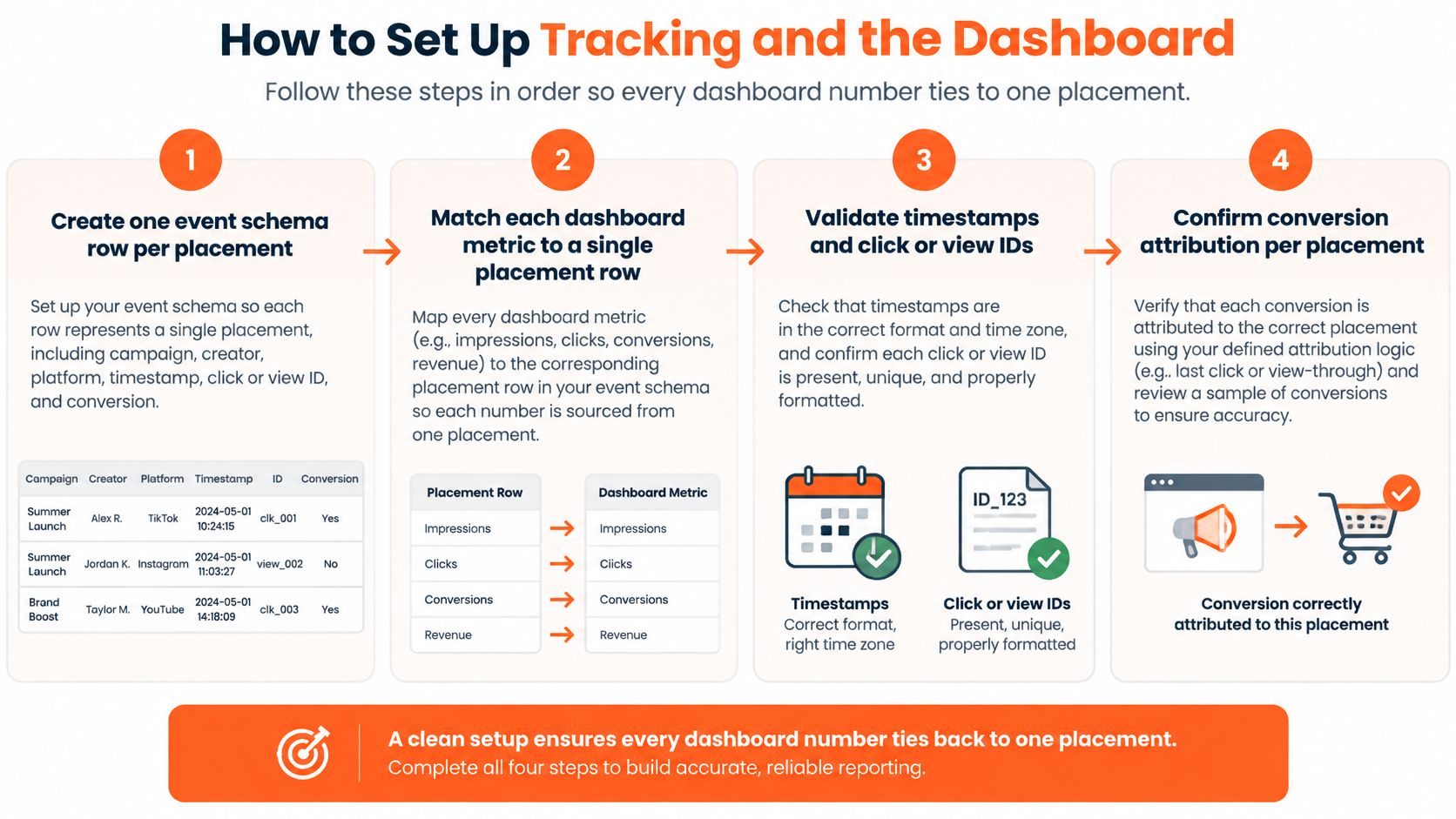
Build around a placement identifier, not a creator's display name. A creator can publish several assets, appear on multiple platforms, and have content amplified separately. Those activities need distinct records if you want to diagnose them.
Use this placement-level flow as the setup check.
Build the reporting chain
Create the schema. Maintain a placement registry containing campaign, creator, platform, publication timestamp, conversion definition, spend, and consent requirements. Join event-level click or view identifiers, conversion events, revenue, and consent status through the placement ID. The failure mode is flattening everything into a creator total that can't explain which asset produced the result.
Issue unique links and codes. Give each creator a unique tracking link and promo code, with placement-specific link parameters where they publish multiple assets. Keep an issuance log and test the landing destination before launch. Shared vanity codes destroy the distinction between creators, while leaked codes can attach unrelated orders to a placement.
Use surveys as a tie-break. Add a short post-purchase question for orders where links and codes miss. Preserve the answer as a separate evidence field, then apply your reconciliation rule. Don't let a survey answer create another full conversion credit for an order already counted.
Reconcile against first-party orders. Join link, code, pixel, and survey records to a canonical order ID. Count the order once in campaign totals and retain the competing signals for inspection. Reconcile platform-reported views separately: delivery and orders aren't interchangeable records.
Freeze reporting boundaries. Set the attribution window, currency, time zone, and revenue treatment before launch. Store timestamps consistently and convert them for display. Otherwise, the same late European purchase can move between reporting days or appear in overlapping exports.
Separate operational and causal boards. Put views, CTR, conversions, CPA, and tracking-health flags on the operational board. Show treatment-versus-control results on the incrementality board only when an actual test exists. An empty causal field is more honest than relabeling attributed revenue as lift.
Label how each number was produced
The IAB's 2024 State of Data report describes the move toward probabilistic methods, contextual signals, media-mix modeling, and multi-touch attribution as privacy restrictions reduce user-level observability.
Make the distinction visible in the dashboard. An order recorded in your commerce system is observed. Assigning that order to a creator is an attribution decision. Estimating missing outcomes through a model is another step again.
Include fields for evidence type, credit method, and measurement limitations. That prevents a click, a purchase, and attributed revenue from appearing to offer identical proof.
Use this video alongside the implementation checklist.
Before launch, verify that every live placement has a tested link, an assigned code, and a schema record. Celebrate the first view after those checks pass, not before.
Report Templates and a Cadence You Do Not Rewrite
Pre-register the measurement plan before results arrive. Include the primary outcome, eligible conversion event, attribution window, treatment and control logic, minimum detectable effect, exclusions, currency, time zone, and scale threshold.
The minimum detectable effect is the lift your test is designed to detect reliably. Set it with the analyst designing the test, using the available audience and baseline conversion behavior. Don't substitute an arbitrary conversion-count floor for a power calculation.
Give every readout a permitted decision
Who gets which campaign report and when
| Readout | Audience | What it contains | Decision it can trigger |
|---|---|---|---|
| Pre-launch lock | Growth lead and finance | Primary KPI, window, credit rule, currency, time zone, scale threshold | No definition changes after results land |
| Weekly ops | Growth manager | Views, CTR, conversions, CPA, tracking-health flags by creator | Fix links, codes, and briefs only |
| Biweekly creator cut | Channel lead | Efficiency rank with sample size and confidence label | Flag creators for the monthly note; do not scale spend yet |
| Monthly stakeholder | Marketing lead and finance | Spend, attributed ROAS, incremental readout, unresolved share | Move budget across creators or platforms |
Use the same report blocks each time: spend, delivery, tracked outcomes, efficiency, tracking-health exceptions, and decision requested. Put the reporting cutoff and data freshness near the top.
A weekly report can include provisional outcomes, provided they're marked provisional. Let delayed conversions mature under the original rules rather than rewriting historical rows without an update log.
For teams standardizing the handoff between channel owners and leadership, PostSyncer's guide to performance reporting for marketing teams provides useful context for organizing the reporting process.
Inspect the numbers before publishing them
The IAB Measurement 360 whitepaper highlights attribution weaknesses including coverage gaps, arbitrary credit assignment, and touchpoints outside outbound clicks; it also discusses experimental evidence in which registration and page-view measurements were more dependable than checkout-conversion measurements.
That's a reason to inspect the purchase pipeline, not to replace purchases with easier metrics.
Before publication, check:
- Identifier coverage. Flag missing click IDs and unexplained changes in matchability.
- Order integrity. Remove duplicates and account for cancellations and refunds.
- Code behavior. Investigate unexpected redemption sources and suspected leakage.
- Timing and consent. Identify delayed conversions and consent-related signal loss.
- Revenue consistency. Don't compare gross revenue in one row with net revenue in another.
Keep an aggregate control-group estimate alongside creator, audience, format, and customer-type cuts. Otherwise, a team can optimize toward a tiny segment whose apparent efficiency is mostly noise.
Reporting discipline: Change a broken implementation immediately. Change a measurement definition prospectively, with an owner and a written reason.
Schedule exceptions too. A tracking outage should trigger an immediate incident note, not wait for the monthly meeting. But an incident note doesn't authorize the growth manager to invent a new attribution rule.
Publish the reporting dates for the next four weeks, name the owner of each readout, and keep the template fixed.
Creator and Platform Reads You Can Trust
Put the confidence label beside the creator's name, before the efficiency rank. A reader shouldn't have to open an appendix to discover that the best-performing row has broken tracking.
When a creator result is safe to act on
| Label | Evidence you need | Budget move |
|---|---|---|
| Decision-ready | Stable click IDs, sample above the pre-set floor, experiment or calibrated model | Scale that creator or platform when the efficiency threshold also passes |
| Directionally useful | Clean tracking, small sample or no holdout | Run another test; do not lock the plan |
| Unresolved | Missing IDs, code leakage, consent loss, or suppressed cells | Fix measurement before more spend |
Decision-ready doesn't mean certain. It means the evidence meets the pre-agreed standard for the proposed decision, with uncertainty disclosed. A result suitable for a controlled budget increase may still be unsuitable for a long-term commitment.
Slice the same metrics, not different definitions
Cut the locked metric set by creator, platform, audience, format, paid amplification, and new versus returning customers. Separate long video, Reels, Stories, and live placements rather than treating all video views as equivalent.
Keep Spark Ads and other amplification identifiable. If organic creator distribution and paid distribution are combined, show their costs and results separately before displaying the combined total.
The useful cuts all start from the same reporting block.
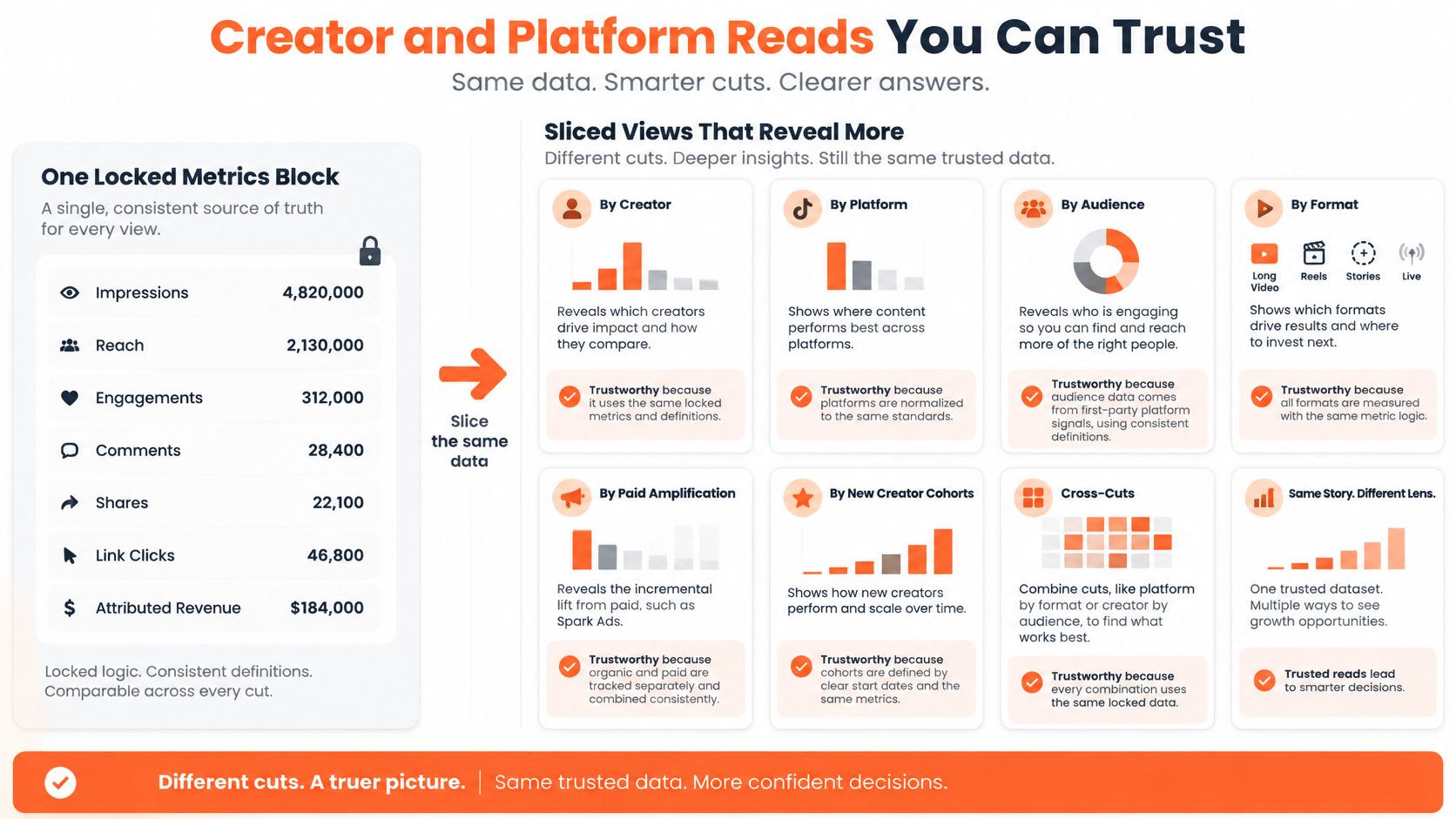
Preserve an aggregate campaign line above the cuts. A tiny creator-audience cell shouldn't outweigh a credible campaign-level estimate because its CPA looks spectacular.
Use delivery economics to diagnose buying efficiency. The influencer marketing CPM guide can help frame that comparison, but cheap exposure doesn't upgrade a weak outcome estimate.
Privacy loss can make the answer unresolved
An academic privacy-measurement framework, tested on 2.0 million Criteo uplift observations and 64,000 Hillstrom email-experiment observations, found that under fine-grained reporting, the share of Hillstrom segments where positive impact could still be certified fell from 100% to 36.0%, while aggregation-threshold suppression reached 39.5%.
Those aren't influencer campaign benchmarks. They illustrate why narrower reporting can become less decision-useful when privacy protections remove or obscure evidence.
Record the cause: lost matchability, broken linkability, shorter windows, suppressed cells, or uneven signal loss. Show confidence intervals where available and state which outcomes remain unobserved. Don't fabricate a precise correction for missing purchases.
Consider a hypothetical comparison:
- Creator A has the hotter last-click CPA. But the code appears on coupon sites, and missing identifiers prevent reliable reconciliation. Label the result unresolved.
- Creator B has a duller CPA. Tracking is intact, the holdout passes the agreed evidence threshold, and efficiency clears the target. That result can support a budget increase.
Creator B gets the increase. Creator A gets a measurement repair.
Overlapping creators and paid amplification may all reach the same buyer, so a code redemption establishes credit under a rule, not that the sale required that creator. Keep the label attached when exporting the ranking, and don't scale an unresolved creator or platform.
Turn This Week's Report Into a Spend Call
A stakeholder shouldn't need to infer the recommendation from a dashboard. Give them a proposed action, the evidence supporting it, and the condition that would change your mind.
Use these spending moves:
- Scale. Increase investment only when the result is decision-ready and clears the pre-launch CPA, CPI, or ROAS threshold. State whether the evidence supports that creator, a platform-level allocation, or the campaign overall.
- Hold and test. Keep a directionally useful placement in a bounded test. Buy the sample needed to answer the question, not a larger annual commitment.
- Stop or rebrief. When tracking is sound and efficiency remains worse than the threshold after the agreed window matures, change the offer, creative, audience fit, or placement.
- Freeze and repair. Pause an unresolved placement and name the fix in the same sentence, such as replacing a leaked code or restoring placement identifiers.
The measurement gap isn't a reason to stop making decisions. It's a reason to distinguish a reversible test from a confident allocation. An unlabeled ROAS line doesn't tell finance which kind of decision you're asking them to approve.
Send a stakeholder note that fits on a page
Use a compact decision note rather than another deck:
| Field | What to write |
|---|---|
| Spend to date | Actual spend, committed spend, and the cost basis |
| Primary outcome versus target | Mature eligible outcomes and efficiency against the agreed threshold |
| Attributed result | Credited conversions, revenue, and attributed ROAS |
| Incremental result | Test estimate and uncertainty, or explicitly state that no test exists |
| Unresolved share | Unresolved placements divided by live placements, with affected spend shown separately |
| Decision requested | Shift budget, extend a bounded test, or fix tracking |
Keep views and CTR in the appendix so the meeting doesn't drift into a debate about reach. Include them in the main note only when they explain the proposed action, such as a broken link despite healthy delivery.
At Social Cloud, our reporting is weekly and shows views, CTR, conversions, and ROAS per creator. That operational view should support the decision note, not replace the evidence standard for changing budgets.
For planning, use the influencer marketing ROI calculator to forecast a campaign scenario. Keep forecast assumptions separate from measured results.
This week, stamp the KPI definition, issue unique links and codes, and complete a weekly reporting cycle before adding platforms. Assign an owner to every unresolved placement, then ask for a spending decision only where the evidence supports one.
Submit your growth target to Social Cloud to get a creator strategy, forecast, and budget within 48 hours. For planning context, download our free The 2026 influencer marketing report, with CPM, CPI, and engagement benchmarks by tier, and use those benchmarks as inputs rather than proof of future returns.