
A $2.68 influencer marketing CPM in 2025, down 42% year over year from the 2026 benchmark roundup, is the kind of number that should change how growth teams think about creator spend, because it's a comparison lens, not a trophy. CPM tells you what reach costs. It does not tell you whether that reach was valuable, and that's where many teams get sloppy with creator budgets. The right move is to use influencer marketing CPM to compare inventory, then shift the decision to outcome-linked pricing, where conversions, revenue, and attribution do the judging.
Table of Contents
What Influencer Marketing CPM Actually Means
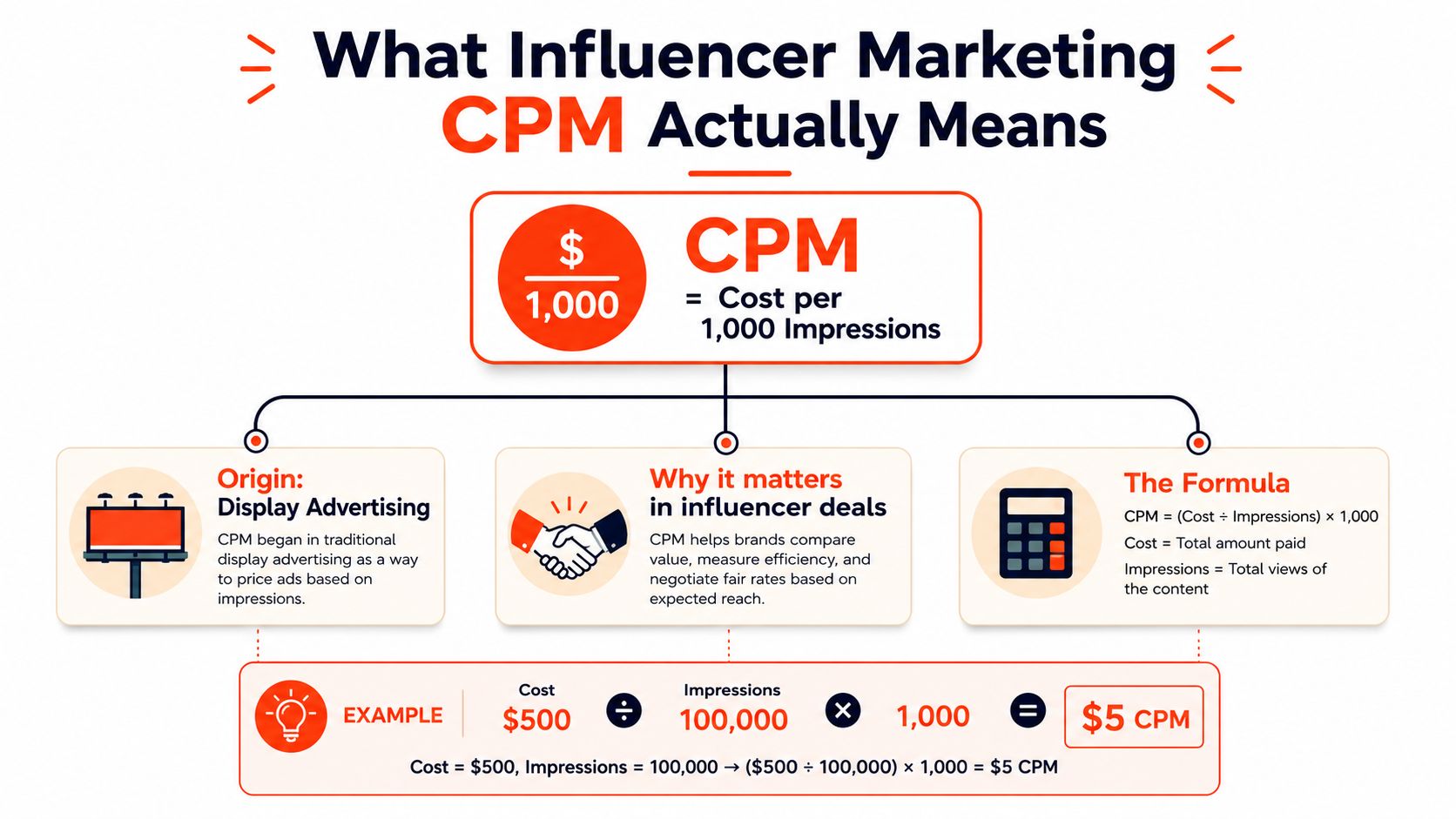
CPM means cost per 1,000 impressions. In creator deals, the formula is still the same one media buyers have used for years, Cost ÷ Impressions × 1,000, because the whole point is to normalize what you're paying across different placements and formats.
If a creator charges $2,000 for a Reel that delivers 400,000 views, the math lands at $5 CPM. That's a clean comparison point, but only if the denominator is real and the cost is all-in. If a deal includes usage rights, whitelisting, or paid amplification, you need to include those costs too or the number is fantasy.
Paid reach and earned reach are not the same thing
Paid reach CPM is what you're paying for when a creator runs a sponsored post, Spark Ad, or whitelisted placement. Earned reach CPM is the effective rate after publication when the post keeps gathering views organically. Creators and agencies will quote both, so you have to ask which one they mean before you compare offers.
The other trap is units. Some platforms report video views, not true impressions, and that can make CPM look better than it really is because a view is easier to rack up than a verified impression. If the platform is giving you views, treat the number as directional unless you can audit the reporting trail.
Practical rule: If the creator can't show you how the denominator was counted, don't treat the CPM as a buying input. Treat it as a conversation starter.
For a deeper look at how creators are monetized by platform, Mallary.ai has a useful breakdown on how to earn more from YouTube views, which helps explain why video economics can look very different from a simple post fee.
The point is simple. CPM is a unit-economics comparison tool, not the goal. If a campaign “wins” on CPM but loses on qualified traffic, add-to-carts, or revenue, it's the wrong buy.
Platform and Tier Benchmarks You Can Trust in 2026
The fastest way to waste time in negotiation is to pretend every creator quote belongs in the same bucket. It doesn't. A nano creator on Instagram, a mid-tier TikTok creator, and a YouTube integration live in different pricing worlds, and the rate card changes again once the niche shifts into beauty, fashion, or B2B.
The table below is the kind of starting point I'd use for planning, not the final word. Always compare it against your own historical spend before you trust anyone else's average.
| Platform | Nano (10K-50K) | Mid-tier (50K-500K) | Macro (500K+) | Notes |
|---|---|---|---|---|
| $8-$25 | $20-$45 | $40-$80 | Stories tend to sit higher than feed-style reach. | |
| TikTok | $5-$15 | $10-$25 | $20-$50 | Short-form reach is usually cheaper, but quality varies fast. |
| YouTube | Not the main buying lane | $15-$40 integrations | $50-$120 dedicated | Longer attention and stronger sponsorship control cost more. |
| LinkedIn short-form | N/A | N/A | $20-$60 | Best treated as a niche reach channel, not broad awareness. |
A lot of teams over-index on the cheapest number in the table. That's a mistake. A lower CPM on TikTok can look attractive until you realize the platform's “views” often reward scroll behavior more than sustained attention, and that's why the quality of the denominator matters as much as the price.
Buying rule: Use CPM to compare similar placements, not to force different platforms into one imaginary market average.
If you want to spin creator assets into paid creative, tools like the ShortGenius AI UGC ad platform are relevant because they sit closer to production and amplification workflows than pure sourcing does. That matters when your team is trying to turn creator content into something that can be measured against downstream performance.
What moves the number up or down
Higher-production placements cost more because they buy more guaranteed exposure time and tighter sponsorship control. Short-form placements compress CPM because they're easier to consume quickly and can reach more people before fatigue kicks in. Vertical also matters, and beauty or fashion usually carries a different willingness to pay than B2B SaaS because the audience economics aren't the same.
The discipline is internal benchmarking. If your own historical CPM on Instagram Reels is trending up while conversion quality is flat, you don't have a creator problem, you have a pricing problem. If your CPM is rising but ROAS is rising faster, the “more expensive” line item may still be the smarter buy.
CPM vs CPI, CPA, and ROAS
CPM answers one question, and only one question. It tells you how efficiently you bought reach. The moment you start asking whether that reach mattered, you need a different lens.
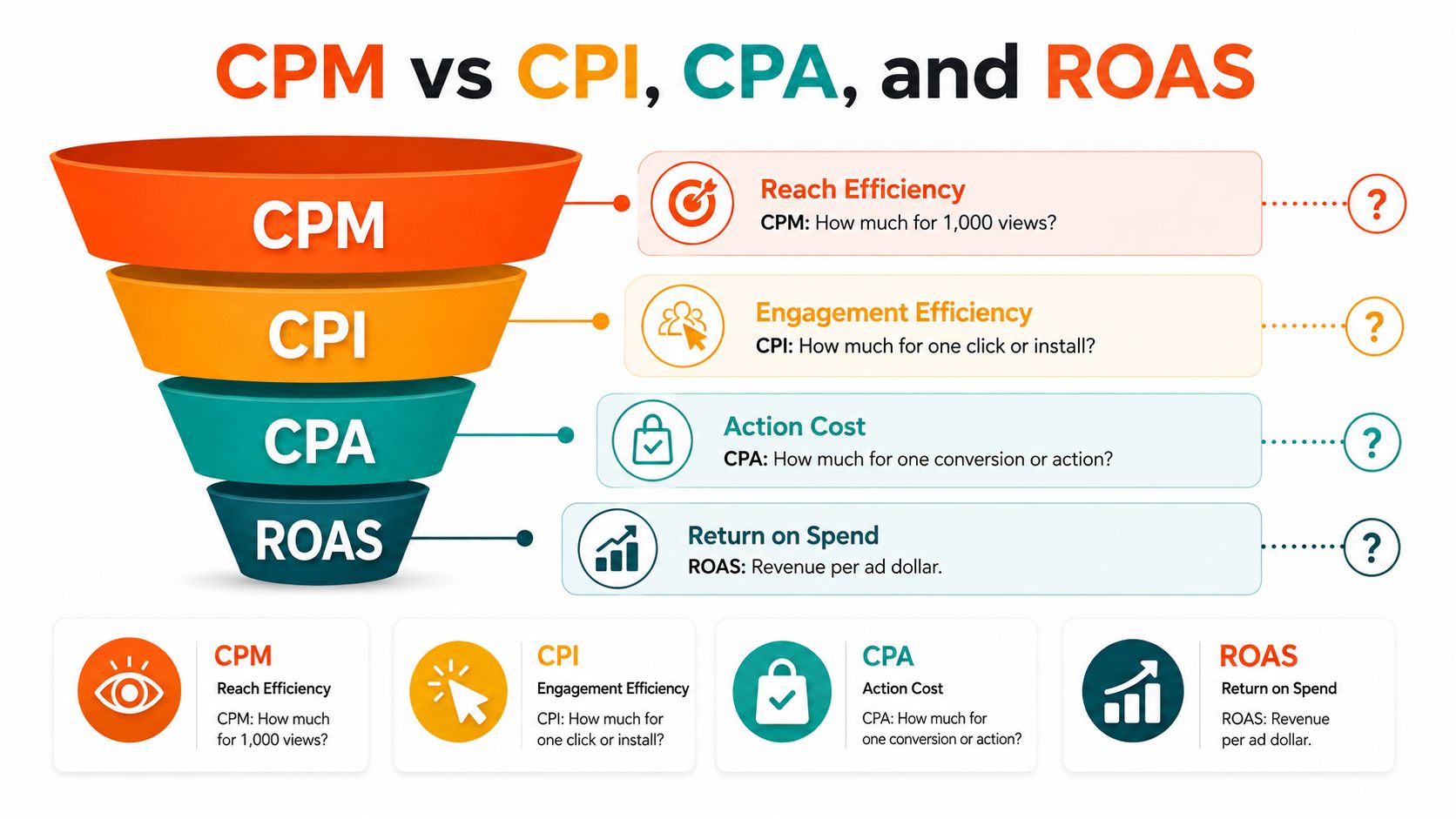
The easiest way to keep the pricing stack straight is to map each metric to the question it answers:
- CPM asks, “How much for 1,000 impressions?”
- CPI asks, “How much for one click or swipe action?”
- CPA asks, “How much for one acquisition?”
- ROAS asks, “How much revenue came back for each ad dollar?”
If you're trying to decide whether a creator slot deserves budget, CPM is the planning input, not the verdict. CPA and ROAS are the decision variables.
The funnel math is where teams get honest
If a creator delivers a $5 CPM, 50,000 views, 1,500 clicks, 120 signups, and $8,000 revenue, the story is not the CPM. It's the progression from reach to revenue. The CPM looks efficient, the CPI and CPA tell you how hard the funnel had to work, and the ROAS tells you whether the whole thing deserves a repeat booking.
That's why I don't let teams present CPM alone in a planning review. A cheap top-of-funnel number can hide expensive intent. A higher CPM can still be the right buy if the audience is closer to purchase and the attribution trail proves it.
Here's the internal reference point that helps most growth teams keep their reporting grounded, how to measure influencer marketing ROI. Use that structure when you need to move a conversation from attention to business outcomes.
Why the higher-cost metric usually wins the budget fight
CPI, CPA, and ROAS all add friction, and that's a good thing. They force you to prove that the impressions mattered. CPM can make bad inventory look neat. ROAS makes profitable inventory obvious.
If you're building a creator plan for performance, start with CPM as a ceiling on reach cost, then move the conversation to the cost of intent and the cost of conversion. That's where the money is either made or wasted.
Calculating CPM With Real Campaign Examples
The formula gets easier to trust when you see how the same budget behaves across placements. A creator quote that looks expensive on paper can still produce a better CPM than a cheaper post if the reach is strong enough.
| Placement | Gross Cost | Estimated Impressions | Resulting CPM |
|---|---|---|---|
| TikTok mid-tier creator | $3,000 | 300,000 | $10 |
| Instagram Reels nano bundle | $1,200 | 180,000 | $6.67 |
| YouTube gaming integration | $5,000 | 200,000 | $25 |
The table is directional, not a universal rate card. The job is to back-solve the deal structure before you sign. If a creator is quoting a flat fee and promising reach, you need platform analytics or third-party measurement to verify the actual denominator.
How to audit the number before you buy
Start with gross cost, then ask what counts as an impression. If the creator is reporting views, make sure you know whether those are repeat views, autoplay starts, or verified impressions. That distinction changes the math fast.
If you want a useful shortcut, work backwards from the CPM you can afford. A target of $25 CPM against 400,000 expected impressions means the line item should land around $10,000 before fees and add-ons. That's the kind of back-solve that keeps reps honest.
For teams running app installs or UA-oriented creator work, this internal guide on influencer marketing for apps is a better planning companion than generic reach advice because it keeps the conversation tied to outcomes, not vanity metrics.
Buyer check: If the math only works because the creator supplied a big view count with no reporting detail, your CPM is probably prettier than your actual performance.
The strongest media buyers I know don't ask whether a deal is “cheap.” They ask whether the impression count is believable, whether the audience fits, and whether the post can be repurposed into something that converts after publication. That's the core calculation.
Why Cheap CPM Can Still Waste Budget
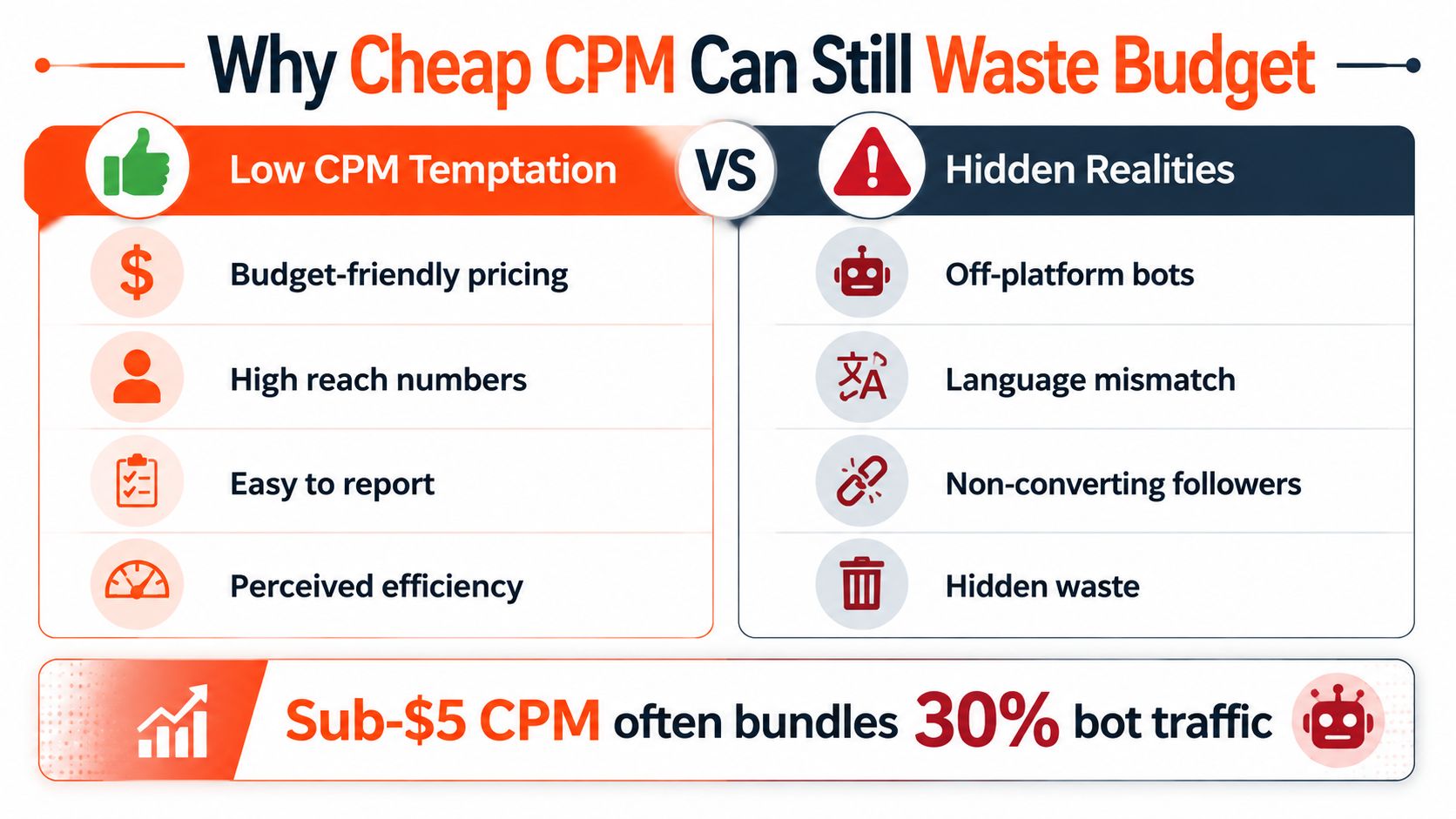
The lowest CPM in the room often belongs to the worst audience. That's not always true, but it's true often enough that a suspiciously cheap creator deal should trigger a review, not a celebration.
A low rate can come bundled with mismatched geography, poor language fit, weak audience quality, or short-form views that disappear before anyone registers the message. Brand-safe filters don't catch purchase intent, and purchase intent is what pays you back.
The four silent killers
- Misaligned geo: Cheap reach in the wrong market is just discounted irrelevance.
- Age-skewed fanbase: A creator can look big on paper and still miss the buyer.
- Low save and share rates: If the audience won't save it, the content didn't land.
- View-through inflation: Autoplay can make a number look healthy even when attention is shallow.
The problem is that these issues don't always show up in the first report. They show up later, when your sales team sees weak lead quality or your ecommerce team sees no lift in purchase behavior. That's why I treat suboptimal CPM as a hygiene check, not a KPI.
Why the wrong bargain is still expensive
A bargain deal that doesn't convert forces you to buy more media, not less. You end up repeating the same mistake at a slightly lower price. That's not efficiency. That's churn.
If the CPM is unusually low, ask what the creator had to sacrifice to get there. Sometimes the answer is honest and useful. Sometimes it's a warning sign that the audience isn't worth reaching twice.
Outcome-Based Pricing and How to Shift Off Pure CPM
Once you stop treating CPM like the finish line, the contract conversation gets a lot cleaner. The deal should pay for output that matters, not just eyeballs.
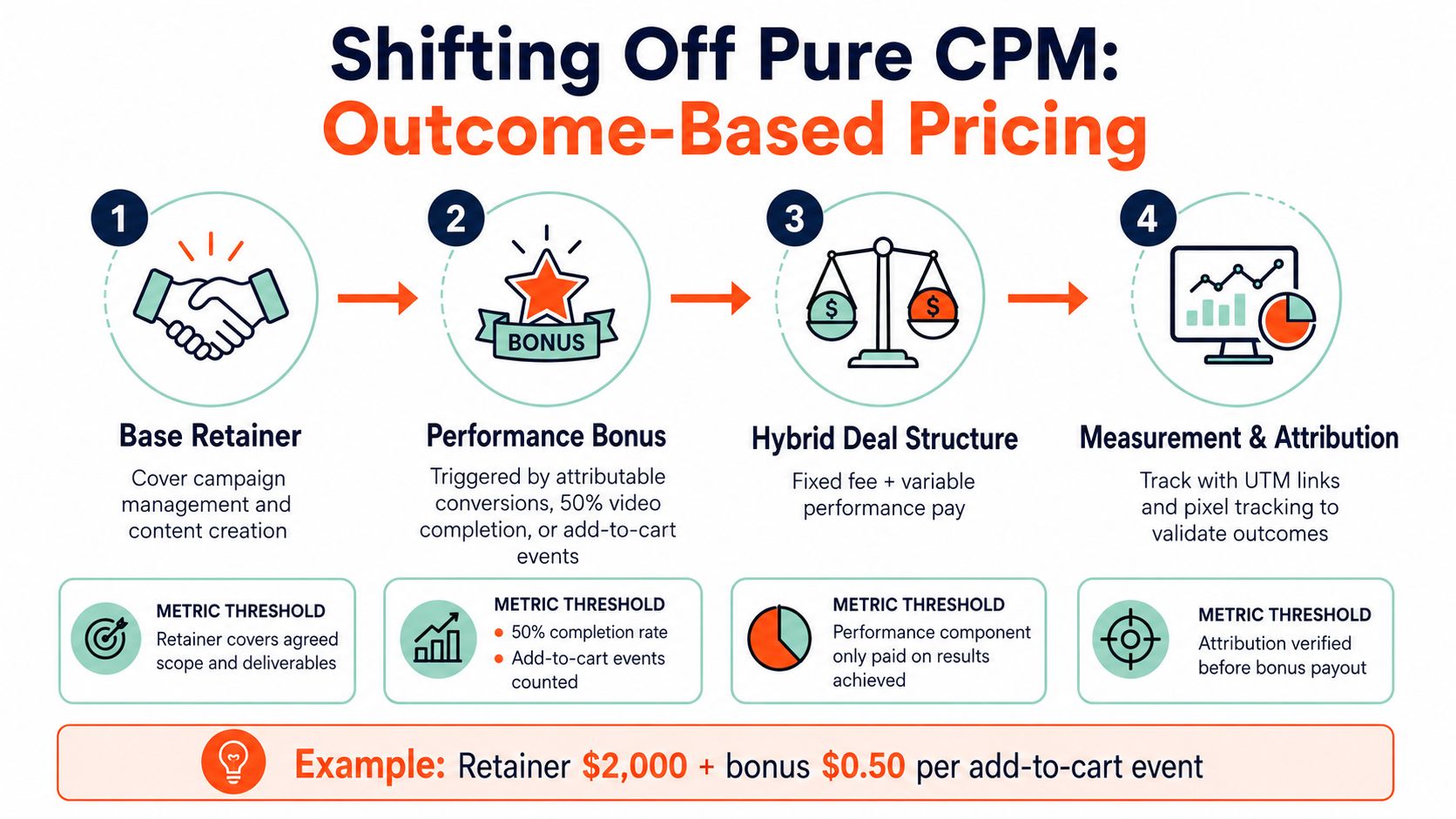
The best structure I've seen is a hybrid, where a base retainer covers production and management, then a bonus kicks in when the campaign proves itself through attributable conversions, completed views past the halfway mark, or add-to-cart behavior. That keeps the creator invested without forcing the brand to pay full freight for reach that doesn't move.
Negotiation rule: If the creator wants full upfront payment, you should still push for a performance component when the business model depends on measurable outcomes.
A practical split is a 60/40 or 70/30 structure, depending on how much of the work is creative versus conversion-driven. The more the campaign is meant to generate revenue, the more you should want the variable piece tied to evidence, not vibes. That's especially true once you add whitelisting, pixel placement, and post-iOS attribution windows into the mix.
If you need a contract frame for this, the performance-based influencer marketing resource is a useful reference point because it centers the discussion on output and measurement instead of fixed-fee comfort.
What to ask for in the deal
Request the rights that let you measure the work. That means whitelisting, proper tracking links, and the ability to validate outcomes after the post runs. If you can't observe the path from impression to action, you're just buying content and hoping the spreadsheet sorts itself out.
The cleanest version looks like this, base fee plus variable payout tied to measurable action. If a creator can deliver both reach and response, reward both. If they can't, don't overpay for awareness dressed up as performance.
Practical Tactics to Optimize CPM Without Killing Conversions
A lower CPM is useful only if it doesn't wreck the rest of the funnel. The right optimization moves improve efficiency without stripping out the audience signals that drive revenue.
First, negotiate tiered flat fees and usage-rights carve-outs instead of trying to bully the creator into a lower reach number. You'll usually get more flexibility that way, and you'll preserve the option to repurpose the best assets later. The trade-off is upfront complexity, but the guardrail is simple, if cost per purchase rises while the CPM falls, the “win” is fake.
Second, split creative into two lanes. Put the quick hook and the proof point in separate assets so weak posts can be cut early and strong ones can be amplified. The trade-off is more production work, but your pause signal should be a drop in watch quality or click quality.
Third, cap your reach-tier CPM while keeping hybrid deals for conversion-tier talent. That stops the team from paying premium rates for placements that were never meant to close sales. The guardrail is downstream revenue, not the headline rate.
Fourth, pre-negotiate platform floors. Retail-style bidding wastes time and encourages bad habits, especially when teams start bidding against themselves for the same audience pocket. A floor gives you a ceiling to negotiate against and a clean reason to walk away.
Fifth, instrument every placement with UTMs, promo codes, and post-purchase surveys. If the CPM changes and revenue doesn't, you need to know whether the problem is the creator, the offer, or the audience. That's the only way to keep spend tied to signal.
Use the right stop-loss metric
A creator can look efficient on a sheet and still be failing in the market. If your cost per purchase rises above your category comfort zone, or your view-through quality gets weak on Reels, you should pause and reallocate. Don't keep funding a cheap illusion.
Putting It Together A Smarter Spend Framework
The cleanest planning framework is boring, which is exactly why it works. Classify every placement first, then decide which metric gets to win.
- Tag the job. Awareness, mid-funnel, or conversion. Don't negotiate a fee until the category is clear.
- Assign the primary KPI. Reach CPM for awareness, view-through quality for mid-funnel, cost-per-purchase or ROAS for conversion.
- Set a tier target. Use the platform benchmarks above, then leave a 10 to 15 percent negotiation buffer.
- Review the portfolio monthly. Move budget toward the tier producing the strongest marginal ROAS, not the prettiest CPM.
That framework forces the team to stop asking whether a creator is “cheap” and start asking whether the placement is doing the job you hired it to do. Optimize CPM inside a tier. Optimize outcome-linked pricing across the portfolio.
If you want that discipline baked into the operating model, Social Cloud runs creator campaigns with attribution on every placement, target CPI or CPA planning, and outcome-based pricing that ties a base fee to performance. Visit Social Cloud if you want a team that'll pressure-test your creator CPMs against actual revenue instead of letting a low number win the slide deck.