
You've got a quarterly install target, a fixed budget, and a spreadsheet full of creators. The pitches look good, but you still can't tell which posts will drive customers and which will produce a nice screenshot for the campaign recap. Choosing a creator marketing agency in New York should solve that accountability problem, not just give you a longer shortlist.
Table of Contents
- Why New York Teams Hire a Creator Marketing Agency
- The Five-Step Workflow From Brief to Results
- How to Vet Creators Beyond Follower Counts
- Choosing Platforms and Measuring Results on One Standard
- Real Campaign Results and What They Show
- Disclosure, Claims and Usage Rights Before Launch
- Pricing Models and What to Lock In Before Signing
Why New York Teams Hire a Creator Marketing Agency
Say your growth team has creator outreach covered, but nobody owns the whole campaign. Your social manager reviews concepts, legal checks contracts, and an analyst tries to reconstruct attribution after the posts go live. Everyone finishes their task, yet nobody can explain whether the spend worked.
An agency should connect strategy, creator selection, briefing, contracts, disclosures, tracking, and reporting. Booking creators yourself is like buying car parts. The agency is the mechanic who assembles them, test-drives the car, and tells you what broke.
New York offers a substantial creative ecosystem: its creative economy generated 11% of the city's total economic output in 2024, according to the New York City Economic Development Corporation. That concentration gives teams access to advertisers, media companies, production crews, and creators. It doesn't automatically make a campaign effective.
The hiring test: Pay for an accountable operating team, not proximity to famous creators.
Social Cloud has offices in Hamburg, New York, and Buenos Aires. We work with growth-stage e-commerce, app, SaaS, and games teams, from their first creator test to always-on programs.
The fit is practical: you have a KPI to hit, more creators than your team can comfortably coordinate, and nobody responsible for results end to end. If your internal team already handles that work well, an agency needs to justify its fee through execution capacity or specialist capability, not another presentation.
The Five-Step Workflow From Brief to Results
| Phase | What Happens | What You Get |
|---|---|---|
| Discover | Goals, audience, and KPIs become a data-backed creator strategy | Strategy, forecast, and budget |
| Match | Verified creators who fit your brand and buyers are hand-picked | Shortlist of creators |
| Create | Brief, creative guidance, and QA while keeping the creator's voice | Approved briefs and content |
| Launch | Contracts, disclosures, usage rights, tracking links, and promo codes | Live placements with tracking |
| Scale | Weekly reporting by creator and platform, then budget moves | Learnings and next budget plan |
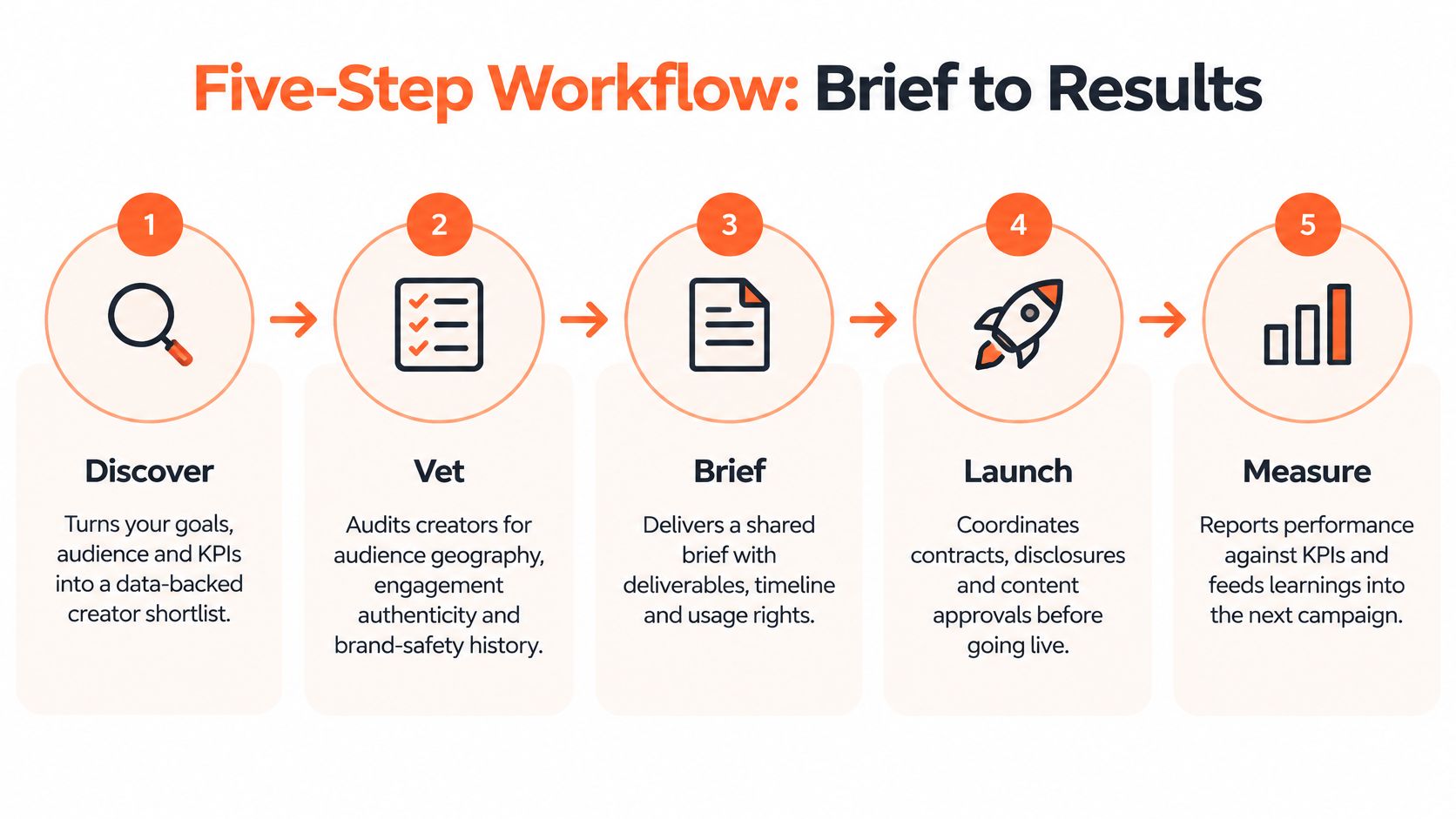
Our process follows Discover, Match, Create, Launch, and Scale, with strategy, creator selection, production, and attribution handled by one team. The important part isn't the labels. It's whether each phase produces something you can approve, inspect, and use.
This diagram shows the operational progression from discovery through measurement.
Turn the brief into decisions
Discover should establish the commercial goal before anyone recommends talent. An app campaign needs an acquisition target and a definition of a qualified install; a SaaS campaign might need qualified trials rather than registrations.
During Match, the shortlist should explain why each creator belongs. During Create, give creators clear product truths, prohibited claims, deliverables, and room to write in their own voice. Our influencer briefing template gives those instructions a shared home.
If you're comparing production options for paid variants, Best UGC Video Generator lets you browse top UGC ad tools. Use that comparison to evaluate editing and production support, not as a substitute for audience vetting or creator permissions.
Make handoffs explicit
Launch is a readiness check, not a publication date. Scale is where the team decides what to repeat, revise, or stop.
Our typical go-live takes 3 to 5 weeks. Product delivery, creator availability, and approval complexity still need a realistic place in the schedule.
Before approving the workflow, settle these questions:
- Discover and Match: What assumptions support the forecast, and what evidence earns a creator a place?
- Create and Launch: Who approves content, and who resolves a missed deadline?
- Scale: Who can move budget, and what evidence authorizes that decision?
A single accountable team prevents a production delay from becoming someone else's problem. Your brand still needs a named decision-maker who can approve promptly.
How to Vet Creators Beyond Follower Counts
A large account can have the wrong audience, suspicious engagement, or no useful record of sponsored performance. Follower count tells you potential distribution. It doesn't tell you whether the creator can explain your product convincingly to someone who can buy it.
We screen creators for audience quality, brand fit, and past sponsored-content performance, not just follower counts. Treat those checks as evidence requirements rather than boxes someone ticks after liking a profile.
Use this visual as a shortlist review aid.

Score the evidence, not the pitch
- Audience quality. Request platform-native audience breakdowns for geography and age. Read comments for relevance, repeated phrasing, and signs that people watched. Our guide to checking Instagram accounts for fake followers helps structure that review.
- Brand fit. Look at how the creator discusses adjacent products. A thoughtful software reviewer and an entertainment-led tech creator may attract similar interests but create very different buying intent.
- Past sponsored performance. Ask for campaign-specific clicks, substantive comments, and attributable purchases where available. Separate sponsored results from the creator's best organic post.
- Format fit. Watch complete integrations, not just highlight reels. A strong short-form hook doesn't prove someone can sustain a YouTube explanation or handle a live demonstration.
- Conflicts. Check competitor commitments, category exclusivity, and recent content that could create a brand-safety issue.
- Rights and responsiveness. Confirm willingness to grant the permissions your plan needs and work within the approval schedule. A promising creator who can't accommodate the launch isn't a usable match.
For a team that uses terms inconsistently, Crowbert's influencer marketing glossary can help align vocabulary before reviewing candidates.
Mix tiers without assuming performance
Mid-tier voices can outperform household names on cost per action, but don't treat creator size as a performance guarantee. Compare the fee against qualified audience access and relevant sponsored outcomes.
Say a fintech app is only suitable for adults, but a creator's audience is predominantly minors. Reject that match even if the account looks impressive. Audience eligibility comes before reach.
Build a manageable shortlist, score every candidate against the same criteria, and record missing evidence before outreach. Unknown isn't a positive score.
Choosing Platforms and Measuring Results on One Standard
Choose platforms around the explanation your buyer needs. YouTube suits demonstrations and deeper evaluation; we arrange long-form integrations and Shorts. Instagram is useful for visual products, quick trials, and reminders through Reels, feed posts, and Stories.
TikTok suits discovery and short-form creative testing, with Spark Ads used in our campaigns to amplify creator posts. Twitch makes sense when live interaction matters, particularly gaming and demonstrations where viewers want to ask questions.
Those are starting hypotheses, not budget allocations. Product complexity, audience fit, and the creator's ability matter more than a platform's reputation.
Keep native metrics, standardize business outcomes
A TikTok view, YouTube view, Instagram impression, and Twitch live viewer aren't interchangeable. In an IAB survey of 53 creator-economy leaders, 67% identified measurement and attribution as the biggest problem, according to Net Influencer's coverage.
Don't solve that by relabeling everything a view. Record each platform's native definition, establish a qualifying exposure standard where the available data supports it, and label noncomparable measures as noncomparable. Set platform-specific benchmarks before launch.
Then judge business performance through a shared chain: exposure, engagement, conversion, revenue, and monetization efficiency. The IAB Creator Economy Definitions and Taxonomy distinguishes conversion, revenue, campaign performance, and monetization efficiency, supporting a broader framework than views alone.
| Metric | What It Tells You | Weak Reading Usually Means |
|---|---|---|
| CPM | Cost per thousand impressions, using a defined exposure measure | Expensive audience or creator priced above their reach |
| CTR | Share of measured exposures that generate clicks | Creative or audience-intent mismatch |
| Conversion rate | Share of clickers who buy or install | Landing page, offer, or tracking friction |
| CPA or CPI | Cost per conversion or install | Creator cost too high for the outcome |
| ROAS | Revenue returned per ad dollar | Weak offer, low conversion, or inefficient scaling |
| Incremental lift | Extra outcomes versus a holdout group | Credit given to customers who would have bought anyway |
Make the comparison auditable
Every placement we run ships with its own tracking link and promo code. Store the creator identifier, platform, asset, spend, exposure measure, clicks, conversions, and revenue together. Add a post-purchase survey when links and platform attribution leave gaps.
Agree on attribution windows, assisted-conversion treatment, and deduplication before launch. Otherwise, a customer who clicks a creator link and later searches for your brand can appear in competing reports.
A smaller roster with auditable outcome data is more useful than a large roster whose cheapest views can't be connected to the campaign goal.
A holdout or matched comparison helps estimate whether the campaign generated additional outcomes rather than merely receiving credit. It doesn't make causality automatic: audience differences, contamination, and insufficient observations can weaken the conclusion.
Brand lift also needs a different method from purchase attribution. Don't force an awareness campaign into a direct-response scorecard, or accept reach alone as evidence for an acquisition campaign.
Choose the metric that controls budget before spending. Review creator-level performance weekly, investigate the broken funnel stage, and separate organic results from paid amplification so you know what you're scaling.
Real Campaign Results and What They Show
HelloFresh's campaign paired lifestyle and foodie creators with an offer that could be evaluated through conversions and revenue. The useful lesson is the alignment between creator category and commercial measurement, not a promise that food content always performs.
Temu's campaign focused attention on acquisition efficiency. Its reported CPI improvement is meaningful only alongside a clear benchmark definition: a comparison against a different market, audience, or attribution window could tell a different story.
Honey's campaign used a broader creator roster to generate installs. That makes creator-level visibility important, because a campaign total alone doesn't show whether the result came from consistent performance or a small group of strong placements.
Read the reported outcomes
These are our agency-reported campaign results, not independent audits.
| Campaign | Creator Roster | Reported Outcomes |
|---|---|---|
| HelloFresh | 14 lifestyle and foodie creators | 4.1× ROAS, 12.2M views, 31.8k conversions |
| Temu | 15 creators | 54% lower CPI versus benchmark, 12k+ installs, 11.3M views |
| Honey | 20 creators | 150k+ installs, 1.7× installs per budget |
The campaigns illustrate different objectives. HelloFresh emphasizes revenue return, Temu emphasizes acquisition cost against a benchmark, and Honey emphasizes install volume and budget productivity. They shouldn't be ranked against each other using whichever headline looks largest.
Ask for the denominator
Before using any case study to approve a forecast, request:
- Tracking method: Which system recorded the outcome, and what attribution window applied?
- Benchmark definition: Was the comparison matched by market, period, audience, and conversion event?
- Spend coverage: Did the calculation include creator fees, paid amplification, production, and agency fees?
- Reporting level: Can the campaign total be reconciled to individual creators and placements?
- Outcome definition: Does an install mean a download, first open, or another tracked event?
Treat “installs per budget” as a metric that needs its baseline explained, not a substitute for CPI. Likewise, reported conversions aren't automatically incremental customers or retained users.
Request case data in a consistent table with spend, outcome definitions, and attribution assumptions attached. A case study is evidence for asking better questions, not a guaranteed forecast for your campaign.
Disclosure, Claims and Usage Rights Before Launch
Disclosure isn't just a copy check at the end of production. If the team discovers missing permissions or an unsupported claim after filming, you're choosing between rework, delay, and publishing risk.
Treat the agreement as part of creative planning.

Separate disclosure from claim approval
A platform label isn't the whole compliance plan. The FTC's Disclosures 101 guidance explains that material connections, including payment and free products, must be clearly disclosed. Gifted seeding can therefore require disclosure even without a cash fee.
Choose language and placement that viewers can notice. Don't hide the relationship in a profile, an expandable caption, or a crowded hashtag block. For video, evaluate both visual and spoken disclosure; for livestreams, plan disclosure around the endorsement and viewers joining midstream.
Claim approval is a separate task. Give health, fintech, security, and gaming creators approved product claims with supporting evidence and clear boundaries. A creator's authentic delivery doesn't make an unsupported promise acceptable.
This video provides an additional resource for the campaign review conversation.
Write permissions before production
An organic-post agreement shouldn't be treated as permission to run paid ads. Our influencer contract template is a starting point for documenting deliverables and permissions; the actual agreement needs to match the intended use.
- Usage scope: Name the channels, territory, duration, editing permissions, and paid amplification rights.
- Approval rules: Identify the reviewer, turnaround commitment, revision allowance, and re-approval process for changed copy.
- Publication controls: Define what happens if content launches early, omits disclosure, or includes an unapproved claim.
- Audit trail: Retain the approved brief, contract, final asset, disclosure screenshot, revision history, and publication timestamp.
Before publication: The team should be able to prove what was approved, what rights were granted, and what actually went live.
Keep legal requirements precise, but leave creators room to choose the hook, pacing, and natural phrasing. Compliance works better as a clear boundary than as a last-minute rewrite.
Pricing Models and What to Lock In Before Signing
| Pricing Model | How You Pay | Main Risk | Best Fit |
|---|---|---|---|
| Flat retainer | Fixed monthly fee for strategy and management | Weak link between fee and results | Always-on programs with stable scope |
| Performance-only | Fees tied to installs, conversions, or ROAS | Targets and tracking must be defined exactly | Clear KPI with reliable tracking |
| Hybrid | Lean base fee plus a performance component agreed upfront | Targets still need careful agreement | Growth teams with a measurable KPI |
A retainer buys predictable capacity. It can work well when the scope is stable, but you still need clear deliverables and a way to address underperformance.
Performance-only pricing shifts more outcome risk toward the agency, but doesn't remove your need to inspect the incentive. If payment depends on easy-to-claim conversions, the agency may optimize for attribution credit rather than additional customers.
Our model combines a lean base fee with a performance component tied to installs, conversions, or ROAS agreed upfront. The commercial safeguard is the definition of the outcome, not the model's name.
Lock down the commercial details
Before committing, put these terms in writing:
- Forecast assumptions: Include the target outcome, expected delivery, spend allocation, and conditions that would change the forecast.
- Budget transparency: Our creator budgets pass through at cost, without hidden markup or padding. Distinguish creator spend from management, production, and paid media.
- Attribution ownership: Identify the source of truth, client access, reconciliation process, and treatment of disputed results.
- Fee calculation: Define qualifying events, exclusions, refunds, cancellations, and when the performance component becomes payable.
- Operational commitments: Specify reporting delivery, approval responsibilities, usage terms, and remedies for missed deliverables.
Don't accept a performance agreement that leaves you unable to reproduce the invoice calculation. Reporting access should continue long enough to reconcile the campaign, with exportable records rather than screenshots alone.
Test the proposal against a real campaign
Social Cloud offers an ROI calculator for campaign forecasting, and we return a creator strategy, forecast, and budget within 48 hours of receiving a growth target. Use a real product, market, and acquisition objective so the forecast can expose assumptions instead of hiding them.
Weekly reporting includes views, CTR, conversions, and ROAS per creator. Before signing, decide who reviews that report and who can authorize changes.
The next step is straightforward: submit a real campaign target, then compare the forecast, fee calculation, and written obligations together. An accountable agency should make both campaign performance and its own compensation inspectable.
Social Cloud brings creator strategy, selection, production, and attribution into one team for growth-focused campaigns. Visit Social Cloud with your target outcome, audience, and budget to request a creator strategy and forecast you can evaluate before committing spend.