You're probably here because a creator deal is sitting in your inbox right now, and the contract template you have feels useless. It has all the familiar legal furniture. Parties. Term. Payment. Governing law. But it still doesn't answer the questions that start fights.
Can the brand run the post as an ad? Who pays if disclosure is buried after the “more” cutoff? What counts as a conversion? If the creator misses the brief but the post still performs, does the fee change? Most templates dodge the hard parts, then everyone acts surprised when the argument starts after content goes live.
A working influencer contract template should do more than document a deal. It should control performance, rights, review flow, and compliance before launch. The legal language matters, but the commercial mechanics matter first.
Table of Contents
- Start with identity, timing, and actual scope
- Payment, review flow, and compliance belong in the middle
- End with rights, termination, and the fallback rules
- Write deliverables like a production brief
- Approval rounds should protect speed, not create a rewrite factory
- Add one clause for post-live corrections
- Define the metric before you define the money
- What usually breaks these clauses
- The clause should reward clarity, not optimism
- The contract should tell the creator exactly how to disclose
- Add correction rights and auditability
- Indemnification should be narrow and usable
- The four clauses that always matter
- What to redline and what to leave alone
- Pre-launch checklist that should sit next to the template
Why Most Influencer Contract Templates Fail Before Launch
The most common failure happens before a creator films anything. A brand grabs a generic influencer contract template, swaps in names and fee, then sends it out thinking the important part is done. It isn't.
The template usually says the creator will post “one TikTok and three Stories,” the brand will pay a fixed amount, and both parties will comply with applicable law. That sounds clean until someone asks basic operating questions. Is the TikTok a Spark Ads eligible asset? Does the brand get raw footage? How many approval rounds are included? Does “post by May” mean May 1 or May 31? Which tracking link goes in bio, caption, or pinned comment? None of that is boilerplate. That is the deal.
Generic templates confuse legal completion with launch readiness
A standard influencer agreement is usually built like any commercial services contract. It defines the relationship, deliverables, compensation, usage rights, exclusivity, disclosure, approval, termination, and governing law, as described in this influencer contract overview from LawDepot. That structure is fine. The problem is how thinly the contract is filled in.
If you're planning a real influencer marketing campaign, your template needs to act like an operating document. It should tell your paid social team what rights they have, your finance team when payment clears, your creator manager how revisions work, and your growth team how attribution is being measured.
Practical rule: If your media buyer, creator manager, and lawyer can all read the same contract and reach different conclusions, the template is unfinished.
The real job of the template
The best influencer contract template does three jobs at once:
- Locks scope: Deliverables, deadlines, platform behavior, and revision limits get defined precisely enough that nobody can pretend they “thought it meant something else.”
- Prices rights properly: Organic posting, paid reuse, whitelisting, and platform-specific amplification need separate treatment because rights change deal value.
- Prevents compliance drift: Disclosure language can't sit in a vague one-line clause. It has to be operational.
What doesn't work is treating creator contracts like admin cleanup after strategy. By then, your influence is gone. The content is already in motion, internal teams have made assumptions, and the contract turns into damage control.
The Core Sections Every Influencer Contract Template Needs
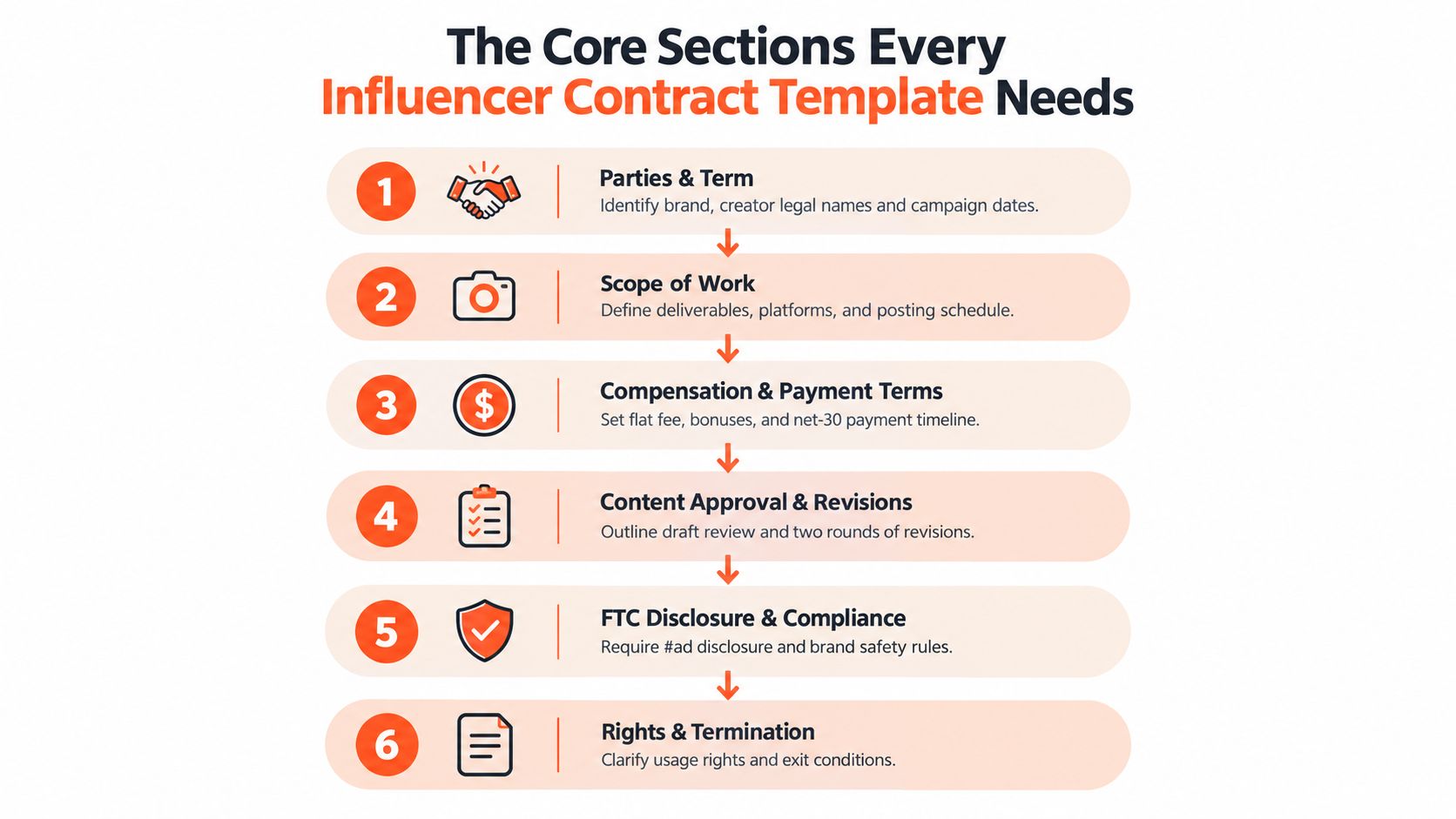
A strong influencer contract template is easiest to build in the order teams use it. Think of a DTC brand onboarding a mid-tier creator for a product launch. The contract shouldn't start with legal boilerplate. It should start with the campaign facts people need to execute.
Start with identity, timing, and actual scope
The first section should identify the brand entity, the creator's legal name or business entity, and the campaign term. Keep this boring and exact. If the creator invoices through an LLC but the template names only the social handle, expect payment friction later.
Then move straight into scope of work. Most templates get lazy here. Instead of “one reel and one story set,” write what's being delivered: format, platform, rough duration, posting window, whether link stickers are required, whether a promo code must be spoken on screen, and whether a pin or caption edit is required after posting.
If you're adapting a broader contractor form, it helps to customize your contractor agreement so it reflects creator-specific issues like platform posting behavior, IP licensing, and disclosure obligations.
Payment, review flow, and compliance belong in the middle
Once scope is clear, compensation becomes easier to draft. State the fee structure plainly. If there's a flat fee, say when it's earned. If part of the fee depends on outcomes, define the metric and measurement source right there, not in a side email.
Use a short checklist in the approval section:
- Draft format: What the creator submits first. Script, concept outline, rough cut, or final cut.
- Review timing: How long the brand has to respond.
- Revision count: Included rounds, plus what happens if the brand requests changes outside brief.
- Silence rule: Whether no response by a deadline counts as approval.
Then put disclosure and brand safety into executable language. The contract should require clear labels such as #ad or #sponsored, plus platform-native paid partnership tools when available. It should also ban hiding disclosure in a hashtag block or after a truncated caption.
Contracts fail when they describe obligations at a high level but never tell either side what “done” looks like.
End with rights, termination, and the fallback rules
The final sections should answer the expensive questions. Who owns the content? What can the brand do with it after posting? Can paid media run through the creator handle? Can the brand crop, subtitle, or localize the asset?
Close with termination, governing law, and any kill fee logic. If the campaign dies after the creator has already filmed, your template should already say what portion of the fee is still owed and what rights, if any, transfer to the brand.
Customizing Deliverables and Approval Clauses for Each Platform
Platform-specific drafting is where an influencer contract template stops being generic and starts being useful. A YouTube integration, an Instagram Story set, and a TikTok Shop video do not need the same approval language. If you use one clause for all of them, you'll either over-control the creator or miss the details that drive performance.
Take a TikTok Shop example. A weak contract says, “Creator will post one TikTok featuring Product X.” A usable contract says the creator will deliver one vertical video, include the product in the opening beat, mention the product benefit on screen, keep the product visible early, use the agreed TikTok Shop link behavior, and leave the post live for the campaign term.
Write deliverables like a production brief
For performance content, define the asset in pieces:
Format and length
State whether it's a talking-head video, voiceover demo, stitch, live segment, or Story frame set.Conversion behavior
If the campaign depends on a pinned comment, product tag, link sticker, promo code mention, or caption keyword, put it in the contract. Don't leave conversion mechanics in Slack.Mandatory and prohibited claims
Especially for health, fintech, beauty, and app campaigns, specify what the creator may say, what they must avoid, and whether exact talking points are mandatory or directional.
Approval rounds should protect speed, not create a rewrite factory
Brands often ask for “final approval” without limiting the process. That's how a simple creator deal becomes six rounds of edits and mutual resentment.
A better clause does four things:
- Sets the review object: concept, rough cut, final cut, or all three
- Limits revision rounds: usually enough to correct brief compliance, legal issues, or factual errors
- Defines turnaround windows: if the brand wants speed, the brand has to review on time
- Separates compliance fixes from creative preference changes: the first is required, the second may cost extra or trigger delay
| Platform | Deliverable Format | Approval Rounds | QA Requirements |
|---|---|---|---|
| TikTok | Short-form vertical video with caption and comment behavior specified | Concept plus final cut, with limited revisions | Product shown early, link behavior correct, disclosure visible, audio and on-screen text checked |
| Instagram Reels and Stories | Reel plus Story frames with sticker or tag requirements | Draft review for Stories, lighter review for Reel if creator-led | Link sticker placement, brand tag, disclosure placement, frame order, cover image if needed |
| YouTube | Dedicated video or mid-roll integration with verbal mention points | Script talking points or outline, then final review for claims | Description links, spoken CTA, chapter placement if relevant, disclosure in-video and in description |
| Twitch | Live read, panel link, chat command, or stream segment | Pre-approved talking points and run-of-show | Command accuracy, disclosure language, timing within stream, VOD treatment if applicable |
Add one clause for post-live corrections
This gets missed constantly. Your template should let the brand request reasonable post-live edits for missing links, broken codes, tagging errors, or disclosure defects.
A creator shouldn't have to remake a strong post because the brand changed its mind. But they should have to fix a broken tracking link or missing paid partnership label.
That one distinction saves a lot of bad-faith arguing.
Structuring KPIs, Attribution, and Performance Fees in the Template
Most templates still feel stuck in an older model. They assume a flat fee is the default and performance is a side note. That no longer matches how many teams buy creator media. Independent industry coverage reported that 61% of marketers used some form of performance-based compensation in 2025, and another source said brand-creator contracts included performance metrics in 68% of cases, up from 42% in 2023 in this Modash coverage of influencer trends, contracts, negotiation, and pricing.
The issue isn't whether to include a KPI clause. It's whether the clause is draftable enough to survive a payout dispute.
Define the metric before you define the money
Take a DTC skincare brand hiring a mid-tier TikTok creator. The deal can be written three very different ways, even if the creative ask stays similar.
| Deal Type | Base Fee | KPI Trigger | Attribution Window | Bonus / Clawback | Best For |
|---|---|---|---|---|---|
| Flat fee with bonus | $2,000 flat | Bonus paid at 1,000 units | Must be defined in contract as platform-native or third-party tracked window | Bonus only if verified results hit threshold | Brand campaigns that need predictable baseline cost |
| Hybrid deal | $1,000 flat | $15 CPA capped at 1,500 units | Must state click window and reporting source | Cap protects budget, payout scales with verified conversions | Brands balancing creator incentive with cost control |
| Pure performance | Pure $20 CPA with a $1,000 floor | Per conversion after floor terms are met | Needs the strictest measurement language | Floor protects creator, validation rules protect brand | Mature programs with reliable tracking and repeat creators |
The fee model changes three parts of the contract.
First, the KPI definition clause. Don't write “engagement rate” unless you define exactly what counts and where it's measured. Better metrics are code redemptions, tracked purchases, qualified leads, app installs, or another verifiable action.
Second, the measurement methodology line. State whether performance is measured by platform-native reporting, affiliate platform data, post-purchase survey data, or a designated analytics stack. If the campaign relies on a pixel, link, or creator code, the contract should say who sets it up and when.
Third, the payment adjustment language. If there's a bonus, say when it's earned and when it's payable. If there's a clawback, write it narrowly. Vague clawbacks create more friction than they solve.
What usually breaks these clauses
Three drafting mistakes show up over and over:
- Undefined vanity metrics: “Good engagement” isn't a contract term.
- Missing tracking requirements: if no one specifies the correct link, code, or attribution method, you're negotiating in the dark later.
- Confused reporting hierarchy: platform numbers and third-party numbers don't always match. Pick the source of truth in advance.
If you need a practical benchmark for modeling creator economics before you write the clause, an influencer marketing ROI calculator can help pressure-test whether a flat, hybrid, or pure performance structure makes sense for the campaign.
The clause should reward clarity, not optimism
A performance section isn't there to make the deal sound impressive. It exists so finance can pay, creators can forecast upside, and growth teams can compare placements without arguing over definitions afterward.
Writing Usage Rights, Whitelisting, and Spark Ads Clauses
The fastest way to blow up a creator relationship is to assume posting rights equal advertising rights. They don't. A brand gets a nice organic Reel, boosts it behind paid spend, and suddenly the creator's manager is asking why the brand is running media on an asset that was never licensed for amplification.
That's why an influencer contract template has to treat rights like a pricing system, not a checkbox.
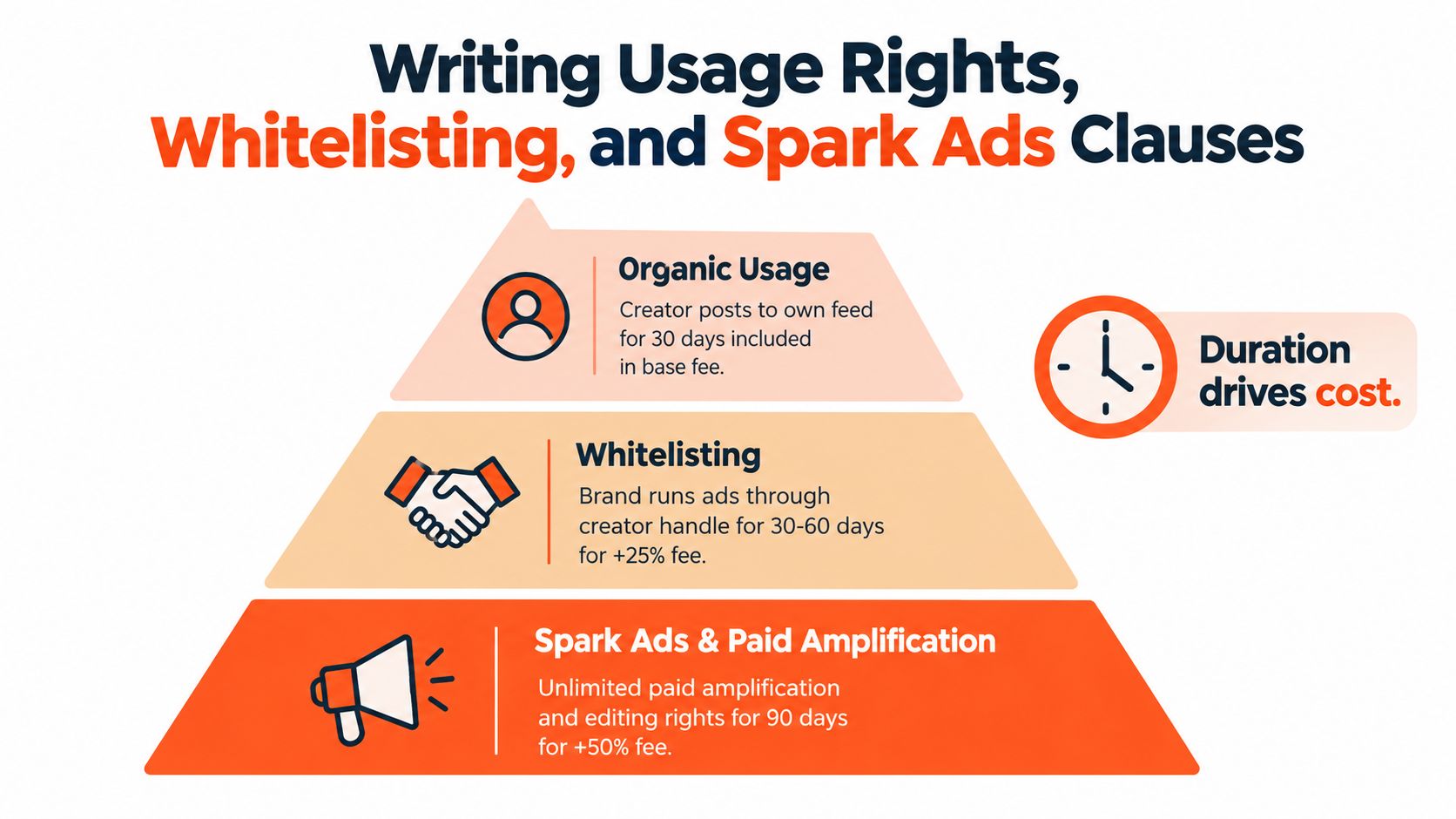
Independent template guidance consistently flags vague scope-of-work language and under-specified usage rights as major dispute points, and one contract resource notes expanded rights can cost 25% to 100% more than the baseline creator fee in this guide to influencer contract templates and rights scoping.
Build a rights ladder into the template
Use separate rights tiers inside the contract instead of one mushy IP clause.
- Organic use only: The creator posts on their own channel. The brand can repost only if the contract says so, and only within the stated channels and term.
- Whitelisting or Spark Ads: The brand can run ads through the creator handle or authorized post, subject to defined platform scope, time limit, and spend treatment.
- Broader paid reuse: The brand can repurpose content across brand-owned social, landing pages, email, retail screens, or other named placements if licensed.
The practical point is simple. The more the brand can do with the asset, the more specifically the contract needs to describe that use.
Clauses that actually work
Your whitelisting language should answer six questions in one paragraph:
- Which platforms are included
- Whether access is granted through creator authorization, ad permissions, or platform code
- How long the right lasts
- Which territories are covered
- Whether editing is allowed
- Whether media spend is separate from creator compensation
A usable Spark Ads block should also include a field for the platform authorization code and who is responsible for generating it. If that sounds operational, good. Rights clauses should be operational.
For a current example of how teams think about paid amplification mechanics, this breakdown of TikTok Spark Ads cost is a useful companion to the contract drafting side.
Here's the other market shift worth paying attention to. A recent creator contract template example separates organic use, paid use, whitelisting, Spark Ads, platform list, term length, territory, and sublicensing. Broader market reporting also says average influencer contracts rose from $3,065 in 2019 to more than $7,400 in 2025 in this UGC creator contract template discussion. When deal value rises, vague rights language gets expensive fast.
Here's a quick explainer before you draft those terms:
Red flags worth killing on sight
“All media, in perpetuity, worldwide” is the classic overreach. Sometimes brands ask for it out of habit. Sometimes creators agree without realizing what they gave away. Either way, it's a bad default.
Rights should be channel-specific, time-bound, and renewable. If the brand wants more later, the template should make that expansion easy to price.
That approach protects the brand from accidental under-licensing and protects the creator from accidental buyout.
Disclosure, Compliance, and Indemnification Language That Holds Up
A creator posts branded content. The product is featured clearly. The comments are strong. Then someone notices the disclosure says “#sp” at the end of a long hashtag block, buried after the caption fold. Now the post is live, screenshots are circulating internally, and the brand has to decide whether to leave it up or force a correction.
This is why compliance language can't be decorative.
The contract should tell the creator exactly how to disclose
The FTC says influencers must disclose any financial, employment, personal, or family relationship with a brand, and its revised Endorsement Guides became effective on July 26, 2023 in the FTC's endorsements, influencers, and reviews guidance. In practice, your template should require explicit terms like #ad or #sponsored, plus any native paid-partnership labeling the platform offers.
Don't stop there. The clause should also state that disclosure must appear where an ordinary viewer will notice it. Not after a “more” cutoff. Not buried inside a dense tag cluster. Not hidden in tiny overlay text that disappears before anyone can read it.
For teams working across markets, this explainer on disclosure rules for influencer campaigns is a helpful secondary read because it highlights how contract wording needs to turn policy into posting behavior.
Add correction rights and auditability
A serious template gives the brand a correction mechanism. If the post goes up without proper disclosure, the brand should be able to require a fix, update, or repost within a defined time window.
Use practical drafting points like these:
- Approved labels: Name the acceptable disclosures in the contract.
- Placement rule: Require disclosures in-caption, on-screen, or through native tools where relevant.
- Correction window: State how quickly a non-compliant post must be fixed after notice.
- Evidence of compliance: Ask for screenshots or post URLs if your workflow needs an audit trail.
One expert-oriented template source emphasizes these controls directly, including explicit labels, noticeable placement, and correction rights. The same source notes potential civil penalties up to $53,088 per violation under the U.S. Consumer Reviews and Testimonials Rule in this influencer contract template guidance focused on compliance.
Indemnification should be narrow and usable
Most indemnity clauses in creator templates are sloppy. They either overreach so badly that creators refuse them, or they're so vague they won't help when something breaks.
A workable clause usually does this:
- The creator indemnifies the brand for the creator's own breach, undisclosed material connection, or unauthorized claims added by the creator.
- The brand indemnifies the creator for claims arising from brand-supplied materials or brand-mandated statements the creator merely publishes.
- Any liability cap should be stated clearly if the parties want one.
This is not optional. Compliance risk doesn't become smaller because the campaign is “just social.”
Negotiation Playbook and Pre-Launch Checklist
The last mile of any influencer contract template is negotiation. That's where the useful template earns its keep. A weak draft collapses into endless redlines because it never established business priorities. A strong one tells your team where to flex and where to hold.
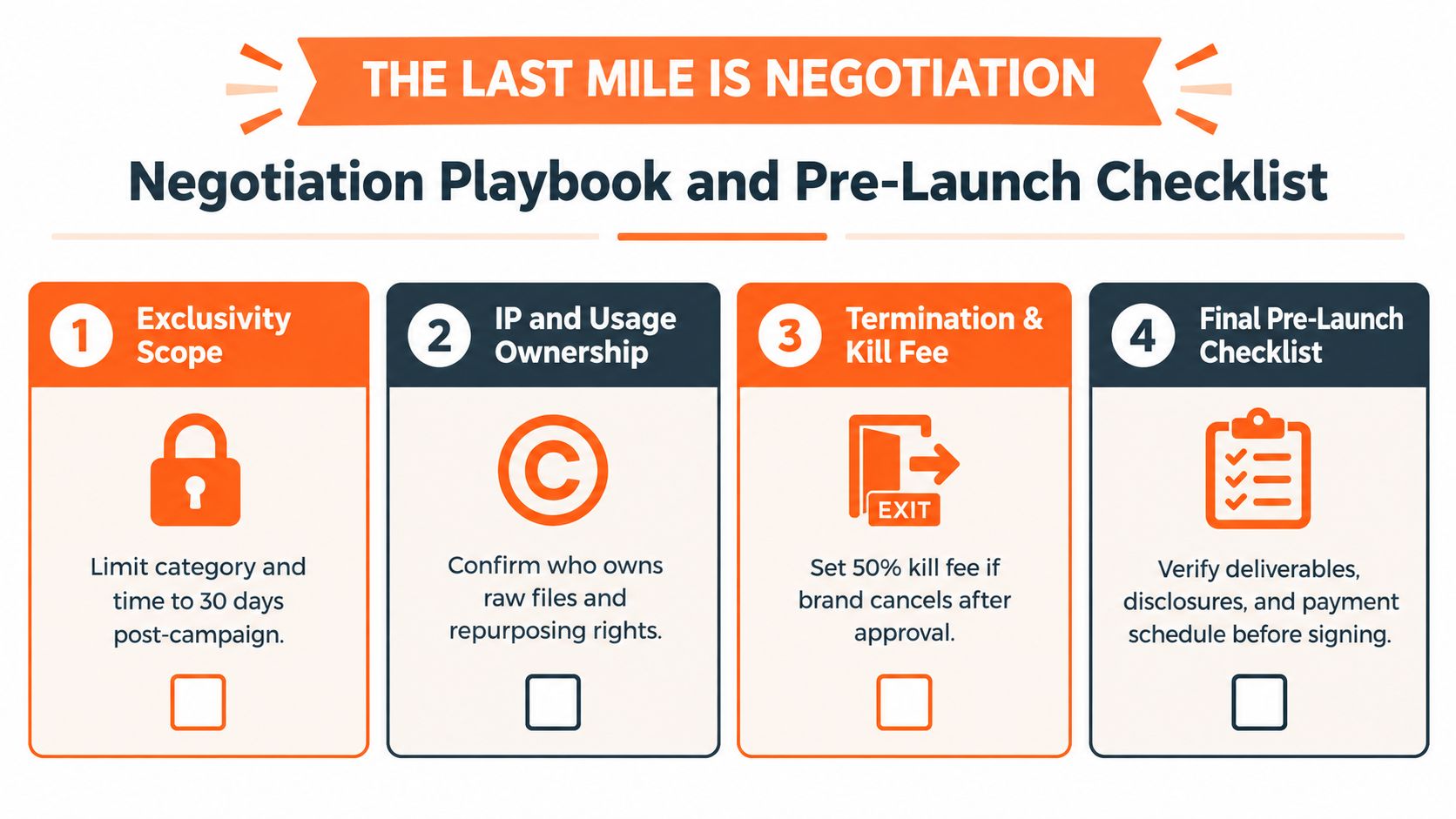
The four clauses that always matter
Most creator negotiations come back to the same battlegrounds.
Exclusivity scope.
Hold on category specificity. Flex on duration if the creator has active pipeline constraints. “No beauty partnerships anywhere” is lazy drafting. “No sponsored lip balm campaigns for named competitors during the campaign term and a short post-live period” is negotiable and coherent.
IP and usage ownership.
Hold on the exact rights you need for launch. Flex on everything you don't. If the brand only needs organic posting plus short paid amplification, don't ask for raw files, perpetual use, and unrestricted edits.
Termination triggers.
Hold on brand protection for breach, legal risk, and missed mandatory deadlines. Flex on convenience termination if you're willing to pay a kill fee. If a creator's manager asks for a kill fee after concept approval, that's not unreasonable. It should already be in your template if cancellation would strand creator labor.
Liability and indemnity caps.
Hold on responsibility for each party's own misconduct. Flex on broad uncapped liability language if it isn't tied to a real risk. Overreaching here slows deals without giving anyone meaningful protection.
What to redline and what to leave alone
When a creator manager counters, don't treat every edit as equally important. Some terms are commercial. Some are just drafting style.
Redline aggressively when the change would:
- erase disclosure obligations
- widen rights beyond what was priced
- make performance measurement unverifiable
- remove correction rights after posting
Leave it alone when the change only:
- cleans up wording without changing meaning
- clarifies invoicing mechanics
- narrows vague morality language into something enforceable
The goal of negotiation isn't to “win” the paper. It's to sign a contract your team can actually run without improvising the hard parts later.
Pre-launch checklist that should sit next to the template
Before signature, confirm the mechanics that usually get forgotten:
- Entity and payment setup: Legal name, tax info, payment route, invoicing contact, currency.
- Campaign mechanics: Final deliverables, posting dates, tracking links, codes, tags, landing pages.
- Compliance pack: Approved disclosure language, screenshots of acceptable placement, claim restrictions.
- Rights setup: Repost rights, paid usage permissions, whitelisting access, Spark authorization if relevant.
- Measurement stack: Source of truth for KPI reporting, link testing, code testing, pixel or affiliate setup.
- Exit terms: Kill fee logic, takedown rights, content retention rule, what happens if launch shifts.
This is the difference between a signed deal and a launch-ready deal. They are not the same thing.
Social Cloud helps brands handle the messy middle that most templates ignore, including creator contracting, rights scoping, disclosure controls, attribution setup, and performance-linked deal structures across TikTok, YouTube, Instagram, and Twitch. If your team wants creator agreements that are built for launch and measurement instead of filing cabinets, visit Social Cloud.