You have a spreadsheet of creators sorted by follower count, a product that needs to sell this month, and a budget that will not survive a pretty campaign that nobody buys from. Sorting by size feels efficient until the post goes live, the comments are emoji, and checkout stays quiet. Follower count hides audience location, whether people stick around for a sponsored post, and whether the creator will label a paid deal in a way a regulator would accept.
A better way to find an influencer is to treat discovery as a short pilot with a scorecard. You pick a platform for one outcome, build a longlist, cut it on audience quality and disclosure history, then rank the survivors on tracked cost, not likes.
Table of Contents
- Pick the Right Platform for Your Goal
- Where to Search for Influencers Before You Shortlist
- How to Shortlist Creators in Four Steps
- Audience Checks That Matter More Than Follower Count
- Check Disclosure and Brand Safety Before You Sign
- Set Up Tracking So Results Don't Double Count
- Score Creators and Run a Pilot Before Scaling
Pick the Right Platform for Your Goal
Start with the sale you need, then pick the network that can show it. Each platform reports performance differently, so a creator who looks strong on one can look ordinary on another. The stakes are large. Statista estimated the worldwide influencer marketing market would reach approximately $33 billion in 2025, more than three times its estimated size in 2020, and forecast $7.1 billion in U.S. influencer marketing spending in 2024.
That size means every platform has agencies and databases arguing for it. Ignore them. The right platform is the one whose native format matches how your buyers decide, and whose metrics can prove the outcome you picked.
Instagram is the default for visual products and brand collabs. Reels reach, saves, and code redemptions tell you whether people kept the post and acted. Giveaways inflate engagement, so a spike around a prize is not demand.
TikTok fits trend-led product discovery. Watch-through, shares, and views per post are the first signals. Pair a strong organic post with Spark Ads, where you boost the creator's own post, when you need reach past their followers. Paid boosts can mask a weak organic baseline, and the shelf life is short.
YouTube pays off on long reviews, tutorials, and evergreen demos. Average view duration and search traffic matter more than a launch-day spike. Production costs more, and the first two weeks understate the life of a video that keeps ranking.
Twitch fits live launches and gaming audiences. Average concurrent viewers and chat activity show whether people stayed. Clicks are hard to trace unless every creator has a code.
| Platform | Best for | Signal to check | Watch out for |
|---|---|---|---|
| Visual products and brand collabs | Reels reach, saves and code redemptions | Engagement inflated by giveaways | |
| TikTok | Trend-led product discovery and Spark Ads | Watch-through, shares and views per post | Short shelf life and paid boosts masking organic reach |
| YouTube | Long reviews, tutorials and evergreen demos | Average view duration and search traffic | Slower payoff and higher production cost |
| Twitch | Live launches and gaming audiences | Average concurrent viewers and chat activity | Hard to track clicks without codes |
Shortlist one or two platforms, not four. Name the primary one and the single metric that proves the campaign worked. For a sales goal, that is cost per acquisition. For a traffic goal, it is cost per qualified visit. That metric becomes the scorecard's ranking rule when the pilot starts, so pick a platform whose reporting can deliver it.
Where to Search for Influencers Before You Shortlist
Search where buyers already talk about the problem your product solves. A cold database pull gives you names. A search inside real conversations gives you names people already trust.
- Search the platform they use. On the network you picked, search product, category, and problem keywords, then the hashtags your buyers type. Save creators who show up more than once, not one-off viral clips.
- Read branded content labels. Instagram's paid partnership label and TikTok's branded content toggle show who already works with brands in your category. Competitors' sponsored posts show who they keep rebooking, which is a stronger signal than a single gifted mention.
- Watch who tags competitors. Creators who comment on or tag several brands in your space often have a relationship that can transfer. Recurrence matters more than one enthusiastic reply.
- Filter a marketplace, then stop scrolling. Use a creator database to filter by country, language, platform, and format, then export. If you want to compare Instagram creators programmatically, an API search beats clicking similar accounts by hand once the longlist gets past a few dozen names. For long-form reviewers, a structured search for YouTubers keeps tutorials from getting mixed in with short clips.
- Ask customers who they already follow. A name a buyer volunteers usually converts better than a creator you found in a directory. Add those names even if their follower count looks modest.
Keep the longlist around 30 to 40 names. Past that, vetting turns into browsing. For each person, record platform, audience market, content format, and the source that surfaced them. After the pilot, that last field tells you which search channel produced creators who sold.
Practical rule: If you cannot say where a name came from, you cannot learn which search habit to repeat.
How to Shortlist Creators in Four Steps
A longlist is not a shortlist. Four filters decide who gets a brief.
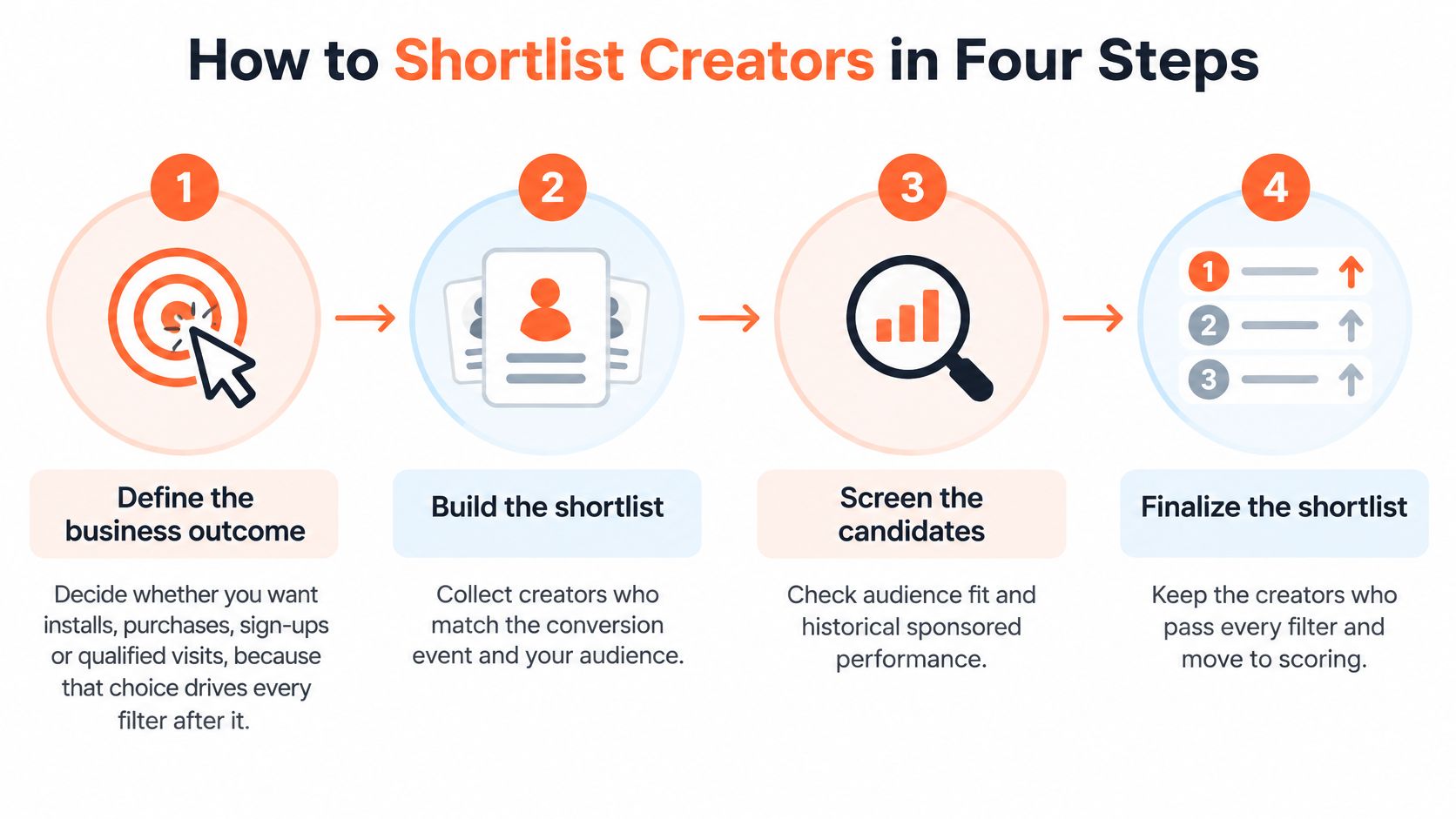
1. Write the conversion event. Decide whether you want installs, purchases, sign-ups, or qualified visits. That choice sets every filter after it. A creator who is excellent at awareness content fails this step if your event is a paid checkout and their audience never leaves the app.
2. Match geography, age, interests, platform, and format. Followers have to live where you sell. A U.S.-based creator with a mostly Brazilian audience will spend your budget in the wrong checkout currency. Set age and interest ranges to the people who buy the product, not to the creator's personal brand. Format has to match the asset you can brief, whether that is a Reel, a 12-minute review, or a live stream.
3. Check audience quality and past sponsored work. Screening for audience quality, brand fit, and past sponsored-content performance, not just follower counts, is the cut that removes most wasted spend. Look at comment quality, posting consistency, and what happened to reach after earlier paid posts. A creator who only performs on unsponsored content is a risk, not a bargain.
4. Hold a small, comparable pilot. Each remaining creator gets a tracking link and a promo code. Same brief, same window, short enough that you rank on results instead of a vibe from the media kit.
The walkthrough below shows how a growth team moves from a messy export to a ranked shortlist without arguing about follower tiers.
Stop at eight to ten creators. For each one, write one line on why they passed every step. If you cannot write that line, they did not pass.
Audience Checks That Matter More Than Follower Count
The most common false signal is a follower spike that looks like momentum. A jump with no new series, collab, or press hit often means bought followers. Steady growth, even if it is slower, is the healthier sign.
Work the checks in order. Audience location should put a majority in your target market. Followers scattered across countries you do not ship to, or where the app is not live, will not become orders. Comment quality should include specific replies and real questions. Emoji-only threads and the same generic praise copied under every post are a pause, not a personality.
Engagement consistency across the last ten posts matters more than the average. One viral post can carry that average and hide a feed nobody watches. Then look at reach after sponsored posts. If paid posts land close to organic reach, the audience stays. A sharp drop after each deal means people tune out the moment a brand appears. Last, age and interests have to match buyers. A polished skincare feed still fails if the audience is mostly teenagers and your product is for adults.
| Signal | Healthy sign | Red flag |
|---|---|---|
| Follower growth | Steady, gradual climb | Sudden spikes with no content trigger |
| Audience location | Majority in your target market | Followers spread across unrelated countries |
| Comment quality | Specific replies and real questions | Emoji-only or repeated generic praise |
| Engagement consistency | Similar results across the last ten posts | One viral post carrying the average |
| Reach after sponsored posts | Close to organic reach | Sharp drop after each paid deal |
| Audience age and interests | Matches the product's buyers | Mostly outside the buyer profile |
Drop anyone with two or more red flags before you write them. If the growth chart looks off, run a fake followers check on Instagram before the rest of the row. A clean location split does not rescue a bought audience.
A great feed can still be the wrong room. Fit is who is watching, not how the grid looks.
Check Disclosure and Brand Safety Before You Sign
Reach without disclosure discipline is a liability you pay for twice, once in fees and again if a regulator or a platform pulls the post. Optimizing for audience size while waving through sloppy labels is how campaigns get expensive after they look successful.
In the United States, the FTC's endorsement guidance treats payments, free or discounted products, employment, family relationships, and other material connections as relationships that generally require clear disclosure. The brand and the influencer both carry that duty, so a platform's native toggle alone may not be enough. Plan on that scrutiny continuing rather than fading.
A 2025 multi-platform study of 292,315 Instagram, YouTube, and TikTok posts, summarized by Maastricht University researchers, found influencer marketing generally underdisclosed, with affiliate marketing disclosures reaching only up to 10% in the examined data. Bigger creators were not necessarily more compliant. Hiring a professional account does not buy you a clean label history.
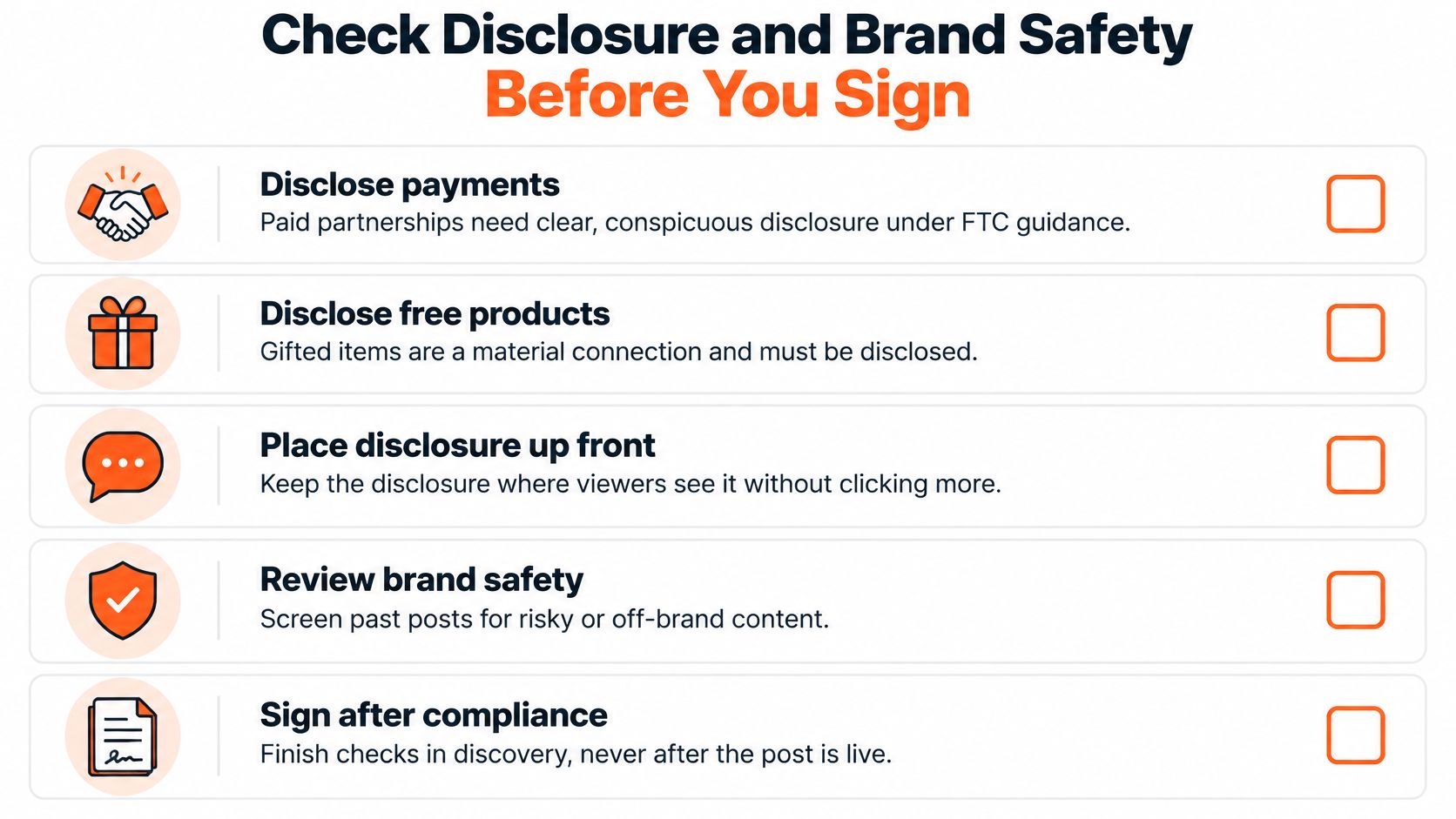
Run this before anyone signs.
- History first. Open past sponsored posts. Clear, conspicuous labels on most of them are a pass. Missing labels on a pattern of gifted hauls are not.
- Plain wording. Require language a viewer understands without decoding. Skip #collab, #sp, and #thanks.
- Visible placement. The label has to appear before anyone taps "more," and it cannot live only in a bio.
- Live monitoring. Approve the placement, then check the published version across formats, because a Story sticker and a feed caption fail in different ways.
- Claims and rights. Fintech, health, and supplements need a second read on what the creator is allowed to say. Usage rights for paid amplification belong in the contract, or you cannot boost the post later without changing its meaning.
Treat disclosure as a scored line in your pilot, not a personality judgment. Weight it against tracked outcomes the same way you weight CTR or conversions, because a creator who hides the ad is also muddying the data you will read later. A creator who will not disclose reliably should be cut, or kept only behind stricter approval. I would rather lose a high-reach name here than explain a missing label after the post is already in feeds.
Set Up Tracking So Results Don't Double Count
Every creator needs a unique footprint in your numbers, or the pilot will crown whoever shouted loudest. Set the attribution rule before the first post, because you cannot rebuild a fair comparison after the data is mixed.
Give each creator three tools. A tracking link with UTM parameters is precise for site visits and on-site conversions, and it misses offline buys and view-through purchases. A promo code ties redemptions to that creator, including some app-store and offline sales, but codes leak onto coupon sites and credit the wrong source. A post-purchase survey that asks where the buyer heard about you catches discovery that never produced a click, though people misremember. Platform reporting on views, watch time, and click-through rate is for diagnosing the creative, not for proving revenue.
| Method | What it tells you | Limitation | Best use |
|---|---|---|---|
| Tracking link | Clicks and site conversions per creator | Misses offline and view-through purchases | Primary attribution for web sales |
| Promo code | Redemptions tied to each creator | Codes leak onto coupon sites | Offline and app-store sales support |
| Post-purchase survey | Self-reported discovery source | Recall bias | Catching discovery moments clicks miss |
| Platform reporting | Views, watch time and CTR | Not proof of sales | Diagnosing creative and reach |
Pick one primary rule, such as last tracked click inside a fixed window, and treat the other methods as support. SourceLoop's take on attribution credit is a useful check if your team is still debating first-touch versus last-touch while creators are waiting on links. The same window applies to every creator. Review weekly during the pilot so a leaking code or a broken UTM shows up before you scale it.
A 2025 IAB survey of more than 450 U.S. creator-ad-spend decision-makers named advanced attribution and consistent reporting as the top needs for improving creator marketing, and proving ROI as the largest measurement hurdle. If you want a worked path from those numbers to a keep-or-cut decision, this guide on how to measure influencer marketing ROI pairs cleanly with the rule you just set.
Do not add a second "source of truth" mid-pilot. You will double-count the same order and then argue about whose dashboard is kinder.
Score Creators and Run a Pilot Before Scaling
Engagement is an indirect signal. It does not tell you who will hit a cost target. A measurement note from Jönköping University separates followers, likes, comments, shares, reach, impressions, views, and watch time from direct indicators such as click-through rate, conversion rate, revenue-based ROI, and incremental lift. The practical instruction is blunt. Do not select an influencer on engagement alone. Forecast qualified reach and conversion, put a unique tracking mechanism on every placement, and compare creators on cost per qualified visit, cost per acquisition, conversion rate, and incremental revenue.

Weight the scorecard before you argue taste
Score the eight to ten who survived disclosure on five criteria. Starting weights sum to 100%. Shift them if your goal is different, but write the new weights down before you see the content, or the prettiest video will gain points.
| Criterion | Starting weight | What good looks like |
|---|---|---|
| Outcome probability | 30% | Forecast CPA or ROAS inside your target range |
| Historical sponsored performance | 25% | Stable results and clear disclosure across past deals |
| Audience quality | 20% | Passes the signal checks in the audience section |
| Creative fit | 15% | Content style matches your brand voice and product |
| Attribution confidence | 10% | Accepts tracking links and codes without friction |
Outcome probability leads because a cheap view that never converts is still expensive. Build the forecast from past sponsored results in a similar category, not from a follower formula. Historical sponsored performance rewards creators whose paid posts held up and whose labels were already clean. Audience quality is the pass-fail from the signal table, scored only for people who cleared the red-flag cut. Creative fit is whether their normal voice can carry your product without sounding like an ad read. Attribution confidence is operational. A creator who refuses a link or a code cannot be ranked, so they should not be in the pilot.
Before any money moves, set a target CPI or CPA, expected views, and the budget split per platform. That forecast is the line the pilot has to beat.
Run three to five creators on the same rails
Take the top three to five. Same brief, same landing page, same attribution window, and enough spend or impressions that one lucky post does not decide the ranking. A small sample is how teams crown a fluke and then scale it.
Use the first two weeks as a checklist, not a vibe check.
- Lock the primary platform and the outcome metric.
- Finish the eight-to-ten shortlist and the disclosure workflow. Anyone who fails disclosure is out.
- Score who remains and keep the top three to five.
- Assign each a tracking link, a promo code, and the attribution rule you already chose.
- At day 14, keep only creators who beat the target cost per acquisition.
The pilot answers one question. Which creator produced the outcome you needed, at a cost you can repeat? Everyone else goes back to the longlist or off it. Scale the winners with more placements on the same tracking, not with a new set of rules.
If you want that scorecard run by one team instead of a chain of freelancers, Social Cloud plans, vets, and measures creator campaigns across YouTube, Instagram, TikTok, and Twitch, with a tracking link and promo code on every placement. Grab the free 2026 influencer marketing report for CPM, CPI, and engagement benchmarks by tier, or use the ROI calculator to forecast a campaign before you brief anyone. When you are ready to turn a shortlist into a tracked pilot, start with Social Cloud.