
The usual advice is to search your niche, sort through big channels, and contact whoever has the most subscribers. That's a fast way to build a list, but a poor way to choose where your budget goes. A creator can be famous, active, and completely wrong for the buying decision you need to influence.
A useful search for YouTubers produces something more defensible: a shortlist backed by recent content, a clear audience-fit argument, and a tracking plan. Start with selection rules, keep discovery repeatable, and make every final candidate earn their place.
Table of Contents
Build a Scorecard Before You Open Any Channel
Subscriber count is a screening detail, not a buying recommendation. It doesn't tell you whether viewers still watch the channel's relevant content, live in your market, or ask the kinds of questions your product answers. Don't let a large audience compensate for a weak fit.
The discovery problem is enormous. Google's YouTube impact report says the platform hosts more than 20 billion videos globally, with creators uploading over 20 million videos every day. You need a consistent evaluation method, not more open browser tabs.
Creator scorecard criteria and benchmarks
Set up these seven scoring columns before opening channels. Keep channel IDs, evidence URLs, and review dates in separate reference fields.
| Criterion | What to record | Benchmark |
|---|---|---|
| Topic relevance | Share of recent uploads on the campaign's topic | At least 3 recent on-topic videos |
| Reach | Median views of recent relevant uploads | Above the campaign's minimum reach requirement |
| Engagement | (likes + comments) / views per video | Competitive within the relevant candidate pool |
| Upload pattern | Uploads per month over recent months | Stable pattern, not one burst |
| Audience fit | Language and geography of viewers and commenters | Matches the target market where data is available |
| Comment quality | Genuine product questions versus repeated bot-like phrasing | Mostly human and on-topic |
| Sponsored results | Past integrations and documented outcomes | If none are documented, mark unverified |
Topic relevance establishes whether the creator regularly serves your intended buyer. Reach establishes whether a normal relevant upload can support your campaign, while engagement helps compare audience response using a consistent denominator.
Upload pattern helps you judge whether you're evaluating an active publishing operation. Audience fit prevents you from buying attention in the wrong market. Comment quality adds context that a numerical engagement rate can't supply, and sponsored results distinguish commercial evidence from organic popularity.
Practical rule: Record missing evidence as unknown. Don't turn an unavailable audience breakdown into an assumed match.
Use an influencer rating framework to keep those judgements consistent across reviewers. Separate hard gates, such as market fit, from comparative strengths, such as production quality.
For the operational side of cadence, the channel management guidance from MakeAutomation is useful context. Still, a polished publishing workflow isn't proof of buyer relevance. Judge the actual uploads, not just how professionally the channel is managed.
Build a Query List and Search It the Same Way Twice
A broad niche term finds broad niche creators. To find someone who can explain your product credibly, search around the customer's problem, the decision they're making, and the format they need.
YouTube's explanation of search identifies relevance, engagement, and quality as ranking considerations and explains that search history can affect results. Your personal results page isn't a neutral creator directory.
Run a controlled discovery process
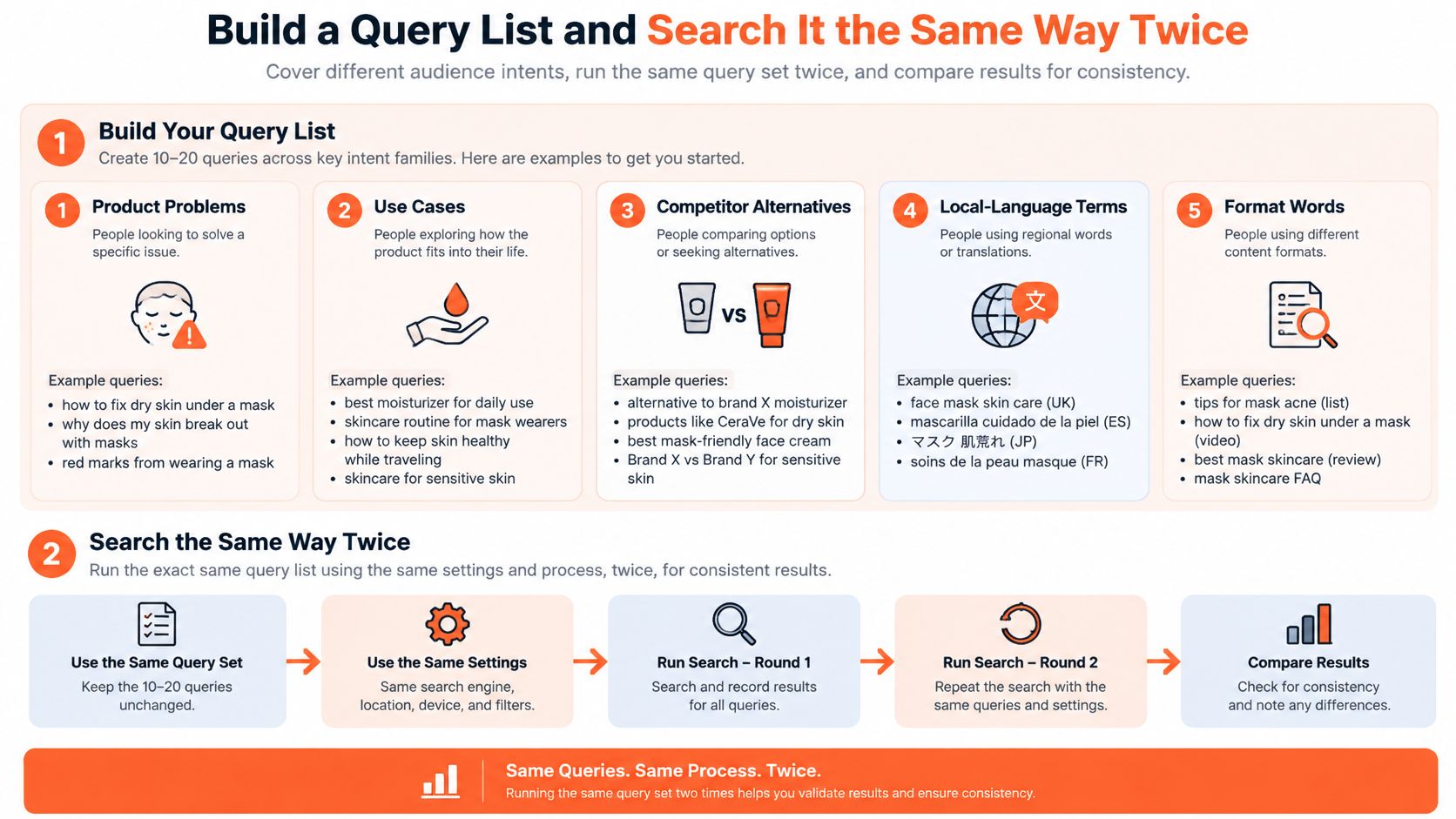
Freeze the query set. Build a working list of audience-intent queries across product problems, use cases, competitor alternatives, local-language terms, and formats. For skincare, combine dry skin under a mask with tutorial, routine, review, or comparison rather than searching only skincare influencers.
Inspect the language manually. Run a handful of queries in a clean, logged-out browser session and watch representative videos. Notice whether creators explain the problem clearly, demonstrate products, and acknowledge limitations instead of repeating product claims.
Repeat through the API. Use the YouTube Data API search implementation guide to configure
search.list, withtype=channelfor channel discovery andrelevanceLanguagefor the intended language. Run the unchanged query set withorder=viewCountand again withorder=date, keeping other parameters consistent and logging the run date.Export enough context to investigate. Save channel ID, discovery query, apparent language, market evidence, recent uploads, and representative product-relevant or sponsored video URLs. Treat language and market as provisional until you've checked them, because a language parameter doesn't verify audience geography.
Deduplicate without deleting useful signals. Merge results by channel ID while retaining every query tag. Repeated appearances across distinct intent families justify closer inspection, but don't count nearly identical keyword variants as independent proof of fit.
Use this workflow to keep the query families and repeated runs organized.
Don't stop at the first results screen. Also inspect relevant videos and the channels behind them. Channel-only queries can miss specialists whose expertise appears in video titles rather than their channel descriptions.
Keep recommendation-based discoveries in a separately tagged bucket. They can reveal adjacent creators, but they aren't a controlled replication of your query search. Preserve that distinction so someone else can understand why each candidate entered the list.
Validate Candidates Through a Two-Stage Funnel
| Stage | Typical volume | Filter applied |
|---|---|---|
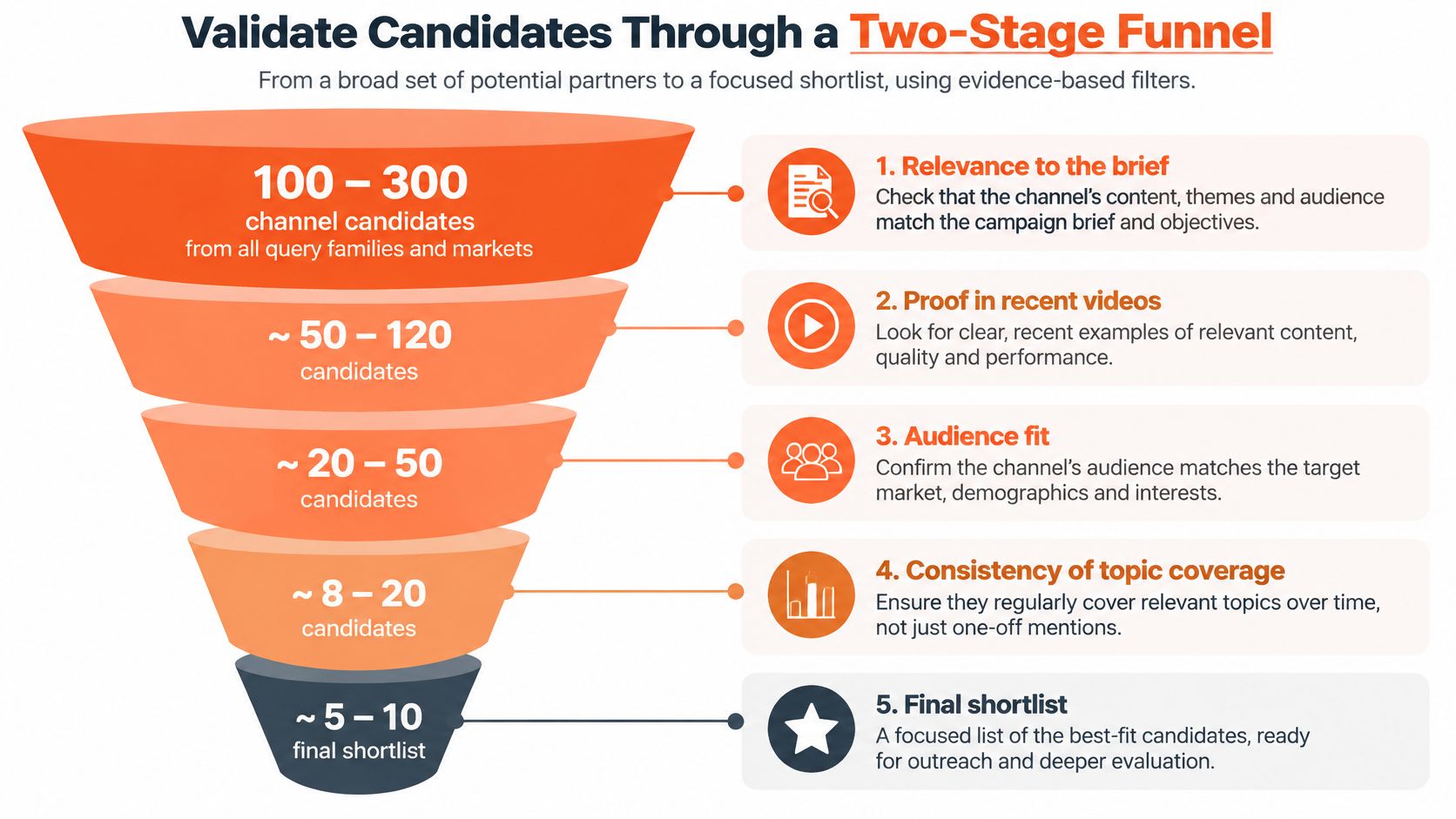
| Broad discovery | Roughly 100–300 channel candidates as a working target | Deduplicated by channel ID across query families |
| Relevance check | Only topic-qualified candidates | At least 3 recent on-topic videos |
| Evidence check | Only reach-qualified, active channels | Relevant-view median clears the campaign minimum; upload pattern is stable |
| Comment audit | Only audience-qualified candidates | Genuine questions, no pervasive bot-like repetition, language fit |
| Final shortlist | Small set you can defend | Full evidence pack per creator |
Treat those volumes and thresholds as workflow choices, not industry conversion benchmarks. The underlying reason for a strict evidence check is straightforward: YouTube's discovery guidance explains that search isn't a list of the most-viewed videos, and recommendations depend on viewer behavior.
The broad pool gives you options. The evidence check determines which options deserve budget.
Apply cheap filters before expensive reviews
Reject obvious topic mismatches before calculating performance. Then manually inspect a consistent sample of recent relevant uploads, recording their publication dates, views, upload frequency, and integration style.
Compare videos at similar ages. A newly published tutorial hasn't had the same opportunity to accumulate views as an older review. If you need view velocity, take dated snapshots; a current public count can't reconstruct early performance.
Keep average views as supporting context. Use the median to assess a typical relevant upload and the lower quartile to understand weaker outcomes. Exclude unrelated entertainment hits from a product-education forecast rather than letting them inflate the channel's apparent reach.
Read the audience's actual questions
Open comments on ordinary uploads, not just the biggest hit. Product-specific questions, follow-up explanations, and discussion of practical limitations are more useful than strings of generic praise.
Don't label a channel fraudulent because some comments look repetitive. Look for a pervasive pattern, check language fit, and mark uncertainty clearly. Public comments can suggest audience relevance, but they don't establish audience geography or purchasing behavior.
A shortlist isn't finished when the spreadsheet looks impressive. It's finished when every retained creator has enough evidence to justify a decision.
Require representative videos, a written relevance reason, current performance evidence, brand-safety notes, and an agreed measurement approach. If the team can't complete that review, reduce the shortlist rather than lowering the standard.
Find Creators Whose Shorts Lead to Long-Form Trust
In Metricool's analysis of 799,718 videos from 71,177 accounts, Shorts generated more than 61% of organic views in the sample, while YouTube Search accounted for about 9% and subscriptions 11%. Treat that split as directional evidence from a single analysis, not a forecast for your category.
Evaluate the creator's delivery format, not just their overall visibility.

A skincare creator might attract enormous attention with a quick transformation clip while their detailed routine reviews attract a much smaller audience. That doesn't make the creator a bad partner. It makes them a different purchase from someone whose viewers regularly sit through product comparisons.
Compare recent Shorts and long-form uploads separately. Look for matching subjects, clear routes toward deeper content, and substantive product questions beneath the long-form videos. Don't assume that viewers move between formats just because both exist on the channel.
Classify the format before buying it
- Short-led creators fit campaigns built around quick demonstrations, memorable hooks, or awareness. Assess whether they can communicate the offer without stripping out necessary context.
- Long-form-led creators suit products that need explanation, qualification, setup, or comparison. Inspect how naturally they integrate a recommendation into the viewer's research.
- Balanced creators may support both discovery and consideration. Require evidence for each deliverable rather than pricing the package from combined channel views.
When reviewing video, pay attention to how the creator develops an explanation, not just the opening hook.
Cross-format presence isn't proof of cross-format movement. Where the decision depends on it, request creator-shared analytics that can clarify traffic sources and viewing behavior. Until that evidence exists, forecast Shorts and long-form performance separately.
For consideration campaigns, a smaller but consistently useful review audience can be a stronger fit than spectacular short-form visibility. Buy the format that serves the decision, not the format with the largest headline count.
Walk One Brief Through the Full Shortlist
Say a skincare brand wants to reach people struggling with dry skin under a face mask. The product needs explanation, and the campaign should help viewers evaluate a routine rather than encourage an unsupported treatment claim.
Start with an influencer marketing briefing that names the buyer, intended market, acceptable product language, desired action, and required format. A vague instruction to find beauty creators leaves too much room for attractive but irrelevant choices.
Turn the customer problem into discovery inputs
Build a compact query sheet around distinct intentions:
- Problem searches might include dry skin under a face mask, tight skin after wearing a mask, or moisturizer pilling under a mask.
- Use-case searches could focus on a workday routine or preparing skin before wearing a mask.
- Alternative searches should use actual competing products and the attributes shoppers compare, such as fragrance-free or lightweight.
- Language and format variants should reflect how the intended audience searches locally, combined with reviews, tutorials, and comparisons.
Manually inspect a sample. Suppose a creator explains the same skincare problem in plain language, shows application, and distinguishes personal experience from broader claims. That's a candidate worth testing, not an automatic selection.
Run the frozen query sheet through the standardized API passes. Merge duplicate channel IDs and preserve the discovery tags, so the team can see whether a candidate appeared for the customer problem, a competitor comparison, or only a broad beauty term.
Make the purchase decision explicit
A creator whose relevant coverage consists mainly of an isolated viral clip doesn't qualify for a sustained product-research campaign. A creator with consistent routine explanations and audience questions about texture, layering, and suitability deserves closer review.
Tag the survivors by format. Assign awareness work to creators who can demonstrate the product clearly in Shorts, and consideration work to those with credible long-form explanations.
The final relevance note should be specific: this creator regularly answers the intended customer's routine questions, uses an appropriate explanatory format, and has recent evidence supporting the proposed placement. That's a decision a stakeholder can challenge constructively, unlike a recommendation based on popularity.
Lock the Shortlist and Confirm Tracking Before Outreach
Copy this checklist into every final candidate's record:
- Written relevance reason: Connect the creator's content and audience to the campaign's buying problem.
- Representative video URLs or IDs: Include topic coverage and an integration example where available.
- Recent performance metrics: Preserve the reviewed sample, capture date, format, and scorecard results.
- Brand-safety notes: Record content concerns, questionable claims, audience issues, and unresolved evidence gaps.
- Measurement plan: Assign a unique tracking link, promo code, and creator-specific post-purchase survey option.
Keep the evidence attached to the selection, not buried in a reviewer's browser history.

Test attribution before sending the offer
Build the link and code before outreach so tracking requirements are part of the proposed placement. Test the destination, campaign parameters, discount behavior, and purchase reporting. Define what counts as a conversion and how you'll handle overlapping attribution before results arrive.
Use a consistent review cadence for views, click-through rate, conversions, and return on ad spend. The guide to measuring influencer marketing ROI can help structure that evaluation. Keep survey responses alongside click and code attribution rather than treating them as interchangeable measures.
At Social Cloud, we screen creators for audience quality, brand fit, and past sponsored-content performance, not just follower counts. Every placement comes with a tracking link and promo code, and clients see views, CTR, conversions, and ROAS per creator weekly.
Before outreach: Test the creator's tracking link and promo code through the intended customer journey.
Save the dated query sheet, scorecard, and evidence pack together. If a candidate can't support the campaign's required tracking setup, remove them rather than changing the selection rules without notice.
Social Cloud plans, runs, and measures YouTube creator campaigns, including Shorts and long-form integrations, with selection grounded in audience fit and sponsored-content performance. Visit Social Cloud to turn your campaign requirements into a defensible creator shortlist with tracking attached to every placement.


