Say your team books the biggest name in gaming for launch week. The stream draws a huge crowd, the clips travel, and the end-of-week dashboard shows a conversion rate so low it looks like a tracking bug. It usually isn't a bug. The audience came for the streamer's personality and the game they already play, and your product landed as a 30-second interruption in the middle of it.
Choosing gaming content creators is a fit problem first and a reach problem second. The genre the audience already plays, the format they show up for, the jokes they tolerate, the claims they'll accept, and the way you'll prove a sale all matter more than subscriber count. A 400k channel with a shooter audience will out-convert a 4M variety streamer for a competitive FPS, and it isn't close.
Format matters just as much. Live inventory sells urgency and community, recorded video sells search and evergreen discovery, short-form sells the cheapest first touch you can buy. Rolling those into one interchangeable impressions line is how campaigns end up unmeasurable.
Below are ten gaming content creators worth a serious look in 2026. Each entry covers the same four decisions: audience fit, format, brand-safety risk, and how you'll attribute results to that specific person. For the faster-moving end of the market, this list of rapidly growing channels in 2026 is a useful companion.
Table of Contents
- 1. PewDiePie (Felix Kjellberg)
- 2. Markiplier (Mark Fischbach)
- 3. Jacksepticeye (Seán McLoughlin)
- 4. Ninja (Tyler Blevins)
- 5. Pokimane (Imane Anys)
- 6. Shroud (Michael Grzesiek)
- 7. Valkyrae (Rachell Hofstetter)
- 8. Kai Cenat
- 9. Ibai Llanos
- 10. Ludwig Ahgren
- How the 10 gaming content creators compare at a glance
- Match Creators to Your KPI, Then Measure Every Placement
1. PewDiePie (Felix Kjellberg)
Felix Kjellberg built one of the largest gaming audiences on YouTube, starting around 2010 with Let's Play videos, commentary, and reaction content. He's the cleanest example of a personality-led gaming channel that grew into a general entertainment brand, and the cleanest warning about what happens to genre fit once that transition completes.
Gaming is now a mainstream format rather than a specialist corner. YouTube's global Culture & Trends report tracks how gaming content runs through the platform's most-subscribed channels, which helps explain why a single top-tier placement can put a title in front of people who never search for it.
The catch is that his audience follows the person, not the genre. A niche title gets a polite reception. A mainstream product, or a brand with an actual story to tell, gets the lift. If your KPI is installs from a hardcore strategy audience, this is expensive awareness rather than acquisition.
The inventory is mostly recorded video: commentary and reaction uploads that keep earning views after launch week. That suits products with a long consideration cycle. It works against anyone buying for same-day urgency.
Brief like this: an integrated segment inside the commentary. A 90-second scripted spot dropped into a video loses the thing you're paying for.
Three things to set up before signing:
- Per-placement tracking: one unique link or code per video, so a traffic spike maps to a specific upload instead of "the campaign".
- Brand-safety review: with a back catalog stretching to 2010, read the last 90 days of uploads and the comment sentiment, not the media kit.
- Usage rights: confirm in writing that you can cut the segment into paid social before anyone agrees a price.
Take a mid-size publisher with a horror title and no console budget. One integrated playthrough video plus a re-cut for Shorts gives them a first-party comparison: which format produced the wishlists, at what cost.
For scale context across the platform, the ranking of the top YouTube creators by reach is a useful reference before you shortlist.
2. Markiplier (Mark Fischbach)
Mark Fischbach is the reliability play. Horror games, comedic commentary, charity marathons, and an audience that shows up for nearly everything he posts. If you want mid-to-top-tier YouTube reach with a fan base that watches to the end, he's the benchmark.
The engagement case is measurable. HypeAuditor's 2025 gaming-influencer analysis puts YouTube gaming creators at a 4.1% engagement rate against a 2.7% average across YouTube, which it frames as roughly 52% higher relative engagement. That gap shows up when creator, title, and audience line up. It disappears when you force a fit.
Where the fit is strong
Horror and thriller titles are the obvious lane. Adjacent categories work if the segment can live inside a reaction: a streaming service with a dark series, a horror tabletop release, a peripheral brand whose look suits the set.
Where it breaks is a scripted 60-second read dropped into a jump-scare run. His audience watches for the reaction, and a stiff segment reads as an ad break they can skip.
- Pitch to the genre, not the demo: a thriller game or horror-adjacent product gives him something to react to, which is the format you're buying.
- Set claims and disclosure in writing: he improvises, so hand over approved claims and the disclosure line before he starts, then leave the wording alone.
- Track by video and by platform: the same segment behaves differently on YouTube and as a Short, and you want that comparison.
Say a publisher with a horror title books one integrated playthrough plus a re-cut for Shorts. Two placements, two tracked links, one clean read on which format produced the wishlists.
3. Jacksepticeye (Seán McLoughlin)
Seán McLoughlin runs on energy. High-volume Let's Plays, indie releases, horror, family-friendly titles, and a relentlessly upbeat delivery that makes a sponsored segment feel like part of the show. For brands that want broad, approachable reach rather than hardcore genre depth, he's one of the safer bets on this list.
The trade-off is sponsorship density. An audience that trusts a creator will tolerate paid segments, but not a wall of them, and the drop-off is gradual before it becomes obvious. If you're planning a three-month always-on program with one creator, this is the channel where you cap frequency and ask what else is booked in the same window.
How to brief:
- Benefits, not a script: give him the three things that matter and let him find the joke. A fixed read kills the reason you booked him.
- Creator-specific codes and links: one code per video, tracked to install or checkout, so this placement is comparable to everything else in the program.
- Frequency guardrails: two competing sponsors in one month dilutes both, so ask early and plan the spacing yourself.
A worked example. An indie studio launching a family-friendly puzzle platformer books a Let's Play slot in launch week and a second segment three weeks later, with separate codes. The second placement usually tells you more about retention than the first tells you about reach.
4. Ninja (Tyler Blevins)
Tyler Blevins is the live-launch benchmark. He became one of the most recognized Fortnite creators, then expanded into wider gaming and entertainment, and his streams remain the reference point for what a launch moment looks like when it lands.
Live is a big market and a concentrated one. Stream Hatchet reported that viewers watched approximately 19.2 billion hours on Twitch during 2025, while YouTube Gaming recorded about 8.8 billion hours, a 12% year-over-year increase and its highest annual total at that point, per this YouTube Gaming research summary. Two platforms, two very different jobs.
The mistake I see most often is treating a live integration like a video integration. Live is unscripted, chat is unfiltered, and you can't QA a stream the way you QA an upload. What you can control is timing, the segment slot, and the tracked action.
Time it to the moment
- Anchor to an event: a launch window, a season reset, a tournament. A live read on a quiet Tuesday is a donation, not a campaign.
- Brief compliance before, not after: disclosure wording, prohibited claims, and what happens if chat turns hostile, all agreed in the pre-stream document.
- Attribute per stream: a time-stamped link and a unique code per broadcast, because one code running all month tells you nothing about which stream worked.
Say a peripheral brand wants a hardware launch. One live segment during a high-traffic event, one code, one time-stamped link, then a comparison against the same offer in a recorded video a week later. If live is new to your team, this primer on influencer marketing on Twitch covers the mechanics and the pricing norms.
5. Pokimane (Imane Anys)
Imane Anys is a variety streamer with a community-first style, which makes her a fit question rather than a reach question. Her streams move across competitive multiplayer titles, so your product needs to match what she's playing this month, not what she played last year.
Platform scale sets expectations. Major live-streaming platforms generated more than 9 billion hours watched in Q2 2025, up 5% year over year, according to this YouTube Gaming facts breakdown. YouTube Gaming accounted for 2.2 billion hours and roughly 24% of that total, while Twitch held about 54% of the gaming live-streaming market. YouTube is the scale-and-search play. Twitch is the live community play.
Ask which one your KPI needs before you ask who's available.
Live reach and recorded reach answer different questions. Concurrent viewers tell you who showed up now. VOD views tell you who found you later.
For a variety creator the practical set-up is unglamorous: a chat-driven call to action with a dedicated code, a backup plan if the game switches mid-stream, and clips cut from the live moment for repurposing. Those clips often beat the stream on cost per click, and they carry the same code.
Say an app company tests one stream and three clips taken from it. Same creator, same offer, four tracked placements. That's the cheapest way to learn whether her audience converts on live or on short-form before committing to a series.
6. Shroud (Michael Grzesiek)
Michael Grzesiek built his audience on precision. Competitive shooters, high-level play, and viewers who care about frame rates, input latency, and how a mouse feels in the hand. For hardware and peripheral brands that's rare: an audience that treats product performance as content.
The format is the pitch. A scripted claim about responsiveness means nothing here. A live demonstration where the creator calls out what changed mid-match means everything, because the audience can see the difference in the play.
What works:
- Performance framing: latency, precision, comfort, consistency. Vague lifestyle messaging gets scrolled past.
- Natural demonstration: let him play, complain, adjust, and re-test. The unedited reaction is the proof.
- Timestamped attribution: mark the exact minute the offer is mentioned and tie a code to that window, so a specific moment connects to a spike in conversions.
What doesn't work is a hard sell to a technical audience. They'll spot a claim that doesn't survive the demo, and they'll say so in chat, publicly.
Say a mouse brand sends a pre-release sample and asks for one honest segment during a normal stream. If the reaction is lukewarm, that's worth more than a positive scripted read, because the audience response tells you whether the product holds up with competitive players.
7. Valkyrae (Rachell Hofstetter)
Rachell Hofstetter sits at a useful intersection: streamer, content creator, and co-owner of an esports organization. That makes her a two-layer partnership, spend on her channel plus presence around a team, which is either efficient or messy depending on how you brief it.
The audience overlap is the selling point. In Bain & Company's 2024 Gaming Report, 16% of surveyed gamers had created content for games in 2024, while 79% had played games containing user-generated content. That's a crowd that participates in game culture rather than just consuming it, and it notices when a partnership is real.
Two stakeholders mean two message tracks. The creator track is personality-led and informal. The org track sits closer to a sponsorship, with logos, team milestones, and event calendars. If the two say different things about the same product, the audience spots the seam.
Watch for: org-linked campaigns where the creator's personal content and the team's official content run on different timelines. Align the dates before you sign.
Attribution gets harder with this structure, not easier. Split budget by placement, track streams and clips separately, and keep team-driven placements in their own reporting line so you can tell which layer produced the conversions.
Say an esports org wants a season sponsor while the creator is pitching a personal integration to the same brand. Structure it as two deliverables with two codes, and negotiate once. If you're structuring this kind of first sponsorship, this guide to sponsorship for gamers is a decent sanity check on deliverables and rights.
8. Kai Cenat
Subathons are the pitch. Kai Cenat runs marathon live events, community-driven segments, and streams where viewers stay for hours and pay to keep the clock running. If your product can survive eight hours of screen time, this is one of the few places an integration gets repeated exposure without repeated cost.
The platform math underneath deserves a hard look. Twitch's standard Affiliate split is reported at 50%, while Kick advertises a 95/5 subscription split, per Visa's 2025 creator report. A bigger share on a smaller platform isn't a bigger income, and creators know it, so migration talk during a negotiation is usually bargaining rather than news.
What the sponsorship actually costs
Sponsorship carries an audience cost too. Sponsored segments on live streams tend to pull fewer concurrent viewers and slower follower growth than comparable organic content, because part of the audience tunes out the moment a read starts. Price that in before you promise a client a follower number.
The format changes your vetting as well. A subathon is unscripted, so watch how he has handled sponsored reads in past streams and write disclosure and content guardrails into the deal. Live gives you no retakes. The screening happens before the contract, not after a clip goes up.
- Build the slot into the schedule: a sponsored challenge at a named hour, with disclosure on screen, beats a floating mention.
- Make the audience do something: codes tied to a challenge, a vote, or a goal. Participation converts better than a passive read.
- Plan the highlights: the stream is the event, the clips are the campaign. Budget for both at the start.
Say a game publisher sponsors one challenge block inside a multi-day event, with a code viewers enter to join. You get an install number tied to one hour, a set of clips to run afterward, and a clean read on what the sponsored hour cost you in viewers.
9. Ibai Llanos
Ibai Llanos works at event scale. The annual La Velada del Año has drawn record viewership across Twitch and YouTube, and his audience is largely Spanish-speaking, making him a distinct buy from an English-language variety streamer rather than a bigger version of one.
Event creators compress discovery into a short window. Developers already lean on that dynamic. In the State of the Game Industry 2025 report, word of mouth and social media were the most-used marketing tools at 86% and 84% respectively, and live-streaming across major platforms reached 36.4 billion hours watched in 2025. The hours exist. What's missing from most plans is a way to tell which creator produced players.
For an event-scale buy, the operational questions beat the creative ones:
- Book early: event sponsorships sell out well before the date, and late inventory is expensive or unavailable.
- Localize properly: creative, disclosures, and legal copy in Spanish, not machine-translated English with a logo bolted on.
- Track per platform: Twitch and YouTube report differently, so run separate links rather than one combined link.
The attribution trap is crediting the event with everything. If installs spike during a four-hour show, check your control: what did paid social and App Store search do in the same window? Incremental lift is the number worth reporting, not total volume.
Say a publisher sponsors a headline slot and sees a strong Sunday. If organic search moved by the same amount, the event didn't cause it, and the next year's budget should know that.
10. Ludwig Ahgren
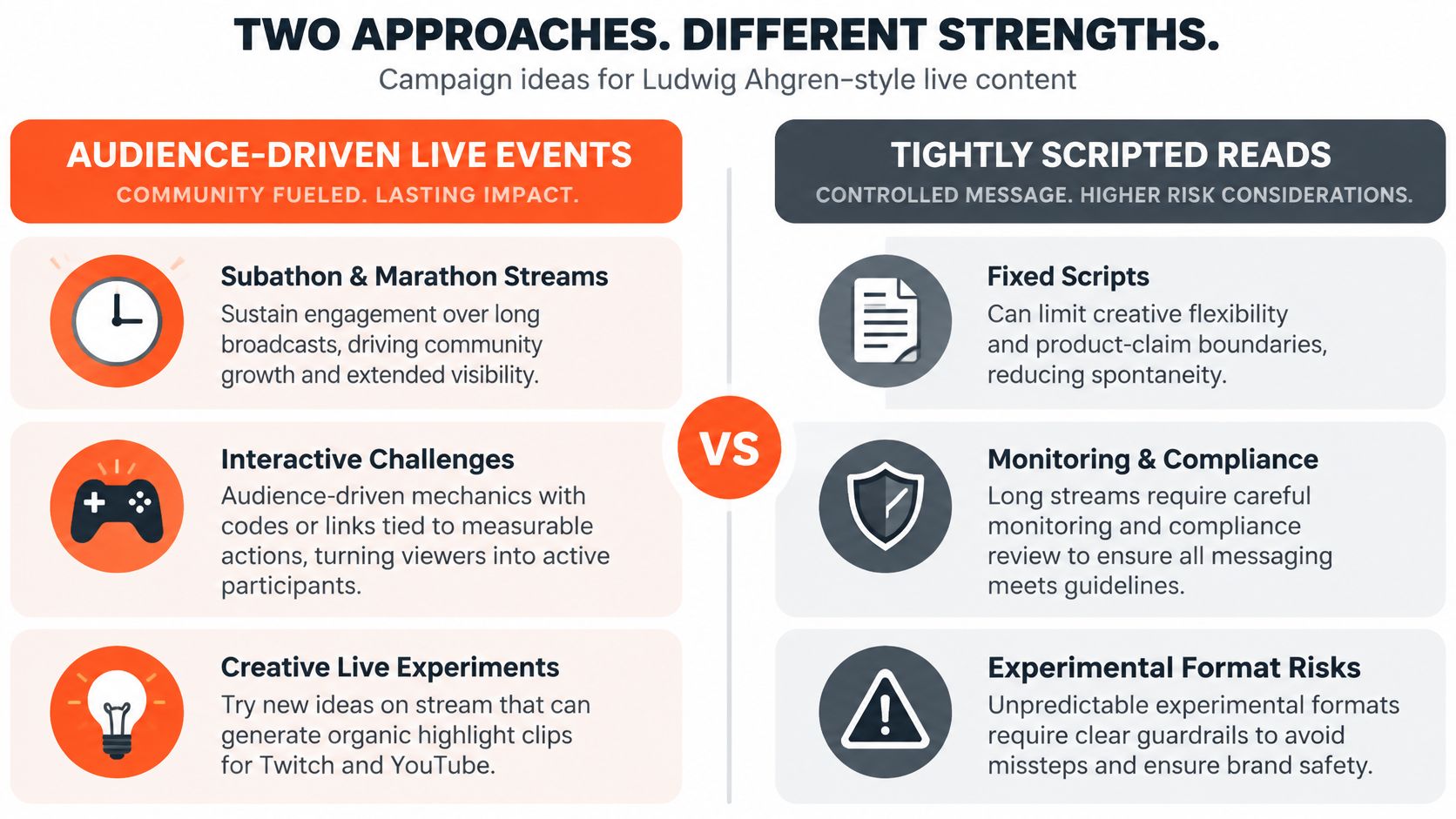
Ludwig Ahgren's value is experimentation. Subathons, live challenges, interactive formats that turn the audience into a participant rather than a viewer. If you want to test a mechanic before rolling it across a program, testing is cheapest here and the audience is most forgiving.
The creator side of that equation is more professional than it looks on screen. In YRS's Gaming Content Creator Report, 30.3% of surveyed gaming creators reported creating content full-time in 2025, while 49.5% combined content creation with full-time employment or education, as reported by Netinfluencer. Nearly half the market is part-time, so availability, response times, and paperwork vary enormously.
And most of them negotiate alone. The same report found that 92.7% of surveyed gaming content creators operated independently without agency representation, per WN Hub's coverage. That cuts both ways. No agency layer means faster decisions, and no agency layer means your brief may be the only structured document in the deal. Put deliverables, dates, disclosure, and usage rights in writing, plainly, and confirm them in the chat you'll use.
The honest comparison: a creative, audience-driven format can beat a polished scripted spot on engagement. It can also produce nothing you can measure if you don't attach an action to it.
So attach one. A challenge with a code, a goal tied to a link, a named action the audience takes at a specific moment. Give creative freedom on presentation and keep measurement rigid.
Say an app brand runs one interactive challenge as a test, with a code and a matched control group in the same market. If it beats the control, you've validated the mechanic before buying it ten more times.
How the 10 gaming content creators compare at a glance
| Item | Primary Platform | Core Content Style | Best For |
|---|---|---|---|
| PewDiePie (Felix Kjellberg) | YouTube | Gaming commentary, Let's Plays, and reaction videos | Broad awareness and long-form game promotion |
| Markiplier (Mark Fischbach) | YouTube | Horror and survival gameplay with comedic commentary | Horror, thriller, and indie game launches |
| Jacksepticeye (Seán McLoughlin) | YouTube | High-energy, upbeat Let's Plays across varied genres | Approachable campaigns with broad gaming appeal |
| Ninja (Tyler Blevins) | Twitch and YouTube | Live competitive and battle royale gameplay | Game launches, esports events, and live integrations |
| Pokimane (Imane Anys) | Twitch | Variety gaming, chat interaction, and community content | Interactive campaigns across gaming and lifestyle |
| Shroud (Michael Grzesiek) | Twitch | Skilled competitive shooter streams | Gaming hardware and performance-focused products |
| Valkyrae (Rachell Hofstetter) | Twitch and YouTube | Multiplayer gaming and esports-related content | Esports and cross-platform gaming campaigns |
| Kai Cenat | Twitch | Long live events, subathons, and audience participation | Extended live activations and community events |
| Ibai Llanos | Twitch and YouTube | Large-scale live entertainment and gaming events | Spanish-speaking audiences and major event sponsorships |
| Ludwig Ahgren | Twitch and YouTube | Interactive challenges, subathons, and creative live formats | Experimental live campaigns and audience-driven activations |
Match Creators to Your KPI, Then Measure Every Placement
The shortlist is the easy part. Anyone can rank names by subscriber count. The work sits in three filters, applied in order.
- Genre fit: ask what the audience already plays, not what the creator has posted. A shooter crowd won't install a puzzle game because a familiar face told them to, and a cozy-games audience won't care about your latency claims.
- Format: live buys urgency and community, recorded video buys search and a longer shelf life, short-form buys the cheapest first touch. Decide which one your KPI needs before you decide who delivers it, because the same creator prices differently across all three.
- Language and market: an English-language streamer selling into Germany is paying for reach you can't convert. Localize, or pick a creator whose audience already lives where your buyers are.
Then every placement carries its own tracking link or promo code. Not a campaign-level code, and not UTMs you'll untangle months later. One code per placement, so a conversion maps to a person, a format, and a date. Without that, you're buying impressions and hoping the numbers move.
Benchmark against gaming norms and your own control, never against a cross-industry influencer average. A gaming audience behaves differently from a lifestyle audience, and a launch window behaves differently from steady-state. Keep a matched control group running alongside the creator spend, even a small one, and report incremental lift rather than last-touch credit.
One lever gets ignored more than any other: the cut. A live segment that never becomes a Short, a clip, or a paid social asset is a single-use purchase. Budget the edit with the placement. If your team handles post in-house, these editing picks for streamers and filmmakers are a reasonable starting point.
Selection, forecasting, and reporting are the parts often underestimated. A partner such as Social Cloud screens creators for audience quality, brand fit, and past sponsored performance rather than follower count, forecasts against a target CPI or CPA before any spend, and puts a tracking link and promo code on every placement with weekly reporting on views, CTR, conversions, and ROAS per creator. First content typically goes live three to five weeks after the brief, which is the timeline worth planning your launch around rather than the one you'd prefer.
The creators on this list are all strong in their own lane. None of them is strong in every lane, and the one you pick should be the one whose audience already wants what you sell.
Social Cloud plans, runs, and measures gaming creator campaigns across YouTube, Twitch, TikTok, and Instagram, with a tracking link and promo code on every placement and weekly reporting on what each creator drove. If you're shortlisting creators for a launch and want the fit, format, and attribution questions answered before you spend, send over your KPI and your buyer profile. Start at Social Cloud.