
You get the DM after a stream: “We'd love to work with you. What are your rates?” It feels like a win, right up until the brand asks for audience details, past campaign results, usage rights, and a conversion estimate. A follower count that looked impressive suddenly doesn't answer the questions that matter.
That's the reality of sponsorship for gamers now. Brands aren't only buying a logo on a stream or a mention in a video. They're buying access to a specific community, a credible recommendation, and a way to connect attention with action. If you can show who watches, why the partnership fits, and what viewers do afterward, you stop looking like a creator asking for a fee and start looking like a media partner with growth value.
Table of Contents
Why Sponsorship for Gamers Works Differently Now
A brand can place its logo on a jersey, put a product beside your setup, or buy a mention during a broadcast. Those placements still have value, but the buyer now expects a job for each one. Teams can compare creators, platforms, audience segments, clicks, installs, purchases, and repeat engagement instead of judging exposure alone.
The market's earlier expansion helped set that standard. McKinsey's esports sponsorship analysis reported global esports revenue of about $950 million in 2019, with a projection of $1.1 billion in 2020 and sponsorship forecast to provide 58% of that revenue. The analysis also projected an esports audience of nearly 500 million enthusiasts and occasional viewers in 2020. That scale made gamer-focused media look like a channel brands could plan around, rather than an experiment.
The buyer is evaluating a channel
A brand manager reviewing your deck is usually checking four points:
- Audience quality: Are viewers in the target market, and do they watch rather than scroll past?
- Contextual fit: Does the product belong in this game, genre, stream format, or community?
- Creative usefulness: Can you demonstrate the product naturally instead of reading a stiff script?
- Attribution: Can the team identify visits, installs, purchases, or qualified actions connected to your placement?
The proof should match the campaign goal. A tournament partnership may focus on recognition, while a mobile game integration may prioritize installs. Use fit scoring to assess the match between your audience, content environment, and the product before you pitch. Then agree on the outcome the placement must support.
A logo may help awareness, but it cannot show which viewers acted. Give each asset a measurable role, such as driving a tracked visit, generating an install, or creating qualified product consideration. Outcome-based pricing becomes easier to defend when the deliverable and reporting method are clear.
Practical rule: Treat every sponsorship asset as a placement with a job. If you can't name the job, the brand probably can't justify the spend.
The market has also expanded beyond traditional gaming categories. A 2025 market report estimated global esports sponsorship at $2.8 billion, compared with estimates around $1.4 billion in 2023, and projected $7.6 billion by 2034 at an 11.7% CAGR. It also estimated that non-endemic sponsors accounted for about 47% of esports sponsorship revenue in 2025, compared with 28% in 2020. The market overview from Dataintelo describes a field that includes consumer, fintech, and technology brands alongside hardware and energy products.
For gamers, the practical shift is simple. Present yourself as a focused distribution partner who understands the community, the product, and the outcome the brand needs. That positioning turns sponsorship from a vanity logo into a performance channel.
Get Sponsor Ready With Metrics and Media Kit Essentials
Before outreach, audit what you can sell. Brands don't need a giant presentation. They need a clear answer to whether your audience matches their customer and whether your content can deliver a credible placement.
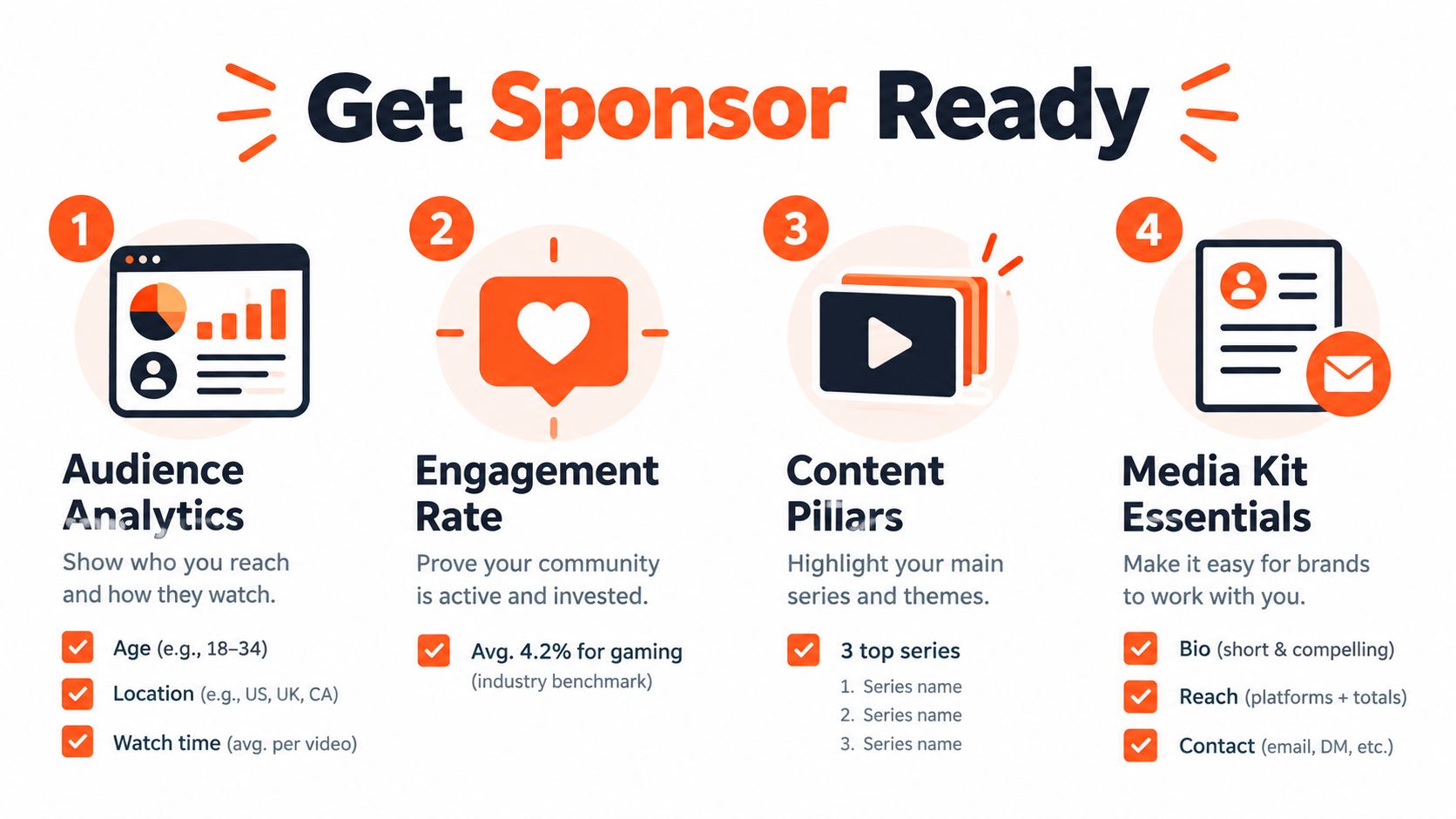
Start with platform analytics, not vanity metrics. Pull recent data from YouTube Studio, Twitch analytics, TikTok Analytics, or the relevant platform dashboard. Look at average views or live viewers, watch time, retention, returning viewers, traffic sources, audience geography, age ranges, device behavior, and chat or comment quality. Use a consistent recent period, and label the period clearly so a strong one-off upload doesn't represent your whole channel.
Build a media kit that answers buyer questions
Keep the first version to one or two pages. A useful kit includes:
- Positioning: Explain your game, format, personality, and community in one tight paragraph.
- Audience snapshot: Show location, age bands, platform split, and relevant interests from native analytics.
- Performance evidence: Include typical views, live concurrency where relevant, engagement quality, and examples of content that held attention.
- Content menu: List integrations such as a dedicated video, stream segment, short-form cut, product demonstration, giveaway, or tournament placement.
- Past partnerships: Name brands only when you have permission, and describe your actual deliverables rather than implying results you can't prove.
- Contact details: Give one business email and a direct next step.
Your niche is often an advantage. A creator focused on a particular competitive title may offer less total reach than a general gaming channel, but the audience can be more coherent. A sponsor selling a product for that community may prefer concentrated relevance over broad, loosely connected traffic.
Don't add screenshots just because they look official. Crop them so the important metric is readable, explain what it measures, and remove private information. If you have no sponsorship history, use recurring series, community questions, affiliate activity, or product-led content to demonstrate that viewers respond to recommendations.
Check your own audience before a brand does
Look for suspicious spikes, mismatched locations, empty comments, and views that don't align with watch time. You don't need to accuse your audience of anything. You do need to know whether the data tells a consistent story.
For a broader framework on audience selection, creator fit, and campaign structure, review influencer marketing for gaming. The useful principle is to connect creator selection to the campaign objective, not to select a name first and invent a reason afterward.
Leave out inflated projections, unrelated follower counts, and vague claims such as “my community loves everything I recommend.” Replace them with evidence: a recurring series, a relevant audience segment, a clear content concept, and a measurement method.
Finding the Right Sponsors and Pitching Without Spam
The fastest way to make sponsorship outreach ineffective is to send the same pitch to every gaming brand. A controller company, a mobile publisher, a meal service, and a financial app may all want gamer audiences, but they don't want the same content or outcome.
Build a prospect list around community fit first. Review products already appearing in your category, brands sponsoring adjacent creators, companies advertising inside your game ecosystem, and products your audience asks about. Non-endemic categories are increasingly active in esports sponsorship, so don't limit your list to peripherals, chairs, energy drinks, and hardware.
Write the pitch around the brand's outcome
Your first message should make the recipient understand the fit without opening a deck. Use this structure:
- Relevant observation: Mention a campaign, product launch, game update, or audience problem that connects to your channel.
- Audience match: State who watches and why that group is relevant to the brand.
- Activation idea: Offer one concrete concept, such as a live product test, challenge, build guide, loadout integration, or short-form clip sequence.
- Proof: Add one or two verified channel metrics that support the idea.
- Measurement: Suggest a tracked link, promo code, install event, or survey question.
- Low-friction next step: Ask whether they're planning creator partnerships for the relevant period.
A weak pitch says, “I have a large gaming audience and would love to collaborate.” A stronger one says, “My viewers follow competitive loadout breakdowns, and your new accessory could fit a live comparison where the audience helps choose the final setup. I can separate the placement with a tracked link and report clicks, conversions, and viewer questions.”
For mobile titles, it also helps to understand how creators can support paid distribution after the organic placement. A practical overview of partnership ads for mobile campaigns can help you discuss creator content as both a recommendation and a potential amplification asset.
Follow up like a professional
Send one concise follow-up with a new detail, not the same message copied again. You might add a revised activation, a relevant recent upload, or a question about the brand's campaign objective. If there's still no response, close the thread politely and move on.
Brands often judge the first 30 seconds of a deck by whether it shows judgment. Put the audience fit, proposed deliverable, expected reporting, and commercial terms near the front. Save personal history and every achievement badge for later.
Don't promise guaranteed sales unless the contract defines the conditions and tracking. You control the placement and creative execution. You don't control the product page, checkout, price, app-store friction, or the brand's follow-up advertising.
Pricing Your Deal and Negotiating Like a Pro
Pricing becomes easier when you stop treating every sponsorship as the same product. A dedicated YouTube integration, a Twitch live segment, a TikTok clip, and a team jersey placement carry different production demands, audience behavior, rights, and measurement options.
The main commercial models are flat fee, cost per install, cost per action, and hybrid compensation. None is automatically fair. The right choice depends on how much control you have over the outcome and how much value the brand receives beyond the initial post.
Choosing Your Sponsorship Pricing Model
| Pricing Model | Best For | Risk and Reward |
|---|---|---|
| Flat fee | Defined deliverables, awareness campaigns, dedicated videos, or live placements | You receive predictable compensation, while the brand carries performance risk |
| CPI | Mobile games and app campaigns with a clearly defined install event | The brand pays for a measurable action, but you carry more risk from store friction and attribution gaps |
| CPA | Purchases, subscriptions, or qualified customer actions | Your upside can grow with results, but you need transparent tracking and a realistic conversion path |
| Hybrid | Campaigns combining guaranteed production with performance upside | A base fee protects your time, while a bonus lets both sides share the upside |
A flat fee should account for preparation, filming, editing, live time, revisions, administration, and the audience access itself. Don't price only the minutes spent saying the sponsor's name. A short segment can require substantial planning, product testing, moderation, and compliance work.
Performance pricing needs definitions in writing. Clarify what counts as an install or action, the attribution window, reporting access, payment schedule, cancellation terms, and whether organic or paid distribution is included. If the brand can run your content as an ad, that usage has value separate from the original placement.
For context on how creator pricing relates to media efficiency, influencer marketing CPM offers a useful way to compare exposure costs. CPM alone shouldn't set your rate, though. It can overlook trust, creative labor, conversion intent, exclusivity, and the value of a well-matched community.
Negotiate the terms that change the economics
The headline fee is only one lever. Review:
- Usage rights: Where can the brand repost, edit, or run the content as paid media?
- Exclusivity: Which competing products are restricted, for how long, and on which platforms?
- Deliverables: Are clips, raw footage, thumbnails, whitelisting, pinned comments, and story posts included?
- Approval process: How many revision rounds can the sponsor request?
- Performance bonus: What happens when the campaign exceeds the agreed target?
- Payment timing: Is part of the fee due before production begins?
A good proposal makes the trade-off visible. You might offer a smaller base plus a bonus for verified actions, or a higher flat fee if the sponsor wants broad usage and category exclusivity. Don't accept vague “exposure” in place of compensation unless the exposure itself has a defined commercial benefit you genuinely want.
Disclosure Legal Basics and Activations That Actually Convert
Disclosure isn't a decorative line at the bottom of a description. It tells viewers that a commercial relationship exists, and it protects the credibility that made the sponsorship valuable in the first place.
On YouTube, identify the paid relationship clearly in the video and description where appropriate. On Twitch, state the sponsorship during the stream and make the commercial nature visible in panels or accompanying information. On TikTok, use the platform's paid partnership tools and clear language in the content itself. Requirements vary by market and campaign, so brands and creators should check current guidance from the relevant regulator and platform.
Avoid vague wording that viewers may miss. “Thanks to the brand” doesn't necessarily explain that money, products, or another benefit changed hands. A direct statement such as “This stream is sponsored by [brand]” is easier to understand, but the final wording should match the applicable rules and contract.
Match the activation to the objective
Asset selection affects recognition. One academic study found the highest recognition scores for team sponsorship and equipment sponsorship, with average ratings of 6.7 and 6.5, respectively. The study by Wu also connects perceived sponsor fit with stronger purchase intentions, which is why a visible product isn't enough on its own.
For awareness, use assets viewers naturally see repeatedly:
- A team jersey or tournament identity
- A peripheral used during real gameplay
- A visible setup element with a short, relevant explanation
- A recurring stream segment tied to the product's purpose
For direct response, add a clear action layer:
- A tracked link in the description and chat command
- A unique promo code spoken aloud and pinned
- A product demonstration that answers a real viewer objection
- A follow-up clip focused on the use case rather than another logo shot
A creator testing a headset can compare comfort during a long session, explain microphone settings, and let viewers hear the difference. A mobile game creator can show the onboarding flow, identify who the game suits, and place the install CTA at the moment of demonstrated value. Both examples work because the sponsor appears inside a useful story.
Authenticity beats forced enthusiasm. Viewers can usually tell when a creator hasn't used the product, doesn't understand the audience, or is stretching the game connection.
Keep the brand presence proportionate. Over-branding can make the content feel like an interruption, while an invisible sponsor can't achieve recognition or action. The best activation gives the product a role the audience understands and a next step the brand can measure.
Measure Report and Renew With Attribution Brands Trust
A renewal conversation starts before the first post. Agree on what success means, how each placement will be tracked, and which data the brand will receive. Otherwise, the campaign ends with a view count and a disagreement about whether the result was good.
Use a distinct UTM link for each creator and placement. Add a unique promo code where checkout or attribution allows it. For products with longer consideration cycles, include a post-purchase survey asking customers how they heard about the brand. This guide to measuring influencer marketing ROI covers the broader logic of connecting creator activity with business outcomes.
Report what happened, not just what looked good
A useful report separates delivery, attention, and action:
- Delivery: Publish date, format, placement, live duration, views, and reach where the platform defines it reliably.
- Attention: Watch time, retention, average live viewers, chat activity, and comment themes.
- Action: Link clicks, code uses, installs, purchases, leads, or survey responses.
- Learning: Which hook, game, format, CTA, and audience segment produced the strongest response.
Be careful with reach claims. A 2025 governance review warns that esports reach can be inferred from streaming-platform totals and inflated, so validate unique performance with creator-level links, codes, and surveys. The review in the Journal of Global Sport Management also points to overcounted exposure and poor sponsor fit as common problems.
A fragmented market makes this even more important. A July 2026 tracker reported 164 gaming brands, roughly 3,000 sponsored YouTube videos, about 1,000 creators, and 207 million views in a single month. The tracker coverage from Blockonomi suggests that smaller creators can matter when discovery, fit, and distribution are evaluated together rather than by marquee reach alone.
Close each campaign with a renewal recommendation: keep, change, or stop each placement. Show the strongest format, the weakest assumption, the next test, and the commercial term you want. A creator who brings verified learning to the next negotiation has more influence than one who only repeats a large view count.
Social Cloud helps brands and gaming teams select creators, plan campaigns, manage disclosures and usage rights, and attribute every placement with tracking links, promo codes, and post-purchase surveys. Visit Social Cloud if you want sponsorship programs built around measurable installs, conversions, and repeatable creator performance.