You're probably staring at a Twitch brief that looks fine on paper. The creator has reach, the budget is approved, the product fits the audience, and someone in the room is already asking why the follower count looks high while last month's campaign barely moved codes. That's the wrong question to start with.
Influencer marketing Twitch works when you treat it like a measurement problem first and a reach problem second. Twitch is built around live attention, not static exposure, so the signals that matter are average concurrent viewers, chat behavior, watch time, creator fit, and what happens in the 24 to 72 hours after stream. A strategy that starts with follower counts usually ends up buying noise, not outcomes.
Table of Contents
What Makes Twitch Different From Every Other Influencer Channel
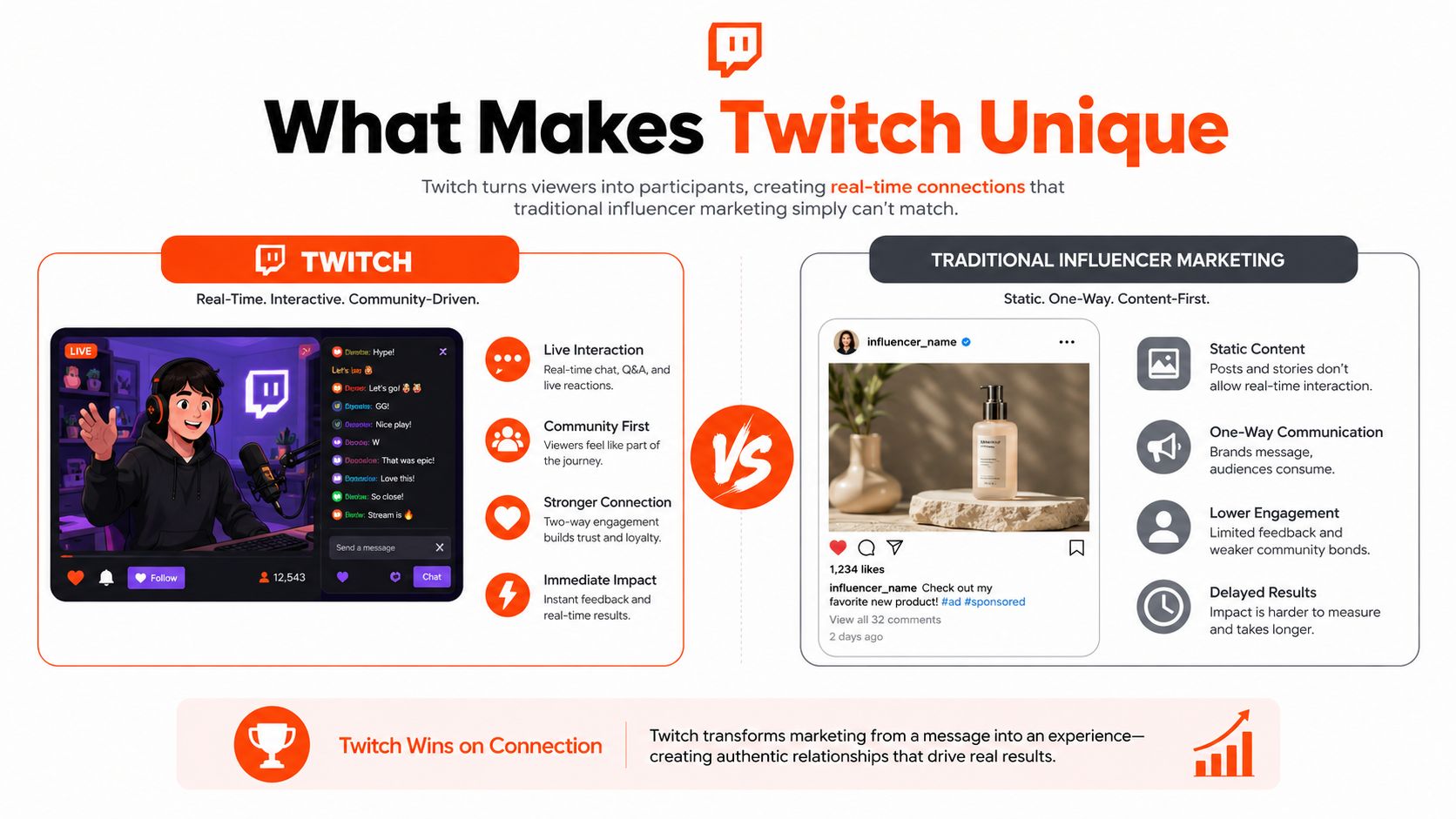
The first thing to understand is that Twitch doesn't behave like a polished post feed. A creator can mention your product, the chat can light up instantly, and the buying signal is sitting in the room while the stream is still live. That's very different from chasing likes on a short-form clip after the moment has already passed.
Twitch's scale makes this even more useful for performance teams. One source reports more than 240 million monthly active users in 2025, over 19 billion annual hours watched, and roughly 93,200 channels actively streaming live at once, while another records a peak of 13.8 million concurrent viewers on July 26, 2025. Those numbers matter because they show why live creator supply and concentrated real-time audiences can support sponsorships, product walkthroughs, and affiliate mechanics at scale. The same data also makes the operating model clear, campaigns here usually rely on repeated live exposure and trust, not one-off impressions. Twitch scale and viewing milestones
Why short-form metrics mislead here
A TikTok or Instagram habit can poison Twitch planning if you let it. On those platforms, the scorecard often lives and dies by quick reach spikes. On Twitch, the room is the asset, and the room stays open long enough for context, objections, and product questions to happen in public.
Practical rule: if you can't explain how a stream earns attention inside the first few minutes, you're probably overestimating what the audience will tolerate later.
This is why ACV, chat velocity, and full-stream dwell time are better planning inputs than follower count or peak viewership. The platform also rewards long-form conversation. A creator can demonstrate a product, answer questions, and let the audience co-sign the recommendation in real time, which is why the channel is strong for gaming, apps, consumer tech, and direct-response offers. If you need a primer on audience growth mechanics inside the platform, Twitch follower growth tactics is a useful companion read, especially if you're trying to understand how channel momentum gets built before any paid activation lands.
Twitch Ad and Creator Formats Worth Your Budget
Twitch gives you two different buying paths, direct ad inventory and creator-led formats. The mistake many make is assuming they're interchangeable. They're not, because one buys placement and the other buys trust.
What each format actually does
Pre-roll is the blunt instrument. It can make sense when you're buying awareness against ACV-heavy audiences, especially if the stream itself already has the right context for your category. Mid-roll is better when the broadcast is long enough for the audience to settle in, because it gives you room for a story instead of a forced interruption.
Sponsored segments, product demos, extended gameplay integrations, and raid-to-offer sequences are where budget usually starts to earn its keep. A creator can show the product in their natural play pattern, answer live questions, and move people toward a link or code without killing the stream's flow. Home screen takeovers and generic display placements can still have a role, but they're easy to overbuy if they aren't tied to a creator moment. If you're turning live streams into cutdowns, find the best clip-making guide and use clips as a retargeting layer, not as a substitute for the live event.
| Format | Best Use | Primary Metric | Verdict |
|---|---|---|---|
| Pre-roll | Broad awareness before a live session | View start rate | Useful when the audience match is strong |
| Mid-roll | Storytelling inside long broadcasts | Watch time during placement | Better than pre-roll for product context |
| Display ads | Supportive reminders | Click-through | Easy to waste if used alone |
| Home screen takeover | Event-level visibility | Sessions driven | Works only with a strong creator tie-in |
| Sponsored segment | Product demo or live explanation | Code use, link clicks, chat intent | Usually the strongest buy |
| Raid-to-offer sequence | Post-stream conversion push | Post-stream conversions | Strong when the offer matches the audience |
| Sub-gift blast | New community acquisition | New subscribers | Better for community building than direct response |
| Clip rights | Off-platform retargeting | Clip views, assisted conversions | Valuable when reused well |
A blended mix usually wins, but the weight should lean toward creator-led segments. Direct inventory can support the program, yet it rarely replaces a creator who can explain why the offer belongs in that stream.
How to Pick Twitch Creators Worth Partnering With
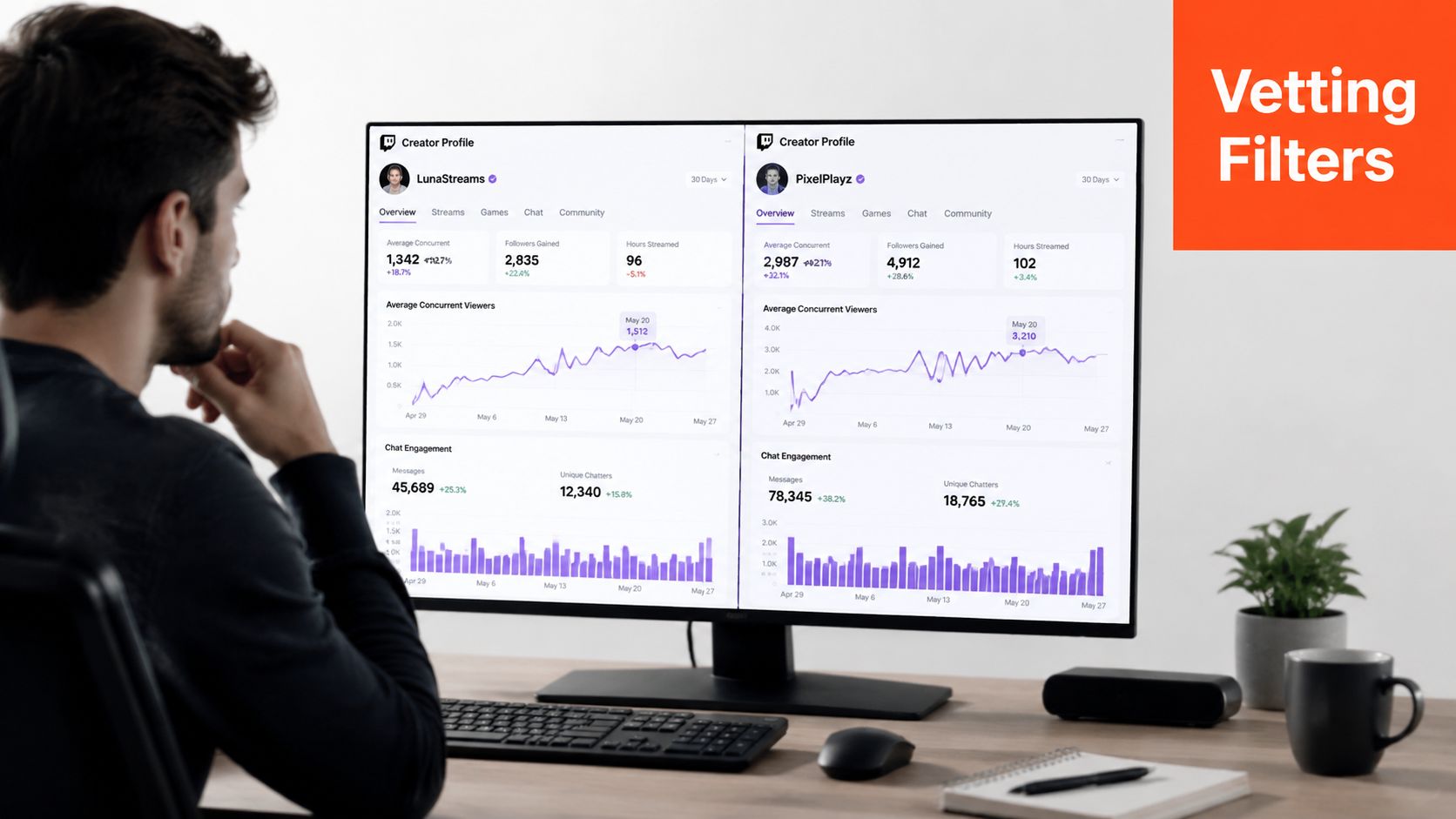
The cleanest vetting process starts with average concurrent viewers, not followers. Follower counts can look impressive while the live room stays thin, and that gap is exactly where budgets go to die. The right question is whether the creator can consistently hold a live audience that behaves like a real audience.
Read the room before you read the profile
Look at chat velocity, unique chatters, and how active the moderation environment feels. A healthy stream usually shows repeated interaction, not just a few names talking to each other while everyone else watches. Low chat on high-view streams deserves scrutiny, because it can mean weak engagement or inflated numbers.
Content fit matters just as much. Check category mix, past brand integrations, and whether the creator can read an offer naturally without sounding like they're reciting legal copy. You should also review region skew when the campaign needs geo alignment, because creator audience makeup isn't always obvious from the profile page.
A stream that fits the category but ignores the audience rarely performs as well as a smaller creator whose community already trusts product recommendations.
A practical scoring rubric helps remove ego from the process:
- ACV floor: decide the minimum live audience you're willing to buy.
- Chat ratio: compare chat activity to average viewers.
- Content adjacency: make sure the product belongs in the stream.
- Prior sponsorship performance: check how naturally the creator handled earlier integrations.
- Red flags: inflated subs, viewbot-looking patterns, or a stream culture that punishes ads instead of absorbing them.
A clean creator list usually comes from tools like TwitchTracker or SullyGnome, plus the creator's own media kit or analytics screen. If you're comparing channels against a broader campaign workflow, Social Cloud handles creator selection, tracked links, promo codes, and reporting across Twitch and other platforms, which can help when one team needs a single attribution view across formats.
Briefing Creators So the Stream Still Feels Live
A good Twitch brief doesn't read like a script. It gives the creator enough structure to stay accurate, then gets out of the way so the stream still sounds like a real person talking to a real community.
What belongs in the brief
Start with one sentence on the campaign objective. Then give the streamer the single message they need to land, plus three to five talking points written as prompts, not lines they must memorize. That difference matters, because prompts let the creator sound conversational instead of promotional.
The compliance block should be explicit. Include the disclosure language the creator needs for FTC-style disclosure and Twitch context, plus the product facts they must not invent. If something can't be verified, it shouldn't be in the live read. You also need a short do-not-say list for claims, comparisons, or discount language that would create risk.
A Loom or voice note usually beats a slide deck. Creators absorb tone faster when they can hear the brand intent instead of decoding a file full of bullet points. After that, the handoff loop should be tight, with talking points reviewed by the creator, factual claims signed off by the brand, a short pre-stream call, and a live producer in chat to surface links or redeem codes on cue.
Useful habit: review facts once, review tone twice, and let the creator own the performance.
A creator-facing checklist should include:
- Timing: when the mention happens and how long it should run.
- Overlay placement: where the code or link sits on screen.
- Raid copy: what gets said if the stream ends in a raid.
- Clip rights: whether the brand can reuse the moment later.
- Disclosure cadence: where and how often the sponsorship is repeated during a long broadcast.
For teams that want a broader video-briefing reference, the workflow around influencer video marketing is a useful parallel, especially when Twitch is part of a larger creator mix.
Tracking Twitch Campaigns the Way Performance Teams Expect
The safest way to judge Twitch is to stop pretending follower count predicts revenue. It doesn't. A live stream needs its own scorecard, and that scorecard should follow the audience from the live room into the conversion window that happens after the broadcast ends.
Build the tracking stack before the stream starts
Every creator should have a unique link and a unique code, even if the offer is the same. Shared codes blur attribution and make it impossible to know which creator pulled weight. If Twitch Attribution tools are available in your stack, use them, but don't rely on them alone. Pair them with UTM-tagged links, creator-level promo codes, and a post-purchase survey so you can separate direct clicks from assisted demand.
The report needs to reflect the lag. Twitch viewers often don't buy in the first minute they see an offer, because they're still watching the stream, waiting for a raid, or checking the creator's Discord after the session. A practical performance window is 24 to 72 hours post-stream, not just day-one ROAS, because that's where a lot of the assisted response shows up.
| Metric | Source | Target | Notes |
|---|---|---|---|
| Average concurrent viewers | Twitch or creator analytics | Set by channel size | Better than peak viewers for planning |
| Unique viewers across stream | Twitch analytics | Track per activation | Helps estimate total exposure |
| Chat activity | Live chat logs | Relative to stream norm | Useful for intent and quality |
| Link clicks | UTM tracking | Per creator | Requires unique URLs |
| Code redemptions | Checkout or promo system | Per creator | Best for direct attribution |
| 24-hour conversions | Store or app analytics | Compare by creator | Captures delayed action |
| 72-hour conversions | Store or app analytics | Compare by creator | Useful for assisted lift |
| Branded search lift | Search or analytics tools | Directional comparison | Shows demand beyond clicks |
If you're formalizing this into a reporting process, how to measure influencer marketing ROI is the right internal reference point to align finance, growth, and creator management on the same definitions.
The minimum reportable fields should be creator name, stream date, ACV, unique viewers, chat activity, link clicks, code redemptions, and post-stream conversions. Anything less and you're guessing.
Twitch Campaign Mistakes That Quietly Burn Budget
Most Twitch waste doesn't come from bad ideas. It comes from lazy operating habits that survive because the creative looked exciting in the kickoff deck. That's how teams end up feeling busy while the actual campaign result stays fuzzy.
The usual failures are easy to spot
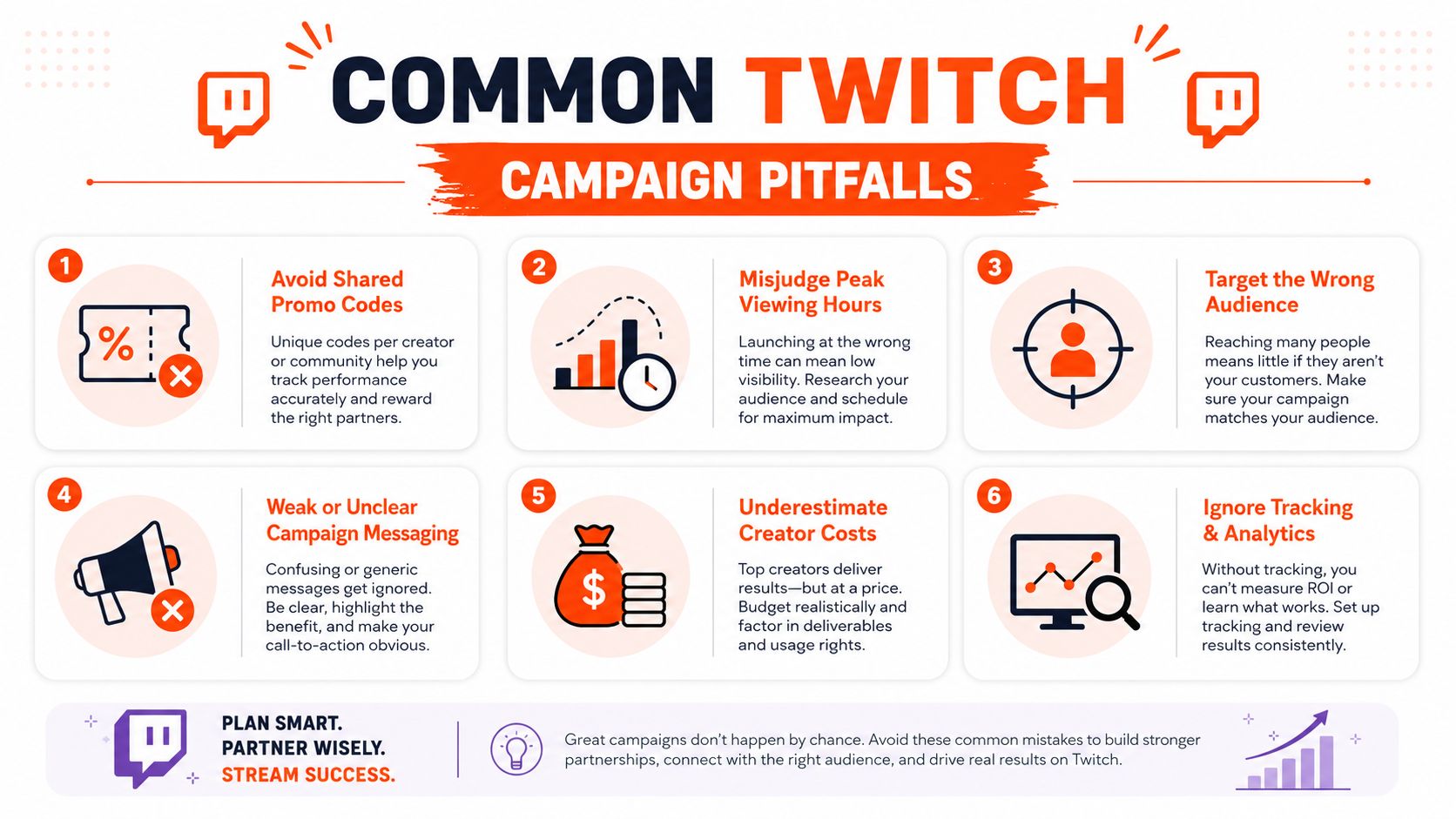
Shared promo codes are the quickest way to ruin attribution. If several creators use the same code, you won't know who generated demand, and the report turns into a post-hoc argument instead of a decision tool. Peak concurrent viewers cause a different kind of mistake, because they flatter the campaign while the live room may have been much less stable than the headline number suggests.
Hard-sell reads are another common miss. A ninety-second monologue that ignores chat can break the flow of the stream and make the audience tune out. So can burying the disclosure once at the beginning and never repeating it during a long broadcast, because viewers join at different times and need context when they arrive.
A few more budget leaks show up again and again:
- Weak creator sync: briefing only in writing and skipping a real pre-stream conversation.
- Overbuying mega-channels: choosing scale when a smaller, tighter community would have converted better.
- No clip rights plan: failing to secure the right to amplify the best moment later.
- Ignoring co-streams: forgetting that the message may need to survive multiple live formats.
- Underusing mid-tier creators: assuming only the biggest names can move a product.
If the stream feels like an ad slot instead of a live moment, the audience usually behaves like it found an ad slot.
The fix is boring but effective. Audit the last activation, name the exact metric or process gap behind each miss, and rewrite the SOP before the next launch. Twitch rewards teams that respect the room, not teams that try to force-feed it.
Your Pre-Launch and Post-Launch Twitch Checklist
A clean Twitch launch depends on owners, not optimism. If one person can't be assigned to each line item, the task isn't real yet. Use this as the campaign run sheet before the next activation goes live.
Pre-launch
- Confirm creator fit: verify ACV, chat quality, and category adjacency.
- Approve deliverables: lock stream date, segment length, disclosure placement, and clip rights.
- Set tracking: build unique UTMs, codes, and post-purchase survey language.
- Review compliance: sign off on mandatory disclosure wording and prohibited claims.
- Run a tech rehearsal: schedule a 24-hour pre-stream check for audio, overlays, and link routing.
Launch day
- Assign moderation: give one person responsibility for chat questions and link support.
- Rotate pinned assets: make sure the right link or code is visible when the offer goes live.
- Monitor the room: watch chat tone, audience reactions, and any confusion in real time.
- Protect the creator voice: let the moderator surface logistics without hijacking the stream.
- Log anomalies: note raids, interruptions, or timing shifts that affect performance.
Post-launch
- Pull 24, 48, and 72-hour snapshots: compare conversions against the live window.
- Archive VOD clips: save the moments worth reusing.
- Capture chat sentiment: summarize what the audience asked, liked, or resisted.
- Reconcile creator uniques with platform data: flag any mismatch before reporting.
- Document the learnings: store what worked, what failed, and what to change next time.
If you're standardizing that process across channels, the broader campaign framework in influencer marketing campaign planning helps keep Twitch aligned with the rest of the creator mix.
If you want a Twitch program that's judged on real performance instead of vanity metrics, Social Cloud plans, runs, and measures creator campaigns with per-creator tracking, disclosure management, and weekly reporting tied to outcomes. Visit Social Cloud to see how a measurement-first workflow can turn live creator attention into something your team can defend.