
The most common advice for choosing an influencer agency is to check its creator roster and campaign portfolio. That's a weak starting point. A recognizable face and a polished case study won't tell you whether the agency can prevent a disclosure mistake, attribute sales to individual creators, or share the financial risk when a campaign misses its target.
If you're searching for influencer agentur Deutschland, judge the operating model before the pitch deck. For a growth team, the purchase isn't access to creators. It's a controlled way to turn creator partnerships into measurable customer acquisition without leaving your marketing team to untangle contracts, tracking, and approvals.
Table of Contents
- What a German Influencer Agency Should Cover
- How to Vet Creators Beyond Follower Counts
- Pricing Models and Who Carries the Risk
- Attribution and Forecasts Worth Asking For
- Disclosure Rules and the Approval Workflow
- Launch Timing and Reporting Cadence
- Confirm the Agency Before You Sign
What a German Influencer Agency Should Cover
Germany's creator market is big enough that booking posts isn't a sufficient agency service anymore. A Lookfamed market summary puts annual German influencer-advertising expenditure at approximately €223 million in 2019, with €622 million projected for 2024. Treat those estimates as directional, since market definitions differ.
The practical implication is straightforward: your agency should operate the campaign, not just introduce the talent.
Say a German subscription brand wants customers rather than general visibility. Someone needs to decide which platforms suit the purchase journey, which creators can explain the offer, how the checkout will record referrals, and who can approve the content. If the agency only negotiates creator fees, your internal team still owns most of the difficult work.
Service layers a full-service agency should cover
| Service layer | What you should receive | Where it runs |
|---|---|---|
| Strategy and forecasting | Target CPI or CPA, expected views, budget split by platform | All four platforms |
| Creator selection | Vetted shortlist screened for audience, brand fit and sponsored results | Micro to macro tiers |
| Briefing and creative QA | Brief, creative guidance and review before publishing | Video, social, trends, live |
| Contracting and compliance | Contracts, disclosures and usage rights | Every market and platform |
| Tracking and attribution | Tracking links, promo codes and post-purchase surveys per creator | Every placement |
| Reporting | Weekly views, CTR, conversions and ROAS by creator | Per platform |
| Gifting and seeding | Affinity-matched product seeding for UGC | Instagram, TikTok, YouTube |
Buy deliverables, not a platform list
YouTube, Instagram, TikTok, and Twitch require different production decisions. A YouTube video can accommodate a detailed demonstration. Instagram Reels, Stories, and collabs serve different discovery and response roles. TikTok Spark Ads require permission to amplify a creator's post, while YouTube Shorts need their own edit. Twitch live sponsorships need talking points that work during an unscripted stream.
A proposal that lists every platform but supplies the same creative approach for each hasn't resolved those differences.
The subscription brand's brief should identify the objection the creator needs to answer. Perhaps buyers don't understand the subscription commitment. The creative review should then check whether the explanation is accurate and understandable, not rewrite the creator's delivery into corporate copy.
Distinguish a campaign operator from a talent booker
A talent-only booker can be the right purchase when your team already handles strategy, legal review, measurement, and production. Don't pay for full-service management if you only need introductions and negotiation.
A full-service proposal should name the owner, deliverable, approval point, and exclusions for every service layer. Look especially for the work that falls between teams: product shipping, replacement creators, broken tracking links, delayed approvals, and paid-media permissions.
Buying rule: If a task matters to launch but nobody owns it in the proposal, assume your team will inherit it.
How to Vet Creators Beyond Follower Counts
Follower count tells you the size of an account, not whether its audience will buy your product. Start with the people watching, the creator's credibility in your category, and the performance of previous commercial content.
Review profiles alongside actual campaign evidence, not a spreadsheet of handles.

Run checks that can disqualify a creator
- Audience quality: Request native audience insights showing location and age. Inspect comments, follower growth patterns, and engagement consistency. Our Instagram fake-follower checking guide gives your team a practical starting point for spotting suspicious signals.
- Brand fit: Read the creator's recent content and commercial partnerships. A suitable audience doesn't automatically make an endorsement believable, especially if the creator recently promoted a conflicting product.
- Sponsored performance: Separate paid posts from organic hits. Request evidence relevant to your objective, such as tracked purchases for commerce or qualified registrations for software. Missing conversion records should be marked as missing, not replaced with likes.
- Content voice: Give the creator a product problem to explain. Check whether they can answer it naturally without burying the offer or making claims your brand can't support.
We screen creators for audience quality, brand fit, and past sponsored-content performance, not just follower counts. In our Match step, we hand-pick verified creators who fit the client's brand and buyers.
Use tiers as portfolio roles
Treat nano creators as potential niche specialists, micro creators as candidates for focused performance testing, macro creators as broader distribution partners, and mega creators as awareness options. Don't assume a tier guarantees trust, efficiency, or reach. Request the agency's tier definitions so its shortlist and reporting use consistent labels.
For a hypothetical test, give niche and broader-reach creators separate budget pools. Keep the offer and landing-page experience comparable, then assess acquisition cost after the agreed observation period. A cheap post isn't efficient if it produces no qualified customers.
For connecting creator choices to objectives, deliverables, and execution, campaign planning with Clipatra is a useful companion resource.
Keep video resources separate from your due-diligence evidence. This embedded video is supplementary, not a substitute for native audience insights and sponsored results.
Finish the vetting conversation with a rejection question: Which creators did you reject last quarter, and why? Request anonymized examples if necessary. An agency that can describe only who made the shortlist hasn't demonstrated how it protects your budget.
Pricing Models and Who Carries the Risk
A fee means little until you know what happens when performance disappoints. A low management fee can sit beside expensive creator commitments, narrow usage rights, and a bonus calculated on revenue your brand would have received anyway.
Compare the payment trigger and the exposure together.
Influencer agency fee models compared
| Model | How you pay | Who carries the risk | Fits when |
|---|---|---|---|
| Flat project fee | Fixed fee for the campaign | Brand carries the performance risk | Clear scope, testing a new market |
| Retainer plus per-post fee | Monthly retainer and a fee per placement | Brand carries most of the risk | Ongoing programmes with steady output |
| CPM-based | Paid per thousand views | Brand pays for views, not outcomes | Awareness and reach campaigns |
| Performance-only | Paid per install, lead or sale, using CPI or CPA | Agency carries most of the risk for the performance-linked fee | Direct-response goals with clean tracking |
| Hybrid base plus performance | Lean base fee plus a bonus tied to agreed metrics | Shared risk | Growth teams that want accountability without full exposure |
A flat project fee buys scope certainty, not outcome certainty. It works when the deliverables and revision limits are explicit. A retainer makes sense for an ongoing programme, but check whether the agency earns more by adding placements.
CPM pricing aligns payment with distribution. That's reasonable for awareness, but it's a poor substitute for acquisition accountability when sales are the objective.
Performance-only pricing shifts exposure only if the contract makes payment conditional. Creator guarantees, production charges, and minimum commitments can leave the brand carrying substantial costs despite the headline.
Prefer a hybrid when both parties control the result
My default recommendation for a growth campaign is a lean base plus a clearly defined performance component. The agency controls selection and execution. Your team controls product availability, checkout quality, pricing, and much of the customer experience. Neither side controls everything.
Our influencer agency pricing guide can help you separate management charges from creator and campaign costs.
Before comparing quotes, resolve these questions:
- Creator costs: Are fees passed through at cost or marked up? What happens to negotiated savings?
- Payment trigger: Does the bonus depend on an install, qualified lead, completed order, or retained customer?
- Measurement authority: Which system decides whether the outcome qualifies for payment?
- Attribution window: How long after an eligible interaction can an outcome count?
- Minimum commitments: Are there guarantees, cancellation charges, or spend floors?
For a purely hypothetical calculation, a €40 CPA applied to 300 eligible conversions equals €12,000 in performance-linked spend. Compare the base fee against that exposure, then add any creator or production costs outside it.
A performance bonus isn't risk sharing if the agency gets paid before your agreed success condition has been met.
Put refund treatment, duplicate leads, existing customers, and disputed attribution in writing. Those details determine the effective price more reliably than the headline fee.
Attribution and Forecasts Worth Asking For
Measurement infrastructure is a meaningful point of differentiation in Germany. The Kolsquare European industry study reports that 15% of German marketers use a technology platform for influencer activities, compared with 39% across Europe, in its 2025 study.
A platform subscription alone proves nothing, though. You need to see how the agency connects a placement to an eligible business outcome.
Build a creator-level measurement record
Assign each creator a unique tracking link and promo code. Add a post-purchase survey asking how the customer heard about the brand, with responses mapped back to creators where possible.
These methods answer different questions. A link records a traceable visit. A code can identify a response without a tracked click, but it may travel beyond the creator's audience. A survey can capture remembered influence, but it relies on the buyer's recall.
Don't add those totals together. Maintain a reconciliation rule so a customer who clicks, uses a code, and completes a survey doesn't become several acquisitions.
Use a shared metric dictionary:
- Views: Platform-recorded views, retaining the platform's definition and separating paid amplification from organic distribution.
- CTR: Tracked clicks divided by the explicitly named exposure denominator.
- CPI: Agreed campaign cost divided by eligible attributed installs.
- CPA: Agreed campaign cost divided by eligible attributed acquisitions.
- Conversion rate: Eligible conversions divided by the specified traffic or interaction denominator.
- ROAS: Attributed revenue divided by the agreed advertising-spend denominator.
For a hypothetical campaign, €20,000 in spend producing €60,000 in tracked revenue gives 3.0× ROAS. That's revenue efficiency, not profit. If margins, fulfilment, and discount costs vary materially, the POAS vs ROAS breakdown from Product Metrics helps frame the profitability question.
Demand assumptions before a confident forecast
Request low, base, and high scenarios for expected views and acquisition cost before committing spend. Each scenario should identify the assumptions behind it: creator delivery, click response, landing-page conversion, and the portion of outcomes the tracking setup can observe.
Then compare forecasts with actuals at the assumption level. If views arrive but clicks don't, changing the checkout isn't the first intervention. If qualified traffic arrives but orders fail, replacing creators may not solve the problem.
Forecast test: An agency should be able to explain what would make its estimate wrong.
Agree when the forecast will be recalibrated and which evidence is sufficient to move budget. Platform-reported conversions and your commerce or app records may differ. Choose the reporting authority in advance, document deduplication, and keep attributed performance separate from claims of incremental lift.
Disclosure Rules and the Approval Workflow
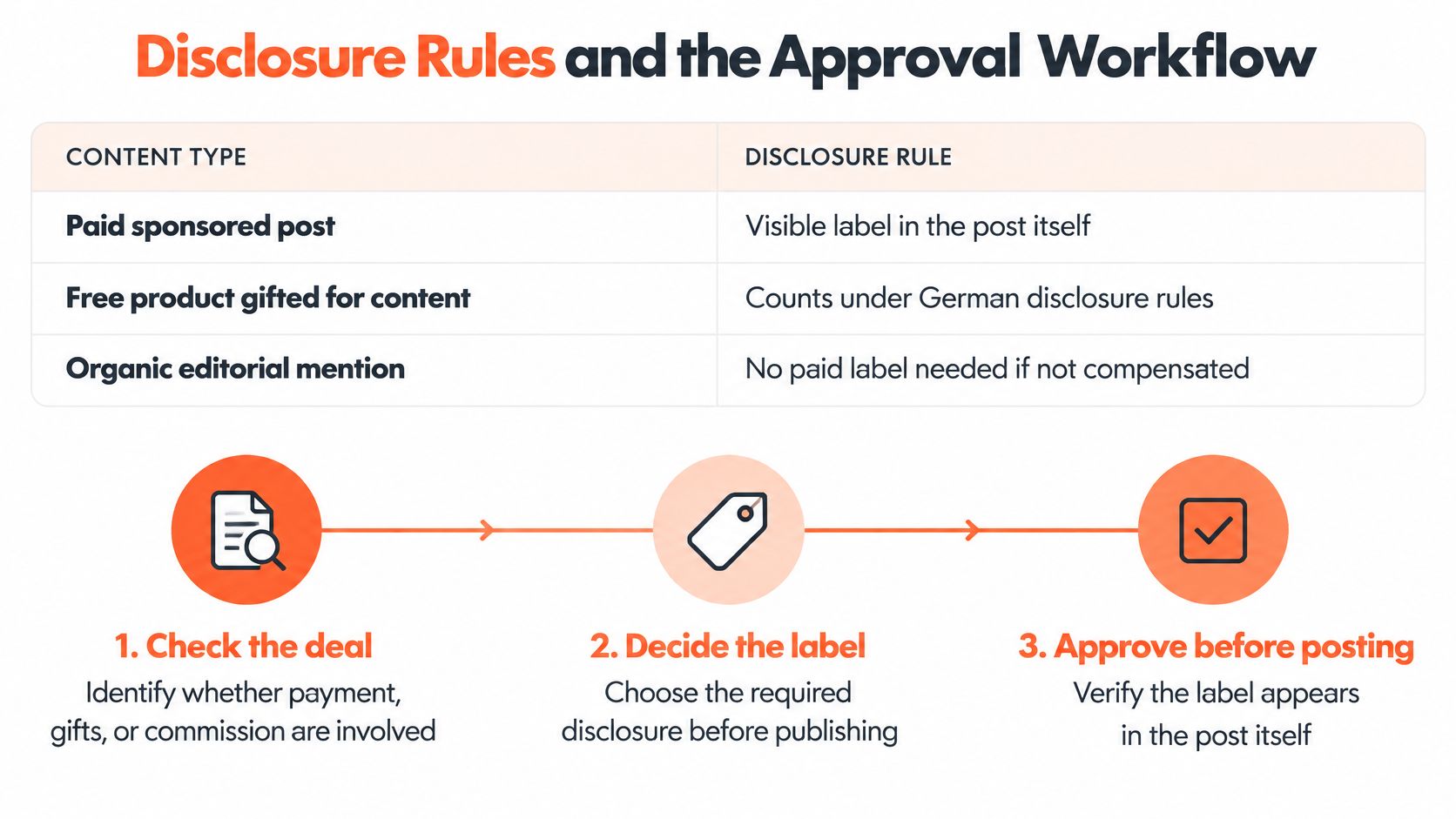
| Partnership type | Counts as advertising? | Disclosure to add |
|---|---|---|
| Paid sponsored post | Yes | Visible label in the post, recognizable at first glance |
| Free product gifted for content | Yes, under German guidance | Same visible label, even with no payment |
| Affiliate or commercial link | Yes when commercially motivated | Label placed next to the link |
| Discount or promo code | Yes | Label in the post itself, not only in the bio |
| Long-term ambassador deal | Yes | Label on every post covered by the deal |
| Creator whitelisting, paid ads from the creator account | Usually yes | Confirm label and rights wording case by case |
The German media authorities' online advertising-labelling guideline treats mentions made under an agreement or in exchange for monetary or non-monetary benefits as advertising and requires disclosure that's recognizable at first glance in the individual content. A profile-wide statement isn't sufficient.
Use the table as an operational starting point, not a replacement for reviewing the actual arrangement. Unsolicited product delivery and an agreed exchange of products for content aren't interchangeable situations.
This visual summarizes the classification and pre-publication control.
Give every placement an approval trail
- Record the consideration. Log fees, products, invitations, commission, and other benefits alongside the agreement.
- Classify the content. Decide whether each deliverable is commercial. Don't leave that decision to the creator at upload.
- Specify the label and position. Require clear disclosure before or at the beginning of the commercial content, adapted to the format. For video and live content, review the viewing experience rather than approving only a caption.
- Name the approver. Obtain written approval of the final content and disclosure. Store the approved version, rights, date, and responsible person together.
- Verify publication. Inspect the live placement and save evidence. Define an escalation owner and correction deadline before anything goes wrong.
German enforcement makes this more than a theoretical checklist: the European Commission's Influencer Legal Hub describes the 2021 Federal Court of Justice judgment reinforcing the disclosure principle for hidden commercial communication.
More recently, the State Media Authority of North Rhine-Westphalia reviewed 496 social-media profiles and issued 232 warning letters in 2025 over inadequate disclosures, while warning that shorthand labels such as #ad may be insufficient in some contexts.
Make compliance part of production
A legal disclaimer buried in the creator contract won't tell an editor where the label belongs. Put the disclosure instruction in the review checklist and the publishing handover.
Our influencer marketing compliance guide provides further context for integrating these controls into campaign execution.
For whitelisted content, review both the original post and the paid use. Confirm account permissions, approval responsibility, and the wording viewers will see. If the arrangement is ambiguous, resolve it before publication rather than asking the creator to improvise a legal interpretation.
Clear disclosure is a launch requirement, not a creative concession to negotiate away.
Launch Timing and Reporting Cadence
A promised launch date is only credible when the agency can explain what must happen before it. Creator availability, shipping, claim substantiation, and your own approval speed all affect the schedule.
Ask for a dependency-based plan rather than a confident start date with no supporting detail.
Schedule the work, not just the announcement
- Brief and forecast: Finalize the business objective, offer, landing destination, exclusions, and decision-maker. Resolve missing product claims before creators start drafting.
- Sourcing and contracting: Confirm creator availability, deliverables, payment terms, rights, and replacement arrangements.
- Creative review: Reserve time for brand and compliance review, plus a defined route for revisions. Final sign-off should cover the actual asset, not an earlier script alone.
- Go-live: Test the destination, permissions, code, and tracking before releasing the placement. Keep a publication log with live URLs and status.
- Reporting and learning: Schedule performance reviews and name the person authorized to change spend or creative direction.
Require an owner and completion date for every phase. Then compare the combined plan with the promised launch window. If product delivery happens after filming is supposed to begin, the schedule needs fixing before signature.
Go-live should follow signed-off creative review. Launching first and collecting approvals later turns avoidable production issues into public ones.
Turn reporting into decisions
We give clients weekly views, CTR, conversions, and ROAS per creator, with a tracking link and promo code on every placement. The useful conversation is what the team changes because of those results.
A learning review should separate insufficient exposure from weak performance. Don't stop a creator because their placement went live later than everyone else's. Compare content at a similar stage of maturity and account for the buying journey.
Agree the initial learning window before launch, then schedule a mid-campaign decision meeting. Its output should be specific: continue, revise, amplify, replace, or pause.
Also identify who answers questions after publication. An account manager who must repeatedly consult separate production and analytics teams can slow decisions. We keep strategy, creator selection, production, and attribution under one team.
Negotiate reuse before producing the asset
Usage rights belong in the launch plan because they affect what you can do with successful content. Specify duration, territories, channels, editing permissions, paid amplification, and access to source files.
Don't assume payment for an organic post includes advertising reuse. Price the intended rights upfront and define what happens when they expire. A strong creative result is less useful if your media team can't legally run it where customers convert.
Confirm the Agency Before You Sign
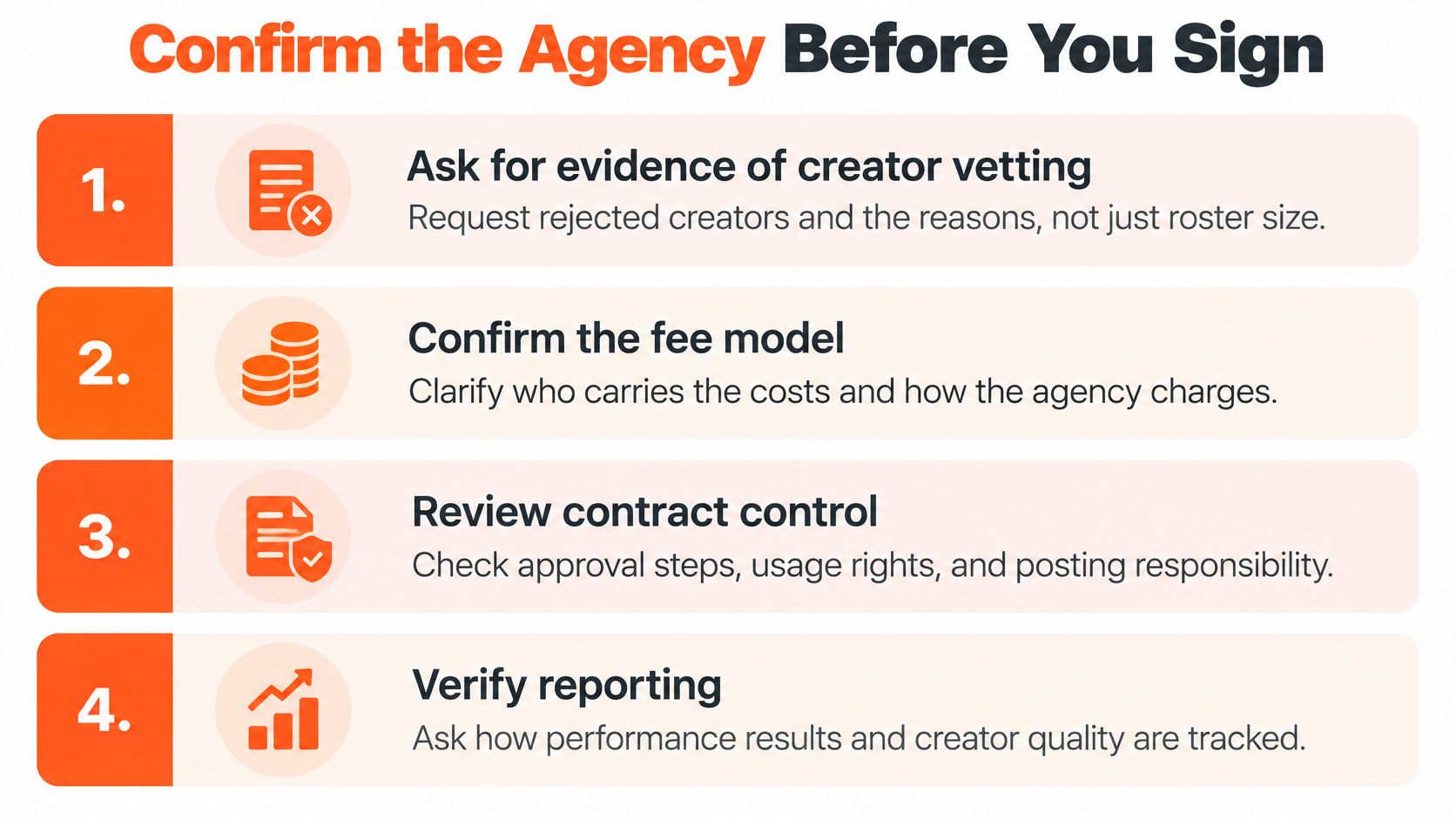
Make the final meeting an evidence review, not another presentation. Send your questions beforehand and request documents the team can inspect: anonymized creator assessments, a sample report, a forecast, and a contract schedule.
Use this checklist to keep the conversation focused.
Questions that should produce evidence
Can you show rejected creators and the reasons? Look for decisions grounded in audience suitability, commercial evidence, or brand safety. A large roster alone isn't a selection process.
What exactly triggers your payment? Have the agency walk through a disappointing campaign, including which costs remain payable. The answer should match the contract, not just the sales explanation.
Can we inspect a creator's measurement record? Request the fields connecting placement, tracking, code, survey responses, and eligible outcomes. Check that the report can distinguish recorded activity from inferred influence.
What supports the forecast range? Ask the team to identify its weakest assumption and explain what evidence would change the recommendation. Confidence without a sensitivity analysis isn't enough.
Who can stop publication? Name the compliance approver, establish where evidence is stored, and confirm what happens if a creator posts an unapproved version.
How will you resolve reporting disagreements? Request the reporting calendar, source hierarchy, and duplicate-removal rules. Confirm who has access to the underlying records.
Will the invoice clearly show the cost structure? Require separate lines for creator fees, agency fees, tools, production, and rights. Clarify treatment of cancellations and unused commitments.
Can we validate relevant campaign results? Request objective-matched case evidence and client references. An app-install case doesn't establish competence in qualified enterprise pipeline.
Read case studies as evidence, not promises
We've delivered 340+ successful influencer campaigns. Our HelloFresh campaign recorded 4.1× ROAS, 14 lifestyle and foodie creators, 12.2 million views, and 31.8k conversions. Those figures describe that campaign, not a guaranteed result for another brand.
Apply the same scrutiny to every agency's examples. Establish what counted as a conversion, which costs entered the return calculation, and whether the offer and customer journey resemble yours.
Shortlist agencies, send them the same brief, and compare their forecasts and sample creator-level reports side by side. Choose the team whose assumptions, responsibilities, and commercial terms you can inspect. A less glamorous proposal with auditable evidence is a better growth decision than a beautiful deck built around follower totals.
Social Cloud plans, runs, and measures creator campaigns across YouTube, Instagram, TikTok, and Twitch, combining data-led selection with per-creator attribution and outcome-linked fees. Visit Social Cloud with your target market, acquisition goal, and campaign brief to discuss a forecast and an operating plan you can evaluate before committing spend.


