
Influencer marketing agency pricing usually lands at $3,000 to $25,000+ per month for retainers, or 15% to 30% of managed creator spend when agencies bill off budget. If you're buying installs, conversions, or ROAS, the question isn't what the agency says it charges, it's whether that fee protects margin or feeds on scale.
You're probably staring at two proposals that look nothing alike. One says “simple retainer,” another says “percentage of spend,” and both claim they'll run the same creator program. That's where teams get burned, because the quote language changes, but the underlying work still has to cover creator sourcing, briefings, contracting, compliance, reporting, and optimization, especially on always-on programs across TikTok, Instagram, YouTube, and Twitch, as noted in Social Cloud's creator marketing agency overview.
Table of Contents
- Platform and format matter more than most briefs admit
- Rights, usage, and paid amplification change the total
Why Influencer Marketing Agency Pricing Feels Confusing
A DTC team can get two proposals for the same brief and still have no clean way to compare them. One agency sends a $7,500 monthly retainer, the other asks for 25% of creator spend, and suddenly the internal conversation gets stuck on optics instead of math. That's the core problem with influencer marketing agency pricing, the units don't match, and the fee often hides what the agency is taking home.
The market benchmark makes the spread obvious. Monthly retainers commonly run from $3,000 to $25,000+, while percent-of-spend management fees usually sit in the 15% to 30% range on top of creator costs, depending on scope and complexity, according to the SevenSix Influencer Pricing Report. Those two structures can look similar on a proposal, but they behave very differently once spend grows. A flat retainer gives you predictability. A percentage fee grows right along with your creator budget.
Why the quotes feel impossible to compare
Agencies rarely quote the same unit. Some price strategy and management together, others bury creator pass-through inside the headline number, and a few keep rights, whitelisting, and reporting outside the first page so the quote looks cleaner than it is. The result is a fee sheet that reads simple while the program itself gets more expensive every time you add creators or expand platforms.
Practical rule: don't compare proposal totals until you've separated creator pay, agency fee, usage rights, and paid amplification.
The rest of this buyer's playbook is about decoding those moving parts, then pressure-testing each quote against your actual business goal. If you're buying awareness, the cheapest structure may be fine. If you're buying attributed installs or revenue, the fee has to make sense against the outcome, not just the activity.
The Three Pricing Models Agencies Actually Use
Think of agency pricing like three different ways to hire help for the same job. One is a monthly retainer, like paying rent for an always-on team. One is percentage of spend, like paying a broker more when the deal gets bigger. The last is performance-linked pricing, where the agency earns more only when the campaign drives verified results.
Monthly retainer
A retainer is the cleanest model when you run creator programs all year. The agency charges a fixed monthly fee, usually to cover strategy, creator sourcing, negotiations, creative briefing, moderation, and reporting, with broad market ranges around $3,000 to $25,000+ per month based on agency size and service depth, per the SevenSix report. This model works when you want a stable team, steady reporting cadence, and enough structure to keep programs moving without re-buying the same services every month.
Percentage of spend
The percentage model ties the agency fee to managed creator costs, usually 15% to 30% on campaigns that need full support. That can make sense for a launch with a defined budget, but it also gives the agency a soft incentive to let spend rise because their fee rises with it. That doesn't make the model bad, it just means the buyer needs caps and line-item transparency.
Performance-linked pricing
Performance-linked pricing is the one more brands should push for when the goal is installs, conversions, or ROAS. A lean base fee covers core operations, then a bonus or upside kicks in when verified outcomes clear an agreed threshold. That aligns the agency with the brand's funnel economics instead of its media volume. It's the same logic Social Cloud applies in its outcome-based model, where the fee structure is tied to installs, conversions, or ROAS.
For contract review, a solid set of marketing agency service agreements can help you pressure-test what's included before you sign.
| Pricing Model | Typical Range | Best For | Risk to Brand |
|---|---|---|---|
| Monthly retainer | $3,000 to $25,000+ per month | Always-on programs, recurring creator work | Paying for idle capacity if the team under-delivers |
| Percentage of spend | 15% to 30% of managed creator spend | Launches, variable budgets, campaign bursts | Hidden upside for the agency as budget rises |
| Performance-linked | Lean base fee plus outcome bonus | Install, conversion, and ROAS goals | Contract complexity if tracking isn't clean |
My view is simple. If your work is recurring, pay a retainer. If your work is a one-off launch, a project fee can be cleaner. If you care about attribution, do not accept pure spend-based pricing without a performance component.
What Really Drives the Price of an Influencer Campaign
Creator tier is still the biggest price lever, and it's the one most buyers underestimate. A nano creator can be cheap in isolation, but once you move into mid-tier, macro, and celebrity territory, the cost curve changes fast. The reason is obvious, larger audiences cost more to access, and the content usually takes more effort to produce.
Platform and format matter more than most briefs admit
A static post on Instagram is not priced like a YouTube integration, and a TikTok video isn't just an Instagram Story with a different caption. Short-form video usually costs more than static content because it takes more editing and a stronger hook. YouTube integrations also tend to be pricier because the content has a longer shelf life and a heavier production lift. Those differences are why one creator's “post” can be three very different economic line items depending on platform and format, as discussed in this CPM guide.
Rights, usage, and paid amplification change the total
A lot of brands get fooled by the first quote because it excludes the expensive parts. Organic posting is one price. Whitelisting, paid amplification, and extended usage rights are another. Once you want the creator asset inside ads, on your site, or across a longer licensing window, the fee moves. That's not a niche issue. It's where a lot of “cheap” influencer work turns into expensive media buying with creator overhead on top.
If you're planning to reuse creator content in paid media, budget for rights first and creator fees second.
Here's the practical takeaway. A $50,000 monthly creator budget can stop being a $50,000 program once rights, production, reporting, and amplification are included. The agency fee should be benchmarked against the all-in number, not the shiny creator subtotal.
| Cost Driver | Low Estimate | High Estimate | Impact on Total Spend |
|---|---|---|---|
| Creator tier | Nano | Celebrity or A-list | Larger audiences raise access costs fast |
| Platform format | Static post | YouTube integration | Video and long-form content cost more |
| Usage rights | Organic only | Paid usage and extended licensing | Rights can materially raise total fee |
| Whitelisting and amplification | None | Ongoing paid support | Adds media and management overhead |
| Production and revisions | Simple asset | Heavily edited deliverable | More revision cycles, more cost |
| Reporting and optimization | Basic recap | Ongoing analysis by creator | More reporting depth raises management load |
Retainer vs Project-Based and When Each One Makes Sense
Retainers win when the brand needs continuity. Project fees win when the brief has a clean start and stop. That's the whole decision, stripped down.
When a retainer pays for itself
If you're running four or more campaigns a year, need constant creator sourcing, or want the same team to optimize in real time, a retainer usually makes more sense. You're paying for access, speed, and continuity, not just deliverables. That matters when a creator pipeline has to stay full and the team can't afford to brief a new agency every quarter.
When project pricing is the better buy
Project-based pricing is cleaner for launches, seasonal pushes, and product debuts. The scope is finite, the timeline is finite, and you want a hard cap. For brands with smaller annual creator budgets, project pricing usually protects cash better because you're not funding a standing team between campaigns.
| Dimension | Retainer | Project-Based |
|---|---|---|
| Cost predictability | High | High, if scope stays fixed |
| Best use case | Always-on programs | One-off launches |
| Talent access | Standing team | As-needed support |
| Reporting cadence | Continuous | Often end-of-project |
| Risk to brand | Paying for unused capacity | Surprise costs if revisions expand |
The failure modes are predictable. Retainers can turn into padded hours if the agency isn't shipping. Projects can look cheap until launch, then get hit with iteration fees, extra approvals, or last-minute rights changes. If you're spending heavily and measuring rolling ROAS, I'd take a retainer with a performance kicker over a pure project fee almost every time.
Sample Budgets for DTC Apps SaaS and Gaming Brands
The fastest way to sanity-check an agency quote is to map the budget to the business model. A DTC brand, a mobile app, and a SaaS company do not buy the same kind of influencer program, even if they all use the same agency.
DTC skincare
A DTC skincare team might run a $12,000 monthly budget and split it across creators, management, amplification, and tracking. In that setup, the agency fee shouldn't swallow the program. You want most of the money going to creator output and a smaller slice going to coordination, because the asset itself still has to sell.
Mobile app acquisition
A mobile app with a $25,000 monthly budget should think in installs, not impressions. That means creator selection, whitelisting, and attribution matter more than pretty content. If the agency can't tie each creator to postbacks or clean install data, the quote is too expensive even if the headline fee looks low.
B2B SaaS
A SaaS team spending $40,000 per quarter should buy niche creator access, repurposing, and measurement. LinkedIn creators, podcast voices, and content with demo intent usually need a more strategic agency layer than a simple content broker. The agency fee can be justified if it helps the team get qualified demos, not just views.
| Brand Type | Total Budget | Creator Spend % | Agency Fee % | Paid Amplification % | Measurement % | Primary KPI |
|---|---|---|---|---|---|---|
| DTC skincare | $12,000/month | 65% | 20% | 10% | 5% | ROAS |
| Mobile app | $25,000/month | 70% | 15% | 10% | 5% | Installs |
| B2B SaaS | $40,000/quarter | 55% | 25% | 12% | 8% | Qualified demos |
The pattern is clear. Consumer brands need a heavier creator share. Apps need more attribution support. SaaS needs more strategy and repurposing. If the agency proposal doesn't reflect those differences, it's probably a generic rate card dressed up as a custom plan.
Turning Agency Spend Into Real ROI
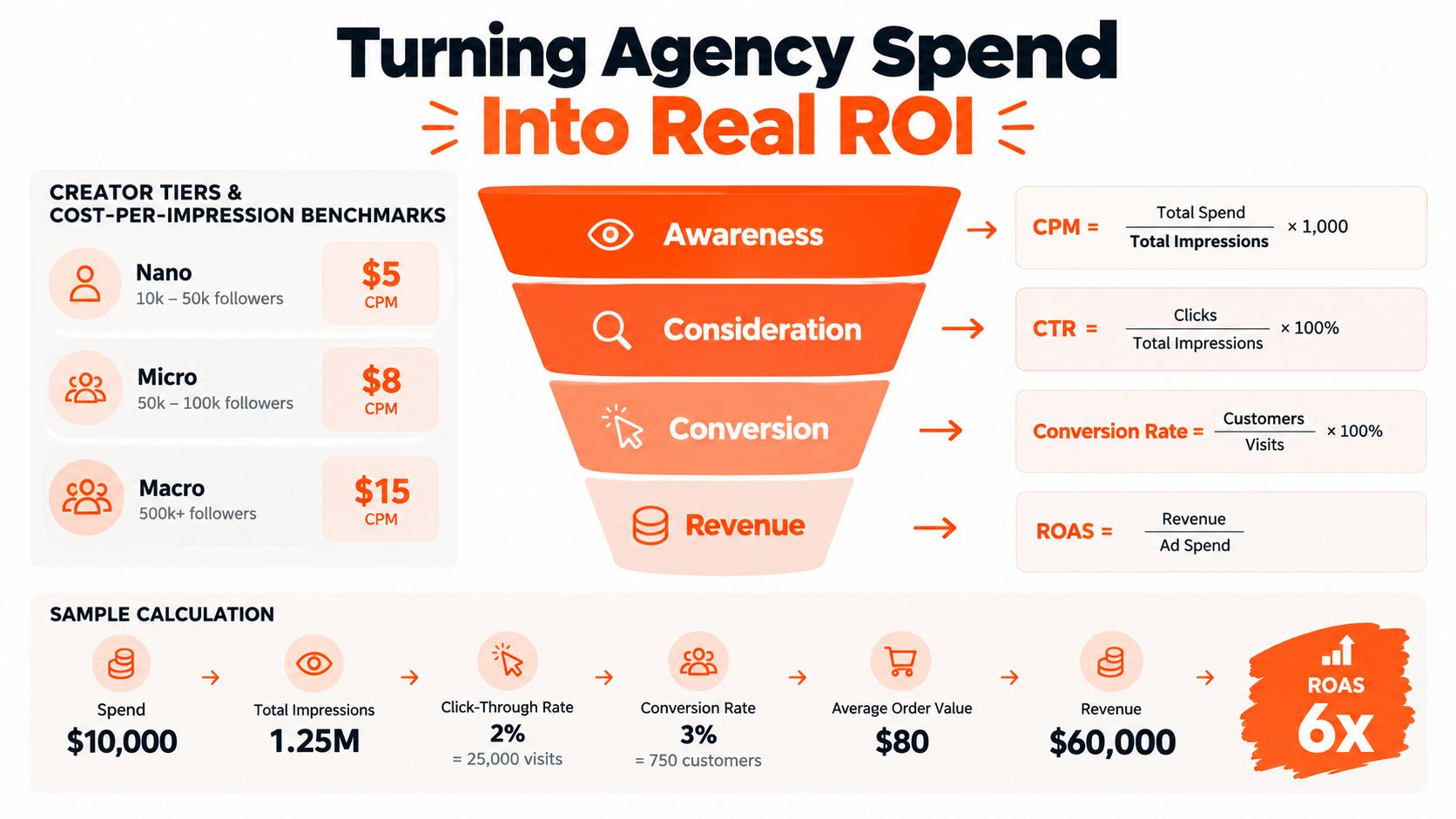
The only number that matters is what the spend returns after the campaign hits the funnel. CPM, clicks, conversions, and ROAS all matter, but only if they line up with a clean attribution path. If they don't, the agency can make the work look efficient while the finance team sees a mess.
Build the math from impressions to revenue
A useful benchmark model starts with creator reach, then works forward to revenue. If the campaign cost is $10,000, generates 1.25M impressions, converts at 2% click-through, produces 25,000 visits, then converts at 3% into 750 customers, and each order is worth $80, the campaign returns $60,000 in revenue for 6x ROAS. That's the kind of math a growth lead can put in front of finance without hand-waving.
Why outcome-linked pricing changes the math
A pure retainer model can reward activity whether or not the campaign converts. A performance-linked fee changes that. When the agency only earns more after the campaign clears a target, they have a reason to select better creators, tighten briefs, and push harder on measurement instead of chasing vanity reach. That's why outcome-linked pricing belongs in any serious acquisition conversation.
Checklist for attribution: require postbacks, creator-level links or codes, platform-level reporting, and a clear source of truth for revenue.
The cleanest buyer mindset is this. Don't ask whether the agency is busy. Ask whether every creator is traceable to a business outcome. If the answer is fuzzy, the fee is already too high.
Why Outcome-Linked Fees Are Gaining Ground
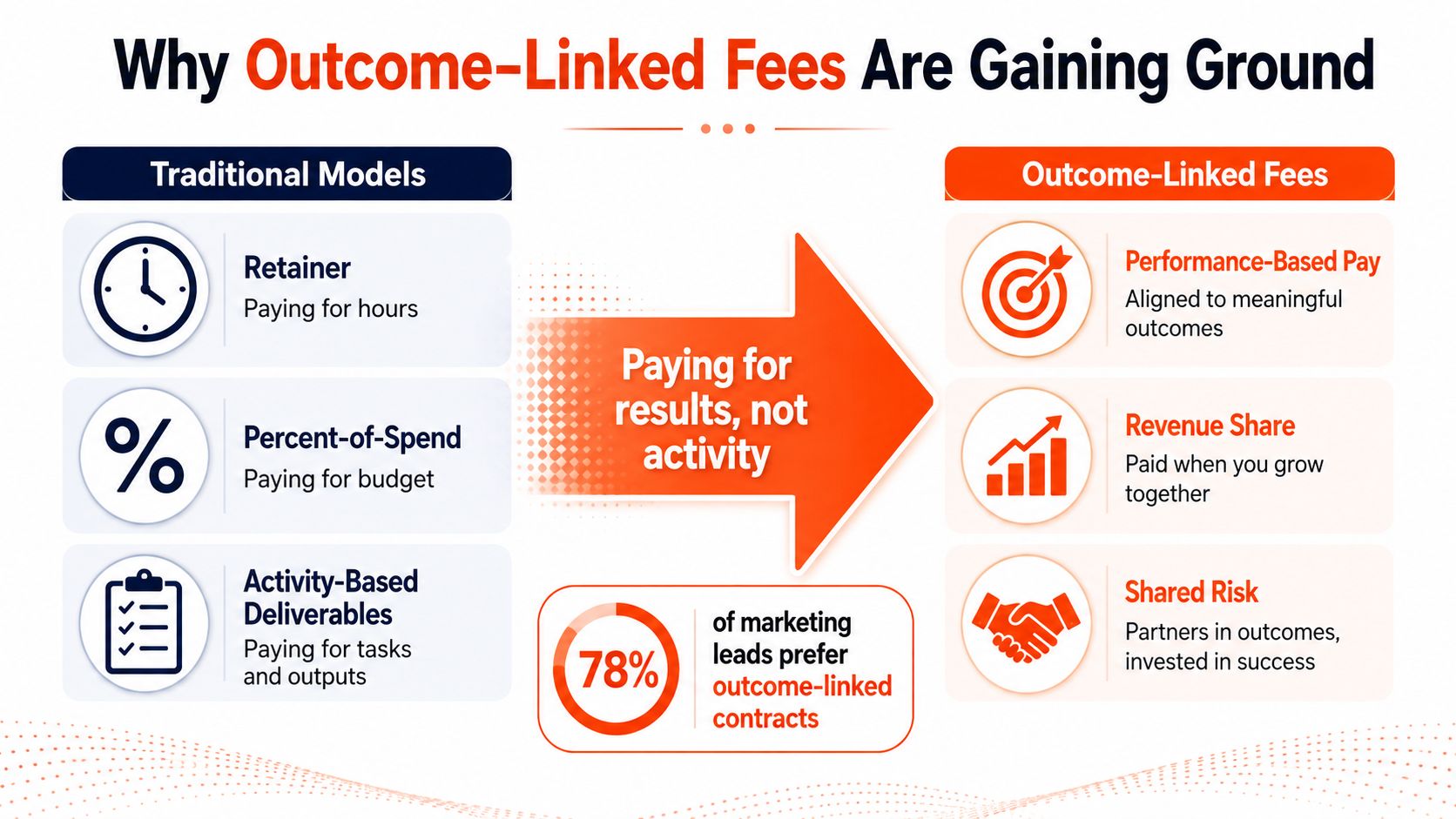
Traditional pricing pays for activity. That's the problem. A retainer can keep a team busy even when the campaign doesn't move installs, and a percentage-of-spend model can reward budget growth even if efficiency slips. Outcome-linked fees fix that by tying part of the agency's upside to verified events instead of just output.
That shift matters because attribution is no longer imaginary. On platforms like TikTok and Meta, and in broader performance setups, brands can connect creator placements to installs, conversions, and revenue with far more precision than they could a few years ago. The agency no longer has to be paid for guesswork if the campaign can be measured by creator.
What a fair fee looks like now
A fair structure usually has two parts. The first is a lean base fee that covers strategy, sourcing, contracting, and reporting. The second is a performance component tied to installs, conversions, or ROAS. That model keeps the agency solvent, but it stops them from making margin because the creator budget got bigger.
Why this is the structure I'd push for
If the goal is attribution quality, then a fee based on verified outcomes is more honest than a fee based on spend. It keeps the agency focused on creators who convert, not creators who only look strong in a deck. Social Cloud uses that model in its performance-based influencer marketing work, and its performance-based influencer marketing guide frames the same issue clearly.
My take: if a proposal doesn't explain how the agency gets paid when results outperform or underperform, the contract isn't aligned yet.
Outcome-linked fees are gaining ground because brands are done paying for motion. They want measurable lift, and they want the agency to share the risk of missing it.
Smart Negotiation Tactics Before You Sign
Negotiation starts before the redline. If you wait until the final contract, you've already accepted the agency's framing. Build the RFP so the fee structure has to survive scrutiny line by line.
Demand the pricing split upfront
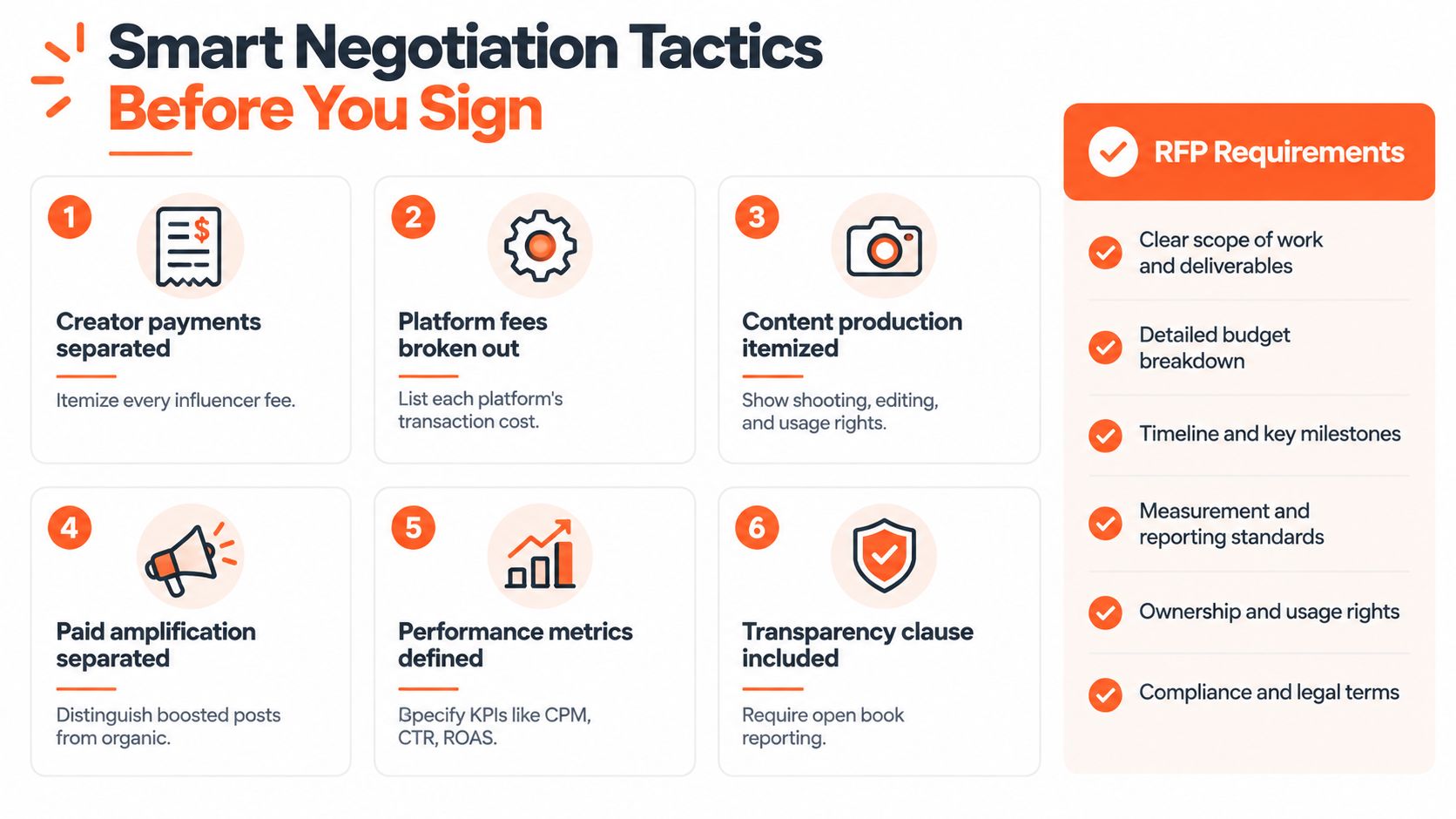
Ask for separate line items for creator payments, platform fees, content production, paid amplification, and the agency's own management fee. If the quote is bundled, you can't see where margin lives. You also can't tell whether the agency is marking up creator costs or just charging for management.
Cap the fee and force accountability
If the agency insists on percentage pricing, cap it as spend grows instead of letting the fee scale forever. Also require a pause clause tied to performance. If CPA blows past the agreed ceiling and the agency can't explain why, you need a clean off-ramp or reset.
Lock the tracking before launch
No attribution, no real negotiation. Require postbacks or equivalent creator-level tracking from TikTok, Meta, or your MMP, and make sure every placement ties back to a creator ID. Also lock usage rights and whitelisting terms in writing before the first asset goes live, so you don't get hit with surprise licensing costs later.
- Creator payments separated: every influencer fee itemized, no blended line.
- Platform fees broken out: ad spend, software, and transaction costs shown separately.
- Content production itemized: shooting, editing, and usage rights listed on their own.
- Paid amplification separated: boosted posts kept out of the base management fee.
- Performance metrics defined: CPA, CTR, ROAS, and other KPIs written into the scope.
- Transparency clause included: reporting and audit rights spelled out in the contract.
The strongest negotiation move is simple. Ask the agency what happens if performance is better than expected, and what happens if it's worse. If they can't answer both cleanly, the fee structure isn't ready.
If you want a pricing model built around installs, conversions, or ROAS instead of vague activity, Social Cloud runs creator programs with a lean base fee, verified attribution, and outcome-linked pricing. Visit Social Cloud if you want a team that can scope the campaign, track every placement, and price against the result you need.


