Your creator has approved the brief, the tracking link works, and paid amplification is ready. Then someone asks whether the free product needs a disclosure, whether the German edit needs different wording, and whether the approved video can become an AI-generated ad. Suddenly, launch approval isn't a checkbox.
Influencer marketing compliance works best at placement level. Give every post its own market, incentive, disclosure, rights, and measurement record. That sounds more involved than adding a hashtag, but it's much easier to manage than reconstructing decisions after a complaint.
Table of Contents
- Native disclosure tools by platform
- Use wording viewers don't have to decode
- Design the disclosure for the format
- Approve what will actually publish
- Extra rules by sector
- Fintech needs control over the whole conversation
- Gaming needs audience-aware production
Disclosure Rules in Each Major Market
Say a UK creator publishes a paid video aimed at customers in France. Their home address doesn't settle the compliance question. Your team needs to examine the intended audience, campaign targeting, language, advertiser location, and applicable local requirements.
Start with the rules that bind the promotion, then configure the platform. A branded-content setting can help you execute a decision, but it can't decide which jurisdiction applies.
The practical requirements are shorter than the legal reading list: make the commercial relationship obvious, use language the audience understands, and check whether business-identification obligations apply.
Disclosure rules by market
Treat this table as a briefing framework, not a substitute for local approval. In particular, don't interpret an absence of influencer-specific identity requirements as an exemption from ordinary business law.
| Market | Core rules | Label that works | Business identity |
|---|---|---|---|
| United States | FTC endorsement framework addressing material connections and misleading endorsements | Use clear advertising wording, such as Ad, before the endorsement or call to action | Check applicable business and sector requirements separately |
| United Kingdom | CAP Code and consumer-protection requirements enforced through the ASA and CMA | Ad or #ad at the start, visible without expanding | Check applicable business-identification requirements separately |
| European Union | Overlapping consumer, audiovisual, and platform-transparency rules | Clear commercial label in the language of the post | Assess trader status and required business details |
| France | National influencer requirements alongside EU consumer rules | Confirm approved French commercial wording and applicable contract requirements | Check French implementation of trader-detail obligations |
| Germany | Unfair-competition and media requirements | Confirm local advertising wording, including Werbung or Anzeige | Check commercial-profile imprint requirements |
The US question starts with the connection behind the endorsement. Don't brief only the cash payment while leaving affiliate benefits or product support out of the approval record.
For the UK, brief creators around immediate recognition. The audience shouldn't need to interpret a relationship announcement to work out that it's an advertisement.
EU campaigns need a country-level check beneath the regional framework. France and Germany shouldn't sit in a spreadsheet cell marked Europe with an English disclosure copied across every asset.
Choose a workable cross-border standard
Use a consistent disclosure design across the campaign, then localize the wording and any additional requirements. Consistency helps production; localization helps the audience understand what they're seeing.
Don't assume that choosing the strictest-looking English label solves everything. Language, product restrictions, trader identification, and contractual requirements aren't interchangeable.
Practical rule: Standardize the review process, not every country's legal answer.
A shared post may need commercial wording for different audiences, or separate localized versions. If adding labels makes the asset unreadable, split the creative rather than shrinking the disclosure.
Before booking creators, ask local counsel to confirm uncertain market entries. Resolving those questions during selection is cheaper operationally than replacing a creator, rewriting a contract, and rebuilding paid assets just before launch.
What Regulators Have Found When They Looked
In its February 2024 sweep of 576 influencers across 22 EU member states, Iceland, and Norway, the European Commission and national consumer-protection authorities found that 97% had published content containing commercial elements, but only 20% systematically identified that content as advertising.
That's a finding about the influencers reviewed, not a measured failure rate for your creator roster. Its operational value is clear: commercial activity and consistent disclosure don't automatically travel together.
What the gap means for campaign teams
The wrong response is to send every creator another generic policy document. A creator can understand the principle and still publish an unclear caption, omit a label from an edit, or misunderstand whether a gifted placement belongs in the advertising workflow.
Use the findings to test your own approval system:
- Classification: Can reviewers see what the creator received and what the brand requested?
- Execution: Does the approved asset show the required disclosure?
- Accountability: Is someone responsible for checking the published version rather than just the draft?
- Business records: Can procurement establish who the commercial counterparty is?
These checks address different failure modes. A perfect caption won't repair missing counterparty records, and a signed agreement won't make an unclear video understandable to viewers.
The UK case that put disclosure into enforcement
The CMA's social-media endorsements case opened on 16 August 2018, and by 23 January 2019, 16 influencers had provided formal undertakings to improve their disclosure practices.
The timeline makes the progression from investigation to commitments easy to see.

The important distinction is consumer protection, not merely platform etiquette. A campaign manager shouldn't treat disclosure as a preference that can be waived because a creator dislikes how the label looks.
For businesses assessing US state-level exposure alongside endorsement requirements, Coto & Waddington, Attorneys at Law, explains Florida consumer protection rules for businesses. Use jurisdiction-specific advice to assess the promotion as a whole, rather than assuming a platform-approved post resolves every consumer-law question.
Enforcement examples also change how you brief senior stakeholders. The useful question isn't whether another creator got away with the same caption. It's whether your team can explain its decision, show the approved asset, and demonstrate how it responded when something changed.
That's a much stronger position than pointing to a contract clause that says the creator handles compliance.
Platform Tools and Disclosure Wording
Use the native tool when required, but don't treat it as a complete disclosure system. Tool availability, names, and display behavior can change, so check the publishing account rather than relying on an old briefing screenshot.
Your review needs both the platform setting and the audience-facing result. A selected checkbox tells you what the publisher configured. A rendered preview tells you what the audience can recognize.
Native disclosure tools by platform
These are working descriptions to verify inside each platform before publishing. The gaps below are review risks, not claims that every interface behaves identically.
| Platform | Native tool | Gap |
|---|---|---|
| Instagram and Facebook | Paid partnership label | Don't assume it replaces explicit Ad wording in the caption |
| TikTok | Branded-content or commercial-content disclosure setting | Verify how the disclosure displays; approve caption wording separately |
| YouTube | Paid promotion checkbox | Review the video, title, and description rather than relying on the checkbox alone |
| X | Paid partnership disclosure option | Confirm the current tool name and display; review post wording separately |
The ASA influencer ad-disclosure report supports the central UK requirement: each piece of influencer advertising must be identifiable as advertising, with prominent disclosure rather than reliance on a biography, another post, or ambiguous relationship wording.
That means approval belongs to the placement, not the creator profile. Someone who labels a feed post correctly hasn't automatically cleared the Story that promotes it.
Use wording viewers don't have to decode
For a UK-facing asset, Ad is a straightforward starting point. Build the commercial relationship around that clear signal instead of expecting words such as gifted or affiliate to explain everything.
A practical caption opener is:
Ad | Paid partnership with Brand
Replace Brand with the advertiser's name and check the wording against the relevant market. This is a production example, not a universal legal formula.
Treat the wording options as a hierarchy:
- Explicit advertising language: Start with the approved Ad or local-language equivalent.
- Relationship explanation: Add accurate context about sponsorship, gifting, or commission where useful.
- Ambiguous language: Don't rely on collaboration, partnership, thanks to, or I work with them alone.
- Profile-level statements: Keep useful background in the biography, but don't count it as the asset's disclosure.
Accuracy matters too. Don't describe a gifted relationship as a cash sponsorship just because the template is convenient. Make the advertising nature clear without misrepresenting the arrangement.
Design the disclosure for the format
Captions need an upfront signal. Put the approved wording before the expandable portion, not after a product story and a cluster of hashtags. Review on mobile, where interface controls and truncation affect what appears first.
For Stories, approve a readable text overlay alongside the native label where available. Keep it away from navigation areas, creator handles, and stickers that obscure it. A disclosure that looks clear in the design file can become difficult to read after upload.
For livestreams, I'd use a layered production standard: an appropriately labeled title or description, visible on-screen identification, and spoken reminders when the sponsored segment resumes. Viewers can arrive midway through a stream, so don't design the entire disclosure around the opening welcome.
For short-form video, review the opening frame, captions, overlays, audio, and final export together. A creator may crop the source file for a different aspect ratio and accidentally remove the disclosure.
Paid reuse deserves its own check. The operational differences in influencer whitelisting matter because authorizing brand access doesn't prove that every ad version has the right wording, rights, or presentation.
Approve what will actually publish
Ask the creator for a rendered preview, not just caption text pasted into an email. Save the preview with the platform, market, incentive type, editorial-control status, and approved disclosure.
Then compare the live placement against that approved version. Watch for:
- Caption changes: A rewritten opening can move the label below the fold.
- New exports: Cropping or subtitles can cover the overlay.
- Cross-posting: The destination platform may need a different native setting.
- Paid edits: A new hook, cutdown, or call to action changes the review object.
Don't block creative freedom unnecessarily. Approve a disclosure zone, permitted wording, and safe editing boundaries so creators can improve the content without reopening every minor stylistic decision.
Contracts, Gifting and Usage Rights
Free products can create disclosure duties. The European Parliament's briefing on influencer marketing describes a framework without a single dedicated EU influencer-marketing law and explains why commercial connections, including gifted products or services, need careful assessment.
That makes product seeding a contracting and briefing issue, even when the campaign team doesn't call it a paid partnership. Record what was offered, what was requested, and what happened next.
Disclosure needs by incentive type
Use this as an operational triage table. Have the applicable market's reviewer resolve borderline relationships before content goes live.
| Incentive | Disclosure needed | Why it matters |
|---|---|---|
| Cash fee | Yes for the advertising placement | The commercial relationship should be recognizable |
| Free product for review | Treat as requiring review and disclosure | Product support can create a commercial connection |
| Unpaid seeding with no conditions | Possibly | No posting obligation doesn't automatically remove the connection |
| Affiliate commission | Yes for promotional affiliate content | The creator benefits from attributed purchases |
| Discount code for followers | Assess the arrangement; usually disclose a promotional relationship | A code may accompany payment, commission, or another incentive |
| Whitelisting or paid amplification | Yes for the advertising placement | Paid reuse needs its own approved presentation |
| Reposting a brand's own content | Assess payment and other commercial connections | Cash isn't the only relationship that can matter |
Avoid an automatic exemption for unpaid reposts. An ongoing ambassador arrangement, gifted benefit, or other connection may still matter even when nobody paid separately for that repost.
Put responsibilities where people can execute them
A useful agreement tells the creator exactly what to deliver and tells the advertiser exactly what it can approve, preserve, and stop.
Include:
- Deliverables and disclosure: Specify formats, approved wording, placement, and market versions.
- Approval and editing: Require approval before publication and written sign-off for material changes.
- Evidence retention: Set an appropriate retention period with legal and privacy input.
- Usage rights: Define channels, territory, duration, editing permissions, and paid-amplification scope.
- Commercial terms: Document affiliate commissions, codes, gifting, and any overlapping arrangements.
- Remedies: State the correction process, suspension rights, and consequences of repeated breaches.
An influencer contract template can help organize those provisions, but the agreement still needs campaign-specific schedules.
Suggested clause language to adapt with counsel:
The Creator will apply the approved advertising disclosure to each contracted placement in the agreed position and will not remove or materially alter it without the Brand's written approval.
The creator controls publication and later edits. The advertiser controls the brief, approval process, evidence collection, and escalation. Allocate those jobs explicitly rather than assigning compliance to everyone, which usually means nobody owns the correction.
For mixed campaigns, separate the permissions. Product seeding, affiliate sales, paid account access, and AI-assisted editing shouldn't disappear inside a broad usage-rights sentence. Commercial permission to reuse a video also shouldn't be mistaken for unrestricted permission to alter someone's face, voice, or testimonial.
Measurement, Privacy and AI-Generated Variants
Performance teams need to know which creators drive purchases or installs. But creator-level attribution doesn't justify collecting every available customer identifier.
The Arnold & Porter analysis of influencer marketing highlights the collision between measurement and privacy, European restrictions on personal-data-based advertising personalization to minors, and synthetic-media disclosure issues under the EU AI Act.
Treat the measurement plan as part of campaign approval, not a technical attachment added after creative sign-off.
Map the information each method uses
A tracking link can carry a creator identifier into analytics, but the associated system may also process device or browsing information. A promo code can connect a sale to a creator while the commerce platform still holds customer details.
Pixels, audience matching, and retargeting deserve particular attention because they can involve data sharing beyond the immediate transaction. Post-purchase surveys look simpler, but open-text answers can collect information you never needed.
Use a short control list:
- Minimize collection: Prefer aggregated reporting when it answers the business question.
- Document the basis: Record the relevant lawful basis and consent requirements with the privacy owner.
- Explain the mechanism: Make tracking and affiliate arrangements understandable through the appropriate disclosures and notices.
- Limit retention: Separate useful campaign summaries from identifiable event-level records.
- Protect higher-risk audiences: Review minors and sensitive health or financial contexts before selecting measurement tools.
The trade-off is real. A less intrusive measurement design may provide less granular attribution. That's a planning decision to make openly, not a gap to hide behind a confident ROAS dashboard.
Re-approve synthetic versions
An AI-generated variation can change more than the production method. It can make a creator appear to say something they didn't record, imply a personal experience they didn't have, or introduce a new product claim.
Evaluate commercial disclosure and synthetic-media disclosure separately. An advertising label doesn't tell viewers that a voice was cloned, while an AI label doesn't explain the brand relationship.
For creative teams learning how to verify authenticity before sharing AI-altered content, AI Video Detector's synthetic-media explainer provides useful context. Authentication tools can inform review, but they aren't a replacement for documented permissions and human approval.
Before approving a variant, inspect the actual output, confirm the creator's permissions, check the applicable synthetic-media rules and implementation dates, and reassess any new claims. Route every changed attribution method through privacy review too, rather than inheriting approval from the original campaign.
Industry Rules for Health, Fintech and Gaming
A clear advertising label doesn't make an unsupported treatment claim acceptable or authorize a restricted financial promotion. Sector review is a separate approval gate, not a more elaborate version of caption checking.
Use the controls below to route work to the right specialist. They're operational safeguards, not a complete statement of every market's sector law.
Extra rules by sector
| Sector | Extra rule to resolve with the market reviewer | Typical control |
|---|---|---|
| Health and wellness | Substantiation and permitted medical or treatment claims | Claims library, evidence file, and medical review |
| Fintech | Financial-promotion permissions, presentation standards, and applicable warnings | Authorized compliance review and approved warning text |
| Gaming | Child-audience protections, purchase messaging, and age-appropriate targeting | Audience review, suitable targeting, and checks on purchase prompts |
| Alcohol and gambling | Product restrictions, audience eligibility, and age controls | Age-gated settings and legal pre-approval |
| Cosmetics and skincare | Evidence for performance and before-and-after claims | Claim-specific evidence and approval of the final images |
For health campaigns, give creators an approved claims library, including prohibited paraphrases. A creator can turn a modest product statement into a treatment promise while trying to make the script sound natural.
Review the visual claim too. Lighting, filters, editing, and before-and-after presentation can change what the audience understands, even if the spoken words remain approved.
Fintech needs control over the whole conversation
Don't send a financial creator a compliant script and assume the surrounding content is harmless. Review the hook, thumbnail, caption, risk language, landing page, and planned responses to predictable questions.
A creator saying a product is easy to use is different from implying it's safe, guaranteed, or appropriate for everyone. Those implications deserve specialist scrutiny before production, not just a disclaimer added afterward.
Build the approval path before recruiting. The workflow behind finance influencer marketing needs room for product-specific review, creator suitability, and market restrictions.
Cross-border visibility also needs a real legal assessment. Don't assume that applying the strictest-looking warning makes a promotion lawful everywhere; permission to promote the product may differ between markets.
Gaming needs audience-aware production
Separate ordinary gameplay promotion from gambling-related mechanics and purchase messaging. A creator's audience profile, stream format, and promotional language all affect the review.
For younger audiences, set conservative production boundaries:
- Purchase prompts: Review urgency, pressure, and how virtual purchases are explained.
- Audience settings: Check targeting controls against the intended campaign audience.
- Live moderation: Brief creators and moderators on claims and purchase questions they shouldn't improvise.
- Content classification: Escalate chance-based mechanics or adjacent gambling themes for specialist review.
Age gates help execute a plan, but they aren't proof that the entire audience is eligible. Ask the reviewer to approve the targeting approach and the content itself.
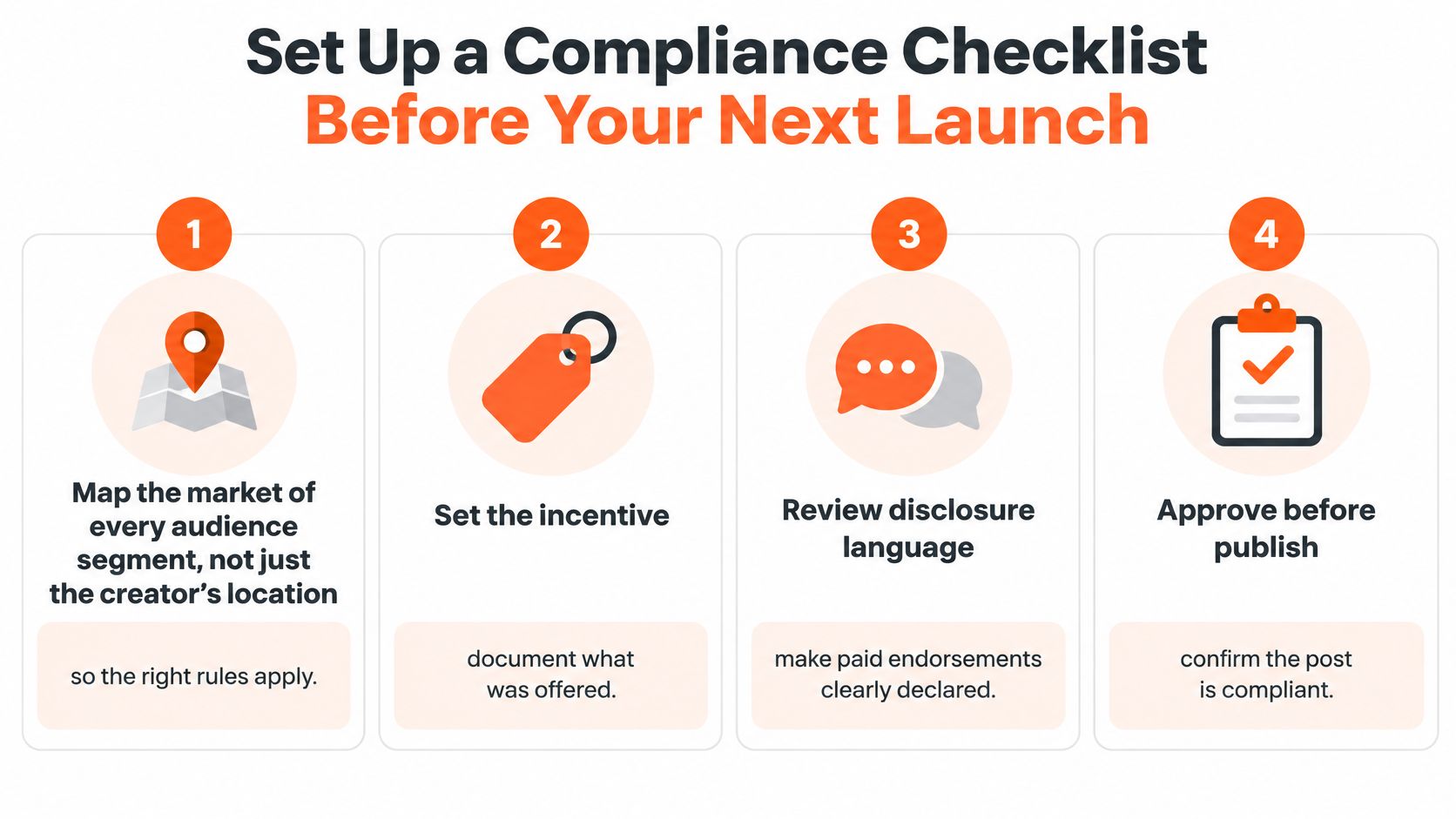
Set Up a Compliance Checklist Before Your Next Launch
Build the checklist around a placement record, not a campaign-level green tick. A spreadsheet can work for a small roster; a project-management system or specialist workflow becomes useful when versions, markets, and approval owners multiply.
The launch summary below is a useful creator-facing reminder.
Make approval traceable
Map the audience markets. Record intended markets, language, targeting, and relevant audience information. Assign a reviewer to resolve jurisdiction questions rather than asking the creator to guess.
Classify the incentive. Log fees, products, commissions, codes, and other benefits clearly. Procurement and campaign teams should work from the same description of the relationship.
Lock the contractual instructions. Attach approved wording, placement requirements, usage permissions, and change-control terms. Make the creator's practical instructions easy to find without searching the entire agreement.
Route sector-sensitive content early. Flag health, finance, gaming, and other restricted categories before production. Reserve the right reviewer's time while the concept is still cheap to change.
Review the rendered asset. Inspect the actual platform preview, including overlays, caption truncation, audio, and destination page. Return a clear approved or changes-required decision tied to that version.
Authorize the specific placement. Log the asset identifier, market, disclosure text, incentive, rights status, tracking method, approver, and paid-use permission. Block amplification if a required field is unresolved.
Preserve the evidence. Save the agreed version, approval, live URL, and publication capture under the applicable retention schedule. Restrict access to personal information rather than keeping everything indefinitely.
The video below can support a team briefing, but keep your campaign-specific approval instructions in the written record.
Give live incidents a clear owner
After publication, monitor for changed captions, deleted labels, unexpected reposts, new claims, and expired usage permissions. Log the placement, check date, status, issue, and person responsible for the fix.
Report compliant placements, incidents, and unresolved actions separately. A clean-looking campaign average can conceal an individual asset that still needs attention.
Launch discipline: An approved draft is evidence of review, not evidence that the live post stayed compliant.
If a required label is missing, pause associated paid amplification and request prompt correction. Capture the issue, notify the creator and brand owner, verify the repair, and record the outcome.
Don't treat a misleading claim as a caption-only problem. Escalate it to the relevant specialist and consider removing the asset while it's assessed. Repeated failures should trigger a contract and creator-suitability review.
Before the next launch, choose a pending placement and complete its record end to end. Any field your team can't confidently fill identifies a decision you still need to make.
Social Cloud offers creator campaign management, including contracting, disclosure requirements, usage rights, and placement-level attribution. Visit Social Cloud to discuss a campaign workflow that connects creative approval, market-specific compliance, and performance measurement before you commit spend.