Spark Ads have no separate rate card, run through the same TikTok auction as In-Feed ads, and typically sit around $4 to $12 CPM, while total cost combines auction media spend with separately negotiated creator authorization fees. That means the actual TikTok Spark Ads cost isn't just what TikTok charges for delivery, but also what you pay to use the creator's post.
A performance marketer can spend an afternoon building a Spark Ads budget and still miss the largest line item. They may estimate impressions, add a media buffer, and feel ready to launch, only to discover that the creator's authorization window, usage territory, and paid amplification rights sit outside the ad account entirely.
That split explains why Spark pricing feels inconsistent. Two campaigns can use similar audiences and objectives, yet have very different total budgets because one creator offers a short authorization period while another negotiates broader or longer usage. The platform auction may look familiar, but the commercial agreement behind the post changes the economics.
This guide separates those costs clearly. You'll see how Spark Ads work, how TikTok bills the media, what pushes CPM and CPA up or down, which benchmarks are useful, and how to forecast a test without treating CPM as the final measure of success.
Table of Contents
Introduction Why Spark Ads Cost Confuses Growth Teams
A growth team often starts with a simple question: “What does a Spark Ad cost?” They expect a rate card, similar to booking a fixed placement or buying a guaranteed sponsorship. Instead, the media buyer opens TikTok Ads Manager and finds familiar campaign objectives, bidding options, and auction behavior. The creator then sends a separate agreement for permission to promote the post.
That creates two budgets that people accidentally merge. The first is paid media spend, which goes to TikTok as the platform delivers impressions, clicks, views, or conversions. The second is the creator fee, which covers the content itself and any authorization or usage rights needed to run it as an ad.
TikTok's own explanation says Spark Ads use the same auction as standard In-Feed Ads rather than a special Spark-only pricing model. In its cited tests, Spark Ads produced a 134% higher completion rate, 157% higher six-second view-through rate, 69% higher conversion rate, and 37% lower CPA than standard In-Feed Ads, although those results shouldn't be treated as a guaranteed account benchmark. You can review the platform's explanation in TikTok's Spark Ads guide.
The practical lesson is easy to miss. Spark Ads may cost more per impression and still produce cheaper acquisitions. A creator post can attract stronger attention, earn more meaningful clicks, or convert better after the click. If that happens, a higher CPM can support a lower CPA and stronger ROAS.
The right budgeting question isn't “What is the cheapest Spark CPM?” It's “What total cost produces an acceptable business outcome?”
This distinction matters most for e-commerce, apps, and other performance programs where the team needs attributed purchases, installs, or leads. If you're still learning TikTok's account structure, this guide to starting TikTok Ads can help with the platform setup before you model Spark-specific economics.
What Spark Ads Are and How They Work
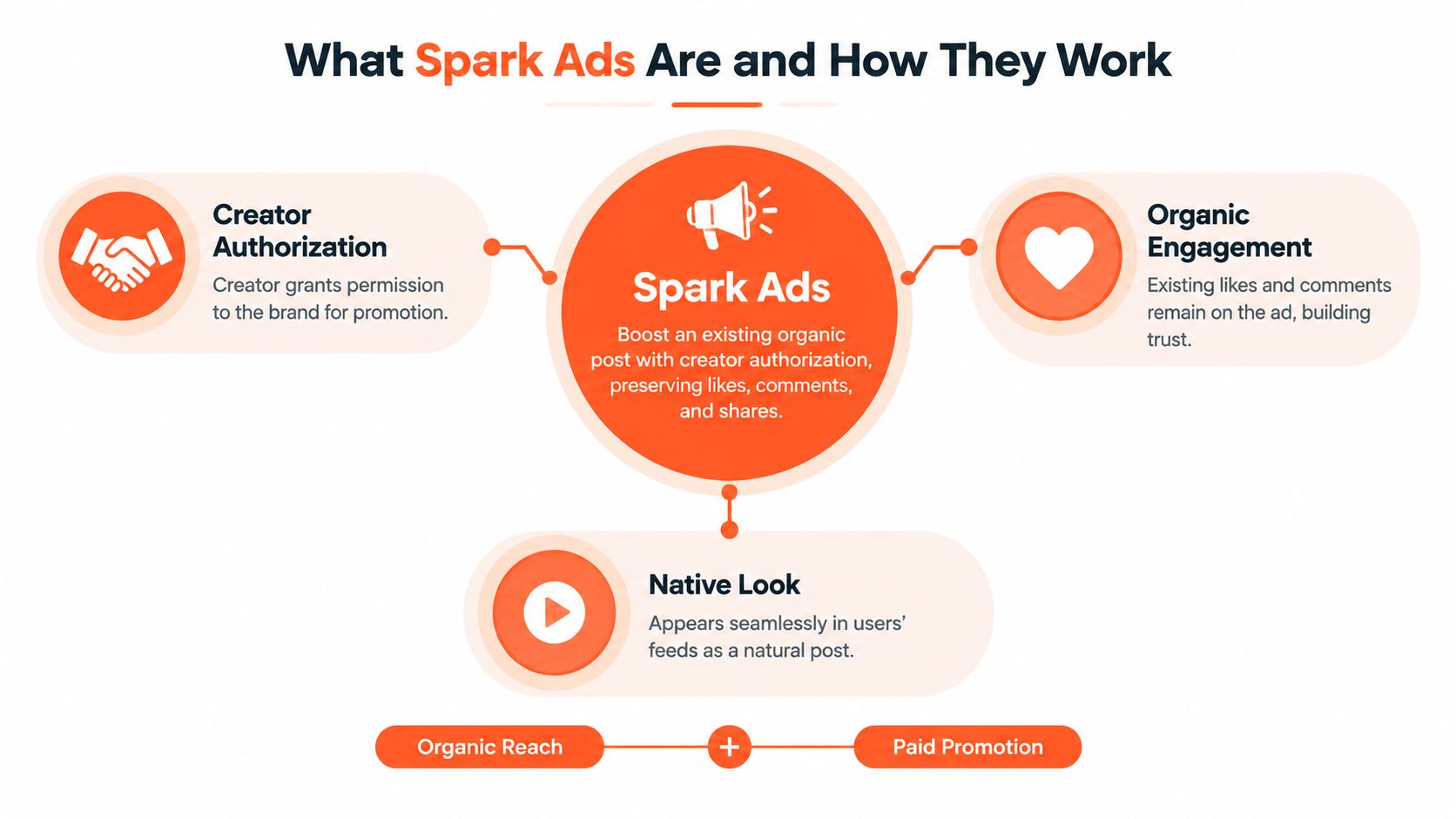
A Spark Ad starts with an existing TikTok post. That post might come from your brand account or from a creator who has published content about your product. Once the creator grants authorization, the brand can promote the post through TikTok's paid system.
The easiest analogy is a storefront. A standard In-Feed ad is like building a new shop window from brand assets. A Spark Ad is like borrowing a creator's existing storefront, including the conversation already happening around it. The post keeps its native identity and can carry its existing likes, comments, and social proof into the paid placement.
The authorization step
The creator doesn't just send a video file. They provide permission for the brand to promote the post through TikTok's advertising workflow. That permission is commonly handled through a creator-generated authorization process or an arrangement where the brand receives the required code and connects the post to its ad account.
The exact commercial terms should be written down before launch. Confirm the authorized post, permitted account, duration, territory, channels, editing rights, disclosure requirements, and whether the brand can continue using the content after the paid period ends. A low content fee can become less attractive if the authorization terms are too narrow for the campaign plan.
The native format is what makes Spark useful. Users see a post connected to a real creator account, rather than a separate brand-uploaded asset with no organic history. That context can make the ad feel closer to the content people already consume in the feed.
For a wider view of campaign setup and performance planning, TikTok Ads for performance marketers is a useful complementary resource.
Spark Ads preserve the creator post's context, and that context can influence how efficiently paid media turns attention into action.
How Spark Ads Billing and Bidding Actually Work
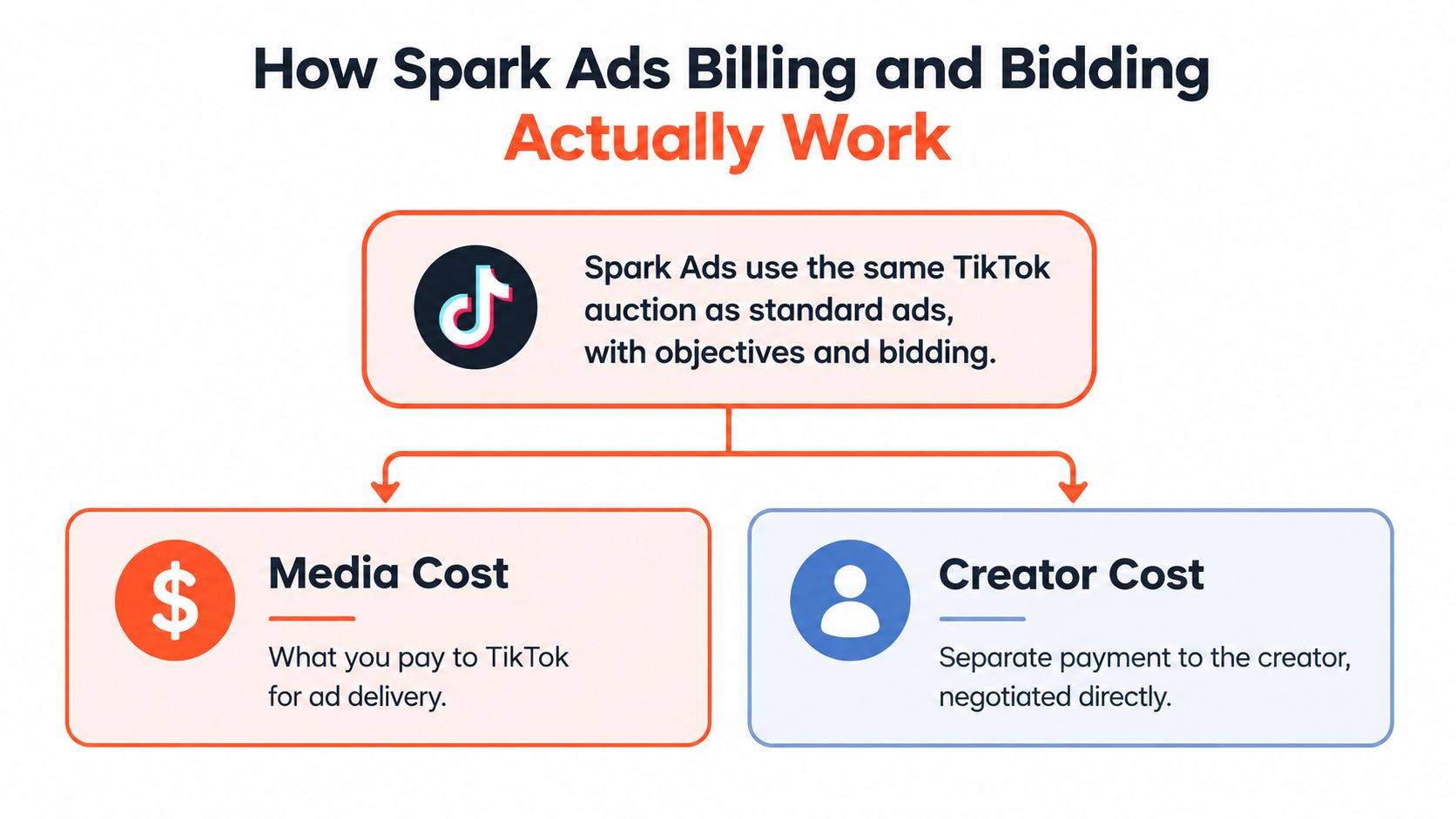
The cleanest way to calculate TikTok Spark Ads cost is to write two lines in the budget sheet before adding any assumptions.
Total campaign cost = TikTok media spend + creator content and authorization fees.
TikTok handles the first line. The creator or agency handles the second. Keeping those lines separate prevents a common mistake, where a media buyer sees a manageable auction budget and assumes the full campaign will cost the same amount.
Media spend follows the normal auction
Spark Ads use the same TikTok auction as standard In-Feed ads. The campaign still has an objective, audience, optimization event, bid strategy, and delivery budget. There isn't an official Spark-only rate card that automatically adds a platform premium.
Independent pricing guides commonly cite minimums of $50 per day at the campaign level and $20 per day at the ad-group level. These figures are planning references, not a guarantee that every account, market, or buying interface will show identical requirements. The Spark Ads pricing guide from AdMake AI describes the same general split between auction media and separately negotiated creator licensing.
The auction price changes with demand, audience quality, objective, creative response, and pacing. TikTok may charge based on the delivery and buying model connected to the campaign, rather than a fixed amount for the post itself.
Creator rights create the second cost
Creator authorization is negotiated separately. Market guides often quote authorization as an add-on to a creator's base content fee, with 15% to 20% for 30 days, 20% to 30% for 60 days, and 35% to 55% or more for longer usage windows. These are market planning ranges, not mandatory TikTok charges, so the final amount depends on the creator, scope, audience, territory, and contract.
A creator may also price differently for category exclusivity, whitelisting, editing, paid usage across other platforms, or continued use after the original window. Those terms belong in the rights discussion, not hidden inside the media estimate.
That is why campaign budgets can range from low four figures to well into five figures. The scale of the auction matters, but the number and quality of creators, the amount of content, and the authorization period can matter just as much.
What Drives Your TikTok Spark Ads Cost Up or Down
The auction doesn't price every Spark impression the same way. Your cost changes as TikTok evaluates the relationship between your objective, audience, creative, bid, and expected response.
Start with the outcome you need. A reach campaign asks the system to find inexpensive exposure, while a conversion campaign asks it to locate people more likely to complete a purchase or another tracked action. Those goals can produce different delivery patterns, even when the video and audience remain unchanged.
The main pressure points
Objective and optimization event: A conversion-focused setup can behave differently from one optimized for views or clicks. Choose the event that matches the business decision you need to make, rather than selecting a cheaper-looking event for the first report.
Audience competitiveness: Popular audiences attract more advertiser demand. Broad targeting can offer TikTok more room to find delivery, while a narrow audience may become expensive when many advertisers want the same people.
Creative response: A Spark post with a strong hook and credible creator voice can earn better engagement and conversion signals. That doesn't guarantee a lower CPM, because stronger response can also place the ad in more competitive auction conditions.
Creator and audience fit: A large following isn't automatically valuable. A smaller creator whose viewers understand the category may generate more qualified action than a broad entertainment audience that watches but doesn't buy.
Seasonality and pacing: Demand can rise around major shopping periods, launches, and category moments. Sudden budget increases can also change delivery quality, especially when the campaign hasn't gathered enough performance feedback.
Bid strategy: Aggressive bids can help a campaign compete for delivery, but they can also raise the price you pay for volume. A controlled test should give the system room to learn before you judge the account.
The counterintuitive part is creative quality. A better Spark post can show a higher CPM because it wins valuable auctions against stronger competition, yet still lower CPA because more viewers click and convert. The 2026 TikTok benchmark analysis from Digital Applied describes this mixed pattern, with datasets showing Spark CPM both above and below standard In-Feed depending on the sample and objective.
When costs rise, inspect the funnel in order: delivery, click quality, conversion rate, then CPA. A CPM problem may actually be a creative or landing-page problem.
If CPA is acceptable and revenue attribution is strong, a higher CPM may be a reasonable trade. If CPM looks attractive but the post produces weak clicks or poor conversion quality, the cheap reach isn't helping the business.
TikTok Spark Ads Cost Benchmarks for CPM CPC and CPI
Benchmarks are useful as a starting point, not as a promise. Different datasets use different objectives, geographies, verticals, attribution windows, and campaign maturity. That explains why one guide can show Spark CPM below standard In-Feed while another shows it above.
Across independent pricing guides, Spark Ads are commonly placed around $4 to $12 CPM, with broader benchmark summaries extending to roughly $4 to $14 CPM depending on market and objective. One comparison reports $11.85 average Spark CPM versus $9.16 for In-Feed, while another reports median Spark CPM around $6.20 versus $7.40 for standard In-Feed. The conflicting direction is the point. Spark isn't cheaper or more expensive in every auction.
For CPC planning, independent guides commonly cite $0.25 to $1.00, while performance datasets can show higher results in competitive categories. A separate compilation reports average Spark CPA of $14.62 versus $23.18 for non-Spark formats, and cites $9.87 CPA for DTC apparel using micro-influencer content under 60 seconds. Treat those as reference points, not targets for your account. The influencer marketing CPM guide is useful when you need to compare paid distribution with creator pricing more broadly.
| Metric | Spark Ads Benchmark | Standard In-Feed Benchmark | What It Means for Planning |
|---|---|---|---|
| CPM | Roughly $4 to $14, with common planning ranges around $4 to $12 | Dataset results vary, including $9.16 in one comparison | Don't assume Spark carries a fixed media premium |
| CPC | Common guide range of $0.25 to $1.00 | Varies by objective, market, and audience | Model clicks from your own creative and targeting history |
| CPA | One compilation reports $14.62 for Spark and $23.18 for non-Spark | $23.18 in that same comparison | Compare acquisition cost, not just traffic cost |
| Creator authorization | Often 15% to 20% for a 30-day window | Not applicable to a brand-owned asset | Add rights as a separate budget line |
The benchmark table also shows why CPI and CPA deserve separate treatment. An app team may care about an install first, while an e-commerce team needs a purchase or revenue event. The same Spark post can look efficient for one objective and weak for another.
Forecasting and Optimization to Lower Cost and Improve ROAS
Build the forecast from the bottom of the funnel, not from a CPM headline. Start with the media budget, estimate impressions, turn impressions into clicks using your expected CTR, and then convert clicks into actions using your expected conversion rate.
A simple example makes the sequence clear. At $10 CPM, a 2% CTR produces a $0.50 CPC. At a 10% conversion rate, that produces a $5 CPA. Those example values are also shown in the required forecasting visual below, and they illustrate the calculation rather than predict an account result.
A practical budget sheet
Use separate cells for each assumption:
Media budget: Record what TikTok can spend through the auction. Don't blend this with creator payment.
Expected CPM: Use a range rather than one precise forecast. Your account history is more useful than a generic industry midpoint.
Expected CTR: Estimate clicks from the post's actual hook, offer, and audience fit. A polished video with weak relevance won't rescue the model.
Expected conversion rate: Base this on the destination experience and event quality. If the landing page loads slowly or the offer is unclear, lower your assumption.
Creator fee and authorization: Add the base content fee, the rights add-on, and any extension or cross-platform usage separately.
Revenue per conversion: Compare expected revenue against the combined media and creator cost, not media alone.
The forecast becomes more useful when you build low, expected, and strong scenarios. If the strong case works only because the CPM is unusually low, the plan is fragile. If the expected case works with a higher CPM because conversion quality improves, the campaign has more room to scale.
Optimize the expensive part of the funnel
Test the opening, creator angle, offer, and proof before making complicated bid changes. Keep the post's native voice intact, then create several Spark-ready variations so you can learn which creator and message generate qualified action.
When one organic post shows stronger engagement and commercial intent, authorize that post for paid amplification rather than spreading budget evenly across every asset. Review performance by creator, post, audience, and conversion event. A blended account average can hide one strong creator and several expensive ones.
A good Spark forecast has two outputs: the media amount TikTok may spend and the total amount your business must pay to use the creative.
Finally, track ROAS with creator-level links, promo codes, and platform attribution. If the campaign is for an app, monitor the install event and downstream activation. If it's for commerce, connect the purchase event to revenue. Optimization gets easier when the team can see which post generated the outcome, not just which campaign spent the money.
When to Choose Spark Ads and Next Steps for Your Budget
Spark Ads make the most sense when the creator's existing post contributes something your brand asset can't easily reproduce, such as a believable demonstration, a comment-led response, or social proof that already exists around the content. They're especially useful when you have a steady supply of creator posts and want to test native creative before scaling paid distribution.
Standard In-Feed ads may be simpler when the brand owns the creative and doesn't need creator authorization. Other formats may fit a different job. For example, TikTok Search Ads can support intent capture, while broader awareness formats may be more appropriate when reach and launch visibility matter more than creator-led attribution.
Use this decision filter before approving a budget:
- Choose Spark when creator context, organic engagement, and authentic product explanation are central to the conversion path.
- Choose standard In-Feed when you need direct control over brand assets, edits, approvals, and media usage.
- Delay amplification when the creator post has views but weak commercial relevance, unclear disclosure, or no measurable conversion path.
- Scale carefully when CPA and revenue remain healthy after adding creator authorization to the media cost.
Your next steps are straightforward. List every creator post you want to promote, confirm the authorization period and territory, separate rights from media in the budget, and define the conversion event before launch. Then run a controlled test, compare creators on CPA and ROAS, and extend rights only for posts that continue to produce profitable outcomes.
The best Spark campaign isn't the one with the lowest CPM. It's the one where the post earns attention, the audience takes the intended action, and the total cost still works after creator rights are included.
Social Cloud plans and measures creator campaigns across TikTok and other platforms, with creator selection, usage-rights management, tracking links, promo codes, and reporting tied to outcomes. If you want help forecasting creator fees and paid amplification together, visit Social Cloud and share the performance goal you're budgeting for.