
Paid social is getting harder to defend. Creative fatigue arrives quickly, CPIs keep moving in the wrong direction, and the dashboard still can't tell you whether an install will become a valuable user. That's why influencer marketing for apps has moved beyond vague brand awareness. Done properly, creator content gives you a native product demonstration, an audience that already trusts the presenter, and a measurement system tied to installs, revenue, and retention.
The catch is that influencer attribution isn't clean. Some users click, some search for the app later, and others install after seeing a creator without ever touching a tracked link. A campaign can look weak in a last-click report while lifting branded demand and organic installs in the background. The practical playbook below focuses on the parts that decide whether creator spend becomes repeatable acquisition: unit economics, creator selection, tracking, forecasting, cohort analysis, and weekly optimization.
Table of Contents
Why Influencer Marketing for Apps Works Now
A familiar paid social meeting starts with the same problem. The team has refreshed the hooks, rotated the formats, and narrowed the audience, but the cost of another install still feels harder to justify. The obvious response is more creative testing. The better response may be to change who delivers the message.
Creators can show an app in use instead of describing it in polished ad language. A fitness creator can build the app into a routine, a gaming streamer can demonstrate the first session, and a finance educator can explain a complicated workflow in a way that feels native to the audience. That format matters because app value often has to become clear before a user decides whether to click, install, or register.
The channel has also grown into a serious performance buying category. The global influencer marketing industry expanded from about $1.7 billion in 2016 to $16.4 billion in 2022, then to roughly $32.55 billion in 2025, according to Sprout Social's influencer marketing statistics. The same source's 2026 industry summaries project continued growth beyond $40 billion in 2026, which points to more creator inventory, more specialized platforms, and more measurement infrastructure around outcomes such as CPI and ROAS.
Practical rule: Treat the creator as both a media channel and a creative strategist. You're buying distribution, but you're also borrowing the format that makes the app understandable.
Short-form video is particularly useful for a product that needs a fast demonstration. That doesn't mean every campaign belongs on TikTok. It means the platform and format should follow the app's buying decision, not the biggest available audience. Teams experimenting with native humor can also study approaches such as branded meme content for CPI, especially when the app's value can be expressed through a recognizable social format.
The rest of the work is less glamorous and more important. Set the profitability ceiling before outreach, vet creators by audience quality and sponsored performance, install measurement before the first post, and read direct attribution alongside branded-search and cohort signals.
Setting CPI and LTV Goals Before You Spend
Don't start by asking which creator you can afford. Start by asking what an acquired user is worth and how much of that value you can spend to acquire them.
Build a simple 12-month LTV model from the revenue events your app records. For a subscription app, that might include trial-to-paid conversion, renewal behavior, and refunds. For a game, it could include payer conversion and repeat purchases. For a finance product, the important value may arrive later, so a cheap initial install can be misleading if activation and funded-account behavior remain weak.
The calculation is straightforward:
- Estimate LTV: Use your expected 12-month revenue per acquired user, adjusted for refunds or other known leakage.
- Choose an LTV:CPI threshold: Decide how much value must remain after acquisition cost. Gaming often needs roughly a 3:1 or better LTV:CPI ratio, while finance apps may justify a higher CPI when 12-month LTV is strong, as described in benchmark guidance for influencer-driven mobile growth.
- Derive the target CPI: Divide allowable LTV by the chosen ratio. If your modeled LTV is $150 and you require a 3:1 ratio, your target CPI is $50. That's a planning example, not a market benchmark.
- Define the quality event: Select the post-install action that proves value, such as account activation, a completed first session, subscription start, purchase, or day-30 retention.
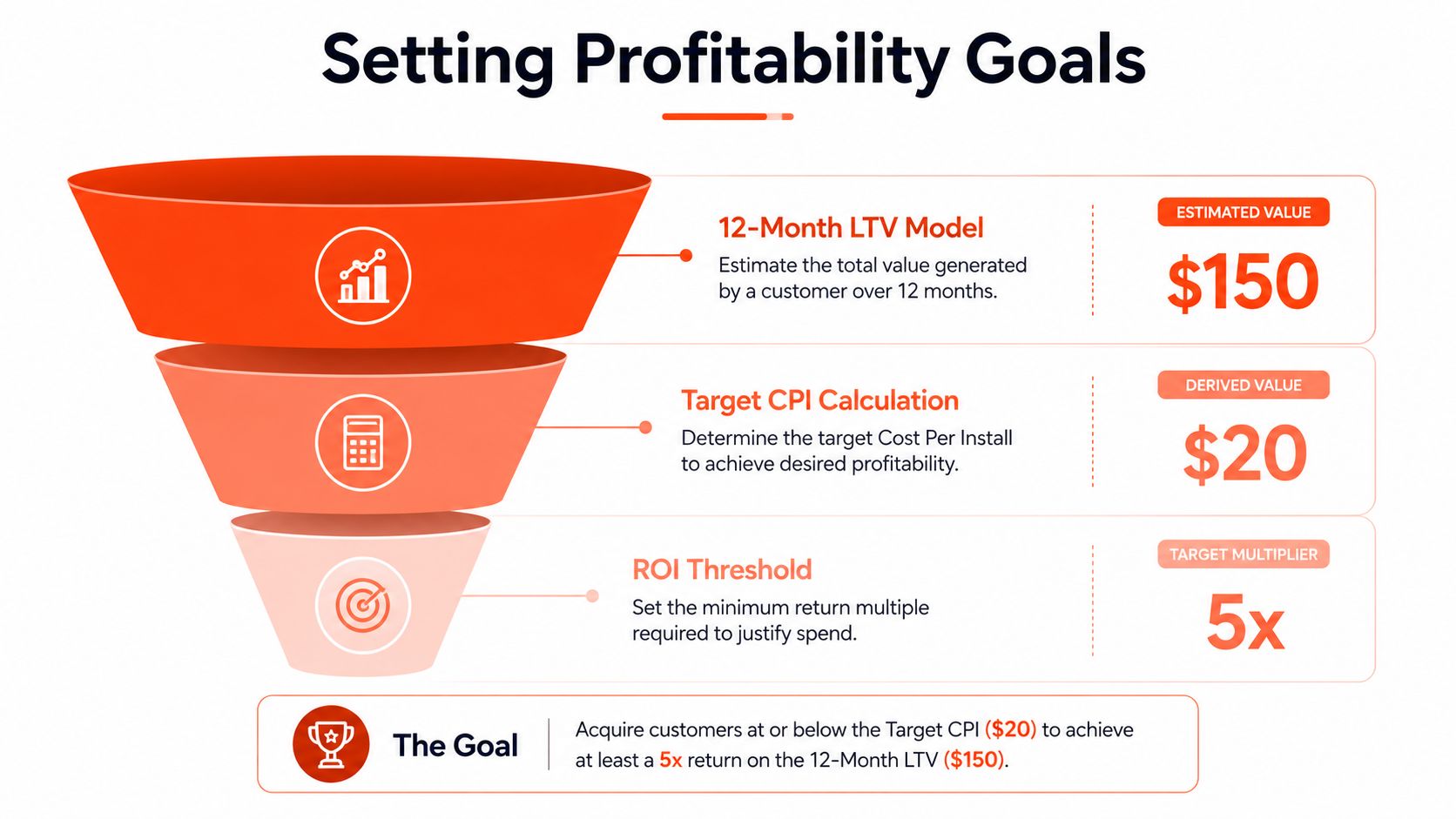
A target CPI is only useful when stakeholders agree on what happens after the install. A creator delivering inexpensive installs can still lose money if those users don't activate, subscribe, purchase, or return. Track LTV:CPI and retention alongside CPI, not as a later reporting upgrade.
Put the brief in writing
Create a one-page campaign brief before anyone contacts creators. Include the target CPI, the LTV:CPI threshold, the primary post-install event, the markets and platforms in scope, the required disclosure language, and the rights you need for paid amplification.
This document protects the campaign from a common failure mode: finance evaluates installs, product evaluates activation, and growth evaluates click volume. Each team can be correct within its own dashboard while the campaign remains commercially unclear. One agreed success event gives optimization a shared direction.
Choosing Creators and Formats That Drive Installs
Follower count is a weak starting point. A creator with a large audience but inconsistent views, shallow comments, or poor product fit can waste more budget than a smaller specialist whose audience asks detailed questions and follows recommendations.
Look at recent content, not a media kit alone. Review average views across comparable posts, comment quality, audience geography, recurring themes, and previous sponsored integrations. A creator who performs for fashion may not translate to a budgeting app, even if the reach looks impressive. For app campaigns, the most useful signal is whether the audience already has a reason to care about the problem your product solves.
Platform choice should reflect the conversion job:
| Platform | Engagement Benchmark | Best Use for Apps |
|---|---|---|
| TikTok | Around 4.25% engagement in 2026 benchmarks | Fast demonstrations, relatable problem-solution videos, trend-led discovery, and testable performance creative |
| Instagram Reels | Around 1.23% engagement in 2026 benchmarks | Lifestyle integrations, visual product walkthroughs, and creator content that can extend into Reels placements |
| YouTube | Around 0.51% engagement in 2026 benchmarks | Longer explanations, reviews, tutorials, and products that need more education |
| Twitch | No benchmark supplied here | Live gameplay, community interaction, and apps where real-time demonstration matters |
The benchmark figures above come from Influencer Marketing Hub's benchmark report. Engagement isn't CPI, so don't select a platform from that column alone. Use it as a clue about interaction, then validate the path from view to install and from install to retention.
Match format to the app
- Gaming: Live streams, challenge formats, early access, and gameplay clips make the product visible in context.
- Health and lifestyle: Day-in-the-life integrations and routine-based demonstrations can make the app feel like part of an existing habit.
- Finance and utilities: Tutorials, comparisons, and question-led videos give creators room to build trust and clarify limitations.
- E-commerce apps: Product discovery, short demos, and live Q&A can connect content to both installation and later purchase behavior.
Give creators a clear value proposition, compliance requirements, and prohibited claims. Don't script every sentence. The most effective sponsored post usually preserves the creator's pacing, language, and visual habits. For additional thinking on authority-led creator programs, the overview of Sift AI KOL marketing is a useful complement to standard influencer selection.
You can also use influencer video marketing guidance when deciding how to repurpose creator footage across organic and paid placements. The important distinction is simple: buy creators for audience fit and message credibility, then buy amplification only after the content proves it can hold attention and generate intent.
Tracking and Attribution Mechanics That Hold Up
Measurement has to exist before the first creator publishes. If you wait until content is live, you lose the clean baseline needed to compare creators, platforms, and cohorts.
Assign every creator a distinct tracking setup inside your mobile measurement partner or analytics stack. Use a creator-level deep link where possible, a unique promo code as a second signal, and a post-purchase or post-signup survey asking users how they heard about the app. Tie each identifier to the creator, platform, campaign, content version, market, and agreed payout.
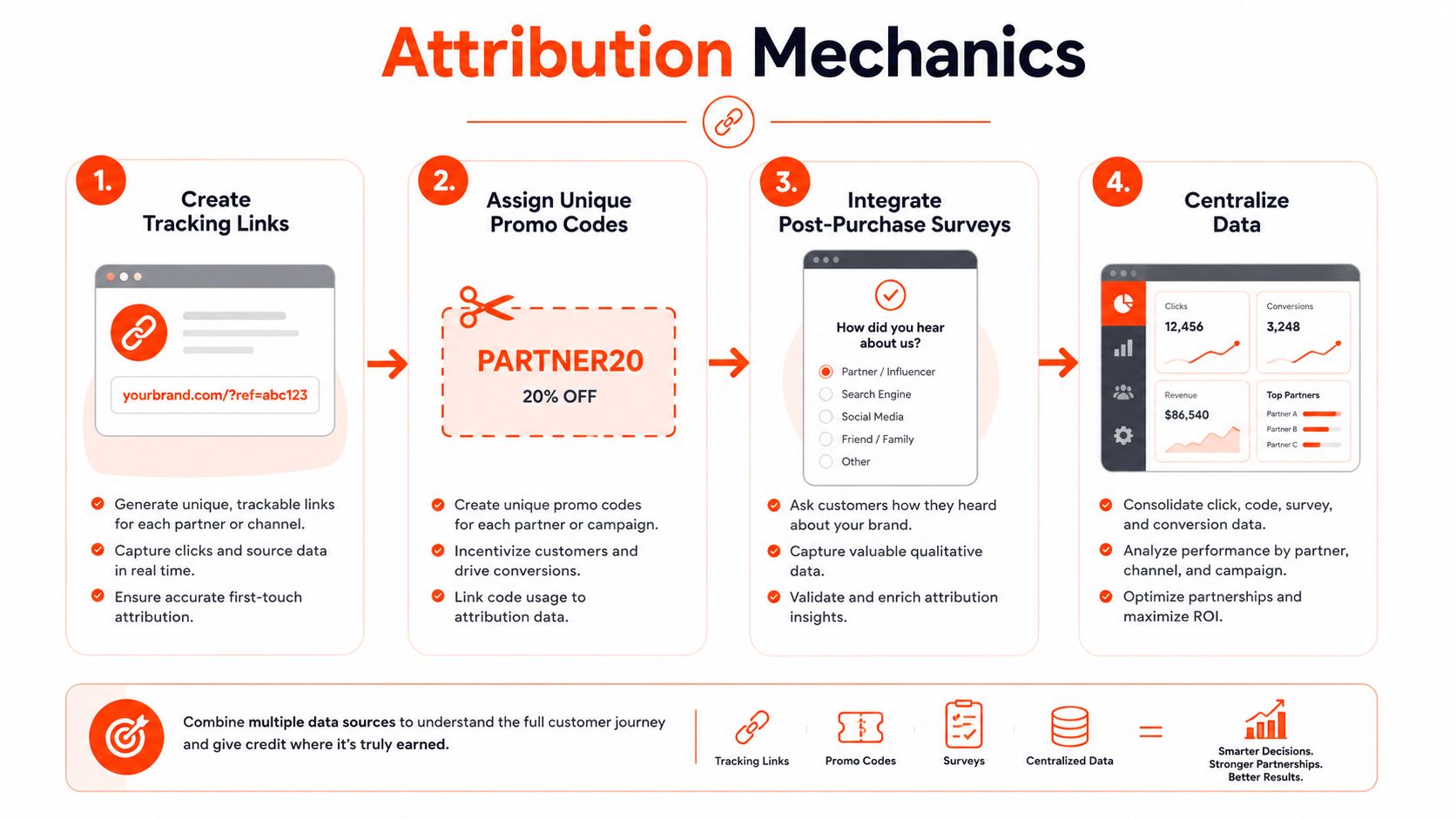
Track more than the install event. The reporting path should connect the creator to registration, activation, subscription, purchase, and retention events. Adjust's guidance on influencer marketing for mobile apps specifically recommends setting creator-level baselines before launch and comparing creator-level CPI and conversion rate later.
Why last click misses creator impact
Click-based attribution can undervalue influencer campaigns by 2–4x because of in-app browsers and delayed installs, according to Apptica's analysis of influencer marketing and mobile game acquisition. The same source says 40–60% of influencer-driven installs may never touch a tracked link.
That doesn't mean you should replace attribution with guesswork. It means you need multiple layers of evidence.
- Direct attribution: Count tracked-link installs, promo-code uses, and creator-reported conversion paths.
- Branded demand: Monitor branded searches, app-store page activity, and organic install changes during the creator's posting window.
- Cohort quality: Compare activation, monetization, and retention for exposed and attributed cohorts over 30–90 days, rather than judging the campaign only on launch-week clicks.
- Baseline comparison: Account for normal organic and paid UA activity so a creator isn't credited for a rise that was already underway.
The aim is not to manufacture lift. It's to avoid under-crediting content that influences users before they convert through another path. Use the full view in your guide to measuring influencer marketing ROI, then keep the rules consistent across every creator.
Building a Campaign Forecast You Can Defend
A forecast should expose uncertainty before spend begins. It shouldn't turn weak assumptions into a precise-looking install promise.
Create one row per creator or placement. Start with the agreed fee, expected views, expected click-through behavior, install conversion assumptions, and any amplification budget. Then calculate projected installs and projected CPI. Keep organic lift separate from direct-link installs so leadership can see which outcomes are measured and which are directional.

Use a worked example with clearly labeled assumptions. Suppose a creator fee is $2,000, your planning model expects 100,000 views, and you assume 1% of viewers click. If 20% of those clicks install, the forecast produces 200 installs and a projected CPI of $10. Those assumptions aren't benchmarks. They're placeholders for your own historical data and should be replaced once your first creator tests produce evidence.
Build scenarios, not one answer
Keep three cases in the spreadsheet:
- Conservative: Lower expected views and weaker conversion assumptions.
- Base: The operating case you'll use for budget allocation.
- Upside: A stronger content result, but never the case used to approve the full budget.
Split the budget by platform according to the job each platform performs. Short-form channels may support rapid creative testing, while YouTube or Twitch may carry more educational or live content. Don't force every platform into the same click model. A long-form review may influence search and direct installs differently from a short video with an obvious call to action.
Include the break-even LTV requirement in the output. If projected CPI rises, the spreadsheet should show how much LTV the cohort needs to produce before the placement becomes viable. You can use a Social Cloud influencer marketing ROI calculator as one planning input, but keep ownership of assumptions inside your own finance and analytics workflow.
Ask creators or their representatives for forecast inputs early, then revise once deliverables, usage rights, and launch dates are confirmed. A forecast is defensible when every input has an owner and every optimistic assumption has a conservative alternative.
Optimizing for Installs and Retention After Launch
The first live report should create decisions, not applause. Review results by creator, placement, platform, market, and cohort. Views tell you whether distribution happened. CTR helps diagnose the hook and call to action. Installs reveal conversion, while activation, revenue, and retention tell you whether the audience was worth acquiring.
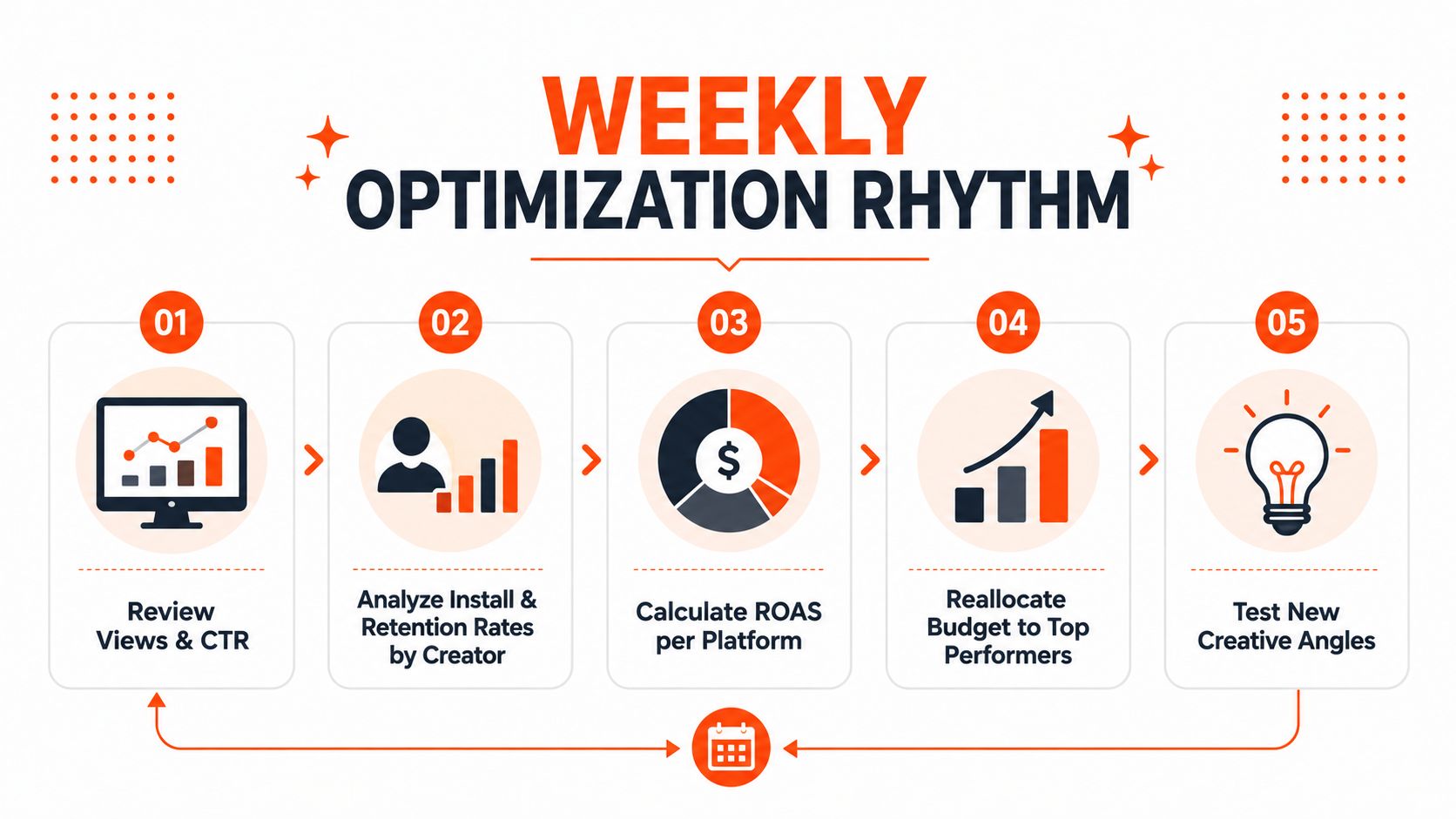
A practical weekly rhythm looks like this:
- Review views and CTR: High views with weak CTR usually point to a mismatch between entertainment and product relevance, or a call to action that arrives too late.
- Analyze creator cohorts: Compare activation and retention, not just install volume. A creator with a middle-of-the-pack CPI and strong day-30 retention can be more valuable than a cheaper placement that brings users who disappear.
- Calculate ROAS by platform: Use realized revenue where available, and separate direct attribution from modeled or directional lift.
- Reallocate carefully: Increase spend or negotiate follow-up content with creators who beat the agreed economic threshold. Don't scale from one early spike without checking cohort quality.
- Test new creative angles: Change the opening, demonstration, objection handling, or CTA while preserving the creator's natural delivery.
A common mistake is cutting a creator because CPI looks average. If that creator's users activate, subscribe, or return at a healthier rate, the economics may be better than the cheapest line in the report. The opposite is also true. A low CPI doesn't rescue a cohort with poor retention and weak LTV.
Turn winners into an asset library
When an organic post performs, secure the rights needed to amplify it. Spark Ads, Shorts variants, and Reels adaptations can extend the life of a creator's strongest explanation without forcing the brand to recreate the concept from scratch. Product seeding can also generate UGC that becomes future paid creative, but only if the team records which samples, messages, and creator profiles produce useful content.
Use this video as a practical prompt for reviewing the relationship between creator content and app growth:
Renewal should follow evidence. A creator who repeatedly produces strong comments, qualified installs, and durable cohorts deserves a longer partnership. A creator who generates views without meaningful intent needs a new angle or a clean exit.
Your First Campaign Plan and Next Steps
A sensible first campaign is deliberately narrow. Set the economics from LTV backwards, choose one or two platforms that fit the app's decision process, and work with a small group of creators whose audiences have a clear reason to care. Measurement should be live before content production finishes, not added after launch.
The forecast must show what you expect and what would change your mind. Include creator fees, projected views, conversion assumptions, target CPI, the break-even LTV requirement, and the post-install event that determines whether a placement earns more budget. Keep branded-search and organic lift in a separate view so the team doesn't confuse directional evidence with directly attributed installs.
Readiness checklist
- Economics: Is the target CPI derived from a documented LTV model and an agreed LTV:CPI threshold?
- Creator fit: Have you reviewed recent sponsored content, audience quality, comments, geography, and content context?
- Creative: Can the creator demonstrate the app naturally without making unsupported product claims?
- Measurement: Does every placement have a creator-level link, code, or survey path before publishing?
- Cohorts: Are activation, monetization, and retention events available for comparison over 30–90 days?
- Operations: Are disclosure, usage rights, approvals, payment terms, and amplification permissions documented?
- Optimization: Does one person own the weekly decision to scale, revise, or stop each placement?
Don't expect creator campaigns to fix a weak product or a broken onboarding flow in a week. Early performance can be noisy, and cohort quality needs time to mature. The channel becomes more predictable when each test improves the next brief, the next creator shortlist, and the next forecast.
Once the CPI and retention math holds, scale through repeat partnerships rather than treating every campaign as a fresh transaction. Add cross-platform amplification selectively, preserve the creator's voice, and keep checking whether the users remain valuable after the initial install. Teams exploring adjacent growth systems can also browse the LunaBloom AI blog homepage for broader perspectives on AI and marketing workflows.
The immediate next step is practical: write the one-page brief, connect the events in your measurement stack, and shortlist creators based on audience intent rather than follower count. Then launch a controlled test that gives you enough signal to make a second decision, not a vague awareness result that can't guide the next dollar.
Social Cloud can help app growth teams select vetted creators, forecast target CPI or CPA, manage briefs and rights, and attach tracking links, promo codes, and surveys to every placement. Visit Social Cloud to discuss a creator campaign with weekly reporting and cohort-focused attribution built into the operating plan.