
You've just signed three creator campaigns. The videos look polished, comments are positive, and the view counts make the weekly dashboard look healthy. Then finance asks the only question that matters: which creator revenue can we verify?
That's where influencer video marketing usually breaks. Teams treat creator content as a creative partnership first and a measurable channel later, so the reporting stops at views, likes, and engagement. The fix isn't another brainstorm. It's a measurement system designed before anyone writes a script, with the brief, platform, rights, landing page, and reporting model built around the business outcome.
Table of Contents
The Real Problem With Creator Video Spend
Creator spend becomes difficult to defend when the campaign has no clear chain from impression to business result. A video can be entertaining, on-brand, and widely shared while still failing to produce qualified traffic or purchases. That doesn't mean the creative has no value. It means the team never decided which value it needed to prove.
Start with the commercial question. If the campaign must acquire customers, choose CPA, revenue, or ROAS as the primary decision metric. If it supports consideration, define the action that signals progress, such as a qualified lead, product-page visit, or assisted pipeline. If it's an awareness program, agree in advance how the team will evaluate branded search, direct traffic, or other qualified signals instead of pretending views equal demand.
Practical rule: Never approve a creator brief until you can complete this sentence: “We'll increase or reduce spend based on ___.”
Work backward from the KPI
A performance-led campaign moves in reverse:
- Business outcome: Define the revenue, acquisition, pipeline, or awareness result the channel must support.
- Conversion event: Select the event that can be attributed consistently, such as a purchase, install, signup, or qualified session.
- Tracking path: Assign creator-level links, promo codes, post-purchase survey options, and platform reporting conventions.
- Creative job: Give the video one primary task, such as generating qualified clicks or resolving a purchase objection.
- Optimization signal: Decide which early indicators justify iteration without replacing the final KPI.
This approach changes how you evaluate a creator. Audience size becomes one input, not the conclusion. A smaller creator with a clear audience fit, strong message match, and clean tracking can teach you more than a larger account whose traffic cannot be separated from the rest of the campaign.
The common budget leak is vanity-metric substitution. Views are useful for understanding distribution, and engagement can reveal audience response, but neither metric proves profitable acquisition on its own. The campaign needs a measurement layer that connects the creator, the asset, the click, the landing page, and the conversion.
That's also why the creative idea comes second. A dramatic product reveal may earn attention, but it can be the wrong vehicle for a high-intent search audience. A straightforward demonstration may look less exciting in a planning deck and produce more useful traffic. Your KPI determines the format, the hook, the CTA, the destination, and the decision to scale.
What Influencer Video Marketing Actually Is in 2026
Influencer video marketing is creator-produced video used to create measurable attention, consideration, or action across organic and paid distribution. The creator supplies audience context and a native communication style. The brand supplies the commercial objective, offer, product access, compliance requirements, and conversion path.
By 2026, video had become a mainstream component of digital strategy. Kapwing's 2026 video marketing data reports that 93% of video marketers said video was important to their overall strategy and 91% of businesses used video as a content marketing tool. The same source projected global digital video ad spending at about $223.5 billion in 2026 and $241.9 billion by 2028, showing why creator video increasingly belongs in the paid-media conversation rather than in a separate “experimental content” budget.
The practical shift is organizational. Growth teams now need creator assets that can work as organic posts, partnership ads, Reels placements, Shorts variations, or TikTok-native paid units. That doesn't mean every organic video should become an ad. It means the rights, tracking, message, and edit plan should be considered before production.
The allocation question
The requested allocation table includes percentage fields that aren't supported by the verified data, so the useful version is directional rather than invented:
| Period | Organic-first allocation | Paid-integrated allocation | Primary platform shift |
|---|---|---|---|
| Earlier programs | Creator content was often planned mainly for organic distribution | Paid use was frequently treated as an additional option | Creator posts were separated from media planning |
| Current 2026 planning | Organic content still supplies testing and community signals | Paid integration is increasingly planned alongside creator production | Short-form placements sit closer to the paid-media stack |
| Forward planning | Keep organic testing tied to audience learning | Reserve rights and budget for proven amplification | Reusable creator assets support cross-platform distribution |
The distinction matters for creator selection. A lifestyle creator may be excellent for showing a product in context, while a technical reviewer may be better at handling objections. A focused lifestyle influencer platform can help teams think about creator fit by use case, but the final decision still belongs in your measurement model.
Treat the asset as an addressable media input, not only as a post. That means each video gets an owner, a tracking ID, a defined usage window, a landing-page destination, and an agreed success metric. The creator's voice remains important, but voice without attribution leaves the growth team unable to distinguish brand lift from expensive noise.
Platform Formats That Match Your Funnel Stage
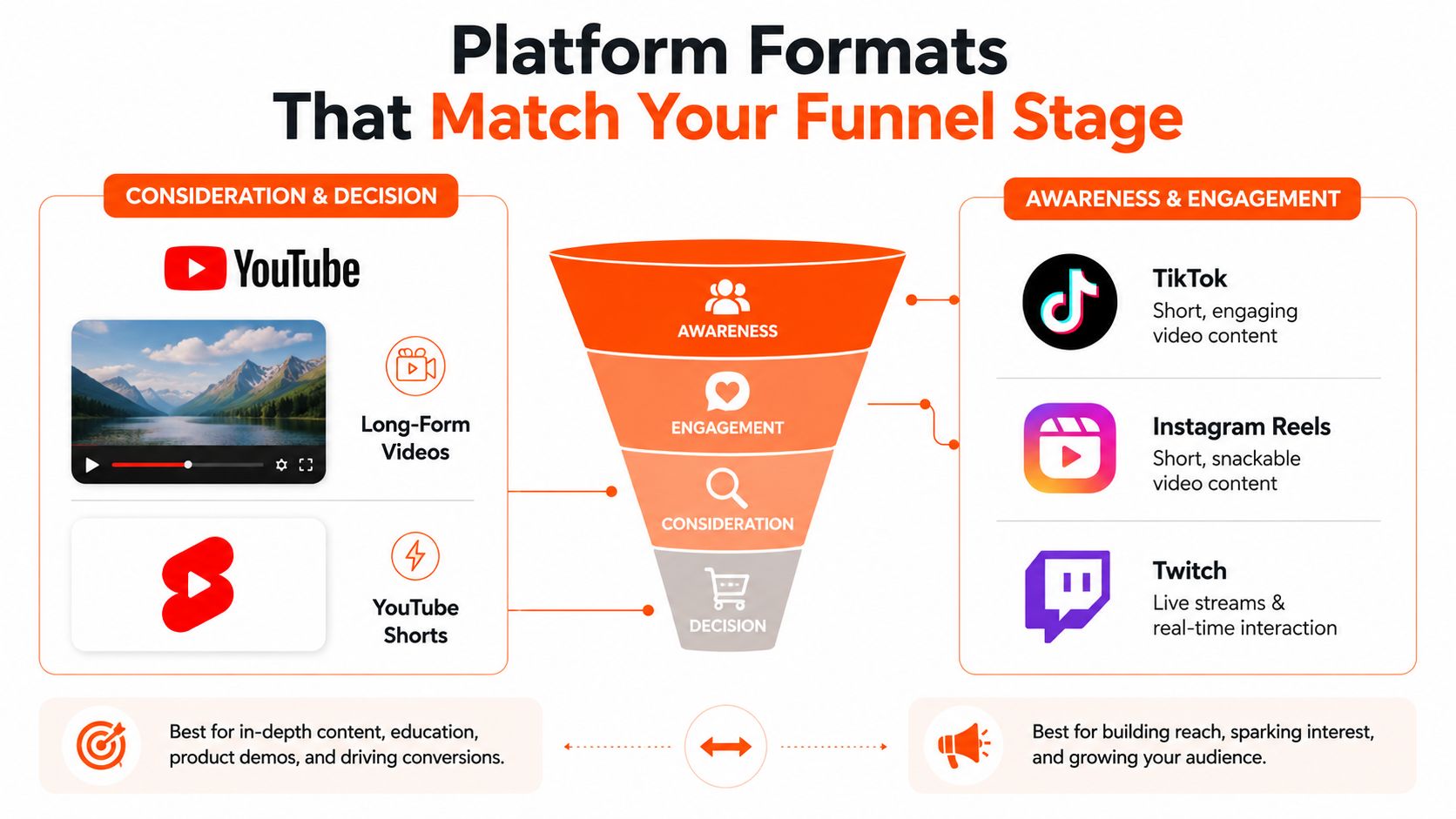
Platform choice should follow the job the video must perform. The same creator can produce useful content for awareness and consideration, but the edit, CTA, audience, and measurement logic shouldn't be identical.
YouTube
Long-form YouTube is strongest when the buyer needs context before acting. Reviews, comparisons, tutorials, and demonstrations can answer objections that a short feed placement can't handle. Search intent also gives YouTube a useful role in consideration, particularly for products where buyers actively investigate fit, setup, durability, or alternatives.
The failure mode is asking a detailed video to behave like a direct-response clip. If the opening delays the product problem, or the CTA appears without a clear reason to click, watch time can look respectable while commercial intent remains weak. YouTube Shorts can support discovery and testing, but they need a separate edit and a distinct expectation from long-form content.
For teams building a dedicated YouTube program, this YouTube influencer marketing resource is a useful planning reference. The key decision is still funnel-specific: use long-form when explanation creates value, and Shorts when speed of discovery matters more than depth.
TikTok
TikTok is built for rapid attention, cultural relevance, and native creator behavior. It's a strong environment for problem-led hooks, demonstrations, reactions, and trend-aware creative. The trade-off is intent. High reach doesn't automatically mean high purchase readiness, so a TikTok campaign needs a clear post-click path and disciplined testing of audience quality.
A video that relies entirely on a trend can generate attention that doesn't transfer to the product. Keep the product problem visible, make the promise understandable without context, and use on-screen text so the viewer can identify the value before deciding whether to continue.
Instagram Reels
Reels sits between lifestyle storytelling and response marketing. It works well for visual products, routines, transformations, styling, and creator-led demonstrations that need an aspirational setting without losing a direct action. Reels can also provide reusable cuts for retargeting, provided the brand secures the correct usage rights.
The common mistake is over-polishing the content until it stops looking native. A glossy ad read can undermine the creator's established style. Preserve the pacing, framing, and language patterns that make the creator recognizable, then add the minimum brand structure needed for clarity and compliance.
Twitch
Twitch is a community and trust environment, especially for categories where live interaction matters. Streams, integrations, product demonstrations, and sponsored segments can work when the creator has genuine authority with a focused audience. Twitch is less suited to a generic, interruption-based message that ignores the live context.
Use Twitch when questions, demonstration, or community credibility are part of the buying process. Give the creator room to explain and respond, then use trackable commands, links, or offers that fit the stream rather than forcing a television-style CTA.
Building a Creative Brief That Drives Watch-Through
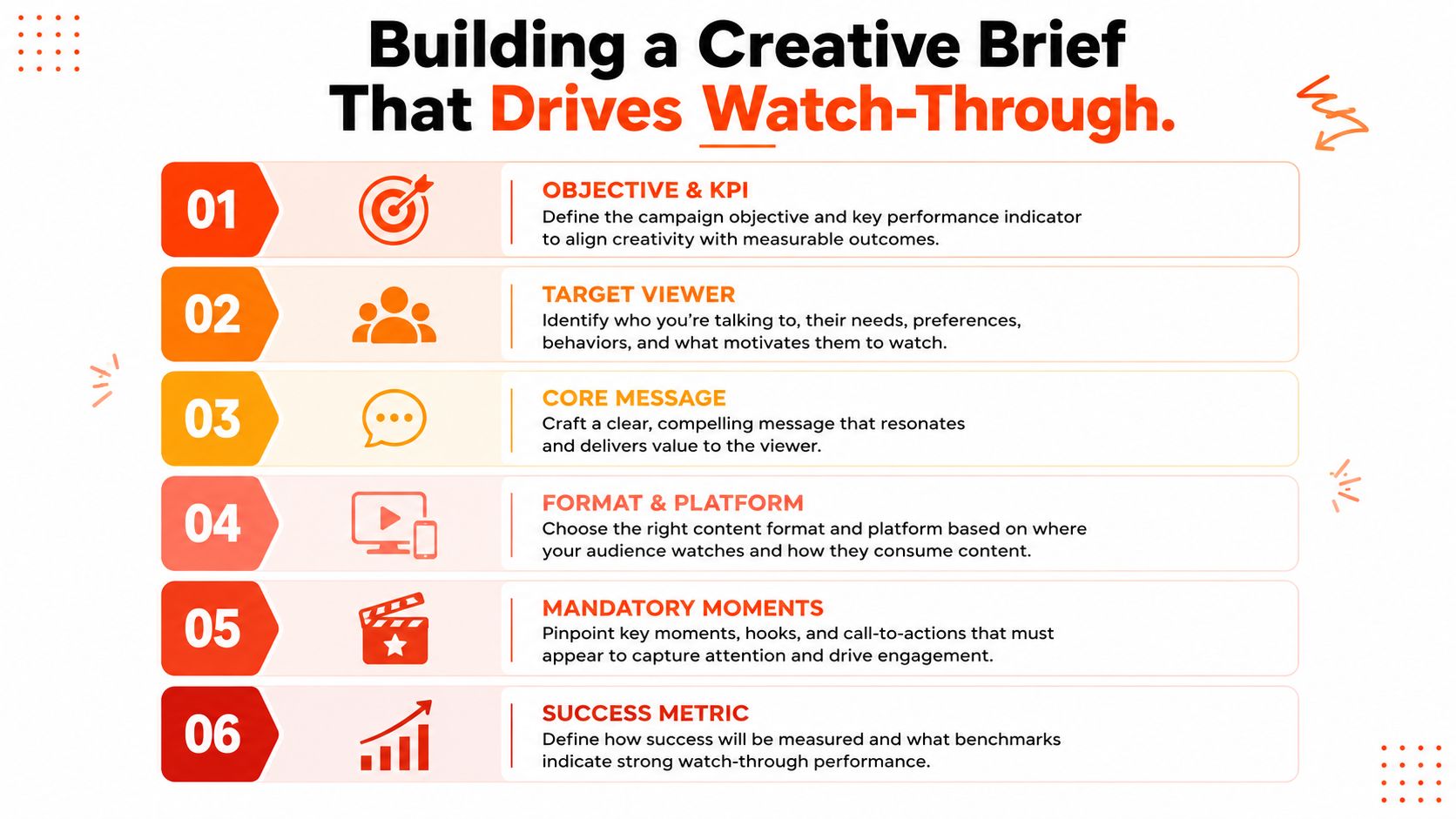
A strong creator brief is a one-page operating document, not a mood board. It should tell the creator what the video must accomplish while leaving enough space for the creator's natural delivery.
Start with the commercial spine
Write the objective in one line: “Generate qualified product-page visits from people who have the problem described in the opening.” Then name one primary KPI. Secondary metrics can diagnose the work, but they shouldn't compete with the main decision.
Define the viewer in practical terms. “People interested in skincare” is weak. “A viewer comparing solutions for a specific routine problem, who needs to see how the product fits into that routine” gives the creator a usable scene and a relevant objection.
Your hook window should match the format. For short-form, demand a clear reason to continue almost immediately. For long-form, establish the problem and promise early enough that the viewer understands the payoff before the explanation begins. A practical formula is: “If you [pain], here's the fix in [time].” The creator can adapt the language, but the problem and payoff should remain obvious.
Design the middle, not just the opening
Create a beat-by-beat outline:
- Opening: Name the pain, tension, or unexpected result.
- Proof: Show the product in use, a relevant comparison, or the process behind the claim.
- Objection handling: Address the concern most likely to block the next step.
- Payoff: Explain what changes for the viewer and who the product suits.
- Action: Give one CTA in the creator's own voice.
Use an open loop when the format supports it. Pattern interrupts can include a change in angle, a close-up, an on-screen label, a new example, or a direct question. The exact rhythm depends on the creator and subject, but a static visual sequence often loses viewers even when the information is useful.
The CTA must name the next action and its reason. “Link in bio” is not a strategy. “Tap through to compare the options for your routine” gives the viewer both direction and context. The landing page must repeat the promise made in the video, or the campaign will create a message mismatch that no amount of creator polish can repair.
Before sharing the brief, review the influencer campaign planning guide for the operational pieces that sit around the creative. The contract, disclosure, usage rights, tracking, and approval process all affect whether the asset can become a useful growth input.
A short walkthrough can help teams align on the structure before production begins:
Metrics That Separate Reach From Revenue
A view is a distribution event. Revenue is a business outcome. The measurement system has to connect the two without pretending that every intermediate signal carries equal weight.
For direct response, defend CPA, conversion volume, revenue, or ROAS. For awareness, use qualified brand signals such as branded search or direct traffic, but define the comparison method before launch. For mid-funnel programs, track pipeline influence or another agreed progression event. The metric hierarchy should make it impossible for a creator to “win” solely by generating cheap views that never produce useful action.
Use diagnostic metrics correctly
A practical chain looks like this:
- Three-second view rate: Tests whether the opening earns attention. The cited short-form benchmark source identifies 35% to 60% of impressions as a healthy range for TikTok, Reels, and Shorts-style influencer placements, with InfluencerDB's benchmark material providing the reference.
- Save rate: Indicates whether the content has ongoing utility. The same benchmark source places a broad benchmark around 0.2% to 1.0% of views.
- CTR: Shows whether the creative and CTA create enough intent to click. The source reports a 1.3% median short-form video CTR and 2.4% top-quartile CTR.
- CVR: Tests message match between the video, offer, and destination.
- CPA: Determines whether the complete path is economically viable.
These numbers are useful as directional benchmarks, not promises. They shouldn't be copied into a forecast without considering audience, offer, placement, creative maturity, and attribution rules.
| Metric | YouTube long-form | TikTok | Instagram Reels | Twitch |
|---|---|---|---|---|
| Primary diagnostic | Watch time and qualified clicks | Opening retention and CTR | Retention, saves, and CTR | Live interaction and tracked action |
| Best commercial role | Consideration and decision support | Awareness and rapid testing | Discovery with response potential | Community-led consideration |
| Main risk | Detailed content without a clear action | Reach without sufficient intent | Polished content that loses native feel | Hard-to-isolate live influence |
| Revenue proof | Tracked conversions and assisted actions | Creator-level clicks and conversions | Paid and organic path analysis | Codes, links, and post-purchase signals |
A campaign that reports only blended CPM will hide weak conversion paths. Divide spend by qualified conversions, not just impressions, and review results by creator, asset, platform, and landing page. For teams formalizing the model, this cross-channel attribution implementation guide is a useful reference for thinking beyond the last click.
The 2016 benchmark report cited in the brief illustrates the full-funnel principle. One large influencer video campaign generated over 47 million views, 970,000 clicks, and more than 24,000 conversions, with reported CPV of $0.02, CTR of 2%, CPC of $1.16, CVR of 2.55%, and CPA of $45.40 in that campaign's context. The lesson isn't to copy those results. It's to report reach, traffic, conversion rate, and acquisition cost together. A guide to measuring influencer marketing ROI can help teams turn that principle into a repeatable reporting workflow.
Repurposing Organic Video for Paid Amplification
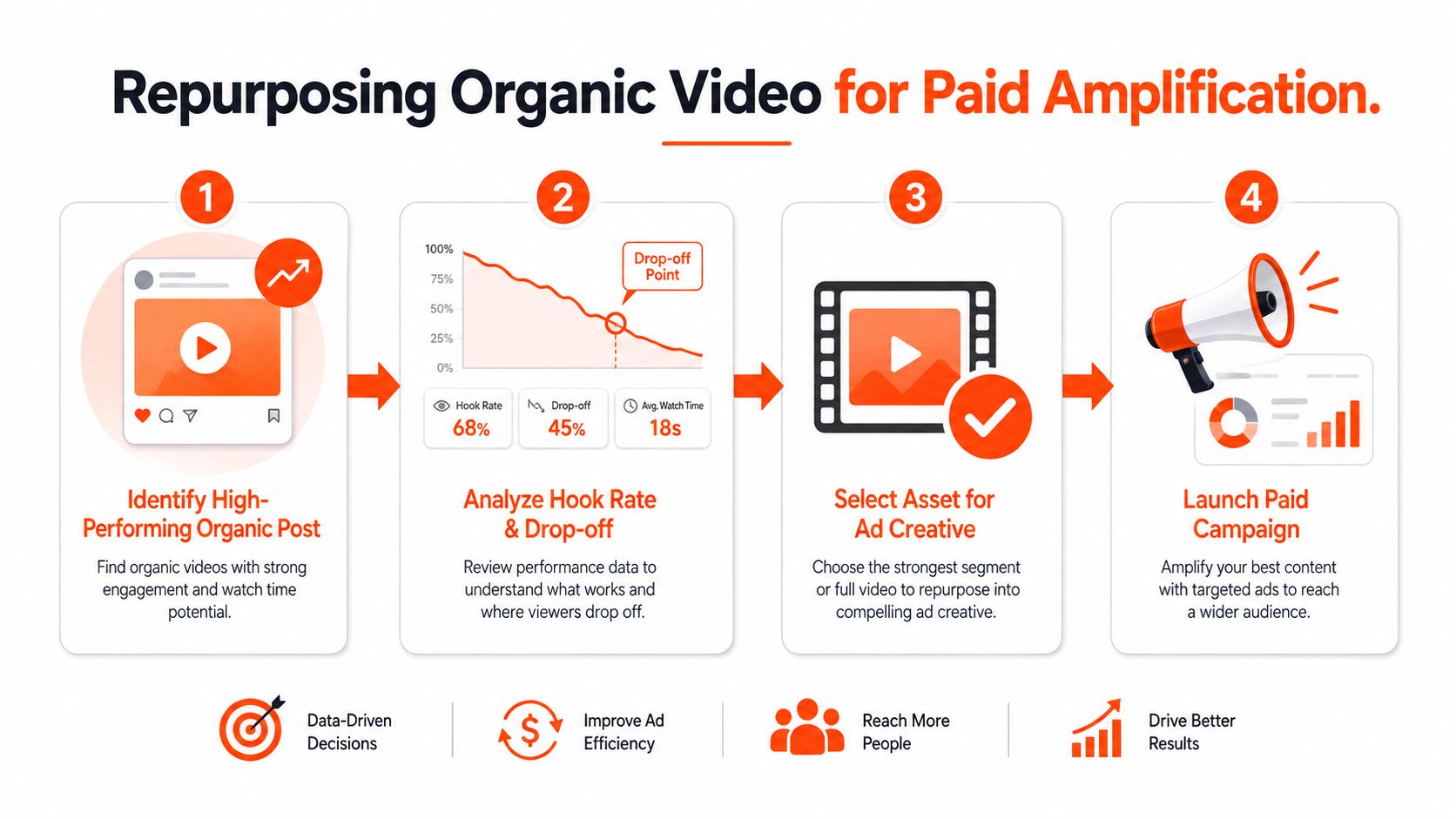
Organic creator video is a creative testing environment, not automatically a complete campaign. The post tells you how an audience responds in its native context. Paid amplification tests whether the asset can create efficient action when the advertiser controls targeting, delivery, and budget.
Select the asset with evidence
Start by identifying organic posts that outperform the creator's normal pattern on opening retention, watch time, or meaningful actions. Don't select a video just because it received many likes. A post can be socially popular and commercially irrelevant.
Then check the contract. Secure permission for paid use, specify the platforms, define the usage window, and clarify whether the creator or brand will authorize the ad. TikTok Spark Ads, Instagram partnership ads, and YouTube Shorts placements each require an operational path that should be agreed before launch.
The edit should be placement-specific. Keep the creator's recognizable opening, but adjust framing, captions, product visibility, audio, and CTA for the destination. One source video may produce a TikTok Spark version, a Reels cut, and a Shorts variation, but those are separate performance assets, not a single file copied everywhere.
Change the measurement model
Organic engagement helps identify resonance. Once the asset becomes paid media, CTR, conversion rate, CPA, and revenue carry more weight. The advertiser's pixel, conversion events, audiences, and landing page replace the creator's follower graph as the main delivery system.
Rights and compliance also change:
- Disclosure: Keep the sponsored relationship clear in the format and placement required by the platform and market.
- Brand safety: Review claims, comments, visual context, and adjacent content before amplification.
- Licensing: Confirm that music, footage, product imagery, and other elements can be used in paid placements.
- Account structure: Decide whether the creator authorizes ads through a creator-owned account or the brand runs the placement through a partnership workflow.
- Version control: Track each cut separately so one weak edit doesn't contaminate the performance read for the original concept.
Teams handling a high volume of cuts may use an automated video repurposing guide to organize the transformation process, but automation doesn't replace rights review or human judgment about the hook.
Feed the learning back into production. Pull the strongest paid variants, identify which opening and proof sequence created qualified action, and use those lessons in the next organic brief. The flywheel works when paid results improve the next creative batch, not when a single post gets boosted without a learning plan.
Trust, Authenticity, and What Actually Converts
“Authenticity wins” is too vague to brief against. Trust depends on format, disclosure, creator fit, and the way the recommendation enters the viewer's experience.
The verified data points in different directions, which is useful rather than confusing. Edelman's 2025 brand and culture research reports that 60% of consumers trusted what a creator said about a brand more than what the brand said itself, while 76% of Gen Z, 72% of millennials, and 66% of the general population preferred video creator content. The same verified data also identifies a trust gap, with one 2025 report placing complete trust in influencer content at 5%, while another trust index reported 74% trust in influencer advertising. Broad acceptance and complete confidence are not the same thing.
Match the format to the trust job
A long-form YouTube review can build confidence through context, comparison, and visible product use. A TikTok haul can create relatability and fast recognition, but it may not provide enough depth for a complex decision. An integrated demonstration often gives the creator room to explain without sounding like a scripted testimonial.
The trust killers are predictable:
- Over-produced ad reads: The message sounds imported from a brand script rather than spoken by the creator.
- Missing disclosure: The audience has to infer the commercial relationship.
- Voice-breaking CTAs: The final instruction uses language the creator would never normally use.
- Unsupported certainty: The video promises an outcome the landing page or product experience can't substantiate.
Don't invent a conversion gap to justify a creative theory. The brief's proposed example of identical hooks producing a 3x conversion difference isn't supported by the verified data, so treat that as a hypothesis to test, not a fact to repeat.
Run a controlled creative comparison instead. Keep the offer and landing page stable, then test two framing approaches, such as an integrated demo against a more direct testimonial. Review hold rate and CTR by audience segment, then inspect qualified conversions rather than letting engagement decide the winner.
Authenticity is a design choice. Give the creator a real problem to solve, enough product access to demonstrate it naturally, a clear disclosure, and a CTA that sounds like them. That combination preserves trust while giving the performance team something measurable to optimize.
Social Cloud plans and measures creator campaigns across YouTube, Instagram, TikTok, and Twitch with creator-level tracking, campaign reporting, usage-rights management, and cross-platform amplification options. Visit Social Cloud to discuss a program built around the KPI your influencer video marketing budget needs to defend.