
You've got a creator shortlist, a negotiated fee, and a launch date on the calendar. The first video goes live, views arrive, comments look positive, and your dashboard reports a healthy spike in traffic. Then finance asks the question that changes the room: how much revenue did this placement create?
That's where influencer marketing on YouTube gets difficult. The platform can support product reviews, tutorials, demonstrations, and other consideration-stage formats, but a campaign can still waste budget if the team can't separate audience attention from business outcomes. In 2026, YouTube is projected to absorb 15% to 25% of global influencer marketing spend, implying roughly $3 billion to $6 billion in annual YouTube influencer spend if the creator economy reaches the forecast range cited by Influencer Fee's 2026 YouTube benchmark. The opportunity is large, but scale makes measurement discipline more important, not less.
Table of Contents
Why Most YouTube Influencer Campaigns Underperform
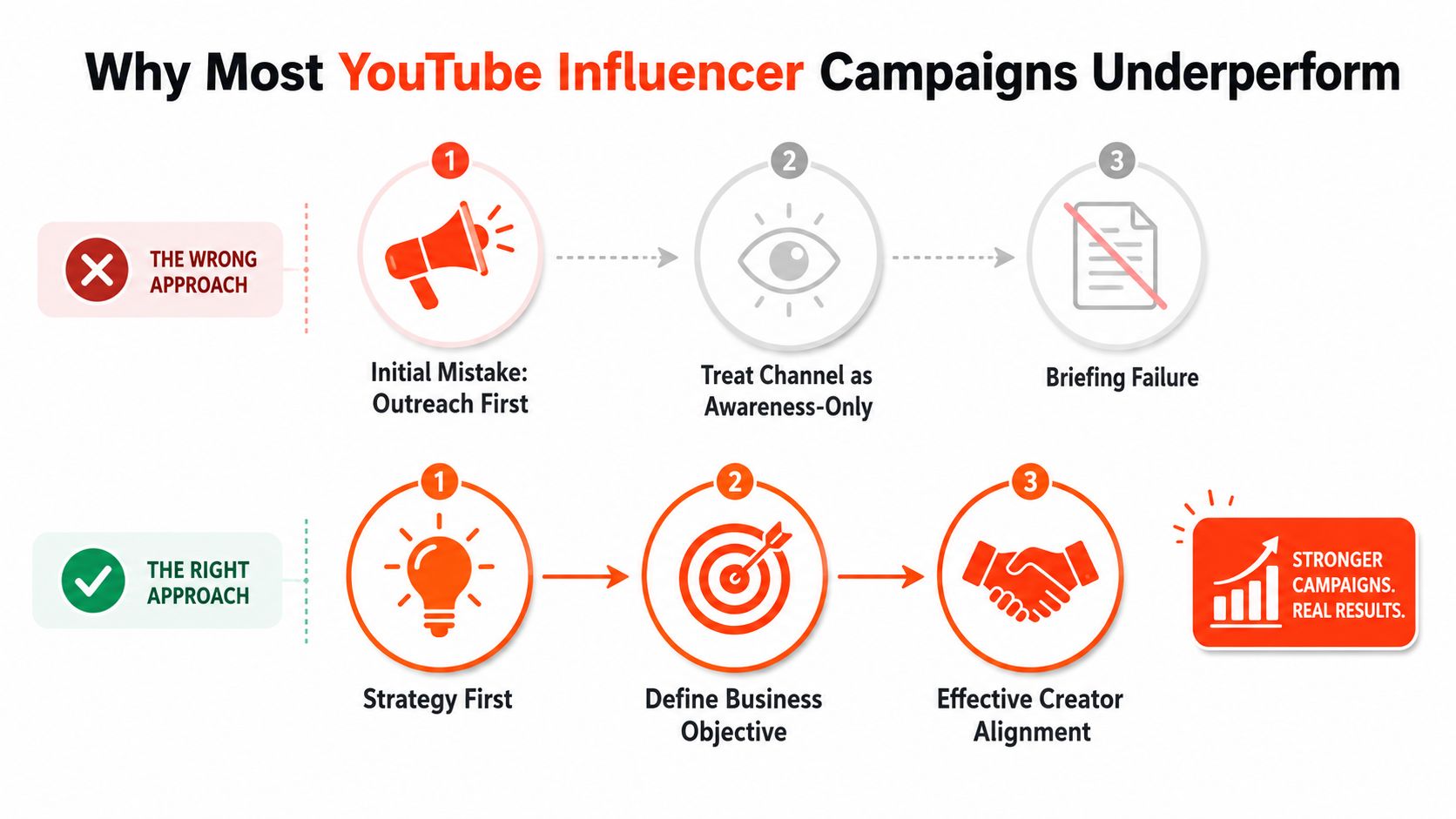
The common mistake is simple: outreach starts before the campaign has a measurement plan. A team searches for recognizable creators, asks for rates, chooses a few names that feel culturally relevant, and builds the business case after the contracts are signed. That sequence turns creator selection into the strategy, even though the creator is only one variable in the performance system.
YouTube's format creates a particular risk. Long-form content can explain a complex product and influence a considered purchase, but views alone don't tell you whether the audience understood the offer, clicked the destination, or converted later through another channel. If the campaign brief says “drive awareness and sales,” the team has already created a reporting problem. Those are different objectives, different creative choices, and different success events.
Start with the commercial outcome
Write the revenue outcome in operational language before contacting a creator. For an e-commerce brand, that might be a first purchase or a qualified new-customer order. For an app, it could be an install followed by a defined activation event. For SaaS, it may be a completed trial, booked demo, or sales-qualified account.
Then document the economics behind that outcome:
- Primary conversion: The event that determines whether the placement worked.
- Acceptable acquisition cost: The maximum amount growth and finance will tolerate for that event.
- Attribution window: The period in which a click, view, or assisted interaction can receive credit.
- Secondary signals: Engaged sessions, product-page depth, branded search activity, or assisted conversions.
Build the stack before the shortlist
Every placement should have a creator identifier, campaign identifier, tracked destination, and defined conversion event. Use links, codes, analytics, CRM data, and surveys as complementary signals rather than pretending one instrument captures the entire customer journey.
A historical benchmark documented 150 campaigns across 95 brands using YouTube creator videos with a conversion pixel, demonstrating that downstream measurement is feasible when sponsored content and conversions are tagged at pixel level. The Influencer Marketing 2016 Benchmarks report also reinforces the operational point: conversion tracking has to be designed into the campaign, not added after launch.
Operator rule: Define the business event, measurement path, and economic guardrail first. Open the creator list only after those three decisions are documented.
Forecasting Views, CPI, and CPA Before You Sign a Creator
A creator quote is not a forecast. It's a commercial input that needs to be translated into expected delivered views, cost per impression, traffic, conversions, and margin.
Start with the creator's historical performance, not their subscriber count. Pull recent videos with comparable formats, topics, placements, and audience intent. Separate organic uploads from sponsored integrations, then record views at consistent checkpoints. For a new program, model the first 7, 30, and 90 days as separate planning windows because YouTube content can continue receiving discovery traffic after launch.
Build the worksheet
Use a conservative base case, then add upside and downside scenarios. Your worksheet can contain these fields:
| Input | Formula | Benchmark |
|---|---|---|
| Creator fee | Contracted fee plus production and rights costs | Use the signed commercial terms |
| Delivered views | Historical comparable views, adjusted for format and placement | Use creator-specific history |
| CPI | Total campaign cost ÷ delivered views | Set a finance-approved ceiling |
| Clicks | Delivered views × expected click-through rate | Use comparable tracked placements |
| Conversions | Clicks × landing-page conversion rate | Use the product's observed conversion behavior |
| CPA | Total campaign cost ÷ conversions | Anchor to allowable acquisition cost |
| Revenue | Conversions × average order value or contract value | Use current commercial inputs |
| Contribution margin | Revenue × contribution margin rate, minus campaign cost | Pause if the result misses guardrails |
These formulas are deliberately plain. Complexity often hides weak assumptions. Document the source of every input and label assumptions as observed, estimated, or unknown.
Compare creator mixes
Model at least three portfolio structures:
- One flagship integration: Concentrates budget and gives you a clear creative test, but one underperforming video can consume the learning budget.
- A mid-tier cluster: Spreads risk across several audiences and creates more variation in hooks, contexts, and conversion paths.
- A long tail of smaller voices: Offers niche coverage and potentially stronger audience alignment, but requires more contracting, QA, tracking, and reporting.
The break-even calculation is straightforward: divide total campaign cost by allowable CPA to find the minimum conversions required. If your base case needs an implausibly high conversion count, don't rationalize the deal with projected reach. Change the fee, deliverable, audience, offer, or creator mix before signing.
Picking Creators With Data, Not Just Vibes
A large channel can deliver attention without delivering buyers. YouTube creator evaluation should therefore begin with audience quality and content context, then use reach as a scaling variable.
Review the audience geography and demographic profile against your actual market. A creator may have strong overall performance but limited relevance if most viewers sit outside the countries you serve or if the content attracts curiosity rather than purchase intent. Returning viewers and subscriber behavior also matter because a loyal community may respond differently from an audience acquired through one viral upload.
Read the channel's performance pattern
Look beyond headline views. Review the public view curve across recent uploads, identify whether performance depends on a single breakout video, and compare sponsored videos with the creator's normal content. Comments can reveal whether viewers understand and welcome the integration, or whether they see it as an interruption. Search for questions about price, use cases, alternatives, and product experience. Those comments often tell you more about commercial fit than a like count.
Ask for creator-side evidence where available:
- Audience geography: Does the viewer distribution match your sales territories?
- Returning versus new viewers: Is the channel building repeat attention or relying on discovery spikes?
- Average view duration: Does the audience stay long enough to hear the integration?
- Sponsored retention: Do brand placements hold attention compared with surrounding content?
- Traffic sources: Does the channel rely on suggested traffic, search, or returning subscribers?
- Commercial history: Has the creator worked with adjacent brands without audience backlash?
Useful tools include YouTube Analytics exports from the creator, Google Analytics for destination behavior, social listening for comment sentiment, and creator discovery platforms that let teams compare audience signals. Teams that need a practical campaign framework can also use this taap.bio guide to influencer campaigns alongside a channel-level review. For the discovery workflow itself, keep a documented process for finding YouTube influencers so procurement can understand how the shortlist was built.
Score the shortlist consistently
| Criterion | Weight | Data Source |
|---|---|---|
| Audience fit | High | Creator analytics and audience geography |
| Content fit | High | Recent uploads and product-context review |
| Sponsored performance | High | Partner-tagged videos and retention evidence |
| Conversion environment | Medium | Description links, comments, landing-page behavior |
| Brand safety | High | Content history, sentiment review, disclosure practice |
| Commercial terms | Medium | Fee, deliverables, rights, exclusivity, revisions |
The weights should reflect the campaign objective. For a conversion program, audience and sponsored performance deserve more influence than raw reach. A defensible score won't eliminate judgment, but it makes the judgment explainable.
Writing a Brief That Preserves Voice and Drives Conversions
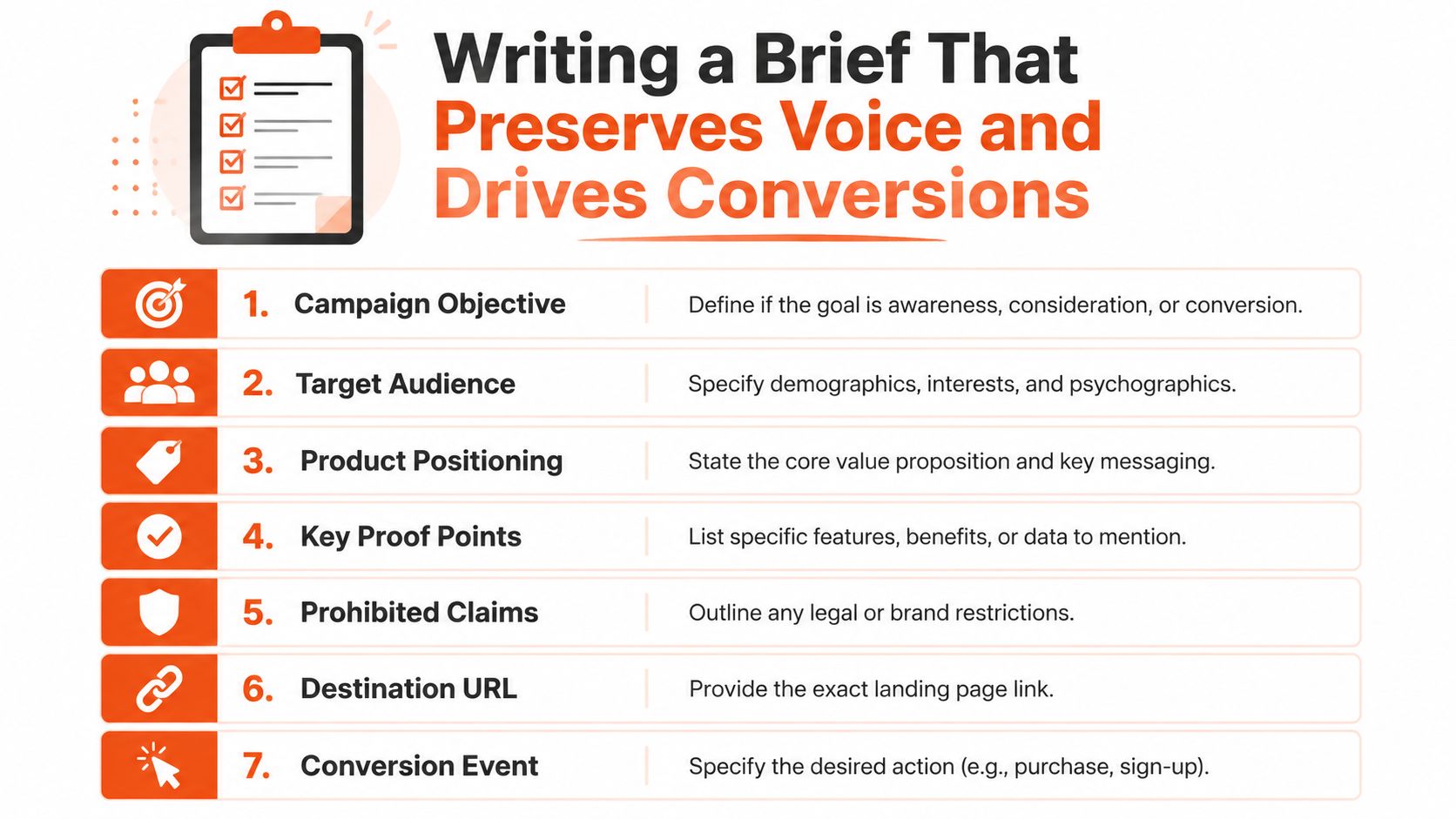
A strong YouTube brief gives the creator clear commercial boundaries and room to make the video native. Start with the inputs they can act on: objective, audience, positioning, proof points, prohibited claims, destination URL, and conversion event.
Reduce the message to one primary action and no more than two supporting ideas. If the creator has to explain every feature, repeat the entire brand story, and include several offers, the audience will feel the brief instead of the recommendation. Give the creator freedom over the hook, examples, demonstrations, pacing, and language.
Protect the opening
The first 30 to 60 seconds should carry a clear value promise. The viewer should understand why the topic matters before the sponsorship feels like an interruption. Agree on the sequence, not a word-for-word script:
- Establish the viewer problem or desired outcome.
- Introduce the product in a relevant context.
- Demonstrate the feature or proof point that supports the claim.
- State the action, destination, and reason to act.
- Repeat the link or code in the description and pinned comment where appropriate.
A creator who normally teaches through demonstrations shouldn't suddenly deliver a corporate monologue. Review the concept and rough cut for audience relevance, message comprehension, watch-time risk, and conversion friction. Don't reject a video because the creator used different adjectives from the brand deck.
Keep approvals structured
Put factual references, claim restrictions, disclosure placement, approval owners, deadlines, revision limits, and usage permissions in the brief. Run two QA rounds. The first checks accuracy, legal language, brand safety, and disclosure. The second checks links, codes, captions, on-screen text, audio, and platform presentation.
The creator should retain control of titles and thumbnails unless those elements are contracted performance responsibilities. Search relevance can inform the conversation, but forced keywords can weaken the creator's normal packaging and reduce click appeal.
Attribution That Connects Every View to Revenue
Attribution starts at the placement level. Assign every creator and deliverable a unique campaign ID, then connect that ID to a tracked link, landing page, conversion event, and reporting row. Don't wait for the video to publish before building the destination and test transaction.
Use UTMs to identify source, creator, campaign, and placement. A creator-specific code adds an important secondary signal, but it shouldn't be treated as a complete attribution system. Codes can be shared, searched, mistyped, or used by customers who first discovered the brand elsewhere. Reconcile code sales with tracked traffic instead of adding both totals together.
Use multiple signals without blending them blindly
Connect YouTube engagement and referral behavior to Google Analytics 4 or your analytics platform. Pass consented transactions into the relevant ad platform, affiliate system, or CRM so growth and finance can evaluate the same conversion record.
For view-through influence, add a post-purchase survey with distinct options for YouTube and a named creator. This captures self-reported discovery, but it shouldn't be merged with click attribution as though both signals have identical certainty. If direct tracking remains incomplete, use a platform lift test or matched-market analysis and report experimental results separately.
| Method | Captures | Main Limitation |
|---|---|---|
| Tracked link | Clicks, sessions, conversions, revenue | Misses unclicked exposure and shared links |
| Creator code | Code-attributed orders | Codes can be shared, searched, or mistyped |
| Pixel or event tracking | Downstream actions after a tagged interaction | Requires implementation, consent, and clean event definitions |
| Post-purchase survey | Self-reported discovery and influence | Subject to recall and response bias |
| Lift test | Incremental impact against a comparison | Needs a credible test design and sufficient control |
Track link clicks, engaged sessions, add-to-cart rate, conversion rate, CPA, revenue per delivered view, and survey-assisted discovery. For teams comparing creator-led measurement with broader platform data, a technical reference such as Captapi's TikTok ads API for developers can help clarify how advertising data access differs across platforms, even though the campaign here is YouTube-focused. For the broader operating model, use this internal guide on measuring influencer marketing ROI.
Choosing the Right Sponsorship Structure for 2026
The right deal structure depends on the job the creator program must perform. A launch test needs speed and controlled scope. A category education program needs repetition and trust. A content pipeline needs rights that let the brand reuse proven creative beyond the creator's original upload.
Compare the commercial options
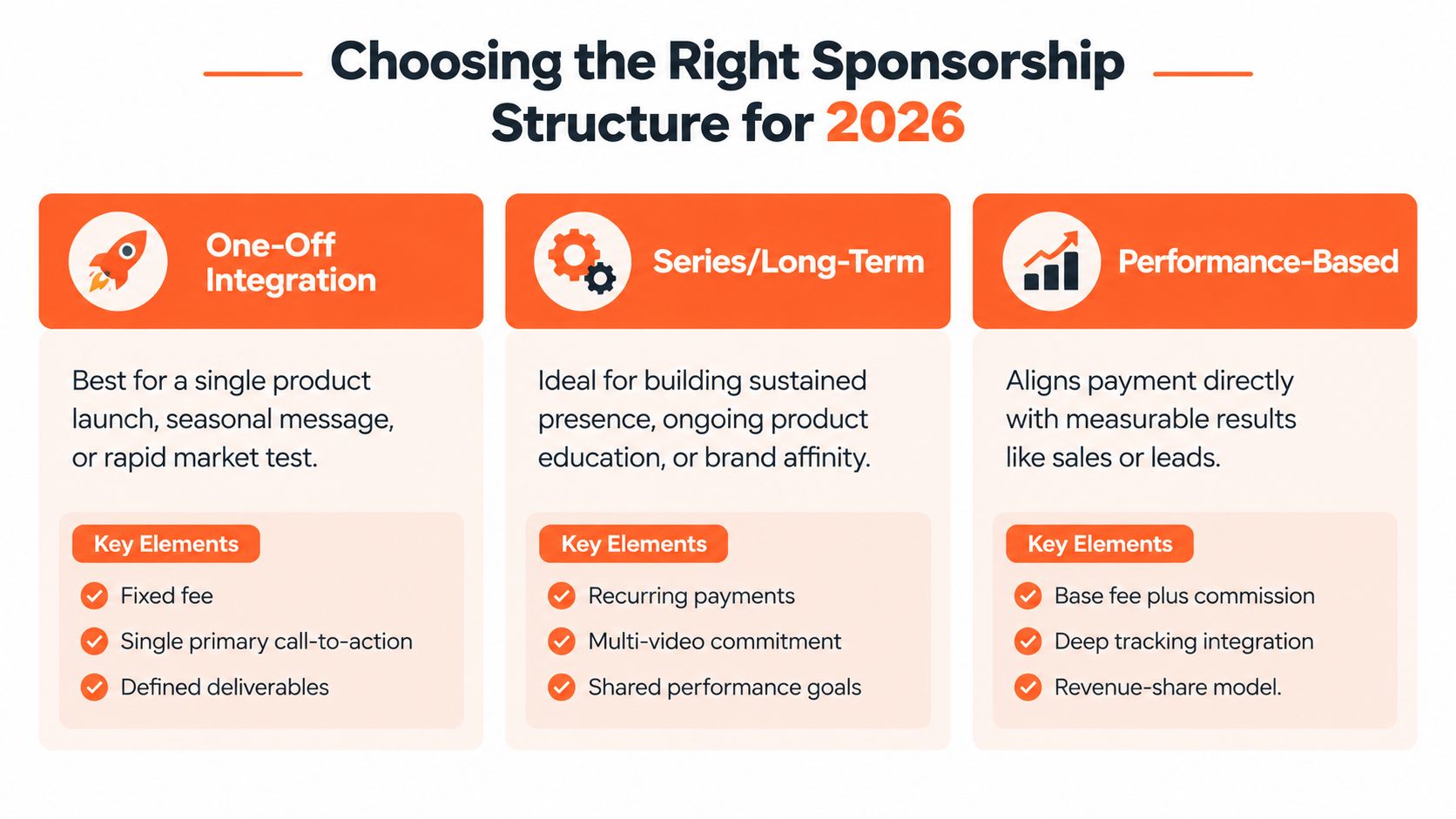
One-off integration fits a seasonal message, product launch, or rapid market test. Set a fixed fee, one primary CTA, defined placement, capped revision rounds, and narrow usage rights. This model gives you a clean learning unit, but it won't automatically create continuity or a reusable asset library.
Series or long-term program works when the brand needs recurring education, community familiarity, or a steady flow of creator content. Replace vague retainers with deliverables, category exclusivity, reporting obligations, and performance tiers tied to views, qualified traffic, conversions, or new-customer CPA. The risk is commitment before the creator has proved commercial fit.
Reusable asset strategy separates content creation from distribution. Commission several concepts, negotiate paid-media rights, whitelisting or creator-authorized amplification, cutdowns, edit permissions, territory, duration, and category rights. Then place the strongest material in YouTube advertising, Shorts, landing pages, retail media, or sales enablement.
Treat rights as a pricing decision
Organic publication and paid distribution aren't the same deliverable. A creator may agree to publish a video on their channel but charge separately for the brand's right to edit, run, or reuse that footage. Define channels, territories, duration, edit permissions, exclusivity, approval rights, and takedown conditions in the contract.
Platform coverage points toward more flexible sponsorship structures, including dynamically insertable brand segments in long-form videos and brand links in Shorts, while industry reporting also describes rising sponsorship demand and stronger opportunities for smaller creators. That makes contract precision more important. Review the implications of performance-based influencer marketing before tying compensation to outcomes.
A practical 2026 path is to begin with a small paid integration portfolio, use the resulting data to identify durable concepts, and expand only the creators and assets that justify recurring investment.
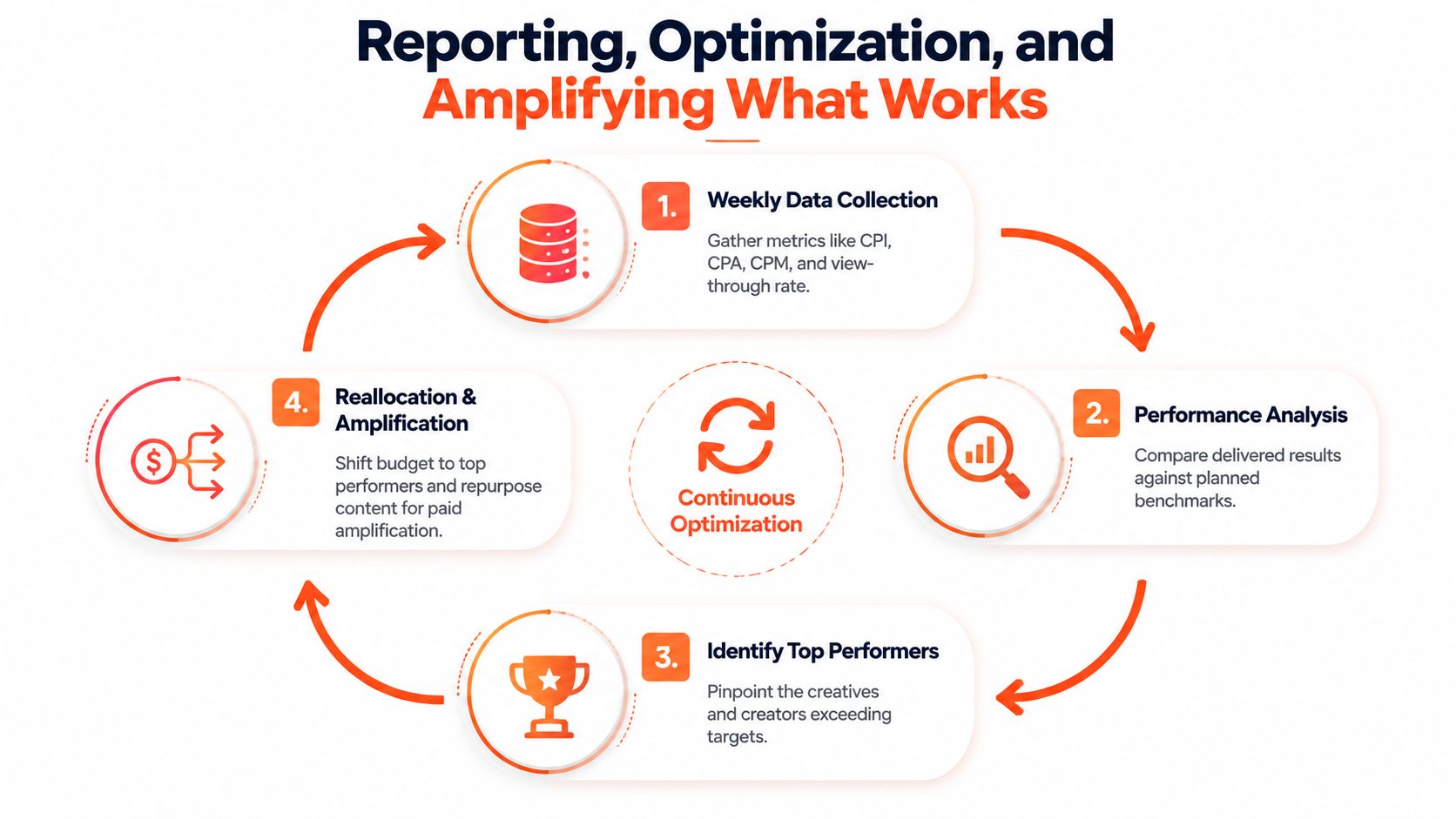
Reporting, Optimization, and Amplifying What Works
A campaign becomes more valuable when every launch improves the next decision. Set a weekly reporting rhythm that compares planned and delivered CPI, CPA, CPM, view-through rate, tracked traffic, conversions, and branded search lift. Keep attributed, survey-assisted, and experimental performance in separate views so the dashboard doesn't create false precision.
The first 72 hours are for signal detection, not final judgment. Check whether the hook earns attention, whether comments show product intent, and whether tracked links generate meaningful engagement. A weak click rate with strong retention may indicate a CTA or landing-page problem. Strong clicks with poor conversion may point to offer mismatch, page friction, or weak audience qualification.
Make small changes before replacing the creator
Optimization should follow the observed failure point:
- Retention is weak before the integration: Rework the opening, shorten the setup, or move the product into a more relevant early context.
- Retention is healthy but clicks are weak: Improve the verbal CTA, description placement, pinned comment, or offer clarity.
- Clicks are healthy but conversions lag: Test the landing page, checkout flow, pricing explanation, and audience-product fit.
- Comments show strong intent: Request a pinned-comment update, add a follow-up integration, or develop a response video.
- A segment performs organically: Secure the rights to cut it into Shorts or use it in paid amplification.
A follow-up placement can extend a proven narrative without forcing the creator to repeat the original script. Long-form footage can also produce Shorts variants, while creator-authorized paid amplification can test whether the strongest organic segment works with a controlled media budget. Treat each edit as a new asset with its own rights and tracking ID.
Scale the learning, not just the spend
Before expanding into adjacent creator tiers, geographies, or languages, record the elements that made the placement work:
- Audience profile and traffic source.
- Video topic and opening hook.
- Integration position and product demonstration.
- Offer, CTA, landing page, and conversion event.
- Rights package and paid amplification result.
- Creator feedback and approval friction.
Then replicate the creative principle, not the exact video. A software demonstration may travel across markets better than a culturally specific joke. A product review may work with specialist creators, while a broad lifestyle integration may need a different audience filter. Growth teams that maintain this learning record can negotiate from evidence, allocate budget faster, and stop treating every YouTube deal as an isolated experiment.
Social Cloud can help growth teams plan YouTube integrations and Shorts, vet creators, forecast target CPI or CPA, manage briefs and rights, and connect each placement to tracked outcomes. Visit Social Cloud to discuss a YouTube influencer program built around creator-level attribution rather than views alone.