
You're probably in the exact spot where influencer rating stops being a vague marketing term and becomes a budget decision.
A creator manager drops two profiles into Slack. Same niche. Similar content. Similar fee. Follower counts look close enough that nobody wants to argue about them. The problem is simple: only one creator is likely to drive the result you need, whether that's sales, installs, qualified traffic, or retained users.
That's why a real influencer rating matters. It isn't a popularity badge. It's a decision tool for buyers who need to defend spend, compare creators quickly, and explain later why one partnership got approved and another got cut.
Table of Contents
- The four dimensions that carry the model
- Engagement quality is where vanity starts to break
- Brand fit and sponsored history separate nice feeds from useful partners
- A workable version for real creator selection
- How to read the output
- Two creators can look equal and rate very differently
- A simple workflow that catches most weak fits
- What to pull into the sheet
- Red flags that should slow you down
The Moment a Rating Actually Matters
The most common mistake teams make is using influencer rating too late.
They wait until the short list is already built, emotions are involved, the founder likes one creator personally, and the social team is attached to another. At that point, “rating” turns into a way to justify a decision that was already made. That's backwards.
A useful influencer rating enters the process at the moment the team has incomplete information and limited time. Two creators can look nearly identical on the surface and still have very different odds of producing an outcome you can attribute. One may have a cleaner audience, stronger trust signals, and a history of sponsored posts that still feel native. The other may have inflated engagement, poor buyer fit, or an audience that watches but rarely acts.
What the buyer actually needs
In that decision window, nobody needs more screenshots of likes.
They need a compressed answer to four questions:
- Is the audience real enough to matter: If follower quality is weak, reach is overstated before the campaign even starts.
- Does this creator hold trust: Surface engagement can hide weak intent. Comments, saves, and replies usually tell you more.
- Will sponsored content perform: Some creators look strong organically and then collapse the second a paid placement goes live.
- Does the audience match the customer: A lifestyle creator can still be a bad acquisition partner if geography, spending intent, or category relevance are off.
Practical rule: If your team can't explain why Creator A beat Creator B in a way finance would accept, you don't have a rating system. You have a preference.
The point of influencer rating is to convert noisy signals into a standard your team can reuse. That gives you something much more valuable than a one-off pick. It gives you a baseline you can test against actual campaign outcomes later.
Why follower parity tells you almost nothing
Equal follower counts create false confidence. They make buyers assume the comparison is fair when it usually isn't.
A creator can have a large audience that's broad, stale, or mismatched to your market. Another creator can have a smaller but tighter audience that listens, clicks, and converts. Recent 2026 reporting supports that pattern. Average creator ratings were highest among smaller accounts, with micro-influencers averaging 4.70 stars and mid-tier creators averaging 4.69 stars, while macro and large creators each averaged 4.58 stars in one report from Social Cat's influencer marketing report.
That gap isn't huge, but it matters. It suggests that audience closeness and trust often beat scale when the goal is performance.
What Influencer Rating Really Means
An influencer rating is a weighted score that estimates how useful a creator is for a defined business outcome. That outcome might be first-purchase conversion, app install volume, qualified demo traffic, or efficient awareness that later assists conversion. The key is that the rating points toward a business result, not just a visible social metric.
Follower count still matters. It just belongs in the model as one input, not the final answer.
A rating is a prediction model, not a leaderboard
The older way to pick creators was simple and usually expensive. Teams sorted by followers, checked whether the feed looked good, glanced at likes, and hoped the creator's audience overlapped with their customer. That process can still work for broad awareness, but it's weak for acquisition.
Modern rating systems look more like media buying frameworks. A documented creator scorecard published by Nowadays Media weights audience alignment at 30%, engagement quality at 25%, brand fit at 20%, content quality at 15%, and past sponsored performance at 10% on a 100-point scale in its creator selection scorecard framework. I like that structure because it forces the team to rank what affects outcomes instead of what's easiest to screenshot.
When teams need help standardizing the creative side too, a tool built for content creation for influencers can be useful as part of the workflow, especially when you need briefs and outputs to stay consistent across many creators without flattening their voice.
What a good rating includes
A credible rating blends signals that answer different questions:
- Audience authenticity: Are these real people, in the right markets, with believable growth patterns?
- Engagement quality: Do people respond in ways that suggest trust, not just passive scrolling?
- Brand fit: Would this product feel natural in the creator's world?
- Sponsored resilience: Does paid content hold up, or does performance fall apart when the post is labeled?
One reason this shift matters is that independent 2026 reporting on creator measurement now emphasizes trust-weighted engagement and downstream signals over vanity metrics. That same framework says comment-to-like ratios above 2% and save-to-like ratios above 3% on Instagram indicate strong creator-audience trust, and it places typical engagement-rate benchmarks at 3 to 7% for micro-influencers, 1.5 to 3% for macro creators, and 0.5 to 1.5% for mega creators in its overview of measuring influencer campaign performance.
That's a better definition of rating than “who has the biggest audience.” It treats creators like performance inventory with creative nuance attached.
The Core Metrics That Power a Rating
Most rating systems get messy because they track too many weak signals. In practice, four dimensions do most of the work.
The four dimensions that carry the model
| Dimension | Key Signals | What It Tells You |
|---|---|---|
| Audience quality | Geography match, demographic fit, suspicious follower share, growth consistency | Whether the people seeing the content are reachable and relevant |
| Engagement quality | Comment depth, comment-to-like ratio, save behavior, format consistency | Whether the audience trusts the creator enough to pay attention |
| Brand fit | Category relevance, tone alignment, product naturalness, audience expectation | Whether the placement will feel native instead of forced |
| Past sponsored performance | Organic vs sponsored engagement gap, link behavior, code usage, conversion history | Whether paid content can produce business outcomes |
Audience quality is the gatekeeper. If the audience is wrong, the rest of the score barely matters. Independent guidance on fraud detection notes that a suspicious-follower share above 25% is a meaningful red flag, and that audience-quality scores below 60 on some platforms deserve a deeper review in Content Grip's write-up on influencer marketing fraud detection.
That's why I'd rather approve a creator with less reach and cleaner audience composition than a larger account with inflated top-line numbers.
Engagement quality is where vanity starts to break
Likes are easy to fake, easy to misread, and easy to overweight.
What helps more is pattern recognition. Are comments specific? Do people ask follow-up questions? Do saves and shares show up on educational or recommendation-heavy content? If you need a refresher on the mechanics, this guide on how to calculate engagement rate on Instagram is useful for building a clean baseline before you compare creators.
For teams building scorecards in spreadsheets, it also helps to define what success means before pulling creator data. Prompt Builder has a solid piece on success metrics definition that's useful for tightening the measurement logic behind your rating model.
Engagement quality answers a harder question than popularity: did the audience react because the creator has reach, or because the audience actually trusts them?
Brand fit and sponsored history separate nice feeds from useful partners
Brand fit sounds soft, but it isn't. If a creator's audience expects product recommendations in a category, the transition into sponsored content is smoother. If the fit is off, the post looks rented.
Past sponsored performance is the closest thing you have to evidence before launch. It won't be available for every creator, but when it is, use it. Compare paid engagement to organic engagement. The same scorecard framework referenced earlier suggests treating weak paid performance as an ad penalty when sponsored engagement drops sharply relative to organic.
A creator who looks great in screenshots but consistently loses audience attention on branded posts is expensive inventory with creative friction.
A Practical Scorecard Framework
If you need one rating model that a team can use, keep it simple enough to score by hand and strict enough to reject weak fits.
I prefer a 100-point scorecard because buyers, founders, and finance teams all understand it immediately.
A workable version for real creator selection
Score each category on a 0 to 10 subscale, then multiply by the weight. Add the weighted scores for the final rating.
| Category | Weight | Subscale | What to Score |
|---|---|---|---|
| Audience authenticity | 25 | 0 to 10 | Real-vs-suspicious followers, geography match, demographic relevance, stable growth |
| Engagement quality | 20 | 0 to 10 | Comment quality, saves, shares, consistency across recent posts |
| Brand and category fit | 15 | 0 to 10 | Natural product fit, tone, creator credibility in the niche |
| Historical sponsored performance | 20 | 0 to 10 | Paid vs organic engagement, proof of prior conversion behavior, audience response to brand posts |
| Content quality | 20 | 0 to 10 | Hook strength, storytelling, production clarity, CTA delivery without sounding forced |
This isn't the only valid setup. It's just practical. It gives enough weight to audience and sponsored performance that the score can't be rescued by aesthetics alone.
How to read the output
I usually treat the final score as a routing tool, not a guarantee.
- Above 80: Shortlist and negotiate.
- Middle band: Test carefully, often with stricter attribution and limited creative risk.
- Below 60: Skip unless there's a specific strategic reason to learn from the placement.
That middle band is where teams waste the most money. They see a creator who looks almost right, then talk themselves into it because the content is attractive or the creator is recognizable. A scorecard protects against that.
Two creators can look equal and rate very differently
Take two creators with similar follower counts and similar rates.
The first has clean audience geography, thoughtful comments, a feed that already includes adjacent product recommendations, and prior sponsored posts that still attract real discussion. The second has uneven growth, comments that read generic, strong organic lifestyle content, and branded posts that feel bolted on. On paper they're peers. In a scorecard they shouldn't be.
That's the entire point of influencer rating. It gives the team permission to rank conversion likelihood above surface similarity.
How to Rate a Creator on Your Own
You don't need a platform subscription to build a useful first-pass rating. A spreadsheet, creator screenshots, and a consistent review process will get you surprisingly far.
A simple workflow that catches most weak fits
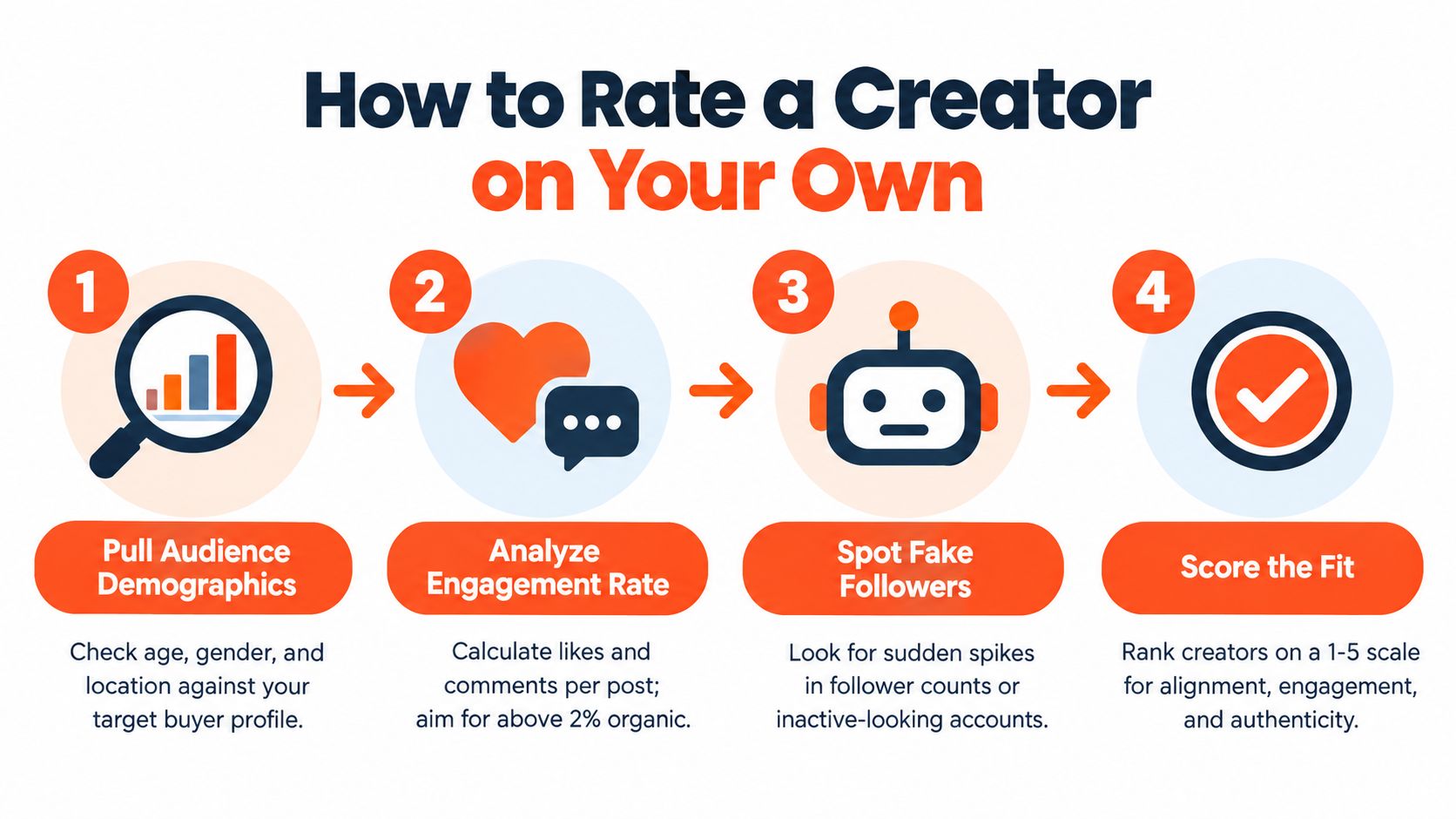
Start with audience data. Ask for platform screenshots that show top geographies, age ranges, and gender mix. Then compare that against who buys from you, not who merely watches your category. A broad audience isn't useful if your product only ships to a few markets or your price point skews toward a narrower customer set.
Next, review recent content manually. Sample a block of recent posts rather than cherry-picking the best one. Use medians instead of averages if one post clearly went viral and distorts the picture.
What to pull into the sheet
Build columns for these checks:
- Audience match: Does location and demographic makeup line up with the buyer you want?
- Engagement pattern: Are interactions steady across recent posts, or does performance spike randomly?
- Comment authenticity: Do replies sound like humans reacting to specific content?
- Sponsored durability: When branded posts appear, do people still engage in a normal way?
- Operational readiness: Does the creator send analytics quickly, answer clearly, and disclose prior paid work?
If you're trying to connect this review to expected economics, an influencer marketing ROI calculator can help frame what a creator would need to deliver for the spend to make sense.
Red flags that should slow you down
A few patterns deserve immediate scrutiny:
- Abrupt follower spikes: These often need an explanation. Sometimes it's legitimate. Sometimes it isn't.
- Comment sections full of generic praise: Strings of emojis and repetitive one-liners rarely indicate strong buyer intent.
- Recycled metrics across platforms: A creator may be strong on one channel and weak on another. Don't let one platform's success stand in for all of them.
- Defensive or incomplete analytics sharing: Good partners understand that buyers need evidence.
Field note: If a creator can't provide enough information for you to rate them, that uncertainty is part of the rating.
The spreadsheet doesn't need to be fancy. It needs to be consistent. Once you score enough creators the same way, patterns appear quickly.
Common Pitfalls That Skew Ratings
Many bad creator decisions come from ratings built on contaminated inputs, not bad math.
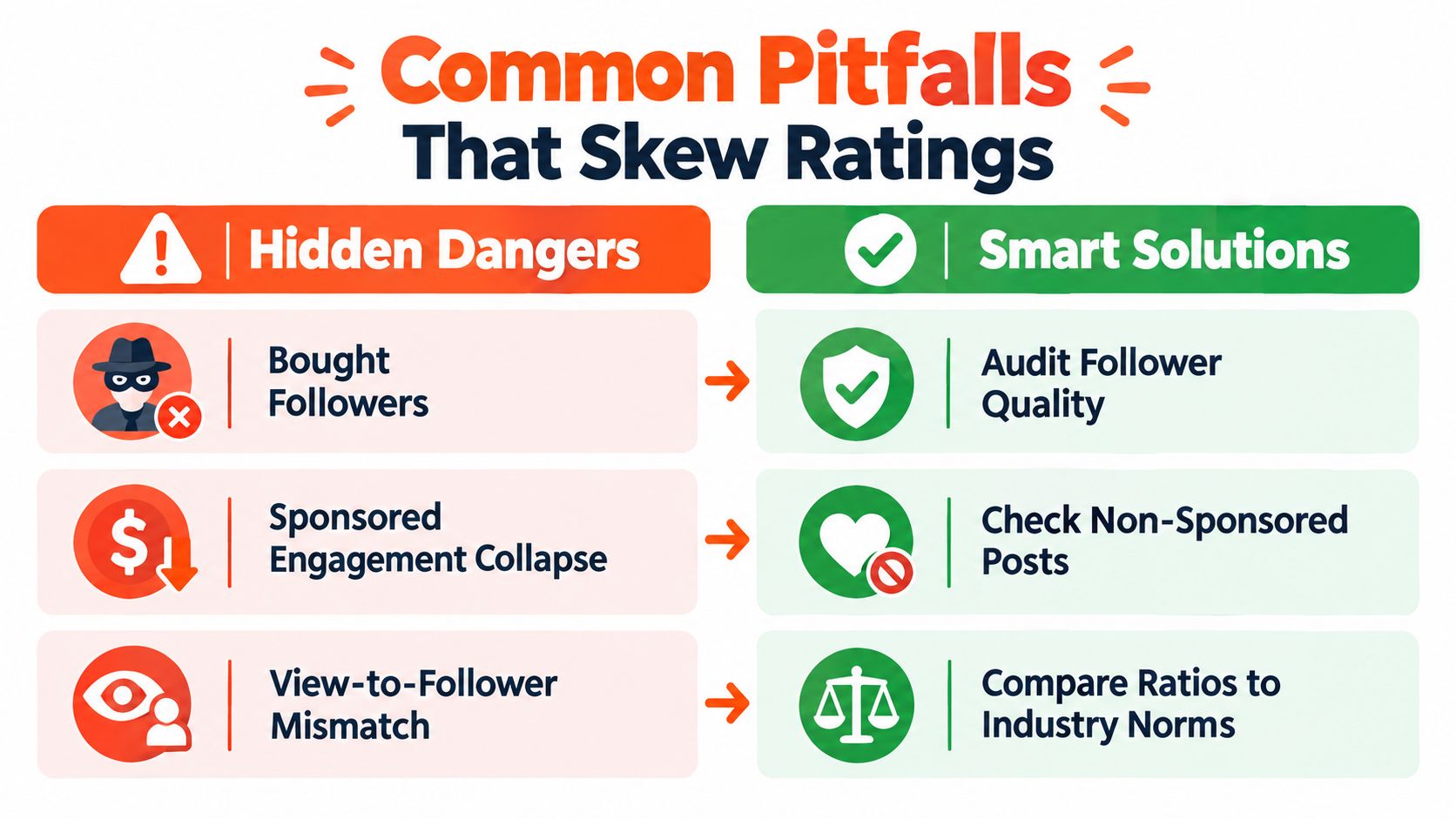
Bought followers are still the obvious trap, but they aren't the only one. Plenty of creators have audiences that are technically real and still commercially weak. The audience may be outside your shipping footprint, follow for entertainment only, or ignore sponsored recommendations entirely.
Another common failure is over-trusting a single high-performing post. One viral clip can distort averages, attract temporary low-fit followers, and make a creator look stronger than they are. Use medians, recent windows, and format-by-format comparisons to avoid rating the outlier instead of the creator.
Three distortions to watch closely
- Sponsored engagement collapse: Compare branded posts against nearby organic posts. If attention disappears as soon as the placement is paid, your score should reflect that.
- View-to-follower mismatch: Big view counts can come from algorithmic distribution that doesn't translate into buyer action. Check whether engagement patterns support the reach story.
- Cross-platform confusion: A creator can be compelling on TikTok and ineffective on YouTube, or vice versa. Don't merge those signals into one undifferentiated score.
A short explainer can help teams spot these issues in practice:
Why trust has become the real rating problem
A lot of public discussion still treats influencer rating like a follower problem. It's more accurate to treat it as a trust problem.
Research discussed in this analysis of influencer fraud and trust points to fake or bot followers as a major source of creator quality issues and notes that trust is shifting away from the biggest names toward smaller creators. That matches what buyers see in campaign reviews. A creator can look expensive and impressive while still producing weak downstream behavior because the social proof is inflated or the audience is disengaged.
If those distortions enter the scorecard, the final rating will look precise and still be wrong.
Linking Ratings to Attribution and Outcomes
A rating is only useful if you can test whether it predicted anything real.
That means every creator needs attribution hooks before the campaign launches. Tracking links show click behavior. Promo codes catch direct-response conversions. Post-purchase surveys pick up assisted influence that click-based tracking misses. Without those signals, your rating stays theoretical.
What calibration looks like after launch
Once the campaign runs, compare predicted quality with actual outcomes and update your scorecard.
| Creator | Predicted Score | Attributed CAC | 30-Day Repeat Rate | Rating Calibration |
|---|---|---|---|---|
| Creator A | High | Efficient | Strong | Increase weight on audience fit and sponsored history |
| Creator B | Mid | Weak | Low | Penalize superficial engagement more heavily |
| Creator C | Mid | Efficient | Mixed | Check whether niche fit outperformed general reach |
You don't need exact perfection from the first version of the model. You need a loop.
If highly rated creators repeatedly underperform, your scoring logic is wrong. If some mid-rated creators consistently beat expectations, inspect what the model missed. In many teams, that missing variable ends up being platform-specific context or stronger-than-expected audience fit.
The score gets smarter when attribution is complete
A useful habit is comparing organic creator strength against paid business output after each flight. If creators with strong comments but modest reach produce cleaner customer acquisition, raise the weight on trust signals. If attractive content drives clicks but low repeat behavior, discount top-funnel appeal and increase the weight on conversion quality.
For teams formalizing that process, this guide on how to measure influencer marketing ROI is a practical companion to the rating model because it connects creator evaluation to the numbers your finance team cares about.
An influencer rating should start as a forecast and end as a calibrated buying system.
Rating Creators You Can Actually Buy From
The final filter is operational. Some creators look good in analysis and still turn into bad partners because they can't provide basics, can't follow a brief, or can't support measurement.
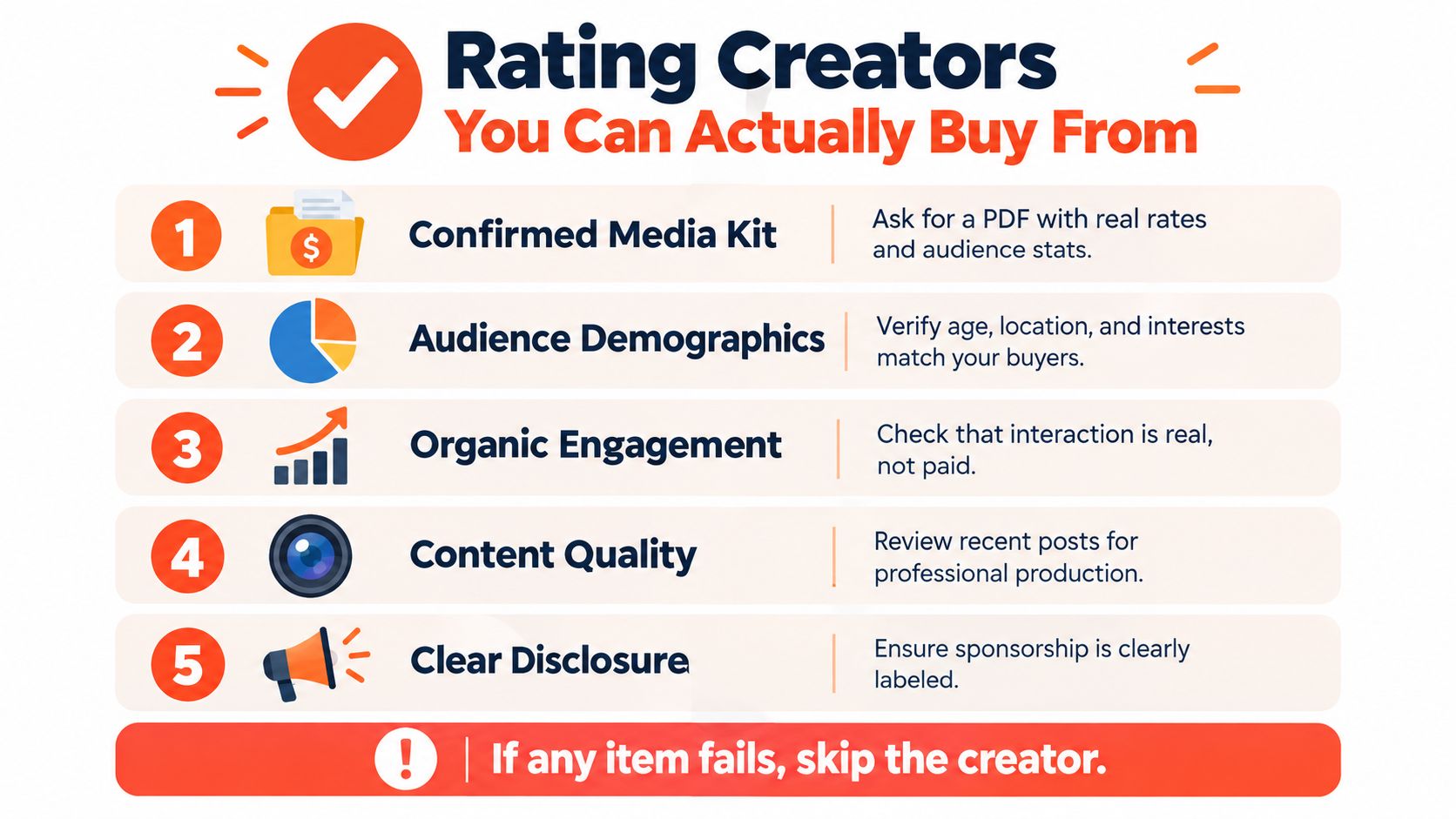
A shortlist should include only creators you can transact with cleanly. That means they can provide a media kit, platform analytics, pricing clarity, and enough sponsored history for a buyer to estimate risk. If they can't, the friction itself is part of the rating.
A practical go or no-go checklist
- Confirmed media kit: Rates, formats, and platform breakdowns should be current and consistent.
- Audience demographics: The creator should be able to verify who follows them and where those people are.
- Organic engagement quality: You want believable interaction, not inflated social proof.
- Content quality: Review recent output, not legacy highlight posts.
- Disclosure habits: Sponsored content should be handled clearly and professionally.
If your team wants outside support for this stage, Social Cloud is one option that handles creator vetting, campaign execution, and attribution across major platforms using outcome-linked measurement rather than follower-led selection.
The decision rule that saves budget
When budget is tight, don't break ties with reach. Break ties with evidence.
Choose the creator with cleaner audience quality, better sponsored-post resilience, and stronger attribution history. If those signals are missing, move on. There are always more creators. The expensive mistake is paying for confidence you didn't verify.
A solid influencer rating doesn't tell you who is famous. It tells you who is buyable, measurable, and most likely to move product.
If your team wants help turning creator selection into an attribution-backed buying process, Social Cloud runs influencer campaigns across YouTube, Instagram, TikTok, and Twitch with per-creator tracking, forecasting, and outcome-linked reporting. It's built for growth teams that need more than a pretty shortlist and want creator decisions tied to conversions, ROAS, and repeatable learning.