Your creator campaign looks healthy in the dashboard. Views are climbing, discount codes are getting used, and the launch channel is full of screenshots. Then finance asks how many customers you wouldn't have acquired without the campaign, and nobody has a clean answer.
That's the hard part of tech influencer marketing. An app install is countable, but it might come from an existing user reinstalling. A SaaS buyer might watch a technical review on their phone, share it with colleagues, and sign up later on a work laptop. You need a plan that pays creators fairly, preserves technical credibility, and separates attributed conversions from incremental demand.
Table of Contents
Set the Goal, Metric and Budget First
A creator quote arrives before the campaign has a clear success condition. Set the outcome and spending ceiling first, so you can judge whether the proposed format and fee fit the economics.
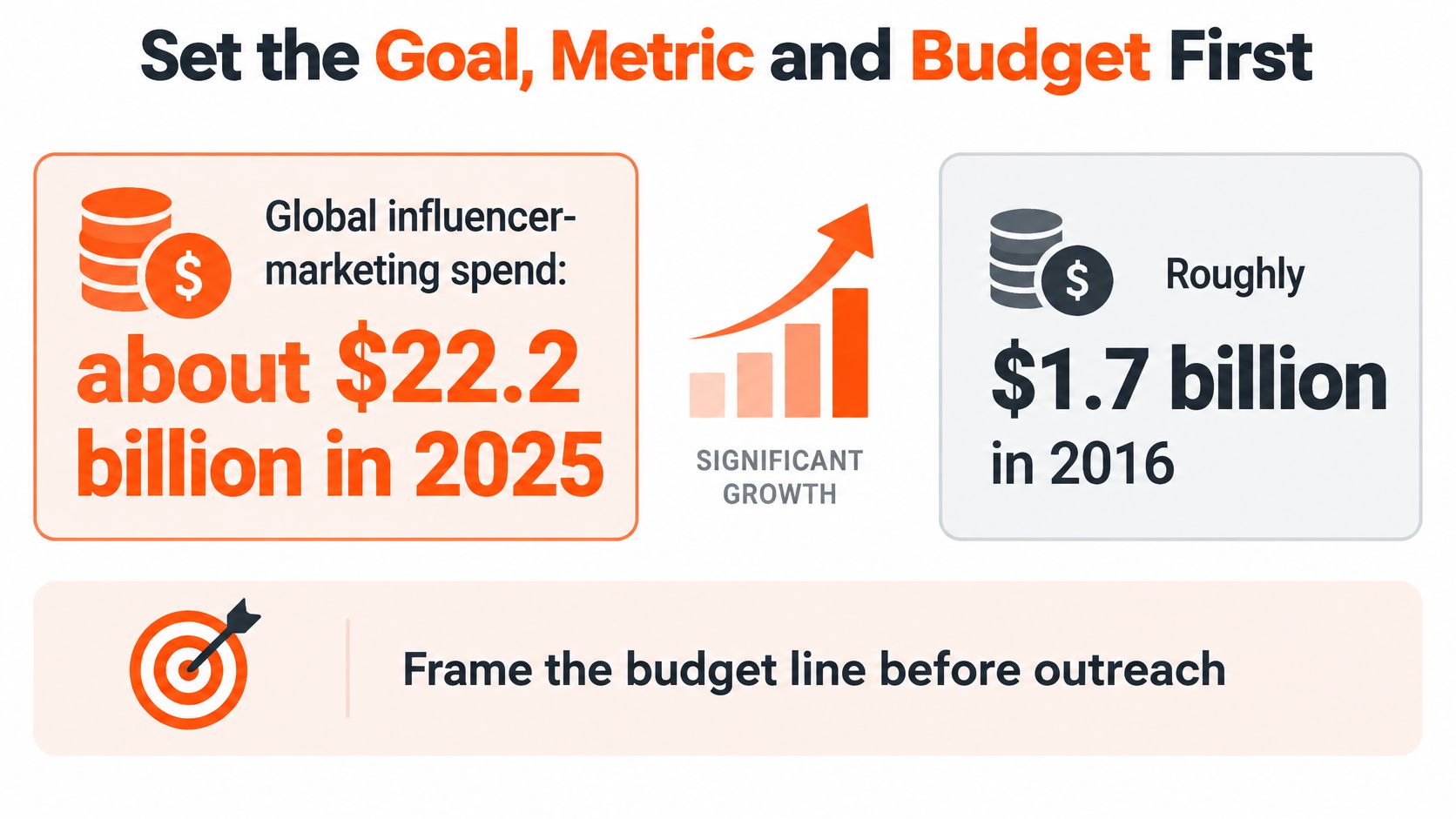
Industry estimates put global influencer-marketing spending at about $22.2 billion in 2025, up from approximately $1.7 billion in 2016, according to the influencer-marketing report published by WFTV. Use that scale as context for the budget conversation, not as a reason to copy another brand's allocation. Finance will need a forecast tied to your own costs and conversion assumptions.
Choose the outcome before the format
A YouTube integration or Twitch stream is a delivery format, not a campaign objective. Choose the customer action first, then pick a format that can show why the product is worth trying or buying.
Campaign goal, primary metric and attribution tool
| Goal | Primary metric | Attribution tool |
|---|---|---|
| App installs | Installs and cost per activated user | Creator-specific store link plus in-app event |
| SaaS trials | Trial starts and trial-to-paid rate | Unique promo code and a signup field asking how they heard about you |
| Hardware launches | Pre-orders and average order value | Unique discount code and a post-purchase survey |
| Fintech sign-ups | Verified accounts and cost per funded account | Tracked link to a compliance-approved landing page |
| Game launches | Wishlists and first-week installs | Creator-specific link or stream code tied to store referrals |
Define the event precisely. An app download is not the same as completing onboarding; a SaaS trial is not the same as connecting the integration that makes the product useful. Those distinctions change the reported cost per outcome.
Use Zemith's campaign planning template to organize the objective, audience, responsibilities and deliverables before outreach. Keep the commercial assumptions alongside the plan so the team can see how the budget connects to the target.
Build the budget around a ceiling
Set a maximum acceptable cost per outcome from your retention, margin and payback requirements. A simple ROI model in a spreadsheet can help compare scenarios, but its output is only as reliable as the conversion assumptions you enter.
Separate creator fees, licensing, amplification, agency work and measurement costs. A low placement CPA can still conceal an unprofitable campaign once those expenses are included.
A hybrid arrangement can pair a base fee for strategy and production with a performance component tied to an agreed event. Set eligibility, duplicate handling, refunds and the conversion window in the contract. Creators should not carry the risk of a broken onboarding flow.
Name an owner for the primary metric and schedule the review date before launch. Give that person authority to pause spend, not just access to the dashboard.
Human, AI-Assisted or Virtual Creators Compared
The efficiency pitch is straightforward: synthetic delivery can make variants and localization easier. The harder question is whether viewers believe the person presenting the product has evaluated it.
Among 27 multinational advertisers surveyed by the World Federation of Advertisers, 15% had tested AI influencers, while 96% cited consumer trust or acceptance concerns. That's a warning about advertiser confidence, not proof that every audience rejects virtual personalities.
For tech products, distinguish production assistance from invented experience. A human creator using editing tools is different from a virtual character claiming to have used a password manager during a security incident.
Decision matrix for human, AI-assisted and virtual creators
| Creator type | Best objective | Disclosure burden | Trust risk | Use when |
|---|---|---|---|---|
| Human creator | Consideration, demos and installs | Standard sponsorship disclosure | Low to moderate, subject to fit | Default for most tech launches |
| AI-assisted human creator | Scaling a proven script into variants | Disclose if the voice or likeness could mislead | Moderate, synthetic delivery may distract | Repurposing content a real creator already validated |
| Fully virtual personality | Top-of-funnel reach tests | Make synthetic identity clear | High in technical and regulated categories | Low-stakes awareness tests outside fintech and health |
| Any type in fintech or health | Conversion with compliance review | Claim substantiation and identity review per market | High if claims are unsupported | Only with legal sign-off per market |
Match identity to the buying risk
Start with the audience's task. Someone choosing a game might enjoy an obviously fictional host. Someone evaluating endpoint protection needs a credible explanation of configuration, permissions, limitations, and failure cases.
Market and audience expectations matter too. Review the actual concept with local stakeholders rather than assuming an accepted format will travel unchanged.
For AI-assisted human content, get explicit permission for synthetic voice, likeness, translation, and derivative versions. Require the creator to approve the finished output. A translated sentence can change the strength of a technical claim even when the original script was acceptable.
Default recommendation: Use human creators when the audience needs evidence of hands-on use. Test synthetic formats where a mistaken impression won't create financial, health, or security consequences.
That doesn't mean human delivery automatically earns trust. A creator reading claims they don't understand can be just as unconvincing as a synthetic presenter. Give the person real product access and enough time to challenge the demonstration.
For virtual awareness tests, evaluate comprehension and identity recognition alongside reach. If viewers can't tell what's fictional, what's sponsored, and what the product does, cheap production isn't a useful saving.
Pick Creators on Audience Data, Not Follower Counts
Say you sell a developer-tools platform and a large gadget channel offers a launch package. Before discussing deliverables, ask whether its viewers write code or enjoy watching new devices. Both audiences like technology, but they don't have the same buying job.
Audience overlap comes first. Ask for platform analytics covering country, language, device, and relevant audience characteristics. For professional tools, supplement demographics with comment quality, newsletter topics, and examples of the problems viewers ask the creator to solve.
Sponsored history needs context. Request anonymized link clicks, code redemptions, and downstream outcomes from comparable tech partnerships. Ask what offer, landing page, and attribution window produced those results. A screenshot without definitions isn't a forecast.
Inspect the work, not just the media kit
Watch a complete sponsored segment. Does the creator explain setup, show limitations, and answer implementation questions, or jump from packaging to praise?
For a specialist category, use a resource such as this cybersecurity creator shortlist as a discovery starting point, then assess each person against your product and buyer. Category membership alone doesn't establish technical competence.
Creator tiers compared for tech launches
| Tier | Strength | Main risk | Best fit |
|---|---|---|---|
| Nano | Concentrated niche discussion and accessible testing | Limited reach and production capacity | Testing hooks and early product feedback |
| Micro | Specialist authority and room for detailed demos | Uneven results between posts | Installs, trials and technical explainers |
| Macro | Broad distribution and established production | Higher fees and possible audience dilution | Category awareness with demo support |
| Mega | Mass visibility and launch attention | Expensive reach outside the buyer profile | Broad brand awareness |
Treat these as planning labels, not performance guarantees. A larger practitioner audience can be more relevant than a smaller general-interest account.
Brand fit includes sponsorship behavior. Check competing endorsements, repeated category switching, and whether the creator's editorial position conflicts with your product's actual strengths. Negotiate narrow, sensible exclusivity rather than blocking an entire technology category.
Before outreach, check Instagram followers for authenticity, then compare any automated flags with native analytics and manual review. A suspicious-looking pattern deserves investigation, not an instant accusation.
Watch for:
- Empty engagement: Likes without substantive discussion on sponsored posts.
- Giveaway distortion: Audience growth that doesn't match normal content interest.
- Missing outcomes: A long sponsorship history with no usable performance context.
Keep a manageable shortlist per market, with alternatives for availability and category conflicts. You need enough choice to test distinct approaches, not a giant contact list nobody can properly vet.
How to Write a Brief Creators Will Actually Use
A useful creator brief protects accuracy without turning the creator into a teleprompter operator. Specify what must be true, visible, and measurable. Let the creator decide how to make the explanation feel natural.
Build the document where both creative and performance reviewers can comment.

Write for decisions, not brand adjectives
State the product promise. Write a plain-language sentence describing the problem solved and the supported claim the creator may communicate. Avoid positioning copy that requires another paragraph to explain.
Describe the viewer. Name their role, device, and current workaround. A mobile freelancer and an enterprise security administrator need different demonstrations.
Name the must-show moment. Specify the action viewers should see, such as connecting a repository, completing first-run setup, or finding an actionable dashboard alert.
Explain the boundaries. List prohibited claims and sensitive competitor comparisons, with a reason for each. Creators can work around a technical limitation more intelligently when they understand it.
Include disclosure instructions. Put the approved wording and placement requirements in the working document, not an attachment the editor might never open.
Supply the conversion route. Include the exact destination, creator identifier, promo code, and call to action. Confirm that the offer shown on screen matches the landing page.
Define permitted reuse. State the licensing window, markets, editing permissions, and whether paid amplification is included.
Set the approval sequence. Name draft, feedback, and publication dates alongside the person authorized to approve changes.
If several organizations are involved, use Bulby's guidance to align agency teams before creative work. A shared decision-maker prevents contradictory comments from product, legal, and brand reviewers.
Use this video as a discussion prompt while shaping the working brief.
Preserve the creator's explanation
For a cybersecurity app, don't approve a blanket promise that users will become unhackable. If your evidence supports it, describe the specific function instead: the app flags suspected phishing links on supported devices. The narrower wording tells viewers what happens without promising universal protection.
Creators may push back on scripts because they know how their audience asks questions. Allow their own opening, examples, and honest qualification of who the product isn't for. Keep review focused on accuracy rather than replacing their vocabulary with internal messaging.
A structured influencer briefing workflow helps separate mandatory requirements from optional creative suggestions.
The creator can change the delivery. Clear disclosure and the approved tracking destination aren't optional.
Disclosure, Claims and Usage Rights Before Launch
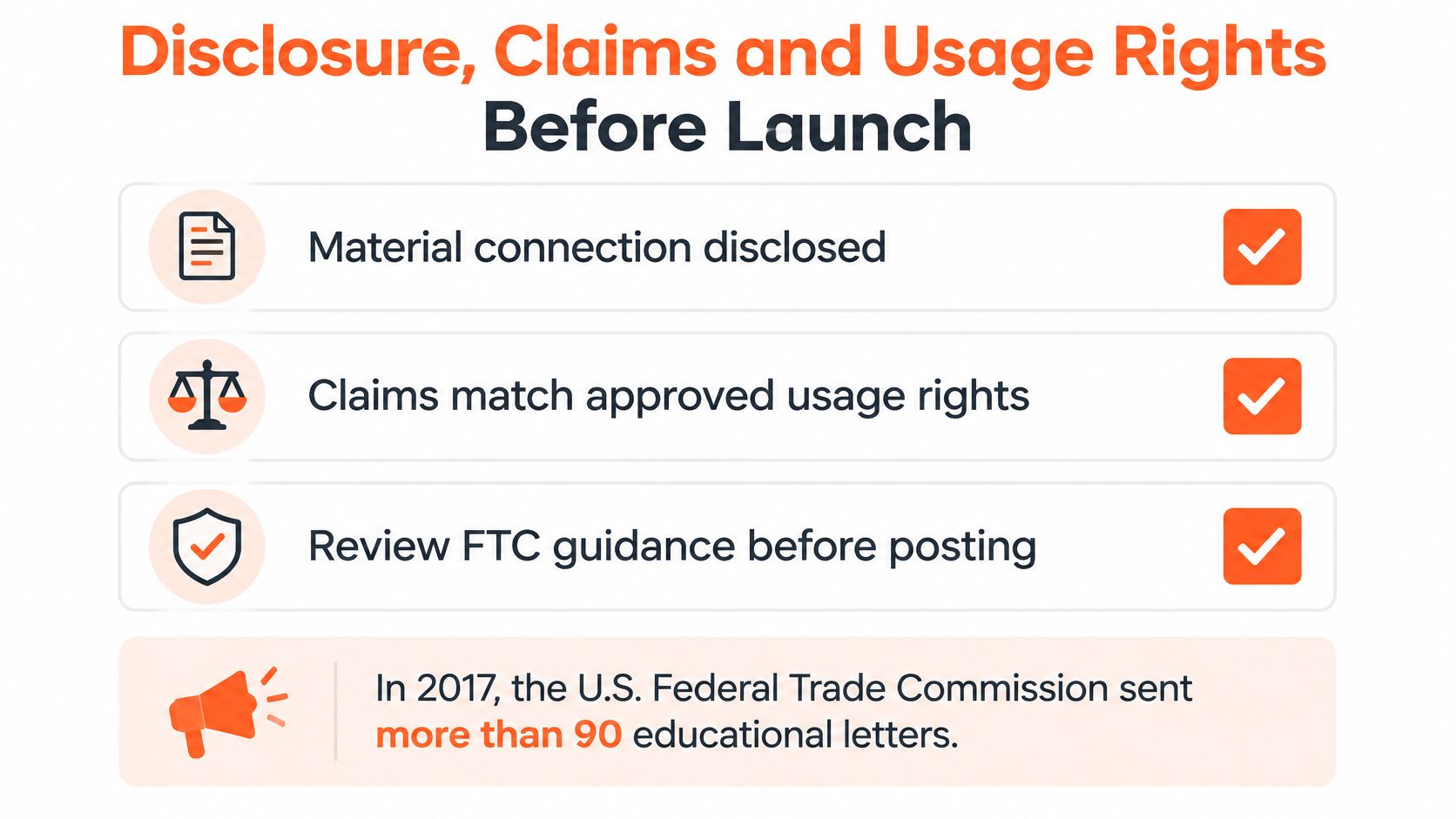
In 2017, the U.S. Federal Trade Commission sent more than 90 educational letters reminding influencers and brands about disclosing material connections, according to the FTC's account of its influencer-related actions. For a technology review that looks independent, sponsorship transparency belongs in the launch approval process.
The FTC's Disclosures 101 guidance explains that creators and marketers share responsibility for clear disclosure and that disclosures buried among hashtags or links may not be conspicuous. Don't treat the creator's signature on a contract as evidence that the published endorsement is compliant.
Use a visible approval checklist before releasing content.
Run the release gate
- Classify the relationship. Record payment, free or discounted access, gifted hardware, employment, family connections, and other incentives that could affect credibility.
- Inspect the endorsement itself. Put understandable disclosure with the message, in its language, where viewers don't have to expand a caption or visit another page to find it.
- Match claims to evidence. Have the relevant product or legal reviewer approve what the demonstration communicates, including implications created by visuals.
- Archive the approved version. Save the script, caption, disclosure placement, creative file, market, publication timestamp, and approval record.
For video, review the experience with sound on and off. For livestreams, plan how sponsorship will remain understandable to viewers joining after the introduction. Platform disclosure tools can support the execution, but don't assume a platform toggle resolves every presentation issue.
License the use you actually need
Claim approval and usage rights are separate checks. Permission to repurpose a video doesn't substantiate its claims, and a substantiated claim doesn't give you permission to turn the creator's face into an advertisement.
The contract should identify duration, territories, channels, paid amplification, creator-account permissions, and permitted edits. Address captions, translations, cutdowns, music, third-party footage, and whether a synthetic voice or likeness may be created.
For global programs, give each market an approval owner familiar with local advertising and consumer-protection requirements. U.S. guidance is a useful reference, not a universal clearance.
Check live posts immediately after publication and after edits. Capture what viewers can see, not just the approved preview. If a caption truncates differently or an editor removes a disclosure overlay, pause amplification until the published asset is corrected.
Measure Incrementality and Launch the First Test
Views, engagement, and code redemptions can look excellent when creators reach people who were already about to buy. Trackable doesn't mean incremental. Attribution identifies an observed connection; incrementality estimates what changed because you spent the money.
Measurement practice isn't settled: revenue or sales attribution was the leading approach at 19% in CreatorIQ's State of Creator Marketing report. Don't confuse the popularity of a method with proof that it answers your particular question.
Build an asset-level record
Assign unique tracking parameters and codes to each creator and asset. Preserve platform-native post identifiers so exported results can be reconciled with the content that ran.
Record reach, qualified views where available, watch-through rate, clicks, landing-page sessions, attributed conversions, revenue, and survey answers. Pass permitted referral information into your CRM or product analytics, and keep privacy and consent requirements part of the implementation.
Measurement methods and what each one can tell you
| Method | Answers | Needs | Main limitation |
|---|---|---|---|
| Tracked links and promo codes | Attributed conversions per creator | Unique link or code per creator | Misses some later, cross-device conversions |
| Post-purchase survey | Self-reported discovery source | A question after purchase or signup | Relies on recall |
| Forced-exposure brand-lift survey | Incremental awareness and consideration | Exposed and control panels | Panel conditions may differ from live exposure |
| Holdout or geo test | Incremental conversions | A comparable control audience or market | Sensitive to contamination and sample size |
| Marketing-mix model | Channel-level contribution | Sufficient clean historical spend and outcome data | Too coarse to judge individual creators reliably |
Nielsen describes a forced-exposure survey approach that simulates a social feed and compares exposed and control groups to estimate brand lift. That answers a different question from whether someone redeemed a creator's code.
For conversion lift, use randomized holdouts where practical. Otherwise, consider matched geographies with comparable pre-test behavior, while documenting promotions, paid search changes, and other differences that could explain the result. Public creator content can cross geographic boundaries, so acknowledge contamination.
Calculate without overstating certainty
- Conversion rate: Attributable conversions divided by attributable clicks.
- Effective CPA: Campaign spend divided by attributable conversions, with the cost scope stated.
- Incremental ROAS: Incremental revenue divided by incremental spend.
Choose the conversion lag window before launch using your product's buying cycle. Keep attributed and estimated incremental results in separate columns, and report confidence intervals or an explicit statement that the sample is inconclusive.
A low attributed CPA is a reason to investigate, not automatic permission to scale.
Start with a small creator group in a single market and a primary outcome. Before publishing, confirm the cost ceiling, mobile landing experience, disclosure, license, tracking events, and approval owner.
At the scheduled review, inspect activation and retention quality as well as acquisition cost. Expand only when the result supports the decision, not because the reporting calendar says it's time.
Quick Check
A launch is ready when the team can explain the decisions without relying on the person who built the spreadsheet. The most useful final check isn't whether every task is marked complete. It's whether an unfamiliar colleague can reconstruct what you're buying, what success means, and what would make you stop.
Test the plan against failure
Give the working documents to someone outside the campaign and ask them to resolve these scenarios.
- The content performs, but onboarding breaks. Can the team distinguish qualified traffic from product friction, and is there a named person who can pause the destination or fix the flow?
- The creator demonstrates an unsupported feature. Can the reviewer identify the approved product version and get a correction published without reopening the entire contract?
- The code appears on a coupon site. Can reporting flag questionable redemptions instead of treating every use as proof that someone watched the creator?
- A trial converts after the review date. Will the team update the acquisition cohort consistently, or count the revenue wherever it makes the current report look better?
- A successful clip becomes a paid ad. Can the media buyer verify that the license covers the market, edit, placement, and intended run?
These scenarios expose operational gaps before they become arguments about creator quality. They also make it easier to give creators clear answers instead of sending contradictory requests after publication.
Decide what would change your mind
Write a decision rule for each plausible outcome. Strong clicks with weak activation call for a different response from weak clicks with strong activation. The former suggests a mismatch in the offer, destination, or onboarding; the latter may justify testing a clearer opening or a different distribution format.
Don't label an inconclusive incrementality result a failure or a win. Decide whether the next test needs a cleaner control, a longer observation window, or a product with a shorter route to purchase.
Preserve the useful learning even when you stop a placement. Record the audience hypothesis, creative approach, objections in comments, and downstream customer quality so the next team doesn't repeat the same experiment under a different campaign name.
Before the first brief goes out, put the primary metric, cost ceiling, accountable owner, and review date on a single page. If the team can't agree on those, more creator outreach won't fix the plan.
Social Cloud offers creator selection, campaign planning, briefing, compliance management, and placement-level attribution with outcome-linked fees. Visit Social Cloud with your product, target market, and acquisition goal to discuss a tech influencer marketing test that reports attributed outcomes separately from estimated incremental impact.