A creator campaign can look healthy right up until the numbers reach finance. The videos are live, views are coming in, and everyone involved agrees the content feels on-brand. Then installs stall, attribution is incomplete, legal finds a disclosure problem, and the team discovers that each creator interpreted the campaign differently.
That failure usually starts before outreach. A vague influencer marketing briefing leaves creators guessing about the audience, gives legal incomplete information, and forces analytics to reconstruct the campaign after publication. A performance-ready brief does the opposite. It turns strategy into executable decisions, gives creators room to make native content, and creates a measurement record that holds up when results need explaining.
Table of Contents
- Why the Brief Decides Campaign Performance
- Put the KPI decision in writing
- Describe people creators can recognize
Why the Brief Decides Campaign Performance
The influencer marketing industry grew from about $1.7 billion in 2016 to roughly $32.55 billion in 2025, an expansion of nearly 19 times in a decade, according to Ringly's overview of influencer marketing statistics. That scale has changed the job. A brief is no longer a polite content request sent to a creator. It's the operating document for creator selection, platform execution, compliance, attribution, and budget decisions across YouTube, Instagram, TikTok, and Twitch.
I've seen campaigns fail because the brief said “drive awareness” without defining what awareness meant, or “make it authentic” without explaining which product truth couldn't be lost. The resulting content often looked acceptable in isolation, but the team couldn't connect it to installs, ROAS, watch-through, or a defensible optimization decision.
Practical rule: If a field in the brief doesn't help someone make a decision, measure an outcome, or prevent a launch problem, remove it.
A useful brief has nine connected blocks:
- Goals, so the team knows what business outcome matters.
- Audience, so creator fit is based on relevance rather than reach alone.
- Creative guidance, so creators get guardrails without a script.
- Tracking, so every placement has an attribution path.
- Legal requirements, so disclosure and claims are settled before production.
- Deliverables, so nobody debates format or scope after signing.
- Timeline, so the launch date drives the work.
- Approvals, so feedback has owners and deadlines.
- A reusable template, so each flight improves the next one.
That makes the document different from both a creative wish list and a vendor contract. It's the shared source of record that creators, brand, legal, paid social, and analytics use when something breaks or when an optimization conversation begins. Teams that want broader context on writing a marketing creative brief can use a general creative-brief framework, then adapt it for creator voice and performance tracking.
Locking Goals, KPIs, and Audience Signals First
Start with the business decision, not the platform. “We want TikTok content” isn't an objective. It's a distribution preference. The objective should state whether the campaign is designed to create awareness, move an interested audience toward consideration, or produce a conversion that can be tied to revenue or acquisition.
Choose one primary KPI and two supporting metrics. A practical measurement workflow recommends converting that choice into a one-page plan with a target CPM or CPA, disclosure rules, deadlines, and a tracking method such as links or coupon codes. It also recommends reviewing 7-day and 30-day results to calculate CPM, CPV, and CPA, as described in this influencer measurement workflow.
Put the KPI decision in writing
A skincare brand selling directly online might use CPA as the primary KPI, with qualified landing-page visits and view-through assists as supporting signals. A SaaS company may prioritize trial signups from unique creator promo codes, while monitoring activation quality rather than celebrating every click. A quick-service restaurant could measure store-visit lift in geo-coded creator markets, supported by tracked offer redemptions.
The examples differ, but the discipline is the same. The brief must say what counts as success, how the team will observe it, and which signals are diagnostic rather than decisive.
| Campaign Objective | Primary KPI | Guardrail KPI | Required Audience Signal in Brief |
|---|---|---|---|
| Awareness | Qualified reach or completed views | Watch-through and sentiment | Platform, geography, content interests, and audience relevance |
| Consideration | Clicks or engaged visits | Saves, comments, and landing-page quality | Search behavior, creator engagement, and problem awareness |
| App acquisition | Cost per install | Trial start or activation quality | Device mix, app category interest, and prior creator engagement |
| E-commerce conversion | CPA or revenue from tracked traffic | Add-to-cart rate and assisted visits | Purchase triggers, product category affinity, and buyer objections |
| Local demand | Store visits or offer redemptions | Reach within target markets | Location, travel radius, and local purchase behavior |
Describe people creators can recognize
Demographics alone won't help a creator write a useful opening. Give them the audience's problem, motivation, objections, and platform habits. “Women aged 25 to 44” is a media filter, not a creative audience.
A stronger persona block might say: “People who have tried to build a consistent skincare routine, feel overwhelmed by product choices, and want a simple explanation before buying. They save practical routines, compare ingredients, and respond to creators who show the product in an ordinary morning rather than a polished studio setting.”
Add first-party audience overlap where available, platform-native audience definitions, and lookalike seeds built from creator engagers. Then check each proposed creator against the brief. Does the audience already discuss the problem? Does the creator's usual format support the desired action? Do past sponsored posts show attention beyond the opening hook?
Don't let the media plan dictate the creator mix before this work is done. A large audience can produce efficient reach and weak conversion if the commercial context is wrong. Locked goals and audience signals make the creative, tracking, and legal decisions easier to defend because every downstream choice has a stated job.
Writing Creative Guidance Creators Actually Use
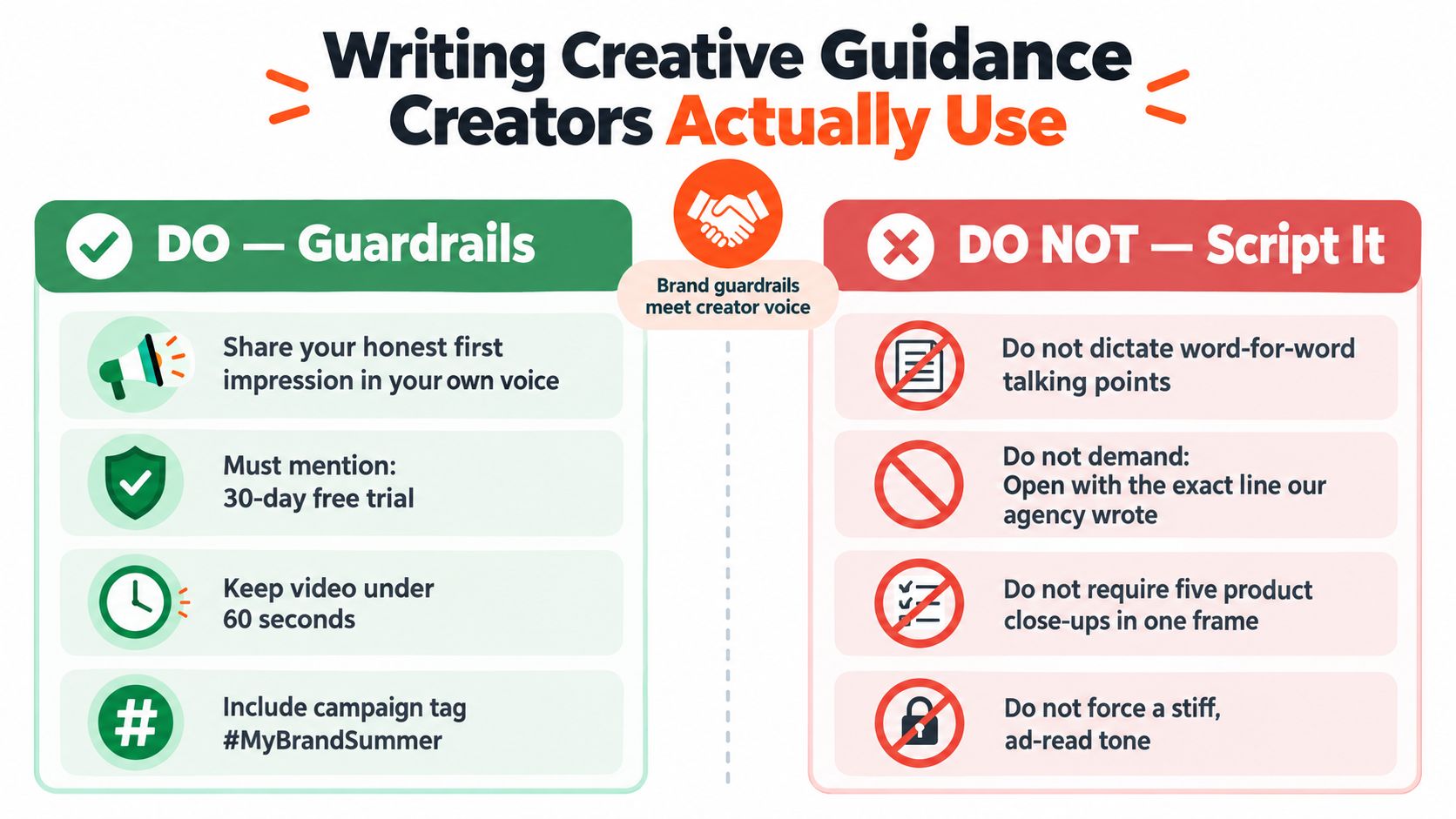
Creators don't need an agency script. They need to understand the problem the campaign is solving, the product truth they must communicate, and the boundaries they can't cross. The creative section should function as a negotiation between brand control and creator judgment.
A weak instruction says:
“Open with the product on a white background, say the approved line, show five close-ups, and finish with the exact CTA.”
A useful instruction says:
“Lead with a problem your audience recognizes immediately. Explain how the product addresses it in your usual style. Mention the 30-day free trial, avoid unsupported performance claims, and end by directing viewers to the tracked link.”
The second version protects the commercial objective without flattening the creator's delivery.
Separate must-haves from choices
Put fixed requirements in one list and creative permissions in another. Must-haves might include the product name pronunciation, an approved claim, the disclosure insertion point, a campaign tag, and the destination URL. Flexible choices can include the filming location, opening anecdote, visual style, background music, and the order of supporting points.
For example:
- Must say: “30-day free trial.”
- Must avoid: Claims that the app guarantees a specific fitness result.
- Must include: A visible disclosure at the beginning of the sponsored content.
- Can vary: Home gym, park, or creator's normal workout setting.
- CTA options: “Start your free trial” or “Try the app through my link.”
For more platform-specific context, teams can review influencer video marketing formats, then decide which requirements belong in the brief rather than leaving creators to infer them.
Annotate the creative, not just the requirement
For a 30-second fitness-app TikTok, the brief might own the problem and commercial facts:
- Brief: Open with a recognizable struggle, such as losing motivation after work.
- Creator: “I used to tell myself I'd train later, then suddenly it was bedtime.”
- Brief: Demonstrate one app feature and mention the 30-day free trial.
- Creator: Shows the feature inside the app and explains how it fits their routine.
- Brief: Close with the tracked installation CTA.
- Creator: “If you want to test it, use the link in my bio and start the free trial.”
For a 60-second YouTube beauty integration, the brief can specify the product claim, required demonstration, and disclosure. The creator should supply the personal setup, texture description, routine placement, and transition back to the video's subject. That division makes review faster because the team knows which lines are factual obligations and which are creator expression.
Every creative block should answer six questions:
- What problem should the hook surface?
- Which product claims are approved?
- Which claims or comparisons are prohibited?
- Which CTA variants can the creator use?
- Where must disclosure appear?
- Which single destination should receive the traffic?
Tightly scoped guidance is easier to read and easier to execute than an inspiration deck full of references. The creator gets a clear lane, and the brand gets content that still sounds like the person who made the audience care in the first place.
Tracking and Attribution Built Into the Brief
A tracking plan belongs beside the creative requirements, not in a separate handoff email. If the brief doesn't identify the platform, conversion event, attribution window, and tracking owner, the campaign isn't ready for production.
List every placement and its intended action. A TikTok may drive installs, an Instagram Story may drive a product-page visit, a YouTube integration may support branded search and direct traffic, and a Twitch segment may move viewers to a sign-up page. Each needs a measurement route that the analytics team can verify before publication.
Make the naming system boring
Boring naming conventions save hours. Define source, medium, campaign, and content before links are generated:
- Source:
creator_ig_handle - Medium:
influencer - Campaign:
codename - Content:
asset_id
The exact convention can change, but it must remain stable across affiliate reporting, paid amplification, CRM, and web analytics. Pair UTMs with the right conversion instrument, such as pixels, SDK events, promo codes, dedicated landing pages, or first-party creator links with stable vanity slugs.
| Parameter | Value Convention | Owner | Example |
|---|---|---|---|
| Source | Creator and platform identifier | Influencer manager | creator_ig_handle |
| Medium | Standard paid creator channel | Analytics | influencer |
| Campaign | Shared internal codename | Campaign lead | spring_trial |
| Content | Unique asset or placement ID | Operations | creator12_video01 |
| Destination | One approved landing page or app route | Growth team | Campaign-specific URL |
| Conversion event | The action being scored | Analytics and product | Install, signup, or purchase |
Define what good means before launch
Include the baseline CPA, target CPA, or target conversion quality in the brief when the campaign has a performance objective. Creators don't need a spreadsheet of every media assumption, but the internal team needs a shared reference for deciding whether to extend, edit, boost, or stop a placement.
Also document incrementality expectations. A tracked conversion isn't automatically an incremental conversion. If the team is using a holdout, geo comparison, post-purchase survey, or another test, name it in the measurement plan so stakeholders don't interpret attributed conversions as the entire causal story.
The debugging protocol should be explicit:
- Which dashboard does the agency check?
- Who owns mismatched UTMs?
- Who verifies promo codes and deep links?
- How quickly must a broken tag be reported?
- When does the team stop accepting post-launch corrections?
A measurement guide focused on how to measure influencer marketing ROI can help teams formalize these questions. The brief's job is to make the answers operational for this campaign, not to leave them in a general analytics document.
Legal, Usage Rights, and Deliverables Without Surprises
Legal issues tend to appear late because teams treat them as contract language instead of campaign inputs. Put the commercial and compliance terms in the brief before creators are asked to produce anything.
Name the deliverable, platform, format, resolution, caption requirement, disclosure placement, review status, and publication window for every creator. “One social post” isn't a deliverable. “One vertical video for TikTok, with caption, tracked destination, approved disclosure, and final file delivered for review” is.
Set the rights before content exists
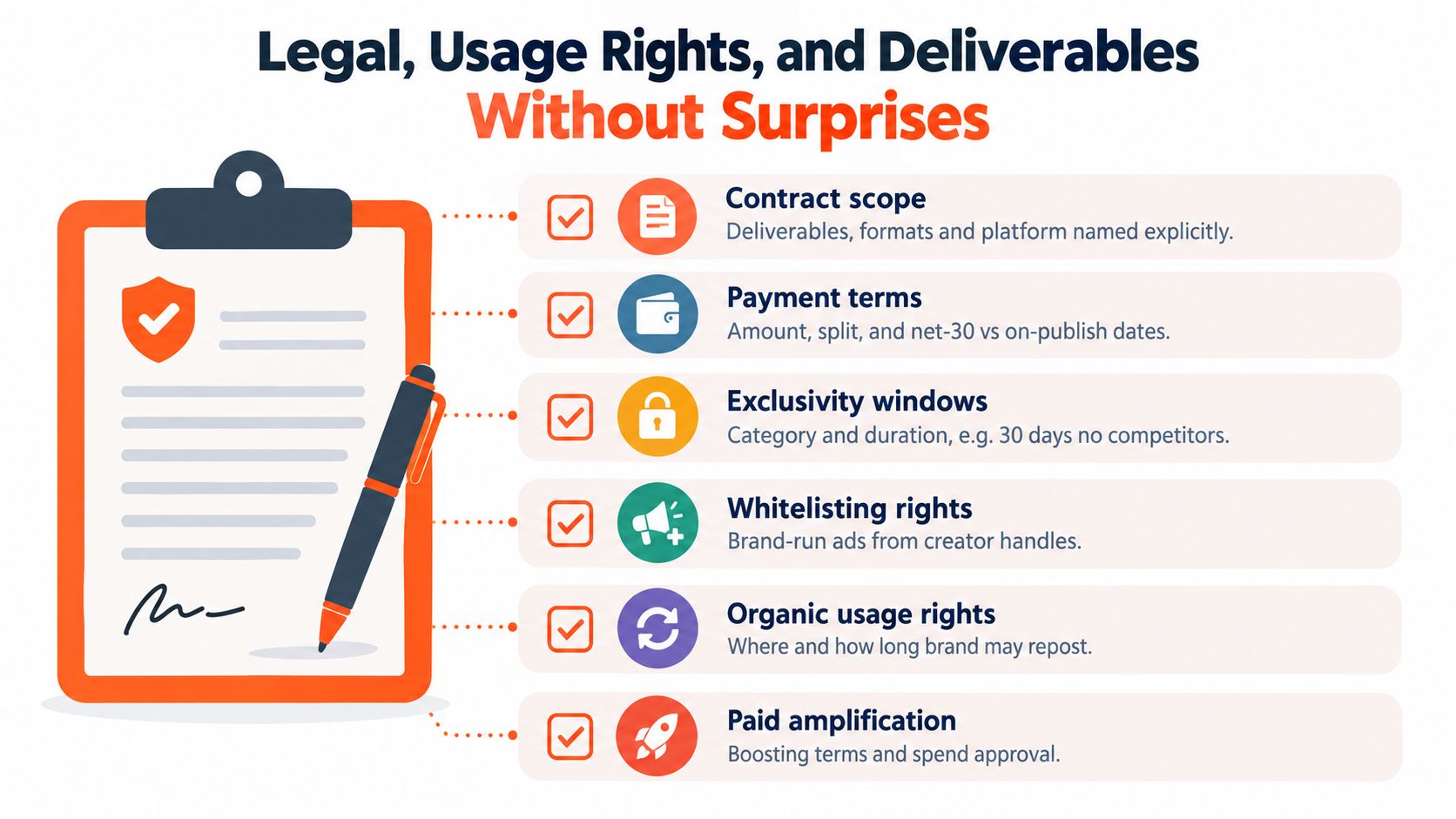
Usage rights should state where the brand can use the content, how long it can use it, whether paid amplification is included, and whether the creator's handle can be used for whitelisting or platform-native amplification. Geographic scope matters too. Organic reposting, paid media, creator-handle ads, website placement, and internal asset storage shouldn't sit under one ambiguous phrase.
Payment terms, exclusivity, cancellation terms, raw-asset delivery, and revision limits belong in the same working record. The signed contract remains the legal agreement, but the brief should make the intended agreement legible before negotiation begins.
Require the creator to use the approved disclosure language and platform-native paid partnership tools before payment releases, subject to the applicable market rules and legal review. A disclosure hidden in a caption or separated from the endorsement creates avoidable risk.
Red flags worth stopping for
- Organic-only wording: The agreement appears to permit reposting but excludes paid social.
- Missing whitelisting consent: The media buyer assumes creator-handle access that nobody authorized.
- Unbounded likeness rights: The contract grants broad future use without a defined channel, term, or purpose.
- Unclear exclusivity: The category, territory, and duration aren't stated.
- Unspecified revisions: The creator can't tell which feedback is required or how much reshooting is expected.
For teams preparing a first draft or standard agreement, an AI contract maker tool can help organize starting language, but legal counsel should review the final terms. A practical influencer contract template can also give operations teams a consistent place to capture scope, rights, and approvals.
Send this block to legal for review, not creative. Creative can flag feasibility, but legal should settle disclosure, claims, exclusivity, usage, and likeness rights before the creator invests in production.
Timeline, Approvals, and the Feedback Loop
Work backward from launch day. The contract date is an administrative milestone, not the moment the campaign becomes possible. Start with publication, then schedule asset delivery, final QA, approvals, revisions, draft review, scripting, negotiation, outreach, and creator sourcing.
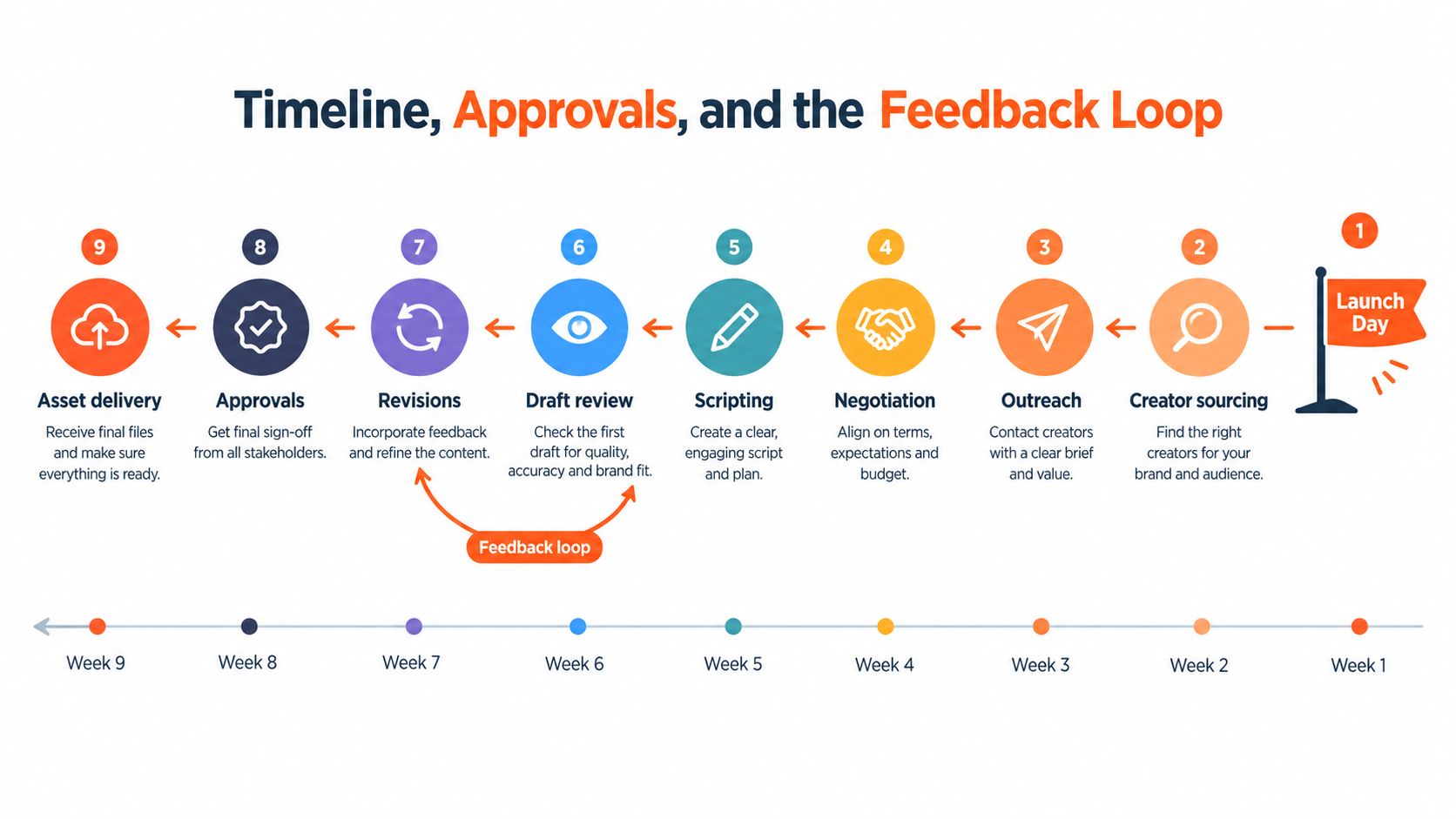
Assign an owner and service-level expectation to every stage. One person should own brand approval, one person should own compliance approval, and the creator should know exactly where to send drafts. Two review passes work well, one for brand fit and one for compliance, followed by a final QA window before publication.
Feedback needs a format. Use time-stamped comments for video, one consolidated document for written content, and a single approver per review round. Split notes into must fix and nice to have so the creator can distinguish a claim correction from a subjective preference.
“Can you make this feel more premium?” isn't actionable feedback. “Replace the unsupported comparison at 00:18 with the approved product benefit” is.
During launch week, bring the creator contact and media buyer into a short daily check-in. Performance questions should be answered while the asset is still live and optimizable, not after the reporting period has closed. Record what changed, why it changed, and whether the change affected the primary KPI.
The post-flight review should happen at the agreed measurement checkpoints, including the 7-day and 30-day results recommended in the cited measurement workflow. Feed the learning into the next brief: stronger hooks, clearer landing pages, better creator fit, or a different conversion event.
Your Reusable Brief Template and Launch Checklist
A reusable influencer marketing briefing template should be short enough to use and complete enough to prevent interpretation gaps. Keep it in a shared document with version history, not as a PDF that disappears into an email thread.
Drop-in brief structure
- Campaign identity: Brand, campaign name, market, owner, and creator.
- Objective: Awareness, consideration, acquisition, retention, or another stated business outcome.
- Primary KPI: One metric that determines the campaign decision.
- Supporting metrics: Two diagnostic measures that explain quality or friction.
- Audience: Demographics, motivations, objections, purchase triggers, and platform habits.
- Creator role: Why this creator is relevant to the audience and desired action.
- Creative guardrails: Hook direction, approved claims, prohibited claims, required mentions, CTA options, and disclosure placement.
- Deliverables: Platform, format, duration, caption, destination, raw assets, and revision expectations.
- Tracking: UTM values, promo code, deep link, conversion event, attribution window, and dashboard owner.
- Legal and rights: Contract scope, payment, exclusivity, disclosure, organic usage, paid usage, whitelisting, territory, and term.
- Timeline: Draft, review, revision, approval, delivery, QA, publication, and reporting dates.
- Decision log: Version, change, owner, reason, and performance result.
For a platform-specific starting point, this SponsorRadar campaign brief can help teams think through YouTube deliverables and planning fields. Adapt any template to your attribution model instead of copying it unchanged.
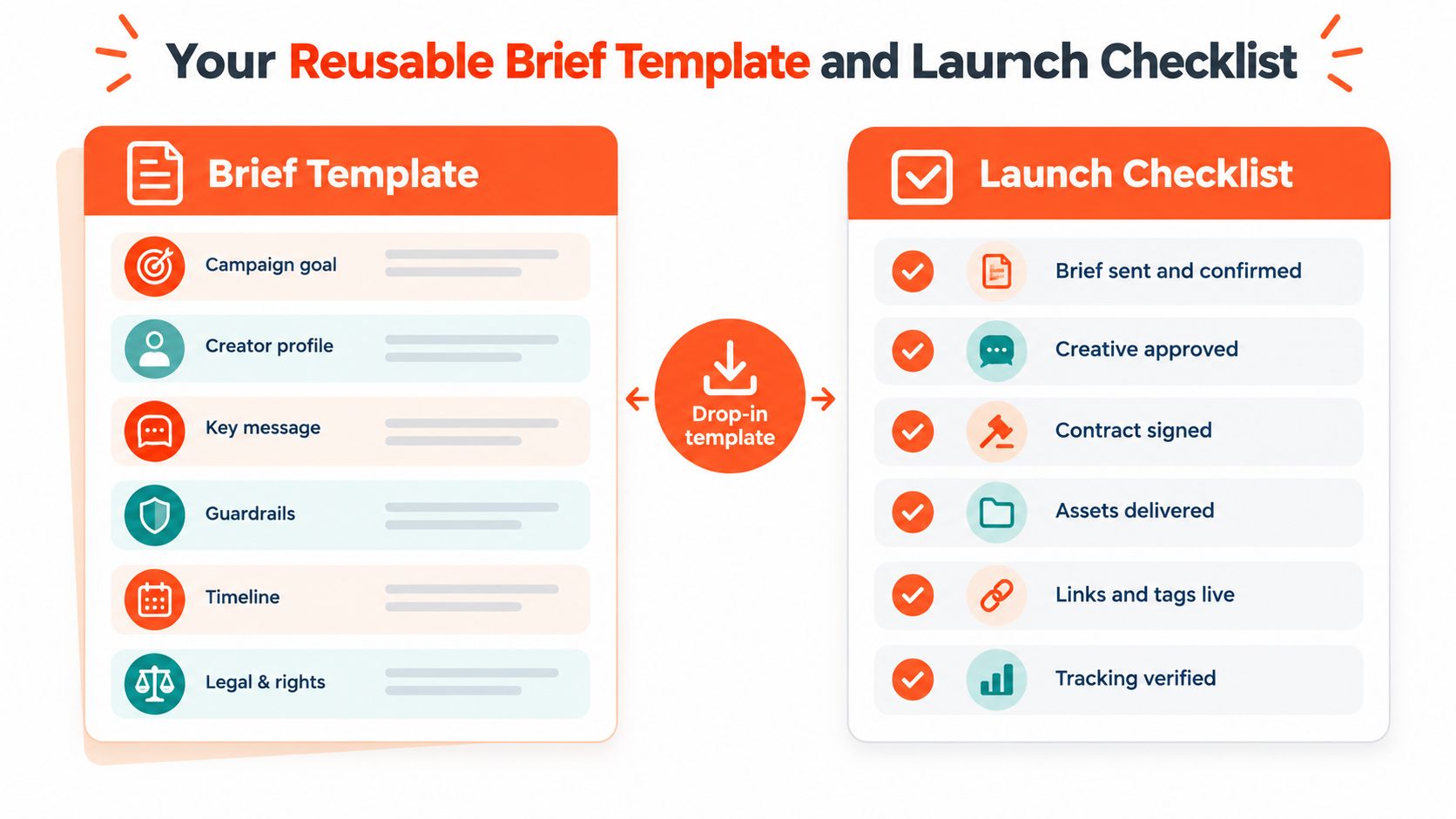
Launch checklist
- Goal signed off: The business objective and primary KPI are approved.
- Audience confirmed: Creator fit is documented with behavioral signals.
- Deliverables specified: Formats, platforms, destinations, and asset requirements are clear.
- Creative guardrails approved: Claims, hooks, CTAs, and prohibited language are ready.
- UTMs generated: Every placement has a unique, stable tracking structure.
- Conversion events verified: Pixels, SDK events, codes, and links work before publication.
- Contract sent: Scope, payment, exclusivity, and rights match the brief.
- Disclosure approved: Required language and platform labels are documented.
- Review owner assigned: One accountable approver is named for each review pass.
- Feedback window set: Draft, revision, and final QA deadlines are visible.
- Reporting cadence scheduled: The team knows when early and downstream results will be reviewed.
- Learning owner named: Someone must update the next brief with what the campaign taught you.
Teams running repeat programs should log creator revisions, score every activation against the original KPI, and archive winning briefs with the talent and platform context attached. Social Cloud is one option for teams that want campaign planning, creator briefing, contracting, tracking links, promo codes, and reporting handled within a performance-focused workflow.
The brief is a living measurement artifact. Update it after every flight, preserve the decisions that worked, and remove requirements that only created friction. When creators, legal, media, and analytics read from the same page, the campaign becomes easier to launch and much harder to misunderstand.
If your creator campaigns are losing time to vague briefs, disconnected tracking, or late rights negotiations, Social Cloud can help plan, run, and measure placements across YouTube, Instagram, TikTok, and Twitch. Bring your next campaign objective and target KPI, and use the team to build a brief that connects creator execution to accountable results.