You've got three TikTok quotes in your inbox, a launch date circled in red, and no clean way to tell if $300, $800, or $2,000 is fair. One creator has the followers, another has the views, and the cheapest quote excludes the ad rights you need. That's where a TikTok influencer pricing calculator earns its keep, not by spitting out a magic number, but by showing every line that built it.
Table of Contents
The Inputs That Drive a Creator Fee
Follower count sets a rough tier. It doesn't set a price. I would treat it the way you'd treat a postcode when valuing a house, useful for sorting, useless for closing.
For a baseline, the 2024 Sprout Social survey of 2,000 social-media users in the United States and United Kingdom found that 69% of influencers charged at least $250 for sponsored content. Nearly half sat between $250 and $1,000, with 24% charging $251 to $500 and 23% charging $501 to $1,000. Because that survey covered the US and UK, use it as a major-market reference, not a global tariff.
Why Views Move the Number More
A creator can hold a big follower count while recent posts barely travel. That's why you pull average views from the last 10 posts and lean on the median, not the best performer. Peak views flatter a quote. Median views show what you're likely to buy.
Then check engagement rate, calculated as likes, comments, and shares divided by views. A large account with weak views and thin engagement is a warning sign, not a bargain. It often means the audience followed for something else, followed a long time ago, or never cared much in the first place.
| Input | Where to get it | How it changes the price |
|---|---|---|
| Follower count | Creator media kit or profile | Sets the starting tier, not the final price |
| Average views (last 10 posts) | TikTok analytics or creator report | Drives the base value through your CPM |
| Engagement rate | Likes, comments and shares divided by views | Adjusts for audience quality and flags inflated follower counts |
| CPM or CPV target | Campaign budget and past buys | Converts expected views into a cost |
| Content type | Brief, single video, duet, series or live | Adds effort, multi-cut edits and voiceover cost more |
| Usage rights | Contract scope, territory, duration, paid use | Adds a separate fee on top of the organic post |
| Campaign goal | Awareness, traffic, installs or sales | Decides flat, performance or hybrid pricing |
Your CPM or CPV target turns expected reach into money, while content type prices the work itself. A quick talking-head video isn't the same job as a scripted series with props, locations, and revisions.
Practical rule: Don't quote until you've got the creator's asking price, the usage scope you need, the number of deliverables, and the posting deadline in writing.
The campaign goal decides the shape of the deal. Awareness can work on a flat fee. Installs and sales usually need a performance element or a hybrid, because you're not really buying views. You're buying outcomes that views might produce.
Benchmark Rates by Creator Tier
Start with the table, then interrogate it. Tiers help you spot a quote that's wildly out of line, but they won't tell you what a specific creator should charge for your brief.
| Follower tier | Median TikTok fee | Typical use |
|---|---|---|
| Below 10,000 | $138 | Testing many creators in a niche with low cost per view |
| 10,000 to 100,000 | $300 | Core paid-social tests and repeatable creator partnerships |
| 100,000 to 500,000 | $500 | Broader reach and higher-stakes launches |
| 500,000 to 1 million | $550 | Large reach campaigns with strict brand fit |
| Above 1 million | $1,000 | Top-of-funnel reach where scale outweighs cost per view |
Those medians come from Collabstr marketplace reporting on TikTok collaboration fees, which also found an average completed collaboration payment of $186 in a 2025 analysis of more than 21,000 collaborations, with 80% of collaborations costing less than $300. That gap matters. Most completed deals sit well below the headline numbers people quote in rate guides.
Asking Price Is Not the Paid Price
Keep both figures in your sheet. A creator's first number often drops once scope, timing, and rights get specific, so your calculator should track asking price and negotiated price as separate columns. If you only store the opener, you'll overstate the market.
Run a quick sanity check. Say a 40,000-follower creator quotes $2,000. That needs a reason, such as scarce niche expertise, proven buyers in the audience, or broad usage rights. Flip it around and a 1.2 million-follower account quoting $300 may have weak recent views or an audience that doesn't match your buyer at all.
Geography bends every tier. Rates in the United States, Europe, Latin America, and other regions can diverge sharply at the same follower count, so don't import a US benchmark into a Latin America buy and call it analysis.
Niche bends it too. Build your own benchmark from completed deals in the same category, using the median fee per tier, and record the niche in every row so comparisons stay within one category. Add a niche premium only when the audience shows matching purchase intent, and check any quote against a published creator rate card before you negotiate. A tier is your first check. It isn't the answer.
Working Through the Calculation Step by Step
Use this order every time. It keeps the quote auditable, which helps when finance, a founder, or the creator asks how you got there.
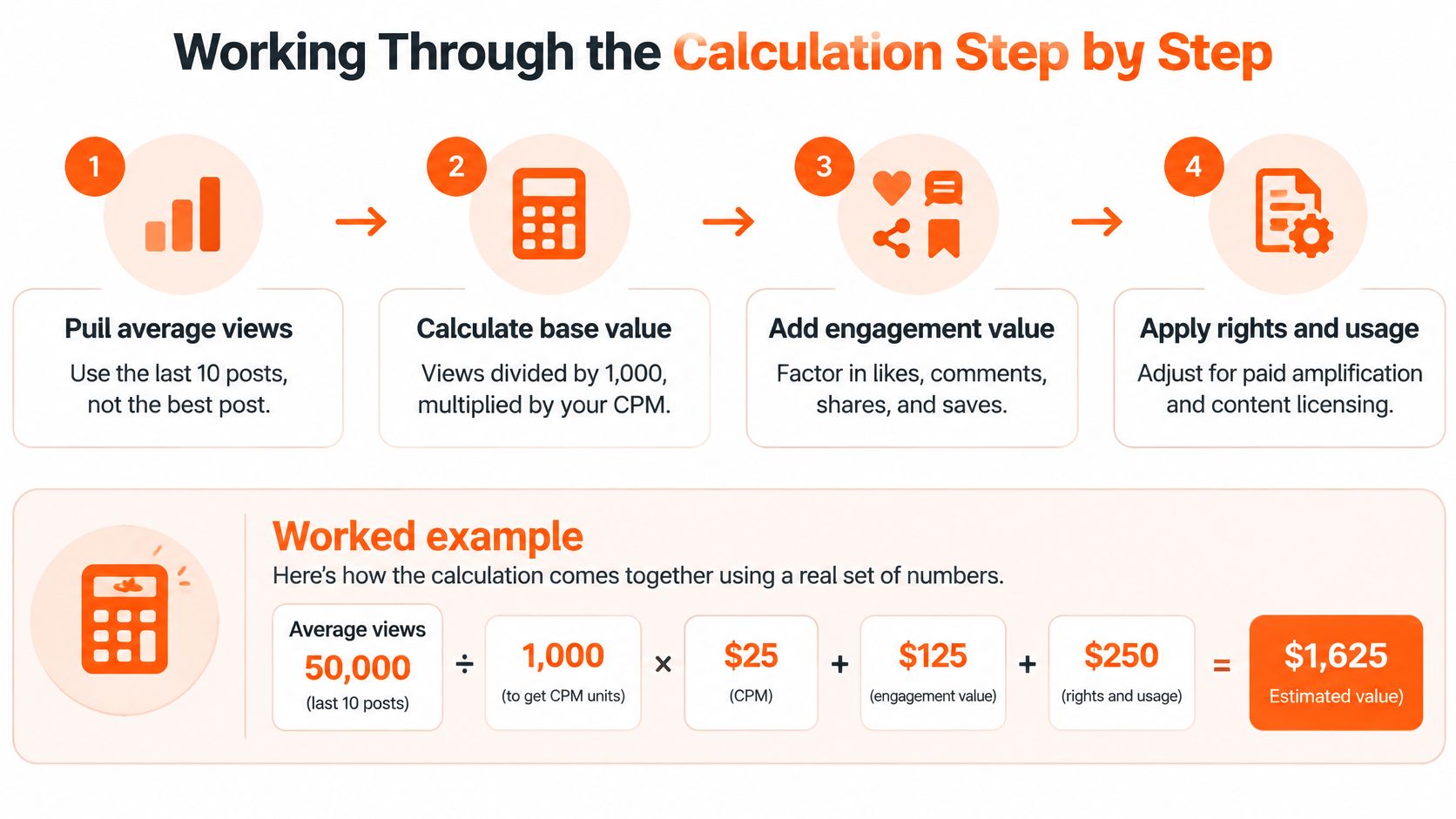
- Pull average views. Use the last 10 comparable posts, not the best post. This stops one lucky video from inflating the whole quote.
- Calculate base value. Divide views by 1,000, then multiply by your CPM. For a reference point, Influencer Marketing Hub reported a 2024 campaign involving 20 influencers that produced 88 TikTok posts and 64.5 million views at an average CPM of $4.50.
- Adjust for engagement. Raise or lower the base by the gap against your benchmark, but cap it. One viral comment thread shouldn't double a fee.
- Add complexity. Charge separately for multi-cut edits, voiceover, duets, extra revisions, or series deliverables.
- Add usage rights. Price reuse as a percentage of the adjusted base for the window and territory you need.
- Sum the lines. That's your quote, with nothing buried inside it.
A Worked Example You Can Check
Say a creator averages 60,000 views, with 4.2% engagement against your 3% benchmark. The gap is 1.2 points, but you cap the adjustment at +10%, so the adjusted base lands at $297. Sixty days of paid reuse at 25% of the adjusted base adds $74.25.
| Line item | Calculation | Amount |
|---|---|---|
| Base value | 60,000 ÷ 1,000 × $4.50 CPM | $270 |
| Engagement adjustment | +10% capped uplift on $270 | $27 |
| Content complexity | Two-cut edit with voiceover | $50 |
| Usage rights | 25% of $297 adjusted base for 60 days paid reuse | $74.25 |
| Total quote | $270 + $27 + $50 + $74.25 | $421.25 |
Reproduce those numbers in your own sheet before you trust any quote. If your total doesn't match, your formula order is off.
Watch the common slip. Marketers often take a CPM from one market and apply it to a creator whose audience sits in another. The math looks clean and the result is still wrong, because you've priced reach you're not buying.
Pricing Usage Rights and Paid Amplification
A lower creator fee can be the expensive choice. If the contract blocks the rights that turn a strong post into an ad asset, you've bought a moment instead of a reusable acquisition tool.
This short desk review shows the kind of offer comparison worth slowing down for before you compare headline fees.

Price three scenarios separately. Organic publication only buys the post on the creator's account. Creator-authorized reuse lets you run the video on your website, email, and owned channels. Spark Ads or other paid amplification lets you put media spend behind it, which is usually the most valuable right because it turns creative into distribution.
The Levers That Change the Rights Fee
- Territory and duration: One country for 30 days costs less than worldwide use for a year.
- Editing rights and platform variants: Recuts for Reels, Shorts, or landing pages add value and should add cost.
- Exclusivity and whitelisting: Blocking competitors and running ads through the creator's handle are separate rights, covered in detail in this guide to influencer whitelisting.
Don't treat disclosure as admin. Under TikTok guidance on the commercial content disclosure setting, improperly disclosed commercial videos can become ineligible for For You feed distribution or receive limited traffic. Build a disclosure check into the contract and confirm the setting before the post goes live.
The walkthrough below is useful background when you're deciding how paid amplification changes what a post is worth.
Judge the deal on total effective cost and cost per usable ad asset, not cost per post. A $250 post with 90 days of reuse can be cheaper per usable asset than a $180 post with no reuse rights, because the second video can't do the job you hired it for.
Turning Expected Results Into a Defensible Fee
A flat rate misleads when the creator's value shows up in installs or sales. You're paying for an outcome, but pricing it like a billboard.
That shift is already happening. Lumanu compensation reporting on creator payouts indicates sponsored-post rates rose 15% in 2025 while performance-based deals grew 35%, and 70% of surveyed U.S. creators said traditional sponsored posts would represent less than one-quarter of their holiday content.
Base Plus Variable, With a Cap
I would structure it as a guaranteed base fee to cover the creator's effort, plus a variable payment per sale or install, capped at break-even. The cap formula is simple. Maximum total payout equals expected conversions multiplied by profit per conversion.
Say you expect 1,000 clicks and make $35 profit per sale. At a 2% conversion rate, you get 20 sales, so the break-even cap is $700. A $300 base plus $12 per sale totals $540, which fits.
Run the edges before you agree. At 1%, you get 10 sales and pay $420. At 3%, you get 30 sales and pay $660, still under the $700 cap. That range is the point. You can defend the fee in the bad case and the good case, not just the hopeful middle.
A smaller creator with stronger historical conversion can beat a larger account, so show expected CPA or ROAS beside the creator's pay.
Tools such as an influencer marketing ROI calculator help you run those cases without rebuilding the sheet each time. When results are measurable but uncertain, pay a base that respects the work, cap the variable part at break-even, and renew on measured outcomes. Don't renew on vibes.
Negotiation and Attribution Tips Before You Sign
Formulas won't save a sloppy agreement. These moves protect the number you've calculated and make the result readable afterward.
- Ask for evidence first: Request analytics for the last 10 posts and a rate card before you negotiate, then anchor on your calculator range instead of the creator's opening number.
- Price rights as a separate line: Keep the usage bundle distinct so you can drop rights before you cut the base fee and damage the relationship.
- Give every creator unique tracking: Issue a separate tracking link and promo code, and add a post-purchase survey question asking where the buyer heard about you.
- Define conversion in writing: Agree the attribution window and whether you're counting installs, sign-ups, or purchases before anyone posts.
- Split the payment: Pay part on delivery and part on verified outcomes, with a clear route for disputes if tracking disagrees.
- Check disclosure before launch: Confirm the commercial content setting while you can still fix it, not after distribution has suffered.
- Refuse follower-count premiums: Don't pay extra for audience size without view and engagement evidence to back it up.
Keep a Negotiation Notes Column
Add one notes column to your sheet and use it every time. Record what the creator accepted, what they refused, and what moved the number, whether that was usage duration, exclusivity, revisions, or payment timing.
That column sounds dull. It's also how your second campaign gets cheaper and faster than your first, because you stop relearning the same lessons creator by creator. You'll spot which rights creators guard, which deliverables they discount in bundles, and where your own brief keeps creating cost. Good negotiation isn't squeezing harder. It's knowing which line to trade.
Run Your First Quote Before You Send a Brief
Build the sheet this week, before the next brief goes out. You'll negotiate better with a mediocre calculator you use than with a perfect model sitting in a planning doc.

- Build one row per creator using the columns below, filled from the source named beside each one.
- Apply the formulas to every row, keeping base, engagement, complexity, and usage as visible lines.
- Quote three creators across two tiers, plus one performance offer with its cap set by the break-even check.
- Launch with unique tracking for each creator, with the attribution window and conversion definition agreed in writing.
- Review after two weeks on cost per usable asset and cost per conversion, then renew or cut on those numbers.
| Sheet column | What to enter |
|---|---|
| Creator handle | Profile link from the media kit |
| Followers | Creator media kit or profile |
| Average views | Median of the last 10 posts from analytics |
| Engagement rate | Likes, comments and shares divided by views |
| CPM target | Campaign budget and past buys |
| Content type and complexity | Brief, single video, duet, series, edits or voiceover |
| Usage scope | Territory, duration and paid use from the contract |
| Asking and negotiated price | Creator's first number and the agreed figure |
| Tracking link and code | Unique to each creator |
| Outcome metric | Conversions, installs or sales from tracking |
| Notes | What was accepted, refused and what moved the number |
Brands that would rather not build and track this model in-house can ask Social Cloud to run it as part of a managed campaign. Either way, present the output as a starting quote, not a guarantee. Your TikTok influencer pricing calculator is only as reliable as the view and conversion data you feed it, so keep the inputs honest and the lines visible.
If you'd rather spend your time on creative and growth than on rebuilding pricing sheets, Social Cloud can plan, contract, and measure TikTok creator campaigns with per-creator attribution, usage rights handled upfront, and fees tied to installs, conversions, or ROAS. Bring your shortlist or start from a brief, and get a quote built line by line instead of guessed from follower counts. Visit Social Cloud to talk through your next campaign.