You're looking at a creator video that already did the hard work. Comments name the product, saves are climbing, and someone on the growth team wants that same clip in front of buyers who have never heard of the creator. The Slack message is usually short: "Can we just run it from their account?"
That request is influencer whitelisting. The media buy is the easy half. Permissions, disclosure, and the moment paid delivery burns the organic signal are the half that decides whether the flight makes money or creates a mess. I'll cover what the permission gives you, how platforms differ, what to pay, and when I'd leave the creator handle alone.
Table of Contents
What Influencer Whitelisting Is and Why Brands Use It
Say a skincare brand has a creator video pulling specific comments about texture and scent. The growth lead doesn't want a recut on the brand page. They want that same video, with that face and those comments, in front of people who have never followed the creator.

Influencer whitelisting is the creator granting permission for the brand to run paid ads through the creator's identity, handle, or account, using content the creator already published. Think of it as lending a name tag. The creator's name stays on the stall. The brand still buys the media, sets the targeting, and owns optimization. The ad wears their social proof.
Licensing the video file for the brand's own page is a different deal. You get the pixels. You don't get the handle, the existing likes, or the sense that a person, not a logo, is speaking. That trust signal is the whole reason the premium exists.
Why the name tag is worth buying
Brands use it for three practical reasons.
- Scale past the follower list. Organic reach stops at people who already chose that creator. Paid delivery can put the same asset in front of lookalikes and purchasers.
- Stack targeting on credibility. Platform delivery, conversion tracking, and budget allocation sit on top of a face people already trust more than a brand template.
- Get per-asset numbers. You stop living on a vague influencer recap and start reading impressions, clicks, and cost by creator and placement.
Vivian Agency's write-up of usage rights notes that Meta reported partnership ads produced 19% lower cost per acquisition and a 13% higher click-through rate than comparison campaigns in sales-intelligence data shared in 2025. Treat that as a platform benchmark, not a promise for your category.
Those lifts only show up when the post, the claim, and the rights can survive paid scale. The readiness test for that sits with the method choice later.
How Whitelisting Works on Each Platform
Platform controls vary, but the working distinction is consistent: the creator grants access to their identity or post, and the brand manages the paid campaign. The creator's handle or post remains visible, which preserves the social context. It also means changes to permissions or content can affect the ad, so confirm control and editing rules before launch.
Meta calls the format Partnership Ads. StackInfluence's Partnership Ads glossary describes the shift from Branded Content Ads to Partnership Ads, expanded and rebranded in 2022, with paid media running through the creator's identity rather than only the brand account. It also describes Meta's creator-discovery system as making more than 10 million creators searchable and reports Partnership Ads exceeding a $15 billion annual revenue run rate in 2026, after growing more than 97% year over year. That figure is advertising revenue, not creator pay.
Whitelisting mechanics by platform
| Platform | Format name | How the creator grants access | Who runs the ads | Watch-outs |
|---|---|---|---|---|
| Meta (Facebook) | Partnership Ads | Creator approves brand access through the partnership flow | Brand controls budget, targeting and optimization | Confirm permission duration and which edits remain available |
| Partnership Ads (via Meta tools) | Creator authorizes the brand on their Instagram account | Brand controls buying; creator handle is shown | Confirm account type and linking requirements | |
| TikTok | Spark Ads | Creator authorizes a boost of their post or shares a post code | Brand boosts from TikTok Ads Manager; post stays on creator profile | Comments and edits follow the original post |
| YouTube | Brand-use permissions for creator content | Creator grants access through the brand-use settings; confirm which account authorizes the use | Check the current settings to see whether the brand or creator controls buying | Confirm permitted edits and whether changes affect the live ad |
| Usage-rights licence (any platform) | No whitelisting; file posted on brand account | Creator grants a licence for named channels and dates | Brand account | No creator handle shown; priced separately |
What changes the brief
Instagram account type can block setup. A personal profile may not complete the partnership link, and the handle is what shoppers see. If the link fails, the ad cannot run under that creator identity.
TikTok authorization applies to a specific post, not the creator's whole account. The brand boosts it through TikTok Ads Manager, while the video stays on the creator's profile. Comments, stitches, and later edits remain tied to that post. A caption change after launch can therefore change what appears in the live ad, so agree on who can edit and when before granting access.
A usage-rights licence gives the brand a video file to publish on its own account. The creator's handle and existing post do not carry over, and the licence fee is separate from any whitelist premium. Choose that route when the brand needs control of its own post; choose creator authorization when the creator identity is part of the paid asset.
YouTube's brand-use options can change, so check the current settings before drafting contract language. Confirm who grants access, who controls ad buying, and which edits are allowed. Apply the same discipline to permission duration on Meta and TikTok: avoid promising access windows or edit rights until the platform settings and creator agreement match. Paid reach can amplify a strong post, but it can also magnify a changed caption, a broken authorization, or creative that no longer reflects the original organic signal.
Permissions, Disclosure and Compliance You Cannot Skip
The awkward truth is that creator-handle ads look most organic at the exact moment regulators want a loud commercial label. Paid amplification keeps the creator's voice and face, then multiplies the audience. Authenticity is the performance bet. It is also the compliance risk.
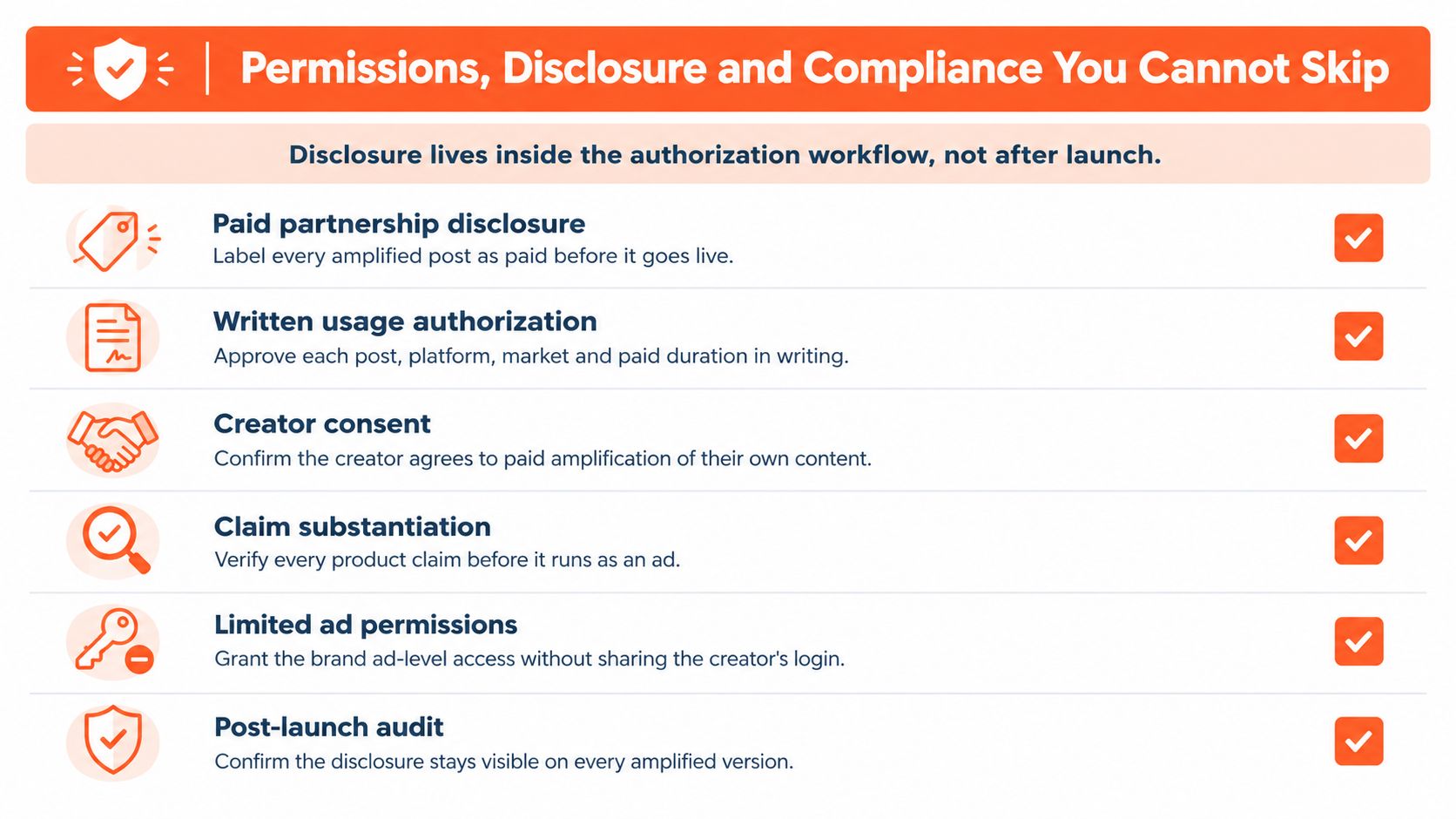
Disclosure has to live inside the authorization workflow, not in a cleanup ticket after launch.
The FTC's Disclosures 101 for social media influencers treats payment, a free product, an employment relationship, or other value as a material connection. The disclosure has to sit with the endorsement itself. A "more" tap, or a platform tag people might miss, is not enough. Both the influencer and the brand carry that duty. The platform label doesn't take it off either of you.
The gap in the wild is large. The European Parliament's 2025 briefing reports that 97% of influencers reviewed in the EU's 2024 sweep had posted commercial content, yet only about 20% systematically identified posts as advertisements. 38% avoided platform labels such as "paid partnership" and used vague wording such as "collaboration."
Practical rule: If the only commercial cue is the word collaboration, the variant is not cleared to scale.
Controls to paste into the brief
- Claim matrix: Pre-approve every product claim, testimonial, and before-and-after. If it isn't on the matrix, it doesn't ship as an ad.
- Two labels, not one: Use the platform paid-partnership tool and an in-copy line such as "Paid partnership with [brand]" in the caption or the opening frame.
- Version control: Lock captions, voiceover, thumbnails, and edits. A "small" cut can drop the disclosure or add a claim nobody substantiated.
- Rights expiry and audience limits: Name platforms, markets, paid duration, and whether retargeting is allowed. Put the end date where media ops will see it.
- Audit record and revocation: Log who approved the wording. You need a path that stops the ad and the underlying creator authorization, not just one of them.
Language has to match the market. A US-English "#ad" doesn't automatically satisfy a German or French reviewer. Local counsel still has to read global flights. Spell the clause in writing before the creator films. A workable starting point is an influencer contract template you then mark up for platforms, markets, and paid duration. I wouldn't launch a creator-handle ad in a new country until that review is back.
How to Set Up a Whitelisting Campaign Step by Step
Treat setup as a controlled test, not a boost button. Each step exists so you can turn the flight off without a legal argument.
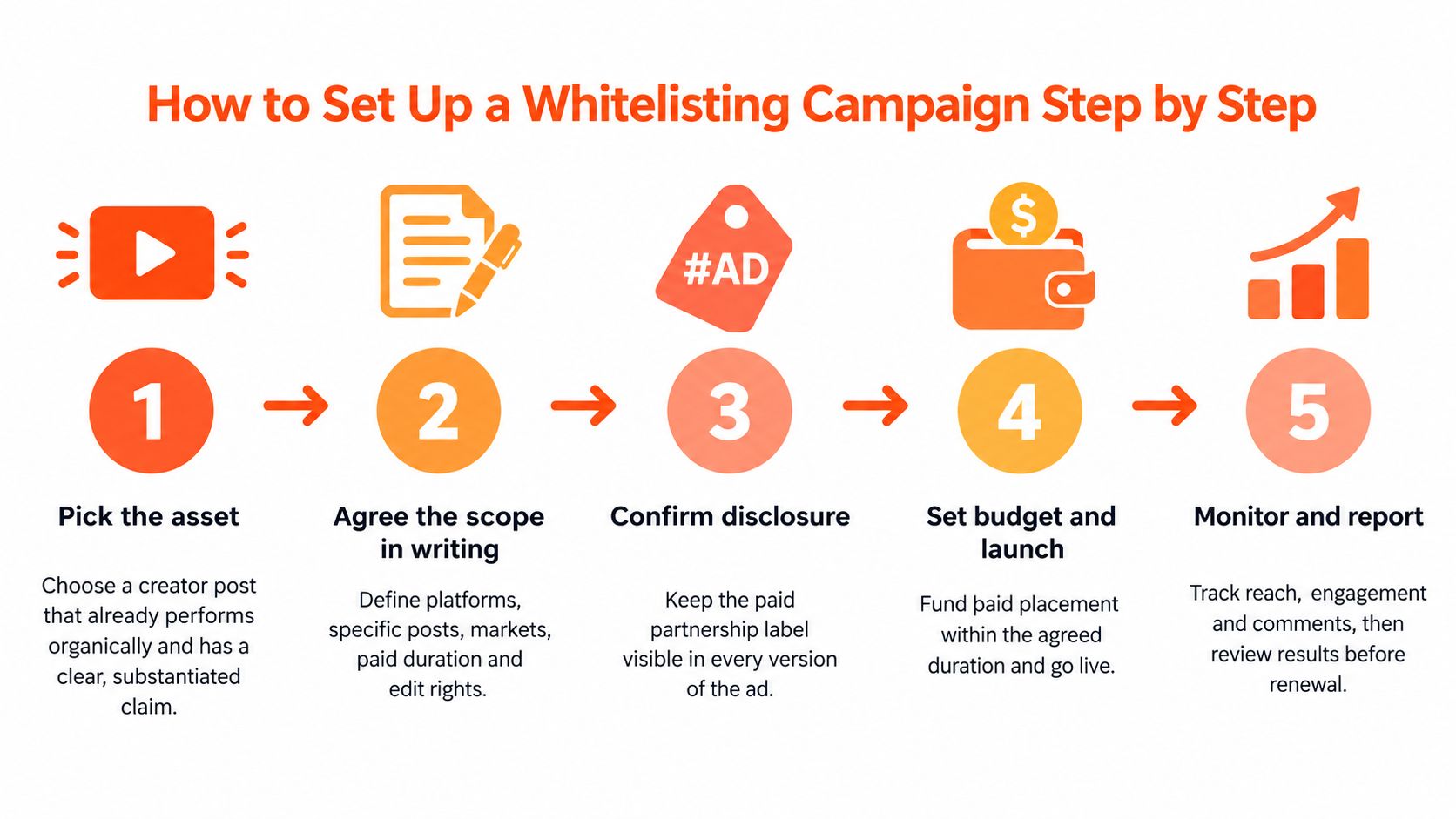
Pick the asset. Choose a creator post that already performs organically and carries one clear, substantiated claim. A pretty video with a fuzzy promise will spend well and teach you nothing.
Agree the scope in writing. Name the platforms, the exact posts, the markets, the paid duration, edit rights, and exclusivity. Say whether the brand may cut new variants or only boost the original. If that sentence is missing, you'll renegotiate after the winner appears.
Clear disclosure and claims. Run the post through the claim matrix. Confirm the paid label is in the caption or the first frame, not parked under a truncation. Reject the asset if the creator won't keep that line.
Authorize through the platform flow. On Meta, the creator grants partnership access to your business. On TikTok, they share a Spark Ads post code for that video. Don't ask for their login. Ad-level permission is enough.
Build a fair test. Hold the objective, bid strategy, landing page, and audience logic constant across creator assets. Append a creator-level tracking link or code so paid results don't get blended into organic vanity metrics.
Launch with a cap and a calendar date. Set a frequency cap before you spend. Put the usage expiry on the team calendar with an owner who can pause the ad. A forgotten end date is how "30 days" becomes a quarter.
Review weekly, then scale or kill. Split results by creator, placement, and audience. Scale only variants that still pass disclosure, rights, and claim checks. Revoke when frequency, comment tone, or the contract date says stop.
Why the stop rule earns its place
Say a fitness app runs one creator's 30-second workout for 30 days. The landing page stays fixed, the audience logic stays fixed, and the only moving piece is delivery. By day nine, frequency is past the cap and cost per install is climbing flight over flight. They cut the ad that afternoon and keep the remaining usage window for a second cut, instead of burning the month because the invoice was already paid.
The launch checklist gets you live. The stop rule is what keeps a tired creator ad from becoming ordinary brand advertising at a creator price.
What Whitelisting Costs and How to Negotiate It
Set the creator fee and the paid-usage fee as separate line items before committing media budget. A 2024 Later agency survey, as summarized by Lumus Consulting found whitelisting fees typically added a 15% to 40% premium to the creator's base post rate, with a 25% median premium for a 30-day usage period. Use that median as a starting point, not a universal rate. The quote can change with the usage window, expected reach, exclusivity, and edit rights, even when the asset stays the same.
Compare that add-on against the organic fee. Current influencer marketing rates can help frame the base rate, but keep it distinct from paid usage so a bundled quote does not hide what each right costs.
Usage terms to price on their own
- 30 days is the period covered by the median premium. Start there when you have not yet established how long the asset can perform.
- 90 days may be available as a renewal rather than a new negotiation, but do not assume the extension is cheaper. No published benchmark covers a 90-day premium, so ask for a separate quote for that window.
- Exclusivity by category or named competitor is a separate right. Price it separately from usage, and define exactly which competing work it restricts.
- Perpetual usage removes a useful control point. Set a dated expiry instead. No published premium covers perpetual use, and an ad can remain active after the creator relationship has changed.
Levers, in the order I'd use them
Agree on the usage window and renewal price first. Then price exclusivity as an optional line item, so you can remove it if the creator's other work does not conflict. Limit edits and retain approval over any new claim. If the creator wants performance upside, tie part of the fee to an agreed cost-per-install band, rather than raw impressions that the creator cannot control.
Set a fatigue or stop-loss rule in the agreement, including who can pause delivery and whether early termination changes the fee. Paid amplification can also change the context of a post: broad delivery, repeated exposure, or edits can weaken the organic signal that made the content effective. Keep the creator's identity, disclosure, approval rights, and expiry tied to the paid asset, not just the original post.
Ask the creator or agent to put the base rate, usage premium, and outcome terms on one page. If the amounts are bundled, you cannot compare quotes or see what you are paying for.
Measuring Lift and Avoiding Common Whitelisting Mistakes
Whitelisting moves you from scoring an organic post to running a paid experiment. The post's total reach is the wrong unit. You want the incremental result of that authorized asset under a defined delivery setup.
Segment impressions, unique reach, frequency, view-through rate, click-through rate, conversion rate, cost per acquisition, and return on ad spend by creator, audience, placement, and optimization event. Track marginal CPA flight over flight. If CPA only looks good because you gave that creator twice the budget, you didn't learn anything about the handle.
Signal versus cause
Creator content is already inside most paid accounts. The CreatorIQ Creator-Powered Funnel report says 92% of surveyed marketers used creator content in paid media, and that creator content represented 44% of paid-media creative on average. That is adoption, not proof that the creator handle caused the lift. High performers often get better targeting, more budget, or a stronger offer.
Run a holdout or a geo-split. Then run the same asset from the brand account beside the creator-handle version, with objective, bid, landing page, and audience logic matched. If the brand-account cut wins on CPA, you bought a licence, not a name tag, and you should price it that way.
Paid reach can also erase the thing that made the organic post work. Watch comment sentiment, frequency, and whether the creator still wants their name on the flight. Those warnings show up before CPA does. A creator who asks you to pull the ad is telling you the social proof is gone.
Label checks belong in the same weekly review as the media metrics. A 2024 UK Advertising Standards Authority report, cited by BlazeHive, found that 34% of influencer advertisements on Instagram and TikTok did not include any disclosure. A winning ad in that bucket is not a scale candidate.
Whitelisting pitfalls, warning signs and fixes
| Pitfall | Warning sign | Fix |
|---|---|---|
| Scaling a variant before its disclosure check | Winning ad live with the label hidden behind more | Scale only variants that pass disclosure and claim checks |
| Ignoring creative fatigue | Frequency climbs while CPA rises flight over flight | Set frequency caps, renewal triggers and stop-loss rules |
| Crediting the creator for paid lift | Creator arm and brand arm differ in budget or targeting | Run a holdout or geo-split test with matched delivery |
| Letting permissions expire silently | Ads still running after the usage window closes | Calendar the expiry and auto-pause the ad |
| Over-editing the creator's voice | Comments turn negative or the creator withdraws approval | Limit edits to the approved claim matrix |
| Using vague labels such as collaboration | Disclosure reads as a soft mention rather than a paid partnership | Use the platform paid-partnership label plus an in-copy disclosure |
Post-purchase quality belongs on that sheet too. A cheap click that refunds, or an install that never opens the app, is not a save. I'd rather kill a fatiguing creator ad on day eight than explain a month of spend that looked efficient in the ads manager and weak in the cohort report.
Choosing Whitelisting Over Other Amplification Methods
Whitelisting wins when you need scale from a creator post that already works, and you can govern the rights. It loses when you have no paid budget, no disclosure process, or no claim you can stand behind. I wouldn't buy the name tag to rescue a video that failed organically.
Answer yes to all four before you commit.
- Do you have a creator post that already performs on its own?
- Do you have paid budget and a reason to put that post past the follower list?
- Can your team handle permissions, disclosure, and per-creator tracking in every market you'll buy?
- Can you watch frequency closely enough to stop a tiring ad before it trains people to ignore that creator?
Which amplification method fits which situation
| Method | Use when | Main trade-off |
|---|---|---|
| Influencer whitelisting | A proven creator post needs scale and you can govern the rights and disclosure | Fee premium, fatigue risk and governance workload |
| Boosting organic brand posts | You want quick tests without creator permissions | Less creator credibility behind the brand name |
| Usage-rights licence on brand channels | You need creator assets for site, email or owned channels | No creator handle, so less social proof in ads |
| Creator-only organic posts | Awareness or community building with no paid budget | No control over reach or timing |
If question two fails, stay with creator-only organic posts. If you need the asset on the site or in email, buy a usage-rights licence and don't pretend it's whitelisting. If governance is thin, boost a brand post until the claim matrix and the disclosure check are real. TikTok Spark Ads are the usual first whitelist format for short video, and they still need the same stop rules as a Meta partnership ad.
When you need extra creator-made cuts to test hooks before you spend on a handle, a tool such as the ShortGenius AI UGC ad platform can draft variants your team then puts through the same claim and disclosure checks. Those drafts are not a substitute for the creator's permission.
One creator, one 30-day flight, one holdout. Review it against the four questions before you add a second handle.
Social Cloud plans, contracts, and measures creator campaigns across YouTube, Instagram, TikTok, and Twitch, including usage rights, disclosure, and creator-authorized paid amplification such as Spark Ads and partnership ads. If you want per-creator tracking and a usage window you can pause whenever needed, visit Social Cloud and send the post you're thinking of whitelisting.