People searching for Upfluence alternatives already know what Upfluence does. The question underneath the search is different: do I need better software, or do I need someone to run the campaigns for me?
Those are two separate purchases, and they're priced in different currencies. Software costs a subscription and assumes your team supplies the hours. A managed agency charges a fee and absorbs the hours, along with the briefs, contracts, creator follow-ups and reporting.
The switch usually starts with something small. A quote that only appears after a demo, a contract term that outlasts the test, or a dashboard that reports engagement beautifully and says nothing about customers. Workflow overhead finishes the job, and the content side of that same decision has already moved, as anyone comparing AI and human UGC quickly discovers.
Software gives you capability. An agency gives you capacity. Plenty of teams buy one and find out they needed the other.
So this list is ordered the way growth teams buy. Model first, tool second, with a decision framework and a migration checklist at the end for anyone who has already picked a side.
Table of Contents
- 1. Social Cloud
- 2. Aspire
- 3. GRIN
- 4. CreatorIQ
- 5. Modash
- 6. HypeAuditor
- 7. Traackr
- 8. Influencity
- 9. Influencer Hero
- 10. Later Influence
- Upfluence alternatives at a glance
- How to Choose With a Decision Framework and Migration Checklist
1. Social Cloud
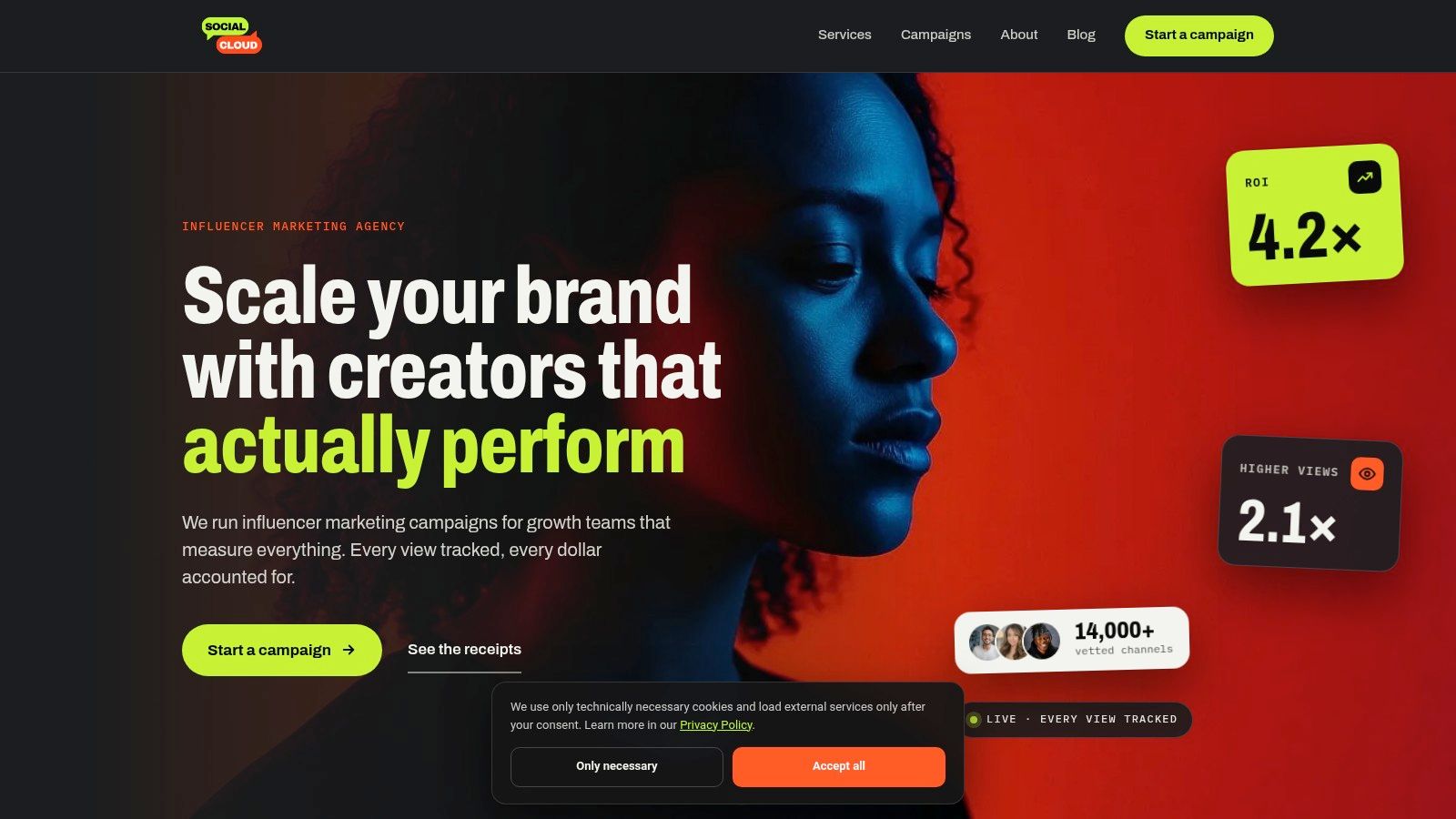
Plenty of options here hand your team a login and a database. Social Cloud is the other model: a performance agency that plans and runs creator campaigns end to end across YouTube, Instagram, TikTok and Twitch, from strategy and creator selection through briefs, contracting, compliance, launch, attribution and reporting.
Here's the reporting view clients work from every week.
Where the Budget Goes Before Launch
What separates an agency from a self-serve platform is what happens before anyone posts. Social Cloud models expected views and a target CPI or CPA per platform first, so the budget conversation happens with numbers on the table. Creator budgets pass through at cost with no markup, the base fee is lean, and the performance component is agreed upfront rather than negotiated after the fact.
A strategy, forecast and budget typically come back within 48 hours of a brief, and campaigns usually go live in 3 to 5 weeks. Creators come from a network of 12,000+, screened for audience quality, brand fit and past sponsored-content performance rather than follower count.
What Reporting Looks Like
Every placement ships with a tracking link and a promo code. Clients see views, CTR, conversions and ROAS by creator, every week, which is the difference between knowing a campaign worked and knowing which five creators carried it.
The track record is concrete. Social Cloud has delivered 340+ campaigns, including a HelloFresh program at 4.1× ROAS across 14 lifestyle and foodie creators with 12.2M views and 31.8k conversions, plus a Temu run that cut CPI by 54% against benchmark on 12k+ installs.
The honest trade-off: there's no rate card, because cost depends on campaign scope. Expect a tailored proposal, and treat any forecast as a planning input rather than a promise.
Website: social-cloud.com
2. Aspire
Aspire sells software and leaves the door to services open behind it. That combination matters if you want your own team running campaigns but you'd like the option to hand one over when capacity runs out.
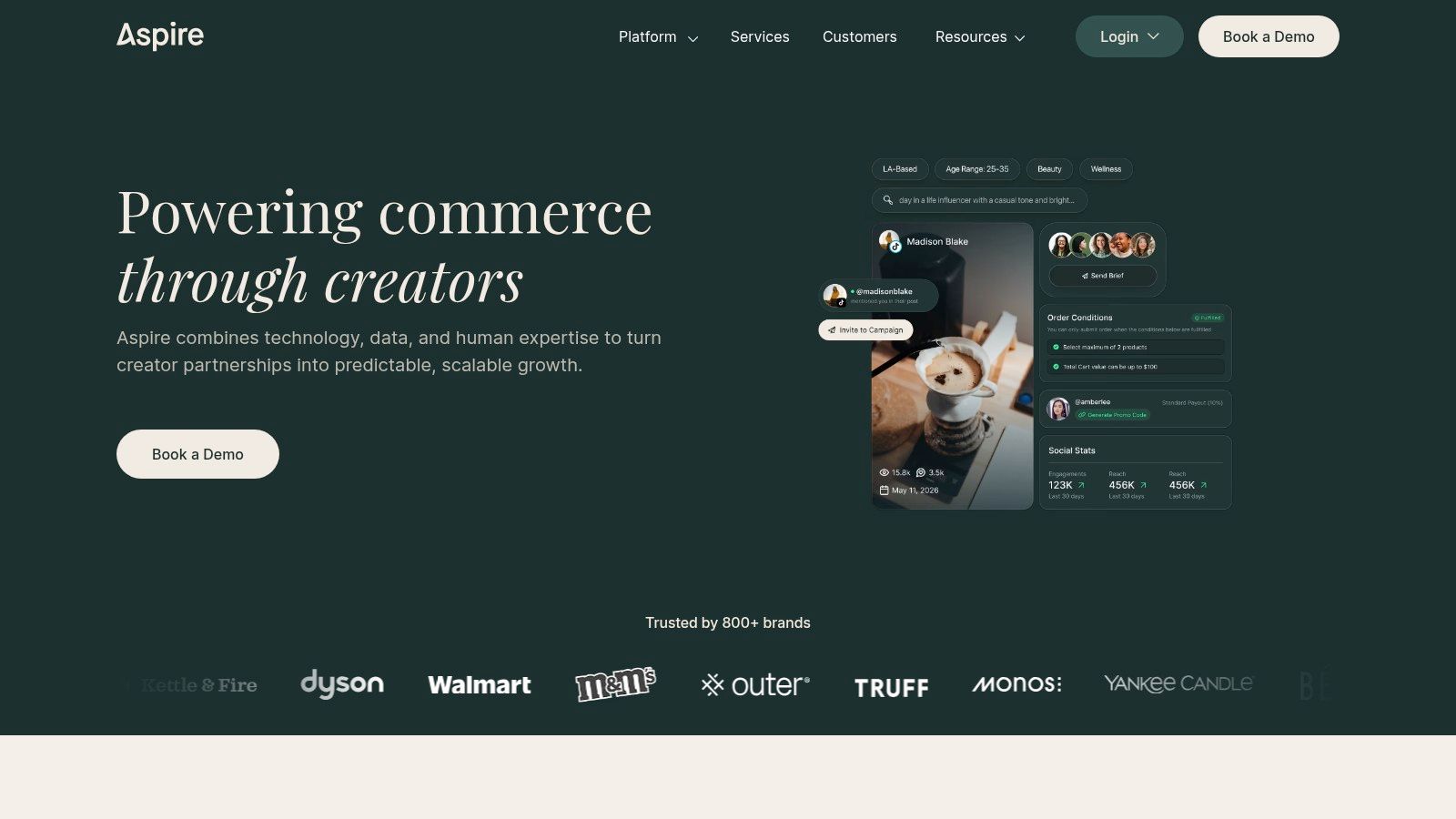
Discovery runs through a marketplace plus search and AI-assisted tools, so creators can apply to you while your team searches on its own. Campaign management covers gifting, follow-ups and relationship history, and the commerce layer handles promo codes, affiliate links, creator payouts and sales dashboards.
Software With an Escape Hatch
The ecommerce features are the primary reason it is shortlisted. If your program relies on product seeding, affiliate revenue and ambassador tiers, Aspire keeps those in one workflow instead of a spreadsheet and three inboxes.
- Marketplace plus search: inbound applications and outbound discovery in the same place.
- Trackable commerce: codes, affiliate links and payout records tied back to campaigns.
- Optional execution: strategy, gifting and paid-media support when internal bandwidth runs short.
Two caveats. Pricing is quote-based, so get a scope in writing before you fall for the demo. And in complex multi-market programs, confirm its measurement and approval workflows cover what your legal and finance teams require.
Before you compare quotes, read up on what an influencer marketing platform should handle beyond discovery.
Website: aspire.io
3. GRIN
Public entry pricing makes GRIN easy to evaluate and easy to misjudge. What you pay for the subscription is the smallest line in a creator program's cost structure.
Comparison data in Leewou's review of Upfluence alternatives shows how wide the spread runs, with some tools advertising entry prices around $69 to $199 per month while others are quoted at roughly $1,400 to $2,499 per month, often on different billing terms and with different feature depth.
The Price You See Versus the Price You Pay
Four numbers decide whether a cheap tool is genuinely cheap: cost per activated creator, cost per qualified conversion, the share of placements with verified attribution, and the internal hours the platform demands each month. A low subscription that leaves vetting, rights and reporting to your team can cost more than a managed program with a visible fee.
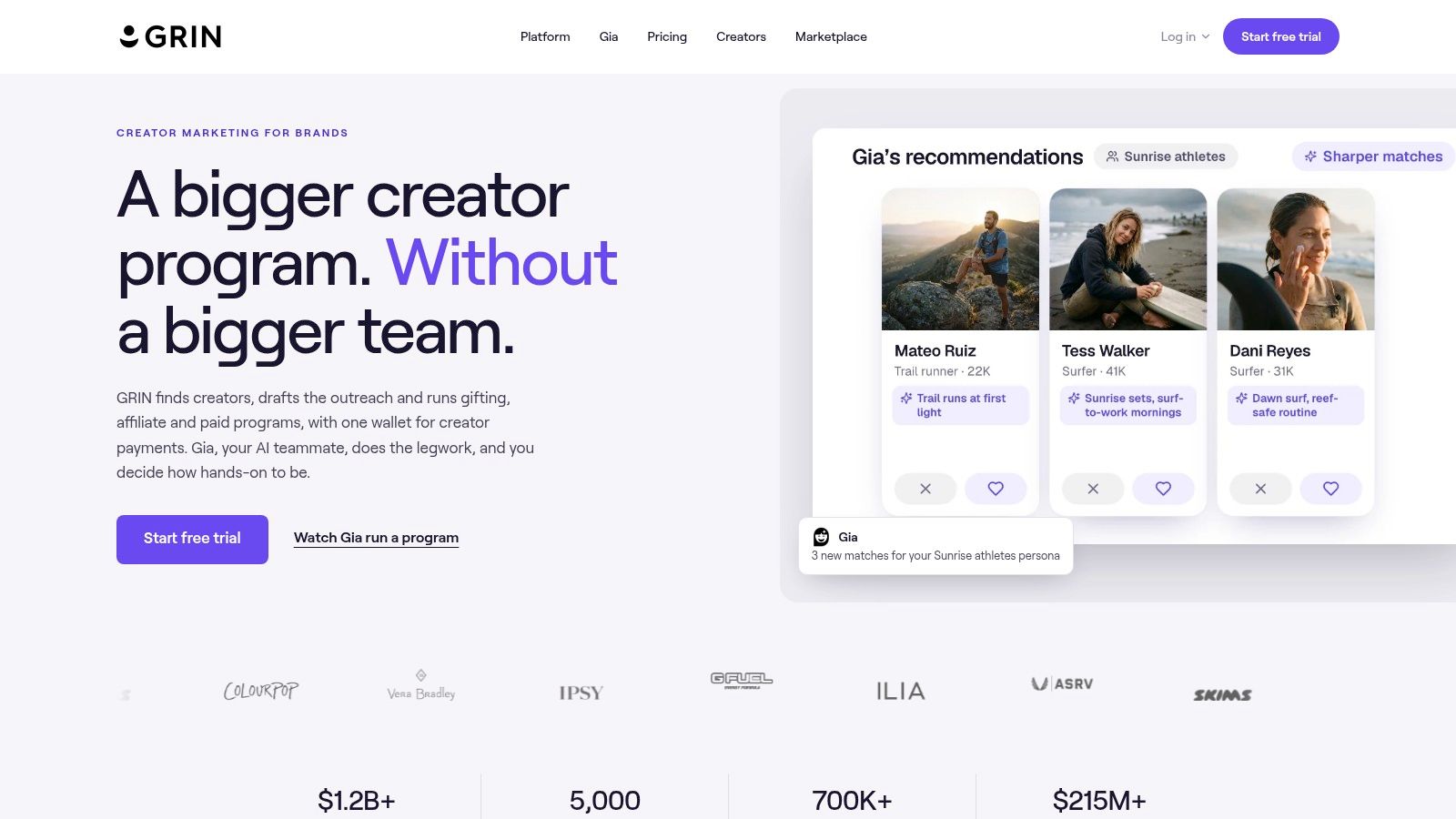
GRIN's strengths sit on the operational side. It's built around a creator CRM for recurring relationships rather than one-off posts, with gifting and affiliate workflows wired into ecommerce, and the Gia AI assistant taking pieces of program admin off your plate.
- Recurring programs: contacts, histories and follow-ups in one system.
- Commerce workflows: product gifting and affiliate activity tracked alongside campaigns.
- Self-serve entry: a free tier and paid plans you can assess without a sales cycle.
Where it stops is where most software stops. Nobody inside GRIN is writing your briefs or chasing late drafts, usage credits and plan limits shape how much work fits a tier, and you should confirm its tracked conversions reconcile with your own analytics before you scale spend.
Website: grin.co
4. CreatorIQ
CreatorIQ fits organizations where creator marketing involves several stakeholders and finance teams need consistent reporting. The market is growing: a 2024 Credence Research estimate of the influencer marketing market valued it at USD 12.266 billion and projected USD 25.076 billion by 2032, with a compound annual growth rate of roughly 9.35%.
Governance Is the Real Enterprise Feature
Regulators have pressed brands on influencer disclosure for years. That is why serious buyers ask about contracts, content approvals, payment records and claims review, not just discovery filters.
CreatorIQ brings creator intelligence and campaign planning together with workflows for approvals, contracts and payments. It also reports on campaign, program and competitive performance, with governance features aimed at large organizations.
- Complex approvals: Suited to brands with legal, brand and regional sign-off layers.
- Consistent measurement: Helps teams compare programs across markets.
- Company-level reporting: Connects creator marketing with wider business reporting.
Smaller growth teams may find the enterprise setup heavier than they need. Pricing is custom and sales-led, and the software does not run campaigns for you. Choose CreatorIQ when centralized oversight and reporting across teams matter more than a lightweight, self-serve workflow.
Website: creatoriq.com
5. Modash
Modash searches Instagram, TikTok and YouTube and skips the rest. That looks like a gap until you check where campaigns run.
HubSpot's 2025 social video trends survey reported Instagram, YouTube and TikTok as the leading video platforms for site traffic, engagement and audience growth, with Instagram strongest of the three on each outcome, and 2024 influencer campaigns split almost evenly between Instagram at 42% and TikTok at 41%.
Three Platforms Is Usually Enough
Coverage of the big three is where most consumer brands spend anyway. Modash combines a searchable creator-profile database with analytics, a CRM and content tracking, plus Shopify integration for gifting and affiliate workflows. Payments and affiliate management sit on the Performance tier, and published plans with a 14-day trial make it one of the easier tools to test before committing.
The limitations are worth naming. Twitch and other networks are outside its coverage, sales attribution is strongest when you can connect Shopify, and it's software rather than a managed service, so the strategy and the outreach volume stay with your team.
Website: modash.io
6. HypeAuditor
Fake followers are cheap to buy and expensive to sponsor. HypeAuditor's product leans on that asymmetry, putting audience-quality and authenticity analysis at the center instead of the margin.
The core is fake-follower detection, engagement quality, demographics and the kind of reporting you can hand a skeptical finance lead. Discovery runs on search filters and AI-assisted recommendations, campaign CRM, outreach and tracking sit alongside, and coverage spans Instagram, TikTok, YouTube, Twitch, X and Snapchat.
Deep vetting beats a big database every time you're about to spend five figures on creators nobody has checked.
Vetting Is the Product
The upside is risk reduction. You can screen for low-quality audiences before the brief goes out, and Twitch discovery plus analytics makes it one of the few options that takes live formats seriously. Campaign management and audience analysis share a workspace, which saves the usual copy-paste between tools.
The downside is weight. Pricing varies by plan and feature access, the analytics are dense enough to need an experienced reader, and the software doesn't come with an accountable team for end-to-end execution. Treat it as a vetting layer, not a campaign department.
Run a fake follower check on Instagram against your current roster before you renegotiate any rate.
Website: hypeauditor.com
7. Traackr
B2B teams reach this category later than ecommerce brands and ask a different question. Not which platform has the biggest database, but whether creator work ever shows up in pipeline.
The adoption curve says they're right to ask. A 2025 LinkedIn and Ipsos B2B marketing benchmark that surveyed 1,500 senior B2B marketers across six countries found 55% already use influencer marketing and a further 29% planned to adopt it within 12 months, with influencer users reporting they outperformed non-users by 30 percentage points on generating qualified sales leads and by 30 points on revenue growth, self-reported comparisons rather than causal lift, as summarized in MarketSplash's B2B influencer marketing statistics.
The B2B Measurement Problem
For SaaS, cybersecurity and AI teams, the buying criteria are operational.
- Persistent creator identifiers: so one creator can be traced from placement to opportunity.
- UTM and lead-source governance: one naming scheme across platforms and markets.
- Exportable event data: API or CSV access for reconciliation in your CRM.
- Match-rate evidence: ask what share of tracked creator leads become qualified opportunities.
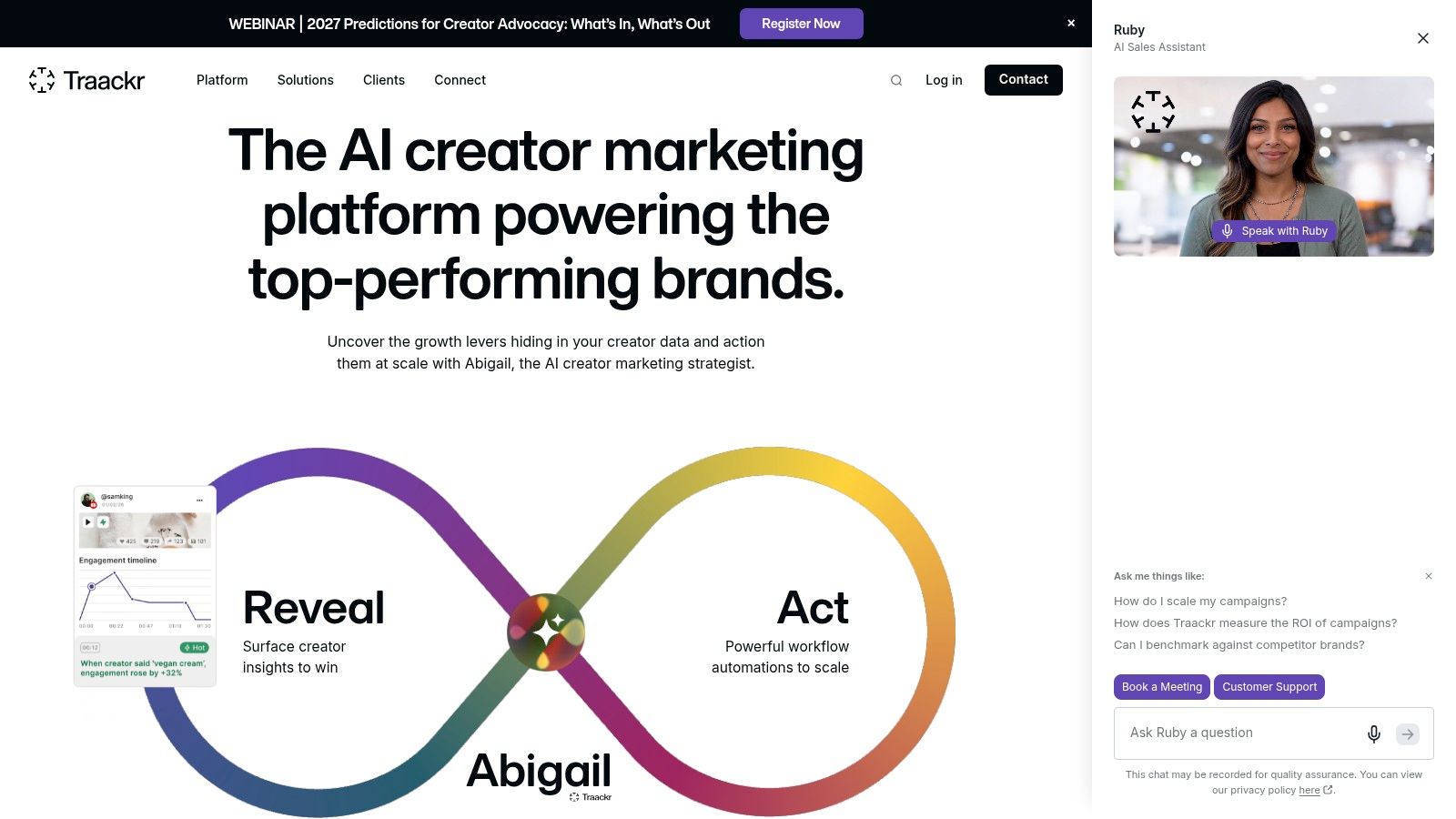
Traackr's pitch is program intelligence: planning, activation and measurement in one place, comparisons across campaigns, platforms, categories and competitors, first-party creator data through social platform partnerships, and Shopify connections for seeding and tracking. It suits mature teams that need benchmarking to justify next quarter's budget. Pricing is quote-based, the analytics emphasis is heavy for a fast first launch, and it isn't an agency team.
Website: traackr.com
Before you commit, read how to measure influencer marketing ROI so your benchmark survives the migration.
8. Influencity
Database size is the most overrated number in this category, and it's the one every comparison leads with.
The scale figures make the point. DataReportal's Digital 2025 global overview report recorded approximately 5.24 billion social media user identities worldwide in February 2025, equal to 63.9% of the global population, while YouTube's advertising tools reported monthly reach of at least 2.53 billion users across 88 countries, and 2025 estimates placed Instagram near 2.0 billion and TikTok near 1.59 billion users.
Why Reach Numbers Don't Pick Your Tool
Those figures describe the audience your campaign competes for, not the creators who'll reach it. Advertising reach is also not the same as monthly actives, and the platforms overlap heavily. A huge profile database tells you a search index is broad. It says nothing about whether the right 20 creators exist for a fintech offer in Germany.
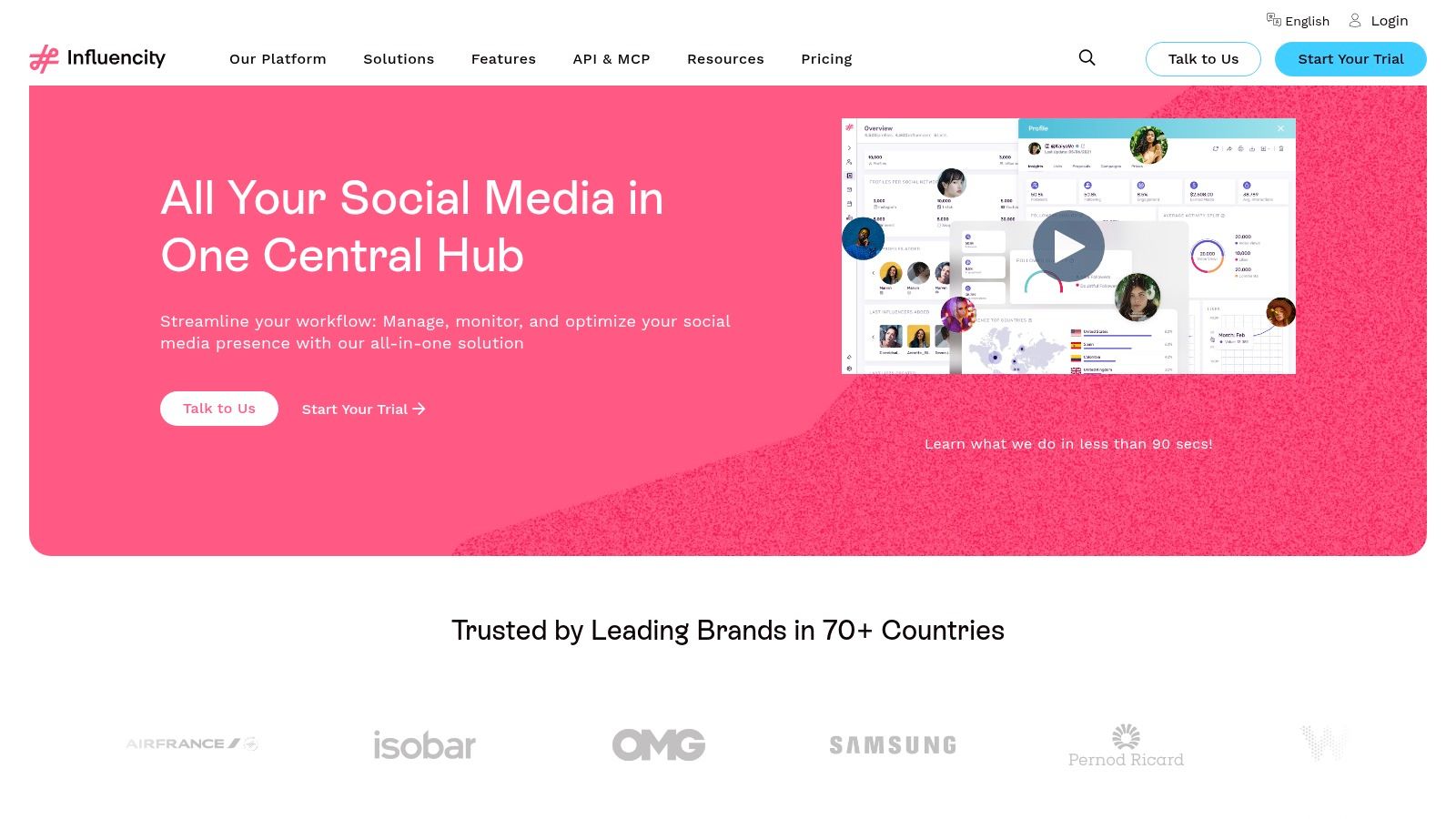
Influencity combines a creator database with discovery tools, campaign and relationship workflows, email-connected communications, and ecommerce connections for seeding, promo codes and creator-level sales tracking. It suits agencies and in-house teams coordinating several campaigns at once. Confirm plan limits directly, and test it against your own channel and reporting requirements before assuming size equals fit.
Website: influencity.com
9. Influencer Hero
If your program stalls in the outreach inbox, Influencer Hero is built for that specific failure.
It bundles creator search and analytics with fake-follower analysis, bulk outreach, email sequences and CRM workflows, then adds UGC tracking, a content library, and Shopify, affiliate link, discount code and creator payment tools. The pitch is straightforward: automate the volume work that eats a coordinator's week.
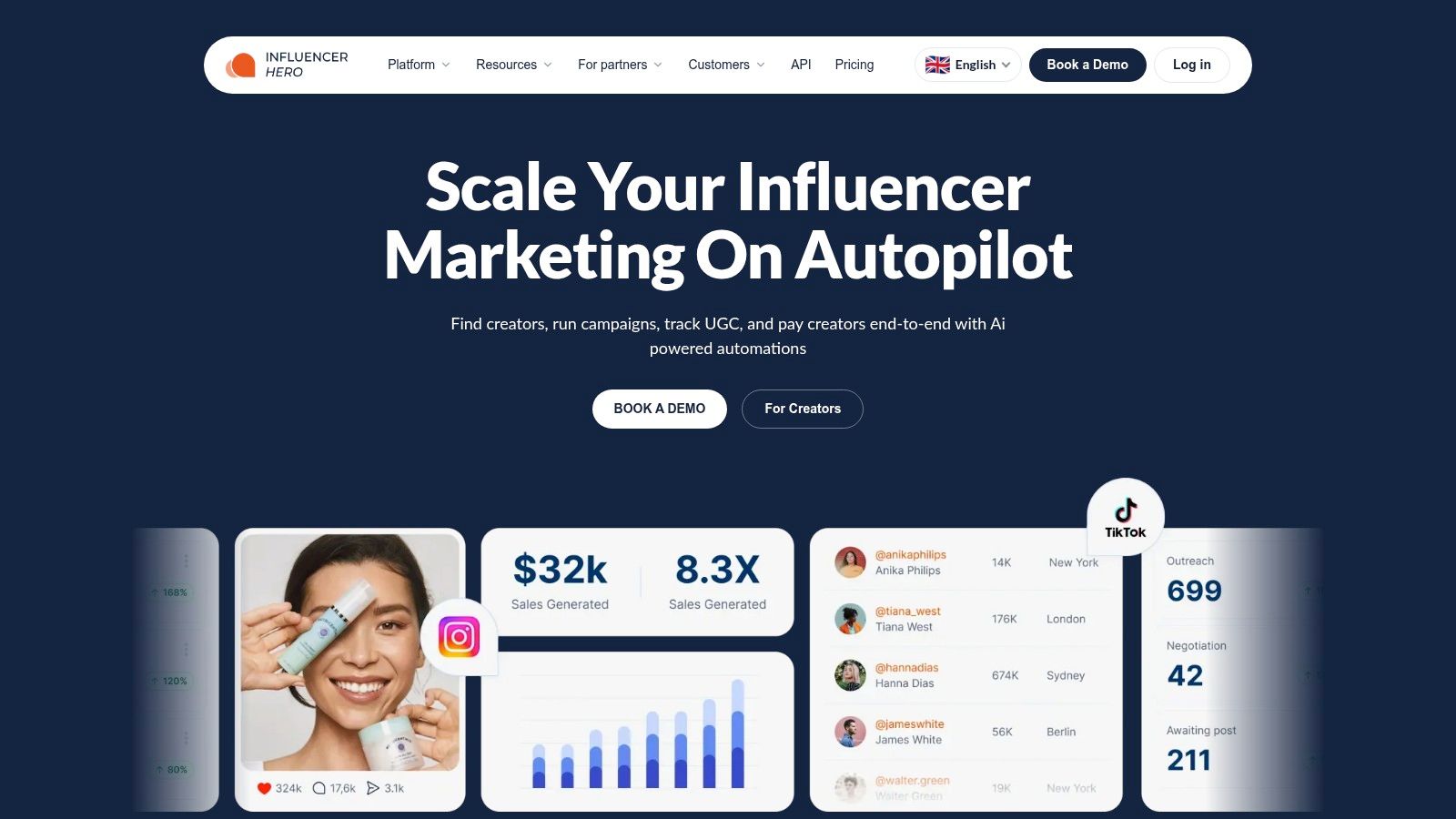
Automation Is the Selling Point
- Published quotas: plan features and limits are documented, so you can size a tier before a call.
- Outreach plus commerce together: sequences, codes and payments share one workflow.
- Room to grow: higher tiers add creator capacity and support.
Read the terms before you commit. Plans carry a three-month minimum, monthly costs climb sharply as the program grows, and the listed networks are Instagram, TikTok and YouTube, so teams running Twitch should confirm fit. It's software too, which means strategy, creator relationships and the judgment calls stay with your team.
Website: influencer-hero.com
10. Later Influence
Later Influence makes most sense for teams already publishing through Later's social tools, where creator campaigns and the content calendar live behind one login.
The measurement question is the one to interrogate. Among brands planning to increase influencer budgets by 50% or more, 89% named brand awareness as a KPI and only 25% named attributable revenue or sales, according to InfluencerMarketing.ai's analysis of influencer ROI and attribution, which also found promo codes are the most widely used measurement mechanism at 45.9%, ahead of affiliate links at 26.0%.
The Measurement Question You Can't Skip
If your reports stop at reach and engagement, every platform looks adequate. If finance wants revenue, check how each tool connects a placement to a purchase before you sign anything.
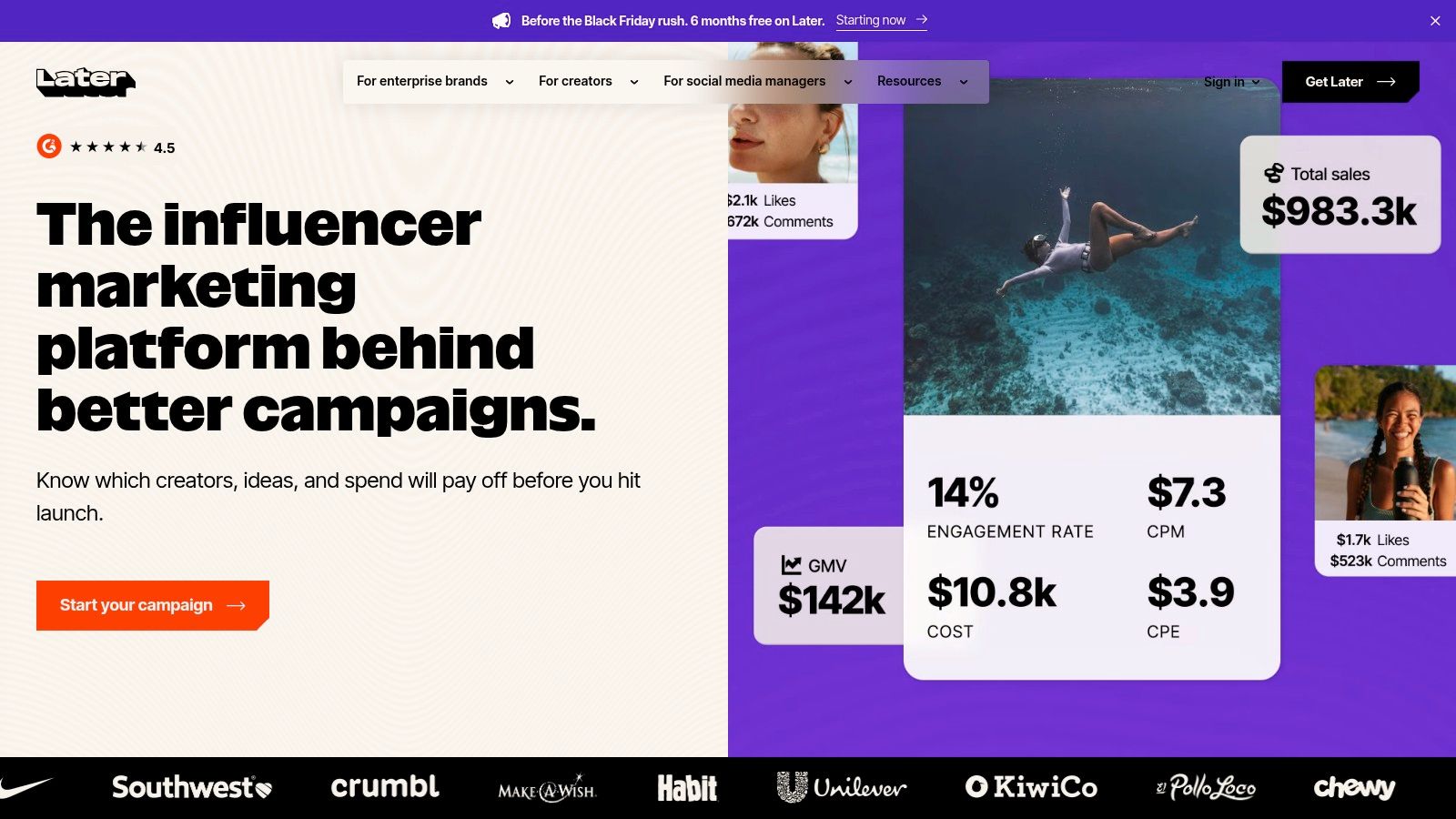
Later's influencer product covers campaign workflows and a creator marketplace, connects to Later's social publishing and analytics, and supports creator content and social planning across a broad platform set. Combining social management with influencer activity cuts tool switching, and marketplace access helps recruitment. Pricing usually needs a sales conversation, add-ons can raise the total, and specialized attribution or performance-linked service isn't the core offer.
If the bottleneck is getting approved creator content published on schedule, a publishing workflow built on Social Media Scheduler is worth fixing before you buy another discovery database.
Website: later.com
Upfluence alternatives at a glance
| Tool | Best for | Pricing model | Platform coverage | Standout strength |
|---|---|---|---|---|
| Social Cloud | Growth teams seeking measurable creator campaigns | Lean base fee plus an agreed performance component; creator budgets passed through at cost | YouTube, Instagram, TikTok, Twitch | End-to-end campaign management with per-placement attribution and ROAS reporting |
| Aspire | Teams combining in-house workflows with optional execution support | Quote-based | Instagram, TikTok, YouTube | Ecommerce, affiliate, and gifting workflows |
| GRIN | Ecommerce brands running ongoing creator, gifting, and affiliate programs | Free and paid self-serve plans | Instagram, TikTok, YouTube | Creator relationships and ecommerce workflows in one platform |
| CreatorIQ | Large organizations coordinating programs across teams and regions | Custom, sales-led pricing | Instagram, TikTok, YouTube | Governance, benchmarking, and cross-program reporting |
| Modash | Teams evaluating creators and managing ecommerce programs | Published plans and a 14-day trial | Instagram, TikTok, YouTube | Searchable creator database with Shopify workflows |
| HypeAuditor | Teams vetting creators across multiple social channels | Plan-based; varies by feature access | Instagram, TikTok, YouTube, Twitch, X, Snapchat | Audience quality and authenticity analysis |
| Traackr | Mature teams planning investment with program-level insights | Quote-based | Instagram, TikTok, YouTube | Performance comparisons across campaigns, creators, and competitors |
| Influencity | Brands and agencies coordinating discovery and campaigns | Plan-based pricing | Instagram, TikTok, YouTube | Creator discovery combined with ecommerce seeding and sales tracking |
| Influencer Hero | Teams looking to automate high-volume creator outreach | Tiered plans; three-month minimum term | Instagram, TikTok, YouTube | Outreach automation paired with ecommerce tools |
| Later Influence | Teams already using Later or seeking connected social workflows | Pricing and packages may require a sales conversation | Instagram, TikTok, YouTube, Facebook, Pinterest, Snapchat | Combines influencer campaigns with social publishing and analytics |
How to Choose With a Decision Framework and Migration Checklist
Which model fits your team: software you operate, a managed partner, or a mix of both? The answer depends on who will run creator operations, what outcomes you need to measure, and how much control you want to keep in-house.
Start With the Model, Not the Tool
Choose software if someone on your team owns creator operations and has time for discovery, outreach, contracting, and reporting. It offers more direct control and can suit ongoing programs with established creator relationships. The trade-off is that your team must supply the operating capacity.
Choose a managed agency if creator work has no clear owner, measurement is a gap, or you need external execution capacity. A partner can handle the work from strategy through reporting, while your team gives up some day-to-day control.
Choose a hybrid model if you have an established creator CRM but limited capacity to run campaigns. Keep creator relationships in-house and assign execution or reporting to a partner. Agree in advance how campaign data and relationship history will be shared.
Score the options against three practical criteria: available team hours, the level of attribution finance requires, and the channels you need to run. A program focused on Twitch or long-form YouTube may need production support; a Shopify-focused program may be manageable with software if the team has enough time.
The Migration Checklist
A platform change can interrupt campaign learning if creator and tracking data do not move with it. Export handles, audience information, past rates, and contact history before switching. Relationship history is an operating asset, not just a list of names.
- Standardize tracking links and promo codes before launch. Keep existing codes active long enough to cover the attribution window.
- Recheck audience quality for the creators responsible for the strongest results, rather than repeating checks across the full roster.
- Pilot two creators on the new setup and compare results with historical benchmarks for the same creator tier.
- Set attribution rules at launch. Record baseline CPA and ROAS by platform, set reporting windows at 30, 60, and 90 days, and document how assisted conversions will be counted.
The same discipline applies when selecting a data enrichment tool: validate the inputs before relying on the output. If nobody has time to operate the software, consider a partner whose fee includes a performance component agreed upfront, so that part of the cost depends on campaign results.
Social Cloud runs performance-focused creator campaigns across YouTube, Instagram, TikTok, and Twitch, with strategy, creator selection, production, and attribution under one team. Each placement includes a tracking link and promo code, and clients receive weekly reporting on views, CTR, conversions, and ROAS by creator. The creator budget, base fee, and performance component are scoped upfront, with no hidden markups. If that model fits your needs, Social Cloud offers a forecast before spend.