
You're managing a growing creator roster, campaign results are due, and the contract folder has vanished into someone else's inbox. Say you've got twenty creators, three spreadsheets, and no reliable way to tell whether last week's sponsored posts brought in customers. An influencer marketing platform should help you answer that question, not just give you more profiles to browse.
Table of Contents
What an Influencer Marketing Platform Is
An influencer marketing platform is software that helps brands discover creators, evaluate audiences, manage campaigns, coordinate content, and measure results. It works like a hotel booking system. It doesn't own the rooms, but it organizes the calendar, guest list, and billing so the people running the hotel can do their jobs.
The same distinction applies to creator campaigns. The platform handles the operating layer. Influencer advertising is the money spent on creator placements, not the software used to organize them.
This is the kind of campaign administration a platform should help replace.

Software and creator spend aren't the same market
A 2024 estimate from Credence Research placed the platform segment at approximately $14.2 billion, up 34% from $10.6 billion in 2023, and forecast $50.3 billion by 2028 at a 37% compound annual growth rate. Separately, Collabstr's 2025 Influencer Marketing Report projected the broader global influencer marketing industry to reach $22.2 billion in 2025, representing 12.12% growth from 2024.
Those estimates describe different categories and use different methodologies. Don't treat them as directly comparable, or assume that software revenue and payments to creators belong in the same budget line.
A platform is the operating system for creator campaigns, not the creators themselves.
For your team, market size matters less than practical usefulness. Can you find the approved brief without searching email? Can finance identify which payment belongs to which deliverable? Can the growth manager connect a placement to clicks, codes, and sales?
A searchable creator database is helpful, but it's only part of the job. A platform earns its place when your team spends less time administering campaigns and gets better evidence for its next spending decision.
The Five Jobs Every Platform Should Handle
Core platform jobs and what they replace
| Feature | What It Does | Manual Version It Replaces | What to Verify |
|---|---|---|---|
| Discovery | Searches creators by niche, audience country, language, and platform | Scrolling hashtags and messaging creators from a spreadsheet | Audience location and age filters, not just follower tier |
| Vetting | Evaluates audience quality, brand fit, and past sponsored results | Checking profiles individually | Fake-follower checks and recent sponsored-post results |
| Contracting | Stores briefs, rates, usage rights, and disclosure terms | Email threads and loose PDF contracts | Usage-rights duration and scope saved per creator |
| Tracking | Assigns tracking links, promo codes, and post IDs | Requesting screenshots and manually matching orders | Creator-level links and codes feeding one conversion record |
| Reporting | Shows views, CTR, conversions, and cost per result by creator | Rebuilding a spreadsheet every week | Weekly creator-level cuts and an explicit attribution window |
These jobs follow the campaign's working order. If you're still separating outreach from activation, this explanation of how influencer marketing works provides useful context for assigning responsibilities.
Discovery needs relevant coverage. TikTok and Instagram accounted for 83% of brand collaborations in 2024, according to Collabstr's 2025 State of Influencer Marketing Report announcement. That doesn't mean those networks suit every brand, but a tool limited to one network may leave gaps in your shortlist.
Vetting needs judgment, not just a score. We screen creators for audience quality, brand fit, and past sponsored-content performance, not just follower counts. Look at what the creator says in sponsored content, whether the audience asks relevant questions, and whether the product naturally belongs in their usual topics.
Check the handoffs between features
Contracting should connect the agreed deliverable to its brief, approval status, and rights record. Otherwise, you've bought a tidier filing cabinet while leaving essential coordination in email.
Creative review also needs room for useful feedback. For spoken product demonstrations, Mimic's guide to clean up ums and ahs can help you give precise editing notes without asking a creator to flatten their personality.
Tracking and reporting must connect to each other. A report that lists posts beside total store revenue hasn't necessarily connected those posts to purchases.
For a live demonstration, use a creator your team already knows. Follow that person from discovery through the final report, including a revised brief or rejected draft, rather than accepting a polished dashboard tour.
Who Runs the Work in a Platform or an Agency
Platform, agency, and in-house models compared
| Model | Who Runs the Work | Best Fit | Main Trade-Off |
|---|---|---|---|
| In-house spreadsheets | Your team | A small pilot with a few creators | Manual tracking becomes fragile as the roster grows |
| Self-serve platform | Your team using platform tools | Teams with a creator manager and steady volume | You own every brief, contract, and report |
| Managed agency | Agency team using its tools | Teams with a KPI and little bandwidth | Less direct control, so establish how data is shared |
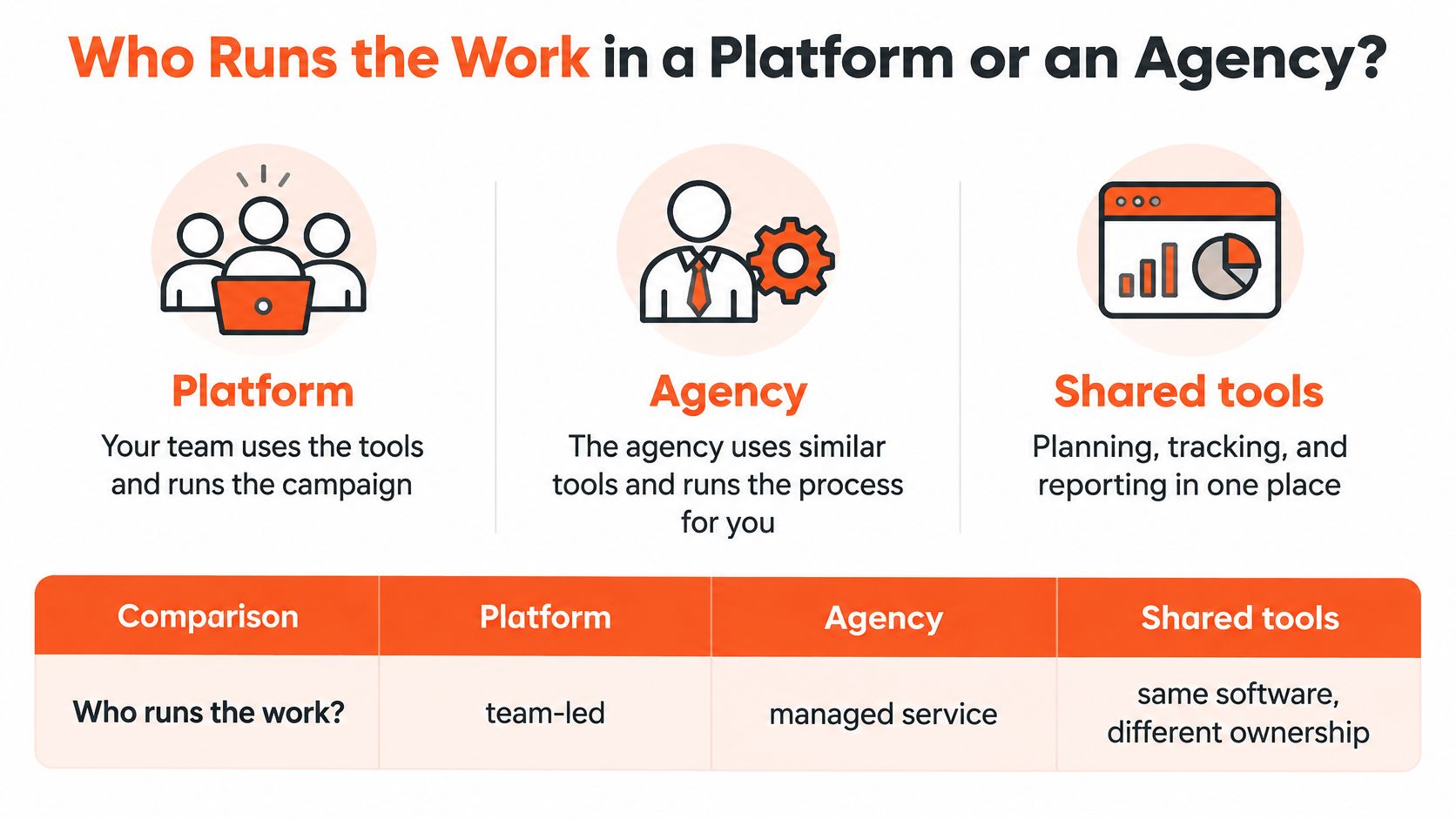
The core difference is labor ownership. A platform gives your team tools. A managed agency assigns people to run the process, often using similar software behind the scenes.
This comparison makes that division of responsibility easier to see.
Spreadsheets can work for a contained pilot because the campaign owner can personally follow each conversation. As the roster grows, missed approvals, duplicate records, and inconsistent naming become harder to catch. There isn't a universal creator count at which you must switch, but repeated reconciliation work is a useful warning.
A self-serve platform suits a team that has someone available to operate it. Software won't negotiate a difficult scope change or decide whether a revised script still sounds like the creator.
Make accountability explicit
Before signing an agreement, settle these questions in writing:
- Data ownership: Who owns the creator-level records, and what can you export when the relationship ends?
- Approval authority: Who signs off on briefs, claims, revisions, and publication?
- Tool access: Can your team inspect campaign records directly, or only receive presentation slides?
- Fee structure: Which charges cover management, creator payments, production, and performance?
Compare a flat retainer with a base fee plus a performance component using the same scope of work. A performance fee needs an agreed definition of qualifying conversions, including cancellations, duplicates, and reporting cutoffs. Otherwise, both parties can calculate a different result from the same campaign.
At Social Cloud, we keep strategy, creator selection, production, and attribution under one accountable team. Whatever operating model you choose, that ownership should be just as clear.
Choose based on how much control you want to retain and how much work you can realistically handle. Revisit the decision when your campaign volume or internal staffing changes.
Measuring Performance Beyond Follower Counts
A widely viewed video can generate little buying activity, while a smaller creator can send highly qualified visitors. Reach tells you about exposure. It doesn't tell you whether the audience needed the product, could buy it, or took action.
A study examining more than 1.8 million purchases across nano-to-macro influencer campaigns evaluated revenue per follower, revenue per reach, and return on influencer spend, showing why follower count alone is an inadequate optimization variable, as summarized in the Baylor Keller Center report.
Build a usable attribution record
Combine creator-specific links, unique promo codes, platform click data, conversion events, and post-purchase survey answers. Each captures a different part of the buying journey, so preserve the distinction between observed behavior and a customer's recalled answer.
Use consistent definitions:
- Conversion rate: Attributed conversions divided by the stated traffic denominator, such as tracked clicks.
- Cost per acquisition: The included campaign costs divided by qualifying acquired customers.
- Revenue per reach: Attributed revenue divided by reached accounts.
- Return on influencer spend: Attributed revenue divided by the influencer costs included in your calculation.
Our placements each have a tracking link and promo code, and clients see views, CTR, conversions, and ROAS per creator weekly. For budgeting decisions, this guide to measuring influencer marketing ROI helps distinguish revenue efficiency from profitability.
Tracked doesn't automatically mean incremental
A buyer might use a creator's code despite already planning to purchase. Another might watch the content, switch devices, and buy later without using the link. Attribution can both capture existing demand and miss genuine influence.
Require a common event schema that preserves creator, post, platform, timestamp, and conversion identifiers. Deduplicate a purchase when the same buyer uses both a link and a code, and state the attribution window before interpreting results.
Keep direct and assisted conversions separate. Label last-touch results as attribution, and report experimental lift separately when you have a credible comparison group.
The practical question is whether tracked sales justify another payment. When evidence is thin, approve further spend only against a defined hypothesis and test, not an assumption that unmeasured influence must exist.
Views tell you who was seen. Tracked conversions tell you who was worth paying.
Treat that as a spending prompt, not proof of causality.
Building Disclosure and Usage Rights Into the Workflow
Disclosure isn't a final checkbox. If someone notices missing sponsorship language after publication, your team has already lost the opportunity to prevent the problem.
The Federal Trade Commission's influencer disclosure guide says material connections, including payment, free or discounted products, employment, and family relationships, must be disclosed clearly and conspicuously in the endorsement itself; responsibility rests with both the influencer and the brand. Burying disclosure among hashtags or beyond the point where a viewer must expand the caption may not meet that standard.
Turn obligations into approval tasks
Build the campaign record around evidence rather than a checked box:
- Before production: Attach market-specific disclosure instructions to the brief.
- During review: Verify the wording, placement, visibility, and suitability for the content format.
- At publication: Retain the published version, timestamp, and screenshots alongside approved copy.
- For reuse: Store the contract and usage-rights terms with the asset.
Automated checks can flag missing sponsorship language or text placed after caption truncation. People still need to review ambiguous wording and sensitive claims, especially in health, fintech, and pharmaceuticals. A documented influencer marketing compliance workflow helps assign that responsibility before launch.
Transparency also deserves a place in performance analysis. In the 2025 Influencer Trust Index, which surveyed more than 3,720 U.S. consumers, 70% felt negatively toward an influencer after discovering undisclosed paid or gifted promotion, while 70% said knowing about a brand partnership didn't make the influencer less trustworthy.
Monitor engagement, sentiment, and conversion alongside disclosure quality. If noncompliant placements occur, examine them as incidents to correct, not as an excuse to deliberately test undisclosed advertising. Observational differences won't establish that disclosure caused a performance change.
Finally, record the term and scope of usage rights, including channels, territories, editing permissions, and paid amplification. Set a review task before expiry so a promising asset doesn't remain in paid distribution after its license ends.
How to Choose a Platform for Performance Campaigns
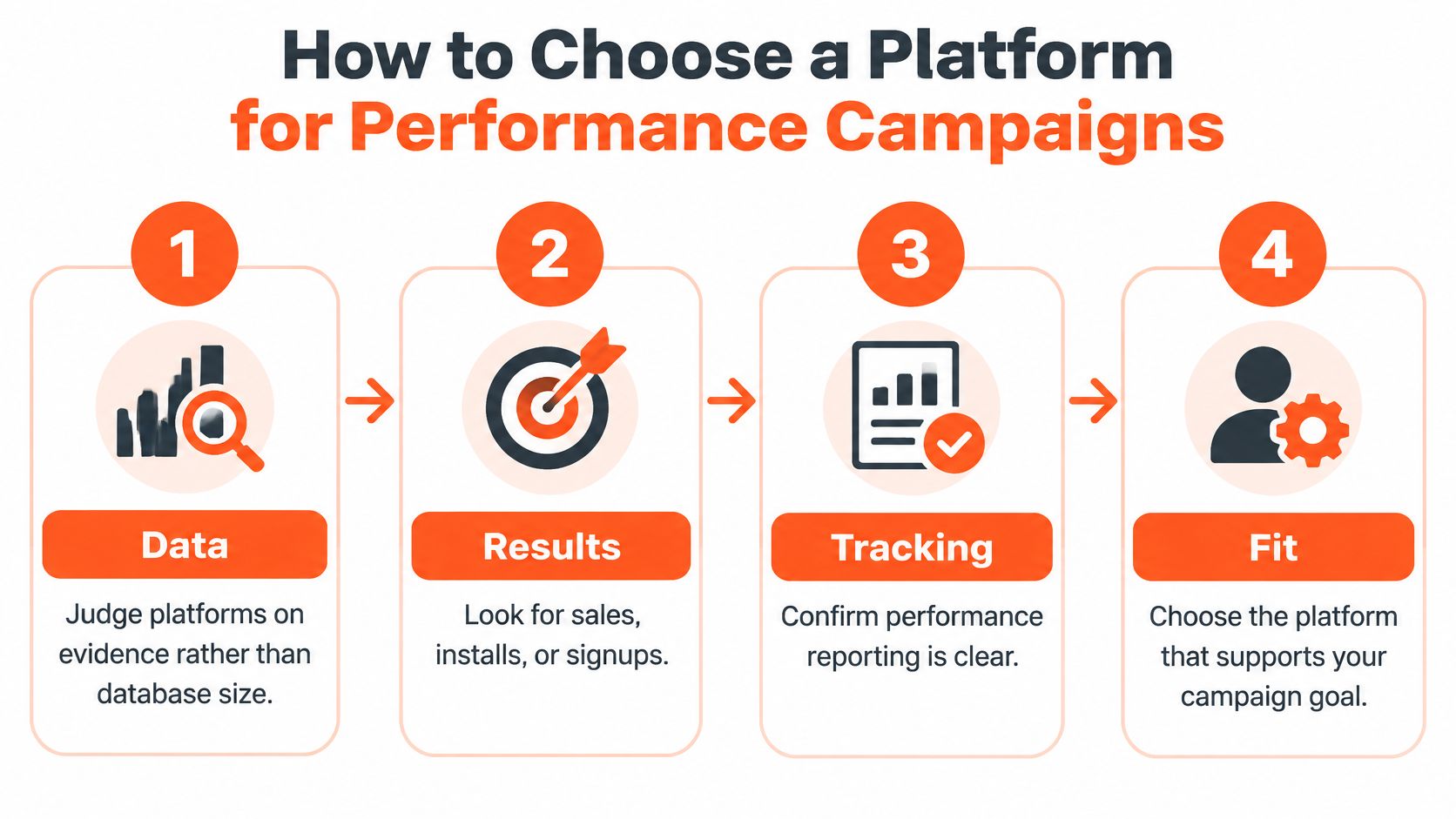
If your program must produce sales, installs, or signups, judge an influencer marketing platform on evidence rather than database size. A large directory won't compensate for missing order records or an approval process nobody follows.
Use this decision sequence to keep the evaluation tied to your campaign goal.
Evaluate the working system
- Start with data transparency. Inspect a creator-level export, its field definitions, and the named data owner. Check whether your analyst can reconcile the export without relying on a vendor's slides.
- Test attribution coverage. Walk through a purchase involving both a link and a code. Then inspect how survey responses and unmatched conversions appear.
- Require an incrementality plan. Establish whether holdouts, geographic experiments, or lift analysis are feasible for your account, including sample requirements and uncertainty. The Influencer Trust Index findings summarized by Kelley Drye reported that 74% of surveyed consumers trusted influencer advertising, compared with 87% for company advertisements, but those attitudes don't establish whether your campaign causes purchases.
- Match coverage to buyers. Search your actual niche, language, and audience location. Inspect usable results rather than the total profile count.
- Open the compliance record. Follow an asset from disclosure instructions through approval and published evidence.
- Inspect vetting inputs. Confirm that audience quality and sponsored-content history inform selection, and that a person can challenge an automated score.
- Test an awkward handoff. Change a deliverable after contracting and see whether approvals, deadlines, and reporting stay aligned.
- Separate the costs. Get platform fees, creator payments, management charges, and licensing costs itemized. Establish whether creator budgets pass through at cost or include a markup.
Use the video below as another prompt for your evaluation, then return to the account-level evidence.
Red flags worth copying into your shortlist
- Follower-only search: Audience relevance is missing.
- Unexplained ROAS: No stated cost basis or attribution method.
- No raw export: Your team can't independently reconcile results.
- Unfalsifiable influence claims: Low tracked sales always receive a vague awareness explanation.
Bring three questions to the vendor call: Can you demonstrate the core campaign jobs using one of our creators? Which incrementality method can you run for our account, and what sample does it require? Who owns the creator-level data if we leave?
Run a Small Test Before You Commit
A pilot should test the platform as well as the creators. Keep the scope narrow enough that your team can independently check what happened, including missed posts, canceled orders, and approval changes.
Give the pilot a written decision rule
- Choose one product line and a primary KPI. First purchases, activated accounts, or installs are clearer targets than a mixture of sales and engagement. Define what counts as a valid result.
- Recruit a manageable roster in one niche. Include enough creative variation to learn something, but avoid changing the audience, offer, and product simultaneously.
- Verify tracking before publication. Place test orders or complete test events, check code behavior, and confirm the creator identifiers survive checkout.
- Create a comparison where feasible. A holdout or geographic split needs sufficient volume and limited spillover. If that isn't practical, label the pilot as an attribution test rather than a causal experiment.
- Write down the attribution window. Freeze the rules before results arrive, including how refunds and delayed purchases will be handled.
- Review weekly, but respect conversion lag. Investigate weak partnerships before reallocating budget. Don't cut a creator because their audience hasn't completed a longer buying journey yet.
Test the format too
Consider a user-generated-content or gifting variant alongside sponsored distribution. On the Collabstr platform, UGC campaigns increased by 133% in 2025, while TikTok-specific campaigns declined by 48%, according to Collabstr's 2026 Influencer Marketing Report. Those are platform-specific changes, not proof that your buyers prefer either format.
Compare the platform report with a manual spreadsheet for the same creators. Resolve mismatched orders, costs, and dates before trusting the headline result.
For a direct-response pilot, continue only if the tracked results beat your baseline cost per acquisition using comparable cost definitions and conversion maturity. Document the outcome either way, including which creators and formats to drop and which unresolved questions need another test.
Social Cloud offers an ROI calculator to forecast your campaign and a free download, The 2026 influencer marketing report, with CPM, CPI, and engagement benchmarks by tier. Visit Social Cloud to build a starting forecast and define the acquisition target your creator pilot needs to beat.


