
YouTube creator spend is projected to reach about $3.45 billion in 2025 in the U.S. market, which is a strong signal that this isn't a soft-awareness channel anymore, it's a serious budget line for growth teams (Tubefilter summary of eMarketer's projection). The mistake is still the same one I see in a lot of teams, though, they buy YouTube influencer marketing like it's brand only, then judge it with the wrong scorecard. If you treat it like paid acquisition, and measure beyond last click, it can produce much cleaner decisions about what drives revenue.
Table of Contents
- The channel earns trust before it earns clicks
- Performance teams should budget for assisted conversion
- Dedicated videos and tutorials suit complex products
- Sponsored segments and Shorts serve different jobs
- Match the format to the goal, not the trend
- Phase one is pre-brief and shortlist
- Phase two is outreach and contracting
- Phase three is production and review
- Phase four is go-live and monitoring
Why YouTube Influencer Marketing Is a Performance Channel
YouTube creator work earns its keep when the viewer is already in research mode. People open a video to compare options, watch a demo, or hear someone explain where a product fits, so the content can move closer to purchase than a quick social impression. The performance case is also easier to see when teams track behavior after the view, not just the view itself.
The channel earns trust before it earns clicks
That trust matters because YouTube gives creators time to make the product legible. A long-form review, walkthrough, or comparison can answer the objections that usually block a click, especially for products that need context before anyone buys. The viewer is not scrolling past a thumbnail. They are choosing to spend several minutes with the pitch.
YouTube also has real staying power. A solid video can keep bringing in qualified traffic after the paid flight ends, especially if it shows up in search or keeps getting recommended. That compounding effect is one reason creator content on YouTube often behaves more like an asset than a one-off placement.
Practical rule: if the product needs explanation, YouTube usually fits better than a short placement built for quick attention.
Performance teams should budget for assisted conversion
The bigger problem is attribution, not intent. A viewer may watch on mobile, search later on desktop, or convert after seeing the creator again in a different session. Promo codes capture some of that activity, but they still miss the people who influenced the decision without using the code.
That gap is where many teams misread the channel. Last-click reporting usually understates what creator content did, especially when the sale happens after a delay or through a separate path. YouTube sits inside Google's broader ecosystem, which gives growth teams more options for retargeting and cross-channel measurement than they get on most creator platforms. That does not solve incrementality on its own, but it does make it easier to compare exposed users with control groups, branded search lift, and downstream conversion behavior.
| Dimension | YouTube | TikTok | |
|---|---|---|---|
| Content lifespan | Evergreen, especially for long-form | Shorter lived | Short-lived, especially in-feed |
| Buyer intent | High for reviews, tutorials, and comparisons | Mixed | Often discovery-led |
| Best use case | Consideration and conversion support | Lightweight awareness and social proof | Reach, trends, fast testing |
| Measurement challenge | Assisted and delayed conversion | Cross-surface attribution gaps | Fast-moving, harder to isolate |
Campaign Types and Creative Formats That Drive Results
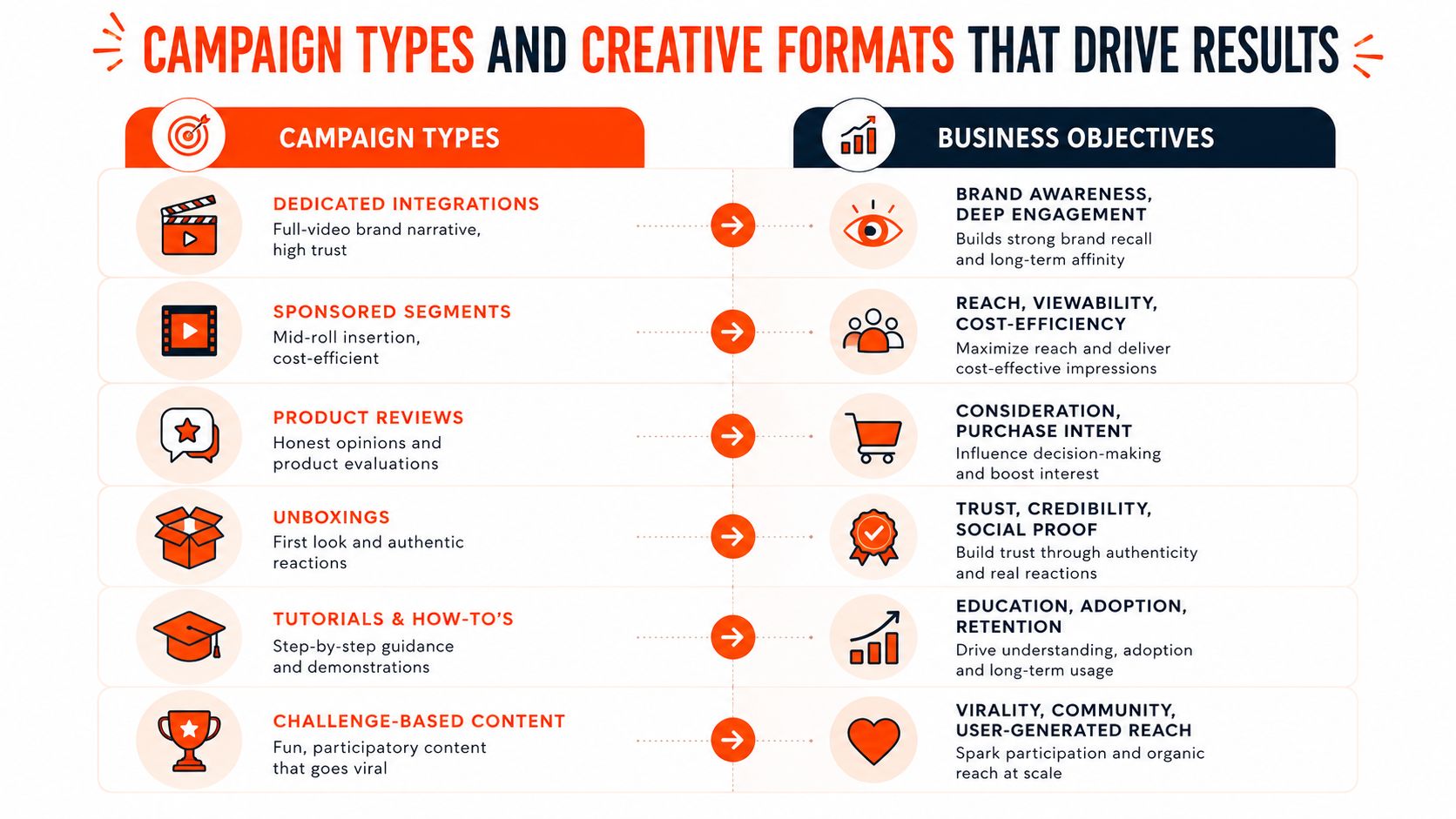
The fastest way to waste YouTube influencer marketing spend is to buy the wrong format for the job. A dedicated review, a mid-roll integration, a Short, and a tutorial all behave differently, and they should be judged differently too. The format has to match both the product and the buying intent.
Dedicated videos and tutorials suit complex products
A dedicated integration or full-review video is the cleanest way to drive direct response when the product needs explanation. That's the right home for software demos, beauty routines, higher-consideration commerce, and any offer where the buyer wants context before they commit. You're buying the creator's full narrative, not just a slot inside it.
Tutorials and unboxings work especially well when the creator can show the product solving a real problem. Challenge-based content can also work, but only if the challenge naturally leads to product use instead of feeling bolted on. The creative has to feel native to the channel, or viewers tune it out fast.
A polished brief doesn't save weak creative. If the hook feels scripted, the audience notices.
Sponsored segments and Shorts serve different jobs
A sponsored segment inside a planned video is usually the better efficiency play. It costs less than a full dedicated video and still gets you access to a channel with real attention. The trade-off is that your message has less room to breathe, so the product has to be easy to explain quickly.
Shorts are different. They're useful when you want reach, teaser traffic, or a bundled package that can be repurposed across platforms. They're not the place to force a complex sell, because the format is built for quick scanning, not deep deliberation. The best use is often a funnel into longer content, where the creator teases the product and then points people toward a full review or demo.
Scripted content versus looser creator-led content is a real trade-off. Overly polished direction can flatten engagement, while too little structure can leave key points out. The best briefs usually define the message, the proof points, and the disclosure, then leave the phrasing to the creator.
Match the format to the goal, not the trend
If the goal is conversion, start with format choices that allow explanation. If the goal is awareness, buy the placement that gives the creator enough room to be natural, then reuse the footage elsewhere if rights allow. If the product is simple and low-friction, a compact integration may outperform a more elaborate custom build because it doesn't interrupt the creator's cadence.
The biggest mistake is choosing the format that looks impressive on a slide deck. The right format is the one the audience will sit through, trust, and act on.
How to Select and Vet Creators Using Data
Subscriber count is the weakest number in the whole decision process. It tells you how big a channel looks, not how much attention it currently earns, and it says even less about whether that audience will buy. The vetting process has to start with audience fit and past sponsored performance, then work backward from there.
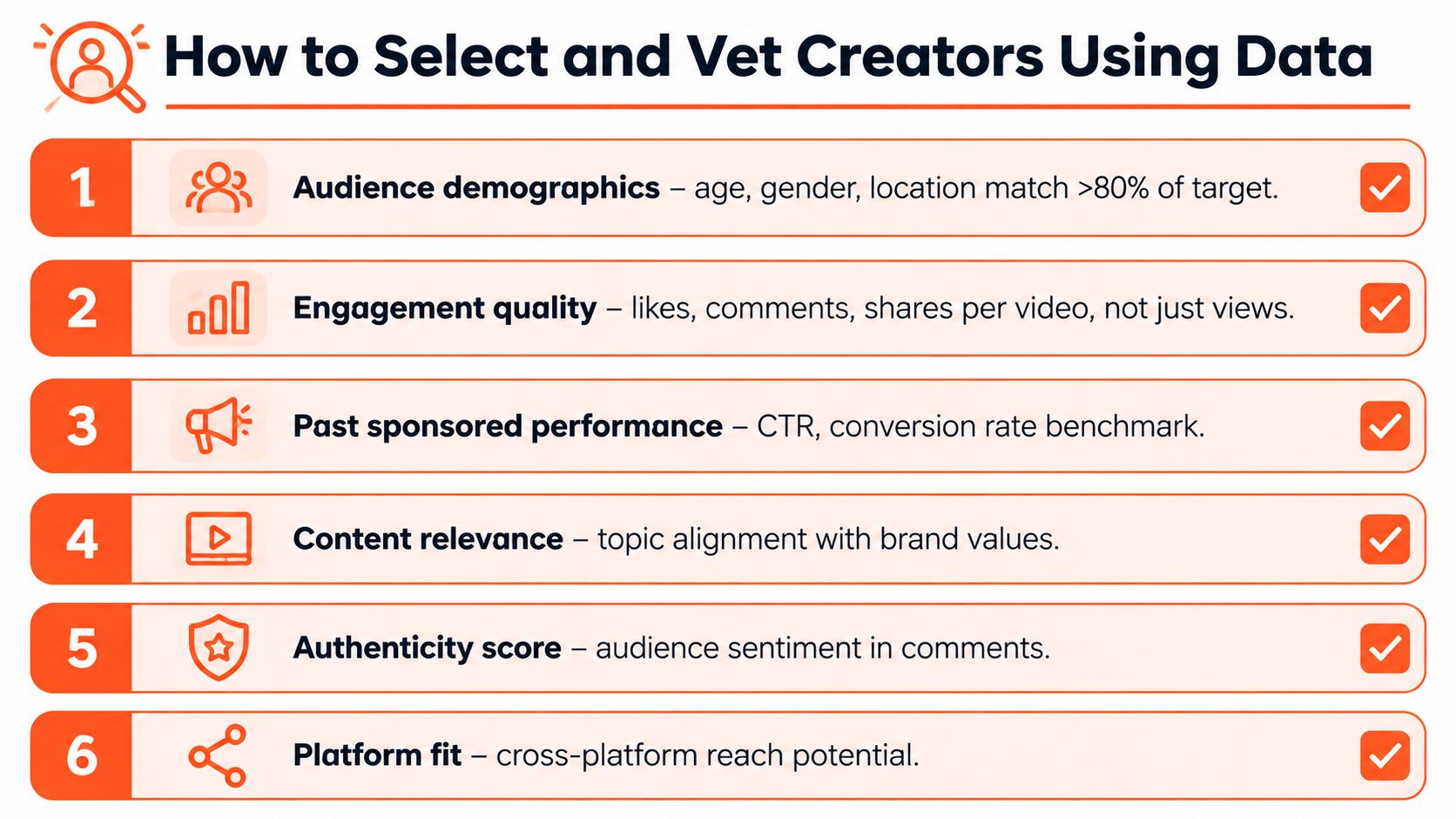
The practical review starts with audience overlap. Look for geography, age, and topical relevance that map to your buying audience, then confirm whether the creator's comment section shows real interest or just passive viewing. Comment quality matters because it reveals whether people trust the creator enough to ask product questions, challenge claims, or share their own experience.
Review what the creator has already sold
Sponsored history is more useful than follower size. Go through the last five to ten brand integrations and ask a few plain questions. Did the product mention feel natural, did the CTA fit the video, and did the audience react like they cared? If the creator's sponsored videos consistently feel detached from the channel's main topic, that's a warning sign.
You should also look for signs that the audience is smaller but more valuable. The University of Mannheim's academic research found that smaller influencers can produce higher ROI than larger ones in DTC influencer marketing, which supports what a lot of growth teams already see in practice, niche fit often beats raw reach (University of Mannheim research). That doesn't mean every micro creator wins. It means you should rank creators by expected incremental revenue, not by vanity metrics.
A simple scoring model keeps the conversation honest:
- Audience fit, 40 percent of the score, because the wrong audience won't convert no matter how good the video is.
- Engagement authenticity, 30 percent, because real interest matters more than inflated activity.
- Past conversion performance, 30 percent, because historical sponsored results usually tell you more than polished rate cards.
Use a shortlist, not a gut feeling
Tools like Social Blade, HypeAuditor, and YouTube BrandConnect can help you see growth patterns and spot obvious red flags, but they're only the starting point. The creator's media kit should also show audience geography and age split, since that's where campaign fit gets validated. If a creator looks promising on paper but their sponsored history is weak, move on.
For a practical workflow, this guide to finding the right YouTube influencer is a good companion to the review process.
Forecasting and Budgeting for Creator Campaigns
Most YouTube influencer budgets are still built like a guess with a spreadsheet attached. Teams grab a CPM, multiply by expected views, and hope the campaign lands somewhere near target. That's too crude for a channel where creator quality, format choice, and attribution method all change the outcome.
A better model starts with what you already know from prior deals. If a creator or vertical has established performance history, use that first, then layer in expected views, click behavior, and conversion rate. The point isn't to predict perfectly, it's to stop buying reach without a plan for what that reach should do.
Budget by certainty, not by ego
A workable allocation model is to put 60 percent of spend behind proven mid-tier creators, 25 percent behind net-new tests, and 15 percent behind amplification of the strongest performers. That structure keeps the majority of budget on creators you already trust while preserving room for discovery. It also keeps a campaign from becoming a one-off bet on a single headline creator.
Hybrid pricing helps here. A base fee plus a performance bonus aligns the creator with your CPA or ROAS goal without forcing them to shoulder all the risk. It also gives you a cleaner internal story in budget reviews because the payment structure reflects both reach and result.
| Budget Category | Allocation % | Dollar Amount | Purpose |
|---|---|---|---|
| Proven mid-tier creators | 60% | Set from the total campaign budget | Reliable performance and repeatable learning |
| Net-new tests | 25% | Set from the total campaign budget | Creative and audience discovery |
| Amplification of top performers | 15% | Set from the total campaign budget | Extend winners with paid distribution |
Use milestone payments to protect cash flow
Cash flow matters more than most briefs admit. Creators often need upfront deposits, and teams often need output before they pay the full amount. Milestone-based payouts keep both sides aligned without turning the relationship into a trust exercise.
The cleanest version is simple. Pay part on signing, part on content approval, and the rest after the post goes live and tracking is verified. That structure protects against production delays, but it also keeps the creator motivated to hit the agreed delivery window.
The other forecasting mistake is assuming all creators should be priced the same way. That's not how the channel works. A creator with strong buyer intent and a smaller audience can be a better budget use than a bigger channel that drives weak post-click behavior, which is exactly why your forecast should be built from expected incremental value, not a flat CPM benchmark alone.
Measurement and Attribution Beyond Last Click
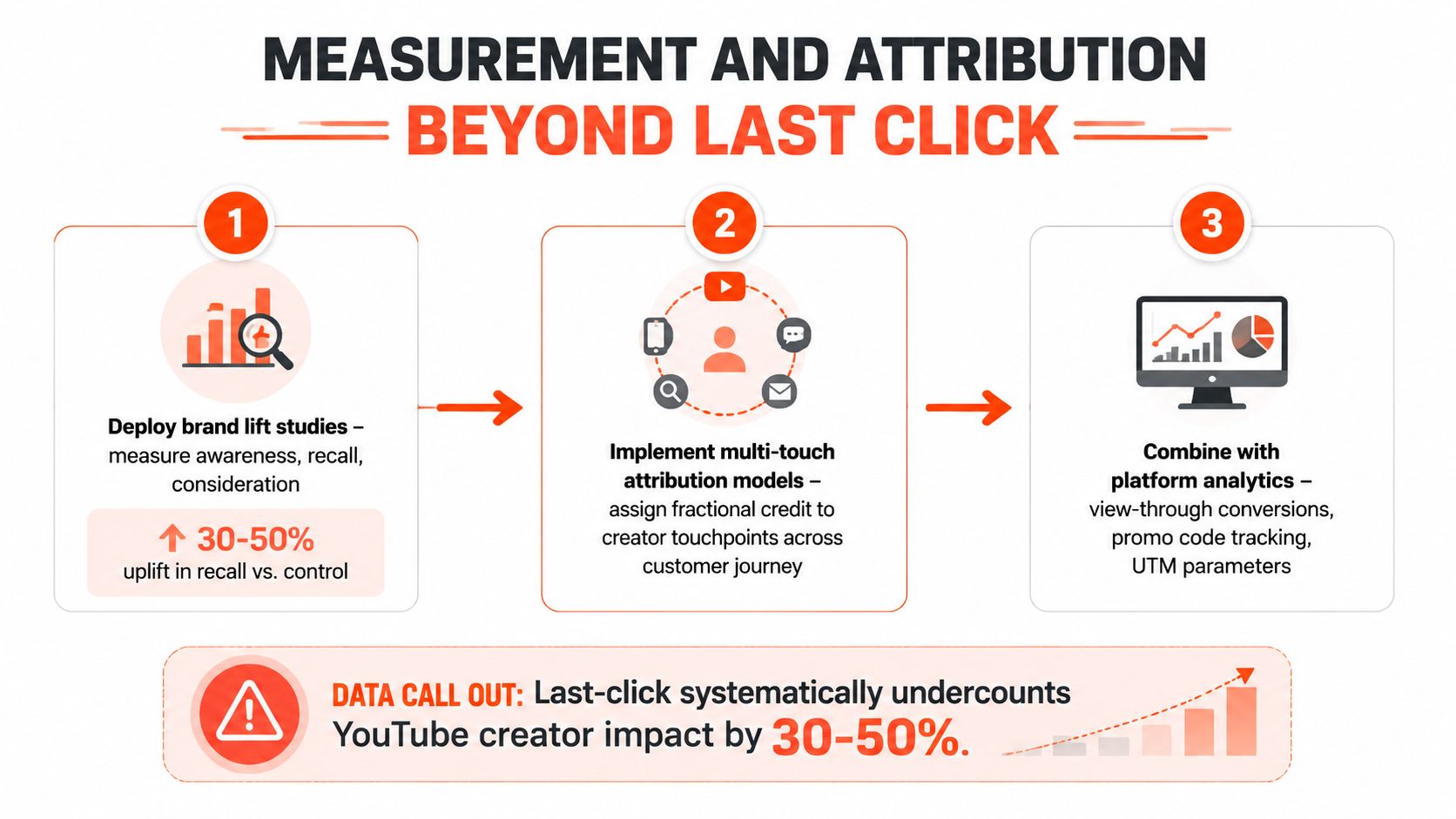
Last-click attribution is the easiest way to underpay creator work. It only credits the final touch, which means it misses the creator mention that sparked the search, the video that built trust, and the delayed return visit that finally converted. For YouTube influencer marketing, that's a serious blind spot.
Industry guidance on creator measurement says that relying only on pixels or last-touch attribution can miss most creator-driven demand because viewers often watch, search later, and convert outside the click window. It also recommends combining pixel data with post-purchase surveys and deduplicating the signals at the creator level so hidden conversions don't disappear from reporting (Agentio measurement guide).
Triangulate instead of trusting one source of truth
Tracked links and unique promo codes still matter, because they capture direct response cleanly. But they're incomplete. YouTube conversions happen across sessions and devices often enough that code-based reporting alone makes some creators look weaker than they really are.
Post-purchase surveys fill in part of that gap. Ask how people heard about you, then compare answers by creator, format, and campaign period. Surveys capture halo effect and delayed recall that tracking pixels never see.
Practical rule: if a creator ranks poorly in last-click but shows strong survey recall, don't cut them immediately. That usually means the campaign is doing more work than the dashboard is showing.
Use lift tests for the incrementality question
If the team wants the answer, run a holdout or geo test. Compare conversion behavior in test markets against control markets while the campaign is live, then use that difference to estimate incremental lift. That's the cleanest way to answer whether the creator generated new demand or mostly intercepted demand that already existed.
You'll get the best read when you combine three signals, promo codes for direct response, surveys for recall and assisted influence, and lift studies for true incrementality. If you want a more operational breakdown of that setup, this guide on measuring influencer marketing ROI is worth keeping handy.
A blended CPA is often the most useful internal metric. It lets growth, finance, and brand teams look at the same campaign without arguing over a single flawed number.
Compliance Rights and Cross Platform Amplification
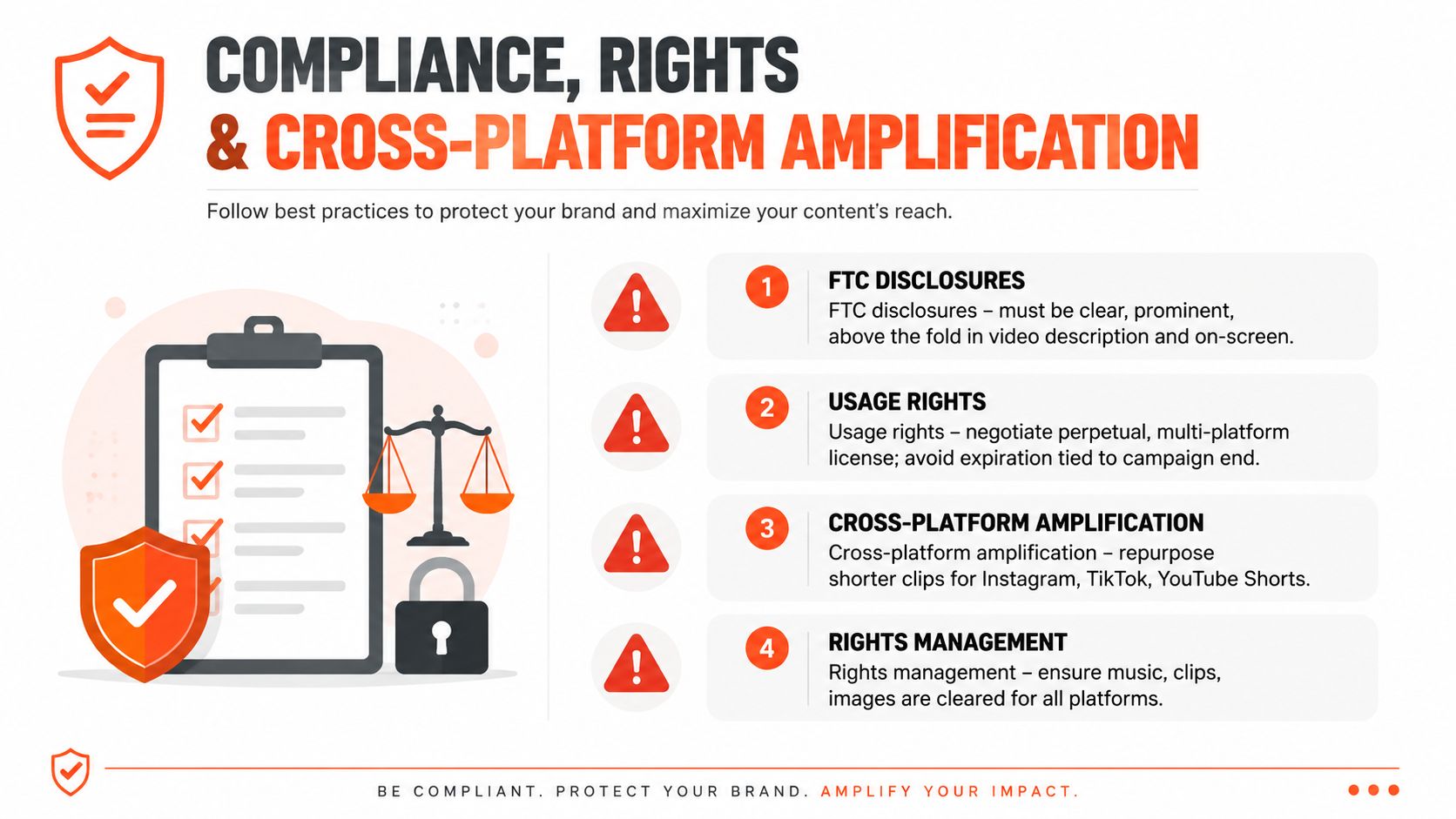
A lot of campaigns don't fail because the creator was wrong. They fail because the content can't be reused, the disclosure is buried, or the team never negotiated the rights to do anything useful with the video after launch. Compliance and amplification are operational levers, not admin tasks.
FTC disclosure on YouTube has to be visible, not hidden in a block of text. The creator should place #ad in the first line of the description, use a verbal disclosure early in the video, and activate the platform's paid promotion disclosure when appropriate. If the audience can't tell it's sponsored, you've created both legal risk and trust risk.
Negotiate rights before the video is shot
Usage rights need to be discussed before production, not after the post goes live. If you want paid amplification, secure a clear window that lets you run the creator's content beyond organic publish. You also want raw files or edit access so the best material can be repurposed into paid social cuts, Shorts, or Discovery placements.
A lot of teams leave value on the table. The creator already made something the audience responds to, but the brand uses it once and stops. That's an inefficient way to buy attention, especially when the strongest cut can be distributed again in a different format.
Amplify the winner, not everything
Not every creator post deserves paid support. The right move is to identify the integrations that already showed strong watch behavior, then extend those with additional distribution. Short-form cutdowns can work well when the original long-form integration gives you a good hook, clear product proof, and a natural CTA.
The important part is matching the amplification format to the original asset. A long tutorial can become a useful YouTube Short or a cut-down ad, but only if the core message survives the edit. If the clip loses the context that made it convincing, it won't perform any better in paid media than it did organically.
I've seen teams improve the economics of a campaign just by giving themselves more than one way to use a strong creator video. The content doesn't need to be remade. It needs to be licensed, cleared, and distributed with intent.
Benchmarks and Case Examples Across Verticals
The best benchmarks are the ones that keep your forecast grounded. YouTube creator campaigns can look very different by vertical, because the role of the video changes with the product. Commerce, apps, and SaaS each reward a different mix of format, creator tier, and measurement.
In e-commerce, a mid-funnel dedicated integration delivered a 3.2x ROAS with a $28 CPA, and the mid-tier creator beat a mega-influencer by 40 percent on cost efficiency. In mobile apps, a Shorts teaser paired with a long-form tutorial reached a $1.85 install cost against a $3.00 benchmark. In SaaS, post-purchase surveys attributed 18 percent of new signups to creator mentions that weren't visible in last-click tracking. Those are useful reference points because they show how format and measurement change the story (Sprout Social industry coverage).
| Vertical | Creator Tier | Format | Key Metric | Benchmark Result | Attribution Stack |
|---|---|---|---|---|---|
| E-commerce | Mid-tier | Dedicated integration | ROAS | 3.2x | Tracked links, promo codes, performance review |
| Mobile apps | Mid-tier | Shorts teaser plus long-form tutorial | Install cost | $1.85 | Audience overlap analysis, tracked installs |
| SaaS | Creator-led, awareness focused | Long-form mention | New signup attribution | 18% of new signups | Post-purchase surveys, last-click comparison |
The lesson is about fit, not format snobbery
The e-commerce result makes sense because the creator had enough room to demonstrate value, which matters more when the purchase needs context. The app result shows why short-form can work as a feeder into longer explanation, especially when the audience is already interested in the category. The SaaS result is the reminder growth teams keep learning the hard way, creator work can drive signups even when the dashboard doesn't hand you the credit immediately.
The benchmark is whether your campaign setup matches the buyer journey. If it doesn't, the numbers will look random even when the execution is decent.
Tactical Checklist to Plan and Launch Your Campaign
A good YouTube influencer launch is mostly process discipline. The creative matters, but the workflow around the creative is what keeps campaigns from slipping, missing tracking, or getting killed in review. The checklist below is the version I'd use in a growth team.
Phase one is pre-brief and shortlist
The growth lead owns the objective, audience persona, and budget split. The creator manager pulls the shortlist using audience fit, engagement quality, and past sponsored work, then sends only creators that match the campaign logic. Nothing moves forward until there's agreement on KPI, format, and the reason the creator belongs in the test.
Phase two is outreach and contracting
Negotiation should be anchored to expected CPM, CPA, or ROAS, not vague channel size. The contract needs to lock disclosure, usage rights, payment timing, and amplification permissions before anyone records. If the creator can't provide what the team needs operationally, the deal isn't ready.
Phase three is production and review
The brief should include the hook, proof points, CTA, and any brand safety or compliance guardrails. The creator should keep voice and pacing, while the brand reviews for factual accuracy, disclosure placement, and rights scope. If the video needs a revision, the analytics or creator manager should verify that the edits didn't break the tracking plan.
Phase four is go-live and monitoring
The launch gate is simple, links work, promo codes work, pixel events fire, and reporting is visible before the post goes live. On day one, the team watches early signal, comments, CTR, and initial conversion behavior so weak setups can be fixed before the whole budget burns. If you want a process template for campaign ops, this influencer campaign framework is a useful reference point.
If you want YouTube creator work tied to real business outcomes, Social Cloud plans, runs, and measures campaigns with tracked links, post-purchase surveys, and creator-level reporting. If you're trying to separate true lift from last-click noise, visit Social Cloud and ask for a plan that's built around the way your buyers convert.