You already know the weird part of YouTube creator spend. The videos are getting views, the comments look healthy, the brand team is happy, and then finance asks the one question nobody can answer cleanly, what turned into revenue? That's usually the moment a growth team stops treating creators like a nice-to-have awareness line and starts looking for a YouTube influencer marketing agency that can connect the campaign to outcomes.
The problem is rarely creative first. It's usually measurement, forecasting, and accountability. Once a team can't tell whether a creator program is helping search, assist conversions, or just inflate a slide deck, the conversation changes fast. Reach still matters, but it stops being the whole story.
Table of Contents
The Moment You Realise YouTube Influencer Spend Needs an Agency
The quarterly review usually makes the issue obvious. Paid search is forecastable, paid social is tracked through pixels, and the media team can explain every swing in CAC. Then someone opens the creator spreadsheet and it's mostly views, subscriber growth, and a few nice screenshots of comments.
That's when the internal tension shows up. The brand marketer wants more creator partnerships because the videos look credible and the audience seems engaged. The finance lead wants to know why a channel with real spend attached still behaves like a black box. Neither person is wrong, they're just measuring different things.
Practical rule: if creator activity is driving attention but not a clean revenue story, the issue isn't “more content”, it's an operating model that can't measure influence properly.
A capable agency is the structural answer because it doesn't just buy placements. It designs the campaign so the brand can forecast, attribute, and compare performance across creators and formats. That matters even more on YouTube, where longer consideration cycles mean a single click rarely tells the full story. Independent industry summaries estimate YouTube now accounts for roughly 15% to 25% of worldwide influencer-marketing spend and about $3 billion to $6 billion of annual spend in 2026 (InfluencerFee). In other words, this isn't a side experiment anymore, it's a real budget line.
The shift is simple to describe and hard to operationalise. Teams don't need a vendor that can only make a creator post happen. They need a partner that can prove whether that post influenced research, assisted purchase, or drove direct response.
What a YouTube Influencer Marketing Agency Actually Does
A real YouTube influencer marketing agency takes ownership of the whole system, not just the handshake with creators. It plans the campaign, sources the right channels, handles the commercial terms, shapes the brief, coordinates publishing, and then traces the work back to outcomes. That's the difference between “we booked some influencers” and “we ran a program.”
The best way to think about the role is by stage, not by service list. First comes creator discovery, where the agency filters for audience fit, topical authority, and prior sponsored performance. Then comes negotiation, where deliverables, usage rights, timelines, and payment milestones are set before anyone starts filming. After that, the agency manages the briefing, review, and launch process, then closes the loop with reporting and learnings.
The parts that matter most
Creator vetting on YouTube can't be generic because the platform behaves differently from short-form social. A specialist agency understands the difference between dedicated reviews, integrated mentions, Shorts, and add-on placements such as pinned comments or description links. It also knows that watch-time, retention, and sponsored content quality matter as much as raw subscriber count.
That's why a generalist influencer shop often underperforms here. A team that treats YouTube like “another social channel” tends to miss how discovery, search intent, and longer-form storytelling affect conversion.
If you're comparing providers, it helps to look at a curated directory of compare leading influencer agencies so you can separate real operational depth from polished positioning.
A specialist agency should be able to explain not just who it would book, but why a given format should be used, how it will be measured, and what would make the campaign worth scaling.
Inside the Workflow From Creator Selection to Live Campaign
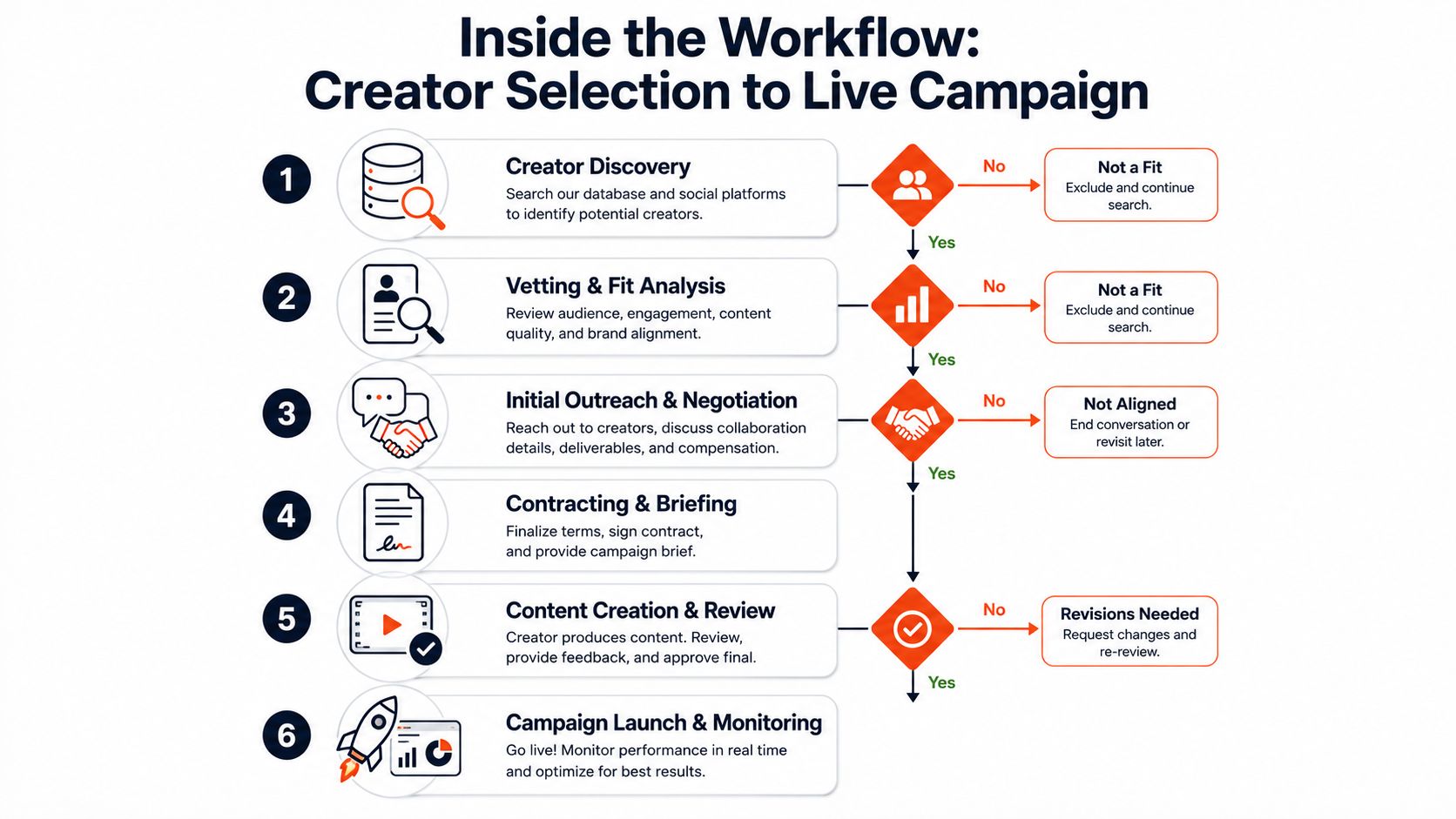
The workflow only looks linear from the outside. In practice, every step feeds the next one, and one weak decision early in the process can distort the reporting later.
Discovery and vetting
The first filter is creator discovery. Good agencies don't just search by subscriber size, they look for audience overlap, category authority, and past sponsored results in similar formats. They also check brand-safety risk, audience authenticity, and whether the creator's comment section shows real category interest or generic filler.
Once the shortlist is built, it gets tiered by reach and fit. A creator with a smaller but highly aligned audience can outperform a larger creator whose viewers are only loosely connected to the product category. That's why the shortlist should be built around the campaign objective, not around vanity status.
Briefing, contracting, and launch
The brief has to match the deliverable. A dedicated video needs deeper product education, clearer proof points, and tighter keyword planning, while a lighter integration usually works better with a shorter set of talking points and stronger creative freedom. If the brief is vague, the video usually becomes vague too, and that affects both retention and conversion.
Contracting should settle usage rights, deadlines, payment milestones, and what happens if a creator over-delivers. From there, the agency reviews the outline or script, approves cuts, lines up publish dates, and decides which videos deserve paid amplification. Underperforming content should not be pushed harder just because it exists.
The process and handoffs are easier to follow if you compare them with this practical overview of how influencer marketing on YouTube works.
Weak briefs don't just create weak videos. They create messy measurement because nobody knows whether the issue was the audience, the message, or the format.
The best agencies run reporting alongside launch, not after the fact. That way, strong organic videos get scaled while weak ones stay contained, and the campaign learns quickly instead of waiting for a post-mortem.
KPIs, Attribution, and How Agencies Set Outcome-Based Fees
You can't price YouTube influencer work well if you only look at the final sale. The channel influences search, comparison, consideration, and delayed conversion, so agencies need a KPI stack that respects that path.
The KPI stack that actually helps
Upper-funnel signals tell you whether the content landed. That includes view-through quality, branded search lift, follower growth around the campaign period, and comment sentiment. Mid-funnel signals show whether the audience took action, such as clicking out, signing up, or starting checkout. Lower-funnel signals are the ones finance cares about most, like assisted revenue, CAC, payback window, and incremental lift versus a holdout.
The forecasting model should be built before spend is committed. Agencies usually combine historical creator results, category benchmarks, and scenario ranges so the brand can understand what “good” might look like before a single deliverable goes live. That keeps the conversation grounded in probability instead of hope.
Attribution plumbing matters just as much as forecasting. Creator-specific UTM links, promo codes, dedicated landing pages, and clean source mapping in GA4 and Shopify help isolate what each creator did. That setup is especially important when standard last-click reporting misses a large share of the effect, because independent agency commentary has cited a cohort study showing about 75% of conversions attributed to YouTube influencer activity were not being tracked in standard measurement (Forbes).
For a deeper operational lens on this topic, this guide on how to measure influencer marketing ROI is a useful companion.
How fees change the incentives
Outcome-based fees are where the relationship gets more honest. Flat retainers are easy to sell, but they don't always align incentives when a program needs sales, qualified leads, or a specific return target. CPA, revenue share, and lead-based bonuses shift some risk back to the agency, which is usually a good sign when the campaign has a clear commercial job.
The best fee structure is the one that makes both sides care about the same result.
| Funnel Stage | Primary KPIs | Data Source | Forecast Benchmark Direction |
|---|---|---|---|
| Awareness | Views, view-through quality, branded search lift | YouTube analytics, search data | Higher is better |
| Engagement | Watch time, comment sentiment, follower growth | Platform analytics, social listening | Higher is better |
| Consideration | Click-out rate, landing-page actions, add-to-cart | UTM links, GA4, ecommerce platform | Higher is better |
| Conversion | Assisted revenue, last-click revenue, CAC | GA4, Shopify, CRM | Lower CAC, higher revenue |
| Incrementality | Holdout lift, payback window | Controlled tests, cohort analysis | Higher lift, faster payback |
True-up logic should also be written into the agreement. If a creator over-delivers on qualified outcomes, the contract should say how that gets rewarded. If performance misses the floor, the agency should know whether the fee adjusts or the learnings roll into the next flight.
The Selection Checklist and RFP Questions That Expose Weak Partners
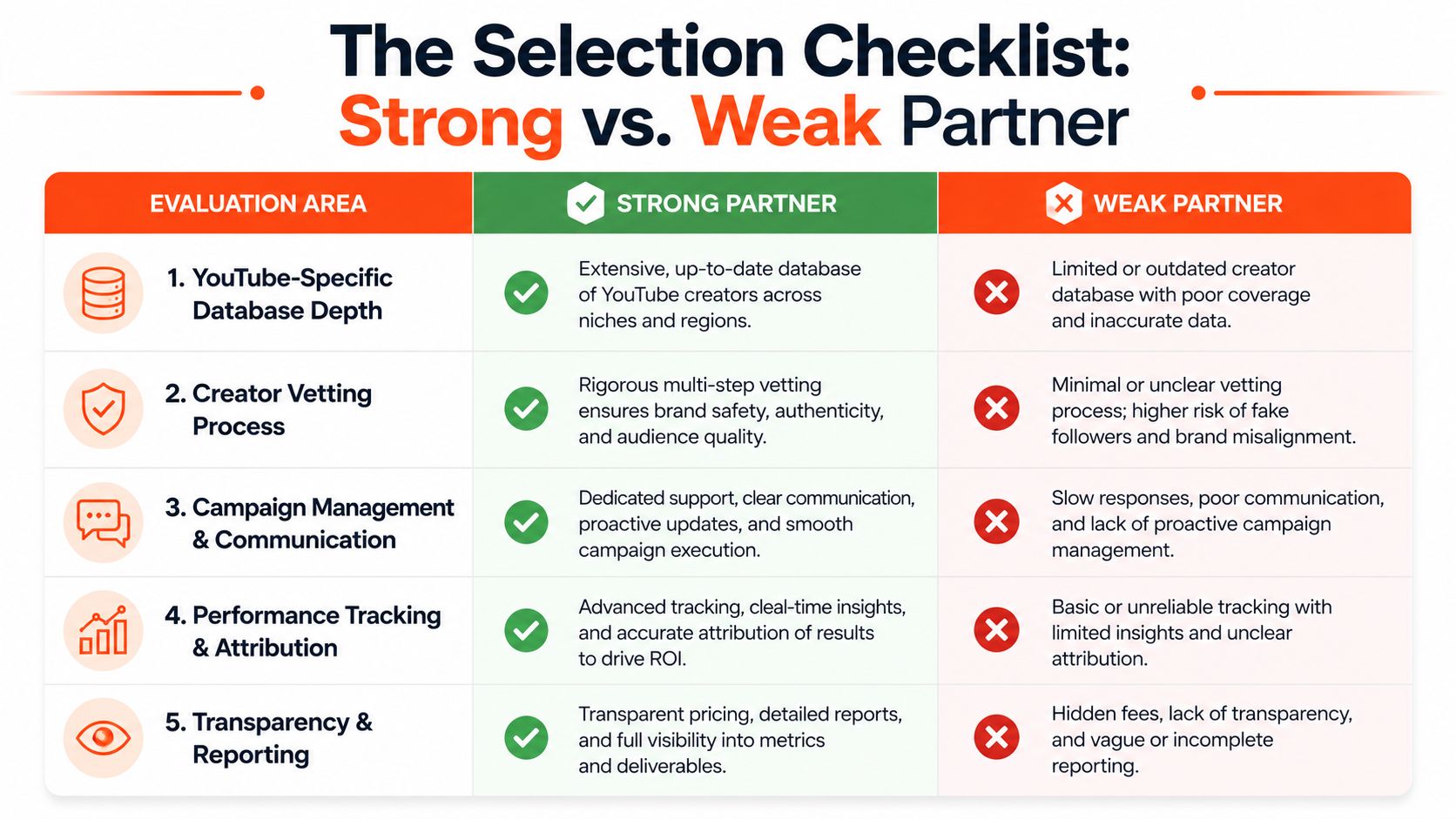
The easiest way to score agencies is to force the decision onto paper. A strong partner can answer specific operational questions without hiding behind “we customize everything.”
What to score
- Creator database depth. Ask how many YouTube-specific creators they can activate in your category, not how many names sit in a general CRM.
- Vetting process. They should explain how they screen for fake comments, audience geography, and whether the subscriber base matches the niche.
- Briefing workflow. Good teams can describe how they preserve creator voice while still protecting campaign objectives.
- Contracts and rights. Usage-rights templates should be clear enough that paid amplification doesn't become a surprise negotiation.
- Payment handling. You want to know who advances creator fees and how milestones are managed.
- Attribution stack. If they can't explain the tracking setup, they're asking you to trust the wrong layer.
- Reporting cadence. Weekly reporting is a good sign when spend is active, because waiting until the end hides problems.
- Outcome-based fees. A partner willing to discuss CPA or revenue share usually has more confidence in its own forecasting.
- Reference work. Ask for campaigns with outcomes that can be checked, not vague testimonials.
- Account seniority. You need experienced people on the work, not just in the sales meeting.
Questions that reveal weak answers
- Who owns the UTM taxonomy?
- How do you price usage rights for paid amplification?
- What happens when a creator over-delivers?
- Will you sign on a CPA or revenue-share component?
- How do you verify audience authenticity before launch?
If the answer is a blanket management fee with no performance skin in the game, treat that as a warning sign. So should vague talk about “brand lift” with no clear measurement plan, or a team that can't explain who on the account runs strategy.
What Good YouTube Influencer Campaigns Look Like in Practice
The strongest campaigns usually look boring in the right places. The selection is disciplined, the brief is tight, and the attribution setup is clean enough that nobody has to guess what happened.
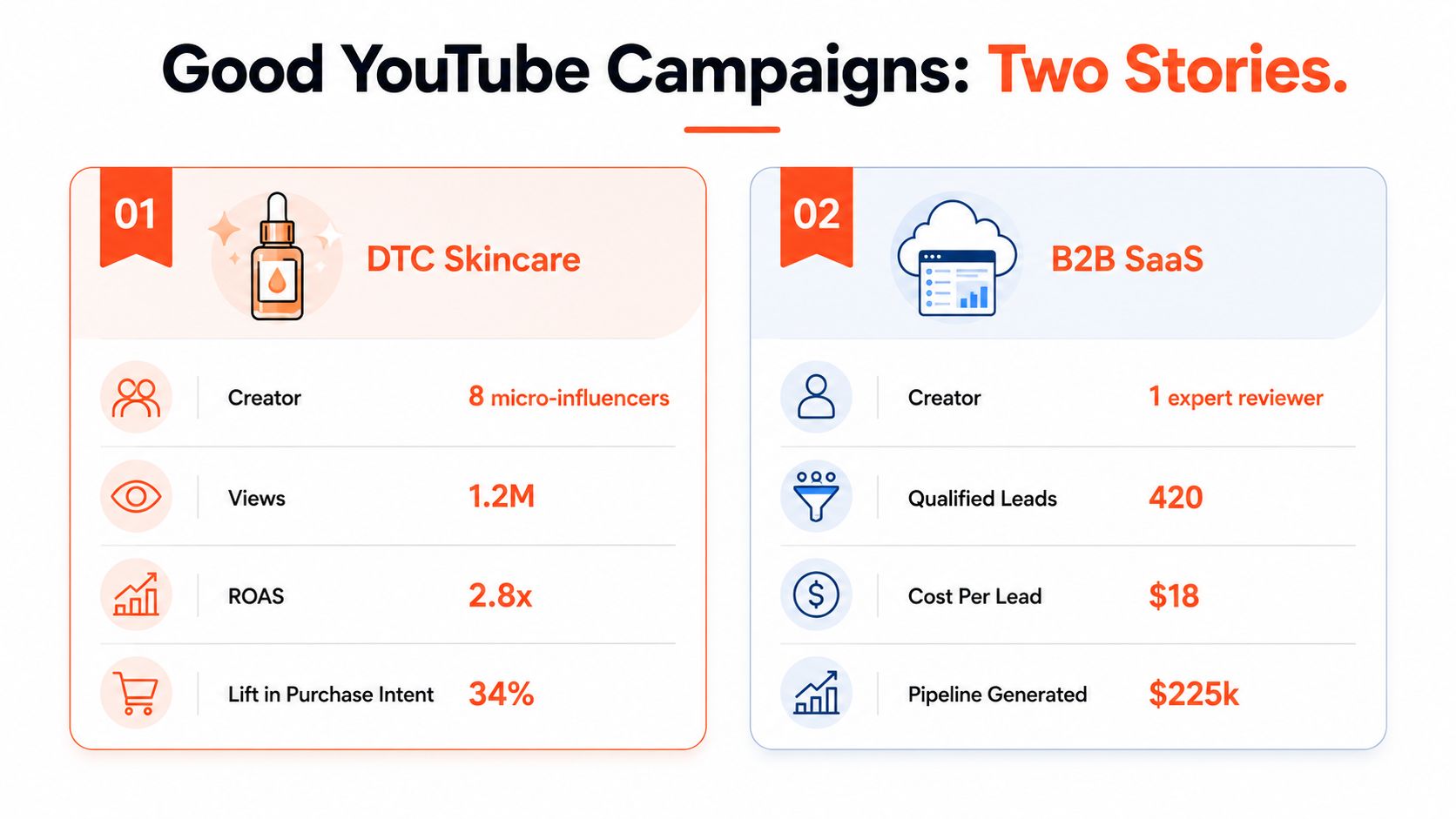
One mid-market DTC skincare brand ran a ten-creator program with mid-tier creators, used a promo code per creator, sent traffic to a dedicated landing page, and held a 60-day attribution window. The result was 3.1x ROAS against a blended CPA of $28. The useful part wasn't just the return, it was the way the agency learned fast enough to shift budget toward the creators whose comment sections showed real purchase intent.
A B2B SaaS team took a different path. It worked with two tier-one YouTube reviewers, tied the content to a gated template, and followed the clickers through a six-week nurture sequence. That program generated 1,400 marketing-qualified leads at one third of LinkedIn CPL. The reason it worked was less about celebrity and more about authority, because the creators already had a technical audience that trusted their recommendations.
What changed after the first underperforming videos? The agency tightened the brief, simplified the call-to-action, and moved paid support behind the strongest organic pieces instead of boosting everything equally. That's the sort of adjustment that turns YouTube from “content that looked good” into a measurable growth channel.
How Social Cloud Runs YouTube Creator Programs End to End
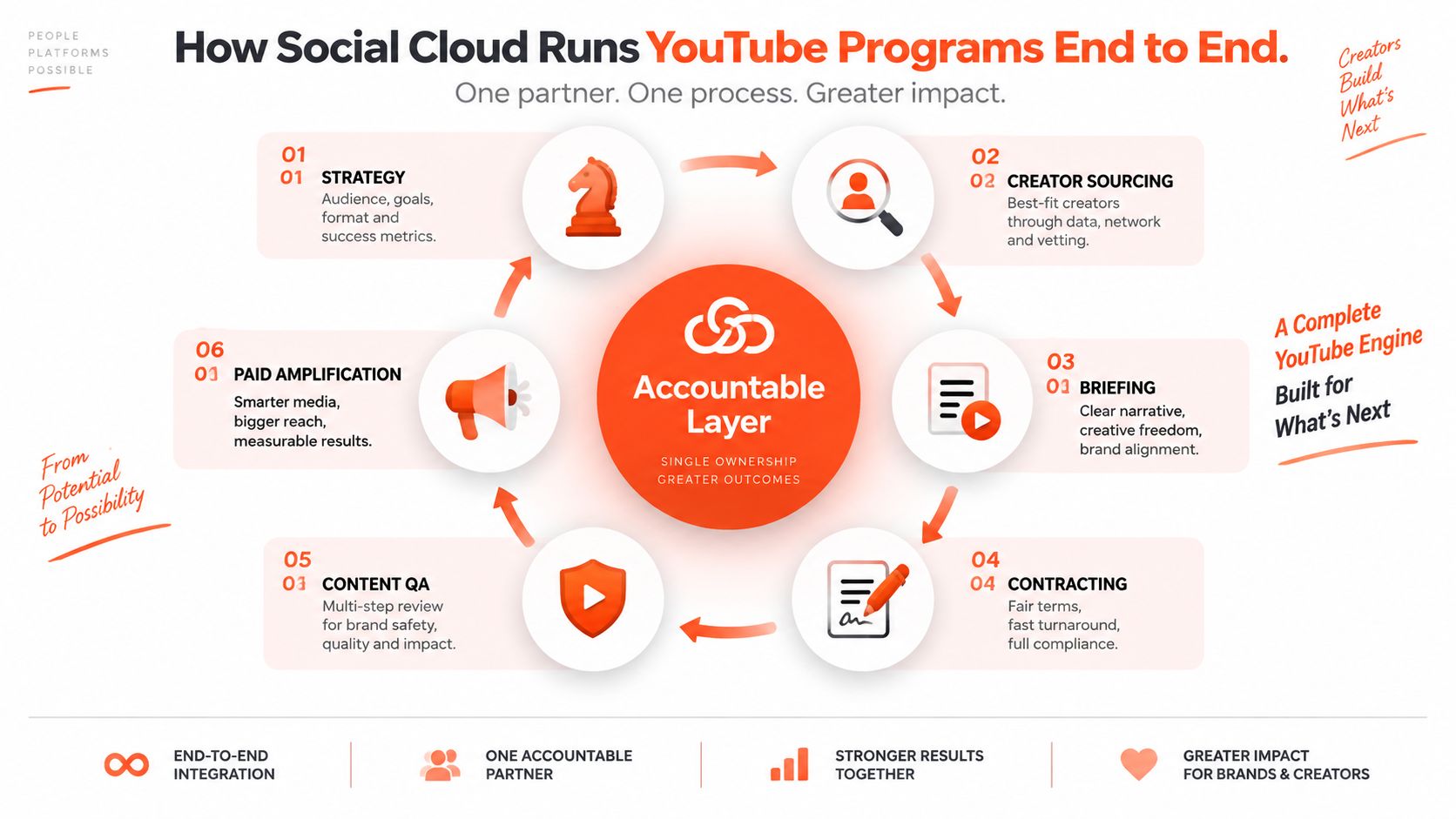
Social Cloud runs YouTube programs as one accountable workflow, not as a chain of handoffs. That means strategy, creator sourcing, briefing, contracting, content QA, paid amplification, and revenue attribution sit inside the same operating layer, so the campaign can be judged on outcomes instead of isolated deliverables.
The practical version starts with the revenue goal, then builds a creator shortlist matched to product positioning and audience fit. From there, the team uses structured briefs with required talking points, locks in contracts with usage rights for paid distribution, and connects each video to first-party tracking through UTM links, promo codes, and pixel-based attribution. Forecasting happens before booking, and fees can be tied to qualified leads or sales rather than only flat retainers.
For brands that want to see the service structure in one place, the Social Cloud services page maps the broader offer across campaign planning, creator selection, attribution, and cross-platform execution.
The change for advertisers is incentive alignment. When the agency is accountable for measurable outcomes, the reporting gets sharper, the creator selection gets more selective, and the creative decisions stop drifting toward what merely looks polished.
Quick Checklist and Honest FAQ for Choosing an Agency
Before you sign, make sure the partner can answer these clearly, in writing.
- Attribution setup: They should explain UTMs, promo codes, landing pages, and how source mapping will work.
- Creator sourcing depth: Ask how they vet audience quality and sponsored performance, not just follower count.
- Contract terms: Usage rights, payment milestones, and creator deliverables need to be explicit.
- Fee structure: Flat retainer, outcome-based fee, or a mix should be easy to compare.
Can an in-house team do this instead? Yes, if the team already has creator relationships, measurement discipline, and time to manage the process end to end. If not, an agency saves a lot of trial and error.
How fast should results show up? It depends on the buying cycle, but the first useful read usually comes from the tracking setup and early creator response, not just final revenue.
When is an agency overkill? If you already have a tight roster, strong creative ops, and attribution handled internally, a full-service partner may be more than you need.
What should worry me most? Weak tracking, vague fee logic, and anyone who treats YouTube like a generic media buy.
If you want a partner that treats YouTube creator work as a measurement problem first and a creative problem second, Social Cloud is built for that. It plans, runs, and measures creator campaigns across YouTube, with tracking, attribution, and outcome-linked fees baked into the process. Visit Social Cloud to see how a performance-focused creator program can be structured around revenue, not just views.