

Typical TikTok benchmark data puts ROAS around 2x, while more than one in four TikTok-attributed conversions happen the same day after an ad view rather than a direct click. TikTok ads can be worth it for teams with strong native creative and incrementality measurement, but they're risky for everyone else.
That distinction changes the question. A campaign can look weak in a last-click dashboard while creating demand that converts later through search, direct traffic, email, or another paid channel. It can also look busy and inexpensive while producing poor economics because the creative, offer, or landing page never earns enough attention.
TikTok has moved well beyond its early experimental phase. One industry analysis reported global advertising revenue of $23.58 billion in 2024, up from $13.2 billion in 2023 and $1.14 billion in 2020, while another estimate placed 2024 revenue at about $23 billion, including $17 billion from advertising (Charle Agency's TikTok statistics analysis). That scale matters, but it doesn't make every campaign profitable.
The useful answer to “are TikTok ads worth it?” is conditional: worth it for which goal, at what creative standard, and under which measurement setup?
Table of Contents
The Short Answer on TikTok Ad Value
Benchmark datasets place typical TikTok ROAS around 2x, with CTR commonly at 0.6% to 1.8%, conversion rate at 1.0% to 2.0%, and CPMs in the high single digits to low teens (2026 TikTok ads benchmarks from Hawky). Treat those figures as reference points, not forecasts. Category, creative quality, offer, tracking, and checkout experience can shift the outcome substantially.
The harder question is how much demand TikTok creates beyond the conversions it receives credit for. TikTok reports that more than one in four TikTok-attributed conversions happen after someone sees an ad and converts directly on the same day, without necessarily clicking first (TikTok's performance campaign measurement guidance). Last-click reporting can miss that view-assisted behavior, along with later purchases that arrive through search, direct traffic, email, or another paid channel.
A practical TikTok decision therefore needs two views: reported efficiency and incremental demand. A campaign can show acceptable ROAS while reaching a category where repeated exposure produces diminishing returns. It can also look weak in a click-based dashboard while creating demand that a holdout test or broader attribution window reveals.
Practical rule: Judge TikTok with a metric that reflects how people consume the platform, then test whether that response is incremental.
Three checks determine whether the channel deserves more budget:
- Can the creative earn attention? TikTok ads need to feel native to a fast-moving feed, rather than resemble television commercials placed in a vertical frame.
- Can the funnel convert that attention? A strong video can still send costly traffic to a vague landing page, slow checkout, or offer that requires more explanation.
- Can measurement capture delayed demand? Place last-click ROAS beside assisted conversions, longer attribution windows, and lift testing where feasible.
Teams publishing a steady flow of posts can use a TikTok scheduling workflow to keep creative testing organized. Scheduling does not improve weak ads, but it can support a repeatable publishing rhythm.
TikTok ads are worth testing when you have native creative production, a product that creates interest quickly, and measurement beyond click-based revenue. They are a poor first choice when creative capacity is limited, the buying journey is complex, or reporting credits only the final click.
Why Worth It Depends on Your Goal
“Worth it” depends on the job TikTok is expected to do. An awareness campaign should not be judged by the same immediate purchase metric as a retargeting campaign. An app-install campaign has a different economic endpoint again. The right question is whether TikTok creates enough value for the objective, including demand that may convert outside the platform or after the initial visit.
Brand lift
Brand campaigns earn value through attention, memory, and future consideration. Assess whether the audience noticed the ad, understood the message, remembered the brand, and became more open to buying. In North America, campaigns reaching at least 40% of their target audience achieved 23% higher ad recall, 26% higher awareness, and 27% higher purchase intent versus average campaigns, according to IG's analysis of TikTok's advertising performance.
Those outcomes will not always appear in immediate ROAS. A viewer may search for the product later, return directly, or convert through another channel. Brand-lift measurement therefore belongs beside click-based revenue, not outside the commercial analysis.
App installs
For apps, TikTok needs to produce qualified users at an acceptable cost per install. Installs alone are an incomplete endpoint. Track registration, activation, subscription, or purchase so the campaign is judged by what users do after downloading.
The buying logic differs from ecommerce, but creative still controls much of the result. A short video that demonstrates the app's use case can outperform a polished brand spot that never gives viewers a clear reason to install. Retention and activation show whether low-cost acquisition is creating useful demand or merely filling the top of the funnel.
Conversions
Conversion campaigns optimize for a defined business action, such as a purchase, lead, or subscription. The hook, product page, price, proof, checkout, and post-click tracking must support the same promise. A strong click rate cannot compensate for a confusing offer or a weak landing experience.
TikTok's advertising revenue growth indicates a scaled media business with established ad formats and measurement infrastructure, as discussed in Charle Agency's TikTok statistics analysis. Scale creates more room for testing, while competition for attention can make inefficient creative expensive. TikTok can distribute an ad, but it cannot clarify an unclear offer.
Evaluate each objective on its own terms:
- Brand lift: recall, awareness, intent, qualified reach, and later demand.
- App installs: cost per install, activation, subscription, purchase, and retention quality.
- Conversions: CPA, ROAS, assisted revenue, and incremental lift.
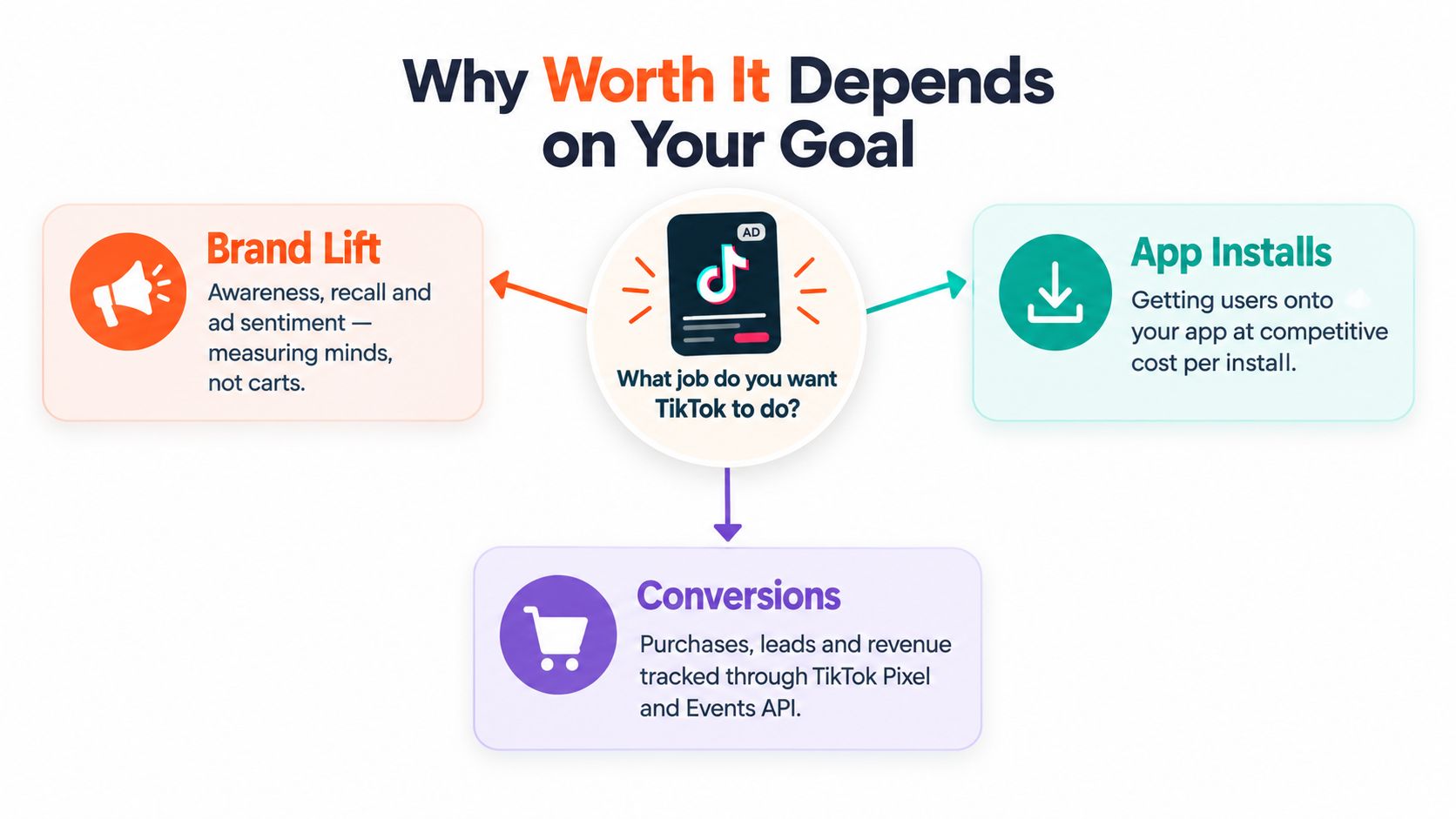
A channel-wide verdict hides these differences. Choose the objective first, then test whether reported performance reflects incremental demand rather than only the final click.
What TikTok Ads Cost and Return
TikTok's economics begin in the auction and end with the creative. Efficient reach can lower the cost of attention, but inexpensive impressions do not create value by themselves. A native-feeling video, clear offer, and relevant landing page can turn that attention into measurable demand. Weak creative raises effective CPA even when media costs look attractive.
Published cross-industry benchmark ranges are useful for comparison, not forecasting. Read CTR as a test of whether the creative and offer earn a click. Read conversion rate as a test of the post-click experience. CPM measures the price of reach, while ROAS measures only the revenue assigned to the campaign. None of these metrics shows how much demand TikTok created that converted through search, direct traffic, retail, or another channel.
| Metric | What it helps assess | What it leaves out |
|---|---|---|
| CTR | Whether the opening and offer earn attention | Downstream revenue and assisted demand |
| Conversion rate | Whether the landing experience supports the promise | Users who convert later elsewhere |
| CPM | The cost of buying reach | Audience quality and commercial intent |
| ROAS | Revenue credited to the campaign | Incremental sales that last-click reporting misses |
The creative response chain
TikTok performance follows a connected sequence:
- The opening earns attention.
- The video communicates a specific benefit or problem.
- The viewer recognizes a reason to act.
- The landing page continues the same promise.
- The measurement setup records direct and assisted outcomes.
Targeting matters, but it cannot repair an ad that feels out of place in the feed. A strong hook can produce clicks that still fail when the page changes the message, hides proof, or adds friction. The useful unit of analysis is creative response multiplied by funnel quality, not cheap impressions multiplied by hope.
Creative also determines whether auction efficiency survives contact with the audience. Platform-native concepts tend to hold attention better than generic commercial edits, which is why testing hooks, formats, creators, and landing-page messages should precede budget expansion. Teams building that process can use this guide to how to start TikTok ads.
The commercial question is incremental demand. If TikTok produces sales that would have happened anyway, reported ROAS can overstate its value. If it creates interest that closes elsewhere, last-click ROAS can understate it. Both effects can occur in the same account.
Category-level diminishing returns make the distinction more important. As spend rises, the next audience segment may be less responsive, creative fatigue may increase, and marginal conversions may cost more. Use holdouts, geo tests, post-view analysis, and assisted-conversion reporting where possible, then compare incremental results with the cost of alternative channels. Resources on how to maximize your video ROI can help when production quality, rather than bidding, limits performance.
Brand Lift Versus Installs Versus Conversions
TikTok's value changes sharply by objective. The same feed that creates inexpensive attention can produce weak direct-response economics if the campaign asks a cold viewer to complete a high-consideration purchase immediately. A useful comparison is not “does TikTok work?” but “which demand stage can TikTok influence, and how will the account capture it?”
| Scenario | What TikTok can do well | Where budget quietly leaks | Decision signal |
|---|---|---|---|
| A creator introduces a new product | Build familiarity through a message that fits the entertainment feed | Views and engagement rise without a clear reason to act | Brand searches, direct traffic, survey response, and later assisted demand |
| An app demonstrates a useful feature | Give prospective users a concrete reason to install | Cheap installs fail to activate, subscribe, retain, or generate revenue | CPI paired with activation, retention, and downstream revenue |
| A retailer promotes a known product | Convert existing intent when the offer and product page align | Creative fatigue, weak proof, or checkout friction turns clicks into wasted spend | Incremental purchases, CPA, contribution margin, and repeat purchase |
The brand scenario has the clearest platform fit because the ad can earn attention before the viewer has expressed active demand. Creator-led demonstrations, product routines, and native reactions make the product easier to remember than a generic commercial edit. That advantage matters most for products with a longer consideration period, where exposure today can influence a search or purchase later.
A campaign can still look successful on surface metrics while creating little commercial value. High reach and engagement may reflect curiosity rather than preference, so brand activity needs a downstream test. Compare exposed and unexposed audiences where possible, or examine whether branded demand and assisted sales rise beyond the level expected from existing channel activity.
App campaigns sit in the middle. The install is only the first checkpoint. The creative should show a gameplay moment, workflow shortcut, transformation, or other use case quickly enough for the viewer to understand what the download enables. Optimizing for installs alone can buy volume without users who activate or pay.
Direct conversion campaigns carry the most conditions. The ad must stop the scroll, establish relevance, address objections, and give the viewer a reason to continue. The landing page then has to preserve the promise and remove friction. TikTok reported stronger measurement outcomes for campaigns using at least 10 unique creatives than for campaigns using fewer than five, including 2.6x higher ad recall, 3x higher purchase intent, and 1.5x higher awareness (IG's report on TikTok campaign measurement). The result supports creative variety, not a universal production quota. Budget, audience size, and fatigue determine how many concepts an account can test responsibly.
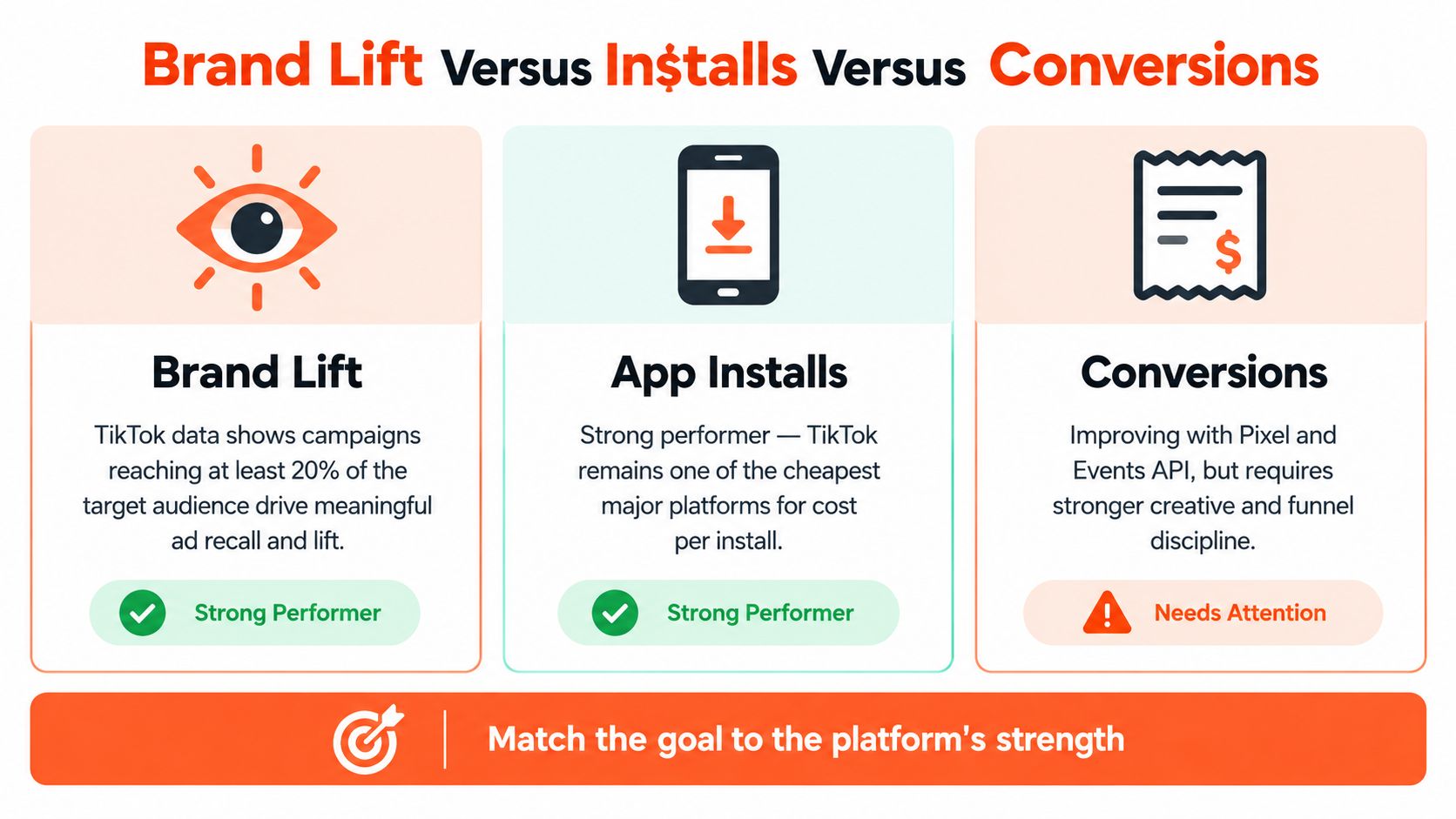
TikTok is structurally better at introducing a product than forcing every purchase on the first visit. That does not make conversion campaigns unworkable. It means the go or no-go decision should compare incremental demand with marginal cost, rather than treating reported direct conversions as the full value of exposure.
Why Last-Click Metrics Undersell TikTok
Last-click attribution credits the channel that closes the sale. It can miss the channel that introduced the product, created interest, or made a later branded search more likely. That gap matters when TikTok generates demand before another channel captures the conversion.
TikTok's Attribution Portfolio separates first-touch, last-touch, and assisted conversions, giving advertisers different views of the customer journey. Its Conversion Lift Study uses randomized treatment and control holdouts to estimate causal lift, addressing a more useful question than reported conversions alone: what changed because TikTok advertising ran?
The hidden contribution
NielsenIQ marketing mix analysis reported that TikTok drove 29% to 33% of incremental sales for two brands while representing a smaller share of media investment (TikTok's NielsenIQ marketing mix analysis). The result does not establish a universal TikTok multiplier. It does show why media spend share and last-click revenue share can understate the channel's contribution.
The same analysis found that lift often peaked later in the test window, including a 68% post-treatment KPI lift and an average 247% demand increase in the second half and post-period. A campaign can therefore look ordinary in its first reporting window while producing more visible commercial impact later. Measurement timing becomes part of the media decision, not a reporting detail.
A better measurement setup
Use separate views for separate decisions:
- Direct response: Track clicks, purchases, CPA, and platform-reported ROAS.
- Journey contribution: Review first-touch and assisted conversions alongside last-touch results.
- Incrementality: Use randomized holdouts or a Conversion Lift Study when the campaign has enough scale and clean test conditions.
- Delayed demand: Extend the observation period so later conversions are not discarded before they occur.
A comparison of TikTok versus YouTube advertising can clarify how the two video channels differ across discovery, attention, and conversion paths. The practical question is whether TikTok is creating new demand or just receiving credit for people who were already close to buying.
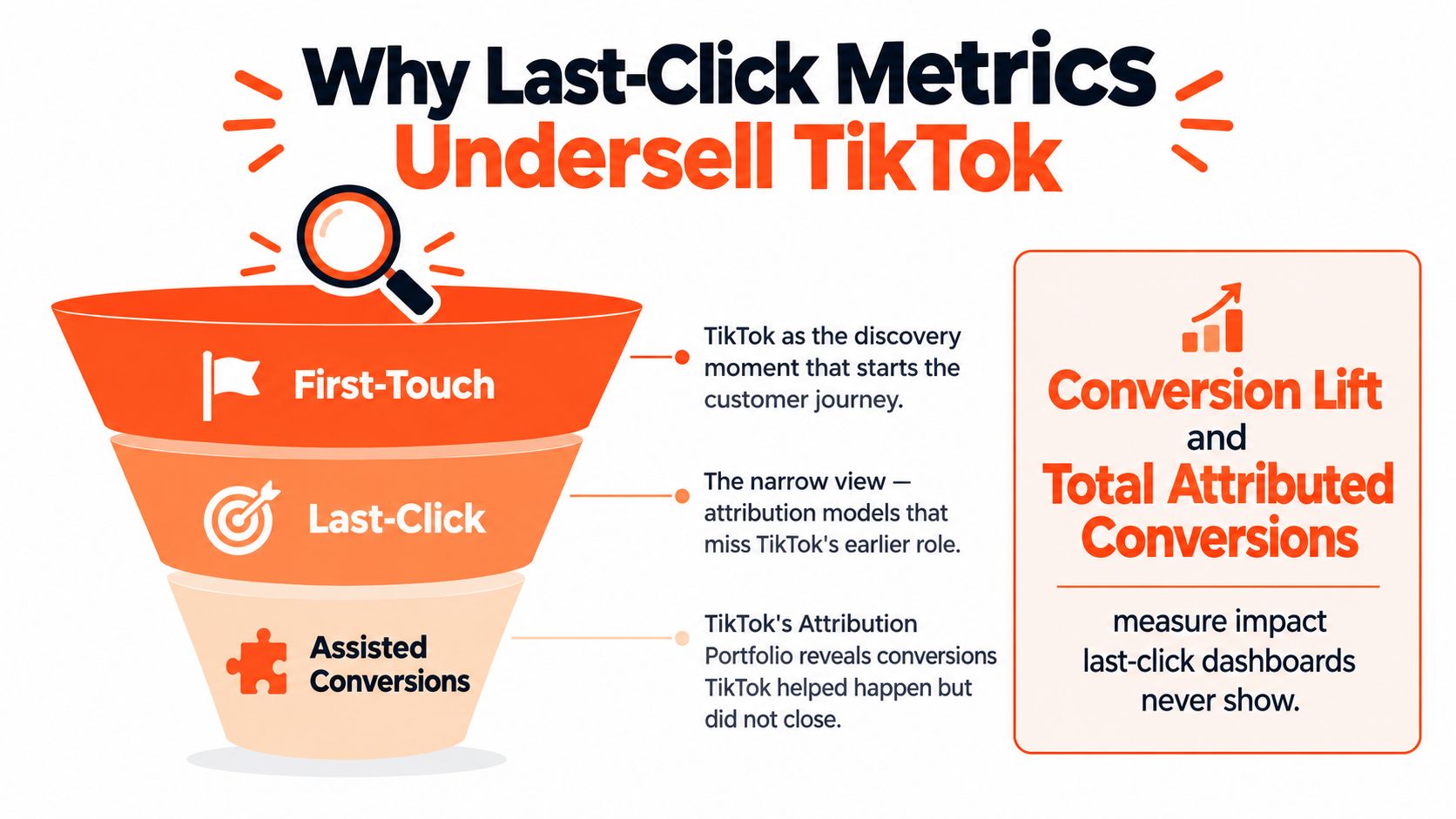
If TikTok succeeds only under its own attribution and fails only under last-click, neither view is enough for a go or no-go decision. Use platform reporting to diagnose the journey, then use incrementality testing to estimate how much demand the channel created.
When TikTok Ads Stop Being Worth It
TikTok performance varies sharply by category. Full-year 2025 benchmark data reported 2.21 overall ROAS, $32.74 CPA, and 2.01% CVR, while Pets & Animals, Food & Beverage, and Health & Beauty ranked among the lowest-ROAS industries (Triple Whale's TikTok benchmarks).
These averages are starting constraints, not automatic stop signs. A product with thin margins may struggle to make average acquisition economics work, particularly when repeat purchases are limited and the first order carries most of the acquisition cost. A channel can also create demand that last-click reporting misses, so weak direct-response numbers deserve examination rather than an immediate verdict.
Diminishing returns creep in
A campaign may begin with a strong concept and reach its most responsive viewers first. As similar messages appear repeatedly, audience response can weaken even while delivery remains steady. CPA then rises, and the dashboard may show normal spending without revealing that creative fatigue is reducing the value of each additional impression.
The decision should shift from “Should we run TikTok ads?” to “What version of TikTok advertising has a chance of working for this product?” Standard in-feed ads, creator-led content, and Spark Ads serve different roles. Creator content can fit the platform more naturally because it brings a recognizable voice and social context. Teams evaluating the format should also compare the mechanics and economics described in this guide to TikTok Spark Ads cost. Spark Ads still need a clear offer, fresh creative, and measurement that separates genuine demand creation from credit assigned after the fact.
A product is easier to defend when its value can be understood quickly, demonstrated visually, discussed naturally, or purchased without extended education. It is more exposed when buyers need lengthy research, margins are narrow, or compliance limits force generic creative.
| Green-light input | Warning sign |
|---|---|
| The team can produce and test native video regularly | The team has only one polished asset |
| The product creates visible curiosity or immediate relevance | The value proposition needs a long explanation |
| The business tracks assisted and incremental outcomes | Reporting uses last-click revenue only |
| The category can support the tested acquisition economics | Category benchmarks already show weak efficiency |
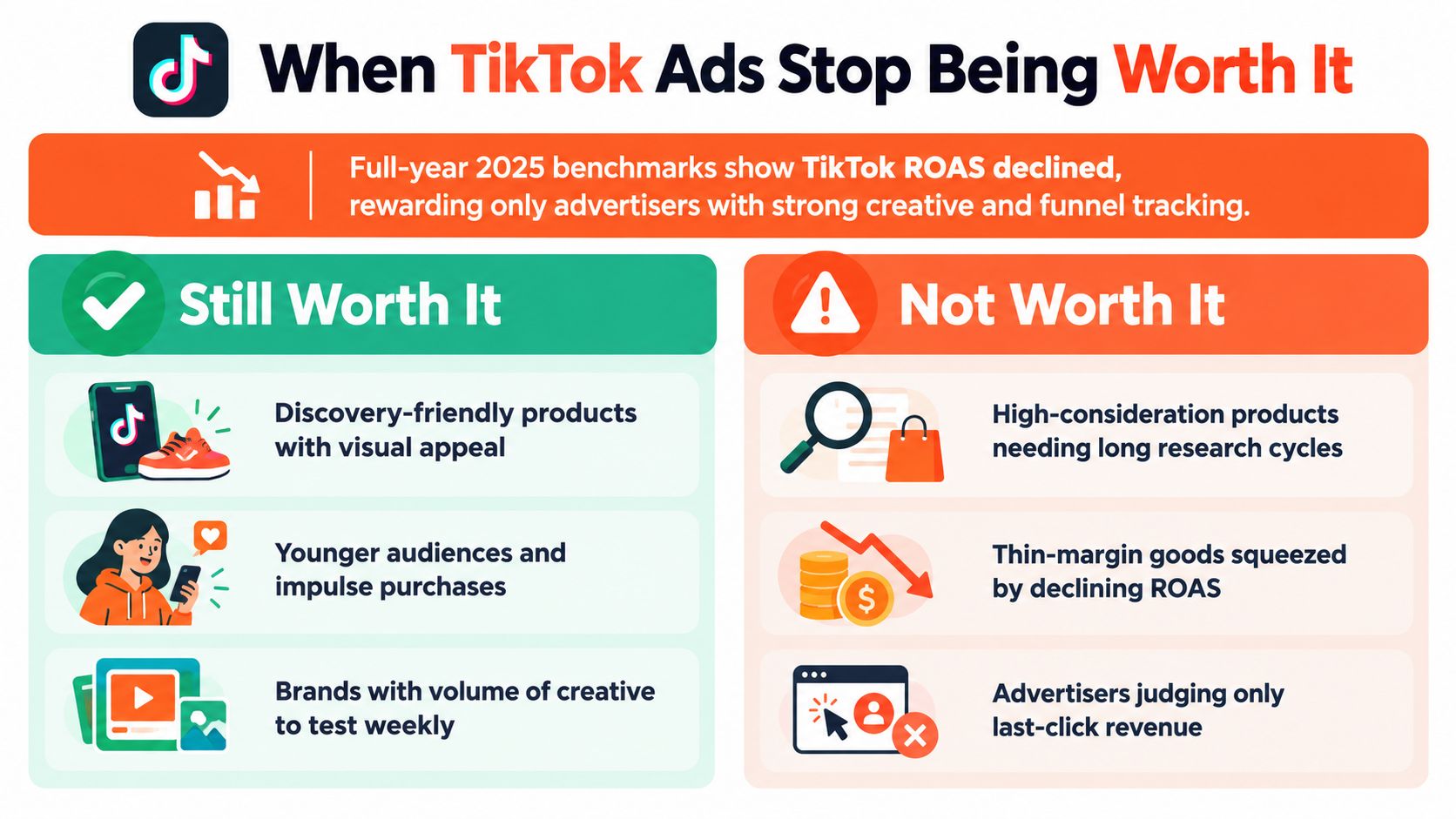
Use category benchmarks to set an initial boundary, then test whether TikTok adds demand beyond the conversions it receives credit for. The go/no-go decision rests on creative iteration capacity, measurement maturity, product economics, and category fit. If several inputs are weak, rising spend can produce more attributed activity without enough incremental value to justify the channel.
Your Go or No-Go Decision Checklist
A sensible TikTok decision doesn't begin with a budget number. It begins with the operating conditions that determine whether the budget can produce useful evidence.
Give it a green light when
- Creative production is repeatable: You can develop native concepts, test different hooks, and replace tired assets instead of asking one video to carry the campaign.
- The goal is explicit: You know whether you're buying awareness, qualified installs, direct conversions, or incremental demand.
- Measurement goes beyond the final click: Your team can review assisted conversions, use longer attribution windows, and run a lift test when the campaign warrants it.
- The offer fits short-form discovery: Viewers can understand the product's relevance quickly, and the landing page continues the same story.
- Creator-led assets are available: You can test content that feels like a real recommendation rather than forcing every message into a conventional ad format.
Hold or reject it when
- The creative bench is thin: One static asset or one heavily edited commercial isn't a testing system.
- The category economics are already tight: A benchmark-level result won't work if your margin structure needs exceptional efficiency.
- The buying journey is too long for the chosen objective: TikTok may still support awareness, but immediate conversion optimization will create unrealistic expectations.
- The dashboard is last-click only: You won't know whether the platform created demand that closed elsewhere.
- Nobody owns the learning loop: Without a person responsible for creative, landing-page, and measurement iteration, spend becomes an experiment without a conclusion.
The answer to are TikTok ads worth it is yes, when the business treats TikTok as a creative-led demand channel and measures the demand it creates, not just the clicks it closes. It's no when the team expects cheap reach to compensate for weak creative, poor funnel alignment, or incomplete attribution.
If you're weighing creator-led TikTok campaigns, Social Cloud plans and measures influencer campaigns across TikTok and other video platforms, including creator selection, tracking links, promo codes, reporting, and Spark Ads amplification. Visit Social Cloud to discuss a test built around your category economics, creative capacity, and incrementality measurement rather than a headline ROAS target.