You've got TikTok Ads Manager open, the landing page is live, and a handful of videos are sitting in a folder named “final-final.” The campaign settings look simple enough. Then the questions arrive: Which objective should you choose? Is the budget large enough to learn anything? Should you use a creator post, standard in-feed creative, or a premium placement?
That's where most first campaigns lose direction. The launch itself is rarely the hard part. The expensive mistakes happen after launch, when tracking is incomplete, the hook is weak, the audience is too narrow, or someone changes the campaign before the data means anything.
Table of Contents
- Introduction to Starting TikTok Ads Without Wasting Budget
- Set the measurement before the media
- Decide what asset you're actually buying
- Standard in-feed for controlled learning
- Spark when creator proof already exists
- Premium inventory for specific moments
Introduction to Starting TikTok Ads Without Wasting Budget
Your first TikTok campaign can spend money without producing a useful answer. A better launch treats the campaign as a learning system. You are buying controlled feedback on the offer, creative angle, audience, and conversion path. Profit remains the goal, while early results should show which idea deserves another test.
Set the campaign around four operating decisions:
- Choose one business outcome: Sales, leads, app activity, traffic, or another defined result.
- Prepare reliable measurement: Events, links, landing page behavior, and attribution must describe the same conversion path.
- Give creative enough room: One video cannot separate a weak concept from a weak execution.
- Protect the test: Changing targeting, budget, and creative together makes the result difficult to interpret.
The first budget should buy learning, not just impressions. If the campaign cannot generate enough conversion signals to compare creative angles, reduce the number of variables and use the available spend on a focused test. If it can, keep the structure stable long enough to make a decision.
TikTok's ad-testing guidance recommends clear goals, one variable changed at a time, statistically meaningful results, and a KPI matched to the objective, such as ROAS, CPI, CPC, or CPM. That framework helps prevent emotional changes based on a few early clicks.
Practical rule: Your first week succeeds when it produces a clear next decision, even if every ad does not win.
For a DTC brand, the decision may be which opening demonstrates the product fastest. For an app, compare a benefit-led hook with a feature-led hook and judge the install result. For lead generation, examine whether the promise and form ask for the right level of commitment.
A broader paid ad campaign playbook for lead generation is useful when TikTok sends prospects into a sales process instead of a checkout. Keep the ad promise aligned with the next measurable action, then use that result to shape the next test.
What to Prepare Before You Launch Your First Campaign
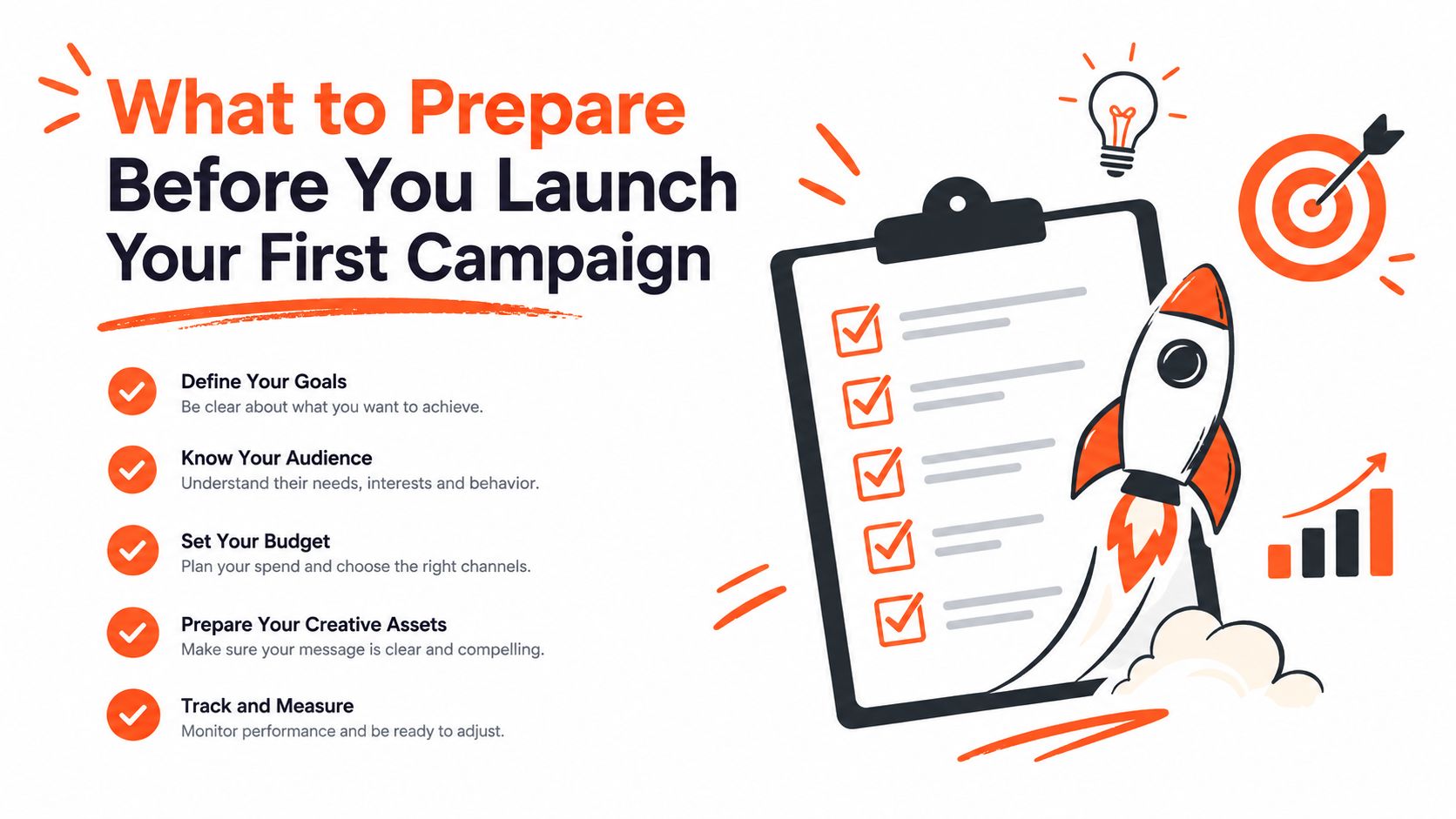
A clean launch starts before you click Submit. Create or verify your TikTok Ads Manager account, connect the correct TikTok profile, confirm billing, and make sure the business name, website, offer, and market are consistent. Review the landing page on a phone, because a good ad can't rescue a slow, confusing, or mismatched destination.
Set the measurement before the media
Pick one objective per campaign. If you want purchases, optimize for the purchase event. If you want app growth, use the event that reflects the stage you value, not a cheaper action that merely looks busy. TikTok's current buying experience gives advertisers tighter control across targeting, creative, and budget, so a vague objective creates confusion throughout the account.
Check that your web events fire correctly and that your attribution window matches the buying cycle. Add tracking parameters to destination links, name campaigns consistently, and test the journey from ad click to confirmation page. For apps, verify that install and post-install events are being received before you spend seriously.
The ad group level controls the practical delivery choices, including targeting, budget, placements, and schedule. Keep those controls understandable. If you change the audience, budget, creative style, and bid approach in the same test, you won't know which decision caused the result.
Decide what asset you're actually buying
If you already have a creator post with a clear product demonstration and permission to promote it, creator-led amplification can be a sensible starting point. If you don't have a suitable organic asset, build standard in-feed ads and make the creative feel native rather than repurposing a polished television-style spot.
Before upload, confirm usage rights, disclosure requirements, product claims, music licensing, and landing-page accuracy. For a more current overview of setup, identity, and measurement considerations, use this TikTok Ads 2026 guide as a supplementary checklist.
Creating TikTok Ad Creative That Stops the Scroll
Targeting matters, but creative is usually the first performance lever to investigate. TikTok's North America guidance reports that campaigns using at least 10 unique creatives achieved 2.6x higher ad recall, 3x purchase intent, and 1.5x higher awareness than campaigns with fewer than 5 creatives. Those figures come from TikTok's creative guidance for brand awareness and ad recall, and the operational lesson is straightforward: don't ask one video to carry the entire campaign.
Build the opening around the problem
The first 3 seconds should make the viewer understand why the video deserves attention. One benchmark set reports that 63% of the highest-CTR ads deliver the key message in that opening window, so don't spend the opening on a logo animation, atmospheric footage, or a slow introduction.
Useful hook structures include:
- Problem first: “Your morning routine is taking longer because of this.”
- Demonstration first: Show the product solving the problem before explaining it.
- Contrarian claim: Challenge a familiar habit, then prove the alternative.
- Specific audience callout: Speak directly to the user who recognizes the situation.
- Creator reaction: Start with a credible response, then reveal what caused it.
For a SaaS or app brand, swap feature tours for a visible outcome. Show the workflow before naming every function. For DTC, let the hands, product, texture, result, or comparison do some of the explaining.
Several creative guides recommend 21 to 34 second in-feed videos because that range produced the strongest click-through and conversion performance versus shorter formats in the cited benchmark. Treat that as a useful testing range, not a rigid rule. A shorter video can work when the offer is instantly understandable, while a longer one earns its place only if every beat advances the story.
Need more ideas for the opening line and visual interruption? These SaaS video hook tips by ShipTeaser are particularly relevant for software teams. You can also study influencer video marketing for ways to preserve creator voice while giving the content a conversion job.
Make variation efficient
You don't need to reshoot every version. Keep the same body footage and change the first sentence, opening frame, on-screen text, proof point, call to action, or final product shot. For an app, one recording can support a pain-point hook, a time-saving hook, and a result-led hook. For a skincare brand, the same demonstration can test a texture opening against a routine opening.
Before uploading, check:
- The benefit appears early.
- Captions are readable without covering the interface.
- The product is clear in the opening.
- The spoken claim matches the landing page.
- The creator has approved paid usage.
- The final call to action tells viewers exactly what happens next.
Use the video below as a practical reminder to think in hooks, pacing, and platform-native structure rather than shrinking another channel's ad.
Budgeting and Testing Structure for Your First TikTok Campaigns
A small budget can launch a campaign, but it may not produce a useful test. You need enough delivery to compare creative or audience decisions without mistaking random early movement for a winner. Set the learning budget before launch, then decide which variable deserves the spend.
Give each campaign one objective and keep the test variable narrow. If you are testing hooks, hold the audience, offer, landing page, and bidding settings steady. If you are testing audiences, use the same creative set. A practical structure is 3 to 5 creatives per ad group and 3 to 5 diversified ad groups per campaign. Review after about 7 days, or once the test reaches TikTok's split-test confidence threshold. The platform's testing guidance supports changing one variable at a time and waiting for meaningful results.
Translate spend into learning
Practitioner benchmarks suggest that in-feed campaigns may generate at least 100,000 to 500,000 impressions per $1,000 of spend when CPM sits around $2 to $10. That range does not predict profitability. It shows how much exposure the test can buy and whether each variation is receiving enough delivery for comparison.
If standard in-feed CPM rises above about €10, check targeting before changing the offer. Narrow audiences can increase delivery costs and restrict the algorithm's ability to find likely buyers. Broad targeting often gives automated delivery more room, but it also makes clean audience comparisons harder.
The common budget mistake is spreading limited spend across too many questions. Five audiences, five hooks, multiple landing pages, and several bidding settings create thin test cells. Choose the decision that matters most, give it enough delivery, and leave the other variables stable. A smaller test with clean variables usually teaches more than an account filled with underfunded ad groups.
| Test Variable | Example Change | Primary KPI to Judge |
|---|---|---|
| Creative hook | Demonstration first versus problem first | CTR or video engagement, depending on objective |
| Offer | Discount versus free trial | Conversion rate or ROAS |
| Audience | Broad targeting versus interest-led targeting | CPA, CPI, or conversion rate |
| Placement | Standard in-feed versus creator-led amplification | CPM, CPC, or downstream conversion |
| App event | Install versus registration | CPI or the deeper post-install event |
Match the KPI to the job
A Sales campaign needs ROAS and conversion quality, not cheap impressions. An app campaign should prioritize CPI and the quality of the post-install event. Traffic campaigns need CPC and landing-page behavior. Awareness campaigns should focus on CPM, reach, recall, or the engagement signal defined in the brief.
Independent 2026 trackers place typical TikTok performance around 0.6% to 1.8% CTR, $4.80 to $13.26 CPM, roughly $1 CPC, and a conversion rate near 2%. DTC-focused datasets report $25 to $85 cost per purchase and a 2.21 average ROAS in some samples. Treat these figures as directional. The 2026 TikTok Ads benchmark coverage notes that industry, format, market, offer, and creative can change the result substantially.
Do not optimize around the first spike. Let the test collect meaningful evidence, then make one deliberate change. Fix the weakest observable layer first: the hook, click intent, landing-page alignment, or conversion friction.
Choosing Placements and Formats When You Are Just Starting
A first campaign can burn budget before you learn anything if every format, audience, and creative changes at once. Start by matching the placement to the evidence you need. Standard in-feed inventory, creator-led Spark Ads, and premium placements each solve a different problem.
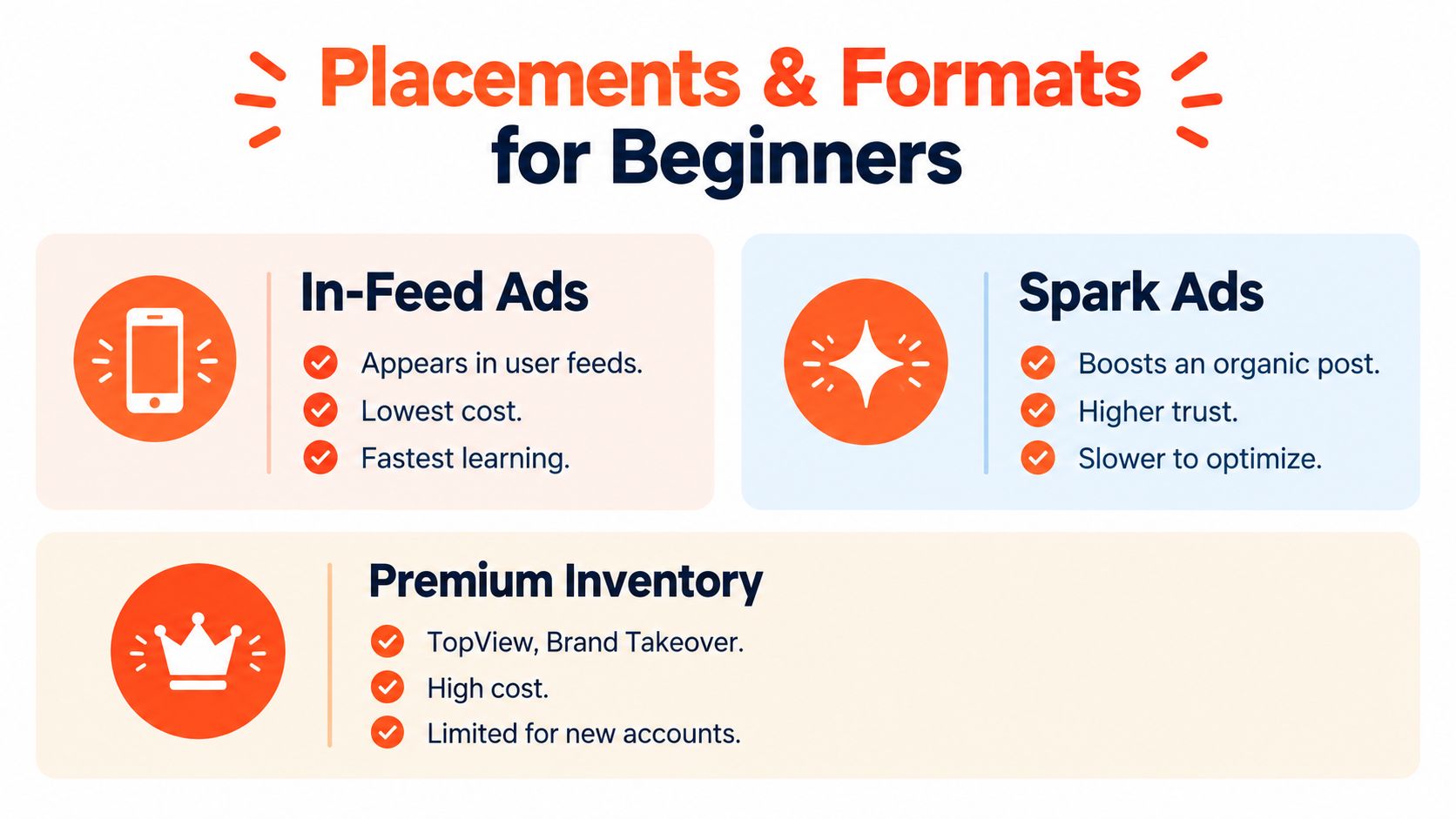
Standard in-feed for controlled learning
In-feed ads are usually the cleanest starting point for acquisition testing. They run inside the feed and let you compare hooks, offers, audiences, and calls to action without relying on an existing organic post. Choose them when your team controls production and can create several variants built for specific hypotheses.
Automatic placement and TikTok's newer automation can find additional delivery opportunities, but they do not replace test discipline. Keep campaign naming, tracking parameters, conversion events, and creative labels consistent. Otherwise, the platform may optimize delivery while your reporting makes the results difficult to interpret.
Spark when creator proof already exists
Spark Ads promote an existing organic TikTok post while preserving its engagement context. They fit creator demonstrations, testimonials, and product reactions that already feel credible, provided you have authorization to use the post.
Organic attention does not guarantee paid performance. The post may still need a clearer offer, stronger call to action, or tighter landing-page match. Spark's practical advantage is the native starting point. It can reduce the interruption people feel when an ad comes from content they already understand as social.
Premium inventory for specific moments
Premium placements cost more to test, so reserve them for situations where concentrated attention matters. The 2026 TikTok cost benchmark provides directional CPM comparisons across in-feed, Spark Ads, and TopView. Use that context to frame a decision, not to forecast your account. Market, creative, offer, and objective can shift delivery costs substantially.
TopView, Logo Takeover, and sequential storytelling placements can support a launch or broad awareness push. They are usually a poor first conversion test when the message, audience, and destination have not produced a reliable signal. Premium visibility can buy attention without proving that the funnel converts.
Your platform choice also depends on the role short-form discovery plays in the media plan. This comparison of TikTok versus YouTube helps clarify when TikTok's discovery-led video is a better fit than a more intent-driven channel. Apply the same attribution rules to every format so reach and attention do not hide weak downstream action.
Your First Week Live and What to Do Next
A campaign can spend for several days before the signal is clear. Check delivery, spend, approval status, event health, CPM, CTR, CPC, and conversions on a consistent schedule. Avoid rebuilding the campaign whenever one metric shifts.
Use the campaign objective to decide what deserves attention. For Sales, review conversion quality and ROAS. For app promotion, compare CPI with the deeper product event that matters. For Traffic, inspect CPC and post-click behavior. Earlier benchmark ranges provide context, not a verdict. A strong offer may support higher media costs, while a weak funnel can waste inexpensive traffic.
Keep these controls in place:
- Don't narrow targeting reflexively: A high CPM may mean the audience is too constrained.
- Don't kill an ad from a tiny sample: Early delivery is noisy.
- Don't edit every variable together: You will lose the lesson from the test.
- Don't scale a curiosity click blindly: Confirm that the landing page and conversion event support the result.
- Don't stop producing creative: Build the next batch from the winning hook, objection, proof point, or visual pattern.
Once the account shows a usable signal, change one meaningful input at a time. Shift budget toward the stronger ad group, create variations around the winning angle, and keep a control version. That setup helps separate a creative improvement from an effect caused by changing the campaign environment.
If creator selection, Spark-ready production, usage rights, or per-placement attribution are slowing execution, a TikTok ad agency can handle that operational layer while your team owns the commercial target. Start the next campaign with a documented lesson, not a blank Ads Manager screen.
Social Cloud plans and measures creator campaigns across TikTok and other video platforms. Its work includes creator selection, Spark Ads amplification, usage rights, tracking links, promo codes, and outcome-focused reporting. Visit Social Cloud for a managed TikTok launch connecting creator content with attribution and ongoing creative iteration.