You've got a Q3 creator budget, two strong briefs, and a familiar problem: TikTok promises fast discovery, while YouTube looks safer for lasting demand. The temptation is to split the money evenly and let the reporting dashboard decide. That usually creates two problems, duplicate attribution and creative that performs acceptably on both platforms but excels on neither.
The better question is where each platform earns its place in the funnel. TikTok is built for high-frequency discovery and pattern interruption. YouTube combines broad reach with a deeper viewing environment, making it better suited to education, search-led demand, and longer consideration. The right plan doesn't pick a universal winner. It assigns each channel a job, measures that job properly, and adapts creator assets to the behavior of the audience in front of them.
Table of Contents
Why TikTok vs YouTube Is the Wrong Question
A growth lead comparing TikTok and YouTube is rarely choosing between two identical media products. The team is choosing between different intent states. One audience is often scrolling through a continuous discovery feed, open to being surprised. The other may be actively looking for a review, tutorial, product explanation, or answer.
That distinction changes your budget decision. If the brief asks, “Can we put this product in front of new people quickly?” TikTok deserves serious consideration. If it asks, “Can we help someone understand a complicated product and return to that content later?” YouTube has the stronger strategic role.
Practical rule: Assign platforms to funnel jobs before you assign them budget.
Use TikTok to test emotional angles, creator hooks, product reactions, and cultural relevance. Use YouTube to build a searchable content library, support consideration, and give viewers enough context to make a decision. The platforms can share a creator or core idea, but they shouldn't share an unedited master asset.
A specialist partner can help. A creator marketing agency can coordinate creator selection, briefs, usage rights, platform adaptations, and measurement without treating every placement as interchangeable.
The rest of the decision comes down to three questions:
- How much audience scale do you need?
- Do you value rapid interaction or durable viewing intent?
- Which outcome should each platform own in reporting?
YouTube gives marketers the larger global audience. TikTok tends to produce stronger short-form engagement and more frequent daily visits. Neither fact settles the media plan alone. Your product category, sales cycle, creative supply, and measurement window matter more than a single headline rate.
The useful outcome is a channel rule, not a leaderboard. Lead with TikTok when discovery and fast feedback matter most. Anchor on YouTube when education, search, and long-tail value matter most. Then use the other platform to extend the journey instead of claiming the same conversion twice.
Platform Scale and Audience Behavior in 2026
Start with reach, because a platform can't support broad distribution if the addressable audience is too small for your market. YouTube launched in 2005, Google acquired it in 2006, and it remains the larger global video platform in 2026. Depending on the measurement source, YouTube is estimated at about 2.65 billion active users worldwide to roughly 2.85 billion monthly active users, while TikTok is estimated at about 1.59 billion monthly active users or about 2.21 billion active users worldwide in broader social-network rankings, as compiled by DataReportal's global social media data.
That places YouTube roughly 1.1 billion to 1.3 billion users ahead of TikTok on the cited global estimates. For a broad-reach campaign, creator distribution program, or multinational launch, that scale advantage gives YouTube more room to find qualified viewers across markets.

Scale doesn't tell you how people behave after they arrive. RealityMine's behavioral comparison reports that TikTok users are more likely to visit daily or near-daily, at 36% compared with YouTube's 23%, and more likely to spend 60 or more minutes per day in the app, 32% compared with 24%. The same source says the platforms reach highly overlapping U.S. Android audiences, but they aren't interchangeable in intent or usage, as detailed in RealityMine's TikTok and YouTube audience analysis.
Feed behavior changes the job of creative
TikTok's continuous feed makes the opening moment decisive. A viewer may not have chosen your topic, creator, or brand. The creative has to earn attention through a fast hook, recognizable tension, or an immediately useful payoff.
YouTube can also deliver interruption-based formats, but its broader ecosystem supports active viewing and content that people seek out again. That makes it a better home for product education, technical explanations, creator reviews, and content that benefits from search or recommendation over time.
The audience overlap creates an attribution trap. A person can discover a product through TikTok, research it on YouTube, and convert after a branded search. If your reporting gives the entire result to the last click, YouTube gets under-credited. If you assign every later conversion to TikTok because it delivered the first view, TikTok gets over-credited.
Treat behavior as a planning input. TikTok is the high-frequency discovery surface. YouTube is the broader, more durable viewing environment. The campaign should reflect that difference in creative, flighting, and KPI ownership.
Side by Side Where Each Platform Wins
A clean comparison helps, but only if you avoid forcing unlike metrics into one verdict. The strongest available benchmarks point to a split decision. TikTok leads on short-form interaction and discovery efficiency, while YouTube leads on installed audience scale and the longer monetization runway of long-form content.
| Criterion | TikTok | YouTube |
|---|---|---|
| Global audience scale | About 1.59 billion monthly active users, or about 2.21 billion active users worldwide in broader rankings | About 2.65 billion active users worldwide to roughly 2.85 billion monthly active users, depending on measurement |
| Overall median engagement | 4.25% in one 2026 benchmark | 3.06% in the same benchmark |
| Short-form engagement | About 2.60% average engagement in one comparison | About 0.30% for YouTube Shorts in that comparison |
| Average views in a view-based comparison | 32,895.07 views per post | YouTube Shorts averaged 5,320.59 views per post |
| Best strategic role | Rapid discovery, cultural relevance, impulse response, and creative testing | Broad distribution, education, search-led viewing, remarketing, and long-form depth |
| Creator monetization quality | Creator Rewards cited at about $0.40 to $1.00 per 1,000 qualified views | Long-form RPM cited around $1.65 to $25 per 1,000 views, with Shorts closer to short-form economics |
| Creative fit | Native, personality-led, fast-moving vertical video | Long-form explanations, searchable reviews, tutorials, plus Shorts as a discovery layer |
The engagement and view comparisons come from the 2026 TikTok versus YouTube engagement benchmark. The monetization figures come from creator pay benchmarks comparing TikTok and YouTube.
The table's practical meaning is straightforward. TikTok can be the better place to create initial demand and identify which message earns attention. YouTube can be the better place to preserve that message in a content library and support a buyer who needs more evidence.
That also explains why you shouldn't evaluate both channels against the same KPI. A TikTok creator may be judged on qualified reach, saves, shares, or assisted site behavior. A YouTube integration may deserve evaluation on engaged views, branded search activity, assisted conversions, and content value after the initial flight.
If your team wants a broader creator program across both surfaces, YouTube influencer marketing planning should sit inside the same measurement framework, not in a separate reporting silo.
No platform wins every row. The next decision is how to turn these differences into a brief an editor and media buyer can use.
Creative Formats and Watch Time Benchmarks
The creative mistake I see most often is taking one vertical video, changing the caption, and calling it a cross-platform strategy. TikTok and YouTube Shorts both reward retention, but the benchmarks suggest different tolerances around length and completion.
Socialinsider's 2026 analysis of more than 6 million TikTok videos found that 15 to 30 second clips delivered the highest engagement rate at 6.00%, while 120 to 180 second videos reached the highest median views at 11,136, according to its TikTok video length analysis. That is a useful warning against a single “optimal length.” Shorter edits can be more efficient for interaction, while longer videos can generate more raw views when the subject earns attention.
Retention targets sharpen the editing decision. Retensis sets TikTok targets above 60% average watch time for videos under 15 seconds, above 50% for 15 to 30 seconds, above 40% for 30 to 60 seconds, and above 30% for 60 seconds to 3 minutes in its 2026 audience retention benchmarks. For YouTube Shorts, the same benchmark sets a strong target above 60% for videos under 15 seconds and above 65% for 15 to 30 seconds, with above 75% considered strong for Shorts under 15 seconds.
| Format | Optimal length | Completion or retention benchmark | CTR benchmark | Best placement |
|---|---|---|---|---|
| TikTok short-form | 15 to 30 seconds for engagement efficiency | Above 50% average watch time for 15 to 30 seconds | No verified benchmark provided | For You feed |
| TikTok extended short-form | 60 seconds to 3 minutes when the idea supports depth | Above 30% average watch time for 60 seconds to 3 minutes | No verified benchmark provided | For You feed |
| YouTube Shorts | Under 15 seconds or 15 to 30 seconds, depending on the idea | Above 60% under 15 seconds, above 65% at 15 to 30 seconds | No verified benchmark provided | Shorts feed |
| YouTube long-form | Match length to the explanation, not a universal target | No verified benchmark provided | No verified benchmark provided | Watch page, search, and recommendations |
What changes in the edit
On TikTok, put the product or conflict in the first visual beat. Don't spend the opening on a logo animation, slow establishing shot, or generic greeting. Use captions to clarify the promise, but keep the screen readable enough for a viewer moving quickly through the feed.
On YouTube Shorts, preserve a little more context when it improves comprehension. The cited retention targets indicate that Shorts can support slightly different pacing, but the opening still has to earn the next moment. A practical resource on Unfloppable's YouTube Shorts video length strategy can help your editors think through length as a creative decision rather than a fixed rule.
For a single creator brief about a new skincare product, the adaptation might look like this:
- TikTok: a fast reaction and application test, with the claim or tension in the first beat.
- YouTube Short: a compact problem, demonstration, and result, with a clearer path to the full review.
- YouTube long-form or pre-roll cut: a more complete explanation of who the product suits, how to use it, and what limitation the buyer should know.
The production team can shoot one session, but it should create separate openings, captions, pacing, and calls to action. A focused influencer video marketing workflow will protect the creator's voice while giving each platform an asset designed for its own viewing behavior.
When TikTok Wins and When YouTube Wins
TikTok wins when the product benefits from an immediate emotional response. Beauty demonstrations, food, fashion drops, and mobile-first DTC launches often need a viewer to feel curiosity before they start evaluating specifications. A creator showing a texture, taste, fit, or transformation can communicate that feeling faster in a native TikTok format than in a carefully structured review.
TikTok also deserves the lead when the brief needs fast view volume and rapid creative feedback. That doesn't mean every video will perform, but the platform's discovery behavior makes it useful for testing hooks, creator personas, and product angles before you commit to a larger library.
Put YouTube in front of considered demand
YouTube is the stronger anchor for B2B software, electronics, finance, health education, tutorials, and how-to content. These categories ask the audience to understand trade-offs, trust the presenter, and sometimes return to the information later. A creator review can continue earning attention after the initial campaign because the video remains connected to a searchable and recommendation-driven viewing environment.
A SaaS company, for example, may use TikTok to test a provocative workflow problem or a quick founder insight. It can then use YouTube for a creator-led product walkthrough that explains setup, integrations, limitations, and the use case for a qualified buyer. The formats support one another, but the YouTube asset carries the heavier consideration burden.
Teams often choose the wrong platform:
- B2B lead generation on TikTok: A cold in-feed viewer may engage with the insight without having enough context or urgency to complete a form.
- Complex products in trend-only creative: A short joke can earn attention while leaving the viewer unable to explain why the product matters.
- Evergreen education built only for TikTok: A strong explanation may disappear into a fast feed instead of working as a durable answer.
- A viral moment forced into YouTube: YouTube can distribute cultural content, but a trend without search value or channel relevance may not build lasting demand.
For paid programs, pair the platform choice with disciplined testing. Crescade's guidance on bidding and creative testing is useful when you need to separate bid decisions from the creative variables that change delivery and response.
The category decision should come before the creator shortlist. If the product sells through impulse and identity, start with TikTok. If it sells through confidence and explanation, make YouTube the home base, then use TikTok to widen discovery and feed the consideration pool.
Building a Channel Mix That Performs
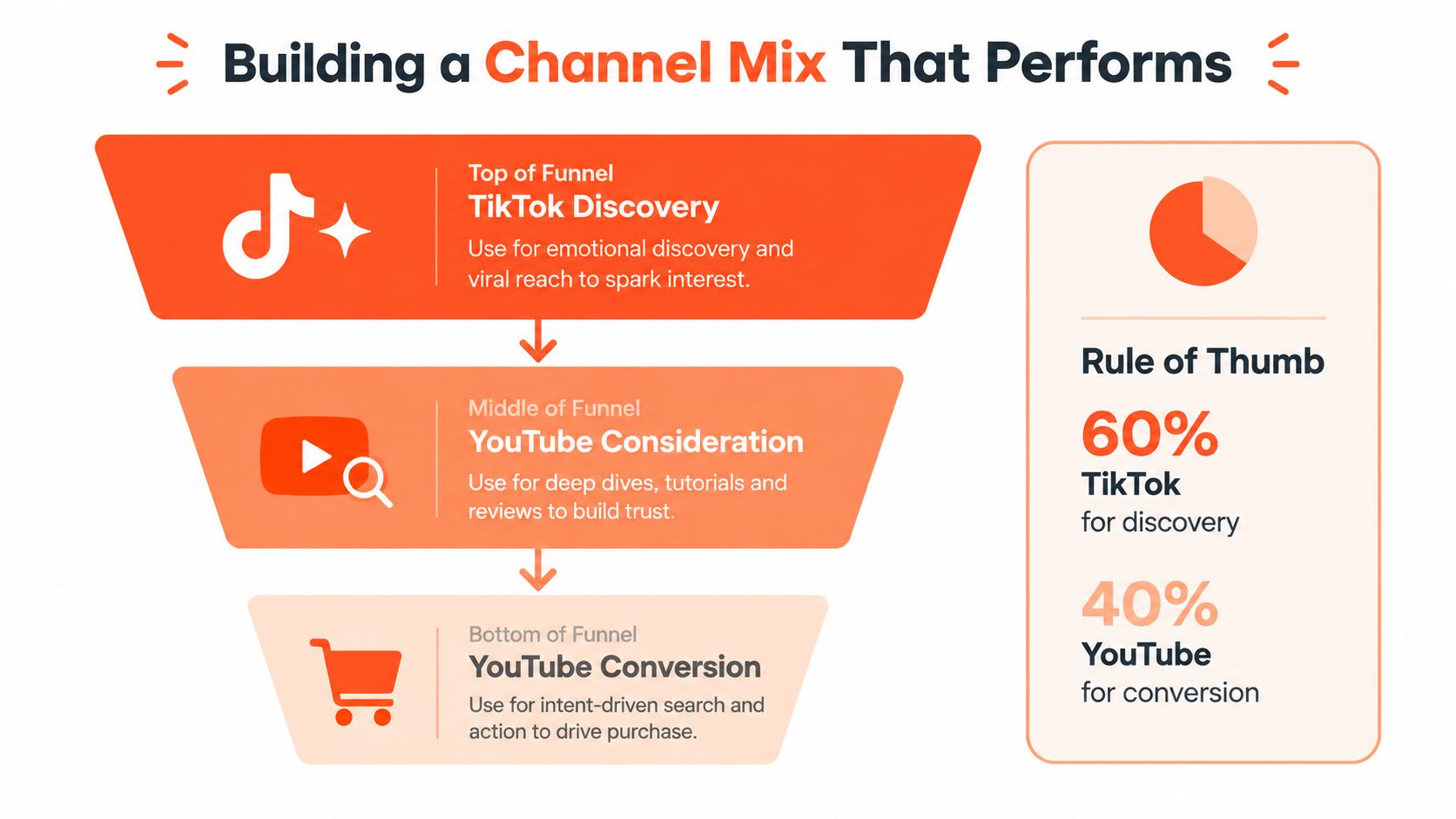
Start with intent mapping, not an arbitrary percentage split. TikTok should usually lead the part of the plan responsible for emotional discovery, new audience testing, and rapid creative learning. YouTube should usually anchor the part responsible for explanation, searchable demand, creator authority, and lower-funnel support.
A practical planning rule
For impulse categories, a TikTok-led mix makes sense because the platform can test more emotional angles quickly. For considered categories, move more weight toward YouTube because the audience needs depth and the content can continue working through search and recommendations. Don't treat those as permanent ratios. Use them as starting hypotheses, then reallocate based on qualified outcomes.
A strong workflow looks like this:
- Brief one creator around one core proposition. Define the audience problem, proof point, objection, and desired action.
- Shoot a modular session. Capture a native TikTok opening, a Shorts version, and a longer YouTube explanation rather than relying on one cut.
- Tag every placement separately. Use unique tracking links, creator-specific promo codes, and post-purchase survey options where appropriate.
- Stagger the flight. Give each platform enough time to produce interpretable signals before shifting the next budget tranche.
- Report platform jobs separately. Don't compare TikTok discovery views with YouTube conversion clicks as if they represent the same stage.
Attribution needs equal discipline. Platform-side reporting can show exposure and engagement, while multi-touch measurement can connect those exposures to later actions. Last-click reporting will tend to favor the final search, direct visit, or YouTube click, even when TikTok introduced the product earlier.
Social Cloud can fit this operating model as one possible partner. It plans creator campaigns across TikTok and YouTube, supports creator selection and briefing, and uses tracking links, promo codes, and post-purchase surveys to attribute placements.
Measurement rule: Give each platform one primary KPI and one supporting signal, then review the combined path separately.
For TikTok, use qualified reach or engaged views as the primary measure when discovery is the job, with saves, shares, or assisted site behavior as supporting signals. For YouTube, use engaged views, qualified traffic, or assisted conversions based on the campaign role. A blended view of the journey is more honest than forcing every channel to win on last click.
The One Recommendation for Growth Teams in 2026
Don't split TikTok and YouTube evenly by default. Start with the platform that matches the immediate business problem, then move budget after the creative proves it can earn attention with the audience you need.
For a discovery-led consumer launch, lead with TikTok during the initial testing period. Test creators, hooks, product angles, and comment themes. Once an angle has clear evidence of audience fit, adapt that winner into a YouTube asset with enough context to support consideration and search-driven viewing.
For an education-heavy, B2B, finance, technology, or health brief, reverse the order. Build the YouTube explanation first, then use TikTok to extract sharper hooks and reach people who haven't yet entered the category. This keeps short-form discovery from carrying a job it wasn't designed to do.
Organic teams should publish natively on both platforms. Reposting the same raw footage can save production time, but it often ignores the different retention expectations and viewer intent. Shoot once if needed, then create platform-specific openings, captions, pacing, and calls to action.
The biggest measurement mistake is assigning every view-through conversion to TikTok or every final click to YouTube. Users can discover a product in one environment and research it in another. Set a quarterly review cadence, name one KPI for each platform, and use blended attribution to understand how the journey worked.
That is the practical answer to TikTok vs YouTube. Use TikTok to find demand and YouTube to develop it, unless your category or audience data clearly says otherwise.
If you need a creator program that connects TikTok discovery with YouTube consideration, Social Cloud can help with creator selection, platform-specific briefs, campaign execution, and placement-level attribution. Bring your next product brief and use the two-platform plan to decide where each creator, asset, and dollar should work hardest.


