A quantitative study of 150 Instagram partnerships tested whether co-creation, the degree to which a brand and an influencer jointly shape campaign content, improves results. It found a positive relationship between the level of co-creation and follower engagement rate, and that the size of that lift depended on brand-influencer fit (Copenhagen Business School research). Collaboration, in other words, is a measurable variable. Not a mood. Not a calendar invite.
The part many teams skip is the second finding. A large audience with weak relevance to the product caps the value of even well co-created content, so the question isn't whether to collaborate. It's who you collaborate with and what you both agree to be measured on.
Most collaboration failures don't come from people refusing to work together. They come from two teams walking into the same campaign with different definitions of success. Brand wants reach, growth wants installs, finance wants a clean payback number, and the creator wants a video that doesn't wreck their channel. The fix is unglamorous and it holds: a metric hierarchy agreed before launch, one named owner per decision, and reporting by partner instead of by channel.
Table of Contents
- What Collaboration in Marketing Really Means
- Three Collaboration Models Compared Side by Side
- Roles and Decisions in a Collaborative Campaign
- How to Launch a Creator Program Step by Step
What Collaboration in Marketing Really Means
The Spiegel Research Center put a number on the gap between confidence and coordination. In a 2025 survey of 161 experienced marketing professionals, 57.2% rated their organization's integrated marketing communication as very good or excellent, and 44.7% still listed it among their top concerns for the year (Medill IMC Council study). Confidence is high. The unresolved problem didn't move.
Collaboration in marketing means several people or teams shaping one outcome together, with shared goals, shared data, and one owner for the trade-offs. It isn't a shared calendar, a Slack channel, or a monthly sync where everyone nods. Think of a restaurant where the chef, the front-of-house team, and the supplier all work backward from the same dinner service. Nobody asks the supplier to guess the covers. Take that logic into a campaign and the brief, the budget, and the measurement come from one plan, not three.
Where It Actually Happens
- Inside the company. Product, sales, analytics, and marketing share a launch date and a forecast. The break point is usually the handoff between the team that ships the feature and the team that has to sell it.
- Between the brand and an agency. Strategy, production, and media buying sit with people who don't report to you. That works when decision rights are written down and falls apart when they're implied.
- Between the brand and creators. A creator lends an audience and a voice. The brand lends a product and a budget. Neither side owns the outcome alone, which is exactly why the metric has to be agreed in writing.
It stalls for boring reasons. 32.9% of the respondents to that Spiegel survey cited a lack of collaboration and support as a challenge, and 32.3% pointed at insufficient vendor or agency skill sets. Neither figure describes a strategy problem. Both describe an operating problem: nobody was assigned the coordination work, so it fell between job descriptions.
One action for your next campaign: write a single sentence naming the shared goal and the person who owns the trade-off between reach, creative quality, and conversion efficiency. If two people think they own it, nobody does.
Three Collaboration Models Compared Side by Side
The three models differ less in the work than in who gets to say no.
| Model | Who shares the work | Who owns the outcome | Best for | Biggest risk |
|---|---|---|---|---|
| Internal cross-functional | Marketing, product, sales and analytics | Shared growth lead or campaign owner | Launches that need product and sales timing aligned | Activity without shared metrics |
| Agency-client | Agency strategists, planners and media buyers plus your team | Client, with the agency accountable for delivery | Brands without in-house creative or media depth | Unclear decision rights and skill gaps |
| Creator partnership | Creators, brand team and performance team | Brand team, measured per creator | Reaching niche audiences with authentic content | Low audience fit and untracked placements |
Internal cross-functional teams win when the campaign depends on timing you control: a launch date, a price change, a feature that ships late. The failure mode is busy-ness. People meet, activity rises, and nobody agrees which number the campaign is judged on. If your report has eleven columns and no single target, that's this model degrading in real time.
Agency-client partnerships win when you lack in-house creative or media depth and need craft fast. The break point is decision rights. Who signs off the concept, who can kill a shoot, who owns the media plan when cost per acquisition drifts on day three? When those answers live in two companies, the agency gets blamed for choices it was never allowed to make.
Creator partnerships buy access and credibility with an audience you can't rent any other way. They fail on measurement far more often than on creativity. When Digiday Research asked marketers which metrics they use for influencer success, impressions (28%) and conversions (27%) came out on top, ahead of watch time at 17%, click-through rate at 14%, and commerce or sales at 13%, while 30% named insufficient performance data as their biggest challenge (Digiday Research on creator marketing). Untracked placements are the default, not the exception.
Most programs that work run all three at once: one internal owner holding the number, a production partner for craft, and creators for reach. The coordination cost lands on the internal owner, which is why that role can't be a committee. If the creator route is the one you're building, the quality of the specialists matters more than the platform list they pitch, and it's worth knowing what separates influencer marketing specialists from account managers before you sign anything.
Rule of thumb: pick the model by where the bottleneck sits, not by what's fashionable this budget cycle. Slow internal feedback argues for a dedicated cross-functional team, thin creative capability argues for an agency, and an audience you can't reach any other way argues for creators.
Roles and Decisions in a Collaborative Campaign
A creator campaign can have aligned people and still stall if each team is optimizing a different result. Settle the metric hierarchy and decision rights before launch: name the business outcome that takes priority, then clarify how channel contribution and execution metrics will inform choices. The weekly operating rhythm should give one owner a shared brief, a clear view of results, and authority to make agreed trade-offs.

- Campaign owner. Holds the business target and decides how to balance reach, creative quality, and conversion efficiency. This person can shift budget between platforms within the agreed limits.
- Creative lead. Protects the creator's voice, shapes the brief, and clarifies what the brand must communicate versus what the creator can express in their own words.
- Performance analyst. Sets tracking links, promo codes, and attribution rules, then leads the weekly review. Agree on how purchases are credited so the team does not count the same conversion more than once.
- Legal reviewer. Handles contracts, disclosure language, and usage rights, including the duration and permitted placements of paid usage.
- Partner lead. Coordinates briefing, approvals, and payments, keeping creators clear on requirements and next steps.
Who Can Stop a Creator Mid Flight
Name the decision-maker for three common pressure points: pausing a creator, approving a new hook or edit, and shifting budget between platforms. Group approval may sound collaborative, but without a clear owner, a time-sensitive placement can wait while stakeholders try to reach consensus.
A Journal of Selling study found support for better performance across several outcomes when sales and marketing were aligned (Journal of Selling). The practical lesson is to make alignment operational: give the people closest to the work shared objectives and defined decision rights. Agreement in a meeting matters less than being able to act on the agreed target.
Run a weekly experiment review against the metric hierarchy. Start with the business outcome, use channel contribution to interpret its movement, and check execution metrics to decide what to change. Decision speed, complete tracking, test results, and cost per acquisition help show whether the team is responding to evidence rather than producing meetings.
Approval delays are an operating problem, not a creator problem. Define who approves content before publishing, with a named approver for each asset type and a clear turnaround window. A creator brief that survives contact with production also gives creative, legal, and performance teams a shared reference before work begins.
Put each role and its decision rights beside the campaign brief. If a role is unfilled, assign it before launch.
How to Launch a Creator Program Step by Step
Capgemini Research Institute's survey of 399 CMOs found only 36% said marketing successfully partners with sales, product development, and operations, and just 23% said sales and marketing share common KPIs and targets, while a separate 2025 integrated-marketing study in the same report found collaboration was a top challenge for 52.9% of companies with $500 million to $1 billion in revenue against 29% of small companies (Capgemini Research Institute). Coordination problems get worse as the org chart gets taller. A creator program is where they surface fastest, because brand, growth, legal, and finance all touch the same placement.
The way out is a metric hierarchy agreed before launch. Business outcome first (revenue, qualified pipeline, installs). Channel contribution second (incrementality or assisted conversions). Execution metrics third (views, click-through rate, watch-through, creator-level efficiency). Everyone still gets a number. They just stop arguing about which one wins.
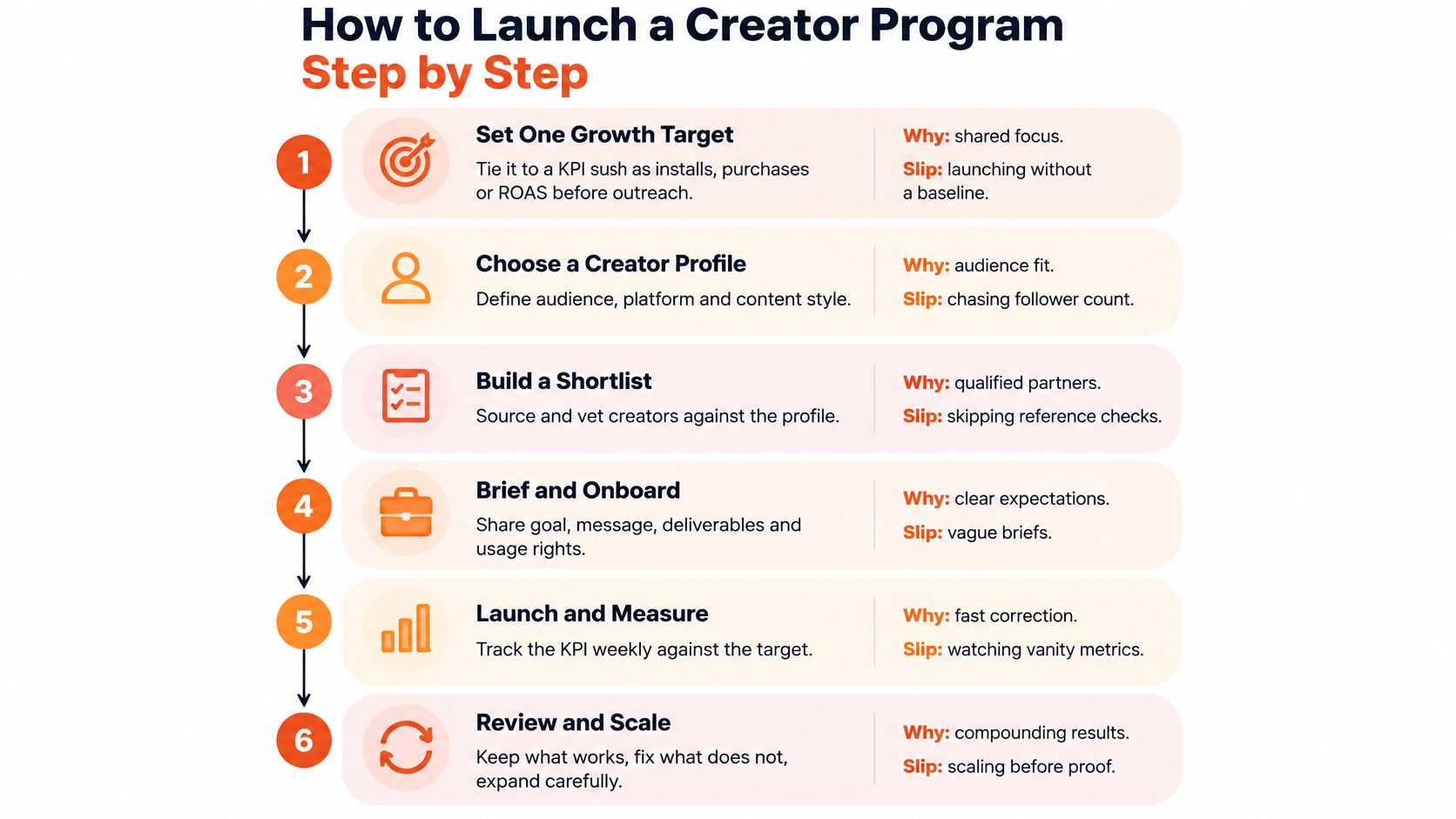
The Six Steps From Target to Scale
- Set one growth target before you contact anyone. Installs, purchases, qualified pipeline, or ROAS, one of them, with a number and a date attached. Reason: every later argument about creative, creator tier, and budget traces back to this line. Common slip: starting from reach, because reach is easy to forecast and easy to report.
- Turn the goal into a creator strategy and a platform split. Translate the audience and the KPI into a platform mix and a target CPI or CPA before spending. Reason: a budget split with no efficiency target is a rounding error waiting to happen. Common slip: allocating by platform habit instead of where the audience converts. If the underlying mechanics are fuzzy, this explainer on how influencer marketing works covers the chain from view to purchase.
- Match on fit, not follower count. Shortlist on audience quality, content style, and past sponsored results, because co-created content only lifts engagement when the creator and product fit. Reason: a mismatched audience converts at a fraction of the rate no matter how good the video is. Common slip: skipping reference checks on previous sponsored work. Our process runs Discover, Match, Create, Launch and Scale, and Match is where we hand-pick verified creators who fit the client's brand and buyers.
- Brief the goal and the requirements, not the script. Say what must be true (the claim, the offer, the disclosure, the usage window) and let the creator shape everything else. Reason: the engagement lift comes from their voice, not your draft. Common slip: over-scripting until the deliverable reads like a brand ad with a familiar face in it.
- Launch with tracking that proves itself before spend. Give every creator a unique link, a promo code, and a conversion definition, then confirm each one reports correctly before the first post goes live. Reason: you can't reallocate budget you can't attribute. Common slip: discovering on day six that half the codes were never registered. If codes carry your offer, how influencer discount codes are structured saves a week of guessing about redemption and attribution.
- Scale weekly by creator, not by campaign. Review views, CTR, conversions, and ROAS per creator every week and push budget toward the ones that convert. Reason: creator-level variance is larger than campaign-level variance, so the average hides the winner. Common slip: judging a creator on one underperforming post and cutting a channel that was working.
Disclosure belongs inside step four, not in a compliance queue. A 2025 meta-analysis of 37 studies, 288 effect sizes, and 12,721 participants found sponsorship disclosure increases consumers' persuasion knowledge and brand recall while reducing perceived credibility, and its overall effect on attitudes and behavioral intentions was statistically insignificant (Marketing Letters). The same analysis found disclosure performed better in video than in text or image, as a hashtag rather than a statement, and when presented by a party other than the influencer. So treat disclosure format as a creative variable alongside the hook and the call to action, and report disclosed content separately by format and audience age rather than assuming one label behaves the same on TikTok, YouTube, and Instagram.
Here's the walkthrough in video form if you'd rather follow the logic than read it.
A healthy launch has a signature. Within the first week, every placement is attributable, every creator has a cost per outcome next to their name, and the next budget decision is already obvious from the numbers. If you can't say which creator produced the cheapest converting click, you launched a content series, not a program.
Social Cloud plans, runs, and measures creator programs for growth teams across YouTube, Instagram, TikTok, and Twitch, with a tracking link and promo code on every placement so each creator's cost per conversion shows up in a weekly report. If you're rebuilding a program around one growth target instead of a follower count, Social Cloud returns a creator strategy, a forecast, and a platform budget split within 48 hours of your brief.