
Someone just handed you a creator budget, a launch date, and a vague instruction to "do influencers." There's no creator list, no target cost per acquisition, and no agreed way to prove a sale came from a post. Now you're expected to find influencer marketing specialists who can turn that mess into revenue.
That's exactly where teams go wrong. They hire for taste, follower counts, or a slick deck, then discover too late that nobody owned tracking, disclosure, or incrementality. I'd judge every candidate on one question first. Can they separate credited sales from sales the creator caused?
Table of Contents
- Choose In-House, Freelance or Agency
- Evaluation Criteria That Separate Real Pros From Pretenders
- KPI Framework That Separates Reach From Revenue
- How to Run a Hiring Process in Five Steps
- Interview Questions That Expose Real Experience
- Contract Terms and Pricing Models That Protect You
- Confirm the Shortlist Before You Sign
Choose In-House, Freelance or Agency
Creator spend lands on someone's desk with no plan, no KPI, and no budget logic. Before you post a job or brief an agency, decide what volume you're really running and who'll own the numbers when finance starts asking questions.
This choice matters because the channel isn't a side experiment anymore. The Statwharf influencer marketing statistics summary puts United States creator-economy advertising spend at $13.9 billion in 2021 and $29.5 billion in 2024, with 2025 spending projected at $37 billion. You're competing for real paid-media budget, so you need real forecasting and measurement.

Hiring Setups Compared
| Setup | Best when | How you pay | Time to first campaign | Main risk |
|---|---|---|---|---|
| In-house specialist | Steady output of several campaigns a quarter | Salary, benefits and tools | 2-3 months including hiring | All the know-how sits with one person |
| Freelance specialist | One-off tests or small always-on programs | Day rate or project fee | 1-3 weeks | Thin measurement and a narrow creator network |
| Agency | Multi-platform, multi-market or compliance-heavy programs | Retainer plus performance fee or markup | 3-5 weeks once briefed | Less direct control over creator relationships |
My rule of thumb is simple. Start freelance for a first test, move in-house once programs run continuously, and use an agency when multiple markets or regulated claims enter the picture. If you're weighing that last option, this guide to choosing a creator marketing agency helps you compare operating models.
Practical rule: Count the creators you'll manage each quarter. That number, plus who owns reporting, decides the row faster than any pitch deck.
Evaluation Criteria That Separate Real Pros From Pretenders
Start with fraud, because polished candidates often skip it. The Influencer Marketing Hub benchmark report found fake or bot followers represented 56.5% of identified fraud or quality issues. Inauthentic or templated comments accounted for 10.6% and fake or purchased engagement for 10.2%, so 20.8% of reported issues tied directly to engagement integrity.
A serious specialist treats those numbers as a screening job, not trivia. They'll compare follower growth against posting history, read comments for originality, and reconcile median views with past sponsored performance. They'll also ask for platform-native analytics instead of screenshots a creator selected.
We screen creators for audience quality, brand fit and past sponsored-content performance, not just follower counts. Ask every candidate whether they do the same, then make them show you a rejected creator and explain why.
Candidate Scoring Criteria
Score each criterion from 1 to 5 and set your passing threshold before interviews start.
| Criterion | Strong signal | Red flag |
|---|---|---|
| Creator vetting | Screens audience geography, age, language and interest before shortlisting | Shortlists on follower count alone |
| Audience integrity | Checks follower growth against posts and reads comments for originality | Accepts big follower jumps with no explanation |
| Measurement setup | Uses tracking links, promo codes and holdout tests | Reports likes and total views only |
| Contract experience | Has written usage-rights and disclosure clauses before | Shrugs off disclosure rules |
| Vertical fit | Has run campaigns in your category or a close one | Pitches one playbook for every industry |
| Reporting cadence | Shares per-creator results every week | Sends a monthly deck with blended numbers |
Walk through the table live. Creator vetting and audience integrity tell you whether they can spot inflated inventory. Measurement setup reveals whether they'll defend spend with evidence or hide behind reach.
Contract experience matters because disclosure and usage mistakes become your legal and media problem. Vertical fit is useful, but don't overweight logos. A candidate from a nearby category with strong measurement habits usually beats a category insider who can't explain lift.
Finally, insist on per-creator weekly reporting. Blended monthly numbers protect weak creators and make budget shifts impossible. If a candidate can't explain which creator they'd cut and why, they aren't ready to manage your money.
KPI Framework That Separates Reach From Revenue
Most creator reports answer the easiest question. How many people saw it? You need a harder one answered. How much revenue did the creator cause, rather than merely receive credit for?
Use funnel KPIs, but don't confuse their jobs. Views and watch-through show attention. CTR shows interest. Promo codes, CPI and CPA track actions. ROAS shows attributed revenue, which still isn't proof of incremental revenue.
KPI Framework by Funnel Stage
| KPI | What it tells you | Watch out for |
|---|---|---|
| Views and watch-through | Attention and whether people stay for the message | Says nothing about purchases |
| CTR on tracked links | Interest strong enough to make someone click | Inflated by curiosity clicks |
| Promo code redemptions | Conversions tied to a specific creator | Codes leak to coupon sites |
| CPI or CPA | Cost per tracked install or acquisition | Over-credits high-intent audiences |
| ROAS | Revenue returned per dollar of creator spend | Attributed, not necessarily incremental |
| Holdout lift | Conversions caused by exposure to the creator | Needs a control group and patience |
Say a fitness creator delivers cheap installs while a smaller coach looks expensive on last-click tracking. The first audience may already search for your app, while the coach creates demand that converts later through branded search or the app store. If you only pay on tracked credit, you'll cut the demand creator and overfund the closer.
How to Measure Incremental Lift
The MarketSplash influencer marketing statistics guide recommends reserving a randomized holdout of 10–20% when user-level randomization is available. If that isn't possible, use a platform split with approximately 10% control, or geographically matched holdouts observed for at least 4–6 weeks.
Run it in plain steps:
- Pre-register one primary outcome: Pick purchases, installs, or qualified leads before launch, per creator and platform.
- Split the audience: Expose the treatment group and keep the control group unexposed where tooling allows.
- Calculate lift correctly: Subtract the control conversion rate from the exposed rate, then divide by the control rate.
- Report two numbers separately: Show tracked conversions from links, codes, and surveys beside holdout lift, never merged into one claim.
That separation matters because buyers don't follow neat paths. Someone watches on TikTok, reads reviews on YouTube, then buys through search three days later. Deterministic tracking misses that journey, while a holdout captures whether exposed people converted at a higher rate overall.
A single ROAS number presented as fact hides uncertainty. Strong influencer marketing specialists explain what was tracked, what was estimated, and what the control group proved.
Pick one primary KPI per creator before spend starts. Use tracked outcomes to forecast CPI, CPA, or ROAS, then validate with lift. For the reporting mechanics behind that split, see this breakdown of how to measure influencer marketing ROI.
How to Run a Hiring Process in Five Steps
Two finalists deliver the same test campaign. One reports a strong ROAS built entirely on tracked links and promo codes. The other shows credited sales and holdout lift as two separate numbers, then explains the gap between them. Hire the second.
That difference is what a hiring process exists to expose. Run candidates through one small, measurable job and compare how they forecast, spend, and report before you commit serious budget.
Five Steps That Reveal Competence
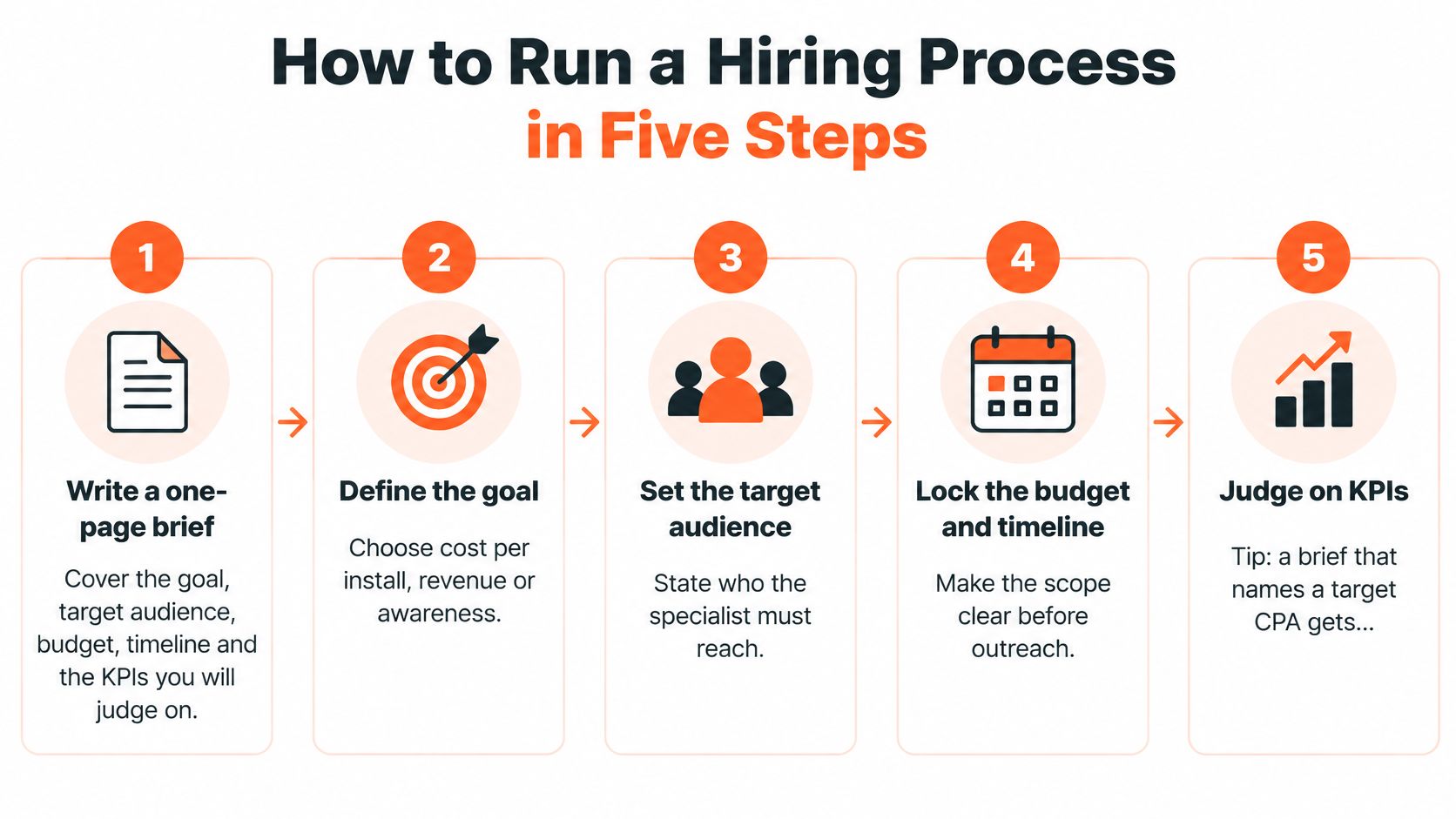
Write a one-page brief. State the goal, target audience, budget, timeline, and the KPIs you'll judge on. "Lower cost per install to a named target in one market within 30 days" earns sharper pitches than "we want more buzz." A brief with a target CPA forces candidates to commit to a number you can score them against. Our Discover step works the same way: the client's goals, audience, and KPIs become a data-backed creator strategy, with a forecast and budget returned within 48 hours of the submitted growth target.
Shortlist five to eight candidates. Check past campaigns in your category or a close one, and look past the highlight reels. Ask what they measured, what missed, and which creators they stopped funding. If your shortlist includes remote specialists or freelancers working across borders, resources for building distributed LATAM teams can help you think through cross-border hiring logistics before outreach.
Run a paid test. Give two or three finalists the same two-week brief: a small creator slate, a fixed fee, a tracking link or promo code per creator, and a holdout plan with enough audience held back for a credible control. Paying for the test buys you real work product and removes the excuse that the strategy was only hypothetical. The scored deliverable is the report itself. Look for credited sales and incremental lift appearing as separate lines, plus a clear answer on which number should drive your scale-up decision. That split is the check most hiring guides skip entirely.
Interview from evidence. Have each finalist walk through their last three campaigns live, including a miss, and open the dashboards themselves rather than presenting slides. Watch whether they explain trade-offs and name the lever they'd pull next. Vague stories about "great engagement" are not evidence.
Check references and audit the roster. Call two references and sample creators the candidate recommends, then review audience quality, sponsored-content history, and disclosure habits yourself. You're checking whether the process they described survives contact with the shortlist they built.
The walkthrough below shows how to pressure-test the brief and scoring sheet before candidates start spending.
The most common mistake is skipping the paid test and hiring on interview chemistry. Chemistry will not reconcile a promo code leak or explain a weak control group. End the process with a scored winner and a signed short-term engagement, then scale only after the numbers repeat.
Interview Questions That Expose Real Experience
Good answers sound specific and slightly unglamorous. Weak answers lean on creator names, total reach, and confidence. Ask these seven questions and listen for numbers, controls, and trade-offs.

Seven Questions Worth Asking
- "Walk me through a campaign that missed target. What did you change?" A strong answer names the metric that moved, the diagnosis, and the lever pulled. Blaming the algorithm is not a diagnosis.
- "How do you tell an engaged audience from bought followers?" Listen for growth checked against posting history, comment reading, geography checks, and median views. Tool names alone aren't enough.
- "How would you prove a sale came from a creator and not a coupon site?" You want unique codes, tracked links, holdouts, and awareness of assisted conversions. You also want honesty about what can't be proven exactly.
- "Which metric would you refuse to report as success?" Strong influencer marketing specialists usually name raw views or engagement on their own. They'll explain what decision each metric can and can't support.
- "What happens when a creator posts without disclosure?" Look for an immediate pause or fix, documentation, and a contract clause that was in place before publication. "We'd ask them nicely" is too weak.
- "How do you brief creators without flattening their voice?" Good briefs set the goal, claims, guardrails, and call to action, then let the creator shape the hook and delivery. Word-for-word scripts usually produce stiff content.
- "Who owns the creator relationships and the data if we part ways?" You need a clear answer on contact access, performance history, content files, and reporting exports. Don't discover rented relationships at exit.
A candidate who discusses uncertainty calmly is usually safer than one who promises every sale can be tracked.
Score the shape of each answer immediately. Did they define terms, show a control, and admit a downside? That's operating experience. A candidate quoting one huge reach figure may have bought distribution, not built a repeatable growth channel.
Contract Terms and Pricing Models That Protect You
In its March 2020 FTC Teami case update, the U.S. Federal Trade Commission reminded advertisers and endorsers that material connections, including payments, must be disclosed clearly and conspicuously. That duty belongs in your paperwork, not just the caption.
Build disclosure into the contract, brief, script review and approval step. Cover gifted products, affiliate links, and paid amplification. Require disclosure inside video content, not only in a description or caption, and approve every language version before launch. Check each market's rules rather than assuming one label works everywhere. This influencer contract template gives you a starting structure.
Compliance also shapes creative performance. Burying disclosure creates trust and regulatory risk, while clumsy placement can interrupt the opening seconds. I'd test compliant variants early instead of treating legal review as a final gate.
Influencer Pricing Models Compared
| Model | How it pays | Fits when | Watch out for |
|---|---|---|---|
| Flat fee per post | Fixed amount per deliverable | Awareness pushes with no tracking | You pay whatever the results |
| CPM | Per thousand views | Reach-led campaigns | Bots can inflate views |
| CPA or CPI | Per tracked action or install | Clear conversion goals | Attribution disputes |
| Base plus performance | Lean base fee plus bonus tied to agreed outcomes | Growth teams with a measurable target | Needs a clear upfront definition of a valid conversion |
| Revenue share | Percentage of attributed sales | High-margin products with simple tracking | Last-click credit, not proven incremental lift |
Beyond price, write down usage rights and whitelisting duration, approval windows, data access, category exclusivity, and a fraud clause that lets you pause or claw back spend.
The clause most hiring guides skip is the one that separates credited sales from incremental lift. Define a counted conversion precisely: attribution window, refunds, duplicate installs, and coupon leakage. Then decide which conversions trigger payment. Sales a tracking link credits to a creator include buyers who would have converted anyway, so I'd pay performance bonuses on lift measured against a baseline or holdout cell, and treat last-click credited sales as reporting data. If a candidate can't explain how they'd isolate lift, that's information about how they'll spend your budget.
If your search extends internationally, context on hiring abroad without unexpected placement costs helps you sanity-check fee structures across markets. However you hire, don't sign performance pricing until both sides agree in writing what outcome triggers payment.
Confirm the Shortlist Before You Sign
Use identical inputs, or you'll compare presentation styles instead of ability. Send three finalists the same one-page brief and require the same forecast format.
This is the point where your process either protects budget or turns into a popularity contest.

Your Final Five Checks
- Send the same brief. Keep goal, audience, budget, timeline, and primary KPI identical for all three candidates.
- Require a forecast and test plan. Each pitch should include the creator slate, tracking method, holdout design, and expected primary outcome.
- Apply your earlier threshold. Score against the six criteria without moving the bar for a charismatic presenter.
- Judge the paid test fairly. Compare results with the pre-registered outcome, not with whichever metric looks best afterward.
- Confirm terms in writing. Lock the scored winner, measurement plan, data access, and disclosure clause before any long contract.
We work with growth-stage e-commerce, apps, SaaS and games teams that have a KPI to hit, from a first creator test to always-on programs. Our clients get a creator strategy, a forecast and a budget within 48 hours of submitting a growth target. Ask any finalist for that same clarity.
If nobody reaches your threshold, widen the shortlist. Don't lower the bar just because a launch date is close. Sign when the test shows real lift or, at minimum, a credible and transparent plan to measure it.
If you want influencer marketing specialists who forecast before spend, track every creator, and tie fees to agreed outcomes, Social Cloud can plan and run that test with you. Send us your growth target and we'll return a creator strategy, forecast, and budget you can judge against the same standards in this guide.

