58% of consumers have made purchases because of influencer endorsements, yet only 5% trust influencer content completely. That tension explains why the answer to "how does influencer marketing work" can't stop at "a brand pays a creator to post." The channel works when creator trust, platform-native content, and measurable commercial action operate as one system. (BBB Influencer Trust Index)
A creator campaign is therefore closer to a performance-media workflow than a one-off sponsorship. The team forecasts an outcome, selects creators for audience fit, contracts the content and usage rights, launches with tracking in place, and reallocates spend according to creator-level results. That discipline matters as influencer marketing becomes a mainstream budget line, with 86% of US marketers estimated to use it in 2026 and US sponsored-content spending projected at $9.29 billion in 2026.
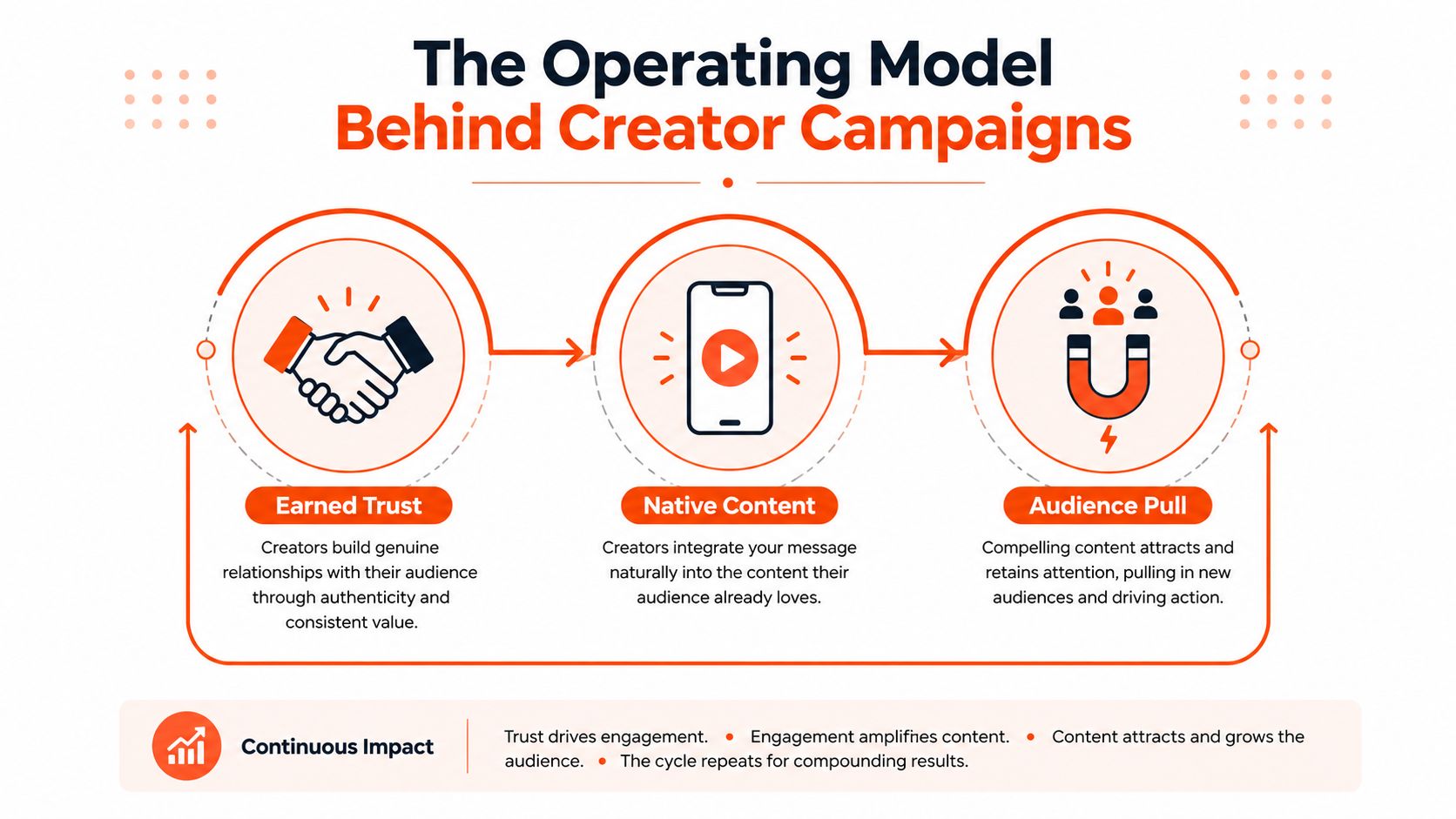
The Operating Model Behind Creator Campaigns
Influencer marketing combines three mechanics that most paid placements struggle to deliver in one piece of content: earned trust, native execution, and an audience action you can measure. The creator brings an established relationship with a defined audience. The post looks and sounds like the platform content people already consume. A tracked link, promo code, landing page, or survey then connects attention to clicks, purchases, installs, or qualified leads.
That combination creates an operating model, not merely a transaction. The brand pays for access to the creator's distribution and creative ability, but it also needs a process for deciding which creators deserve budget and what each placement must produce. Without that process, follower count and impressions become the reporting endpoint, even though neither one explains whether the campaign generated profitable demand.
The workflow that makes the model work
A growth team typically moves through this sequence:
- Forecast the outcome. Decide whether the campaign buys reach, qualified traffic, installs, purchases, or another business result. Estimate the required spend before creator outreach begins.
- Vet the creator. Match the offer to audience composition, category authority, content style, and historical sponsored performance.
- Contract the activation. Define deliverables, disclosure, claims, approval windows, exclusivity, and rights to reuse or amplify the content.
- Launch with identifiers. Give every creator a unique link, code, or landing-page path so the placement can be evaluated independently.
- Review and reallocate. Compare creators by cost, clicks, conversions, revenue, and creative quality. Shift future placements toward evidence, not excitement.
The model has a feedback loop. A creator may produce strong engagement but weak purchase intent, while another generates fewer visible interactions and more revenue. Those creators shouldn't receive the same next-step budget because their posts look equally popular.
Practical rule: Treat every creator placement as both a media buy and a creative test. The post has to attract attention, and the tracking has to show what that attention did.
The channel has evolved toward this measurable structure. It grew from celebrity endorsement, became scalable through social platforms in the 2010s, and now supports performance-led buying decisions. Global industry estimates reached $32.55 billion in 2026, according to Marketing Dive's influencer marketing milestones. The important shift isn't the size alone. It's that creator spend increasingly has to defend itself against other acquisition channels.
Setting Goals, KPIs, and Forecasts
Forecast the economics before contacting creators. The first decision is what outcome are you buying? Awareness campaigns may optimize for reach, views, or qualified exposure. Performance campaigns require a defined unit such as cost per acquisition, cost per install, return on ad spend, or qualified lead.
Keep those objectives separate in reporting. A creator can introduce a product effectively without generating immediate last-click sales, while another can produce conversions with less visible reach. Define the primary KPI before choosing creators, platforms, or compensation terms. Teams can also use a structured workflow to automate social goals when several platforms and reporting owners share responsibility.
Build the forecast before outreach
Start with the commercial target and work backward:
- Define the conversion event. Select the action that matters, such as an install, completed order, subscription, or qualified lead.
- Set the allowable cost. Use contribution margin, customer value, and payback requirements to establish the maximum acceptable acquisition cost.
- Estimate the funnel. Forecast views, clicks, landing-page sessions, and conversions from relevant benchmarks. Label every assumption.
- Reserve testing budget. Early placements should test hooks, audiences, and formats instead of committing the full budget to creators who only appear proven.
- Set the review cadence. A weekly review gives the team time to adjust before the final report.
In our testing, weekly reviews proved essential for catching drift before it compounded into a missed quarter. The benchmark table below shows why platform and KPI need to be paired. Sprout Social reports typical influencer-content conversion rates around 1% to 5%, with e-commerce often around 2% to 4%. Treat those ranges as planning references, then replace them with first-party post-click behavior once the campaign produces enough data. (Sprout Social influencer marketing statistics)
| Platform | KPI | Benchmark Range |
|---|---|---|
| TikTok | Influencer posts, average engagement rate | 1.59% |
| Sports and fitness influencer engagement | 2.31% | |
| Influencer content | Typical conversion rate | 1% to 5% |
| E-commerce influencer content | Typical conversion rate | 2% to 4% |
Use these figures to establish a starting model, not to justify equal spending across channels. TikTok and short-form video can help identify creative angles. YouTube may support deeper consideration. Newsletters and podcasts may bring higher-intent traffic, but each requires separate economic evaluation. Allocate budget according to expected contribution and historical evidence.
A forecast is useful only when it can be disproved. Document the assumptions behind the CPI or acquisition-cost target, compare them with a performance-based influencer marketing approach, and revisit them weekly. The output should be an operating model the team can challenge, update, and use for reallocation, not a polished spreadsheet that survives unchanged after launch.
Choosing Creators That Actually Convert
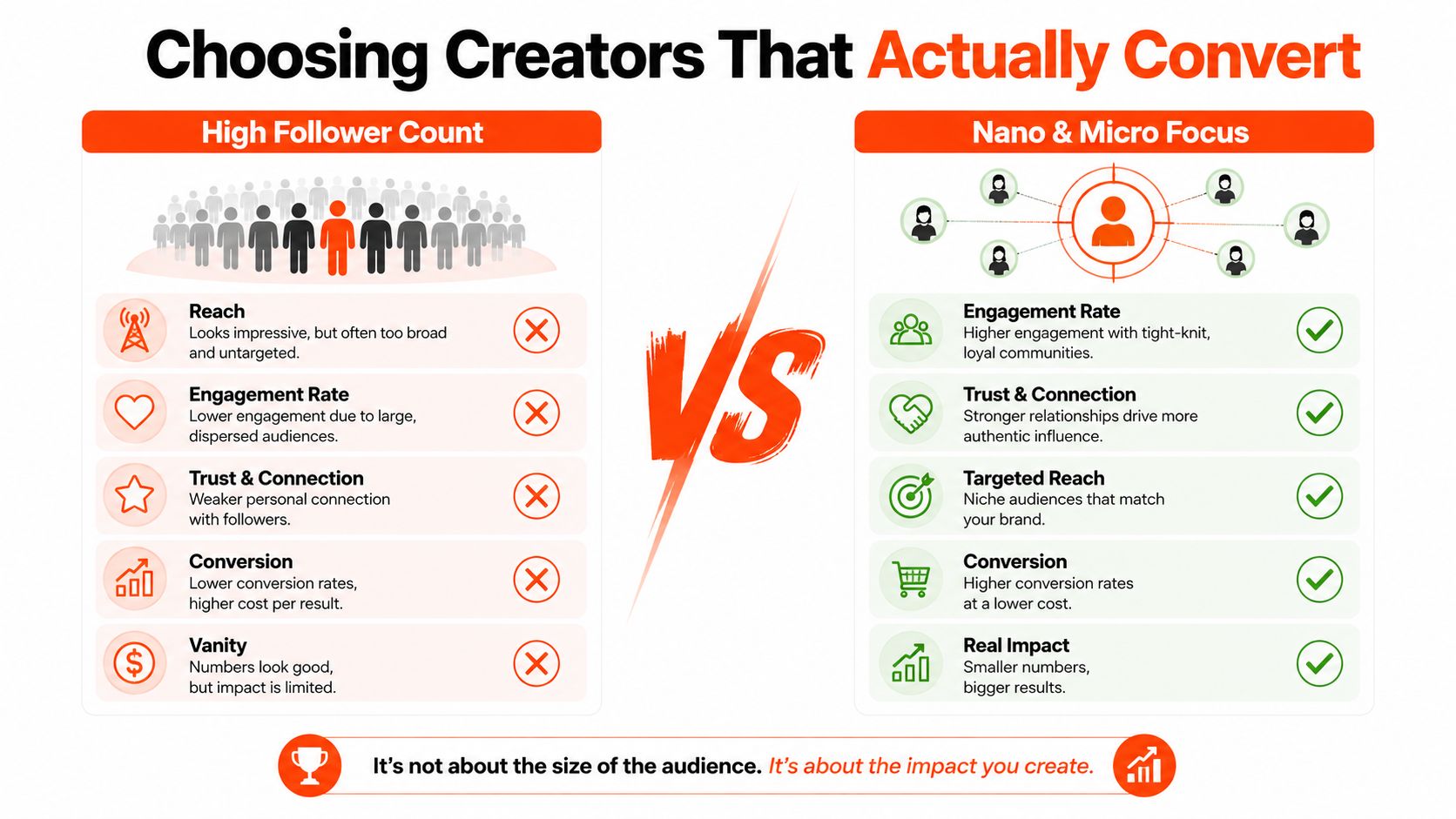
Follower count is a distribution signal, not a conversion forecast. It shows potential reach, but says little about audience fit, recommendation credibility, or what viewers do after exposure. Start creator selection with the buying decision, then assess whether the creator can move that decision.
Ask four practical questions: Does the audience resemble the buyer? Does the creator have authority in the category? Does the content style fit the placement and offer? Can the team verify engagement quality and prior sponsored work?
Compare tiers by job, not status
Nano and micro creators suit offers that depend on specificity. Their communities often form around a narrow interest, giving the creator more conversational credibility with that audience. Earlier benchmark data shows that engagement varies materially by niche, which is why a focused audience can matter more than raw scale. (Sprout Social influencer marketing statistics)
Mid-tier creators are often the practical scaling layer. They can deliver meaningful reach while keeping a recognizable point of view, and a portfolio of these creators can generate enough volume to test different hooks, objections, and use cases. The trade-off is operational: more contracts, approvals, tracking links, and creator-level reporting.
Household-name creators can produce broad awareness and cultural visibility. Their audiences may be less concentrated around the product category, their content can attract heavier scrutiny, and their fee may be difficult to defend against a direct-response target. Use this tier when the objective is explicitly brand-led or when the creator's authority directly matches the buying decision.
Use the conversion ranges from the forecasting section as planning inputs, not as selection criteria. Two creators can deliver identical reach and still produce different CPAs. Creator A may reach a broad audience with limited overlap with likely buyers. Creator B may reach the same number of people, but with stronger category relevance and repeated exposure among high-intent viewers. If both generate the same number of clicks, Creator B can still produce more qualified sessions and purchases because fewer visits are accidental or poorly matched. Report results by creator, not only by campaign average.
What to inspect before signing
I’ve seen teams overlook audience overlap until after signing, which wasted budget on creators who looked right but brought the wrong buyers. Look beyond the media kit:
- Audience credibility: Review sudden follower spikes, unusual like-to-view ratios, repetitive comments, and visible engagement pods.
- Category fit: Check whether the creator already discusses the problem the product solves. A correctly sized audience is still wrong if the recommendation feels unrelated.
- Engagement consistency: Compare recent posts, not one viral result. A stable pattern gives a better forecast than an outlier.
- Sponsored content quality: Watch previous integrations with sound on. Read-from-script delivery, vague product use, and weak calls to action usually remain weak under a new contract.
- Conversion readiness: Look for explanations, demonstrations, comparisons, and audience questions that signal buying intent.
Selection should also reflect the platform's buying journey. A short-form creator may be useful for rapid creative testing, while a long-form reviewer can support research-heavy decisions. Teams assessing that format can use this guide to influencer marketing on YouTube for additional platform context.
The right creator is the one whose audience overlap, credibility, and format create a measurable path to action. Confirm those conditions before signing, then keep creator-level results visible through activation and reporting.
Briefing, Compliance, and Going Live
A creator brief shouldn't turn a natural recommendation into a corporate script. It should give the creator a clear job, the audience action, required product facts, prohibited claims, and the freedom to deliver the message in a platform-native way.
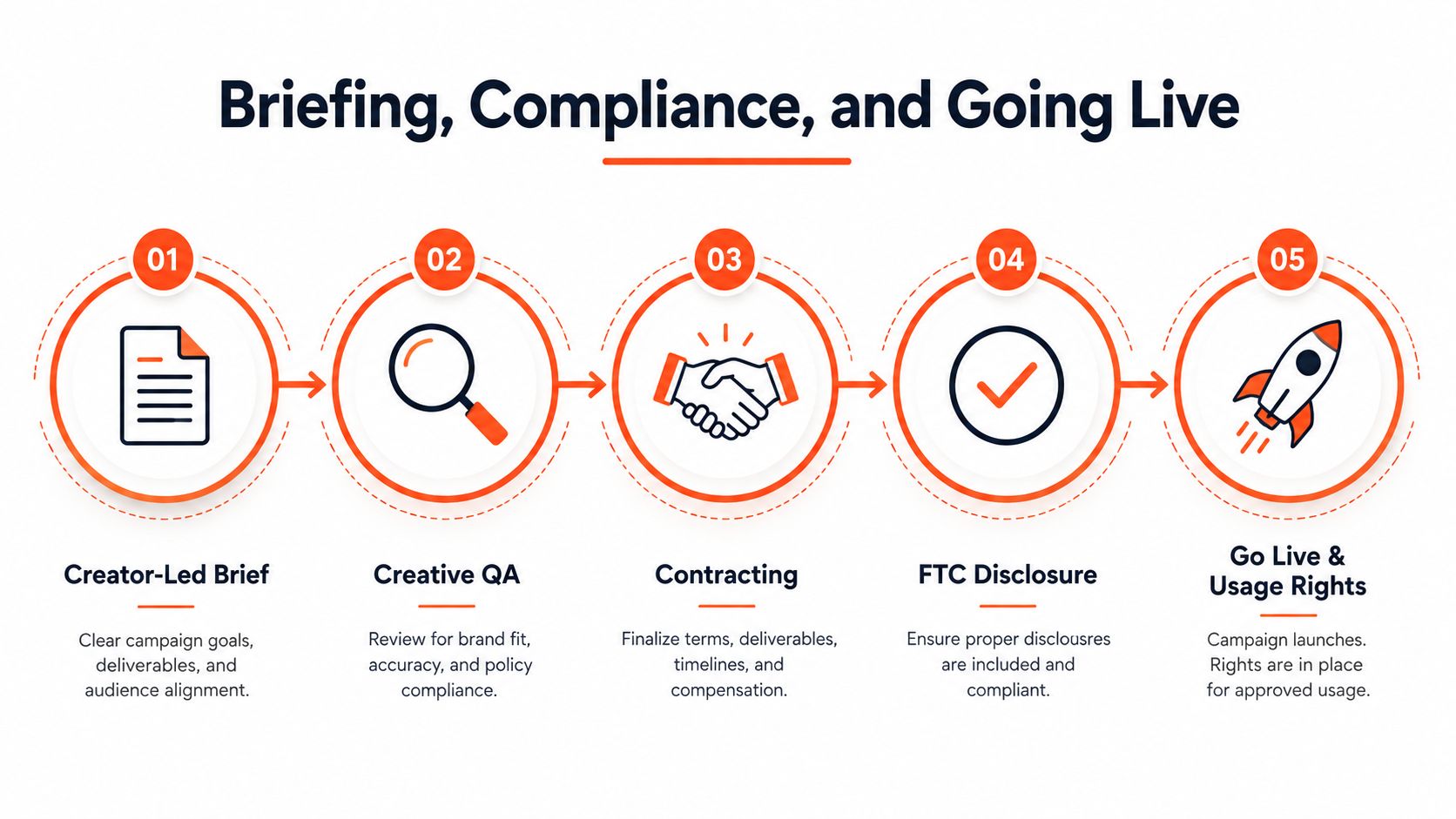
Treat creative, legal, and media requirements as one pipeline. The team that separates them often discovers too late that a good video can't be used in paid media, a claim needs to be removed, or the disclosure isn't visible enough.
Run one connected activation process
Creator-led brief: Define the audience, problem, offer, required talking points, call to action, format, deadline, and tracking identifier. Explain why the product matters, but leave room for the creator's normal language and structure.
Creative QA: Check factual claims, competitor references, product demonstrations, music rights, brand-safety risks, and platform specifications. QA should protect accuracy without sanding away the creator's point of view.
Contracting: Put deliverables, payment, revisions, cancellation terms, exclusivity, and approval windows in writing. Add the rights needed for reposting, paid amplification, edits, duration, territory, and channels.
Disclosure: Require clear sponsored-content disclosure that follows the relevant rules for the market and platform. The disclosure should be easy to notice, not buried after the audience has already acted on the recommendation.
Go live and verify: Test every link, UTM parameter, promo code, landing page, and event before publishing. Once the post is live, confirm that the identifier appears correctly and that monitoring can capture comments, sentiment, and compliance issues.
Usage rights deserve particular attention because they determine whether a creator post remains a single placement or becomes a reusable media asset. A brand may want to repost the content organically, place it on a product page, or amplify it through a creator handle. Each use should be agreed in advance rather than assumed.
For teams formalizing these relationships, this guide to influencer brand partnerships provides useful context on collaboration expectations. The principle is practical: don't ask for broad rights informally after the creator has delivered. Negotiate the intended use before production begins.
Running the Approval Workflow
Formal approval workflows have moved from informal email threads to structured processes that balance brand safety with measurable outcomes. A recent workflow guide breaks the collaboration into eight steps: goal setting, budget planning, creator identification, outreach, negotiation, creative brief, content review and approval, and performance tracking (Source: Hootsuite blog). The approval stage is no longer just a final sign-off; it is a control point where marketing teams catch compliance issues before they go live.
In my experience, the biggest bottleneck isn't the review itself—it's the revision loop. Brands average 2–3 approval rounds before final acceptance, and optimized systems can cut approval time by 30–50%, according to workflow best practices (Source: Swydo guide). To avoid that delay, teams should use a structured schema that tracks deliverable status at every stage.
| Stage | Status Field | Data Tracked |
|---|---|---|
| Submission | Draft / In Review / Approved / Rejected | Submitter, timestamp, file version |
| Initial Review | Pending Review / Feedback Required | Reviewer role, feedback comments, due date |
| Revision | Revised / Resubmitted | Revision count, updated timestamp, previous feedback reference |
| Legal/Compliance | Legal Cleared / Legal Flagged | Compliance notes, regulatory checklist items |
| Final Approval | Approved / Rejected | Final approver, approval timestamp, rights confirmation |
This schema gives every stakeholder visibility into where a piece of content sits. When a creator resubmits after feedback, the system increments the revision count and timestamps the change. When legal flags a claim, the status stays visible rather than hiding in an email chain. That transparency is what lets teams scale without losing control.
Influencer Content Approval Workflows: A Step-by-Step Guide
The scale of influencer marketing has made approval workflows and deliverable tracking more operationally important. In 2026 benchmark data, 66.33% of respondents said their influencer marketing was managed entirely in-house, which suggests that many teams are handling approvals and status tracking without deep external process support (Source: Influencer Marketing Hub benchmark report). That operational burden is exactly why structured systems matter—one guide found that brands using formal approval workflows can reduce content approval time significantly by eliminating ambiguity.
A strong content approval workflow is now closely tied to measurable business performance, not just creative control. Industry guidance notes that formal approval systems catch 73% more compliance issues before publication than unstructured processes (Source: Swydo guide). For a business like Social Cloud, that matters because launch speed and compliance safety are directly linked to campaign ROI.
Here’s the step-by-step workflow that works in practice:
- Content Submission: The creator uploads draft content to the platform with all required assets (video, captions, tags). The system logs the submission timestamp and assigns a unique deliverable ID.
- Automated Pre-Screen: Basic compliance checks run automatically—missing disclosures, blocked keywords, or incorrect aspect ratios trigger immediate flags before human review begins.
- First Round Review: The marketing team reviews for brand alignment and creative quality. Feedback is logged in the system with specific timestamps and revision requests.
- Creator Revision: The creator addresses feedback and resubmits. The system updates the revision count and notifies reviewers of the new submission.
- Legal/Compliance Check: For regulated categories (finance, health, food), legal review runs in parallel or sequentially. Issues are tracked with resolution status.
- Final Approval: The designated approver gives final sign-off. The system records the approver’s identity, timestamp, and confirmed usage rights.
- Go-Live Trigger: Once approved, the platform schedules the post or sends a notification to the creator with the approved tracking parameters ready to deploy.
This workflow closes the gap between creative intent and operational execution. When every stage has a status field and a responsible role, bottlenecks become visible instead of mysterious delays.
Attribution That Connects Views to Revenue
Attribution is what turns influencer marketing from a brand expense into a performance channel. Every placement needs its own identifier, otherwise your reporting can show activity without showing ownership.
Use three tracking layers together. Tracked links capture the direct path from content to site or app. Promo codes connect the creator to an order when a user doesn't click the original link. Post-purchase surveys capture remembered influence that pixels and last-click systems can miss.
Use complementary signals
A creator-specific link should include platform and campaign parameters, then resolve to a destination that works on the relevant device. Store the creator ID in the analytics system so clicks, sessions, and downstream events roll up to one placement rather than disappearing into a shared campaign bucket.
Promo codes are less elegant but highly practical. Give each creator a distinct code, confirm that it registers in the checkout or point-of-sale system, and prevent duplication across partners. A code can also make the offer easier to remember when the audience sees the post away from the moment of purchase.
Post-purchase questions add another layer. Ask customers how they heard about the brand, then compare those responses with link and code data. The survey won't provide a perfect causal read, but it can reveal view-through influence, word of mouth, and creator exposure that the clickstream misses.
| Tracking Method | Signal Captured | Latency | Best For |
|---|---|---|---|
| Unique tracked link | Clicks, sessions, and downstream events | Near real time | Direct-response traffic |
| Creator promo code | Orders or purchases tied to a creator | Depends on checkout reporting | Code-led conversion and offer recall |
| Post-purchase survey | Self-reported creator influence | After purchase | View-through and assisted discovery |
| Per-creator reporting | Cost, attributed conversions, CPA, and ROAS | Reporting-cycle dependent | Budget reallocation |
The useful management unit is a per-creator P&L. Record creator cost, attributed conversions, revenue, CPA, ROAS, content quality, and any approved paid-media value. That view supports weekly decisions, such as extending a strong partnership, changing the call to action, or reducing spend on a creator whose audience engages but doesn't buy.
Last-click attribution has a built-in bias. It tends to over-credit the placement closest to purchase and under-credit creators who introduced the product earlier. Blend direct conversion data with survey responses and branded-search movement where available, then keep the limitations visible rather than presenting one metric as absolute truth.
The guide to measuring influencer marketing ROI can help teams turn these signals into a consistent reporting framework. The goal isn't perfect measurement. It's enough reliable creator-level evidence to make the next budget decision better than the last one.
Why Performance and Authenticity Now Reinforce Each Other
Performance and authenticity aren't opposing objectives. A creator who sounds believable can make the performance path more efficient because the audience understands why the product belongs in their life, not merely that a sponsor paid for a mention.
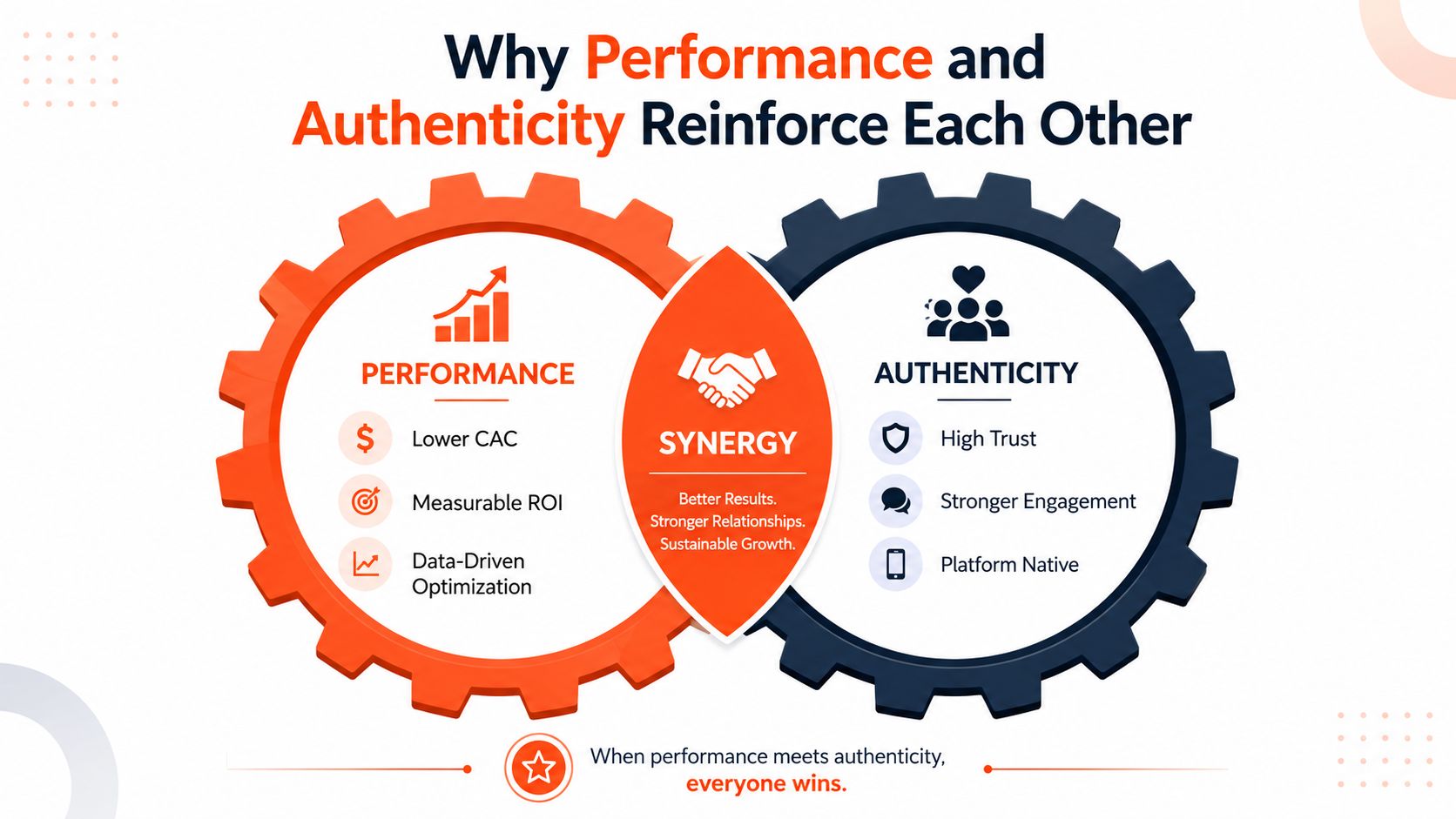
Trust still requires careful handling. Recent trust research found that 77% of consumers favored influencer-created content over professionally scripted ads, while Harvard Business Review summarized a sharper concern: 88% of consumers say authenticity matters, yet nearly half believe most influencers are fake and more than a third think influencers misrepresent themselves or the products they endorse. (IZEA trust research)
That contradiction changes the brief. A creator shouldn't be asked to pretend that every product is a lifelong favorite. The content needs a credible reason for the partnership, an honest explanation of use, and a disclosure that doesn't try to hide the commercial relationship.
The trade-off between reach and credibility
Broader creators can create a large awareness event, but the recommendation may feel less personal. A portfolio of micro and niche partners usually produces more creative variation and less concentrated reach, while giving the growth team more opportunities to learn which audience contexts and messages convert.
Longer partnerships can strengthen that effect. Repeated product use gives the creator time to answer objections, show results, and integrate the offer into recurring content. One-off placements may generate a spike of attention, but they give the audience less evidence that the creator would mention the product outside a paid obligation.
Industry coverage reports that 80% of brands maintained or increased influencer budgets in 2026, 47% raised them by 11% or more, and 73% preferred micro and mid-tier creators. The same coverage notes that only 49.2% of brands planned to increase spend in another benchmark, while creator participation in brand deals reportedly fell from 94% in 2024 to 78% in 2025. Together, those figures point to selective professionalization, not automatic expansion. (PR Newswire influencer marketing data)
Frequently Asked Questions
What is an influencer content approval workflow?
An influencer content approval workflow is a structured process that moves creator content through distinct stages—from submission and initial review to legal compliance checks and final approval. It replaces informal email chains with tracked status fields, ensuring every piece of content is reviewed, compliant, and ready to publish without delays. Industry guides suggest breaking this down into eight clear steps, including goal setting and performance tracking (Source: Hootsuite blog).
How do I track deliverable status in an influencer campaign?
Deliverable status is tracked using a schema that logs each stage: Draft, In Review, Approved, or Rejected. Key data fields include the submitter, timestamp, revision count, reviewer role, and feedback comments. This visibility lets teams identify bottlenecks and manage multiple creator relationships efficiently.
What fields should a campaign deliverables data model include?
A robust campaign deliverables data model includes: deliverable ID, creator ID, platform, content type, submission timestamp, current status, approver role, feedback history, revision count, compliance flags, and usage rights confirmation. These fields enable per-creator reporting and budget reallocation.
Why do approval workflows reduce compliance issues?
Formal approval systems catch 73% more compliance issues before publication than unstructured processes (Source: Swydo guide). By routing content through legal and brand checks before go-live, teams prevent costly takedowns, FTC violations, and brand safety incidents that damage campaign ROI.
How many approval rounds are typical in influencer campaigns?
Brands average 2–3 approval rounds before final acceptance. Optimized workflows with clear briefs and automated pre-screening can cut approval time by 30–50%, allowing campaigns to launch faster while maintaining quality control.
What’s the difference between nano, micro, and macro influencers for conversions?
Nano and micro creators (1K–100K followers) typically drive higher conversion rates because their audiences are niche-specific and highly engaged. Mid-tier creators (100K–500K) offer a balance of reach and credibility. Macro influencers (500K+) excel at awareness but often have lower conversion rates due to broader, less targeted audiences.
Launch Checklist and Pitfalls to Avoid
A launch document should let another operator understand the campaign without opening scattered messages and spreadsheets. Keep the following items in one place:
- Objective and KPI: State the conversion event, allowable cost, reporting window, and secondary awareness measures.
- Creator shortlist: Record audience fit, category relevance, recent engagement quality, content format, and previous sponsorship notes.
- Contract terms: Confirm deliverables, payment, disclosure, exclusivity, approval process, and usage rights before production.
- Tracking map: Assign a unique link, code, UTM structure, landing page, and reporting owner to every creator.
- Launch schedule: Include review dates, publication windows, monitoring responsibility, and the weekly optimization meeting.
- Reallocation rule: Decide what evidence triggers more spend, a creative revision, or a pause.
The quiet budget drains are predictable. A vague KPI makes optimization subjective. Unsigned usage rights can block paid amplification. Shared promo codes corrupt creator-level reporting. A team that waits until wrap-up to review results loses the chance to move money while the campaign is still live.
Run a 48-hour post-launch audit covering tracking fidelity, creative compliance, and disclosure language. Check that every link resolves, every code registers, and every live post contains the agreed disclosure. Flag weak performers early, but don't pause solely on shallow delivery data when the creator is designed for consideration rather than immediate conversion.
Audience complaints also need an owner and a response path. Engineering and support teams dealing with unusual campaign-related issues may find this resource on Influencer Complaint Rescue for engineers useful when they need to document, triage, and resolve complaints without losing the campaign context.
Social Cloud helps growth teams plan creator campaigns, vet partners, manage briefs and compliance, and connect each placement to tracked clicks, conversions, and revenue across YouTube, Instagram, TikTok, and Twitch. Visit Social Cloud to discuss a forecast-led campaign with per-creator attribution and weekly performance iteration built into the operating model.
For additional platform comparisons, SuperX maintains an updated list of the best influencer marketing platforms for 2026, covering features, pricing, and workflow capabilities.