
Yes, YouTube Shorts can pay, but only after your channel clears the YouTube Partner Program thresholds, and Shorts Feed ad revenue specifically needs 1,000 subscribers plus 10 million qualified public Shorts views in the previous 90 days. Views alone don't move money into your account.
The most popular advice on this topic says the opposite. Post Shorts, stack views, and the ad revenue follows at some tidy rate per thousand. That framing survives because it's simple, not because it's accurate. A channel can sit inside the partner program, publish to millions of viewers, and still collect nothing from the Shorts Feed, while a smaller channel in a strong ad market earns more than its view count suggests. So does YouTube Short pay? Sometimes, later than people expect, and for reasons that have almost nothing to do with the size of the number under your video.
Table of Contents
- Whether Your Channel Qualifies for Shorts Revenue
- How the Shorts Payout Pool Works
- What One Million Shorts Views Actually Pays
- Which Views Count Toward Eligibility and Earnings
- Other Ways Creators Earn From Shorts
- What Brands Should Measure in Shorts Campaigns
- Decide Where Shorts Fits Your Plan
Whether Your Channel Qualifies for Shorts Revenue
Payment on Shorts isn't automatic, and the conditions hide in three places: subscriber count, qualified views or watch hours, and whether you've accepted the Shorts Monetization Module after joining the partner program. The YouTube Partner Program requirements set the full threshold at 1,000 subscribers plus either 4,000 valid public watch hours from long-form video in the previous 12 months or 10 million valid public Shorts views in the previous 90 days.
That's the bar for ad revenue and YouTube Premium revenue. YouTube also runs a lower bar that most explainers flatten into the first one, which is where creators get hurt.
YPP tiers and what each one provides
| Tier | Requirements | What it unlocks |
|---|---|---|
| Lower entry tier | 500 subscribers, 3 public uploads in 90 days, plus 3,000 long-form watch hours in 365 days or 3 million Shorts views in 90 days | Memberships, Super Thanks and shopping; no Shorts Feed ad sharing |
| Full YPP for Shorts | 1,000 subscribers, plus 10 million qualified public Shorts views in 90 days, plus Shorts Monetization Module accepted | Shorts Feed ad revenue sharing and YouTube Premium revenue |
| Long-form YPP path | 1,000 subscribers, plus 4,000 valid public watch hours in 12 months or 10 million valid Shorts views in 90 days | Ad and Premium revenue sharing |
The lower tier is the confusing one. It needs 500 subscribers, three public uploads in 90 days, and either 3,000 long-form watch hours in 365 days or 3 million Shorts views in 90 days, and it opens memberships, Super Thanks and shopping. It does not, by itself, hand you a cent of Shorts Feed ad revenue.
Where creators get stuck: selling through Shopping at 500 subscribers feels like monetization has arrived, but the Shorts Feed pool stays locked until the 10 million view mark is cleared and approved.
Views don't override any of this. A channel can pull millions of views and earn nothing from Shorts ads because it sits below the full threshold or never accepted the terms. Policy bites too: ineligible or policy-violating views generate no revenue at all, even when they appear in the public count.
The five-minute check in YouTube Studio
Four numbers answer the whole question, and you can pull them in one sitting.
- Subscribers. 1,000 is the Shorts ad bar, 500 is the lower tier.
- Public uploads in the last 90 days. Three is the lower-tier minimum, and a dormant channel fails on this alone.
- Qualified Shorts views over the last 90 days. Compare against 10 million for ad sharing and 3 million for the lower tier.
- Module status. Confirm the Shorts Monetization Module is accepted and no policy strike or copyright claim sits across the window.
Founders tend to hit this from a different direction, publishing Shorts as a distribution test rather than an income plan. This breakdown of whether Shorts pay founders in 2026 walks the same thresholds from that side of the table.
How the Shorts Payout Pool Works
Shorts got a real payout system on February 1, 2023, when YouTube converted Shorts payments into a formal revenue-sharing program and moved away from the earlier era in which many creators leaned on promotional funds and outside sponsorships, as YouTube's launch announcement describes.
Follow the money in four steps
The ads you see while swiping run between videos in the Shorts Feed. None of them sits inside your individual Short, and that single detail kills the idea of a personal CPM on Shorts.
Each month, YouTube gathers Shorts Feed advertising revenue into a Creator Pool, accounts for music-licensing costs, then distributes what remains according to each eligible creator's share of qualified Shorts views within that country or market. The creator keeps 45% of the allocated amount, whether or not the Short uses music.
Here's the whole sequence in one view.
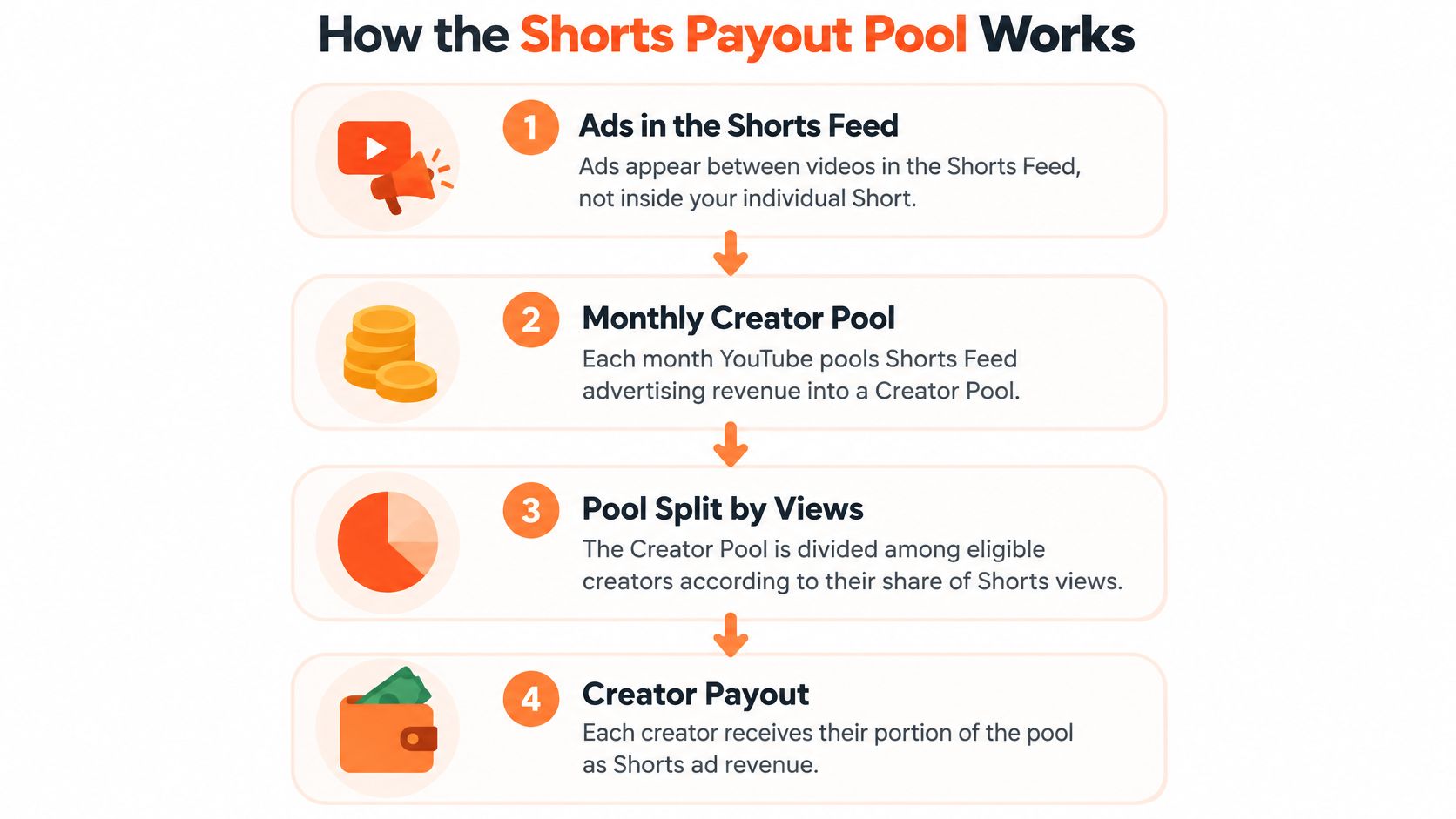
Take a pool holding $100,000 after music costs, and a creator with 1% of qualified views in their market. The allocation is $1,000, and the creator keeps $450. That's an illustration of the arithmetic, not a forecast and never a rate. Change the pool size or the percentage of views and every number moves with it.
Why 45% is not a per-view rate
The percentage applies to an allocation, not to a price per thousand views. Advertiser demand in that month, viewer geography, whether the content is suitable for advertisers, and the total number of creators drawing from the same pool all shift the total before your 45% is calculated. More creators and more views competing for one bucket makes each slice thinner.
Read it as a shared bucket, because that's what it is. Your share of qualified views decides your slice of a fixed sum, and the sum itself is set by how much advertisers spent on Shorts in your market that month.
Check two things monthly rather than one. First, qualified views by country in your geography report, since a view from a high-demand market is worth more than a view from a low-demand one. Second, whether your revenue moved with the pool or against your own view count. If views rose and payout fell, geography or competition explains it far more often than a policy change does.
For brands and agencies, this is the cleanest reason to keep creator sponsorships, affiliate links and tracked conversions in a separate ledger from YouTube's platform payout. The pool pays the creator, not the campaign.
What One Million Shorts Views Actually Pays
One million Shorts views can pay under $200. Creator-reported Shorts RPMs have come in below $0.20 per 1,000 views, against roughly $3 to $6 for long-form video, which is where that under-$200 figure comes from, and YouTube's Shorts revenue-share policy documents the mechanism without publishing a rate that would contradict it.
Why there's no official number
YouTube publishes how the money is split, not what a view is worth, so every figure in this section is either reported by creators or derived from published percentages. Advertiser demand, viewer geography, music usage, content suitability and the number of creators competing for the pool all move the total. No universal rate exists for YouTube to publish, which means anyone quoting a single number per thousand views is quoting a month, a market or a guess.
Estimated Shorts earnings per 1 million views
| Scenario | Shorts RPM basis | Estimated earnings per 1M views |
|---|---|---|
| Reported low end | under $0.20 per 1,000 views | under $200 |
| AIR range, low | 3% of a $3 to $6 long-form RPM, about $0.09 to $0.18 per 1,000 views | about $90 to $180 |
| AIR range, high | 14% of that same range, about $0.42 to $0.84 per 1,000 views | about $420 to $840 |
The middle and bottom rows come from an AIR Media-Tech analysis of 274 channels published in 2026, which found Shorts RPM landed at 3% to 14% of long-form RPM across almost every niche. Apply those percentages to the long-form band and the per-million earnings fall out, and the spread between $90 and $840 for the same million views is the entire story.
Practical rule: quote Shorts revenue as a range tied to a market and a month. When someone hands you one number per 1,000 views, ask which country and which month produced it.
What moves your number
- Audience geography. Views from markets with strong advertiser demand pull the pool share up.
- Advertiser demand in the month. Seasonal budgets change the size of the bucket before anyone is paid.
- Music use. Licensed tracks create costs that come out ahead of the split.
- Content suitability. Limited-ads topics earn less even when the views are enormous.
- Pool competition. Every additional qualifying creator dilutes your share of qualified views.
Build a scenario instead of looking up a rate. Take the three countries that supply most of your qualified views, apply a per-market range, and then track your own realized RPM monthly until the estimate is replaced by your own history.
Which Views Count Toward Eligibility and Earnings
The most expensive misconception in Shorts monetization is that bought views count toward qualification. They don't. Paid-ad views are excluded from the partner program thresholds, and YouTube may run ads against a channel that hasn't qualified without passing that channel a share, as the partner program eligibility rules confirm.
Run the arithmetic on a real case. A channel with 8 million organic Shorts views across 90 days and 3 million from paid promotion sits at 8 million qualified, which leaves it 2 million short of ad sharing. The dashboard reads 11 million, and the dashboard is not what gets reviewed.
Buying promotion still has a job. It buys reach, and reach sometimes pulls in the follow-on organic viewing that does count. Treat it as a distribution tool and never as an eligibility shortcut, because the two numbers live in different places in your analytics.
The filters a view has to pass
- Advertiser-friendly content. A view attached to a limited-ads topic earns nothing regardless of volume.
- Original material with commercial rights. Footage you didn't shoot or license sits outside the pool.
- Monetization policy compliance. Strikes and warnings on the window remove views from the count.
- Remixes and licensed clips. Repurposed content must clear the same rights rules before its views count at all.
The four-step view audit
- Split paid from organic in analytics, using campaign tags on every promoted link.
- Check policy warnings and copyright claims in Studio for the last 90 days.
- Confirm rights on every clip you didn't film, including music beds.
- Recount qualified views against the 10 million threshold and write the gap down.
Keep the paid number visible in your own reporting afterward, because it explains the spikes that will never convert into revenue share.
Other Ways Creators Earn From Shorts
Shorts income rarely comes from the pool alone. For most creators, the larger money sits in what a Short sends people toward: a membership, a product page, a sponsor brief or a long-form video that carries mid-roll ads.

Shorts income options compared
| Option | Who pays | What drives the amount |
|---|---|---|
| Shorts Feed ad share | YouTube, from the monthly pool | Qualified views, geography, advertiser demand, music use |
| Memberships and Super Thanks | Viewers | Size and engagement of the loyal audience |
| Shopping and affiliate links | Shoppers and retailers | Product fit and conversion rate |
| Brand sponsorship | Brand | Audience fit, past sponsored results, agreed deliverables |
| Long-form ad revenue | YouTube, CPM-based | Long-form watch time and RPM, reported at $3 to $6 for long-form |
Memberships and Super Thanks suit channels with a recognizable face and a repeat audience; they're slow to start and steady once they do. Shopping fits product-led channels where the Short is an unboxing, a comparison or a fit check. Sponsorship pricing follows audience quality and the results of your last sponsored slot far more than it follows raw Shorts views, which is why two creators with identical view counts can quote wildly different fees.
Repurposed and remixed clips carry a second risk beyond rights: the same eligibility filters apply, so a compilation of other people's footage can stack views and earn nothing. Creators who avoid appearing on camera often build Shorts from stock and generated assets, and this collection of faceless video generator articles covers the production side, though the rights checks still come first.
If you want to see the format built end to end, the walkthrough below is a useful reference.
Three decision points decide which stream to try first.
- Audience size. Small, engaged audiences respond to memberships faster than thin, broad ones do to affiliate links.
- Buying power in your niche. Beauty, tech and home audiences convert on product links; comedy audiences rarely do.
- Disclosure rules. Sponsored Shorts need clear disclosure, and that affects which brand categories will work with you at all.
Pricing a sponsored slot is its own exercise, and this creator rate card guide is the version to read before you quote a number. Then pick one stream, run it for 30 days, and judge it on tracked outcomes before adding a second.
What Brands Should Measure in Shorts Campaigns
The expensive brand mistake is treating Shorts view counts as a payout proxy or as evidence of return. Three ledgers stay separate: YouTube's platform payout to the creator, the fee you pay the creator, and the sales you can attribute. Model them separately or the campaign can't be read at all.
So the measurement list starts with realized RPM by market and content type, then moves to retention, clicks and tracked conversions. Every placement Social Cloud runs carries a tracking link and a promo code, and clients see views, click-through rate, conversions and ROAS per creator every week rather than in a closing deck.
Set the target before the test
Forecasting comes first. Pick a target cost per install or cost per acquisition, an expected view range, and a budget split per platform before any money moves, which is how we scope campaigns before the first creator is briefed.
Then test small across several creators with identical deliverables. Compare creator by creator instead of averaging the campaign, because averages hide the finding you need. Say two creators each deliver the same view count from the same brief: one produces a steady run of code redemptions and the other barely moves the counter, and the view totals alone would have you rebook the wrong person.
Report weekly, not at the end: views, click-through rate, conversions and return on ad spend per creator. A campaign you can't break down by creator can only be described, never optimized.
Scale the creator who converts, cut the one who doesn't, and rerun the test with a sharper brief. If you're still deciding which numbers belong in that weekly sheet, this guide to influencer marketing KPIs covers the set worth tracking.
Decide Where Shorts Fits Your Plan
Three situations, three different moves. Below the full threshold, your job is reaching the lower tier and growing organic qualified views, using the Studio check from earlier. Qualified but earning little from Shorts, test routing that audience into long-form episodes and watch whether RPM rises. Running Shorts as a brand, set a target cost per outcome and test before you scale.
If your Shorts are music-led, the production side matters as much as the payout side, and this guide to making vertical music videos with AI covers the workflow. Still splitting budget between platforms? This comparison of TikTok and YouTube for creator campaigns makes the tradeoff concrete.
For teams that want the work handled, Social Cloud arranges long-form integrations and Shorts, screens creators for audience quality and past sponsored results rather than follower counts, and sets a target CPI or CPA with the budget split before spend begins.
- Run the eligibility checklist in Studio and confirm organic views are separated from paid views.
- Pick one income stream from the comparison table and commit to it for 30 days.
- Review the result against your realized RPM or your cost-per-outcome target, then keep or cut.
One question decides next month's plan: which income stream or campaign outcome cleared its target?
If you want Shorts to earn something you can forecast rather than something you explain after the fact, Social Cloud plans and runs the placements that make it measurable. We arrange long-form integrations and Shorts with creators screened for audience quality and past sponsored performance, attach a tracking link and promo code to every placement, and report views, CTR, conversions and ROAS per creator each week so the next decision is based on outcomes instead of view counts. Visit Social Cloud to set a target cost per outcome and get a forecast back before any money is spent.