
61% of investors aged 18 to 34 say they've made investment decisions based on social media personalities. That makes finance influencer marketing a real acquisition channel, but it also makes compliance and attribution essential.
The old model treated creators as an awareness add-on. A finance brand would pay for reach, approve a few talking points, and judge success by views or clicks. That approach breaks down when a creator's recommendation can influence broker choice, app adoption, deposits, or trading behavior.
The operational challenge is harder than finding someone with a finance audience. You need a campaign system that works across jurisdictions, preserves the creator's credibility, records every approval, and connects exposure to qualified customer actions over a buying cycle that rarely ends with the first click.
Table of Contents
Why Finance Influencer Marketing Matters Now
The headline finding changes the budget conversation. The FINRA Foundation research brief reports that 61% of investors aged 18 to 34 had made investment decisions based on recommendations from a social media personality. Across all surveyed investors, the figure was 26%. The same brief found that 29% of investors used social media and 26% followed finfluencers, which means creator-led finance content has moved beyond hobbyist communities.
Consider a young investor comparing mobile brokers. They may discover a product through a short video, watch a longer explanation later, read comments, visit a comparison page, and only then open an account. The creator didn't necessarily close the sale, but their content may have established trust before the brand's conversion channel appeared.
That distinction matters to growth teams. A campaign can influence demand without producing the final tracked click. If reporting credits only the last interaction, finance influencer marketing looks less effective than it is. If reporting counts every view as success, it looks more effective than it is.
Practical rule: Treat creators as demand initiators and educators, not just as coupon distributors.
Regulation made the channel a board-level issue
Regulators have responded because financial promotions carry consequences that ordinary consumer endorsements don't. The SEC Marketing Rule took effect in the United States on 4 November 2022. It permits testimonials and endorsements, including paid finfluencer endorsements, for registered investment advisers, but requires disclosures, written agreements, and supervision.
FINRA's first enforcement case involving a broker-dealer's social-media finfluencer program followed in 2024, with an $850,000 fine for communications that weren't fair and balanced, alongside supervision and recordkeeping failures. Australia's ASIC Information Sheet 269 has been in force since March 2022, adding to the broader move toward tighter oversight.
The lesson isn't that regulated brands should avoid creators. It's that creator marketing now belongs inside the same operating model as other financial promotions. Legal review, disclosures, evidence capture, and performance measurement need to exist before the first brief goes out.
A campaign that earns attention but can't prove what was said, who approved it, or which users acknowledged the relevant risk information isn't a growth asset. It's an unresolved liability with media spend attached.
Compliance and Brand Safety in Finance Creator Campaigns
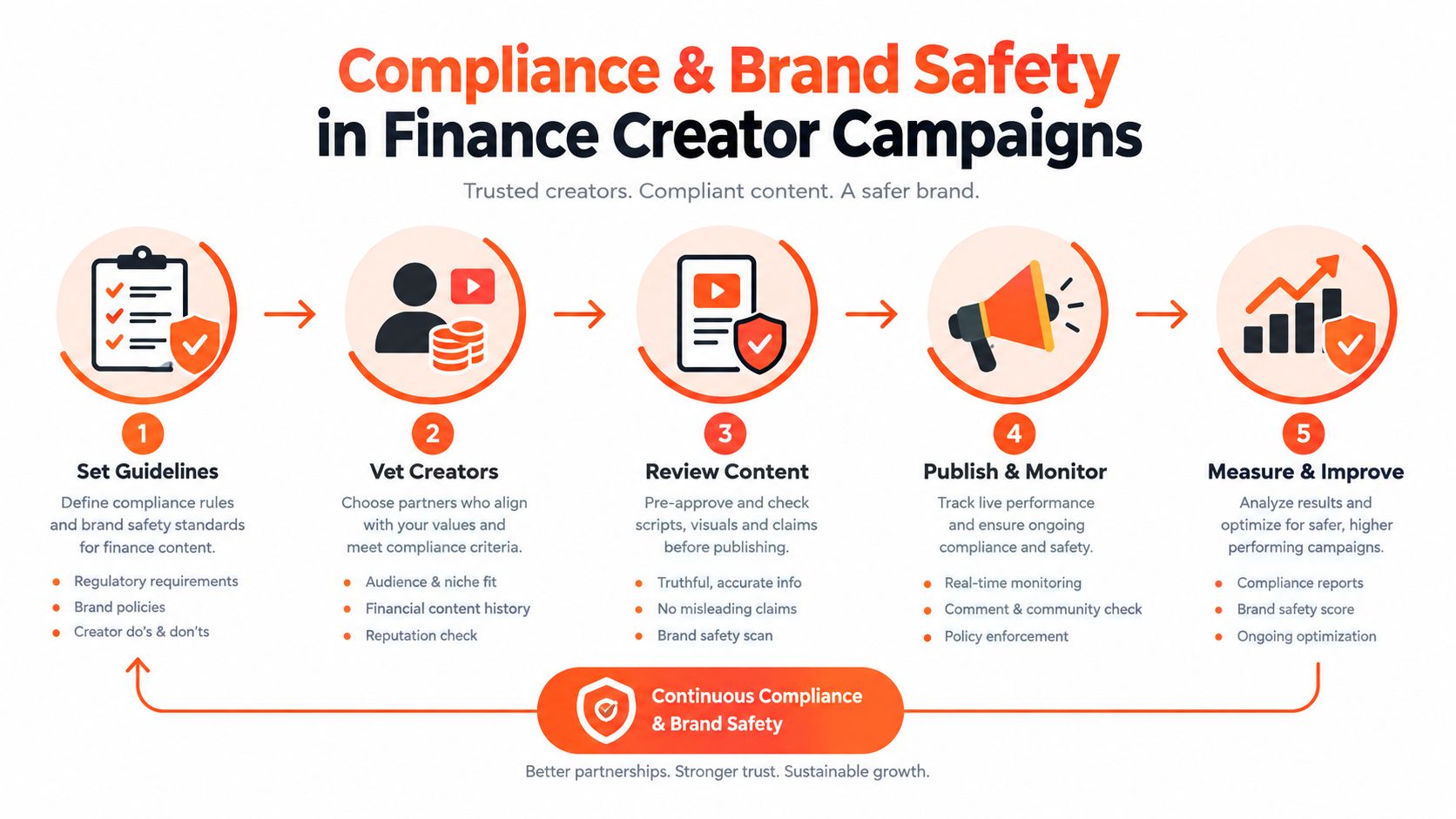
Compliance shouldn't arrive as the final approval gate after a creator has filmed the content. By then, the script, format, claims, and publishing schedule may already make revisions expensive or impossible. Build the governance model into creator selection, briefing, production, publishing, and reporting.
The stack should answer four questions for every placement:
- What did the creator disclose?
- What risk information did the audience see and acknowledge?
- Who approved the content, and when?
- Can the brand reconstruct the customer journey later?
Build one operating spine, then add market rules
A practical system starts with a global baseline. Define prohibited claims, required disclosures, risk language, escalation rules, approval ownership, usage rights, and record retention in one master playbook. Then create market-specific overlays instead of asking each country team to invent a separate workflow.
The baseline should capture:
- Disclosure visibility: Record whether the paid relationship appeared clearly in the content and preserve the published version.
- Risk acknowledgment: Where the product or promotion requires it, connect the audience interaction with the relevant risk statement or landing-page acknowledgment.
- Approval evidence: Store the brief, script, edits, final asset, approver, timestamp, and publishing destination.
- Creator controls: Define what the creator can personalize and what they must not change, especially claims about returns, safety, eligibility, or product outcomes.
- Audit trail: Retain links, screenshots, versions, contracts, comments, and takedown decisions in a searchable record.
A specialized fintech advertising agency can help coordinate these steps, but the brand still owns the regulatory obligation. Outsourcing execution doesn't outsource accountability.
Design for the strictest realistic scenario
Market rules can change quickly. The UAE introduced a dedicated finfluencer licence in May 2025, while Hong Kong's SFC launched a thematic inspection in April 2025 and said it would issue guidance for firms engaging finfluencers and digital platforms. The coverage of these regulatory developments also describes enforcement against unauthorized finfluencer activity.
That environment favors modular campaigns. Use a creator brief that separates universal claims from jurisdiction-specific language. Route the local version to the appropriate reviewer, restrict publishing territories where necessary, and make takedown responsibility explicit in the contract.
Legal bottlenecks usually come from unclear ownership, not from review itself. Give compliance a defined service level, provide complete context at submission, and let creators work from pre-approved claim libraries. The result is more control without turning every post into a bespoke legal project.
Creator Selection and Vetting for Finance Brands
Follower count is a weak starting filter for a regulated finance campaign. The useful question is whether a creator can explain the product accurately to an audience that matches your customer profile, in a style that survives scrutiny without losing authenticity.
Start with audience quality. Review geography, age bands, language, interests, and signs of artificial or irrelevant engagement. A creator with a smaller but concentrated audience may be more useful than a broad account whose followers sit outside your eligible markets.
Then inspect the content itself. Look for whether the creator explains uncertainty, distinguishes education from advice, and avoids implying guaranteed outcomes. A polished feed can still reveal risky habits in older sponsored posts, captions, comments, or live streams.
Use a four-part vetting screen
Audience fit comes first. Ask whether the creator reaches eligible customers in the markets where the product can be offered. Check audience overlap with existing CRM segments, not just the creator's self-described niche.
Communication discipline matters next. Review how the creator handles corrections, negative comments, market volatility, and questions about losses. Finance audiences notice overconfidence quickly, and compliance teams notice it too.
Sponsored history reveals operating risk. Examine earlier brand partnerships for disclosure placement, claim accuracy, delivery reliability, and whether the creator followed required edits. A creator who resists basic approval controls may create more work than their reach justifies.
Product alignment completes the screen. A creator known for speculative trading may be a poor fit for a conservative savings product. The issue isn't popularity. It's whether the creator's established voice supports the product's risk profile.
A simple scorecard can rate each candidate on audience relevance, regulatory maturity, creative fit, sponsored execution, and measurement readiness. Keep the evidence behind every score so the decision doesn't collapse into personal preference.
The finance influencer selection guidance is useful as a starting point, but don't treat any directory or network as a substitute for your own review. Ask for historical audience data, examples of approved finance content, and permission to inspect the final placement before publication.
Compare creators by role, not status
A YouTube educator may be ideal for a product explainer but too slow for a time-sensitive app-install push. A TikTok creator may generate strong conversation while requiring tighter controls around compressed risk language. A niche newsletter or podcast host may produce fewer visible interactions but influence a high-intent audience.
The right portfolio balances trust, reach, creative flexibility, and measurement clarity. Select each creator for the job they can perform, then price and brief them around that job.
Campaign Formats by Platform
Platform choice should follow the customer action you need, not the audience size available. Finance brands often make the mistake of adapting one approved script everywhere. That creates content that feels unnatural on fast platforms and too shallow on channels where people expect explanation.
| Platform | Best Format | Ideal For | Attribution Window |
|---|---|---|---|
| YouTube | Educational integrations, reviews, explainers | Trust building and considered decisions | Longer, because viewers may research before converting |
| Reels, Stories, carousel-supported explanations | Awareness, reminders, and retargetable interest | Medium, with links and saved content supporting later action | |
| TikTok | Native short-form education and creator-led demonstrations | Discovery and conversation with younger audiences | Often indirect, requiring codes, surveys, and assisted-conversion analysis |
| Twitch | Live discussions, community integrations, and demonstrations | Real-time engagement and product familiarity | Longer when viewers return after the stream |
YouTube gives creators room to explain eligibility, fees, limitations, and use cases without forcing every idea into a compressed format. The trade-off is that viewers may take several sessions before acting, so a last-click report will under-credit the placement.
Instagram works well for a sequence. A Reel can introduce the problem, Stories can answer objections, and a landing page can handle the detailed disclosure. The format supports repeated exposure, but you need version control across every asset.
TikTok rewards a creator's normal delivery. A script that sounds like an approved television commercial will often perform poorly in a feed built around personal commentary. Give the creator approved facts, mandatory disclosures, and prohibited claims, then leave room for their established rhythm.
Twitch offers a different advantage. Live formats let audiences ask questions in real time, but that openness creates a larger moderation and escalation burden. Prepare responses for predictable questions and define when the creator must defer to official product information.
The buying cycle should determine the reporting model across all four channels. Use platform-native metrics to diagnose creative quality, but connect the campaign to account opens, qualified leads, funded accounts, app installs, or deposits wherever the product journey allows it.
Measurement and Attribution Frameworks
Last-click attribution is especially misleading in finance. A customer may first encounter a creator, return through a search result, compare products on a review page, click a retargeting ad, and complete an application through a direct visit. The final click is easy to record, but it doesn't explain what created the initial demand.
A finance performance guide recommends attribution windows of 90 to 180 days for retail-style campaigns and 12 to 24 months for institutional lead generation. Those windows aren't universal settings. They're a reminder to match measurement to the time it takes your audience to make a decision, as described in the finance influencer attribution framework.
Track the journey at placement level
Every creator placement should have its own tracking structure. Use standardized UTM parameters, creator-specific landing pages where appropriate, promo codes, and post-purchase or post-application surveys asking how the customer first heard about the product. Capture exposure and conversion data in the CRM rather than leaving it inside a platform dashboard.
Track the stages that matter to the business:
- Attention: Views, watch time, completion behavior, and meaningful comments show whether the format held interest.
- Intent: Landing-page visits, product-page depth, calculator use, and eligibility checks show active research.
- Qualification: Applications, verified leads, or approved users separate curiosity from commercial value.
- Activation: Funded accounts, app installs, deposits, or first transactions connect the campaign to the intended outcome.
- Assistance: Assisted conversions reveal creators that influence decisions without receiving the final click.
The analysis of what causes campaign conversions can help teams think beyond the last interaction. In practice, combine platform data with CRM events, exposure logs, audience overlap, and customer feedback instead of forcing one source to answer every question.
Make incrementality the decision layer
Tracked conversions tell you who interacted with a measurable asset. They don't prove the creator caused the action. To estimate incrementality, compare exposed audiences with a credible holdout where possible, stagger creator launches, or test matched markets and audience groups. Keep the test design consistent with privacy requirements and the product's eligibility rules.
Finance CPMs can reach $20 to $60, among the highest consumer-category ranges cited in a 2026 finance influencer guide (industry rate context). At that cost, measurement errors distort budget allocation quickly. A creator with fewer direct conversions may still generate valuable assisted demand, while a creator with many cheap clicks may produce low-quality traffic.
Report both outcomes together: direct conversions, assisted conversions, qualification rate, activation rate, cost per qualified action, and evidence of incremental lift. That gives finance leaders a basis for scaling rather than a flattering view-count summary.
Outcome-Linked Pricing Models
Flat fees are easy to administer, but they place most performance risk on the brand. Pure CPA deals shift risk toward the creator and can discourage the education and trust-building work that happens before a customer converts. For finance campaigns, a hybrid model usually handles the trade-off better: a defined base fee covers production and compliance effort, while a performance component rewards agreed business outcomes.
The contract needs more precision than “pay for results.” Define the qualifying event, attribution window, source of truth, approval status, invalid-traffic rules, cancellation terms, and payment timing. A funded account may be more valuable than an app install, but it may also take longer to verify. A qualified lead may be the right event for one product and a weak proxy for another.
Compare the main structures
Flat fee: Predictable for the creator and simple for procurement. It works for awareness objectives, but the brand carries the full risk if the audience or creative underperforms.
Pure performance: Efficient when the conversion event is clear and tracking is reliable. It can fail when the buying cycle is long or when creators are expected to provide substantial educational production before any action occurs.
Hybrid fee: Shares risk while protecting creator capacity. Set a modest base fee for approved deliverables and add payment for qualified actions, with a ceiling or review point that keeps spend controllable.
Usage-rights premium: Separate paid amplification, whitelisting, or extended content rights from the creator's original placement. Otherwise, a campaign can appear affordable while the brand expands the media value it expects from the creator.
Negotiation principle: Pay for the work the creator controls, then add upside for the customer behavior the campaign is designed to influence.
A model that rewards only views can encourage broad, low-intent content. A model that rewards only immediate conversions can push creators toward aggressive claims. Tie incentives to quality gates, compliance completion, eligible geography, and verified downstream actions.
Before negotiating, review influencer marketing agency pricing with finance, legal, and procurement in the same room. The cheapest fee structure isn't necessarily the cheapest campaign once review cycles, rights, tracking, reporting, and remediation are included.
Case Studies and Ready-to-Use Templates
The most useful documented example comes from a 2026 Filene FiLab test involving 13 credit unions. The participating organizations used short-form campaigns across Instagram and TikTok, moving through goal definition, creator sourcing, content creation, and post-campaign measurement. The Filene account of the test reports that 11 of the 13 had never worked with an influencer before, which makes the operational lesson more relevant than a polished enterprise case study.
The reported outcomes included more than 300,000 total impressions, approximately 37,000 views per campaign, and an average campaign spend of $4,300. Redwood Credit Union's campaign generated 297 click-throughs, representing 29% of its total website traffic on launch day. Treat those results as documented context, not a forecast for your own program. The repeatable pattern was structured testing, creator fit, early tracking, and enough creative freedom for the content to feel native.
Use this campaign brief before outreach:
- Objective: Name the business action, not just the platform metric.
- Audience: Specify eligible markets, customer characteristics, and exclusions.
- Approved claims: List permitted product facts and required qualifiers.
- Prohibited claims: Include returns, guarantees, urgency, and advice boundaries.
- Deliverables: Define format, duration, revisions, disclosure placement, and rights.
- Measurement: Assign links, codes, CRM events, survey questions, and attribution windows.
- Governance: Name the approver, escalation contact, archive owner, and takedown process.
For creator review, keep a separate checklist covering audience geography, sponsored-post history, disclosure behavior, comment quality, risk language, brand alignment, and response to feedback. For the post-campaign report, separate direct conversions from assisted conversions and record what changed in the next brief.
Social Cloud plans, runs, and measures finance creator campaigns across YouTube, Instagram, TikTok, and Twitch, with vetted creator selection, compliance coordination, placement-level tracking, and outcome-linked fees. If you need a campaign forecast or a multi-market operating plan, visit Social Cloud and discuss the product, jurisdictions, and customer actions you need to measure.