
The biggest finance influencer isn't automatically the best campaign buy. Reach can create awareness, but performance depends on whether the creator's audience has the right intent, whether the format explains your offer clearly, and whether you can attribute the next action.
This roundup evaluates seven supplied finance influencers as measurable campaign partners, not as a popularity ranking. Each profile considers audience fit, platform format, funnel role, creative suitability, regulatory sensitivity, and the quality of outcomes a performance team can track.
Before outreach, define the conversion event. It might be an app install, approved application, funded account, first transaction, or qualified lead. Then request current audience and engagement data, build a platform-specific brief, and give every placement its own tracking link, promo code, or post-purchase survey. The broader principles of influencer marketing explained matter here, but finance requires stricter control over claims, disclosures, and attribution.
Social Cloud is a relevant example of an end-to-end partner. It combines creator selection, forecasting, compliance, campaign execution, and placement-level reporting. That can help teams move beyond “How many views did we buy?” and answer “Which creator generated qualified action at an acceptable cost?”
Table of Contents
1. Social Cloud Services
Social Cloud suits finance teams that need creator activity tied to measurable acquisition. Its workflow covers creator selection, campaign planning, creative guidance, compliance, contracting, and reporting across YouTube, Instagram, TikTok, and Twitch. Each activation can carry its own tracking link, promo code, or survey, allowing marketers to compare creators instead of reading one blended traffic total.
The platform draws from a vetted network of 12,000+ creators, screened for audience quality, brand fit, and past sponsored performance. It reports a forecast within 48 hours of a brief and describes typical go-live timing of 3 to 5 weeks. Those planning references still depend on creator availability, legal approval, product readiness, and market requirements.
Best fit for measurable finance programs
Creator selection should follow audience intent, format, and funnel role. A budgeting app may need short-form reach and a low-friction install. A brokerage or credit product may require a longer explanation, eligibility language, and additional compliance review. Social Cloud can support long-form integrations, short-form variants, live formats, trends, and amplification such as TikTok Spark Ads.
Its outcome-linked pricing combines a base fee with a performance component tied to agreed installs, conversions, or ROAS. That can align incentives more closely than a flat awareness fee, but it also raises the standard for measurement. Define the conversion event, attribution window, approval process, and data-sharing rules before launch.
In recent fintech programs, placement-level tracking was used to separate YouTube integration conversions from TikTok Spark Ads assists before reallocating budget. That kind of breakdown is more useful than ranking creators by views alone.
Practical rule: Treat every creator placement as its own acquisition channel. If you cannot separate the link, code, audience, and conversion window, you cannot make a reliable renewal decision.
The operating model is most useful for campaigns involving regulated claims, usage rights, several platforms, and a defined conversion event. Direct outreach may be faster for a small one-off placement, while managed coordination can reduce handoffs across strategy, creator management, compliance, and reporting. Its creator marketing agency model is therefore a better fit for repeatable programs than isolated tests.
Creators assessing monetization options can also review this guide to becoming a tool creator, which outlines product-led paths that may complement sponsorship income.
Learn more through Social Cloud's services.
2. Graham Stephan
Graham Stephan is a strong candidate when the brief needs a finance-native YouTube audience and enough content depth to explain a considered offer. His coverage spans investing, real estate, credit, and macroeconomic news, giving brands several routes into a long-form integration. The main channel also connects with the Iced Coffee Hour podcast, creating room for a campaign that uses both educational video and conversation-led content.
That format suits products where trust and explanation matter more than an immediate impulse click. A brokerage, credit product, financial-planning tool, or real-estate service may benefit from an integrated ad read that gives the creator time to explain eligibility, product mechanics, and the next step. A simple, low-friction offer can still work, but the brief shouldn't force a complex product into a shallow CTA.
Where the format earns its cost
Graham's public sponsor intake makes initial scoping more straightforward. The recurring presence of long-form integrations also gives marketers a useful starting point for understanding how he handles sponsor messaging, tone, and disclosures. Ask for current audience geography, age distribution, device mix, recent sponsored views, click behavior, and category exclusivity before treating historical performance as a forecast.
The likely drawback is cost. A large finance-native YouTube presence usually requires a serious budget, and the price should be judged against qualified conversions rather than headline views. Market commentary can also be polarizing, so compliance teams should review adjacent content, not just the proposed script.
A practical brief should define:
- Conversion event: Choose one primary action, such as a completed application or funded account.
- Message boundary: Pre-approve rates, projections, investment language, testimonials, and risk disclosures.
- Attribution setup: Use a creator-specific link and code, then compare assisted conversions with direct responses.
- Usage rights: Confirm whether the brand can cut the integration into paid social or landing-page creative.
Graham is best for a full-funnel YouTube test where the product benefits from context. He isn't the obvious choice for a tiny awareness experiment or a campaign that needs rapid creative iteration across many short-form variations. For planning guidance on the channel, review this YouTube influencer marketing resource.
Visit Graham Stephan's website for sponsorship and business information.
3. Andrei Jikh
Andrei Jikh brings a more produced, cinematic style to investing and market education. The visual identity can make a sponsored message feel like part of the program rather than an interruption, provided the product gives the creative team enough substance to work with. This is particularly useful for fintech offers that need a clear demonstration, comparison, or narrative rather than a generic endorsement.
His content covers investing and markets, with occasional crypto-adjacent topics. That combination can attract financially engaged viewers, but it also raises the compliance workload for products connected to investing, trading, digital assets, or financial outcomes. The brand needs to separate educational explanation from language that could be interpreted as a recommendation or promise.

Use production quality as a conversion asset
Andrei's visible sponsor history and public business contact streamline the first conversation. They don't remove the need for diligence. Request recent sponsored examples, audience breakdowns, average view ranges, retention information where available, and any category restrictions that could affect your launch schedule.
The creative opportunity is integration quality. A fintech brand could brief a visual explainer, a product walkthrough, or a scenario-based demonstration. The weaker approach would be to send a rigid script filled with claims that don't match the creator's normal pacing. Give the creator a clear promise, approved facts, prohibited claims, required disclosures, and the exact conversion event. Let the production style do the communication work.
A polished integration can improve attention, but attention only becomes performance when the offer, landing page, and tracking path make the next action obvious.
Pricing may be premium when production demands and sponsor demand are both high. Evaluate the placement against contribution margin and conversion quality, not against low-cost reach. If a crypto-related angle is involved, build extra time into legal review and make risk language visible rather than treating it as an afterthought.
Andrei is a good fit for a mid- or lower-funnel fintech campaign with a product that can be shown clearly. He's less suitable when the offer needs a stripped-back, high-volume short-form test or when the legal team can't approve the creative quickly.
Explore Andrei Jikh's business site before preparing a proposal.
4. Minority Mindset with Jaspreet Singh
Minority Mindset, led by Jaspreet Singh, gives performance marketers a broad personal-finance and entrepreneurship context. The brand covers debt, budgeting, markets, business, and macro topics across long-form video and podcast formats. That breadth is useful for top-funnel campaigns, especially when the product serves people who are still framing a financial problem rather than actively comparing providers.
The recognizable identity also helps a campaign travel beyond one narrow product category. A bank, budgeting app, financial education service, or entrepreneurial tool could build a message around financial confidence, better habits, or a practical next step. The offer still needs a precise audience. Broad relevance doesn't mean every viewer is a qualified prospect.
Build around the content pipeline
An active publishing rhythm creates more activation possibilities, but it can also increase ad fatigue. A campaign should avoid repeating the same generic read across every surface. Use the long-form episode for explanation, the podcast for a more conversational treatment, and short-form cuts for reminder exposure or retargeting where usage rights allow it.
Sponsorship pricing isn't public, so the proposal needs to do more work. Include the target audience, campaign objective, desired formats, flight dates, exclusivity needs, approval requirements, and measurement plan. Ask for deliverables and revision rules before discussing a blended package.
The main advantage is approachable communication. That can work well for awareness and consideration, but a broad educational audience may require a second touch before a high-friction conversion. Use a creator-specific landing page that repeats the message from the content, answers common objections, and makes eligibility or product limits easy to understand.
Compliance remains central. Finance education can move quickly into advice, particularly around markets, debt, or product selection. Pre-approve claims and require clear sponsorship disclosures in the content itself. Don't rely on a disclosure buried in a description if the message is delivered verbally in a video or podcast.
Minority Mindset is best for top-funnel reach with a clear path into consideration. It can also support a broader content program, but marketers should watch frequency, audience overlap, and assisted conversion behavior rather than judging the partnership on one last-click report.
Visit Minority Mindset to start a brand conversation.
5. Humphrey Yang
Humphrey Yang is a useful option for brands that need finance explained without a heavy technical tone. His background as a former Series 7/66 financial advisor supports a consumer-friendly approach to investing and personal finance, while his presence across YouTube, TikTok, and Instagram gives marketers more than one format to test.
That mix creates a straightforward funnel design. Use short-form explainers to introduce a problem, a longer video to answer objections, and a direct response path for people ready to act. A single short video may work for a simple app install, but higher-value financial products often need repeated exposure and more information before conversion.
Match format to decision friction
Humphrey's templates and tools suggest an audience that may be willing to take a practical next step, not just watch educational content. That makes him relevant for budgeting products, fintech onboarding, financial tools, and broad user-acquisition funnels. The creative should show what the user can do, not merely state that the product is useful.
The main limitation is attribution across short-form surfaces. Viewers may see a video, search for the brand later, and convert through another device or channel. Use separate links and codes wherever possible, then supplement platform reporting with a post-purchase or post-signup survey asking how the customer discovered the offer.
A clear test plan could separate:
- Discovery creative: A short explanation of the financial problem and why it matters.
- Action creative: A direct demonstration of the product and its eligibility or setup process.
- Long-form support: A deeper explanation for users who need more context before signing up.
No public rate card means the team should request a focused proposal rather than assume a standard package. Ask for platform-specific deliverables, recent sponsored performance, category exclusivity, whitelisting or usage rights, and the reporting available after publication.
Humphrey is a strong fit for straightforward education and broad fintech acquisition. He may be less efficient for a high-AOV product if the campaign uses only short-form placements. In that case, sequence the content and measure assisted conversions instead of demanding that every clip close immediately.
Find collaboration information on HumphreyTalks.
6. WhiteBoard Finance with Marko
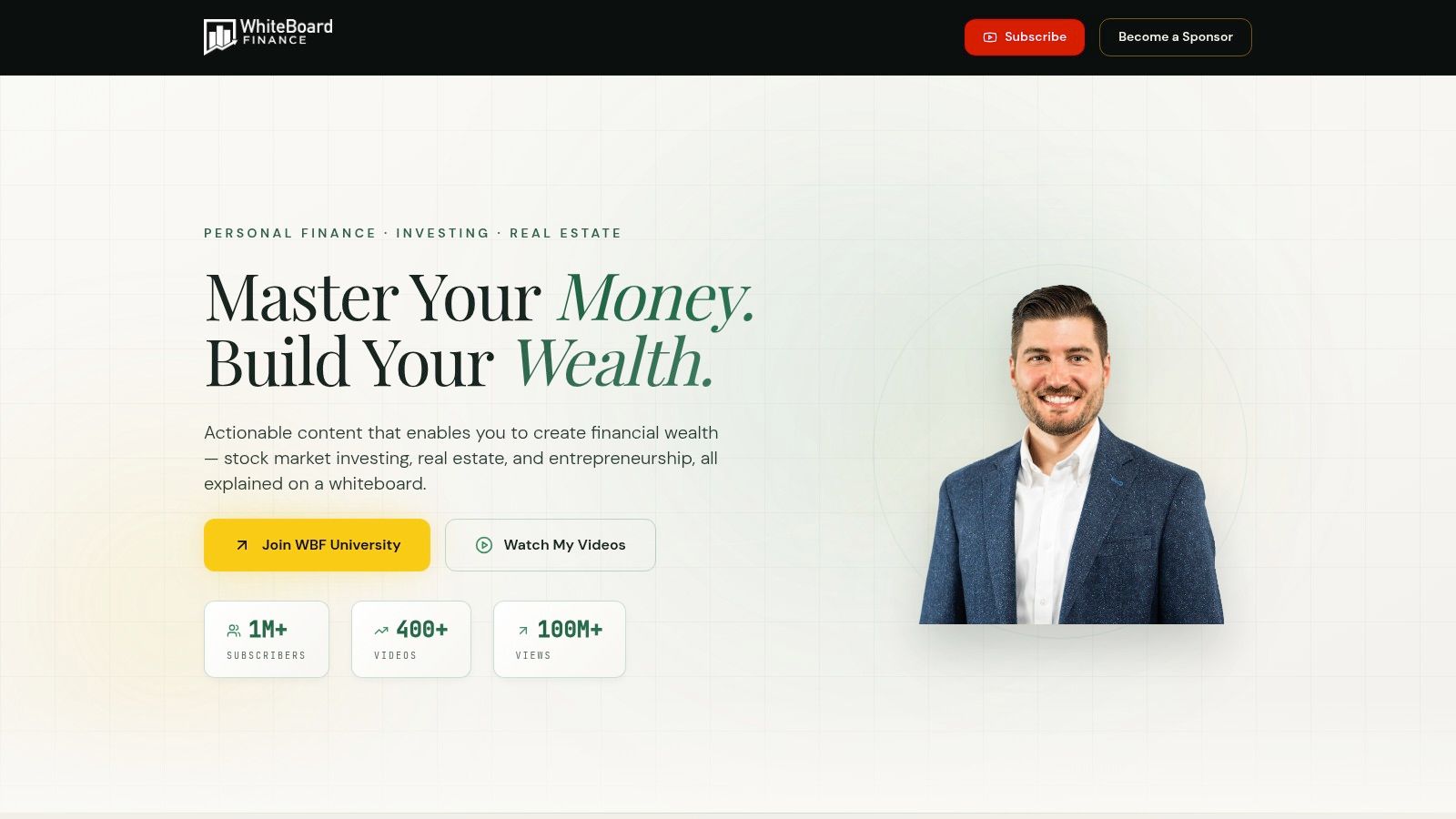
WhiteBoard Finance takes a methodical route through personal finance, stock investing, real estate, and entrepreneurship. That teaching style attracts viewers who want frameworks they can apply, which makes the channel more suitable for consideration and action than for a purely impression-led brief.
The audience's interest in practical education can help a product that needs explanation. A brokerage might sponsor a contribution walkthrough, a property platform could support an educational real-estate segment, and a financial tool could fit inside a step-by-step planning exercise. The integration needs enough time to establish the problem, show the workflow, and explain the CTA without disrupting the lesson.
Use paid engagement as a fit signal
WhiteBoard Finance University gives the brand a paid education product alongside its free content. That doesn't prove a sponsorship will convert, but it does indicate that the audience can engage beyond passive viewing. Ask how the paid product and sponsor categories are separated, whether exclusivity is available, and what kinds of educational offers have performed well.
The strongest brief will respect the whiteboard format. Give Marko the approved facts and the outcome you need, then let the explanation remain structured and instructional. A rushed product mention with a discount code may underperform because it doesn't match what the audience came to learn.
The audience may skew toward male DIY investors, so don't assume broad demographic coverage. If your product serves a wider audience, use inclusive examples and check audience data before buying. Measure qualified actions by cohort where possible, especially when product eligibility varies by age, location, income, or investing experience.
Compliance review should focus on claims about returns, risk, product suitability, and testimonials. A practical teaching style can make a message persuasive, which increases the importance of precise wording and visible disclosures.
WhiteBoard Finance is a good choice for education-led consideration, list building, and products with a meaningful learning curve. It isn't the best match for a one-line offer that depends on impulse response. Teams comparing creator quality and fit can also use this influencer rating guide.
Review WhiteBoard Finance for sponsor contact and audience context.
7. Tori Dunlap from Her First $100K
Tori Dunlap and Her First $100K offer a sharply defined audience proposition around women's financial independence. The platform spans a website, newsletter, the Financial Feminist podcast, community, and programs, so a campaign can be planned across several surfaces instead of relying on one social post.
That focus makes audience fit more valuable than raw scale. Banks, budgeting apps, employee-benefit platforms, credit products, savings tools, and consumer fintech brands can build a relevant message around debt payoff, credit, savings, career decisions, or financial confidence. The offer must support the brand's values. A poorly aligned product will feel obvious to an audience that expects a clear point of view.
Plan a layered activation
The multi-channel engine supports different roles in the funnel. A podcast placement can create a personal, explanatory introduction. A newsletter can give the audience a direct response path. Website or program integrations can support deeper education, provided the brand secures the necessary usage and placement rights.
The campaign should still define a primary conversion. Don't allow a broad mission-led brief to become impossible to measure. Separate each placement, record assisted actions, and ask whether the audience's response reflects brand trust, product interest, or both.
Her public positioning is an advantage and a constraint. It can create strong relevance for aligned brands, but the message needs to pass a values and compliance review before it reaches the creator. Avoid unsupported promises, oversimplified financial outcomes, or calls to action that pressure users into a decision.
No public sponsorship rate card means the outreach should include a complete proposal. State the audience you want, the product problem, the activation surfaces, the timeline, the exclusivity requirements, the desired rights, and the reporting needed. A generic “media opportunity” email won't communicate enough respect for the platform or its audience.
Tori is the strongest option in this list for a women-focused personal-finance campaign with a clear social and educational fit. She's less suitable for an offer that can't explain its relevance to that audience or that requires aggressive performance language.
Learn more about Her First $100K.
Top 7 Finance Influencers Comparison
| Item | Implementation Complexity 🔄 | Resource & Speed ⚡ | Expected Outcomes 📊 | Effectiveness / Quality ⭐ | Ideal Use Cases 💡 |
|---|---|---|---|---|---|
| Services (Social Cloud) | Medium, requires tracking/integration but agency handles end-to-end | Higher budget + integration; fast setup (forecast 48h; go‑live 3–5 weeks) | Measurable installs/conversions/ROAS with placement‑level attribution | ⭐⭐⭐⭐⭐, outcome‑linked pricing aligns incentives | Performance-driven user acquisition, fintech growth, conversion-focused campaigns |
| Graham Stephan | Low, public sponsor intake simplifies scoping | Premium pricing; scheduling lead times | Strong long‑form reach and integrated conversions | ⭐⭐⭐⭐, large, brand‑safe audience | FinTech/real‑estate brands needing long‑form integrations and broad awareness |
| Andrei Jikh | Low–Medium, direct outreach; high‑production integrations | Premium budgets; strong performance placements | High watch‑through and strong fintech/brokerage conversions | ⭐⭐⭐⭐, cinematic production, high engagement | Fintechs and brokerages seeking persuasive, well‑produced native ads |
| Minority Mindset (Jaspreet Singh) | Medium, proposals often required; multi‑channel planning | Moderate budgets; high upload volume (may need standout creative) | Broad top‑funnel awareness across personal finance & entrepreneurship | ⭐⭐⭐, energetic, approachable delivery | Awareness campaigns, entrepreneurship & personal‑finance audience reach |
| Humphrey Yang (HumphreyTalks) | Low–Medium, multi‑platform; contact form for outreach | Moderate budgets; short‑form benefits from multi‑touch sequencing | Trust‑building explainers that drive user action over time | ⭐⭐⭐, clear, consumer‑friendly education | Consumer fintech user acquisition, education funnels, template/tool promotion |
| WhiteBoard Finance (Marko) | Medium, education‑first format may need longer integrations | Moderate budgets; good for list‑building and community funnels | Engaged audience primed for practical offers and paid products | ⭐⭐⭐, trusted teaching style with paid‑product signals | Lead‑gen, education products, deeper engagement campaigns |
| Tori Dunlap – Her First $100K | Medium, requires mission/value alignment and compliance review | Moderate to premium; multi‑channel activations available | High engagement within women‑focused demographic and trust signals | ⭐⭐⭐⭐, strong relevance for female audiences | Banks, budgeting apps, benefits and fintechs targeting women |
Turn Creator Fit Into Measurable Lift
Start selection with audience and offer fit, then consider reach. The question isn't which creator has the biggest platform. It's which creator can make the product credible to a defined audience, in a format that supports the next action, with enough evidence to justify another placement.
Ask every candidate for current audience-quality and engagement data. Review geography, age, audience interests, recent sponsored content, engagement quality, and signs of overlap with your existing paid channels. Confirm category exclusivity before negotiations, because a creator's recent partnership history can affect both credibility and conversion.
Your commercial brief should settle the basics before creative work begins:
- Conversion event: Define whether success means an install, lead, approved application, funded account, first transaction, or another business action.
- Reporting window: Agree when results will be evaluated and how late conversions, assisted actions, and refunds will be handled.
- Rights and exclusivity: Confirm paid usage, whitelisting, editing, platform variants, duration, territory, and competitor restrictions.
- Commercial terms: Request rates, deliverables, timing, revision rules, cancellation terms, and any performance component in writing.
Don't use one creative brief for every format. Long-form integrations need a narrative and enough room for explanation. Podcast placements need natural spoken language and a memorable response path. Short-form explainers need a fast opening, one clear message, and a frictionless CTA. Live content needs real-time moderation and escalation rules. Amplified assets need separate permission and platform-specific creative QA.
Finance campaigns also need stricter review than ordinary consumer sponsorships. Pre-approve regulated claims, projections, testimonials, comparisons, eligibility language, and calls to action. Require clear disclosures where the audience will see or hear them. The content should explain material limitations and risks without burying them in small text or a description field.
For attribution, assign a unique tracking link and promo code to every placement. Add post-purchase or post-signup surveys where appropriate, particularly when viewers may search for the brand later or convert on another device. Report views, CTR, conversions, ROAS, and learning by creator and platform. A creator-focused AI audio separation tool can help teams prepare approved content variants, but it won't replace rights clearance, disclosure review, or conversion tracking.
Personalize outreach around the creator's format and audience. Explain why the product fits their viewers, what you want them to make, and how you plan to protect their voice. Ask for past sponsored performance and the operational details that determine whether the campaign can launch cleanly.
Social Cloud is an option for teams that need vetted creator selection, forecasts, compliance management, and verified attribution across a multi-platform program. Its outcome-linked model can also connect creator activity to agreed conversion events, rather than leaving finance influencer spend as an unmeasured awareness line.
If you're planning a finance influencer campaign, Social Cloud can help you select vetted creators, forecast performance, manage compliance, and attribute every placement. Share your audience, offer, and conversion event to build a measurable YouTube, Instagram, TikTok, or Twitch program.