
Your acquisition team has three agency pitches open, a compliance review stuck in legal, and no agreement on whether success means an install, an approved application, a funded account, or revenue. One agency promises cheap clicks. Another has attractive creator content but can't explain how it will connect a post to a qualified customer. The third includes “performance pricing” without defining which costs are passed through and which are marked up.
That confusion is expensive. Fintech ad spending has risen by more than 45% year over year since 2021, while U.S. financial-media-network ad spend is projected to reach $1.22 billion in 2026, nearly doubling from $640 million in 2025, according to fintech digital marketing statistics from Webtonic. Growth teams need an agency that can manage both sides of the problem, compliant execution and measurable acquisition.
Table of Contents
- Introduction to Working With a Fintech Advertising Agency
- Build the compliance checklist before the pitch
Introduction to Working With a Fintech Advertising Agency
At 9:00 a.m., the UA manager wants new creator concepts. By lunch, legal has rejected two claims, the privacy team has questioned the tracking setup, and finance has asked why the agency's forecast uses account opens while the board expects funded accounts. Nobody has a clean answer because the brief, contract, approval workflow, and dashboard were built separately.
That's how fintech agency relationships go off track. The agency buys media before the conversion event is defined, creators are selected for reach rather than audience fit, and legal review happens after production instead of before it. The resulting campaign may generate attention, but the growth team still can't tell which placement created a valuable customer or why the launch missed its testing window.

A good fintech advertising agency should remove that ambiguity. It should help define the downstream event, forecast spend against that event, document what claims creators can make, and report performance at the placement level. You shouldn't accept a polished presentation as proof of capability. Ask for the operating details, including who approves content, how tracking works, what happens when a creator misses a disclosure, and whether the agency can separate media spend from fees.
The rest of this guide gives you practical ways to make that decision. You'll get a compliance checklist, an agency evaluation framework, contract terms for outcome-linked pricing, an onboarding schedule, and a reporting template your UA team can adapt immediately.
Define Goals Compliance and Budgeting
A launch can hit its media date and still miss its business target. That happens when an agency optimizes for clicks or installs while finance values funded accounts, completed applications, or first transactions. Set the downstream conversion event before choosing channels, then label earlier actions as diagnostic signals rather than success.
Your event determines the budget model. Reported benchmarks vary by fintech sub-vertical: neobanks sit around $35 to $90 per account open, payments and wallets around $22 to $75 per first transaction, retail lending and BNPL around $45 to $120 per application, and investment apps around $150 to $400 per funded account, as outlined in Meta fintech ad benchmarks for 2026. Use those ranges for planning, not promises. A blended CPA can look efficient while low-cost account opens fail to become funded accounts.
Build the compliance checklist before the pitch
Give agencies these requirements before they recommend creators or media:
- Claims: List approved benefits, prohibited wording, required disclaimers, and evidence for each claim.
- Audience rules: Define age, geography, eligibility, exclusions, and targeting limits.
- Data handling: Specify shareable events, protection for personally identifiable information, and analytics access ownership.
- Creator controls: Require disclosure language, script and caption approval, and an edit or takedown process.
- Rights: Define paid usage, duration, platforms, territory, whitelisting, and asset reuse.
- Approval ownership: Name legal and compliance owners, plus backups for absences.
Approval time belongs in the budget and launch plan. Pre-approval of creator posts can add 5 to 10 business days to launch timelines, while authentic influencer content can lift engagement to 3.4 times branded content, according to financial advisory social media marketing statistics. That delay creates a budget risk: an agency may reserve media, creator capacity, or production resources before reviewers clear the assets. Require a dated approval schedule, escalation owner, and rule for unused media commitments in the proposal.
For a video-led acquisition program, Taja AI's practical playbook can help organize content around audience intent before production begins. Use it to shape concepts, then route every claim, script, caption, and final asset through the agreed compliance workflow.
Evaluate Agency Expertise Measurement and Attribution
The sector is too large for generalist reporting. U.S. financial services companies spent $28.4 billion on digital advertising in 2024, up 12.3% from the prior year, and 47% allocated more than half of their marketing budgets to digital channels, according to Webtonic's fintech branding statistics. With that level of digital investment, an agency that reports impressions without downstream attribution isn't offering performance marketing.
Compare agencies across four practical dimensions.
| Evaluation area | Weak proposal | Strong proposal |
|---|---|---|
| Fintech experience | Lists finance as one category among many | Shows relevant work in your specific sub-vertical and market |
| Attribution | Uses platform-reported conversions only | Combines tracking links, promo codes, analytics integrations, and post-purchase surveys |
| Creative operations | Presents finished concepts without review controls | Shows briefs, claims libraries, creator QA, and revision workflows |
| Commercial model | Bundles media, creator fees, and agency fees | Separates pass-through spend, base fees, and performance components |
Ask every finalist to demonstrate the reporting path from a creator post to your analytics platform. You should see consistent UTM conventions, placement IDs, promo-code ownership, event definitions, and a method for reconciling agency data with your internal numbers. If the agency can't explain why its dashboard differs from AppsFlyer, Adjust, GA4, or your CRM, the problem will surface after money has already moved.
Use a weighted selection scorecard
Score each agency on sub-vertical knowledge, compliance maturity, creator quality, forecasting, measurement, communication, and commercial transparency. The exact weighting is yours, but don't let presentation quality outweigh tracking or regulatory experience.
Request case evidence that matches your goal. For a mobile wallet, ask about first transactions rather than views. For lending, ask how the agency distinguishes an application from an approved or funded customer. For a wealth product, ask how it handles long consideration cycles and restricted claims.
Teams comparing broader demand-generation partners can use this guide to finding the right demand gen agency as a useful evaluation reference. For creator-specific work, also inspect the agency's process for working with a creator marketing agency, especially around selection, briefing, rights, and measurement.
Develop Briefs and Secure Outcome Based Contracts
Your brief should make bad assumptions impossible. Give the agency enough detail to decide whether a creator, audience, channel, and conversion event belong in the same campaign.
Include the product's actual differentiators, target customer profiles, eligibility rules, approved claims, prohibited claims, required disclosures, landing pages, creative formats, review contacts, usage rights, and reporting requirements. Add examples of acceptable and unacceptable language. “Explain how the product helps users manage spending” is useful. “Guarantee financial improvement” is a compliance problem.
Tie payment to the event you can verify
A sensible contract separates three money streams:
- Base fee: Covers strategy, account management, briefing, production coordination, compliance administration, and reporting.
- Pass-through budget: Covers creator compensation and media spend, itemized and approved before activation.
- Performance component: Applies only to a defined event, such as a verified first transaction, approved application, or funded account.
Don't pay a performance bonus on a metric the agency can't independently verify. A creator may generate clicks, but your CRM or analytics system should determine whether the user completed the agreed event. Define the attribution window, duplicate handling, refunds, fraud checks, and treatment of organic conversions.
Contract rule: If the agency can't show where the conversion came from and how it was reconciled, it shouldn't receive an outcome fee for that conversion.
Use a fee waterfall in the proposal. For example, the agency can show the fixed operating fee first, approved creator and media costs second, and the performance fee third. Require a written no-markup statement for pass-through spend, plus approval rights for any new vendor, creator, platform, or production expense.
Usage rights deserve equal attention. State whether you can run creator content as paid social, edit it into short-form variants, use it on landing pages, or deploy it through platform amplification. Make the creator's disclosure obligations survive repurposing, and confirm that every music, image, logo, and third-party asset has usable rights.
For a deeper look at commercial structures, review this guide to performance-based influencer marketing. The best contract makes incentives clear without turning the relationship into a dispute over attribution.
Plan Onboarding Timelines and Manage Launch
A signed contract does not put a compliant campaign on the runway. Assign one internal owner for growth, compliance, analytics, and product or CRM access. Require the agency's launch plan to name every dependency, owner, approval gate, and fallback date. Outcome-based fees make this discipline more important, because an approval delay can postpone the conversion window while fixed costs continue.
Use kickoff to confirm the conversion event, attribution rules, reporting definitions, and launch criteria. Provision platform and analytics access while creative is in production. Give legal a claims library and reusable templates early. Sending isolated creator posts for review at the end creates avoidable rework.
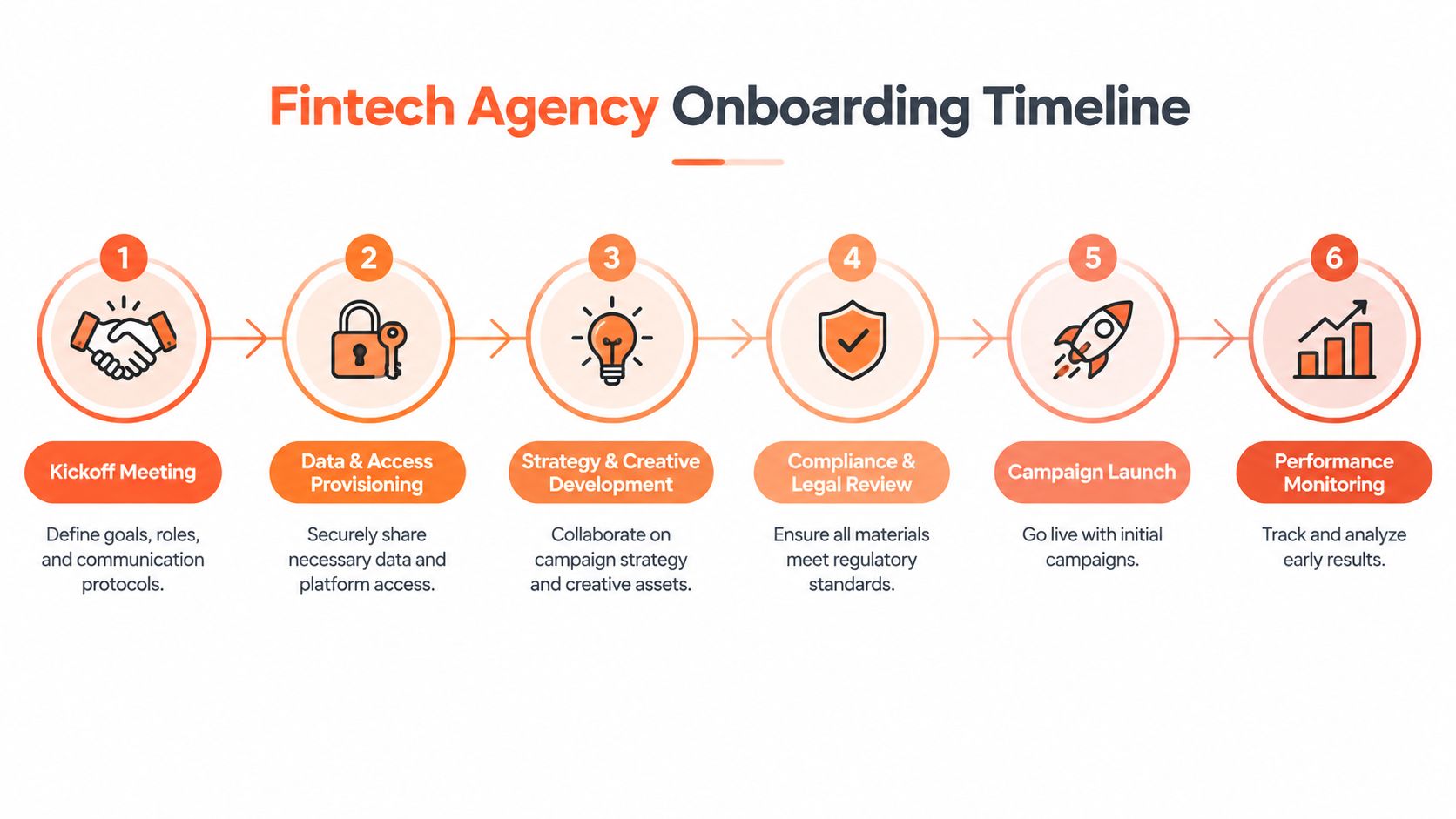
Use this sequence:
- Kickoff: Confirm goals, roles, markets, conversion events, and communication cadence.
- Access and data: Set up ad accounts, tracking links, promo codes, dashboards, and permissions.
- Strategy and creative: Approve audience hypotheses, creator shortlists, scripts, and landing-page alignment.
- Compliance review: Send complete packages, including captions, disclosures, visuals, claims, and usage rights, to legal.
- Launch: Publish approved assets only, verify tracking, and record each placement's live timestamp.
- Monitoring: Check early signals, flag broken links or compliance issues, and document optimization decisions.
Creator pre-approvals can add 5 to 10 business days, according to Webtonic's compliance-focused social media data. Put that window in the schedule and budget. Run access provisioning and audience research in parallel while legal reviews the first creative batch. Standardized disclosure language, version-controlled claims, and a named backup approver reduce delay without asking legal to skip controls.
Monitor Reporting Templates and Performance Metrics
A weekly report should answer three questions. What happened, why did it happen, and what will change next week? If the dashboard only shows reach and engagement, it isn't sufficient for fintech acquisition.
Use one row per creator and placement, not one blended campaign total. That structure exposes differences in audience quality, creative angle, platform behavior, and conversion friction.
Sample Weekly Performance Dashboard
| Creator | Platform | Views | CTR | Conversions | ROAS |
|---|---|---|---|---|---|
| Creator A | TikTok | ||||
| Creator B | YouTube | ||||
| Creator C |
Views describe distribution, but they don't establish acquisition value. CTR helps identify whether the hook and call to action create interest. Conversions should use the agreed downstream event, not whatever platform metric happens to be available. ROAS requires consistent revenue attribution and should be separated from softer indicators when revenue takes time to realize.
Add fields for spend, creator fee, approved asset status, disclosure status, tracking ID, landing page, audience segment, and optimization decision. A row with strong CTR but no completed application might need a landing-page or eligibility review, not more budget. A row with modest engagement but verified funded accounts may deserve protection from premature cuts.
Automate data pulls where possible, but keep a human QA step. Check duplicate conversions, broken links, missing promo codes, delayed CRM events, and mismatches between platform and first-party records. Set alerts for tracking failures, unusual conversion patterns, and unapproved creative changes.
Run incrementality tests when the budget and audience allow it. Hold out a comparable audience or market, document the test design before launch, and avoid claiming lift from platform attribution alone. The guide to measuring influencer marketing ROI offers a useful framework for connecting creator activity to business outcomes.
Tips Checklist and Next Steps
Treat the checklist as a preflight review before every campaign cycle. The agency may be the same, but the product, market, claims, audience, and conversion event can change.
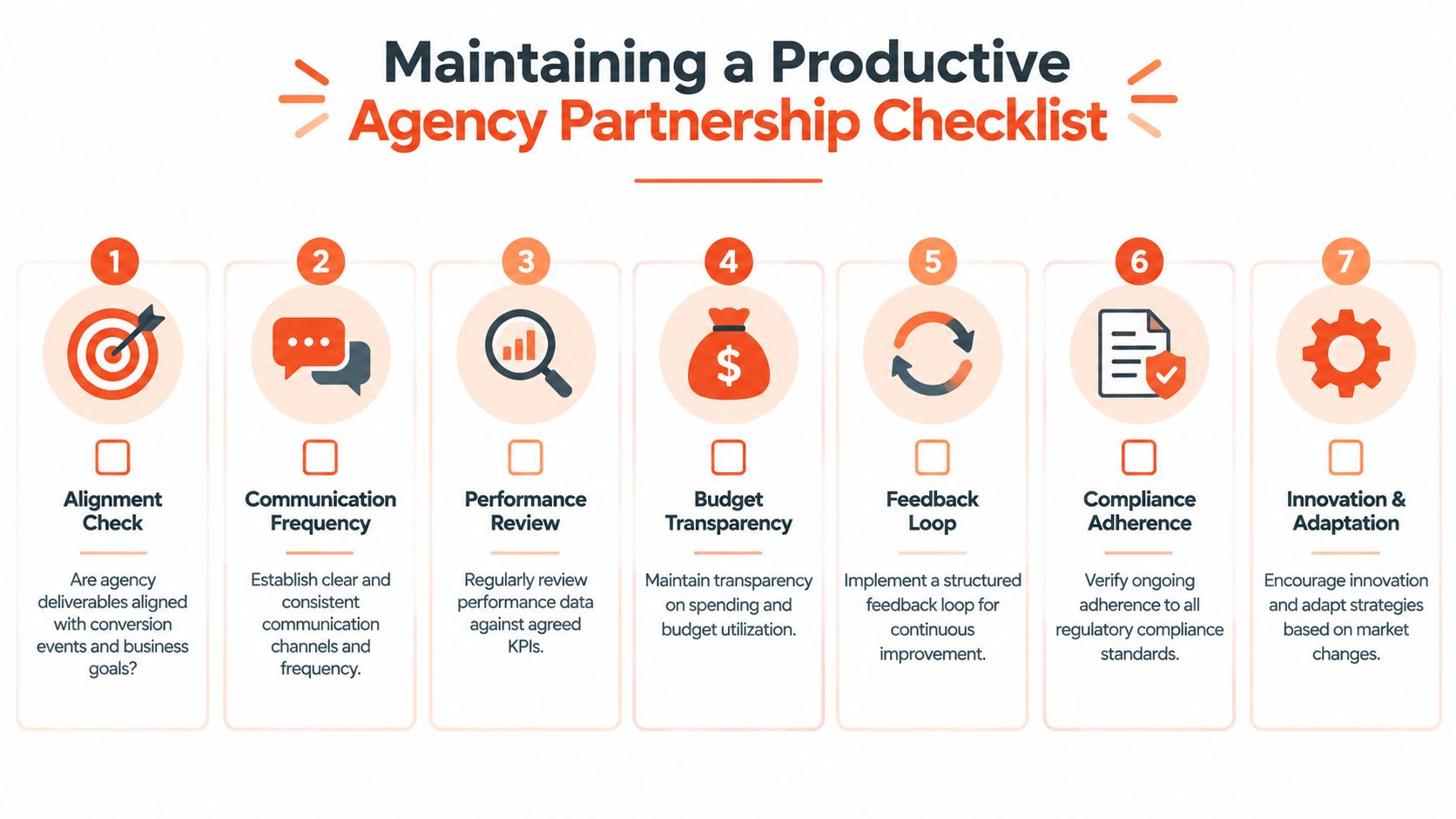
- Conversion alignment: Do deliverables and bonuses map to the event that creates business value?
- Compliance evidence: Can you audit approvals, disclosures, claims, rights, and final published assets?
- Budget clarity: Are creator fees, media spend, production costs, base fees, and performance fees separated?
- Attribution integrity: Does every placement have a tracking link, code, or another documented measurement path?
- Communication rhythm: Are weekly operating reviews separate from strategic reviews, with clear owners for decisions?
- Testing discipline: Does each new creator or creative angle have a hypothesis, success condition, and stop rule?
- Market readiness: Have legal and compliance requirements been reviewed before expanding into a new geography or product line?
Don't scale a creator cohort because one post looks popular. Check audience quality, conversion quality, disclosure compliance, and whether the content can be reused safely. Targeted seeding can create organic UGC, while approved Spark Ads or equivalent cross-platform amplification can extend the reach of assets that already meet your standards.
Keep a living claims library and update it whenever the product, pricing, eligibility, or market changes. Review the agency's forecast against actual performance, then revise the next brief instead of asking for “more of the same.” Teams producing a high volume of creative can also consult guidance on efficient client ad campaigns using AI, provided every generated variation still passes human brand and compliance review.
Social Cloud is one option for teams that need creator selection, contracting, disclosures, usage rights, placement-level attribution, weekly reporting, and outcome-linked fees managed in one workflow. Visit Social Cloud to assess whether its fintech campaign model fits your conversion events, compliance process, and reporting requirements.