
A fintech marketing agency earns its place when it can manage expensive acquisition with discipline. Average fintech CAC is around $925 for B2C and $1,830 for B2B, according to industry fintech marketing benchmarks.
Those figures change the buying decision. You're not just hiring a team to produce ads, publish blog posts, or book creators. You're hiring a partner to protect trust, satisfy compliance requirements, connect campaigns to meaningful revenue events, and show whether the next dollar is creating a funded account rather than another unqualified signup.
That distinction matters because fintech funnels are unusually easy to misread. A click can look efficient while KYC completion stalls. A creator can generate impressive reach while producing no activated users. A campaign can launch quickly and then lose weeks to claim reviews, disclosure corrections, or missing approval records.
Table of Contents
- Trust extends the buying cycle
- Regulation makes mistakes expensive
- Cheap traffic can create expensive noise
- Compliance-aware campaign design
- Performance media connected to real outcomes
- Content that reduces financial hesitation
- Creator strategy with measurement attached
Why Fintech Marketing Costs So Much
The SMB segment sits between consumer and B2B acquisition at roughly $1,450 per customer, a planning figure that many growth models treat too casually. The number matters less as a universal benchmark than as a warning: fintech CAC changes with the product, buyer, activation path, and revenue event.
A consumer wallet, business payments platform, and lending product can require very different journeys. Still, they share one operating reality: fintech acquisition can't be managed like a low-consideration consumer campaign. Registration is only an early signal. The budget has to account for verification, activation, funding, retention, and the operational work required to prove that each stage is progressing.

Trust extends the buying cycle
People hesitate before handing a company their identity, money, transaction history, or business financial data. They look for clear pricing, credible explanations, security signals, responsive support, and evidence that the product works as promised. Business buyers add procurement, risk, legal, and integration questions.
That trust burden makes broad awareness a weak success measure on its own. A fintech marketing agency must connect attention to confidence, then connect confidence to an event with commercial value. Content, search, paid media, public relations, lifecycle messaging, and creator campaigns should answer the same trust questions rather than operate as separate projects.
The hidden cost is measurement. A campaign can generate qualified-looking leads while KYC completion, first funding, or account usage remains low. Growth teams should define the funded account, activated user, or sales-qualified opportunity before an agency launches media, then require reporting against that event.
Regulation makes mistakes expensive
Financial claims need evidence and careful presentation. Teams may need to substantiate rates, eligibility, savings claims, performance statements, product limitations, and risk disclosures. Influencer content can require pre-approval, compensation disclosure, communication retention, and documented supervision.
A generalist agency may know how to buy traffic or write conversion copy without knowing how to keep claims fair and usable. The resulting costs include rework, delayed launches, rejected assets, and reputational exposure. Compliance is part of production, not a final legal gate.
The stronger operating process puts claim rules into briefs, contracts, approval logs, and reporting. It identifies which statements creators can make, which language needs evidence, and who approves publication. That work can slow an initial draft, while reducing the chance of scaling an asset that cannot pass review.
Cheap traffic can create expensive noise
Paid channels can support fintech acquisition, but a $6.45 average Google Ads CPC only pays back when optimization reaches funded accounts rather than registrations, according to fintech marketing industry statistics.
The practical test is the feedback loop. Send downstream events from analytics, the CRM, or the data warehouse back into bidding and reporting. Compare channel cost with KYC completion, funding, activation, and retained usage. An agency that reports impressions, clicks, and signups without those outcomes may improve dashboard performance while leaving unit economics unchanged. Growth teams should request a sample funnel report and confirm exactly which event controls budget decisions before signing.
What a Fintech Marketing Agency Actually Delivers
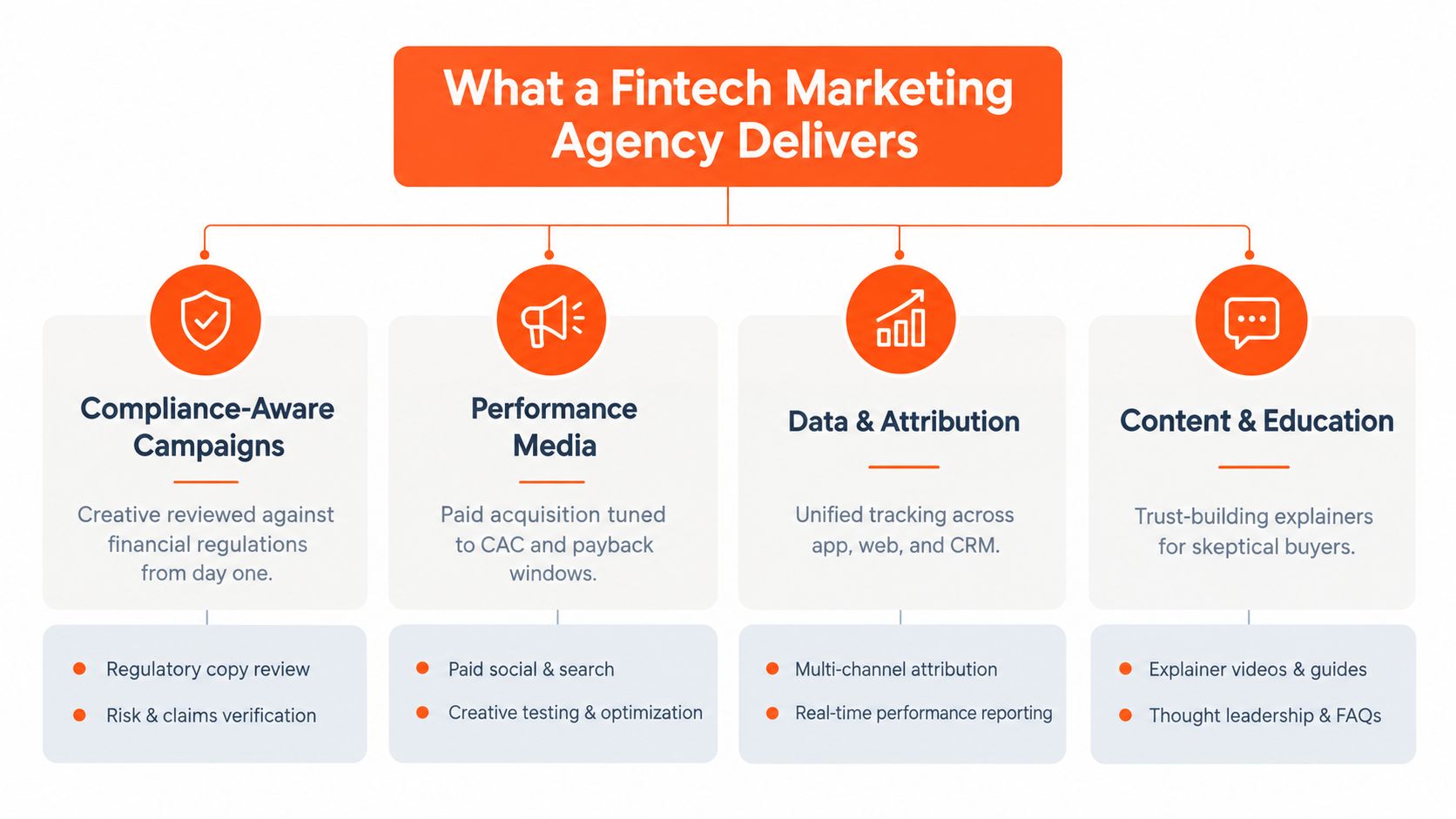
A credible fintech marketing agency isn't just a collection of channel specialists. Its value comes from making compliance, content, media, and measurement work as one operating system.
Compliance-aware campaign design
For regulated financial-services programs, review usually covers more than a final ad. A practical workflow can include creator due diligence, claim substantiation, fair and balanced presentation, referral-compensation disclosures, contract restrictions, approval records, and monitoring after publication.
The best setup places those checks before production locks. That allows the creative team to develop a compelling idea inside known boundaries instead of producing an asset that legal later strips of its useful message.
Performance media connected to real outcomes
Paid search, paid social, retargeting, affiliate activity, and creator amplification all need a shared definition of success. Depending on the product, that might be a funded account, a linked bank, a KYC-complete user, a paying subscriber, or a qualified sales opportunity.
The agency should explain how it will move from the ad platform to the CRM or data warehouse. If it can't show the path, you'll probably receive channel reports that look polished but don't answer whether acquisition is profitable.
Content that reduces financial hesitation
Fintech content has to teach without sounding evasive. Product pages should explain eligibility, fees, security, setup, limitations, and the next step in plain language. Articles and videos should resolve objections that sales and support teams hear repeatedly.
That content also gives paid campaigns somewhere credible to send skeptical prospects. A creator video may introduce the problem, while a comparison page, calculator, product demonstration, or onboarding guide helps the user decide.
Creator strategy with measurement attached
Creator marketing works differently in fintech because audience fit isn't enough. You need a creator whose community understands the product, whose communication style can support compliant claims, and whose traffic can be tied to a downstream event.
That requires contracts, disclosure guidance, usage rights, tracking links, promo codes, post-purchase surveys, and a process for approving and monitoring published content. Without those pieces, creator activity becomes another awareness line item instead of an accountable acquisition channel.
The Compliance and Attribution Puzzle
Compliance and attribution solve different problems, but fintech teams need both before they scale. Compliance answers, “Can we publish this?” Attribution answers, “Did it create a valuable customer?”
Regulated influencer programs commonly require pre-approval, retained communications, fair and balanced claims, compensation disclosures, and documented supervisory workflows, as outlined in guidance on influencer marketing for regulated categories. These controls create production overhead. They also reduce the likelihood that a campaign will need to be pulled apart after launch.
Build the event map first
Start with the deepest meaningful conversion your business can reliably capture. For one product, that may be a funded account. For another, it may be a linked bank, a KYC-complete account, or a paying subscription.
Then map every upstream event to that endpoint:
- Capture the click. Preserve platform click IDs, creator IDs, UTMs, landing-page details, and campaign metadata.
- Record intermediate actions. Track registration, application start, identity verification, bank linking, and funding separately.
- Connect the lifecycle. Pass those events into the CRM, product analytics system, or warehouse so marketing can distinguish progress from revenue.
- Return qualified signals. Send activated or closed-won events back to advertising platforms where possible, rather than optimizing only for cheap registrations.
- Audit the path. Check that creator codes, tracking links, and offline events reconcile with internal records.
This structure prevents a common failure: a campaign appears efficient because it generates many signups, while the activation rate is weak. As fintech measurement guidance explains, optimization should focus on meaningful downstream events such as funded accounts or qualified opportunities, not raw signup volume.
Make every approved asset reusable
A centralized approval log should record the asset version, claims reviewed, reviewer, date, market, creator, disclosure language, and permitted usage. That record supports monitoring and makes it safer to repurpose compliant UGC into paid placements.
The same discipline applies to risk operations. Teams evaluating their broader control environment may also find DevArmor for fintech risk useful when reviewing governance and compliance needs beyond campaign execution.
For creator-specific planning, finance influencer campaign guidance can help growth teams think through audience selection, disclosure, content review, and conversion tracking as one workflow.
Pricing Models That Actually Align Incentives
Agency pricing determines which risks the partner carries and which risks remain with the fintech team. A flat retainer makes budgeting predictable, but it may leave the agency focused on deliverables rather than funded accounts. A percentage of media spend can reward larger budgets even as efficiency declines. Performance-only pricing ties payment to results, yet creates disputes when tracking, approvals, product changes, or conversion quality sit outside the agency's control.
| Model | Base Cost | Performance Link | Best For |
|---|---|---|---|
| Pure retainer | Fixed monthly fee | Usually indirect, through reporting and agreed deliverables | Teams buying strategy, content, or operational capacity |
| Hybrid outcome-based | Lean base fee plus variable component | Installs, conversions, or ROAS agreed upfront | Growth teams with reliable tracking and shared control |
| Pure performance | Minimal or no fixed fee | Directly tied to an agreed outcome | Mature programs with stable attribution and clear conversion ownership |
Pure retainers buy capacity
A retainer fits an agency responsible for several connected workstreams, such as strategy, creative production, paid media, reporting, and compliance coordination. Its hidden cost is management time. The client still has to connect weekly activity to activation, funded accounts, or qualified opportunities instead of treating a full delivery calendar as proof of growth.
Specify deliverables, review cycles, testing responsibilities, reporting definitions, and ownership of tracking infrastructure. Define how compliance reviews affect timelines and which team pays for extra revisions. A retainer should provide a repeatable operating rhythm, not an unlimited queue of vaguely defined tasks.
Hybrid models share risk
In practice, the hybrid model combines a smaller fixed fee with a variable charge tied to agreed installs, conversions, or ROAS. Social Cloud describes this structure in its service overview, but the useful question is whether the attribution method is auditable by the client, not whether the model sounds performance-led. Any conversion definition should distinguish inexpensive registrations from actions that contribute to funded accounts.
The base fee may be higher because the agency carries campaign volatility. The contract should settle conversion windows, invalid-traffic rules, attribution priority, approval delays, budget responsibility, and the effect of landing-page or onboarding changes. It should also state how compliance work is scoped, since repeated claim reviews can consume capacity that a simple media comparison overlooks.
Before comparing pricing plans, use consistent definitions for strategy, media spend, production, creator fees, reporting, and performance compensation. This guide to agency pricing offers a useful reference for influencer-related cost structures.
Pure performance isn't automatically safer
Performance-only agreements can work when the agency controls enough of the funnel and the conversion event remains stable. They become difficult when activation depends on product releases, underwriting, compliance approval, sales follow-up, or customer support.
A workable contract names the event, data owner, attribution window, audit rights, payment timing, cancellation terms, creative usage rights, and treatment of rejected or reversed conversions. It should also require regular reconciliation between agency reporting and internal records. Incentives improve when both parties can see the same measurement system and influence the result it rewards.
Case Study - How Social Cloud Runs Fintech Creator Campaigns
A creator campaign earns its budget only when attention becomes a measurable business event. The brief should therefore define the audience, product promise, permitted claims, target conversion, tracking method, approval path, and budget allocation before anyone is selected.
Social Cloud offers a useful operating example. Its model runs influencer campaigns across YouTube, Instagram, TikTok, and Twitch, using a vetted network of 12,000+ creators screened for audience quality, brand fit, and previous sponsored performance, according to Social Cloud's campaign offering. The roster is a starting point, not evidence that a campaign will produce funded accounts.

The campaign starts with a forecast
Set a target CPI or CPA, estimate expected views, and assign an initial budget by platform. This forecast gives the growth team a decision boundary. If a creator appears relevant but the expected path from click to funded account cannot support the target, change the mix before production begins.
Creator selection needs more than demographic matching. Review audience quality, content context, prior sponsored work, comment quality, market suitability, and the creator's ability to explain a financial product without unsupported promises. A large audience can produce cheap reach while contributing little to KYC completion or account funding.
Briefs preserve voice and control
A rigid script can make a creator sound unnatural. An open brief can create compliance risk. The practical middle ground states the problem to solve, approved product facts, prohibited claims, disclosure requirements, visual guidance, and the required call to action.
Quality assurance should review drafts before publication and confirm that the final asset matches the approved version. Contracts should cover compensation, disclosure, usage rights, edits, market restrictions, and reuse in paid media. These controls create review work that belongs in the campaign forecast, because each revision can delay launch and consume agency capacity.
The right creator brief protects two things at once: the creator's credibility and the fintech brand's audit trail.
Attribution must exist at placement level. Use tracking links, promo codes, and post-purchase surveys to connect activity to a creator and platform. The reporting layer should separate views and CTR from applications, KYC-complete users, funded accounts, and ROAS. A placement that wins on reach may lose once deposit or funding quality is measured.
The workflow should produce a clear record at every stage:
- Planning: Audience definition, target event, creator shortlist, forecast, and budget allocation.
- Production: Approved brief, creator drafts, claim review, disclosure check, and usage rights.
- Launch: Unique tracking for each placement, live-content monitoring, and issue escalation.
- Optimization: Views, CTR, conversions, funded-account quality, ROAS, and learnings by creator and platform.
- Reuse: Approved UGC adapted into paid formats, provided the rights and claims still apply.
Use the following video as a visual reference for creator-led campaign operations:
The practical test is simple. Ask the agency to show how it would move budget away from high-view, low-funding placements, document compliance decisions, and reconcile creator reporting with internal account data. That separates a creator program built for vanity metrics from one managed for funded-account growth.
How to Choose the Right Fintech Marketing Agency
The right partner depends less on agency size than on operational fit. A seed-stage company may need positioning, landing-page clarity, and a clean measurement foundation. A mature fintech team may need channel specialists, creator scale, lifecycle optimization, and reliable offline conversion reporting.
Ask questions that expose the operating model
Use the sales process to test how the agency thinks:
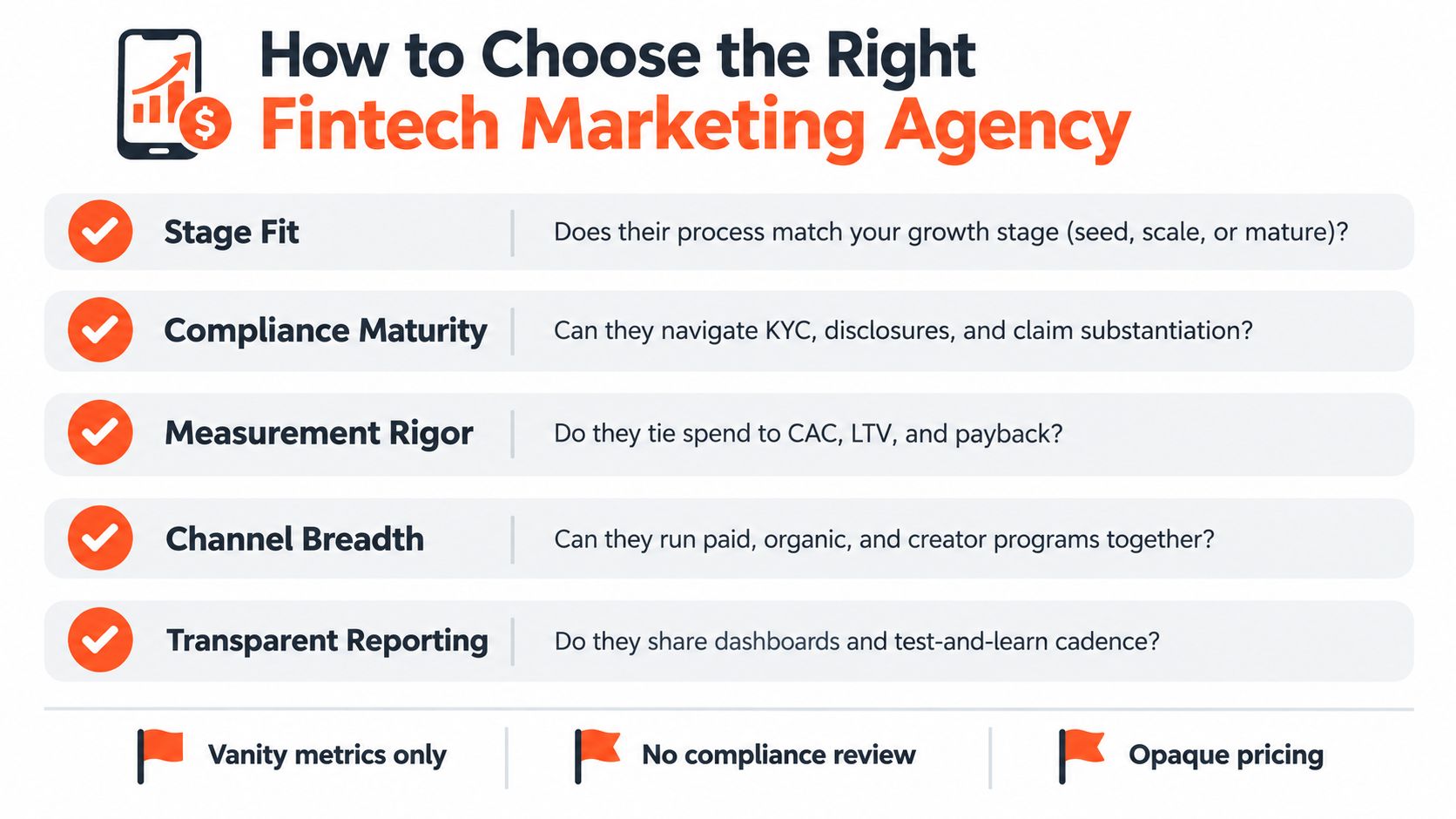
- Stage fit: Can they explain what they'd prioritize at your current stage, rather than presenting the same channel package to every prospect?
- Compliance maturity: Who reviews claims, creator content, disclosures, and approval records? Ask to see the workflow, not just hear that compliance is included.
- Measurement rigor: Can they map spend to a funded account, linked bank, KYC-complete user, or paying subscriber? Ask which systems receive the event data.
- Channel breadth: Can paid media, SEO, lifecycle, PR, and creator activity share one acquisition model, or will each team report independently?
- Reporting transparency: Will you receive raw conversion definitions, creator-level performance, test history, spend context, and explanations for budget changes?
The warning signs are predictable. An agency that leads only with impressions and clicks may not understand your commercial endpoint. One that treats compliance as a final approval may create avoidable delays. An opaque proposal makes it difficult to compare the actual cost of strategy, production, media management, creator fees, and performance compensation.
For a narrower view of paid acquisition, this fintech advertising agency resource can help you assess how channel execution should connect to broader growth planning.
Run a structured evaluation
Give shortlisted agencies the same brief. Include your product, audience, activation event, current tracking, compliance constraints, target markets, existing creative, and decision timeline. Compare the quality of their questions before comparing the polish of their slides.
A useful evaluation should end with five tangible outputs:
- A proposed event map from click to activated customer.
- A compliance workflow with owners and approval points.
- A channel and creative testing plan.
- A transparent fee and performance model.
- A reporting example that separates vanity metrics from revenue-bearing events.
Don't choose the lowest quote if the agency can't explain how it will protect the funnel after the click. Choose the team that can make acquisition measurable, publishable, and operationally manageable.
Social Cloud plans, runs, and measures creator campaigns across YouTube, Instagram, TikTok, and Twitch, with vetted creator selection, compliance workflows, per-placement attribution, and outcome-linked pricing. If your fintech team wants to evaluate creator acquisition against funded accounts or another meaningful conversion, visit Social Cloud and start with a brief that defines the event you need to improve.