
The most popular advice in gaming influencer marketing is also the most expensive shortcut: hire the biggest streamer you can afford and buy reach. That approach can create attention, but attention alone doesn't tell you whether players installed the game, returned after the first session, or generated revenue. A creator campaign becomes a growth channel only when the agency connects creator selection, content, media buying, attribution, and retention.
The market reflects that change. The gaming influencer marketing services market is projected to grow from USD 2.36 billion in 2026 to USD 4.34 billion by 2031, representing a projected 12.96% compound annual growth rate over that period, according to Mordor Intelligence's gaming influencer marketing services market analysis. That scale creates opportunity, but it also raises the standard for execution. A gaming influencer marketing agency should be accountable for more than views, likes, and follower counts.
Table of Contents
Why Gaming Influencer Marketing Requires a Specialized Agency
A one-hour sponsored stream with a famous creator can work for a launch moment, but it isn't a complete user-acquisition strategy. The creator may attract a large audience, yet the campaign can still struggle if the audience doesn't match the game, the content doesn't communicate a compelling reason to play, or the tracking setup loses users between a clip, a search, an app store, and the first paid session.
Gaming audiences also behave differently by genre, platform, and community. A competitive shooter needs credibility with players who notice mechanical details. A role-playing game may benefit from lore discussions, build guides, or long-form discovery. A mobile title often needs a fast creative hook and a clear path to install. A generalist agency can arrange a sponsorship, but it may not understand why a creator's audience watches, chats, searches, and converts.
The industry has moved toward downloads, installs, cost per install, and retention, rather than likes or follower counts, as described in Net Influencer's report on performance metrics and cross-platform gaming strategy. That shift changes the agency brief. You need a partner that can forecast performance, assign unique tracking, compare cohorts, and feed the results back into creator selection.
Bigger audiences can hide weaker intent
Mega-creators still have a role. They can generate cultural visibility, provide launch authority, and produce content that travels beyond the original placement. The trade-off is that a broad audience may contain fewer players with a strong fit for your specific title. A smaller creator who lives inside one genre or community may produce less reach but more meaningful comments, clicks, installs, and returning players.
These are often called comfort creators, niche voices whose audiences trust their recommendations because the relationship feels familiar and relevant. One industry source reports that these creators can drive 7% to 12% engagement and stronger purchase intent than large streamers, while a Mintel finding cited in the same analysis says 73% of 18 to 34-year-olds only buy influencer-promoted products they believe the creator uses. Those figures appear in PartnrUp's analysis of gaming influencer marketing trends and comfort creators.
Practical rule: Choose the creator who can make the game feel native to the audience, not merely the creator who can expose it to the largest audience.
A specialized agency earns its fee by making that judgment repeatedly, then proving whether it was correct. Its work should include audience quality checks, genre fit, historical sponsored performance, creative guidance, tracking, and post-install analysis. A useful primer on how specialist partners differ from broad creator services is this overview of creator marketing agencies.
Choosing the Right Platforms and Campaign Formats
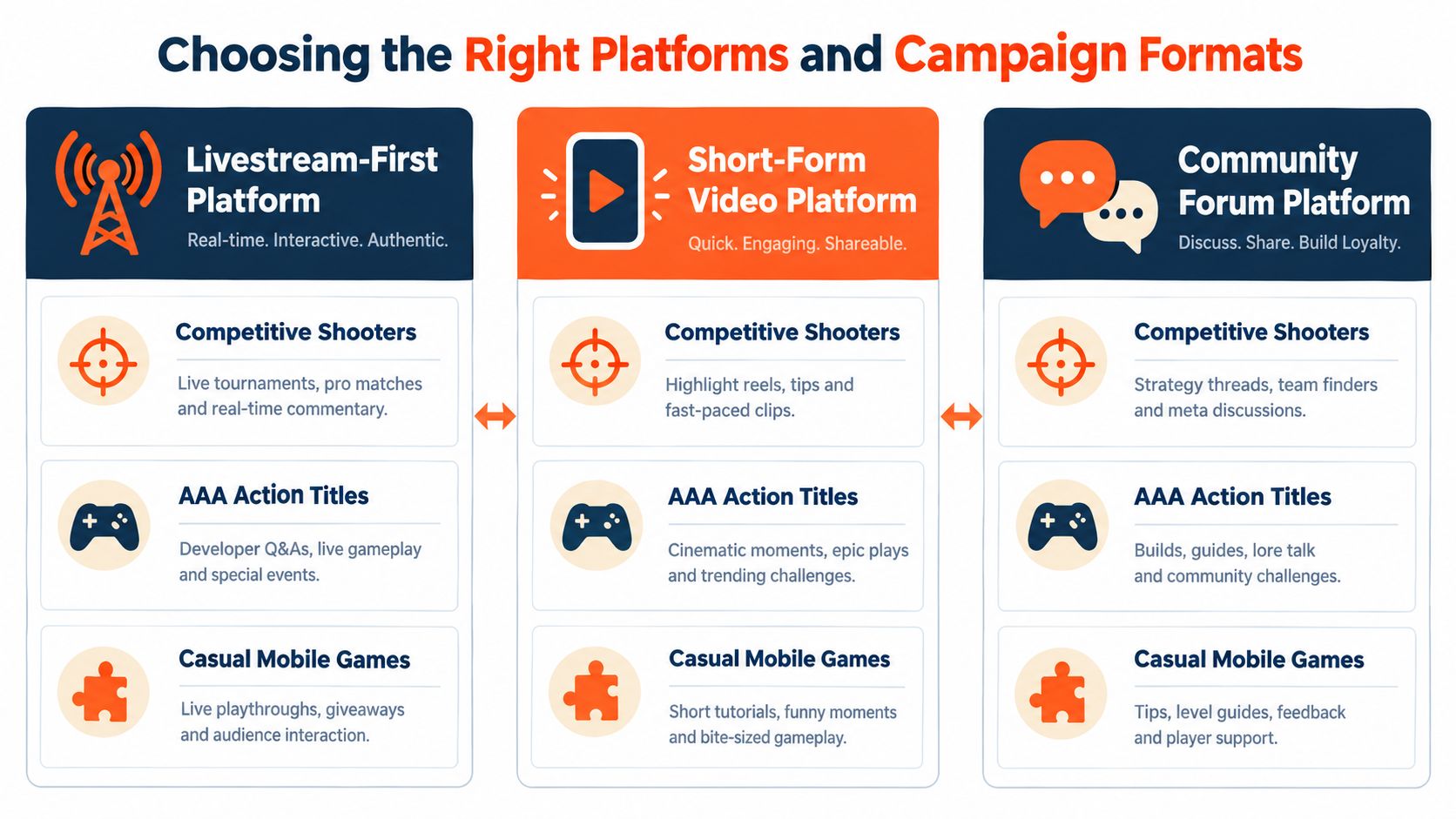
Platform choice should follow the acquisition task and the game's player behavior. A gaming influencer marketing agency should assign each channel a measurable role, then test whether its audience produces qualified traffic, installs, and downstream players rather than rewarding reach alone.
Match the platform to the job
YouTube fits propositions that need explanation. Long-form gameplay, reviews, tutorials, challenge videos, and comparisons give creators time to demonstrate the core loop and answer objections. The resulting library can keep generating discovery after publication, although production, approvals, and revisions often take longer than short-form placements.
Twitch works when live interaction helps qualify intent. Chat questions, spontaneous reactions, community participation, and creator credibility reveal how viewers respond in real time. Launch streams, co-op sessions, tournaments, and developer appearances perform best when the creator can preserve an authentic format. Teams assessing this channel can use a practical guide to influencer marketing on Twitch to examine its live campaign dynamics.
TikTok supports discovery and rapid creative testing. Short clips can present an unexpected mechanic, a comic failure, a character moment, or a specific player problem. The format makes hook testing efficient, but fast attention can remain shallow unless the call to action and store path are clear.
Instagram can support lifestyle positioning, mobile gaming, creator identity, and reusable short-form assets. It is often more useful within a sequence than as the only channel for a complex game proposition.
Use formats across the funnel
Give each format a defined handoff. Live sponsorships can create consideration through questions and demonstrations. Short-form creator content can test discovery hooks, while strong assets can receive paid distribution through platform-native options such as TikTok Spark Ads. Gifting and precision seeding may suit games that benefit from organic demonstrations, but free product distribution does not prove acquisition efficiency.
A campaign brief should document the channel's job, the signal it is expected to produce, and the next touchpoint. That structure also keeps pricing discussions grounded in outcomes: a placement built for awareness should not be judged by the same conversion target as a creator asset built for installs.
Executive teams translating creator activity into business reporting can use AI social strategy for CEOs as a reference for clearer communication. The agency should report test results, audience quality, and campaign decisions, not a collection of platform screenshots.
Building Full-Funnel Attribution and Measurement
Attribution should exist before the first creator publishes. If tracking arrives after launch, the campaign may generate activity without producing evidence that finance, product, or UA teams can trust.
Build the measurement layer first
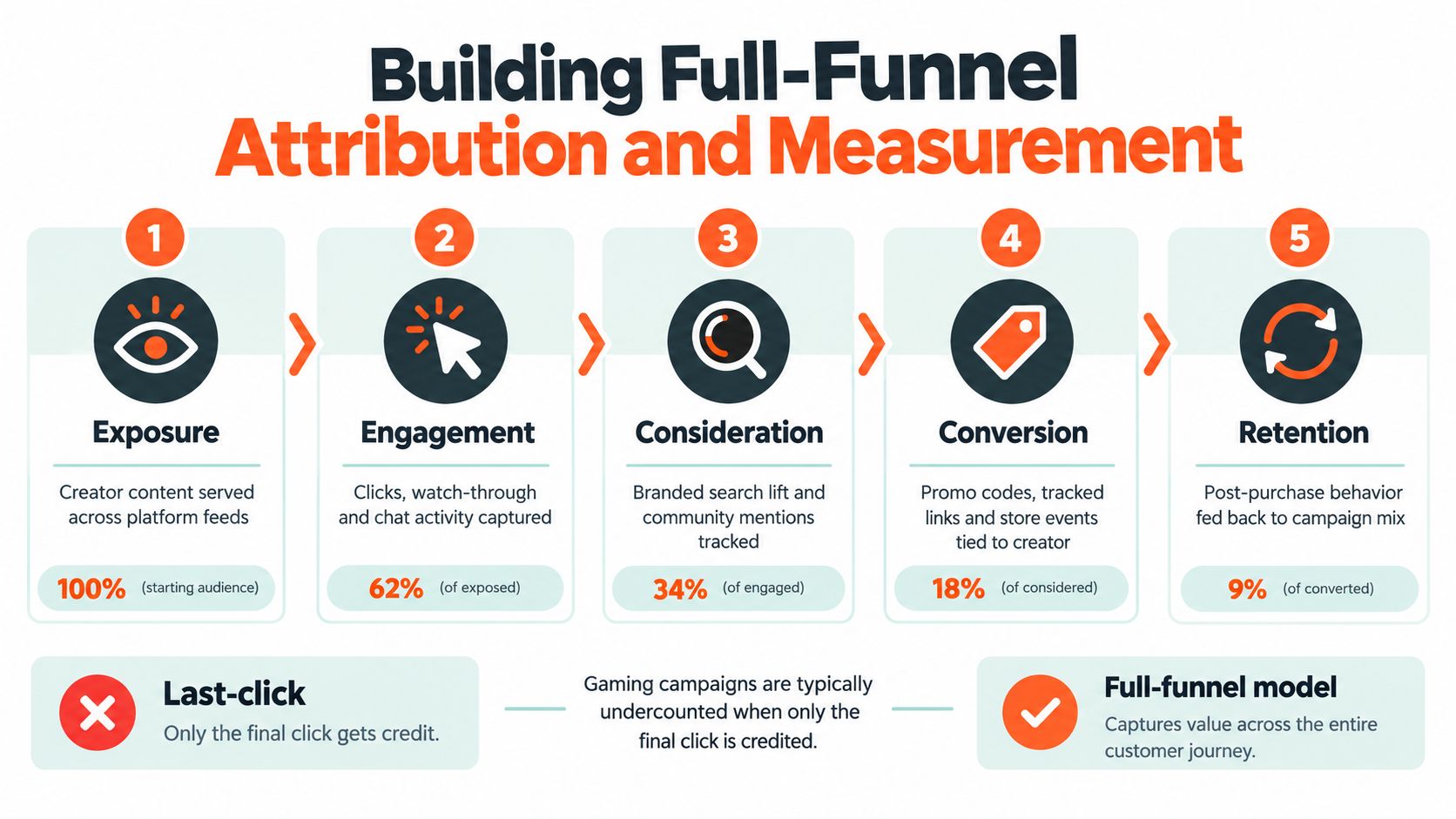
Start with a unique tracking link for every creator and placement. Add creator-specific promo codes where the game or store journey supports them, then connect those identifiers to install events, purchase events, and player cohorts. A post-purchase or post-install survey can capture self-reported discovery when users saw content but didn't click the supplied link.
The minimum useful view goes beyond reach:
- Traffic quality: Track CTR and the quality of visits generated by each creator.
- Acquisition cost: Measure CPI or eCPI by creator, platform, market, and creative format.
- Conversion behavior: Compare store visits, installs, registrations, and first meaningful in-game actions.
- Retention: Cohort players by creator and monitor D1, D7, and D30 retention.
- Revenue efficiency: Evaluate D30 ROAS and downstream monetization, not just the initial install.
The technical guidance in ClickAnalytic's gaming influencer measurement framework recommends this kind of full-funnel setup and points to geo holdouts or randomized tests for validating incremental impact.
Treat last click as one signal, not the verdict
A player may discover a game in a Twitch stream, see a related TikTok clip, search the title on YouTube, and install through an app-store visit that receives the final click. A last-click report will usually credit the last measurable action, even when the creator created the original demand.
That doesn't mean every creator deserves credit for every conversion. It means the agency should compare multiple views of performance. Use creator-level cohorts, assisted-conversion indicators, branded search movement, community mentions, and controlled tests where practical. Dark-social behavior, including private group discussions and untracked sharing, makes perfect attribution impossible, but it doesn't make disciplined measurement optional.
The decision isn't whether attribution will be imperfect. It's whether the imperfection is visible, consistent, and tested.
A technical dashboard should show raw platform data alongside owned conversion events. It should also preserve the ability to compare creators by acquisition cost, retention, and revenue. For a broader framework on connecting influencer activity to commercial outcomes, see this guide to measuring influencer marketing ROI.
Understanding Pricing Models and Campaign Timelines
Agency pricing determines behavior. A flat fee can be simple to approve, but it may reward delivery of contracted content rather than quality of acquired players. A pure performance model aligns incentives more closely with installs or revenue, yet it can create disputes if attribution rules, fraud controls, refunds, retention windows, and creator responsibilities aren't defined in advance.
A practical structure combines a lean base fee with a variable component tied to agreed outcomes. The base covers strategy, forecasting, creator management, briefing, compliance, and reporting. The variable portion can reflect installs, conversions, or ROAS, with clear rules for invalid traffic and delayed revenue.
Make the budget legible
Ask the agency to separate creator compensation, paid amplification, production costs, platform fees, and agency fees. Creator budgets should be passed through at cost when promised, with no unexplained padding. You should also know whether usage rights, whitelisting, exclusivity, and revisions are included or priced separately.
Outcome-linked pricing only works when both sides can inspect the same evidence. Define the attribution window, event hierarchy, reporting cadence, optimization rights, and payment triggers in the contract. If the game has long retention or monetization cycles, don't judge every creator on an immediate install alone.
Plan for real operational lead time
A credible process begins with a forecast and strategy briefing, not a creator shortlist pulled from a spreadsheet. Social Cloud's operating model describes a forecast within 48 hours of a brief and a typical go-live window of three to five weeks, as provided in the publisher information. That timeline allows room for creator fit checks, negotiations, briefing, creative review, legal approvals, tracking QA, and scheduling.
Rush launches can still happen, but they force trade-offs. You may accept fewer creators, simpler creative, limited usage rights, or less time for testing. The right agency makes those compromises explicit instead of presenting speed as free.
Evaluating Agency Capabilities and Compliance Standards
A polished creator roster isn't proof of operational maturity. The useful question is whether the agency can show how it evaluates creators, protects the brand, manages rights, and reports performance when a campaign produces mixed results.
Inspect the creator-vetting process
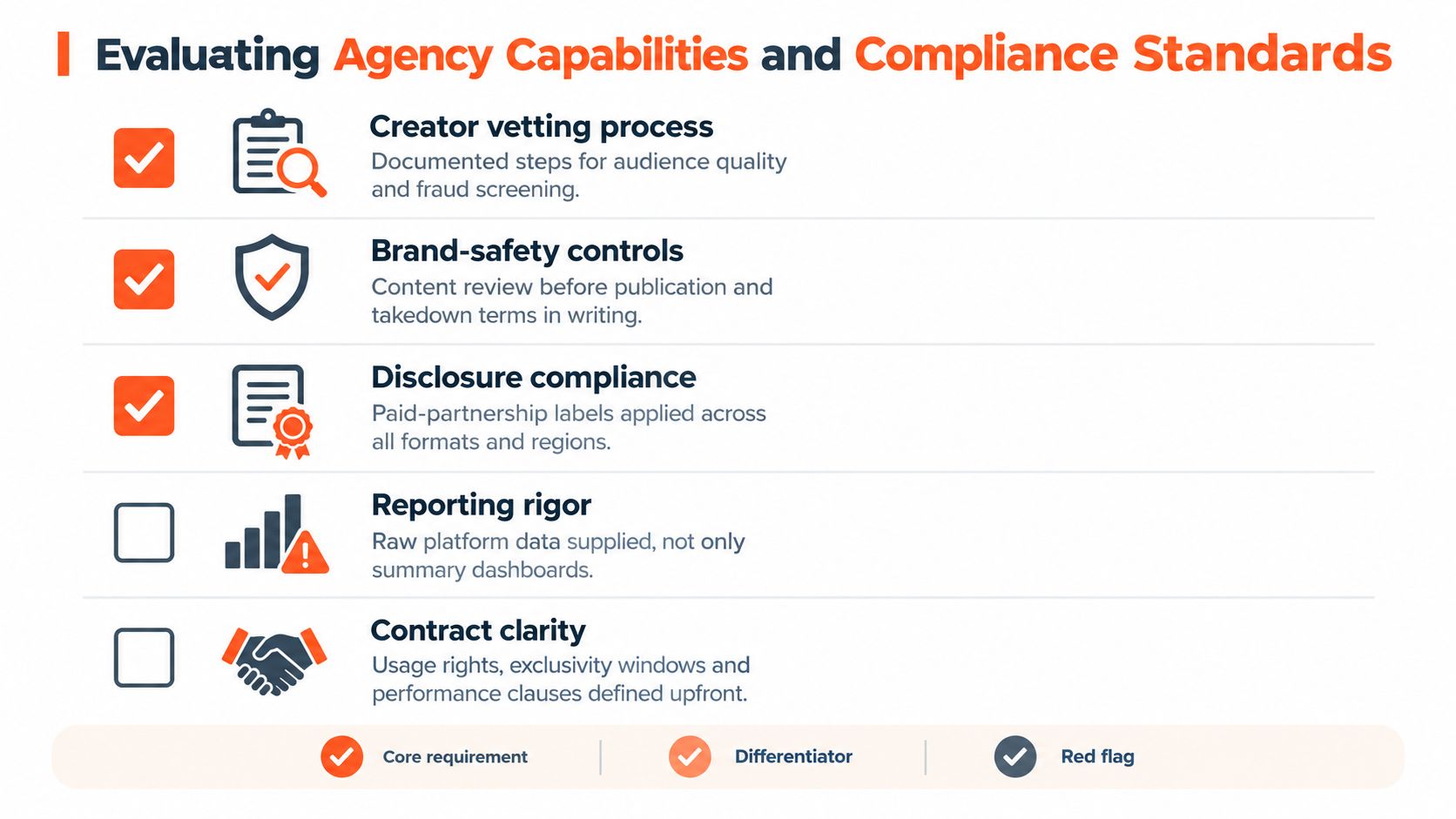
Ask for the actual checks, not a promise that the network is vetted. A thorough review should examine audience quality, geographic fit, content context, engagement patterns, brand history, and previous sponsored performance. It should also identify whether a creator's audience matches the game's target players rather than just matching a broad gaming label.
Request examples of both accepted and rejected creators. The rejection logic often reveals more than the roster. A specialist partner should be able to explain why a creator with a large following may be unsuitable, and why a smaller channel may be worth testing.
Put compliance inside the workflow
Every placement needs a clear disclosure process that works across formats and markets. The agency should coordinate paid-partnership labels, required language, approval records, and publication checks for live, long-form, and short-form content. It should also maintain takedown terms and an escalation route if a creator publishes outside the approved brief.
Contracts need to cover usage rights, paid amplification, exclusivity windows, revisions, disclosure duties, cancellation, and performance clauses. Rights become especially important when a strong creator asset could be adapted into a paid ad, a store page, or a Shorts or Reels variant.
Look for one accountable team
Fragmented handoffs create avoidable delays. If strategy, creator outreach, legal, creative QA, tracking, and reporting sit with disconnected vendors, nobody owns the gap between a good idea and a measurable launch.
Use this evaluation checklist:
- Audience evidence: Can the agency provide audience and historical performance data?
- Brand safety: Are review, takedown, and escalation terms documented?
- Raw reporting: Will you receive platform data and event-level outcomes, not only a summary score?
- Rights clarity: Does the contract define paid usage and repurposing?
- Testing discipline: Can the team run cohort comparisons and incrementality tests?
Reviewing Benchmark Metrics and Real-World Performance
Gaming media costs vary sharply by geography and by game category. A global rate card can therefore mislead a forecast before the campaign begins. The benchmark data below, from Zorka Agency's gaming influencer benchmarks, gives planners a starting point for comparing inventory and audience response.
Gaming influencer benchmarks by market and genre
| Market / Game Title | CPM (USD) | CTR from Views |
|---|---|---|
| USA | $30.58 | Not provided |
| UK | $31.61 | Not provided |
| Canada | $34.00 | Not provided |
| South Korea | $46.61 | Not provided |
| World of Warcraft | Not provided | 0.50% |
| Multi-game channels | Not provided | 0.46% |
| League of Legends | Not provided | 0.41% |
| Elden Ring | Not provided | 0.11% |
The market figures show why geography belongs in creator selection and forecasting. South Korea's reported CPM is $46.61, while the reported figure for the USA is $30.58. A higher CPM doesn't automatically mean worse performance. If the audience has stronger intent or the creative generates better response, the more expensive market may still produce acceptable acquisition economics.
The genre figures create a similar trade-off. The reported CTR from views reaches 0.50% for World of Warcraft, 0.46% for multi-game channels, and 0.41% for League of Legends, while Elden Ring is reported at 0.11%. These values shouldn't become universal targets. They should inform test design, creator comparisons, and the assumptions behind your CPI model.
Use benchmarks to shape the test
Separate the forecast by country, game vertical, platform, creator tier, and format. Then ask what would have to be true for the campaign to reach its target CPI or ROAS. A cheap impression source with weak click or install intent can be less useful than a higher-cost placement with a better-qualified audience.
Creative analysis matters as much as media cost. Marketers reviewing watch-through, click behavior, and conversion should use a disciplined approach to analyzing video performance for marketers. The agency should report not only which creator performed, but which opening hook, game moment, call to action, and format helped produce that result.
Launching Your First Performance-Driven Creator Campaign
Start with the economics, not the creator list. Define the target CPI, conversion event, retention threshold, and ROAS window your team will use to judge the test. If those definitions remain vague, the campaign will drift toward whichever metric looks most flattering after launch.
Then build a focused creator cohort:
- Choose for fit: Prioritize mid-tier and nano creators whose audiences already care about the relevant genre, platform, and player problem.
- Write a flexible brief: Specify the required product truth, tracking link, disclosure, and call to action, while leaving room for the creator's natural format and voice.
- Instrument every placement: Assign unique links, codes, platform identifiers, and event tracking before content goes live.
- Launch a controlled test: Keep the first wave narrow enough to compare creators, countries, formats, and audience quality.
- Review weekly: Track views, CTR, CPI, conversions, retention, and ROAS, then move budget toward creators producing valuable players rather than inexpensive traffic.
Don't optimize the first test for maximum reach. Optimize it for learning that changes the next allocation. Once the team can identify which creators drive installs and returning players, it can scale with more confidence and negotiate pricing from evidence.
Social Cloud plans, runs, and measures gaming creator campaigns across YouTube, Instagram, TikTok, and Twitch, with creator vetting, tracked placements, compliance management, and outcome-linked fees. If you want to replace unmeasured creator spend with a practical acquisition test, visit Social Cloud and discuss your title, target CPI, and campaign goals.