
You've approved a polished brand video, pushed it across every major platform, and watched the dashboard fill with impressions. The problem appears a week later: weak click-through, little qualified traffic, no clear sales lift, and a comment section asking questions the video never answered. That's the gap many Gen Z brands face. Attention is available, but trust has to be earned in public, one useful interaction at a time.
Creator-led campaigns can close that gap, but only when creators sit inside a measurable performance system. The strongest programs connect audience insight, platform-native creative, creator selection, paid amplification, and attribution. They don't treat authenticity as a mood. They test it as a commercial signal.
Table of Contents
Why Gen Z Brands Need a Creator-Led Playbook
A high-production brand film can communicate a controlled message. A creator can show how that message survives contact with real life. That difference matters because Gen Z audiences evaluate whether a product feels useful, credible, and relevant to their identity, rather than absorbing a brand promise.

Start with an audience question, not a content format. Ask which problem the campaign should clarify, which tension it should resolve, or which part of the customer's identity it should reinforce. Then mine creator comments, product reviews, DMs, and search language for the words people already use. Those phrases often produce stronger hooks than a brand's internal positioning document.
Turn creative into a testing system
Commission several angles instead of one “hero” asset. One creator might demonstrate the product in a routine, another might compare alternatives, and a third might answer a skeptical customer question. Keep the core claim consistent, but allow each creator to choose the opening, pacing, setting, and proof style that fits their audience.
Track the full journey:
- Attention: Hook rate, early hold, completion, and rewatches.
- Intent: Saves, shares, profile actions, qualified traffic, and product-page engagement.
- Commercial impact: Add-to-cart activity, conversions, revenue, and assisted conversions.
- Quality: Comment sentiment, refund behavior, repeat purchase signals, and customer-service themes.
Follower count can help with planning, but it's a poor final verdict. A smaller account with a focused audience and clear product demonstrations may send more qualified traffic than a large account whose viewers enjoy the entertainment but ignore the offer.
Practical rule: Let creators supply cultural proximity, but make the product experience strong enough to justify the recommendation.
Merchandise can also extend a creator relationship beyond a single post, especially when the product naturally belongs to the creator's community. A useful starting point is this resource on merch for creator brands, particularly when you're considering community-led product extensions.
The operating model resembles a specialist creator marketing agency, but the principle applies internally too. Insight informs the brief, creators generate native variations, paid media amplifies validated content, and attribution sends performance evidence back into the next brief.
What Actually Shapes Gen Z Loyalty and Trust
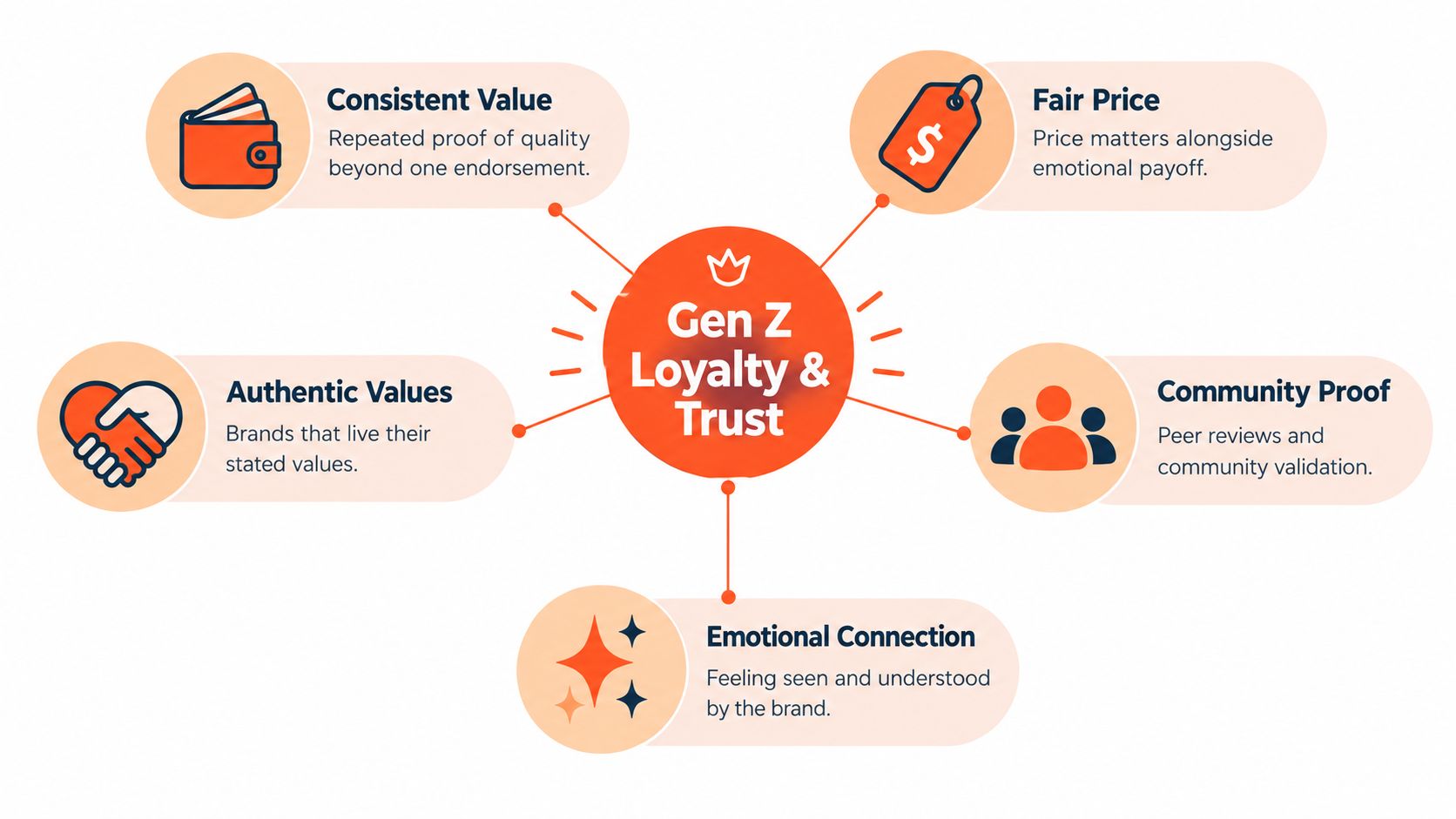
A creator can win the first click and still lose the customer. In a 2026 study of 903 Gen Z consumers in the United States and Canada, 64% said they stay loyal to a brand they like “always” or “most of the time,” while only 9% said influencer recommendations keep them coming back, according to Rival Technologies' Gen Z loyalty research. The performance implication is clear: creator content must start demand, then hand off to a product experience that earns repeat purchases.
Price and value led at 82%, followed by product quality at 80%. Rewards or perks reached 41%, and alignment with values reached 36%. A strong brief therefore shows what the customer receives for the price, demonstrates how the product performs, and makes limitations visible instead of covering them with aesthetic language.
Four durability checks
Review every creator concept against four practical questions:
- Value: Does the offer solve a real problem, or does the post only create desire?
- Product proof: Can viewers see how it works, including limitations and trade-offs?
- Relevance: Does the message fit the audience's routines, constraints, language, and community?
- Responsiveness: Will the brand answer questions and improve the experience after feedback?
Relevance directly affects repeat behavior. Among respondents who felt a brand understood them “really well,” 45% reported being loyal “always,” compared with 5% among those who felt misunderstood, as reported in the Rival Technologies study. That gap makes audience understanding a commercial input, not merely a creative preference.
Trust can also fall quickly after a poor brand experience. Morning Consult reported that 94% of tracked brands scored lower on net trust with Gen Z than with the average U.S. adult, with Gen Z's average net trust about 8 points lower, as summarized by YPulse's 2026 brand loyalty coverage. Separate APAC research in the same source found that almost 9 in 10 Gen Z consumers had stopped buying from a brand after losing trust.
Track whether the recommendation survives beyond the view: comment sentiment, saves, repeat views, branded search, conversion quality, customer questions, and post-purchase feedback. High reach with weak product credibility can create a cheap-looking attention spike. Clear demonstrations, credible caveats, and useful comment replies create evidence that moves viewers from discovery to consideration and purchase.
Platform Strategy Across TikTok, Instagram, YouTube, and Twitch
TikTok, Instagram, YouTube, and Twitch shouldn't receive identical edits from a shared content folder. They support different forms of discovery, explanation, participation, and community credibility. Build one core claim, then adapt the first seconds, pacing, proof, and call to action to the platform's buying context.
TikTok is strongest when the problem appears immediately. Use native captions, visible demonstrations, and formats that invite comments, stitches, duets, or rewatches. Instagram gives brands more room to combine visual identity with proof. Reels can drive reach, Stories can collect questions and poll responses, carousels can explain a product, and Collabs can place the same post in both creator and brand contexts.
YouTube earns attention when the buyer needs a deeper explanation. Reviews, comparisons, integrations, and search-led demonstrations can remain useful after the initial launch, while Shorts can introduce viewers to longer content. Twitch works differently again. A live sponsor needs natural fit with the stream, the chat culture, and the creator's established category. A forced read can interrupt the relationship that makes live content valuable.
For teams building TikTok discovery programs, this practical TikTok growth strategy offers useful context on native growth mechanics. For Twitch, channel fit and live interaction deserve a dedicated influencer marketing Twitch workflow rather than a repurposed short-form brief.
| Platform | Primary Role | Best Formats | Trust Signals | Priority KPIs |
|---|---|---|---|---|
| TikTok | Fast discovery and participation | Native videos, demonstrations, stitches, duets | Immediate proof, comments, rewatches | Hook rate, hold, completion, saves, shares, profile actions |
| Identity, validation, and product consideration | Reels, Stories, carousels, Collabs | Visual consistency, replies, tagged products, creator context | Shares, saves, profile visits, product clicks, assisted conversions | |
| YouTube | Explanation and search-led consideration | Reviews, comparisons, integrations, Shorts | Detail, transparency, sustained watch behavior | Watch time, returning viewers, search traffic, qualified clicks, assisted revenue |
| Twitch | Live participation and community credibility | Streams, integrations, chat activations | Natural fit, creator fluency, audience interaction | Live viewers, concurrent viewers, chat engagement, code redemptions, post-stream lift |
Don't scale a cut merely because it looks polished in a different feed. Repurpose winners only after the original platform shows a strong signal, then rebuild the opening and call to action for the new environment.
Selecting and Briefing Creators That Fit Gen Z Brands
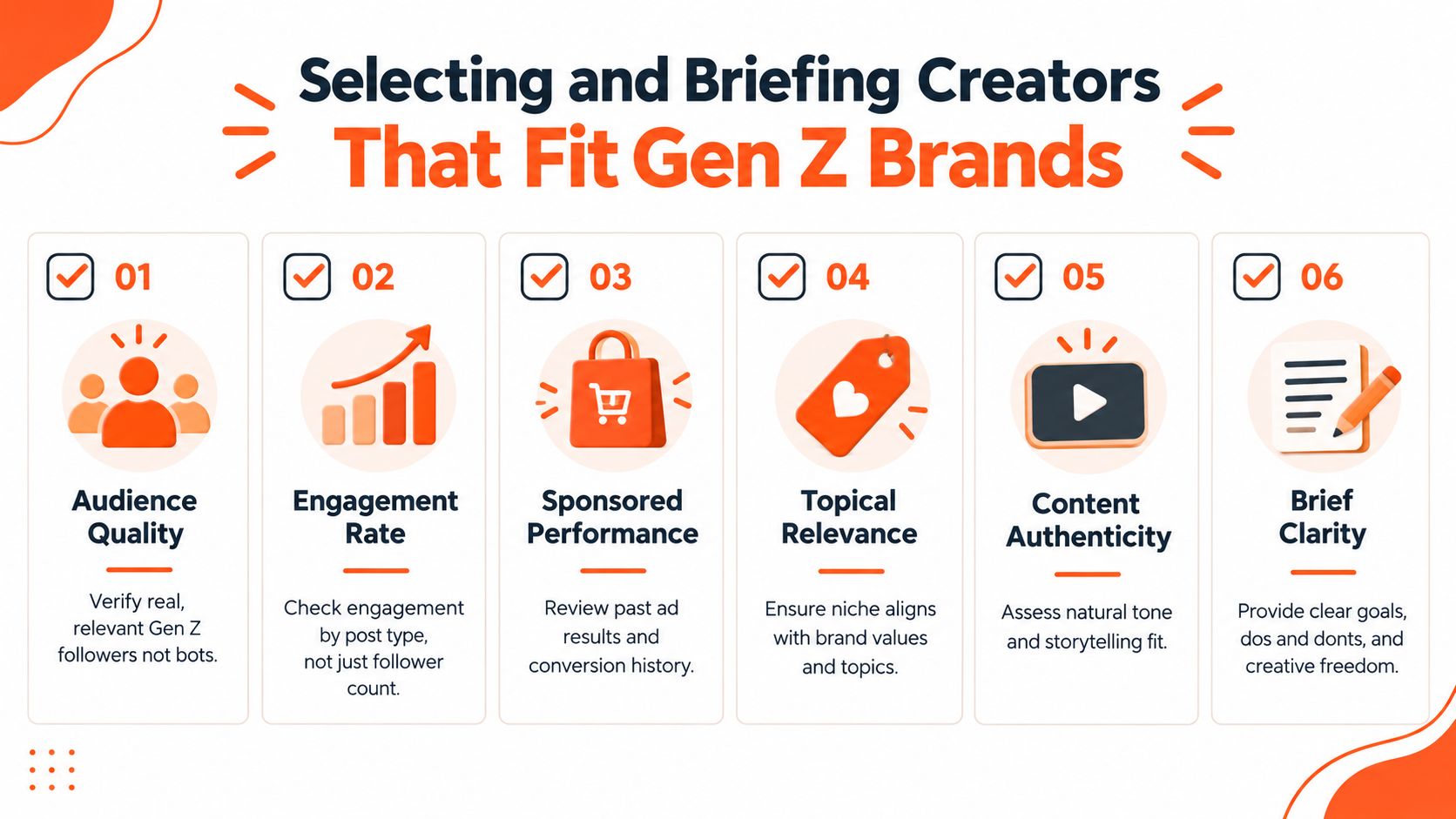
The first filter shouldn't be follower count. It should be whether the creator reaches the right people, explains products credibly, and has a history of making sponsored content feel native without hiding the commercial relationship.
Vet the audience before the aesthetic
Review engagement by post type, not just an account-level average. A creator may generate lively reactions on personal content but weak responses on product posts. Read the comments for evidence of genuine understanding, recurring questions, purchase intent, and audience skepticism.
Tools such as Modash and HypeAuditor can help assess audience quality, overlap, geography, and suspicious growth patterns. Look for sudden follower spikes, irrelevant audience locations, repetitive comments, or a sharp mismatch between a creator's stated niche and the people interacting with sponsored posts. Then inspect organic work in adjacent categories. A creator who naturally compares products, tests routines, or explains trade-offs has more useful proof than one who only produces attractive awareness content.
Score candidates with a weighted rubric:
- Relevance: Audience and topic fit.
- Creative quality: Clarity, pacing, storytelling, and platform fluency.
- Conversion history: Past sponsored performance and evidence of qualified action.
- Cost efficiency: Expected value relative to fee, production effort, and rights.
Source talent through platform-native discovery tools, specialist marketplaces, agencies, or targeted outreach. Keep the shortlist broad enough to test different voices, but narrow enough that every creator receives a thoughtful brief.
Brief for a conversion, not a script
Define one primary action, such as a product-page visit, trial, purchase, or tracked sign-up. Supply the product hooks, mandatory disclosures, factual talking points, prohibited claims, landing-page details, and usage-rights terms. Don't write every line of the video. Over-scripted delivery removes the natural phrasing and timing that made the creator valuable.
Ask for a concept before filming, approve the direction, and request a rough cut when legal or factual risk justifies it. Once organic posts identify the strongest performers, place paid amplification behind those assets instead of spreading budget evenly across every submission.
Compliance, Rights, and the Production Workflow
A creator campaign can perform well and still create avoidable risk if the disclosure, contract, or usage plan arrives late. Build compliance into the production calendar before anyone films.
The brief should define deliverables, platforms, claims, deadlines, approval rounds, disclosure language, tracking requirements, and contingency steps. Paid partnerships need clear disclosure, such as #ad or an appropriate platform paid-partnership label, placed where viewers can see it rather than buried among unrelated hashtags. Requirements vary across markets, so legal review should cover the relevant FTC, ASA, EU, and APAC expectations for the campaign rather than relying on one global assumption.

Put rights in writing
Specify the paid media amplification window, whitelisting permissions, exclusivity boundaries, ownership of raw footage, editing rights, territory, and renewal process. A brand that wants to run creator content as an ad needs more than permission to repost it organically. The contract should state where the asset can appear, who can modify it, and what happens when the agreed rights period ends.
Use a launch checklist:
- Creative QA: Check claims, captions, links, branding, accessibility, and platform specifications.
- Legal timing: Review high-risk claims before filming, not after final delivery.
- Disclosure setup: Confirm the label appears in the intended placement and format.
- Tracking: Assign creator-specific links, codes, landing pages, or tags.
- Contingency planning: Define what happens if the creator misses a deadline or a platform rejects the asset.
- Rights handoff: Record expiry dates, approved files, permissions, and renewal owners after launch.
This workflow protects performance too. Clear requirements reduce reshoots, prevent ads from going offline, and preserve the ability to amplify a proven asset when the original post gains traction.
Attribution and KPIs That Prove the Channel Works
Creator spend becomes a performance channel when every placement has a measurement path. Platform analytics show what happened inside the platform, but first-party tracking connects that activity to sessions, carts, purchases, and revenue.
Assign a unique UTM structure, promo code, vanity URL, or shoppable tag to each creator. Combine those signals with GA4, Shopify source attribution, post-purchase surveys, and creator-specific pixel events where the platform supports them. Whitelisted placements, TikTok Shop activity, and paid creator posts can then be evaluated alongside organic performance rather than in a separate reporting silo.
A useful reporting story starts with one creator whose video earns strong completion and saves but weak clicks. The right response isn't automatically to pause. Check the landing page, offer clarity, comments, and audience fit. Another creator may produce fewer views but stronger qualified traffic and revenue. That creator deserves a larger share of the next test, even if the first dashboard makes the reach comparison look unfavorable.
The practical question is not “Which creator got the most views?” It's “Which creator produced the most valuable next action per qualified viewer?”
| Funnel Stage | Primary KPI | Benchmarks |
|---|---|---|
| Attention | Hook rate, hold rate, view-through rate | Use your own historical platform and format baselines |
| Consideration | Click-through rate, qualified sessions, saves, product-page engagement | Compare by creator, format, audience, and landing page |
| Conversion | Add-to-cart rate, CPA, conversion rate, ROAS | Judge against contribution margin and campaign objective |
| Retention and advocacy | Repeat purchase, branded search, referrals, follower velocity | Track direction over time and segment by creator source |
Review performance weekly. Pause clear underperformers, scale the strongest creative, and document the learning behind each decision. Outcome-linked fees can also align incentives when the conversion event, attribution window, and reporting rules are agreed before launch.
For a deeper measurement framework, use this guide to measure influencer marketing ROI as a reference point, then adapt the model to your sales cycle and platform mix.
Putting the Gen Z Brand Growth Loop Together
The repeatable system is a loop, not a launch sequence. Audience insight shapes the brief. Creators turn the brief into native content. Organic response identifies the strongest concepts. Paid amplification extends those winners. Attribution connects the response to commercial outcomes, and the resulting evidence improves the next creator brief.
Run the loop on a clear cadence:
- Daily: Review new creative, comments, safety issues, and early retention signals.
- Weekly: Hold a performance sync by creator, platform, angle, and conversion action.
- Monthly: Rebalance the creator portfolio, removing weak audience or product-fit relationships and expanding the strongest ones.
- Quarterly: Refresh audience assumptions using platform-native trend data, search behavior, customer feedback, and category changes.
The most important tooling decision is shared taxonomy. Use consistent UTM parameters, discount-code naming, campaign IDs, and creator IDs across TikTok Shop, Instagram, YouTube, and Twitch. Without that structure, every platform reports a different version of reality and the team spends its time reconciling spreadsheets instead of improving creative.
A creator relationship management layer keeps briefs, contracts, assets, rates, rights, and past results in one place. A measurement partner or analytics process should resolve cross-platform identity as far as the available data allows, while clearly separating observed conversions from modeled or assisted outcomes.
Score creators on revenue per qualified view, not vanity reach alone. Keep the strongest performers in rotation with bespoke briefs, fresh hooks, and appropriate whitelisting permissions. Use community feedback to decide what the product or landing page needs next, not only what the next post should say.
Gen Z brand growth compounds through repetition with learning. The winning team isn't the one that finds one perfect creator or one viral format. It's the team that can run disciplined tests, protect trust, identify commercial signals, and reinvest in the voices that consistently make the product easier to understand and safer to choose.
Social Cloud helps growth teams plan, run, and measure creator campaigns across TikTok, Instagram, YouTube, and Twitch, with vetted creator selection, platform-specific creative guidance, tracking links, promo codes, and weekly performance reporting. If you want to connect creator content to qualified traffic, conversions, and revenue through an outcome-focused workflow, visit Social Cloud.


