
94% of surveyed marketers send free products to influencers, but only 19% say they get meaningful advocacy back, according to a 2025 study cited by Advertising Week. That's the problem with treating gifting influencer marketing as a cheap media buy: you can pay to deliver a box, but you haven't bought someone's enthusiasm.
The better approach is to decide what kind of relationship you're offering before anything ships. Then track what creators choose to do separately from anything you later pay them to produce or amplify.
Table of Contents
Why Most Gifted Boxes Never Become Advocacy
Say a skincare brand builds its mailing list by sorting Instagram accounts by follower count. The team sends the same kit to everyone, includes a vague request to share, and celebrates when fulfillment closes the shipment batch.
Another brand starts with creators who already discuss the category. Its team checks whether their followers ask buying questions, chooses a relevant serum, confirms interest, and prepares disclosure instructions and individual tracking codes before shipping.
The first team counts parcels. The second runs a test of product affinity.
This visual captures the marketer survey gap, not the percentage of individual boxes that become posts.

Start with a decision, not an address list
Product seeding means putting a product in relevant creators' hands without guaranteeing publication. It can help identify future partners, generate voluntary content, or reveal why people don't find the product worth discussing. Those are different outcomes, so choose the main one before building the list.
For a growth team, the useful questions are concrete:
- The deal: Are you offering a gift, inviting an optional mention, or commissioning work?
- The operation: Who confirms interest, handles delivery, and checks published content?
- The evidence: What would justify another wave or a paid creator brief?
If you're building the commercial scorecard alongside the mailing list, SuperX's guidance on how to measure ROI from influencer campaigns is a useful companion. Decide what counts as a result before the content arrives, rather than selecting whichever metric looks strongest afterward.
Don't interpret silence as an unpaid invoice. A creator may accept the product, try it, and decide it isn't something they want to recommend.
A gift is a handshake. A required Reel with deadlines and revisions is a job. Confusing the two is how a friendly introduction becomes an awkward collection call.
Three Deals a Gifted Product Can Mean
Three gifting deals and what each one includes
| Deal | What you may ask | Compensation | Usage rights | Disclosure |
|---|---|---|---|---|
| Unsolicited seeding | Nothing; no post, deadline, or edit | Product only | Creator owns any content; brand has no license | If they mention it, disclose the gift |
| Voluntary gifted post | An optional mention with no deadline or revisions | Product only; no fee | Organic post stays with the creator unless a license is signed | Clear gift disclosure on the post |
| Contracted content | Required posts, deadlines, revisions, or whitelisting | Fee, license fee, or both, plus the product | Term, platforms, edits, and exclusivity written in the contract | Paid-partnership label plus gift if one was sent |
Treat the table's disclosure column as a starting point, not permission to rely on a platform label alone. The audience still needs to understand the actual relationship.
A gift leaves the decision with the creator
With unsolicited seeding, you haven't asked for publication. The creator can use the product privately, give it away, or never open it. Operationally, asking permission before collecting a shipping address is cleaner than sending a surprise package.
A voluntary gifted post adds an invitation, not an obligation. You might explain why the product fits their cooking tutorials and say they're welcome to mention it if they enjoy using it. You can provide product facts and answer questions, but you can't add approval rounds afterward.
That distinction matters to creators. In the 2025 Europe-wide Kolsquare creator survey, 51% of creators had completed gifted collaborations in the prior year, and creators criticized brands that later requested multiple videos without payment.
Acceptance of a parcel isn't acceptance of a production brief. Keep the initial message explicit about what isn't expected, not just what you hope might happen.
A commission needs compensation and permissions
Contracted content starts when you need defined output: a demonstration, a launch-day post, a revision round, or permission to advertise through the creator's account. Budget for the work and negotiate the rights rather than treating the product's retail value as an automatic substitute for a fee.
Separate production from licensing. Making a video and allowing a brand to use that video in advertising are different permissions.
A usable agreement should specify:
- Deliverables and approval: Formats, deadlines, factual checks, and revision limits.
- Usage scope: Platforms, territories, duration, and permitted edits.
- Advertising access: Whether Spark Ads or other creator-handle advertising is included.
- Exclusivity: Which competing products are restricted and for how long.
Say a creator accepts a serum and voluntarily posts an Instagram Story. That doesn't mean they've agreed to a paid cut-down, cross-platform reuse, or perpetual ownership. Ask for the specific license, agree on compensation, and record the permission before the media team touches the asset.
If you would chase a missed deadline, you're hiring, not gifting.
Disclosures That Still Apply When Nobody Was Paid
No cash doesn't mean no disclosure. The relevant question is whether the audience should know about a connection that could affect how it evaluates the recommendation.
In October 2009, the FTC's revised Endorsement Guides clarified that material connections include in-kind compensation such as free products. An unpaid mention can therefore still carry a disclosure obligation.
Put the explanation where people will see it
Build disclosure instructions into outreach, not into a hurried message after publication. Explain that if the creator mentions the product, they should make the gift clear alongside the endorsement.
Use plain wording that identifies the brand and the benefit. For example, suggest a sentence stating that the brand sent the product for free, rather than a vague thank-you or an unexplained hashtag.
- For a caption: Put the explanation where readers can see it without expanding hidden text.
- For video: Include the disclosure in the video itself, visibly and, where appropriate, audibly.
- For a platform label: Check that it accurately describes the relationship and doesn't replace necessary context.
Don't ask creators to conceal the gift to make a post feel more natural. Transparency and a creator's honest opinion can coexist.
Give someone responsibility for checking
A voluntary post doesn't go through your normal creative approval queue. Assign someone to review live mentions, save the post URL, and flag missing or unclear disclosures for follow-up.
Your outreach should also name a contact who can answer questions. That makes it easier for creators to clarify the wording without guessing at legal requirements.
The trust problem extends beyond American campaigns: a 2025 BEUC consumer-fairness report cited 74% of consumers reporting insufficient transparency around influencers' paid product promotion. That finding concerns paid promotion broadly, not a gifting-only sample.
For international sends, use local legal review rather than assuming an English-language insert covers every market. Our influencer marketing compliance guide can help teams organize those checks.
Operating rule: When a creator mentions the gifted product, make the gift clear, whether or not your team requested the mention.
When a Bigger Gift Makes the Post Less Believable
A lavish package can make brand involvement more obvious without making the recommendation more convincing. That's a useful warning for teams spending more time designing the unboxing than checking whether the creator needs the product.
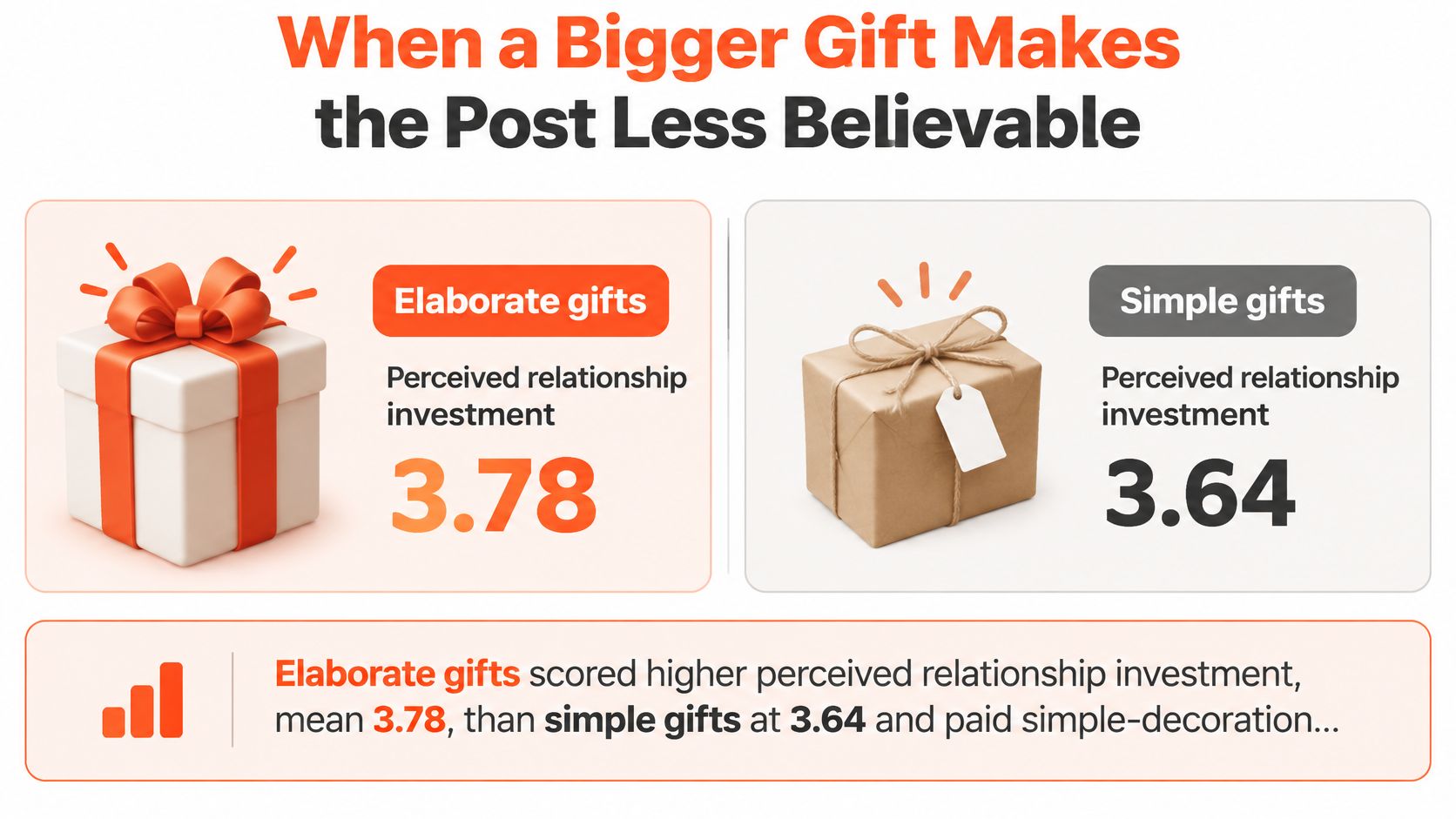
In a 2024 peer-reviewed study using Instagram Story experiments, researchers publishing in Psychology & Marketing found perceived relationship investment scores of 3.78 for elaborate gifts, 3.64 for simple gifts, and 3.33 for paid content with simple decoration; elaborate gifting also increased perceived persuasive intent, which was associated with lower influencer trustworthiness and brand attitude.
The comparison below shows the relationship-investment scores. They aren't purchase rates or a forecast of campaign returns.
Send something that belongs in the creator's life
Consider a cookware brand sending a replacement pan to a food creator who already uses that style of pan. The creator can test it while making a normal recipe, with no special performance built around opening the box.
Now consider a beauty brand sending a towering package with unrelated extras and a shot list. Even if the accompanying email says posting is optional, the presentation suggests an advertising assignment. Neither scenario guarantees an audience reaction, but the second creates more tension between the claimed gift and the expected performance.
The practical distinction isn't plain cardboard versus attractive packaging. It's useful product versus promotional spectacle.
A creator recommendation can influence buying decisions, but don't confuse that general potential with proof that elaborate gifts work. In Mavely's consumer gifting study, summarized by SponsorRadar, 28% of consumers in 2024 said they'd purchased a gift based on a creator or influencer recommendation. That measures gift purchases, not returns from product-seeding campaigns.
Test credibility, not just visibility
Compare similar creators and products while changing the kit format. Keep disclosure clear in every version, and separate voluntary seeding from guaranteed-post contracts so you can interpret the responses.
- Content response: Look at saves, useful questions, and comments about actual use.
- Buying response: Examine tracked visits, conversion, and branded-search movement.
- Audience interpretation: Note whether viewers discuss the product or focus on the sponsorship.
Treat those signals as evidence to investigate, not automatic proof of causation. A beautiful unboxing can attract attention without helping someone decide whether the product solves their problem.
For a visual companion to the gifting discussion, watch the video below.
How to Run a Seeding Wave From Brief to Doorstep
Build the workflow around permission and traceability. The person handling creator outreach, the fulfillment team, and the growth analyst should all be able to see the same recipient status.
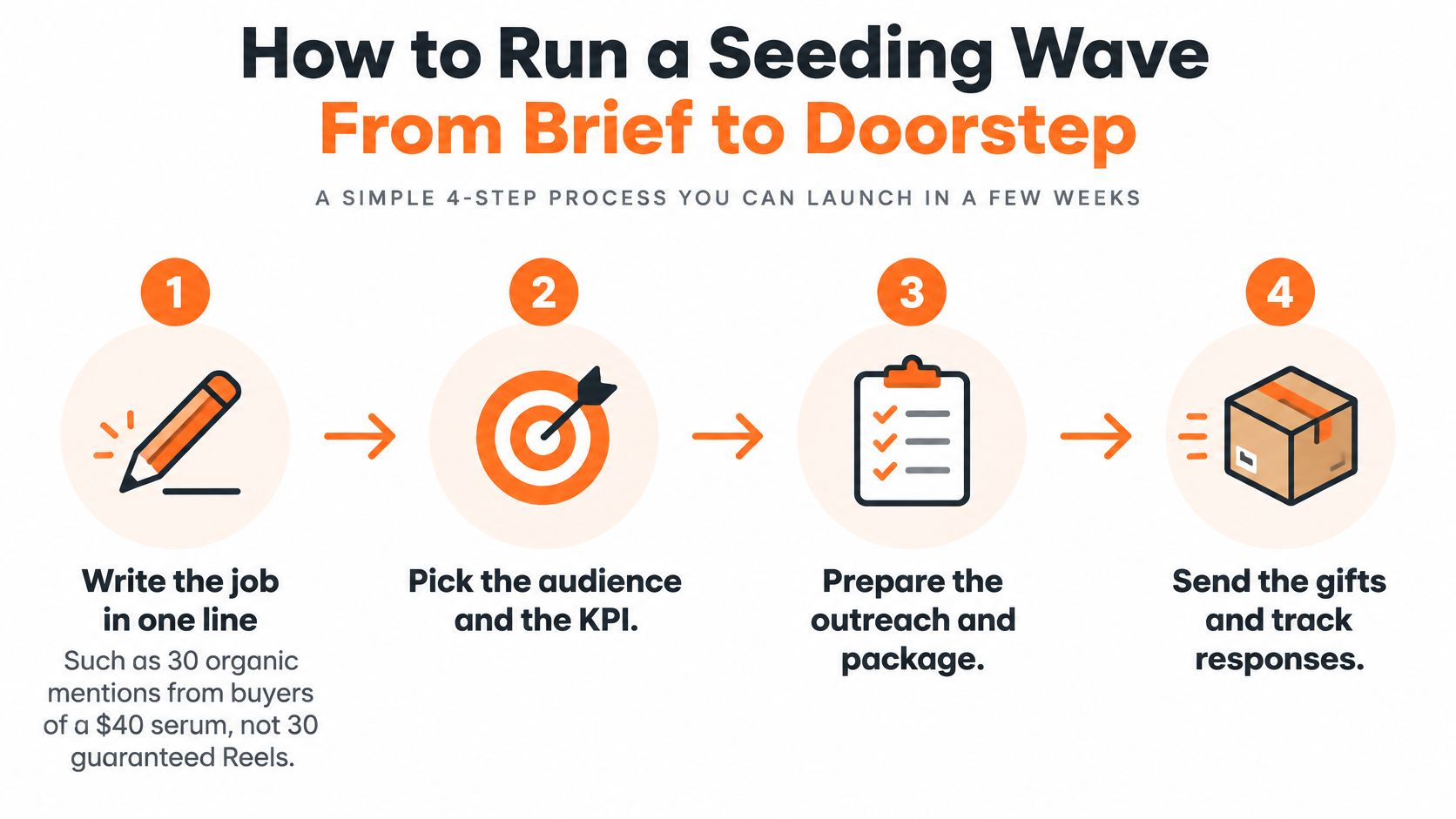
This process overview keeps preparation ahead of shipping.
Prepare the offer and the audience
Write the objective in a sentence. For example, test whether skincare-category creators voluntarily discuss a new serum and attract qualified product-page visits. An internal target is fine, but it mustn't become an undisclosed promise imposed on recipients.
Choose the audience and KPI before names. Specify the buyer profile, shipping market, and lead success measure. If the objective is product discovery, don't select creators solely because they produce polished studio footage.
Build a shortlist around fit. Review audience questions, content style, and available sponsored-content results. Check recent posts for repeated competing launches or signs that another similar product would be irrelevant.
Match the product and explain the offer. Choose a useful SKU, confirm the creator wants it, and state that publication is optional. Include factual product information without turning the insert into a script.
Use Magic Genie's creator brief builder to organize a draft if your team needs a starting structure. Then remove deliverables and approval requirements that don't belong in a voluntary send; our influencer marketing briefing guide can help distinguish useful context from creative control.
Make the shipment traceable
Create the recipient record. Log product value, market, shipment details, and the disclosure instructions sent. Keep shipping addresses in a restricted system rather than a widely shared campaign presentation.
Prepare tracking before dispatch. Generate the creator's code and tagged landing-page link, and test both. Don't require publication to make tracking available, and don't add a commission arrangement without explaining its terms.
Ship and allow a defined observation window. Choose the window before launch, based on delivery and realistic product-testing time. A delivery check is reasonable; repeated messages asking when content will appear aren't.
Thank creators who participate. Respond to useful feedback as well as public posts. Offer a separate paid brief when their work and audience justify it, rather than attaching new requirements to the original gift.
Pause repeat sends to nonparticipants. Mark them for review before another shipment, not as people who owe you content. A quiet recipient may be a poor fit, unavailable, or uninterested in publishing.
- Participation: Recipients who published divided by delivered shipments.
- Content quality: Save rate with its denominator stated, relevant comments, and audience questions.
- Demand: Tracked visits, redemptions, and assisted revenue under your chosen rules.
- Reusable assets: Content with documented licenses, not everything your team downloaded.
- Go only with a clear objective. If the team can't name the lead KPI in a sentence, resolve that before selecting recipients.
- Go only with disclosure instructions. Missing wording in outreach is a preparation problem, not something to fix after publication.
- Go only with an honest offer. If the team expects edits in return for a free unit, negotiate commissioned work instead.
If a retailer, legal team, or launch calendar requires approved content on a fixed date, use a contracted workflow instead. Don't force a voluntary seeding process to carry obligations it wasn't designed to handle.
What to Count After the Box Is Delivered
A shipment is not an impression. Read your report as a sequence of distinct signals, not a pile of interchangeable activity.
Gifting signals and what they are not
| Signal | What it proves | Do not treat it as |
|---|---|---|
| Shipment delivered | The product arrived | An impression or a post |
| Reply or opt-in | The creator is interested | A posting commitment |
| Organic post | Earned advocacy | Guaranteed media |
| Qualified views, saves, comments | Content quality | A conversion |
| Unique code, link, or survey mention | Assisted demand from that creator | Full revenue or view-through ROAS |
| Spark Ad, whitelist, or boost | Paid amplification | Organic seeding performance |
Use these labels carefully. A voluntary negative review belongs in earned content reporting, but not in your tally of positive advocacy. Views, saves, and comments are indicators to interpret, not proof that everyone watching found the content useful.
Keep the record at creator level
Build a ledger containing creator identity, product value, ship date, market, disclosure instructions, content status, usage rights, and any subsequent fee or posting commitment. That lets an analyst trace a reported outcome to the actual arrangement.
Include a disclosure check rather than treating compliance as a separate folder nobody opens. The FTC's Disclosures 101 guide explains that free or discounted products can create a material connection and that disclosures must be clear and conspicuous.
Keep earned response and paid amplification in separate reporting columns. If you later boost a voluntary unboxing, retain its pre-boost performance and record the advertising spend and additional delivery separately.
For attribution, combine creator links, code redemptions, and post-purchase survey responses. Deduplicate overlapping orders, and label survey-reported influence separately from directly tracked purchases.
Make the scorecard useful for decisions
Set the reporting cutoff and attribution rules before launch. Include:
Calculate direct cost per organic post as product cost plus shipping, divided by qualifying organic posts. For a fully loaded comparison, add packaging, handling, tools, and team time; include production and licensing fees when comparing contracted work.
Our guide to measuring influencer marketing ROI helps connect that operational scorecard to commercial outcomes.
Don't overdiagnose from a single pattern. Sparse posts with strong clicks may reflect a highly relevant creator, while plentiful posts with no redemptions could indicate audience mismatch, a weak offer, or broken tracking. Check the mechanism before prescribing more boxes.
Launch Your First Gifting Wave
Make the go-or-no-go choices before approving fulfillment:
Keep the first test easy to interpret
Choose a tightly matched group, a hero product, and a manageable market. Keep enough capacity to answer creator questions, check delivery issues, and review the content that appears.
Write a compact campaign page containing the deal type, buyer profile, KPI, disclosure wording, observation window, and progression criteria. Give the same page to outreach, fulfillment, and reporting so nobody changes the offer.
Before dispatch: Have someone outside the outreach team read the message. If they can't tell whether posting is optional, rewrite it.
Decide how you'll select future paid partners. Consider content quality, audience relevance, useful feedback, and buying signals together, rather than rewarding the creator with the loudest unboxing.
At the review, separate creators ready for a commercial brief from people worth staying in touch with and people who shouldn't receive another automatic send. Respect a creator who declines. That response is useful information, not a failed obligation.
If you want selection, contracting, and per-creator tracking managed together, our team can handle that operational layer. We've delivered 340+ successful influencer campaigns, and we keep creator strategy connected to production and attribution.
Your next action is simple: finish the campaign page, approve only recipients who fit it, and make sure someone owns the review before the first parcel leaves.
Social Cloud's Influencer Gifting service sends products to creators who care about them, with tracking and a clear path to separately agreed paid partnerships. Visit Social Cloud and submit your growth target to receive a creator strategy, forecast, and budget within 48 hours.