You've hired a TikTok team, approved a stream of creator videos, and watched the dashboard fill with views, clicks, and platform-attributed conversions. Then finance asks the question nobody prepared for: How many of those purchases happened because of TikTok, rather than in spite of it?
That's the dividing line between a TikTok agency that manages activity and one that manages growth. Creative matters, but a polished portfolio won't tell you whether the agency can isolate incremental value, connect creator content to revenue, or price its work around outcomes. I've seen brands choose agencies for viral reels and discover later that nobody owned the tracking architecture.
TikTok deserves more scrutiny now because it has moved far beyond an experimental social format. One 2026 industry estimate projects global TikTok ad revenue at $34.8 billion, with the U.S. projected above $17 billion, while global planning tools show ad reach exceeding 2.2 billion adults, excluding India. Those figures are compiled in TikTok marketing statistics, and they explain why serious media plans increasingly include TikTok across the funnel.
Table of Contents
- Week one should create alignment
- Weeks two and three should produce usable strategy
- Launch preparation needs a hard gate
Why Choosing the Right TikTok Ad Agency Matters
A consumer brand I worked with once evaluated agencies almost entirely through creative reels. The winning pitch featured energetic edits, recognizable creators, and videos that looked native to the feed. The agency understood hooks and production, so the brand signed quickly.
The first campaigns looked healthy. Video completion was strong, traffic increased, and TikTok reported conversions. But the internal team couldn't answer basic commercial questions. Which creator drove qualified customers? Which campaign generated demand that wouldn't have existed otherwise? Were view-through conversions incremental, or were they just claiming customers who would have purchased through another channel?
That gap became expensive because the agency optimized toward what it could report easily. It refreshed creative, shifted spend between ad groups, and celebrated platform ROAS. Nobody had designed a controlled test or connected TikTok exposure to the company's broader customer journey.
TikTok has become a serious media channel
TikTok's advertising economics show how quickly the platform matured. A compiled statistics source estimates worldwide advertising revenue at approximately $3.88 billion in 2021, projected at about $9.89 billion in 2022 and $18.5 billion by 2024, before moving into the $30 billion-plus range by 2025 and 2026. The historical figures appear in TikTok user and demographic data.
That progression matters when you hire a TikTok ad agency. A small test channel can survive on reach reports and creative opinions. A major paid channel needs forecasting, conversion tracking, attribution analysis, creator authorization management, and a clear relationship between spend and business results.
Hiring rule: Treat an agency like a senior growth hire. Ask what it will measure, how it will make decisions, and what happens when the data challenges its original strategy.
A portfolio is only the starting point
Creative examples show taste. They don't prove measurement discipline. An agency can produce excellent videos and still misallocate budget, overstate conversions, or lack the infrastructure to learn from failed tests.
The right partner should show you how it connects creative variables to outcomes. That means explaining the hypothesis behind a hook, the audience exposed to it, the conversion event being tracked, and the method used to distinguish correlation from incremental impact. If the presentation spends more time on viral views than on test design, ask harder questions before signing.
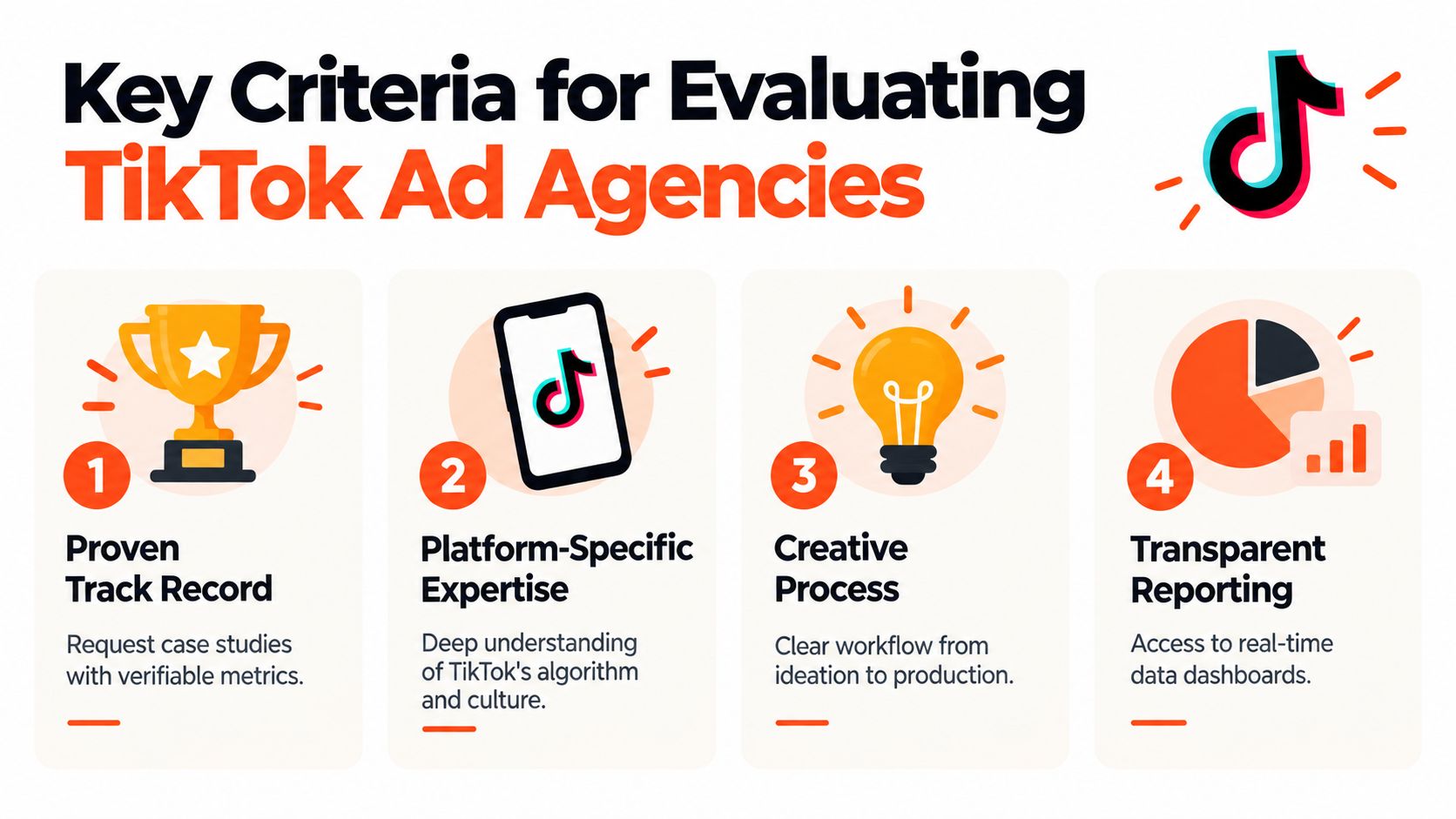
Key Criteria for Evaluating TikTok Ad Agencies
A capable TikTok agency should pass four tests: relevant performance evidence, platform-native expertise, a repeatable creative operation, and transparent reporting. Don't accept broad claims such as “we're full service” or “we know the algorithm.” Ask the team to demonstrate how those capabilities work inside your account.
What to verify before you shortlist
Relevant track record: Request recent examples from brands with similar sales cycles, compliance constraints, audience characteristics, and conversion events. A creator campaign for a low-consideration product won't validate an agency's ability to generate qualified SaaS pipeline or regulated-category sales.
Measurement infrastructure: Ask whether the agency can work with TikTok Pixel, Events API, CRM events, post-purchase surveys, and controlled lift tests. You want access to raw platform data and an agreed reporting layer, not a monthly PDF filled with screenshots.
Creator vetting: Network size is a weak buying criterion. The agency should explain how it checks audience quality, brand safety, content fit, disclosure history, and past sponsored performance. A smaller vetted roster can outperform a huge directory full of poor-fit creators.
TikTok-native execution: The team should understand Spark Ads, creator permissions, native storytelling, in-feed behavior, and the operational requirements of turning organic creator assets into paid placements. Generic Meta tactics adapted to vertical video aren't specialization.
Green flags and red flags
Green flags include clear test hypotheses, named account operators, documented approval workflows, transparent creator fees, and reporting that separates platform-reported results from independently observed outcomes. A mature agency will also tell you what it can't prove yet.
Red flags include guaranteed ROAS without a testing plan, reluctance to share account access, vague answers about creator usage rights, and case studies that show only impressions or views. Be cautious when an agency insists that every conversion attributed by TikTok is incremental.
For broader vendor diligence, the HarvestMyData vendor sourcing guide offers a useful framework for comparing suppliers, documenting requirements, and reducing selection bias. If your program depends heavily on creators, review how a specialist approaches creator marketing agency services, particularly around vetting, contracting, and campaign coordination.
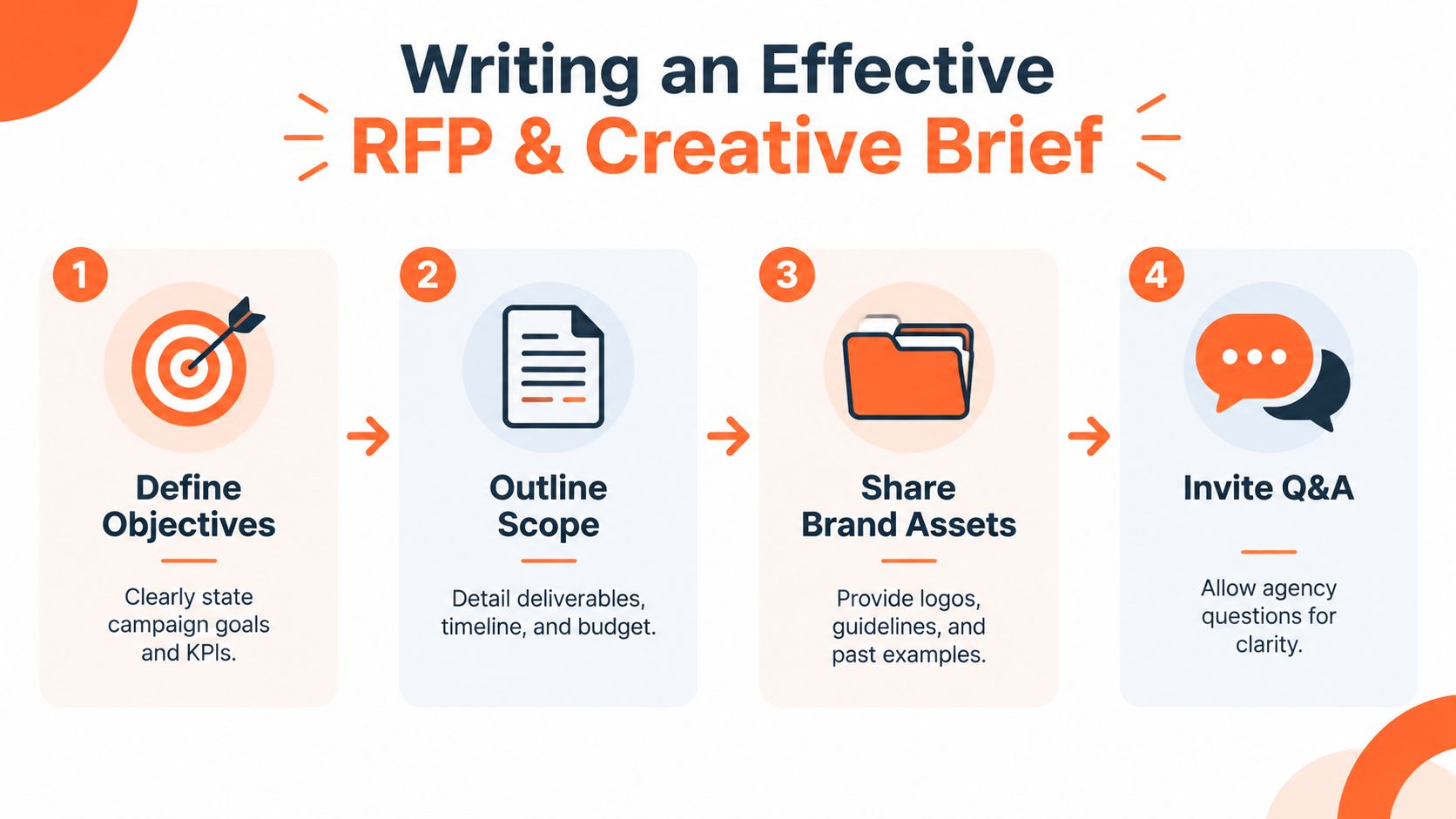
Writing an Effective RFP and Creative Brief
Your RFP should force agencies to reveal how they think. Don't ask only for a proposal and fee. Ask for the assumptions, evidence, measurement design, ownership model, and operating cadence behind the proposal.
Start with the business problem. State whether you're trying to generate purchases, qualified leads, app events, subscriptions, or demand that will be evaluated through a longer sales cycle. Give agencies enough context to understand the economics, but don't prescribe the creative answer before they've diagnosed the audience.
Put these requirements in the brief
Define the objective. Name the primary conversion and the business outcome behind it. Separate leading indicators, such as qualified visits or completed views, from the metric that determines commercial success.
Describe the audience. Include customer segments, exclusions, geography, existing first-party audiences, and known objections. For B2B, give the agency your ICP and sales qualification criteria rather than relying on broad demographics.
Set measurement expectations. Require a proposed attribution model, tracking plan, reporting schedule, incrementality approach, and explanation of how view-through activity will be handled. Ask how the agency will reconcile TikTok reporting with analytics and CRM data.
Define scope and ownership. Specify whether the agency handles creator sourcing, scripts, production, editing, Spark authorization, media buying, landing pages, TikTok Shop operations, and reporting. State who owns raw footage, ad accounts, creator rights, and tracking data.
Share commercial constraints. Give a budget range qualitatively if you're not ready to disclose the exact amount, but insist that proposals identify management fees, production costs, creator payments, usage rights, and testing costs separately.
Set approval and compliance rules. Include required claims substantiation, legal review, disclosure standards, brand safety exclusions, and revision responsibilities. Regulated categories need this before creative production begins, not after a creator submits a finished video.
Leave room for agency judgment
A weak brief tells the agency to produce a certain number of videos in a certain style. A strong brief defines the problem, constraints, customer, and measurement standard, then asks the agency to recommend the creative system.
Require each finalist to present a first testing roadmap. It should include hypotheses, audience logic, creative angles, success criteria, decision rules, and what the team will do if the first results are inconclusive. You're not looking for a perfect forecast. You're looking for disciplined thinking.
Understanding TikTok Agency Pricing Models
Pricing reveals incentives. If an agency earns more whenever you spend more, it may have an understandable commercial model, but you'll need safeguards against scaling before the evidence supports it. If it charges only for outcomes, confirm that your tracking and sales process can support fair measurement.
| Pricing Model | Typical Range | Best For | Key Considerations |
|---|---|---|---|
| Monthly retainer | Agency-defined | Ongoing strategy, creative, and media management | Clarify included hours, deliverables, revision limits, and excluded production costs |
| Percentage of spend | Agency-defined percentage | Larger media programs with changing budgets | Check whether the fee rewards spend growth rather than efficiency |
| Project-based | Fixed project fee | Audits, launch setup, creative packages, or one-off tests | Define ownership, post-launch support, and change-order rules |
| Performance-linked | Base fee plus agreed outcome component | Mature programs with reliable conversion data | Establish attribution rules, validation windows, caps, and dispute procedures |
The brief doesn't provide a verified market range for agency fees, so don't trust a generic “typical TikTok agency cost” figure. Ask every agency to model the total cost of ownership, including management, creator fees, production, licensing, usage extensions, landing-page work, tracking setup, and any platform or commerce support.
Retainers and percentage-of-spend fees
A retainer works well when the agency is responsible for continuous strategy, creator relationships, testing, reporting, and optimization. It gives both sides predictable planning, but it can hide under-delivery if the contract defines access and outputs vaguely.
Percentage-of-spend pricing is simple to administer, yet it can create a conflict. A larger budget increases the agency's fee even when performance hasn't improved. If you choose this model, add efficiency gates, approval thresholds, and a rule that budget increases require evidence from agreed metrics.
Performance-linked pricing
Outcome-linked pricing is attractive because it aligns the agency with your objectives. Social Cloud, for example, describes a model combining a lean base fee with a performance component tied to agreed installs, conversions, or ROAS, alongside creator-level tracking and post-purchase surveys.
That model only works when both sides define the outcome precisely. Agree on attribution windows, assisted conversions, refunds, repeat purchases, offline sales, data access, and who controls variables such as landing pages or inventory. Otherwise, the contract turns into an argument about whose dashboard is right.
Negotiation principle: Pay for outcomes only when you can independently verify the outcomes.
Onboarding Timeline and Expected Deliverables
The first campaign shouldn't launch until the agency can explain the account structure, conversion events, creative approval path, and reporting logic. Fast onboarding isn't the same as rushed onboarding. Skipping tracking work at the start usually creates expensive confusion later.
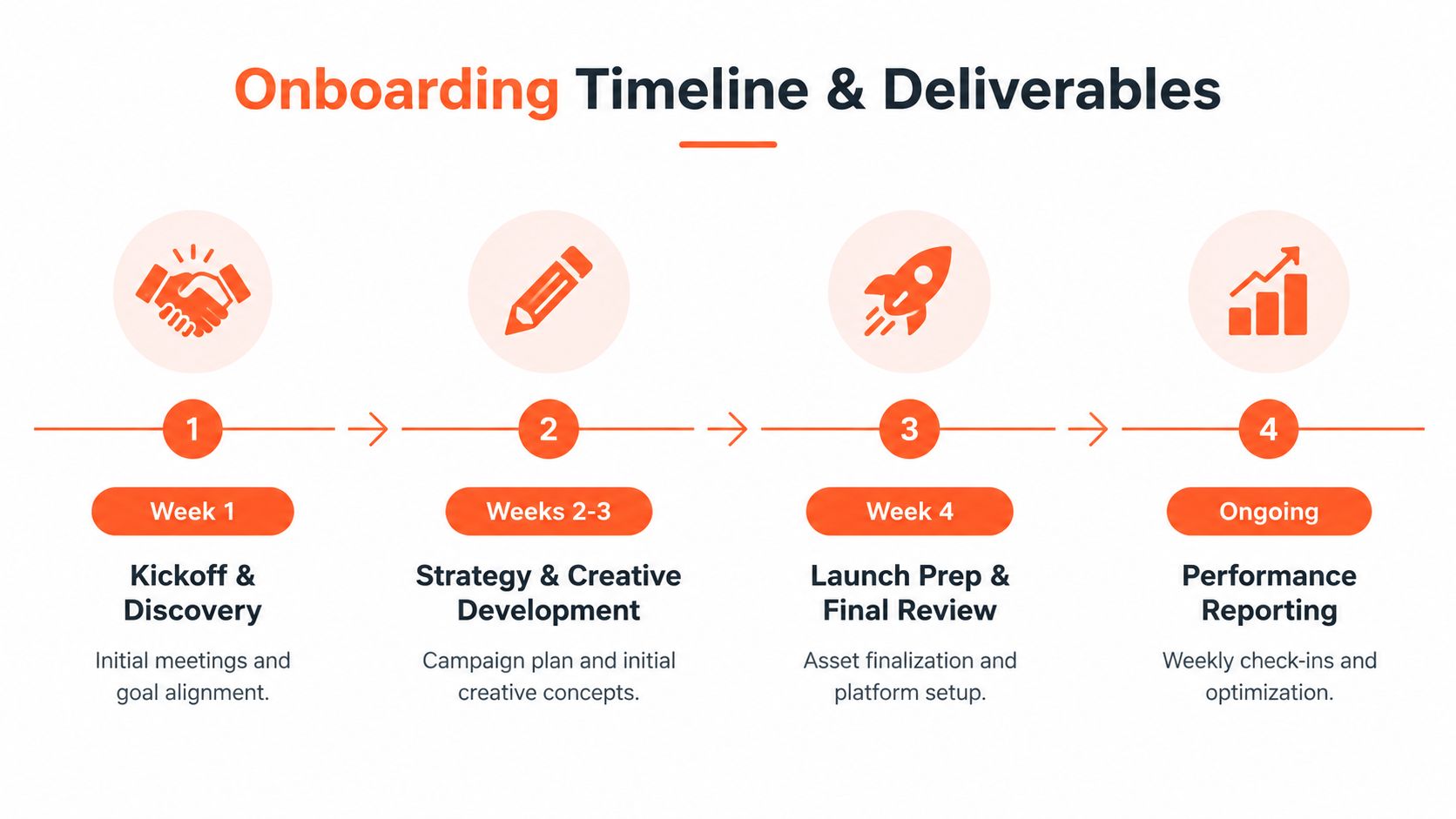
Week one should create alignment
The kickoff should identify one accountable decision-maker on each side, confirm the commercial objective, document the audience, and map the customer journey. The agency should collect brand guidelines, approved claims, historical performance data, creative assets, analytics access, CRM definitions, and existing creator contracts.
By the end of discovery, request a written document covering:
- Business objectives: Primary outcome, secondary indicators, exclusions, and decision thresholds.
- Measurement plan: Events, UTMs, attribution windows, data sources, and reporting ownership.
- Creative system: Angles, formats, creator requirements, testing logic, and approval stages.
- Operating model: Meetings, response times, revision limits, escalation paths, and account access.
Weeks two and three should produce usable strategy
The agency should turn discovery into a campaign architecture and creative roadmap. That roadmap should distinguish prospecting, retargeting, creator-led placements, and any commerce activity. It should also explain how creative learnings will affect the next round of production.
Don't accept “we'll test and see” as a strategy. Ask what the agency considers a meaningful test, what it will hold constant, and which result would cause it to stop, revise, or scale an idea.
Launch preparation needs a hard gate
Before launch, verify event firing, naming conventions, landing pages, creator permissions, disclosures, budget approvals, and the reporting dashboard. Assign final approval to a named person, then document how many revision rounds are included and what happens when legal review introduces changes.
Ongoing reporting should include decisions, not just metrics. A useful weekly review states what changed, why it changed, what evidence supports the decision, and what the team will test next.
Why Measurement Rigor Matters More Than Creative Virality
Viral creative can attract attention without producing profitable demand. An agency that talks endlessly about trends but can't explain incrementality is optimizing for applause, not growth.

TikTok is particularly vulnerable to undercounting in click-only measurement. Independent research covering more than 100 lift tests reported that 94% of TikTok lift tests showed performance was underreported by traditional attribution, with incremental ROAS reaching up to 2.35 times the level suggested by last-click attribution. The findings are summarized in this TikTok incrementality study coverage.
That doesn't mean you should accept every platform-reported conversion. It means click-only reporting can miss part of TikTok's contribution, while platform reporting can claim too much. Your agency needs a triangulation process that uses controlled lift tests, attribution analysis, view-through signals, post-purchase surveys, and, where appropriate, media-mix modeling.
Ask the agency to prove the counterfactual
The key question is simple: What happened because the person saw the ad that wouldn't have happened otherwise?
A credible test might compare exposed and unexposed audiences, hold out a defined segment, or use another controlled design appropriate to your buying cycle. The agency should explain how it will avoid contamination, define the measurement window, and use the result to calibrate other reporting systems.
TikTok's own guidance emphasizes split testing, attribution analytics, view-through attribution, and post-purchase surveys. Review the TikTok attribution overview and ask your agency which methods it will implement, rather than allowing it to default to the easiest dashboard metric.
For teams that need broader creator measurement context, this guide on measuring influencer marketing ROI is useful when creator content, paid amplification, and purchase behavior overlap.
Creative still matters. Resources covering viral growth strategies for TikTok can help your team understand attention mechanics, formats, and discovery. But virality is an input to test, not a business outcome.
A mature agency will report both platform performance and independently validated impact. It'll show which creative earned attention, which audience responded, and whether the resulting behavior exceeded what would have happened without exposure.
Your Action Plan for Hiring a TikTok Ad Agency
Start with a short list built around business fit, not follower counts or viral examples. Remove any agency that can't show relevant work, explain its measurement design, or give you direct access to the account and underlying data.
Then run a structured evaluation:
- Request evidence. Ask for relevant case studies, client references, sample reporting, and an explanation of what the agency measured independently.
- Run a working session. Give finalists the same business problem and ask each to produce a testing roadmap. Compare the questions they ask before comparing their creative ideas.
- Audit the contract. Confirm deliverables, ownership, creator rights, data access, fees, approval timelines, revision limits, cancellation terms, and exit support.
- Use a bounded pilot. Give the agency enough time and budget to install tracking, produce meaningful creative tests, and evaluate early signals. Don't demand instant profitability, but don't accept activity without learning.
- Set review gates. Schedule formal assessments around data quality, creative throughput, incremental impact, and commercial outcomes. Replace the agency if it repeatedly misses agreed responsibilities or refuses to address measurement gaps.
For another perspective on evaluating outsourced media expertise, use this guide to hiring a media buying service. If you operate in a regulated or complex category, review how a specialist approaches fintech advertising agency selection before you finalize your shortlist.
Bring capabilities in-house when you have stable creative production, experienced media operators, reliable analytics, and someone accountable for experimentation. Keep agency support when you need creator sourcing, cross-platform execution, specialized measurement, or faster access to expertise than internal hiring can provide.
Social Cloud plans, runs, and measures creator campaigns across TikTok, YouTube, Instagram, and Twitch, with creator-level tracking, Spark Ads support, and outcome-linked pricing. If you want a TikTok program built around attributable results instead of vanity metrics, visit Social Cloud and start a practical conversation about your goals.