
German marketers aren't dabbling anymore. Germany-based companies invested an average of €5.74 million in influencer marketing in 2024, according to Kolsquare's European study of 385 business decision-makers, as reported by iBusiness. At that level, you don't need a friendly local booker with a creator list. You need forecast speed, clean fees, and proof by creator.
Table of Contents
- A €150,000 Test Budget You Can Actually Read
- Split the Bill Into Three Lines
- Why the Forecast Matters More Than the Rate Card
What a Cologne Influencer Agency Actually Does
That €5.74 million average changes the job. An Influencer Agentur in Köln isn't there to find you a famous face for a launch photo. It's there to plan, staff, contract, and report creator work for brands that need German-language audiences and EU disclosure rules handled properly.
Think of a typical campaign as a relay. The agency turns your brief into a creator shortlist, forecasts views and cost per result, then locks contracts and usage rights before anything goes live. After posts ship, you get a weekly read on what sold, not a pretty screenshot deck at the end of the month.
Cologne helps with that backbone. The City of Cologne's statistical analysis counted more than 52,000 media and IT jobs in September 2021, representing 9% of Cologne's industry structure. That gives you video producers, analysts, and platform people nearby, even if the creators themselves are scattered across Germany.
The Producer's Office, Not the Talent
The agency is the producer's office. It doesn't star in the video. It makes sure the right person posts the right asset, on the right day, with tracking and a contract that lets you reuse the clip.
Buyers usually buy four formats:
- YouTube: Integrations, dedicated videos, and Shorts cutdowns.
- Instagram: Reels and feed posts you can reuse in paid media.
- TikTok: Native videos built for fast reach and Spark Ads.
- Twitch: Live segments where viewers can watch the product work.
Don't judge those formats the same way, because the buyers behind them aren't the same.
Three Buyers, Three Definitions of Success
A DTC brand wants revenue and a defensible CPA. An app team wants installs at a target CPI, with deep links that survive the click. A fintech or health brand wants growth too, but it can't afford a creator improvising claims about returns, diagnoses, or results.
If an agency pitches all three buyers the same creator list and the same report, walk away. The briefs only look similar until money moves.
Your first test is simple. Ask who owns the forecast, who owns disclosure approval, and who explains a miss in the weekly report. If those are three different vendors, you've bought coordination work for yourself.
Platforms, Fees and Budget Split
Start with the job, not the logo. What a Cologne agency should deliver by platform looks like this:
| Platform | Hired for | Core asset | Tracking that must ship | Failure mode |
|---|---|---|---|---|
| YouTube | Consideration and purchase intent | Integration or dedicated video plus Shorts cutdowns | Unique link, code, and post-purchase survey | Integration reduced to a 15-second logo slap |
| Product discovery and social proof | Reel or feed post with rights for paid reuse | Unique link or code and saved usage rights | Creator audience mostly outside Germany | |
| TikTok | Fast reach and Spark-ready creative | Native video cleared for Spark Ads | Unique link or code plus Spark authorization | Product needs a longer explanation |
| Twitch | Live demo and community trust | Stream segment with on-screen offer | Code or tracked overlay link read on stream | Offer not readable on stream |
Most plans will lean short-form. In 2024, TikTok and Instagram together accounted for 83% of brand-creator collaborations, according to Collabstr's analysis of data from more than 40,000 advertisers and 100,000 creators. That's useful context, not a command to copy everyone else.
YouTube still earns a serious share in Germany. In 2024, 29% of German internet users aged 16 and over had bought a product or used a service because of YouTube influencer advertising, according to the Social-Media-Atlas 2024 study commissioned by PER Agency and Toluna with IMWF. If your product needs explanation, comparison, or trust, don't starve YouTube just because short-form is fashionable.
A €150,000 Test Budget You Can Actually Read
Say you're testing with €150,000. A sensible starting hypothesis is about half on TikTok and Instagram, roughly a third on YouTube, and a small live slice on Twitch. That gives you fast creative learning, one deeper consideration channel, and a contained live experiment.
Treat that split as a draft, not a promise. The agency's 48-hour forecast should revise it based on your category, price point, landing page, and past creator results. If the forecast just sends your own percentages back in nicer formatting, you haven't bought expertise.
Twitch deserves discipline. Buy it when a streamer can demo the product live, answer objections, and read the offer clearly on screen. Don't buy it because gaming sounds exciting in a pitch meeting.
Gifting has a narrower job too. Use precision seeding to generate organic UGC and Spark-ready clips from creators who already fit the product. Don't call unpaid gifting a media plan, and don't expect posting dates you haven't contracted.
Split the Bill Into Three Lines
Insist on seeing fees in three separate lines. Cologne agencies, and agencies everywhere, either get transparent or get creative.
- Creator cost pass-through: Creator spend passed through at cost, with no padded rate card or hidden markup buried inside talent fees.
- Lean agency base: A base fee for strategy, briefing, contracting, QA, and reporting, stated separately from creator spend.
- Performance fee: A result-based component agreed before launch and tied to installs, CPA, or ROAS, not invented after a good week.
Exact fees come from the quote. I'm not publishing a price range here because a fake range helps nobody negotiate. If you want a useful sense check on how quotes are usually structured, read this breakdown of influencer marketing agency pricing before you compare proposals line by line.
The same discipline helps outside influencer buying. If you're comparing AI tooling for your growth stack, for example, you can compare LunaBloom AI plans on a single pricing page instead of guessing from sales calls. Creator fees should be just as legible.
Negotiating rule: If the agency won't separate creator cost from its own fee, assume you're paying a markup and price the risk accordingly.
Why the Forecast Matters More Than the Rate Card
Budgets are moving too fast for vague proposals. The 2024 European market study from Kolsquare and NewtonX reported that German marketers allocated an average annual influencer-marketing budget of €5.74 million, and 82% of German marketers had increased influencer spending by 10% to 49% during the previous year. When spend rises that quickly, a forecast isn't paperwork. It's how you avoid scaling a guess.
Set the benchmark before you sign:
- Within 48 hours: Target CPI or CPA, expected views, creator shortlist logic, and platform split.
- Within 3 to 5 weeks: Contracted creators live, with tracking and rights already cleared.
- Before launch: The attribution window and the number that triggers scale, pause, or replacement.
Compare that with the slower pattern of separate strategy, talent, and legal vendors passing PDFs around. You'll lose weeks, and nobody will own the final number.
Don't ask an agency, "What do creators cost?" Ask, "What will this budget buy, at what forecast CPA, and what evidence backs that forecast?" That's the conversation that separates a performance partner from a booking desk. Measurement is where those forecast numbers either become believable or fall apart.
How Views Become Tracked Revenue
Say a shopper watches a Cologne creator try your product on Tuesday. On Thursday she sees your paid ad, on Friday she searches your brand, and then she buys. Last-click attribution gives the sale to search and makes the creator look useless.
That isn't a reporting quirk. It's how good creators get cut and weak search campaigns get more budget.

The Lancashire research on influencer attribution notes that benchmark research found only 24.9% reported using conversions or sales as a success measure. That's why pretty view reports survive. Marketers keep grading creator work with exposure metrics, then wonder why finance doesn't trust the channel.
The Minimum Tracking Stack
Every placement needs three things, no exceptions:
- One tracking link or app deep link: Unique to that creator and placement, never a generic homepage URL.
- One promo code: Short enough to say out loud on YouTube or Twitch and easy to type on mobile.
- One post-purchase survey question: A "How did you hear about us?" field that names the creator as a selectable answer.
Reconcile those three with platform views, web analytics, and CRM records. A code tells you who acted directly. A survey catches buyers who saw the creator, forgot the code, and still came because of that post.
If you want the fuller method, this guide on how to measure influencer marketing ROI is worth reading before you approve a dashboard template.
What the Weekly Dashboard Must Show
Demand these fields, in this order, split by creator and platform: views, watch-through, engagement, click-through rate, conversion rate, cost per acquisition, and revenue. If the report stops at views and likes, it's a media recap, not a performance report.
Codes have a limit, and you should say it out loud in planning. They only catch people who remember to use them. Larger budgets should add a holdout group, a geo split, or a marketing mix model so you're estimating incremental impact, not just collecting coupons.
Write the target CPI, CPA, or ROAS and the attribution window into the forecast before launch. Changing the window after results arrive is how teams lie to themselves politely.
Use a simple example in your review. Say two creators both deliver strong views in week one. Creator A has clicks but no code redemptions and no survey mentions. Creator B has fewer comments, yet her code and survey answers show paid orders inside your target CPA. Creator B gets the next brief. Follower count doesn't even enter the discussion.
How to Score an Agency Before You Sign
Score the pitch, not the city on the footer. A Cologne postcode won't fix a hidden markup, and a Hamburg or Berlin address won't break a campaign that tracks every placement.
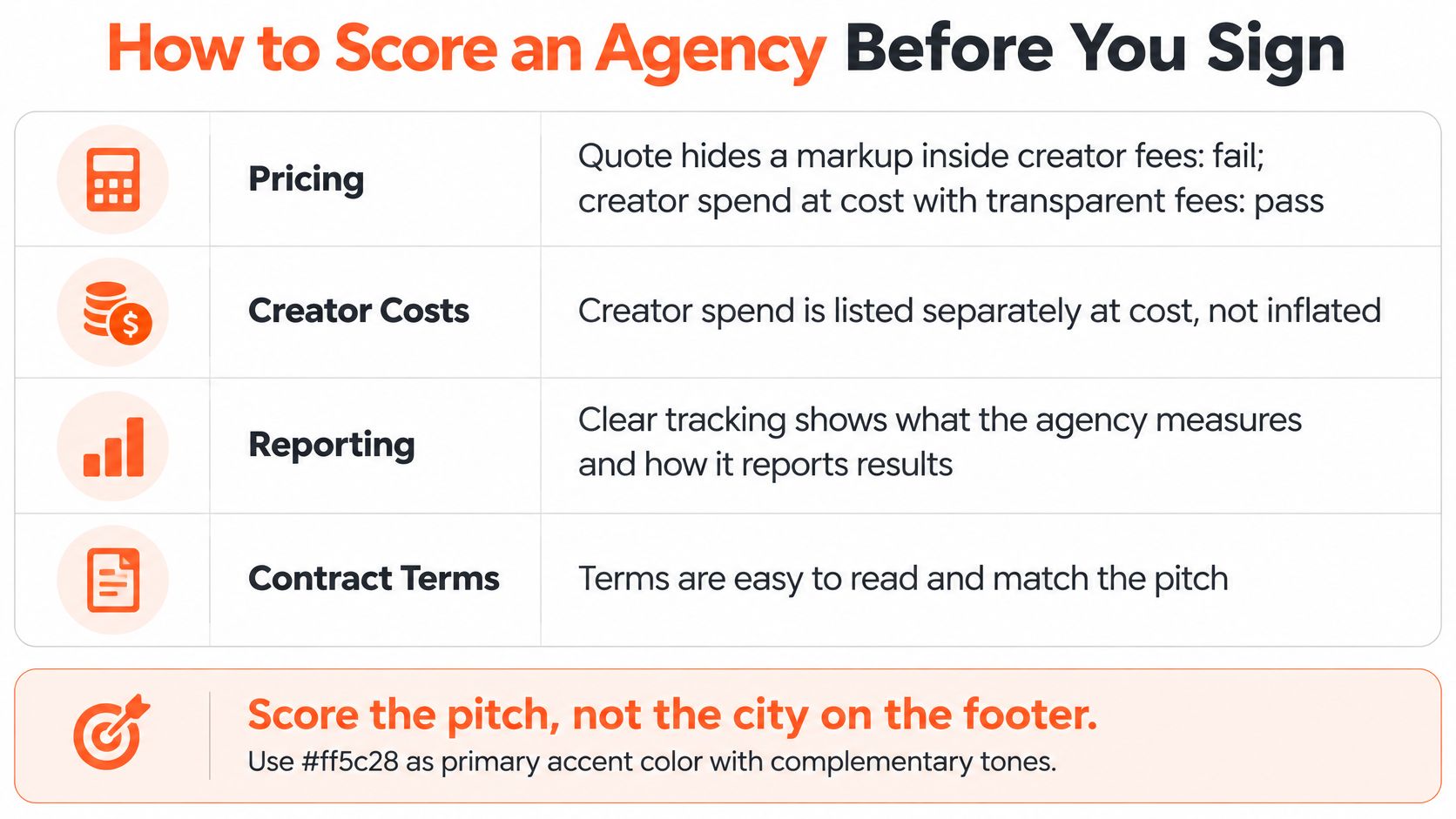
Agency scorecard before you sign
| Check | Weak sign | Pass standard |
|---|---|---|
| Pricing | Hidden markup inside creator fees | Creator cost at pass-through plus base and performance fee |
| Attribution | Views and likes only | Link, code, or survey on every placement |
| Speed | Forecast in weeks | Forecast within 48 hours and go-live in 3 to 5 weeks |
| Roster | Follower-count list | Vetted creators screened on fit and past sponsored results |
| Ownership | Strategy, legal, and reporting split across vendors | One team from brief to report |
| Rights | No reuse allowed | Contracted usage and paid-amplification permission |
Walk the rows in the sales call. Pricing fails when the quote hides margin inside creator fees. Attribution fails when the sample report is a view deck. Speed fails when the first forecast needs a fortnight of internal meetings.
Roster quality needs a concrete bar. Social Cloud's figure to beat is 12,000-plus creators screened for audience quality, brand fit, and past sponsored results. Another agency can beat that with a smaller, sharper roster, but it has to show screening evidence, not a scraped list sorted by followers.
Weight the Rows, Don't Waive Them
A gaming UA lead might weight CPI forecasting and Twitch or YouTube depth heavily. A DTC lead might care more about ROAS, Spark rights, and UGC reuse for paid social. That's fine. Neither should waive the tracking row.
Rights are where cheap quotes get expensive later. If you can't whitelist the post, run it as a Spark Ad, or cut it into paid variants, you've rented attention once and thrown away the asset. Get usage, whitelisting, and Spark or partnership permissions in the contract before the creator films.
Send this three-question email today:
- Show proof: Send a redacted per-creator report with views, conversion rate, CPA, and revenue.
- Show the split: Separate creator pass-through, agency base, and performance fee.
- Name the owner: Tell me who approves disclosure and claims before publish.
Vague answers are answers. They tell you exactly how the campaign will feel in week six.
Why Clear Ads Can Still Sell
A visible ad label doesn't kill a good post. A muddy paid relationship does.

A representative 2026 Forsa survey reported by SHZ found that 87% of 14–25-year-olds said they could easily recognize social-media advertising, yet 40% had bought food because of an influencer recommendation. Young buyers can spot the ad and still buy when the recommendation feels useful and credible.
Treat disclosure as a commercial control in Germany. The Media Authority of North Rhine-Westphalia guidance on advertising states that in North Rhine-Westphalia, the regulator reviewed 496 social-media profiles and issued 232 warning letters for inadequate advertising disclosures in 2025. Cologne sits in that state, so this isn't distant theory.
The Five Pre-Publication Checks
Run every deliverable through the same sequence. 1. Mark the compensation type, whether money, free product, invitation, or another incentive. 2. Pick platform-specific wording for Instagram, YouTube, TikTok, Twitch, or a blog. 3. Place it in the first frame or opening line, not only in a profile bio. 4. Name an approval owner. 5. Archive the approval before publish.
Gifting trips teams up. A free product with no cash fee can still make content advertising when there's a commercial incentive. Don't let a seeding list bypass the same QA you'd apply to a paid post.
Paid amplification needs the same care. Spark Ads and partnership ads need clear disclosure plus contracted usage rights. If you're tightening your paperwork, use a solid influencer contract template as the starting point and adapt the disclosure and rights clauses to each platform.
Working standard: Go for 100% pre-publication disclosure QA. One unchecked post can cost more trust than a week of reach buys back.
Health, fintech, food, and youth campaigns need the tightest claim review because the regulator, parents, and customers all read those posts differently. Clear labeling plus credible creative keeps both the compliance file and the ROAS report calm.
Local Cologne Case Studies
Don't accept a Cologne case study that can't show its working. Publishable cases should come only from redacted campaign reports that the client has agreed to release. If a client file doesn't back a result, the result doesn't appear.
Use one fixed template for every case so buyers can compare fairly:
- Brand category and claim limits: State the sector and any health, finance, or youth restrictions applied.
- Platform mix and creator count: Name YouTube, Instagram, TikTok, or Twitch and how many creators ran.
- Budget band: Give a range the client has cleared for publication.
- Forecast set within 48 hours: Show the target CPI, CPA, or ROAS agreed before launch.
- Actual result against forecast: Report the outcome against that original target, not a revised goal.
- Per-creator attribution: Explain the link, code, deep link, or survey used for each creator.
- What changed next: State what the team cut, scaled, or rewrote in the following brief.
Include one redacted creator-level report as the exhibit. It should show views, conversion rate, cost per acquisition, and revenue split by creator, with brand and creator names removed where needed.
If no client agrees to publication yet, publish the template and a redacted sample report instead of inventing results. Say plainly that signed cases will be added once cleared. That restraint is more credible than a logo wall.
Brief Social Cloud When Proof Matters More Than a Postcode
Social Cloud provides a performance-focused alternative to choosing an influencer agency by postcode. It works across YouTube, Instagram, TikTok, and Twitch, with a vetted roster of more than 12,000 creators. Creator budgets pass through at cost, every placement has attribution, and fees combine a lean base with a performance component agreed upfront.
The German office is in Hamburg, alongside offices in New York and Buenos Aires. A Cologne storefront does not determine campaign performance. For Cologne brands, the useful checks are whether Social Cloud returns a forecast within 48 hours and can typically launch within three to five weeks.
The fit depends on your brief. If you want unpaid gifting without tracking, this is the wrong setup. If you cannot name a CPI, CPA, or ROAS target, set that target before approaching an agency.
Send a One-Page Brief
Include these fields:
- Product and market: What you sell and whether the campaign targets Germany or audiences relevant to Cologne.
- Monthly budget band: Your test range and what you could allocate if the campaign works.
- Target CPI or ROAS: The performance measure you will use to assess creators.
- Platforms in mind: Where you expect the campaign to run and why.
- Claim limits: Any health, finance, food, or youth restrictions creators must follow.
Before signing, ask for the forecast, a clear fee split, and a sample creator-level report. Check that the forecast states its target, creator costs are passed through at cost, and reporting connects placements to outcomes. A brand deck and creator mood board alone are not enough to judge performance.
Send Social Cloud a one-page brief with your product, budget band, and target CPI or ROAS. Ask for its forecast, fee split, and sample per-creator report. If tracked outcomes matter more than a Cologne postcode, start with Social Cloud.