Most marketing guides treat product seeding like free PR. Ship out fifty boxes, wait for organic buzz to roll in, and celebrate whatever mentions show up in your notifications. If you've run gifting at volume, you know how quickly that story falls apart.
Gifting isn't a free awareness hack. It's an inventory, compliance, and attribution problem disguised as a brand-building exercise. Every box carries hard product cost, pick-and-pack fees, carrier shipping, and hours of coordinator time spent chasing addresses in Instagram DMs. When creators ghost after delivery, or when a post goes live without proper disclosure or tracking, those boxes burn margin without leaving a paper trail your finance team can defend.
That operational reality is why serious growth teams stop running seeding out of spreadsheets and start shopping for an influencer gifting platform. The right setup turns scattered shipments into a trackable acquisition and content engine. The wrong one just helps you lose inventory faster.
Table of Contents
- Why Gifting Became a Software Category
- What an Influencer Gifting Platform Actually Does
- Disclosure and Rights You Cannot Skip
- How a Gifting Campaign Runs Step by Step
- The Numbers That Decide Whether Gifting Paid Off, and Which Model to Buy
- How to Score a Platform Before You Commit
- Your Next Step Is Picking the Model, Not the Logo
Why Gifting Became a Software Category
Say a direct-to-consumer skincare brand decides to seed a new cleanser. At ten boxes a month, one social media coordinator can handle everything with a Google Sheet, a Shopify draft order, and a few friendly emails. Now push that same team to run five seeding waves every month across two product lines and three regions. Addresses go stale, duplicate packages ship to the same creator, no one remembers who agreed to usage rights, and the warehouse starts complaining about untracked zero-dollar orders.
That scaling bottleneck explains why gifting evolved into dedicated software alongside the broader creator channel. According to the Collabstr 2024 Influencer Marketing Report, one 2024 market estimate valued global influencer marketing at $19.8 billion, up 13.7% from $17.4 billion in 2023. The same report cites a separate forecast estimating the broader creator economy at $127.65 billion in 2023 and projecting it to reach $528.39 billion by 2030, which implies a 22.5% compound annual growth rate. Those two figures sit at different scales because analysts define influencer marketing and the creator economy differently, yet both reflect the same shift from informal PR favors to a structured budget line. For a closer look at how creator revenue streams are expanding behind those budgets, DBotMaker tracks the latest creator monetization statistics across platforms.
Gifting frequency climbed right alongside that spending. A Kolsquare and NewtonX survey of European activity reported by Kolsquare found that UK brands ran an average of 61 gifting campaigns per year in 2024. Nobody runs sixty-plus seeding pushes a year out of an inbox without dropping packages and missing posts.
Two Forces That Killed the Spreadsheet
Once seeding volume passes a few dozen creators a quarter, two operational pressures make manual tracking unworkable:
- Repetitive multi-step logistics: Outreach, opt-in logging, address verification, warehouse dispatch, delivery confirmation, and post monitoring repeat for every single recipient. Without automation tied to your storefront, staff labor quickly costs more than the merchandise inside the box.
- Mandatory disclosure governance: Sending free goods creates legal record-keeping duties around commercial transparency. Teams have to prove who received what, what briefing they accepted, and whether published posts followed local advertising rules.
Software solves the shipping, logging, and follow-up grind, but it never automatically proves profitability. Measuring incremental value per gifted unit still lands squarely on your marketing team.
Even with clean dashboards, a platform only gives you the raw operational ledger. Turning that ledger into profitable growth depends on knowing which capabilities move revenue and which ones are just shiny add-ons.
What an Influencer Gifting Platform Actually Does
Most buyers evaluate gifting software backward. They see a sleek creator search bar bolted onto a Shopify order trigger and assume they're looking at a complete tool. In reality, a solid influencer gifting platform is a system of record that binds creator vetting, logistics, legal governance, and sales attribution under one persistent creator ID.
Without that shared ID, your data fractures immediately. Your fulfillment tool knows a box arrived in Austin, your social listening tool spots a TikTok video from a slightly different handle, and your e-commerce store sees a discount code used at checkout, yet nothing connects all three events back to the same person. Tools like Modash, GRIN, Influencer Hero, and SARAL tackle parts of this stack natively through Shopify integrations that create zero-dollar orders and exclude them from core store metrics like AOV and CAC. Others, such as Influencer Gift Form or Shopfluence, focus almost exclusively on the order-capture form and leave discovery or deeper measurement to separate software.
Comparing Core Capabilities Side by Side
Use the table below as a baseline rubric before sitting through vendor demos. Every row maps an operational job to the specific performance metric it should move.
| Capability | What it does | Metric it moves |
|---|---|---|
| Creator discovery and vetting | Filters creators by audience quality, brand fit, and past sponsored performance | Content publication rate |
| Outreach and acceptance tracking | Sends invitations and records accept, decline, and no-response per creator | Acceptance rate |
| Address collection and consent | Captures shipping details with opt-in and consent records | Delivery success rate |
| Fulfillment and tracking | Ships product, confirms delivery, and flags failed or refunded orders | Refund rate on gifted orders |
| Disclosure and compliance | Stores disclosure status and approved wording per market and validates presence in content | Compliance pass rate |
| Usage rights capture | Records whether content can be reused in paid, organic, or Spark Ads | Repurposable asset count |
| Attribution | Issues tracking links and promo codes per creator and ties posts to clicks and conversions | CPA, ROAS |
| Reporting and cohorts | Compares nano, micro, and mid-tier results by cohort and format | Contribution margin per gifted unit |
Where Most Vendors Fall Short
Almost every tool on the market shines on two or three of those rows and goes paper-thin on the rest. Discovery-first platforms give you massive filters for niche and audience demographics, while inbound marketplaces like Afluencer or The Social Cat flip outreach by letting creators apply to your offer. Store-connected tools like Upfluence can even spot creators who already buy from your brand, while Insense focuses heavily on turning seeded videos straight into Meta Partnership Ads or TikTok Spark Ads.
The three rows where software most often leaves dangerous gaps are disclosure and compliance, usage rights capture, and attribution. Many platforms scrape hashtags to detect posts, yet never verify whether a caption met regulatory standards or whether you legally hold ad rights before your media buyer boosts the clip. Before shortlisting big-name suites, reading an independent breakdown helps expose those trade-offs early; you can browse Grin pros and cons on KeenVerdict to see how an established all-in-one tool balances Shopify automation against discovery limits.
Evaluation tip: Copy the eight-row capability table into a shared sheet and score every shortlisted vendor from one to five per row before you look at pricing. Gaps in compliance and attribution cost far more to patch manually than a slightly higher monthly license.
Disclosure and Rights You Cannot Skip
A gifted product is still a paid relationship. Growth teams that skip disclosure because no cash changed hands, and no contract required a post, are stacking legal exposure on top of inventory they already shipped.
Each outgoing box is a commercial transaction with a paper trail: declared product value, carrier proof of delivery, and the rights you hold if the content later runs as an ad. Gifting breaks first as an inventory, compliance, and attribution problem, not as a free-PR tactic.

The Federal Trade Commission's Disclosures 101 guide treats free or discounted products as a material connection even when no money is paid and no posting obligation exists. If the creator endorses the gift, the disclosure has to sit with the endorsement and be hard to miss. The FTC places that duty on both the influencer and the brand, not on the software vendor that sent the package.
The FTC Guides Concerning the Use of Endorsements and Testimonials in Advertising were first drafted in 1980, when a celebrity tie was assumed to be obvious, and substantially revised in October 2009 to cover less transparent social-media connections. Habits in the field stayed loose anyway. Creator programs that add names faster than they add a compliance check still publish endorsements the brand cannot defend.
Three States Your QA Queue Must Separate
One "Status" column cannot tell a delivered parcel from a legal endorsement. The record needs timestamps, creator acceptance, declared product value, carrier shipment data, the approved disclosure wording for that market, and the final live URL. QA has to hold three distinct states for every creator:
- Product receipt: The carrier confirmed delivery to the creator's address. Receipt proves inventory landed. It does not prove an endorsement.
- Content publication: A live Story, Reel, TikTok, or YouTube clip went up mentioning or showing the brand.
- Endorsement compliance: A reviewer or automated check confirmed the required disclosure was clear in the caption, video overlay, audio, or livestream before the post was logged as compliant.
A glowing review without that wording belongs in the QA queue, not in the win column. I would hold the post out of performance reporting until the disclosure is fixed. Audit fields for those three states are laid out in our guide to influencer marketing compliance.
Usage Rights and Cross-Posting Edge Cases
The bill gets larger when a gifted video performs and paid social wants to put budget behind it. An organic tag does not give you commercial usage rights to download the file, run it as a whitelisted ad, or embed it on a product page. Cross-posting makes disclosure fail in a second way: a line that is clear on an Instagram Reel is often truncated or dropped when the same clip lands on TikTok or YouTube Shorts.
Watch the short walkthrough below for how brands lock disclosure language and rights permissions before products leave the warehouse.
Market-specific disclosure wording and signed usage-rights records belong in the platform, tied to the shipment, not in someone's email. A caption that clears one market can still fail in another if the local disclosure term never made it into the brief. If those permissions stay in a thread, paid media either waits on clearance or boosts creative the brand does not have a license to run.
How a Gifting Campaign Runs Step by Step
Knowing what a platform should store is one thing; running clean weekly cycles without letting shipments pile up in limbo is another. Below is the exact eight-step operating workflow I'd hand to a growth or influencer ops team, condensed visually in this four-stage flow first.
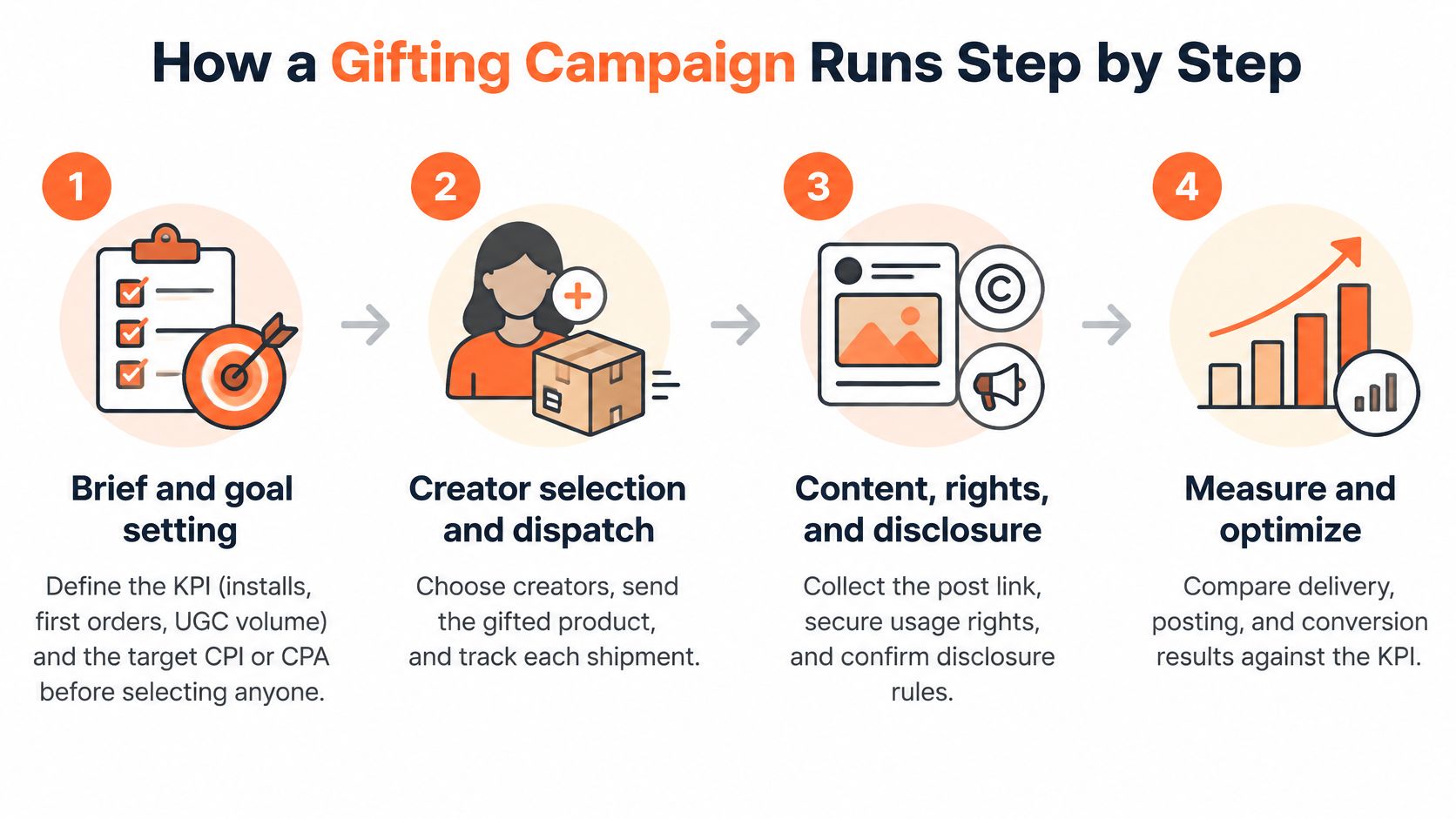
Follow these steps in order so attribution, compliance, and fulfillment never get out of sync:
- Brief and goal setting: Lock in one primary KPI, such as mobile app installs, first-time e-commerce orders, or whitelisting-ready UGC assets, along with your target CPI or CPA before searching for a single creator. Without a ceiling on acquisition cost, you won't know how much inventory value you can safely put into each box.
- Creator discovery and vetting: Build a curated shortlist screened for real audience quality, buyer fit, and historical sponsored performance rather than raw follower count. Divide the roster cleanly into nano, micro, and mid-tier test cells so you can measure tier efficiency later.
- Outreach and acceptance: Send personalized invitations and log every accept, decline, and non-response inside your CRM. State posting expectations clearly right here, because whether you ask for a deliverable or send a no-strings gift directly changes how many boxes turn into posts.
- Address collection and consent: Route accepted creators to a branded opt-in form that validates shipping addresses, captures SKU preferences like size or shade, and records consent. Run extra age-gating or category checks here if you operate in regulated verticals like health, supplements, or fintech.
- Fulfillment and tracking: Generate unique tracking links and personalized promo codes before the warehouse prints shipping labels, tying both to the creator's ID. Push the order through your store integration, monitor carrier scans for confirmed delivery, and flag bounced or refunded shipments immediately.
- Disclosure and creative QA: Once posts start surfacing, inspect every caption, audio track, and on-screen overlay against your market-specific disclosure checklist. Flag missing labels promptly while the creator can still edit a caption or add pinned text.
- Content collection and rights: Capture live post URLs, publication timestamps, and downloadable raw files (especially for ephemeral Instagram Stories that vanish fast). Verify that usage permissions are logged in the creator's record before handing winning clips to paid media.
- Reporting and iteration: Review views, click-through rate, conversions, and ROAS per creator on a weekly cadence. Cut underperforming niches quickly and shift next month's inventory budget toward the creator cohorts clearing your unit-economics target.
If you're mapping gifting into a broader paid creator calendar, our breakdown of running an influencer marketing campaign covers how to align creative briefs across both channels.
Where Most Campaigns Quietly Stall
From initial brief to live performance data, a well-run gifting wave typically spans several weeks rather than a quick sprint. Across almost every ops team, two specific hand-offs account for the majority of delays.
The first bottleneck is address collection. Creators enthusiastically reply "yes" in a DM, then take ages to submit a form with their apartment number and product choice. Automated reminders that stop the moment an address lands keep this stage moving without burning coordinator hours.
The second stall point is creative QA and disclosure checks. Teams obsess over getting boxes out the warehouse door, then forget to staff the review queue two weeks later when posts go live. Assigning one clear owner for weekly QA ensures earned content gets verified, rights-cleared, and moved into paid amplification while the momentum is still fresh.
The Numbers That Decide Whether Gifting Paid Off, and Which Model to Buy
The fastest way to ruin a gifting budget is to measure success by "boxes shipped" or estimated social impressions. Look at what happens when you track actual operational drop-off from warehouse to post link.
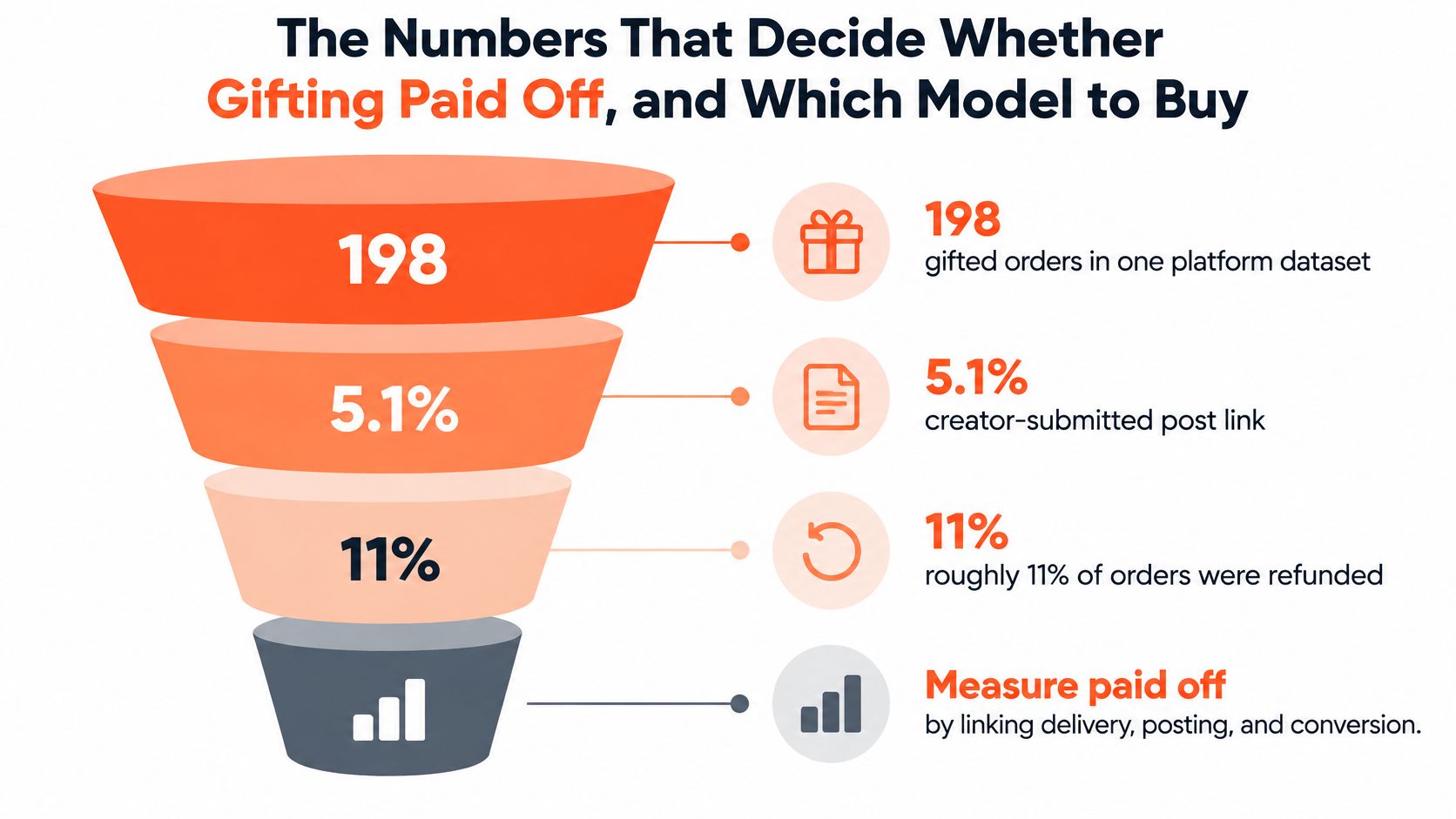
In one recent platform dataset cited by Seed Influencers, only 5.1% of 198 gifted orders generated a creator-submitted post link. Another dataset in the same analysis showed that roughly 11% of product orders were refunded when fulfillment went wrong. Think about what those two figures do to your unit economics: before a single customer clicks a link, logistics failures and silent recipients can erase the illusion of "cheap" acquisition.
Posting terms shift the middle of that funnel noticeably. According to a 2025 Modash marketer survey reported by Bazzaal, creators posted about 50% of the time when posting was required in exchange for gifted products, compared with 43.8% when products were gifted without posting obligations. Requiring a post lifts output, though it also requires clearer agreements and pushes the partnership closer to paid-in-kind advertising.
Gifting Funnel Benchmarks to Track
Track every stage of your cohort against a clean funnel ledger rather than cherry-picking standout videos.
| Stage | What to track | Benchmark or target |
|---|---|---|
| Dispatch | Units shipped per cohort | Baseline for all downstream rates |
| Delivery | Confirmed deliveries | Match dispatched count minus carrier exceptions via scan confirmation |
| Refund or failure | Refunded gifted orders | About 11% when fulfillment goes wrong |
| Post link submitted | Creator-submitted link per gifted order | 5.1% in one platform dataset |
| Post rate with obligation | Posts when posting was required | About 50% |
| Post rate without obligation | Posts when posting was optional | 43.8% |
| Tracked clicks | Clicks per creator via link or code | Positive click volume per live post, benchmarked against a paid test cell |
| Contribution margin | Margin per gifted unit | Positive versus holdout |
Testing Creator Tiers Against a Real Baseline
Don't assume bigger accounts automatically yield proportionally better returns. Recent empirical research using Instagram data published in the International Journal of Advertising found that gifting amplifies social-media engagement, with that effect moderated by influencer size. In practical terms, creator tier is a test variable, not a simple scale multiplier.
Run a stratified comparison across nano, micro, and larger creators while holding product category, audience geography, content format, and posting window steady. Because higher engagement does not automatically translate into incremental sales, compare downstream conversions against a holdout group or matched-creator baseline. Your go-or-no-go metric should be contribution margin per gifted unit (or incremental revenue per recipient), factoring in landed product cost, shipping, platform fees, and reusable UGC value. For a deeper formula walkthrough on separating true lift from organic noise, read our guide on how to measure influencer marketing ROI.
Reach tells you who might have scrolled past your logo. Contribution margin per gifted unit tells you whether you can afford to ship the next hundred boxes.
Choosing Between the Three Buying Models
Once you see the funnel math, picking a vendor becomes a staffing and accountability question rather than a feature checklist. Most growth teams buy gifting through one of three routes:
| Buying route | Operational depth | Attribution and compliance | Best fit |
|---|---|---|---|
| Standalone gifting platform | Deep seeding forms and store fulfillment triggers, minimal strategy | Basic promo codes and light post scraping; rights tracking is often thin | Ops-capable teams running a narrow, self-serve seeding push |
| Full influencer suite | Broad creator database for paid and affiliate talent, with gifting as one module | Strong cross-placement reporting and centralized disclosure storage | Teams where paid sponsorships and gifting share one budget and reporting line |
| Managed service | Large pre-vetted roster with end-to-end briefing, fulfillment coordination, and creative QA | Unique tracking link and promo code on every placement, with contracts and disclosure handled by one team | Growth teams where speed to value and clear ROI accountability beat owning another software login |
Matching Pricing Models to Your P&L
Before signing any contract, clarify two cost mechanics that vendors often gloss over. First, check whether you're paying a per-campaign fee, a per-creator or per-post fee, a recurring SaaS subscription, or a performance-linked fee tied to installs or conversions. Second, confirm who carries inventory and carrier shipping costs, since brands almost always supply the physical product and postage on top of software or management fees. Reviewing the Rankozo cost guide for procurement teams is a smart way to compare recurring SaaS tiers against usage-based and outcome-based structures before negotiating terms.
How to Score a Platform Before You Commit
Demos are designed to show spotless dashboards with fabricated campaign data. Use a structured scoring process to pressure-test whether a platform or partner can survive messy real-world shipping and global regulations.
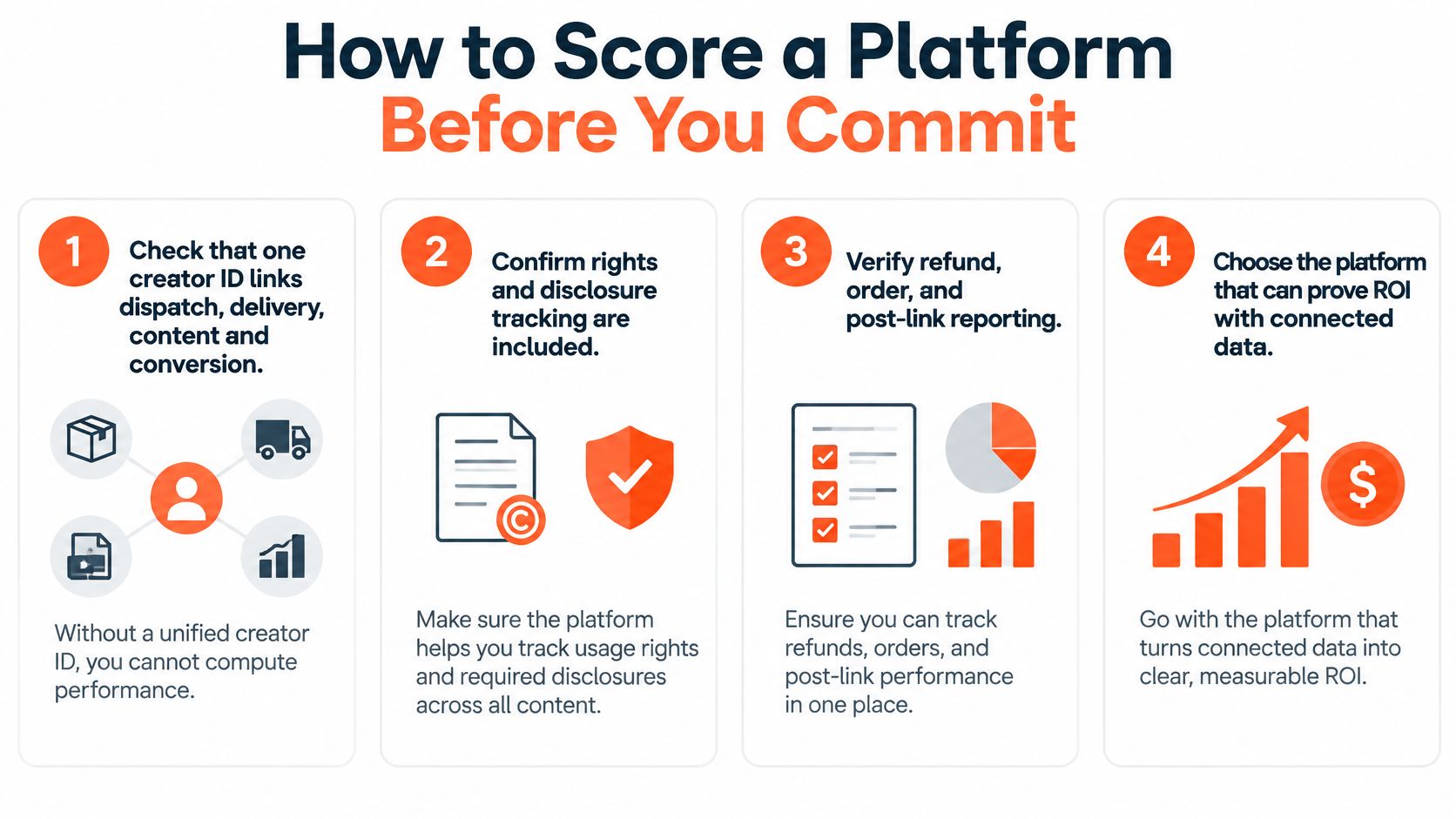
Work through these seven checks before any contract reaches procurement:
- Verify the single creator ID. Ask the rep to click from a single creator's dispatch record directly to carrier delivery confirmation, live post URL, clicks, and attributed revenue. If those live in separate CSV exports, you won't be able to compute per-recipient margin cleanly.
- Demand recent cohort benchmarks. Skip cherry-picked case studies and ask for acceptance, publication, and fulfillment refund rates across comparable campaigns from the last two quarters.
- Audit multi-market disclosure logic. Global gifting is far more nuanced than telling everyone to slap
#giftedin a caption. As outlined in Stack Influence's analysis of gifted campaign governance, standards shift across borders: the UK generally expects a prominent "Ad" label, Norway uses terms like "reklame" or "annonse," and German treatment can depend partly on product value. Ask how the platform enforces country-specific templates, handles cross-posted clips, and manages escalation rules for regulated health, fintech, or children's categories. - Confirm upfront usage-rights capture. Make sure licensing terms for paid social and TikTok Spark Ads are signed and timestamped at acceptance or contracting, not negotiated weeks later after a video takes off.
- Check support for a paid test cell. A mature workflow lets you run a small paid cohort side by side with your gifted cohort inside the same reporting view so you can separate incremental revenue from organic chatter.
- Inspect weekly creator-level reporting. Confirm whether you get granular weekly updates showing views, CTR, conversions, and ROAS per creator, or only lagging end-of-month rollups.
- Clarify human ownership. Software rarely writes strong creative briefs, vets audience authenticity with judgment, or runs tight QA. Ask plainly who owns strategy, briefing, and creative review once onboarding ends.
Vendor Red Flags That Should End the Call
Walk away quickly if you spot any of these warning signs during evaluation:
- Reach as the headline KPI: Any vendor leading with "estimated impressions" or "earned media value" instead of clicks, conversions, and margin is hiding weak attribution.
- No visibility into failed shipments: If a tool can't surface undelivered boxes or refunded orders, your true cost per post is invisible.
- One-size-fits-all disclosure advice: Treating a single generic hashtag as sufficient for international or regulated campaigns pushes legal risk directly onto your brand.
Before committing budget, ask every finalist for a written campaign forecast or ROI model using your actual product cost, shipping rate, and target CPA. Vendors who understand performance gifting won't hesitate to put their math on the table before you spend a dollar.
Your Next Step Is Picking the Model, Not the Logo
Comparing twenty nearly identical software homepages is the easiest way to stall a quarter. Start by picking the operating model that matches your internal bandwidth and performance targets:
- Standalone gifting platform: Pick this route if you have dedicated in-house ops capacity and a narrow product-seeding goal.
- Full influencer suite: Pick this route if paid sponsorships, affiliates, and gifting already share one internal team, budget, and reporting line.
- Managed performance service: Pick this route if speed to market, vetted reach, and accountable revenue outcomes matter more than managing another software tool yourself.
Three Actions to Run This Week
You don't need a six-month RFP to clean up your seeding math. Knock out these three steps over the next five business days:
- Pull your real funnel rates. Audit your last gifting push for creator acceptance, verified post rate, and fulfillment refunds so you know your true starting baseline.
- Design one stratified test. Split your next wave cleanly between nano and micro creators with a matched holdout group, keeping category and format constant so you measure incremental lift.
- Move legal data out of spreadsheets. Audit where disclosure approvals and ad usage rights live today, and require structured per-creator records before shipping another batch.
If you'd rather hand off the heavy operational lift, that's where a managed partner shortens the path. At Social Cloud, we manage the entire creator partnership lifecycle, from precision gifting through our vetted network of 12,000+ influencers to cross-platform distribution across TikTok, Instagram, and YouTube. In our Match step, we hand-pick verified creators screened for audience quality, brand fit, and past sponsored performance rather than follower counts. Every placement ships with a unique tracking link and promo code, so you see views, CTR, conversions, and ROAS per creator every week, with an upfront campaign forecast before you spend and performance fees tied to what the campaign delivers.
Whichever route you pick, judge the program by one simple standard: positive contribution margin per gifted unit. Hit that number consistently, and gifting stops being an unpredictable PR expense and becomes a repeatable growth channel.
Ready to turn product seeding into a trackable acquisition channel without drowning your team in spreadsheets and compliance checks? Social Cloud plans, runs, and measures precision gifting and full-funnel creator campaigns across TikTok, Instagram, YouTube, and Twitch, backed by per-creator attribution and outcome-linked fees. Visit Social Cloud to forecast your next campaign and see what performance-led gifting can deliver for your brand.