
The most popular advice about influencer marketing B2B is also the least useful: find a respected industry voice, buy a thoughtful post, watch the impressions, and wait for revenue to appear somewhere in the CRM. That approach treats influence as media inventory. It ignores how B2B buyers evaluate complex products, involve multiple stakeholders, and return to a vendor through several untracked touchpoints.
A performance-led creator program works differently. It starts with a commercial question, chooses voices that can answer it credibly, builds content for a specific buying stage, and instruments every placement for learning. Awareness still matters, but it's only valuable when it improves consideration, account engagement, pipeline movement, or revenue attribution.
The category has already moved beyond experimentation. One independent compilation reports that 85% of B2B marketers now include influencers in their marketing mix, compared with 34% in 2020, while another market summary says 55% of B2B marketers work with creators and 82% of B2B buyers say creator content influences decisions. These figures are reported in the 2026 B2B influencer marketing compilation, and they point to a practical shift: creator partnerships now need the same planning discipline as paid media, partner marketing, and sales development.
Table of Contents
Rethinking B2B Creator Partnerships for Demand Gen
B2B influencer marketing isn't paid thought leadership with a tracking link attached. The creator isn't there merely to repeat your positioning. Their value comes from helping a skeptical audience understand a problem, challenge an incumbent assumption, or evaluate a category through a trusted professional lens.
That distinction changes the brief. A weak brief asks for “brand awareness” and a mention of product benefits. A useful brief identifies the audience, the objection, the decision stage, and the action you want the audience to take. For example, a technical practitioner might explain how a workflow breaks under operational pressure, then invite qualified viewers to inspect a product walkthrough. A category voice might frame why the old solution no longer fits, then support a research report or executive webinar.
Awareness is an input, not the business case
Reach and engagement are still useful diagnostic signals. They tell you whether the topic, hook, format, and creator-audience fit are working. They don't prove that a creator generated qualified demand.
B2B buyers often consume content before they identify themselves to sales. They may watch a video, read a newsletter, discuss the recommendation internally, and return through a branded search or direct visit. If your team optimizes only for last-click conversions, it will undervalue the creator. If it counts every engaged viewer as pipeline, it will overvalue the creator.
Practical rule: define the commercial role of each creator before negotiating the fee. If the role is education, measure progression into a meaningful next stage. If the role is conversion, give the audience a clear, trackable route to act.
The adoption data reinforces why this operating model matters. The same 2026 compilation reports that 79% of B2B buyers engage with creator content monthly and 87% prefer credible industry-influencer content. Those figures support a focus on subject-matter expertise, especially where buyers need confidence rather than impulse.
Brief creators around buyer friction
The best creator programs don't force every partner to deliver the same message. They give creators a controlled set of facts, prohibited claims, proof points, and conversion routes, then allow them to translate the story into their own language.
Align content to the funnel:
- Problem recognition: use a practitioner to describe a costly workflow problem without turning the content into a product pitch.
- Consideration: use demonstrations, teardown videos, technical explainers, or independent comparisons to help buyers assess fit.
- Validation: use customer-facing experts, analysts, or respected operators to address risk, implementation, security, or procurement concerns.
- Conversion support: connect creator content to a trial, consultation, benchmark, event, or sales enablement asset with creator-level tracking.
Broad reach can help create category familiarity, but niche credibility usually does more work in complicated buying journeys. The creator who can answer difficult follow-up questions may influence fewer passive viewers and more of the people who shape a purchase.
Selecting the Right Creator Archetypes for Your Funnel
Follower count is a poor substitute for influence quality. A large audience can contain the wrong job functions, regions, seniority levels, or buying context. A smaller technical audience may be more valuable if its members actively evaluate tools, advise customers, or participate in the buying committee.
The market is moving toward niche experts, employee-adjacent voices, and platform-native formats across LinkedIn, YouTube, podcasts, and newsletters, as described in recent analysis of creator-led B2B growth. The practical question isn't which archetype is universally best. It's which voice can remove the next obstacle in your funnel.
Match authority to the decision
A deep-niche practitioner is a strong fit for product education, technical reviews, implementation guidance, and use-case content. Their credibility comes from experience. They can explain trade-offs that a polished brand video tends to avoid.
An employee-adjacent creator, such as a solutions architect, customer success leader, or product specialist, can make complex expertise more accessible. The risk is perceived bias, so disclosure and clear separation between personal opinion and approved company claims matter.
An analyst or established category commentator can help a brand enter a broader conversation. This is useful for category creation and executive visibility, but the content may produce less direct conversion intent. Newsletter curators and podcast hosts sit between authority and distribution. They can be effective when the audience trusts their editorial judgment and the placement fits naturally into the publication or episode.
| Creator Archetype | Best Funnel Stage | Ideal Content Format | Primary KPI |
|---|---|---|---|
| Deep-niche practitioner | Consideration and validation | Technical walkthrough, review, teardown | Qualified visits, demo requests, opportunity influence |
| Employee-adjacent expert | Education and objection handling | Live session, explainer, practitioner post | Engaged target accounts, content-assisted progression |
| Analyst or category voice | Problem recognition and category creation | Research commentary, keynote, podcast interview | Target-account reach, branded demand, senior engagement |
| Newsletter curator | Consideration and recurring education | Sponsored editorial section, buyer guide | Qualified traffic, assisted conversions |
| Podcast host | Recognition and trust building | Interview, host-read segment, roundtable | Listener engagement, direct and assisted response |
Vet the audience, not the profile
Ask for audience evidence that helps you assess commercial fit. Review job roles, company types, regions, recurring topics, comment quality, and the creator's history with sponsored work. A creator who attracts detailed questions from practitioners may be more useful than one whose posts generate broad but shallow reactions.
Look at how the creator behaves under scrutiny. Do they explain limitations? Do they distinguish personal experience from universal advice? Do they disclose partnerships clearly? Those signals predict whether they can operate safely in fintech, health, or enterprise software.
For channel planning, a practical B2B influencer marketing strategy guide can help teams map creator formats to objectives, but the final selection should still come from audience evidence and funnel requirements. Don't buy a channel because it's fashionable. Buy access to a specific audience and a credible route through a specific decision.
Navigating Compliance and Usage Rights in Regulated Markets
A creator can make a technical product feel understandable in a few minutes. They can also create a compliance problem in a few seconds if the brief, approval process, or rights agreement is vague.
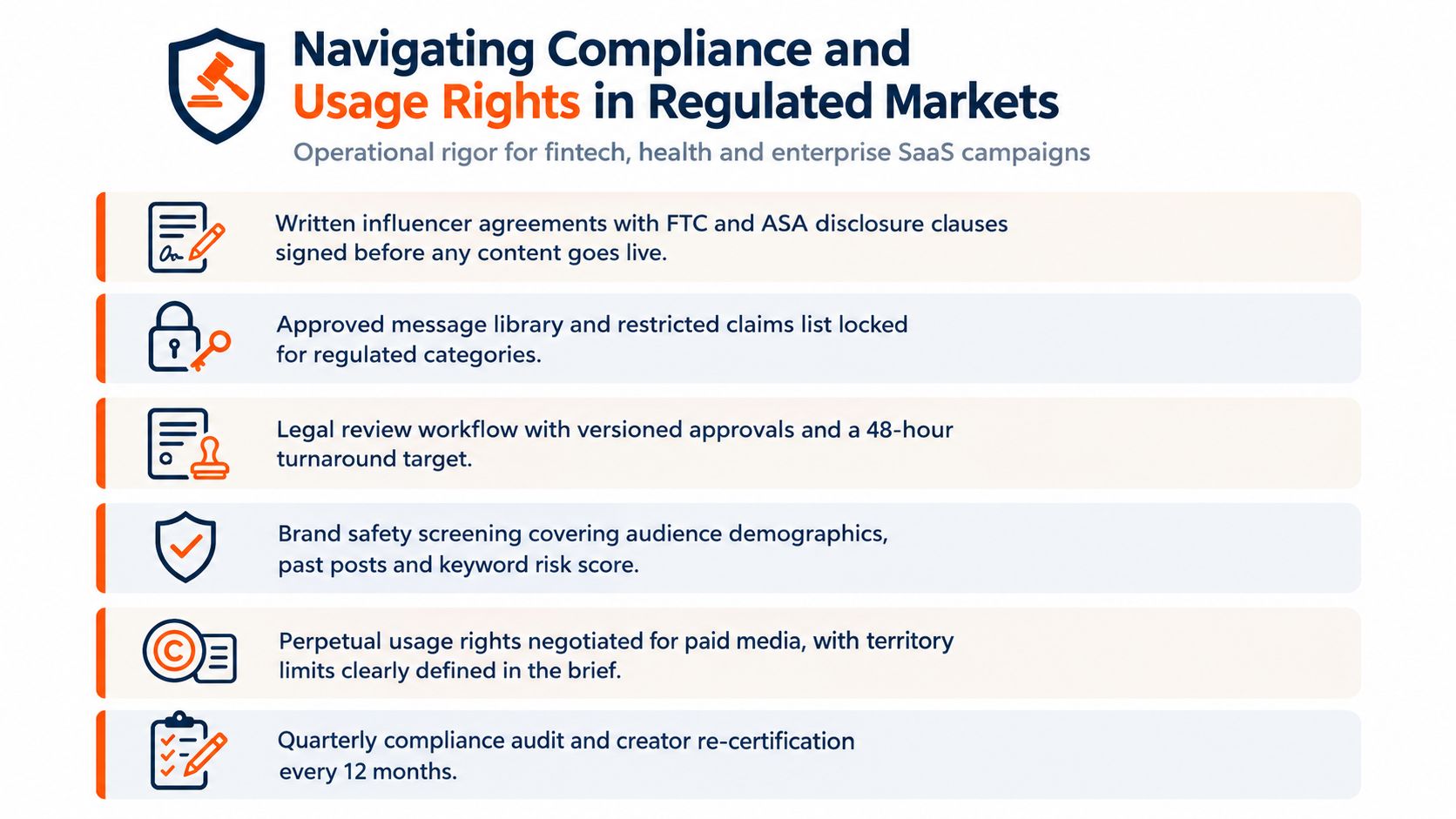
Fintech, health, and enterprise SaaS programs need operational controls before content production begins. That means centralized contracts, approved claims, disclosure requirements, audience screening, and a rights structure that matches how the brand intends to distribute the asset.
Build the workflow before the campaign
Start with a written agreement for every creator. It should define deliverables, disclosure language, approval responsibilities, prohibited claims, payment terms, cancellation conditions, and content ownership. Disclosure can't be an afterthought added during publishing. It belongs in the contract and the brief.
Next, create a message library and restricted claims list. Give creators approved product descriptions, evidence they may reference, and language they must avoid. This preserves their voice without asking them to improvise around regulated promises.
A workable approval workflow includes:
- Brief review: marketing and legal agree on audience, claims, format, and required disclosures.
- Draft review: the brand checks factual accuracy, substantiation, brand safety, and regulatory language.
- Version control: the approved asset receives a clear version label, with changes recorded.
- Publishing check: the team verifies disclosures, links, captions, landing pages, and geographic restrictions.
- Post-launch audit: the brand records what ran, where it ran, and whether the creator remains suitable for future work.
For teams operating across regulated categories, a specialist fintech advertising agency resource offers useful context on why channel execution and compliance can't be separated.
Negotiate rights as a growth asset
Usage rights determine whether a strong creator asset can support paid distribution, sales enablement, landing pages, event promotion, or regional adaptations. Don't accept a vague “brand may use the content” clause. Specify channels, territories, duration, editing permissions, whitelisting or thought leader ad access, and whether the creator must approve adaptations.
Brand safety screening should cover audience composition, previous posts, conflicts, controversial topics, and keyword risk. A creator who fits the audience today may become unsuitable if the brand never reviews the relationship again. Regular audits and re-certification protect both sides, particularly when campaigns run continuously.
Building an Attribution Framework That Proves Pipeline Impact
The measurement gap is clear. 95.4% of influencer campaigns track standard engagement metrics such as impressions, reach, views, and CTR, while 73.6% also measure business outcomes such as lead generation, pipeline influence, sales acceleration, or revenue attribution. Only 23.6% report direct revenue attribution, according to independent B2B survey evidence on influencer measurement.
That doesn't make engagement metrics useless. It means they answer a different question. Views show distribution. CTR shows response to a placement. Neither metric, by itself, explains whether the creator influenced a qualified account or helped move an opportunity forward.
Start with a forecast
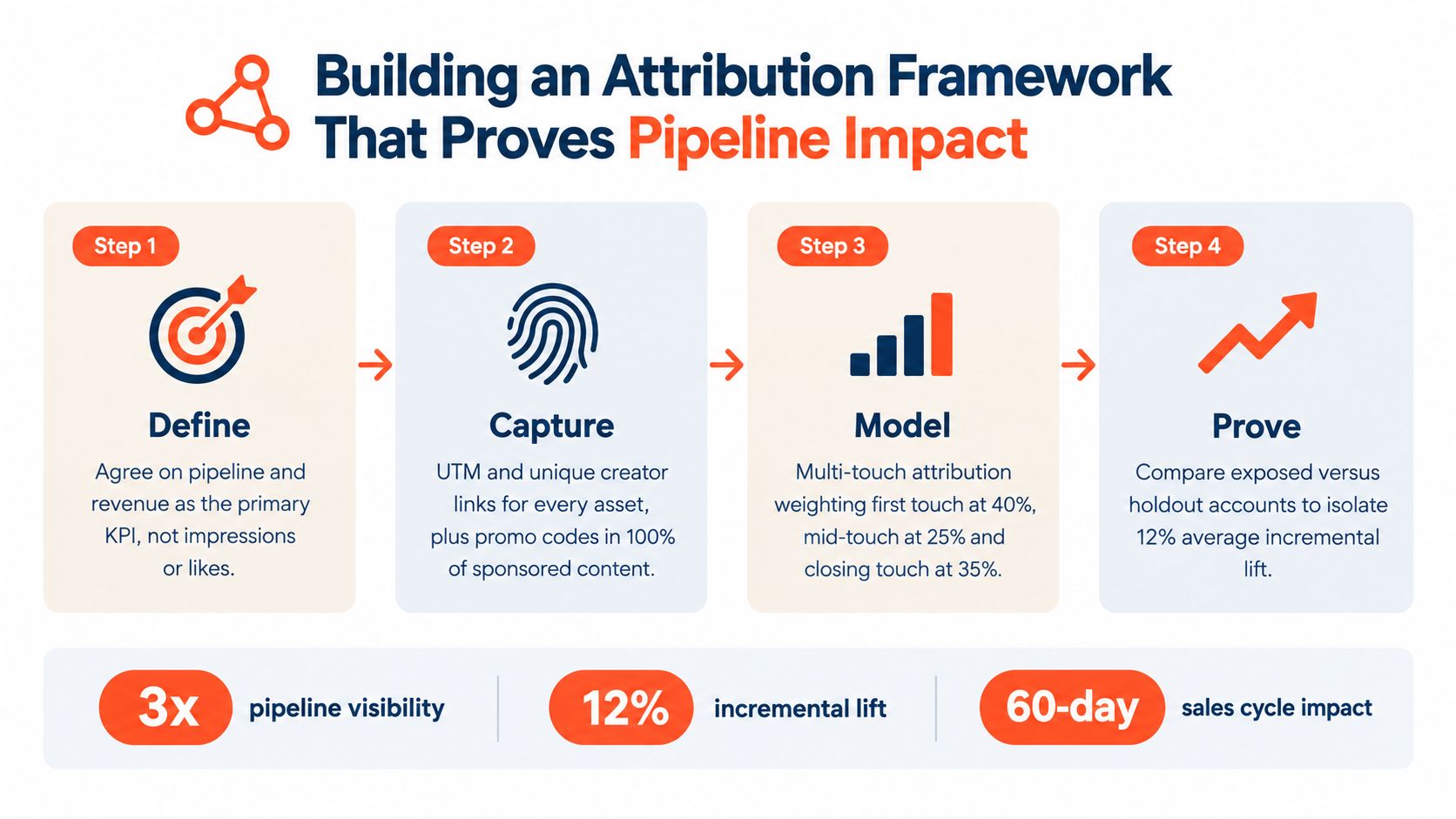
Before spend, define the outcome you're trying to influence. That might be qualified opportunities, pipeline value, account engagement, sales acceleration, or revenue. Forecast by creator and placement, not only at campaign level. The forecast creates a baseline for budget allocation and gives the team a reason to stop, expand, or revise a partnership.
Then instrument the journey:
- Use creator-specific UTMs: assign unique parameters to every link, asset, and landing page.
- Add unique codes where appropriate: codes can capture self-reported or direct response that analytics misses.
- Map CRM stages: preserve the creator touchpoint when a contact becomes qualified, enters an opportunity, advances stages, or closes.
- Ask post-purchase questions: include a “how did you hear about us?” field or survey that names the creator and content source.
- Record account exposure: match known target accounts against content engagement, site activity, event attendance, and sales notes.
Separate response from influence
Use a multi-touch model as a decision aid, not as an objective truth machine. First-touch logic helps identify discovery creators. Assisted-touch logic shows which partners support consideration. Opportunity-stage and close-stage touches reveal whether the content helps sales overcome friction.
Your model should also include qualitative evidence. Ask sales whether prospects referenced a creator, used a creator's terminology, or arrived with a more informed objection. That feedback won't replace tracking, but it can explain why a creator appears commercially important even when the click path is incomplete.
A dedicated guide to measuring influencer marketing ROI can help teams formalize the reporting layer. The core principle is simple: report engagement for optimization, but defend the budget with account movement, opportunity influence, and revenue evidence.
For a visual explanation of the mechanics, use the following video after your initial measurement design is in place.
Campaign Examples for SaaS Fintech and Health Demand Gen
A technical SaaS company shouldn't ask every creator to publish the same product announcement. It should choose a use case, find practitioners who understand the workflow, and make the next action easy to measure.
Consider a SaaS campaign built around implementation friction. A small group of YouTube practitioners could record workflow walkthroughs showing how they evaluate a solution, where integrations tend to fail, and which teams need to be involved. The brand supplies a sandbox, approved technical facts, and a tracked route to a product trial or architecture consultation. Paid amplification can extend the strongest asset, but the team should judge success by qualified trial behavior and opportunity influence, not views alone.
A fintech program needs a different trust architecture. A newsletter curator or podcast host may be effective for explaining a market problem to finance leaders, but the brief must separate educational commentary from financial claims. The brand can support the creator with an approved evidence pack, a controlled landing page, and a conversion action such as a risk assessment or executive briefing. Sales should receive the content and talking points so the creator's narrative continues inside the buying process.
Health technology requires even tighter vetting. A compliance-reviewed clinician or healthcare operator can explain a workflow problem in language clinical buyers recognize, while the brand controls product claims and patient-sensitive information. Content may work best as an expert interview, a moderated roundtable, or a practical implementation discussion rather than a direct endorsement.
Design the channel mix around behavior
Each scenario can combine creator-owned distribution with brand amplification, but the mix should follow audience behavior and approval capacity. YouTube supports depth. Podcasts support sustained explanation. Newsletters support editorial context. LinkedIn can support executive discussion and sales follow-up.
The broader category is increasingly assessed as a full-funnel channel. A 2026 B2B influencer marketing report describes a methodology combining benchmark data, 30+ expert interviews, 170 surveys, and case studies. That research direction matters because it moves the conversation away from isolated posts and toward program-level performance evidence.
Don't copy a format from another industry without copying its operating discipline. The same creator style can educate a SaaS buyer, create unacceptable risk in fintech, and feel irrelevant to a clinical audience.
Why Outcome-Based Pricing Beats Traditional Agency Retainers
Flat retainers make it difficult to tell whether an agency benefits from performance or from activity. The brand pays for strategy, coordination, creator fees, reporting, and account management, but the commercial risk remains mostly with the client.
Outcome-based pricing creates a more useful tension. A lean base fee covers the work required to plan, contract, produce, and manage the program. A performance component connects part of compensation to agreed outcomes such as installs, conversions, qualified opportunities, or ROAS. The model won't eliminate uncertainty, especially in long B2B sales cycles, but it forces both parties to define what success means before launch.
The economics of the category make that discipline more relevant. One 2026 industry estimate says B2B influencer marketing spend reached $4.1 billion, rising 47% year over year, while the broader influencer market expanded at about 30% annually, as reported in 2026 B2B influencer marketing spend analysis. As budgets scale, hidden markups and unmeasured delivery become harder to defend.
What to demand from a partner
A credible performance model should include:
- Transparent creator budgets: creator payments should be visible and passed through without unexplained padding.
- Per-creator tracking: links, codes, conversion events, and CRM outcomes should roll up to the individual placement.
- Weekly learning: reporting should show what changed by creator, format, platform, and audience.
- Pre-spend forecasting: the partner should state assumptions about target outcomes, expected distribution, and budget allocation.
- Shared downside: the agency should have a financial reason to improve creator selection and conversion quality.
Outcome-based pricing isn't a license to pay only for last-click leads. That would punish creators who influence research and account consensus. Use a balanced model that recognizes direct response, assisted pipeline, account engagement, and sales feedback, with definitions agreed in writing.
A traditional retainer can still make sense for brand strategy or content production. For a demand channel, though, the commercial structure should encourage the agency to find the right creators, reject weak placements, improve briefs, and report uncomfortable results quickly.
Your 90-Day B2B Influencer Launch Checklist
A launch should begin with measurement, not creator outreach. Teams that can't define the target account, conversion event, approval owner, and reporting path will struggle to interpret results once content is live.
The broader measurement challenge is especially important when the objective is account influence, pipeline acceleration, or long-cycle revenue rather than immediate lead capture. The B2B influencer marketing report from TopRank Marketing highlights this underserved problem: mature programs need a credible way to connect indirect influence with commercial outcomes.
Days 1 through 30
Define the ICP, funnel role, target accounts, conversion events, budget rules, claims policy, and reporting owner. Build a shortlist based on audience quality and subject-matter fit, not surface reach. The supplied launch framework calls for shortlisting 20 creators and using a paid pilot with 3 creators, but those are operating instructions from the campaign plan, not universal benchmarks.
Contract the pilot creators before production. Secure disclosure language, approval rules, geographic restrictions, and the rights needed for paid amplification. Set up UTMs, creator links, codes, CRM fields, account matching, and post-purchase questions before the first asset publishes.
For teams evaluating YouTube partners, Tokify influencer engagement tips provide a practical starting point for assessing creator fit and audience engagement. Use that kind of discovery guidance alongside direct audience review and sponsored-content history.
Days 31 through 60
Launch the pilot with distinct hypotheses. One creator might test technical education, another objection handling, and another category framing. Keep the conversion path consistent enough to compare performance, while allowing each creator to use a platform-native format.
Review early indicators without declaring a winner too soon. Check qualified traffic, account engagement, completion behavior, sales feedback, comments from relevant buyers, and assisted conversion signals. Pause placements that attract attention without commercial relevance, then revise the brief before expanding.
Days 61 through 90
Scale the creators who show credible audience fit and useful downstream behavior. Expand to a second channel only when the team can maintain compliance, rights management, tracking, and reporting quality. Negotiate quarterly usage rights where paid amplification or sales enablement will extend the value of creator assets.
At the end of the period, calculate cost per qualified opportunity, influenced pipeline, account progression, and the quality of sales conversations. Present leadership with three decisions: what to scale, what to stop, and what measurement limitation still needs solving. A strong launch doesn't pretend attribution is perfect. It makes uncertainty visible and improves the evidence with every cycle.
Social Cloud plans, runs, and measures creator campaigns with data-led selection, creator-level tracking, compliance support, usage-rights management, and outcome-linked fees. If you're building influencer marketing into a measurable B2B demand program, visit Social Cloud to discuss a campaign model tied to pipeline and revenue evidence.