You've got the budget, the creator shortlist, and a deck that looks solid. The problem is that the spend still feels hard to defend because the campaign numbers stop at views, likes, and a few upbeat comments.
That's the usual trap. Teams treat creator work like sponsorship, then act surprised when finance asks how it moved revenue. A strong influencer marketing strategy starts with the same discipline you'd use in paid social, objective, forecasting, attribution, and pricing that shares risk with the creator instead of pushing it all onto the brand.
The channel has grown too large to run casually. Worldwide spend is estimated at about $17.4 billion in 2023, $24.0 billion in 2024, and roughly $32.55 billion in 2025, a rapid expansion of more than 86% in two years, and one survey cited by Statista found 86% of U.S. marketers partnered with influencers in 2025 while 59% planned to expand their creator roster further (Statista). If you're still planning creator campaigns as isolated one-offs, your competitors are probably already treating them like core media.
Table of Contents
Why Most Influencer Marketing Strategies Fail to Move Revenue
A growth team usually doesn't realize it has a measurement problem until the quarterly review gets ugly. They've spent six figures on creators, the content looked great, and the report is full of impressions, views, and a few screenshots of positive comments. Then someone asks what sold, and the answer is a spreadsheet full of guesses.
That failure usually comes from the same pattern. The team picked creators by follower count, allowed each post to run under a different brief, and accepted last-click attribution as the final word. The channel looked busy, but it wasn't managed like a performance media program.
Practical rule: if the objective can't be written into the brief, it won't survive reporting.
The fix is simple in theory and hard in practice. Define the goal first, then build the creator plan around that goal, not around vanity metrics. If the business wants trials, installs, or revenue, the brief needs tracked links, a clear call to action, and a measurement plan that includes post-purchase survey attribution when upper-funnel credit matters.
Traditional influencer playbooks fail because they ask the wrong questions. They focus on reach charts, brand-safety checklists, and whether a creator has a polished feed, not on whether the audience fits the product or whether the fee structure protects margin. That's why a channel that can work beautifully still gets treated like an expense line instead of a growth lever.
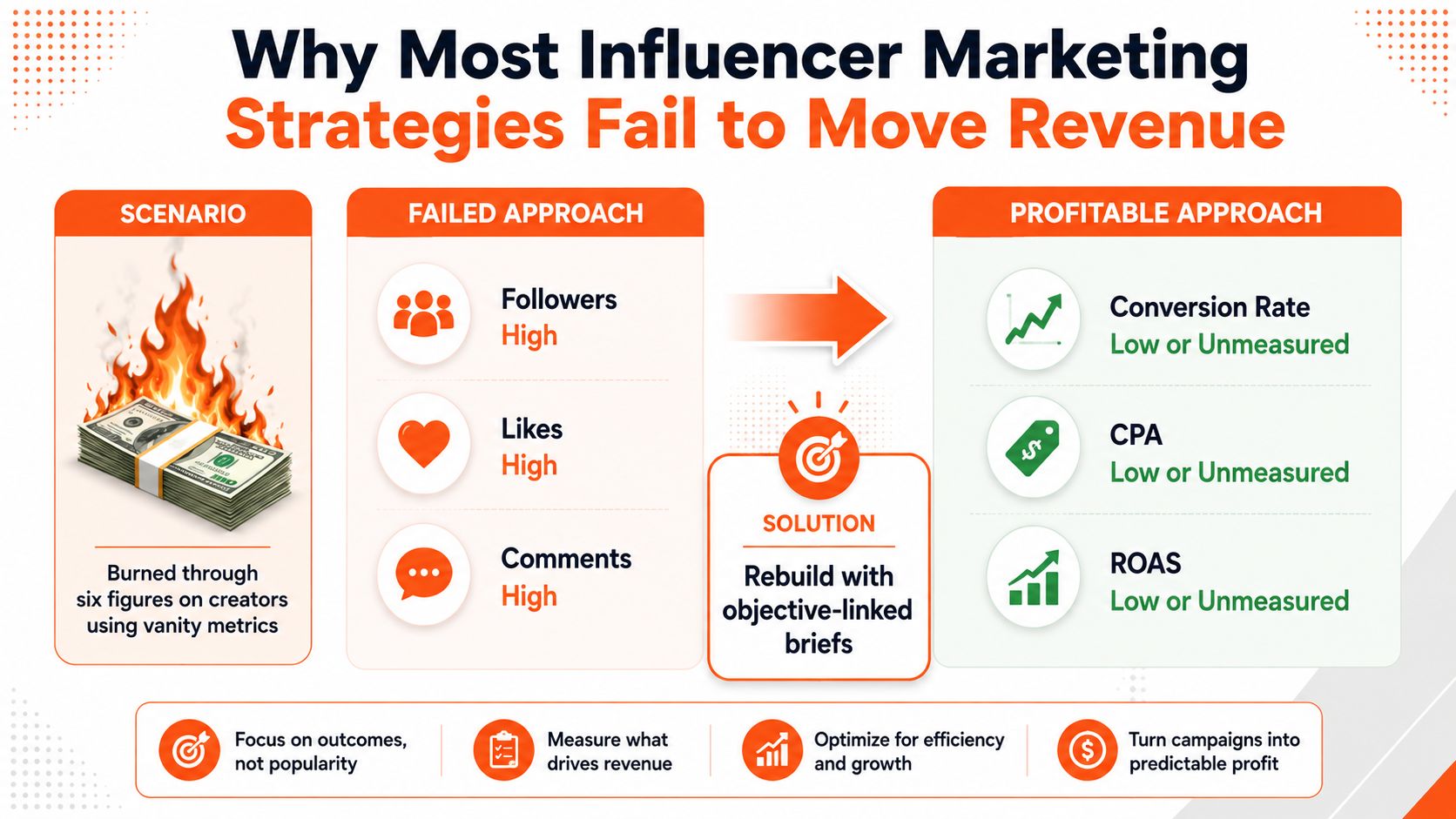
The five failure patterns are consistent. Objectives stay vague, platform choice gets copied from whatever worked last quarter, creator vetting stays shallow, attribution is weak, and pricing never shares downside with the creator. Once those are fixed, the same budget usually becomes far easier to forecast and defend.
The Core Building Blocks of an Influencer Marketing Strategy
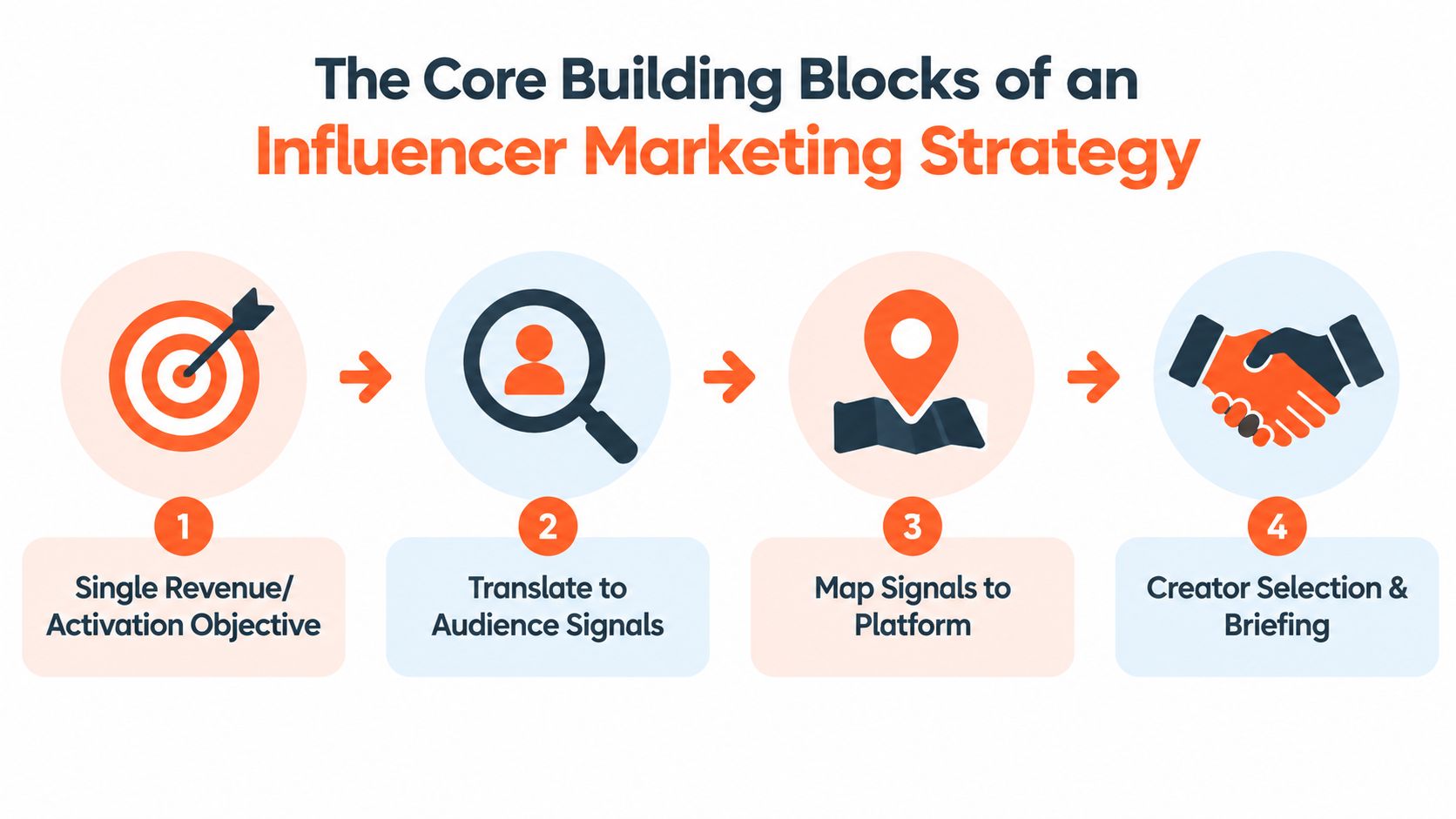
Start with one revenue or activation objective. Not three. A campaign that wants awareness, signups, and app installs all at once usually ends up optimized for whichever metric is easiest to show in a slide, not the one the business needs.
Once the objective is fixed, translate it into audience signals you can buy against. For example, a buyer who watches long demos, saves product posts, or clicks comparison content behaves differently from someone who only stops for entertainment. That distinction matters more than generic demographics, because creator content works when it meets a specific intent state.
Map the objective to the media mix
A useful way to plan is to think in layers. One layer is the primary platform where the objective should happen. A second layer is amplifiers, where the content gets extra distribution or gets repurposed into paid social. A third layer is the community surface, where the audience keeps seeing proof after the first exposure.
If you want a clean framework for this, it helps to build a media marketing mix first, then slot creators into that plan instead of treating them as a separate experiment. That keeps creator spend accountable to the rest of the budget, not floating on its own.
Budget allocation should follow expected marginal CPA, not equal splits. A small creator with a tighter audience can outperform a bigger name on efficiency, especially when the product needs trust instead of spectacle. Reserve part of the budget for retargeting creator-engaged audiences on paid social, because the value often shows up after the first click, not inside the post itself.
The cleanest strategy docs answer four questions before outreach starts, what is the objective, who is the buyer, which platforms match that behavior, and how will the spend be measured if the post gets shared, saved, or watched without clicking?
The artifact list should be boring and complete. You need the objective, audience definition, platform rationale, creator tier logic, measurement plan, creative guardrails, and budget split. If one of those is missing, the campaign is too easy to debate later and too hard to optimize now.
Choosing the Right Channels Across YouTube, Instagram, TikTok, and Twitch
YouTube, Instagram, TikTok, and Twitch are not interchangeable distribution pipes. Each one rewards a different content shape, a different attention mode, and a different kind of trust. If you choose the platform by habit instead of objective, you'll end up paying for the wrong outcome.
| Platform | Format Strength | Audience Intent | Typical Cost Shape | Best-Fit KPI |
|---|---|---|---|---|
| YouTube | Long-form reviews, demos, comparisons | High consideration | Higher production overhead, often more talent time | Branded search lift, assisted conversions |
| Reels, Stories, saveable social proof | Social proof and recurrent discovery | Moderate creative and posting costs | Saves, shares, CPA support | |
| TikTok | Short-form testing, trend-native clips | Discovery and scale | Efficient reach, but volatile creative needs | Incremental reach, CPA testing |
| Twitch | Live integrations, community moments | Deep community and real-time engagement | Live production and creator coordination | Concurrent viewer conversion |
YouTube is the safest choice when the product needs explanation. It gives creators enough room to show how something works, compare options, and handle objections. That's why teams lean on it for bottom-funnel education, especially when the buyer already knows the category but needs confidence to move.
TikTok is where you test creative angles fast. It's useful when the team needs discovery, cheap signal, or a way to find which hooks produce action. Instagram tends to work better when you want ongoing social proof, because saves and shares often matter more there than raw view counts.
Twitch is its own beast. It's strongest when community is the product, or when live interaction can turn attention into immediate trust. Gaming, niche product launches, and creator-led activations can work well there, but only if the brand accepts that live execution needs tighter coordination than a clipped short-form post.
If you want a deeper channel-specific breakdown, the internal guide on influencer marketing on YouTube is a useful complement to this framework. The main decision rule is still simple, though, choose the platform that matches the buyer's intent, not the platform your team is most comfortable briefing.
Setting KPIs, Forecasting Performance, and Building Attribution That Sticks
KPIs should follow the objective, not the other way around. If the goal is awareness, the team should care more about qualified reach and view quality. If the goal is conversion, then CTR, CVR, CPA, and ROAS matter more than whether a creator posted a polished thumbnail.
The forecasting process starts before the brief goes out. Estimate the reach you can buy, the engagement you should expect from that creator tier, and the conversion efficiency your historical data suggests is realistic. That lets you size spend based on expected return instead of arguing about it after the campaign has already launched.
Build the measurement stack
A solid attribution setup usually combines several layers. UTM-tagged links show source and medium, unique promo codes help when links get stripped or copied, pixel-based event capture records downstream actions, and post-purchase surveys can recover upper-funnel influence that last-click misses. The important point is not that every creator needs every method, it's that the program needs more than one.
For teams that need a reference point on ROI measurement, this guide on how to measure influencer marketing ROI helps frame the logic. In practice, the weekly view should be creator-level, platform-level, and objective-level so no one has to reconstruct the story from screenshots during finance review.
Forecasting rule: if the campaign can't show a plausible path from creator output to conversion, the budget is too large for the amount of certainty in the plan.
A useful dashboard will show the same creator across all placements, not just the winning post. That's where teams learn whether the creator is consistently efficient or just had one lucky piece of content. It also keeps decision-making honest when a high-engagement post fails to produce meaningful downstream action.
Selecting Creators That Actually Convert at Your Tier and Budget
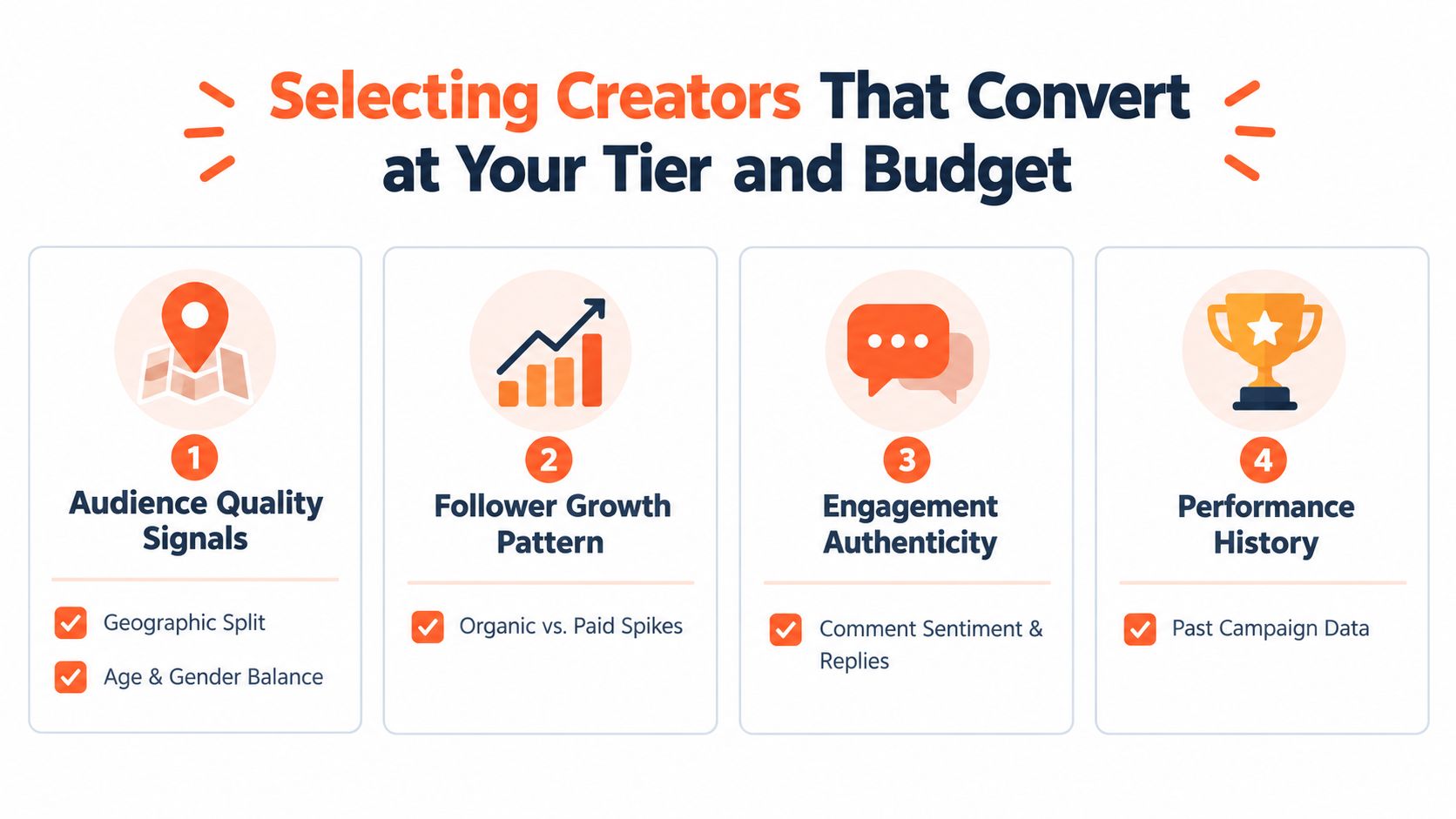
Follower count is the least useful thing to check first. Audience quality tells you far more about conversion potential than the size of the number at the top of the profile. Look at geography, age and gender balance, growth pattern, and whether comments look like real participation or recycled noise.
The best shortlist starts with fit, not fame. A creator can have great content and still be wrong for the brand if their audience overlaps poorly with the buyer persona or if their recent partnerships make the feed feel crowded. Historical sponsored performance matters too, especially whether the creator's branded content still gets natural engagement when the disclosure label goes on.
Read the creator like a media asset
The signal that matters most is consistency. If a creator's audience responds well to sponsored posts, replies in a normal way, and keeps engagement authentic when the content is paid, that's a strong sign the placement won't collapse under commercial pressure. If the feed is full of sudden spikes or suspicious comment patterns, move on.
Recent benchmark summaries show that Instagram micro-influencers typically land around 1.5% to 4.0% engagement, while nano creators often reach 3.4%+ to 5% to 8%, and mega accounts fall near 0.5% to 1.0%; on TikTok, micro creators commonly sit around 4% to 9% or higher, depending on format (Qoruz). The strategic takeaway isn't to chase the highest rate on paper, it's to match tier to the task, since smaller creators often deliver better efficiency and authenticity for conversion-oriented work.
A practical shortlist should score a few things separately:
- Audience quality signals, because geography and demographic fit determine whether clicks can turn into customers.
- Follower growth pattern, because organic growth is a different sign from a paid spike.
- Engagement authenticity, because comment quality tells you whether the audience actually cares.
- Performance history, because past sponsored work is often the best clue for future sponsored work.
The creator selection process gets easier when the campaign is built around objective-fit instead of vibes. If the brief is clear, the wrong creator becomes obvious faster, and that saves far more money than chasing one large profile that doesn't convert.
If the team needs help turning short-form creator footage into usable ads, the ImagineVid UGC production guide is a practical reference for structuring creator-led content without stripping out the creator's voice.
Comparing Pricing Models and Why Outcome-Based Fees Win
Flat fees are easy to understand, and that's why teams default to them. The brand pays a fixed amount, the creator delivers agreed assets, and no one has to argue about post performance before the invoice goes out. That works fine for hero launches or exclusive content, but it puts all the downside risk on the brand.
CPM shifts the conversation toward reach. It's useful when the campaign is mostly about awareness and the only thing the team cares about is efficient exposure. CPE works better for engagement-led TikTok or Reels programs, especially when the brief is optimized for interaction instead of direct response.
| Pricing Model | Payment Basis | Who Carries Risk | Best Fit For |
|---|---|---|---|
| Flat Fee | Fixed amount per deliverable | Brand | Hero launches, exclusives |
| CPM | Cost per thousand impressions | Brand, mostly | Awareness and reach |
| CPE | Cost per engagement | Shared, but still brand-heavy | Engagement-focused short-form |
| Outcome-Based | Per install, signup, sale, or ROAS target | Creator and brand share the outcome | Performance budgets |
Outcome-based pricing should usually be the default for performance teams. If the business is graded on installs, signups, or revenue, the creator compensation should reflect that same standard. A lean base fee plus a performance component keeps stronger creators engaged without forcing the brand to absorb all the risk up front.
The negotiation tactic that works most often is hybrid structure. Pay enough fixed compensation to respect the creator's time, then add a bounty tied to the outcome that matters. That keeps the partnership credible with talent and keeps the finance team from treating the program like an unmeasured sponsorship line.
For teams looking for a more detailed breakdown of this model, the internal guide on performance-based influencer marketing is worth reading. The key point here is simple, pricing should reward the action the business cares about, not just the content the creator happened to post.
Industry Playbooks for E-commerce, Apps, SaaS, Gaming, Fintech, and Health
E-commerce lives and dies on the handoff from creator to purchase. TikTok Shop, creator-coded discount links, and short conversion windows tend to work because they reduce friction between discovery and checkout. The best workflow is usually simple, product demo, tracked offer, and a fast attribution loop tied to commercial value.
Mobile apps need a different shape. UGC-style creative on TikTok and Reels can drive installs, but the work starts after install, so the campaign has to capture source data and keep the post-purchase survey loop alive. Whitelisting often matters here because the best-performing creator clip may need paid amplification to scale efficiently.
SaaS is slower and more trust-heavy. YouTube demos, LinkedIn support, and long-cycle nurture are a better fit than a bursty reach strategy, because the buyer usually needs to understand workflow change before they trial anything. The clean KPI is qualified trials, not raw signups.
Gaming is built for live energy. Twitch integrations and creator-led tournaments can work when the audience wants to participate, not just watch, and the workflow should be measured against retention and downstream revenue instead of one-time attention. Fintech and health need stricter compliance, with claim-locked creative, disclosure discipline, and messaging that's tightly aligned to what can legally and ethically be said.
A few practical defaults help keep the plan grounded:
- E-commerce: creator video plus tracked offer, optimized for purchase value.
- Apps: short-form UGC with attribution, optimized for install quality.
- SaaS: demo-first creator content, optimized for qualified trials.
- Gaming: live and community-led activations, optimized for retention.
- Fintech: explainer content with compliance review, optimized for funded accounts.
- Health: education-first content with claim control, optimized for qualified leads.
Social Cloud fits naturally here as one option for teams that want full-service creator strategy, selection, production, and attribution across YouTube, Instagram, TikTok, and Twitch. The useful part isn't the promise, it's that the work gets planned, tracked, and reported inside the same operating model.
Rolling Out Your Strategy in 30, 60, and 90 Days
The first month should feel like setup, not scale. Define the North Star KPI, document the measurement protocol, audit pixel hygiene, and run a small pilot with four to six creators across the shortlisted platforms. That gives you baseline data on CPM, CTR, and CPA before anyone makes a big budget promise.
The next 30 days are for portfolio build-out. Double down on creator archetypes that are already producing decent signals, layer in pricing tests, and stress-test attribution with holdouts or side-by-side comparisons. Weak briefs usually show up here, because creators who looked promising in discovery suddenly underperform when the objective gets fuzzy.
By day 90, the program should look like an operating system instead of an experiment. Lock the tier mix, automate briefing and approvals where possible, and negotiate outcome-linked renewals with the creators who are producing on-target results.
The first week matters more than many teams admit. Tracking links need to be live, contracts need to match the measurement plan, outreach needs to go out to the first creator batch, and creative QA needs a fast approval path so the launch doesn't stall in internal review. If the campaign is moving live within seven days of kickoff, the team has probably built the right foundation.
If you want creator campaigns planned and measured like a real performance channel, not a side project, Social Cloud handles strategy, vetted creator selection, briefing, contracting, attribution, and reporting in one workflow. Visit Social Cloud to see how a measurement-first creator program can be structured around CPA, ROAS, installs, or revenue instead of vanity metrics.